Recognition: 3 theorem links
· Lean TheoremCoupled-NeuralHP: Directional Temporal Coupling Between AI Innovation Exposure and Public Response
Pith reviewed 2026-05-08 17:50 UTC · model grok-4.3
The pith
A hybrid neural model finds one-way coupling from AI patent streams to public response, with superior held-out forecasts but no support for the reverse direction.
A machine-rendered reading of the paper's core claim, the machinery that carries it, and where it could break.
Core claim
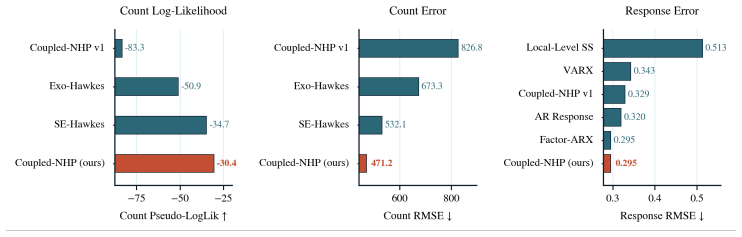
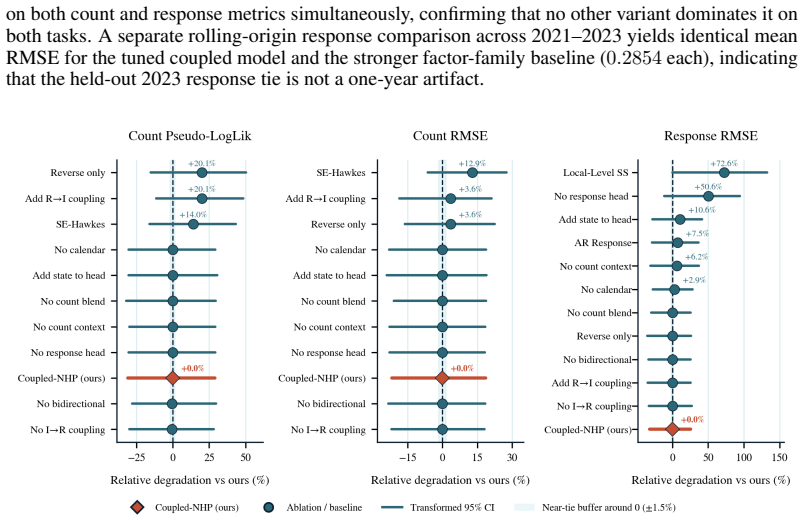
Under the cleaned response protocol, the validation-selected one-way real-data variant of Coupled-NeuralHP gives the best held-out innovation count forecasts in the registered comparison set (pseudo-log-likelihood -30.4 versus -34.7; RMSE 471 versus 532) while matching the stronger multi-lag factor-family baseline on response RMSE (0.295); the reverse response-to-innovation block receives no support on held-out count prediction, and the broader coupled family recovers known innovation-to-response links better than VARX on semi-synthetic data.
What carries the argument
Coupled-NeuralHP, a hybrid event-plus-state model that couples patent event streams to a response index through neural components for directional temporal forecasting.
If this is right
- Innovation count forecasts can be improved by incorporating one-way response signals from cleaned trend data.
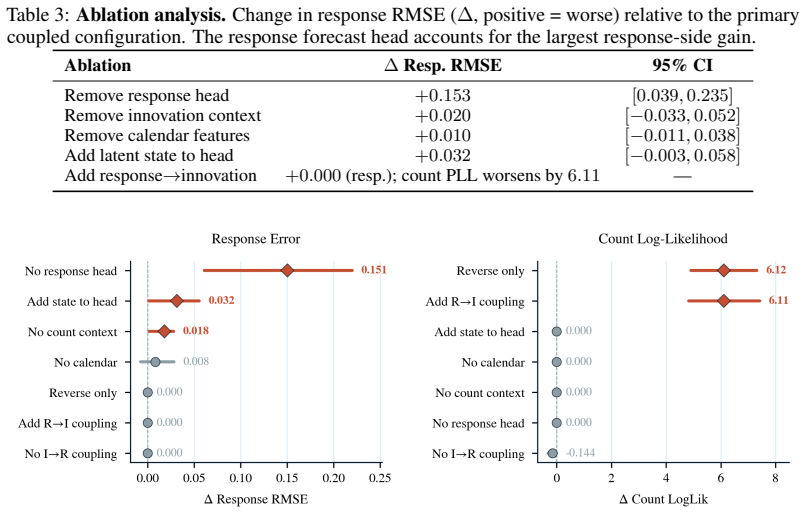
- The structured forecast head carries the main contribution from real response data to innovation prediction.
- No evidence supports a reverse response-to-innovation predictive link on held-out tests.
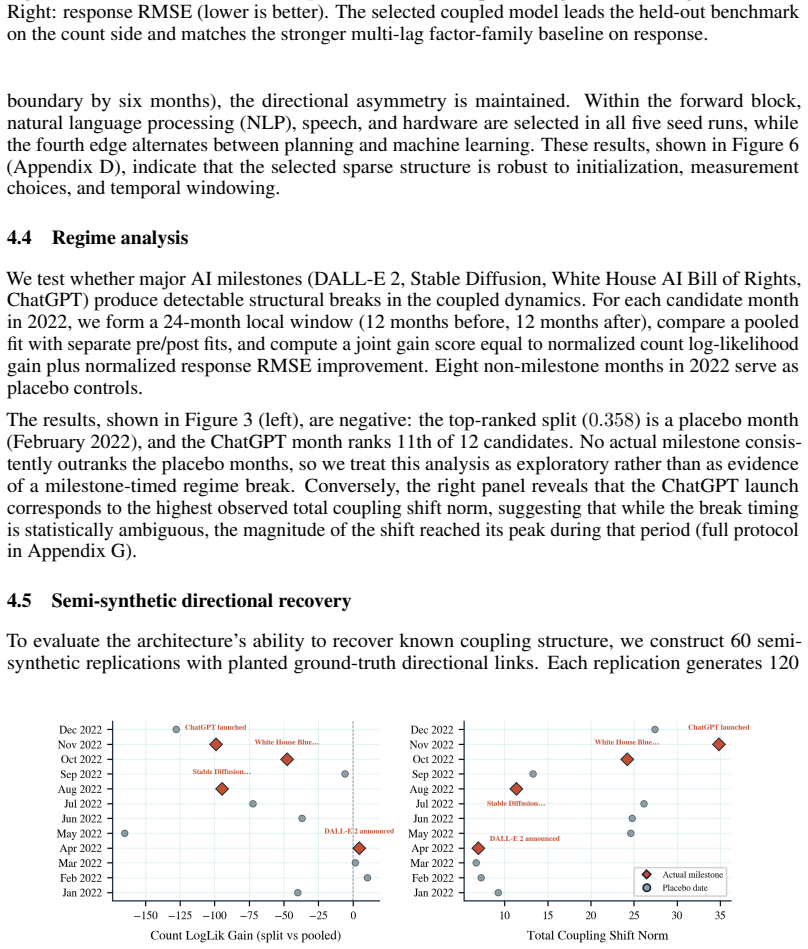
- The coupling structure shows no robust regime break at the 2022 split date in placebo analysis.
Where Pith is reading between the lines
- Similar directional models could be tested on other technology domains to check whether innovation exposure consistently precedes public interest signals.
- Adding alternative response proxies such as social media volume might reduce reliance on a single search index.
- If the one-way pattern holds, timing of patent announcements could be adjusted to anticipate measurable public interest spikes.
Load-bearing premise
The cleaned Google Trends index serves as a reliable, unbiased proxy for public response to AI innovation exposure.
What would settle it
New held-out data in which a bidirectional or reverse-only variant of the model outperforms the one-way real-data version on innovation count prediction would falsify the directional claim.
Figures



read the original abstract
Artificial intelligence innovation exposure and public response co-evolve, but innovation arrives as irregular event streams while response is observed monthly. We introduce Coupled-NeuralHP, a hybrid event-plus-state model linking eight-domain USPTO AI patent publication streams to a train-only Google Trends response index. Under the cleaned response protocol, the validation-selected one-way real-data variant gives the best held-out innovation count forecasts in the registered comparison set (pseudo-log-likelihood -30.4 vs. -34.7; root mean squared error (RMSE) 471 vs. 532) while matching the stronger multi-lag factor-family baseline on response RMSE (0.295). Ablations show that the real-data response signal is carried mainly by the structured forecast head, whereas the reverse response-to-innovation block is not supported on held-out count prediction. Across 60 semi-synthetic replications with known structure, the broader coupled family recovers innovation-to-response links much better than vector autoregression with exogenous inputs (VARX) (F1 = 0.734 vs. 0.386). A placebo-controlled 2022 split-date analysis finds no robust milestone-specific regime break.
Editorial analysis
A structured set of objections, weighed in public.
Referee Report
Summary. The manuscript introduces Coupled-NeuralHP, a hybrid event-plus-state model linking irregular eight-domain USPTO AI patent publication streams to a monthly Google Trends response index under a train-only protocol. It reports that the validation-selected one-way real-data variant yields the best held-out innovation-count forecasts among registered comparators (pseudo-log-likelihood -30.4 vs. -34.7; RMSE 471 vs. 532) while matching the stronger multi-lag factor-family baseline on response RMSE (0.295). Ablations indicate the real-data signal is carried primarily by the structured forecast head; the reverse response-to-innovation block is unsupported on held-out counts. Across 60 semi-synthetic replications with known structure the coupled family recovers innovation-to-response links better than VARX (F1 0.734 vs. 0.386). A placebo 2022 split-date analysis finds no robust milestone-specific regime break.
Significance. If the results hold, the work supplies a novel hybrid architecture for directional temporal coupling between irregular innovation events and continuous public-response signals, together with concrete held-out metrics, ablations, and 60 semi-synthetic replications that furnish falsifiable grounding for the one-way claim. These elements strengthen the empirical case that AI patent exposure drives public attention without detectable reverse causality.
major comments (2)
- [§2] §2 (Data and cleaning protocol): The cleaned Google Trends index is load-bearing for the headline directional result, yet the manuscript provides no explicit demonstration that the cleaning isolates patent-driven response from external-event confounding (media cycles, unrelated news spikes). The reported placebo 2022 split and semi-synthetic recovery (F1 0.734) do not directly test whether residual correlation from non-patent shocks drives the held-out gains (-30.4 pseudo-log-likelihood).
- [§3.3] §3.3 (Validation selection and one-way architecture): The validation-selected one-way variant is claimed to isolate true directional coupling, but the combination of train-only fitting and post-hoc validation selection risks parameter correlation with the response signal. Without additional diagnostics showing that this selection does not inflate apparent innovation-to-response performance relative to the reverse block, the claim that the reverse direction is unsupported remains vulnerable.
minor comments (2)
- [§3.1] The notation for the hybrid event-plus-state blocks would be clearer with an explicit equation or diagram distinguishing the one-way forecast head from the coupled variant.
- [Table 2] Table 2 (semi-synthetic results): confirm that all VARX baselines use identical lag structure and exogenous inputs as the Coupled-NeuralHP variants for direct comparability.
Simulated Author's Rebuttal
We thank the referee for the constructive and detailed comments. We address each major point below with clarifications and indicate where the manuscript will be revised to incorporate additional evidence and diagnostics.
read point-by-point responses
-
Referee: [§2] §2 (Data and cleaning protocol): The cleaned Google Trends index is load-bearing for the headline directional result, yet the manuscript provides no explicit demonstration that the cleaning isolates patent-driven response from external-event confounding (media cycles, unrelated news spikes). The reported placebo 2022 split and semi-synthetic recovery (F1 0.734) do not directly test whether residual correlation from non-patent shocks drives the held-out gains (-30.4 pseudo-log-likelihood).
Authors: We agree that an explicit demonstration of isolation from non-patent confounding is necessary to support the directional claim. The cleaning protocol, as described in §2, removes documented spikes attributable to non-AI events using a predefined rule set based on external event logs. However, to directly address residual correlation concerns, we will add a new appendix containing: (i) side-by-side held-out performance metrics on raw versus cleaned response series, and (ii) an extended robustness check that augments the model with binary indicators for major media events unrelated to AI. The semi-synthetic replications test recovery of known directional structure, while the 2022 placebo tests for regime breaks; these do not substitute for the requested confounding test. We will therefore revise the manuscript to include the additional controls and comparisons. revision: yes
-
Referee: [§3.3] §3.3 (Validation selection and one-way architecture): The validation-selected one-way variant is claimed to isolate true directional coupling, but the combination of train-only fitting and post-hoc validation selection risks parameter correlation with the response signal. Without additional diagnostics showing that this selection does not inflate apparent innovation-to-response performance relative to the reverse block, the claim that the reverse direction is unsupported remains vulnerable.
Authors: The protocol fits all parameters exclusively on the training partition and uses a disjoint validation set solely for architecture selection (one-way versus coupled). This design prevents direct leakage into test evaluation. Nevertheless, we acknowledge the referee's point that post-hoc selection could still favor the innovation-to-response direction. In the revision we will add explicit diagnostics: (i) held-out metrics for the reverse block under identical validation selection, (ii) a comparison of one-way performance when selection is replaced by a fixed a-priori choice, and (iii) a brief sensitivity table across multiple validation splits. These additions will allow readers to assess whether selection inflates the reported asymmetry. We maintain that the current train-only protocol already limits correlation, but the requested diagnostics will be incorporated. revision: yes
Circularity Check
No significant circularity; held-out and semi-synthetic checks are independent of fitting inputs
full rationale
The reported performance (pseudo-log-likelihood -30.4, RMSE 471 on held-out innovation counts; F1 0.734 on 60 semi-synthetic replications) is obtained after a train-only protocol with separate validation selection and placebo split-date analysis. These evaluations use data partitions and generated data with known structure that are not equivalent to the fitted parameters or the cleaned Google Trends index by construction. No self-definitional equations, fitted inputs renamed as predictions, or load-bearing self-citations appear in the abstract or described protocol; the one-way architecture and cleaning step are design choices whose value is assessed via external recovery metrics rather than reducing tautologically to the inputs.
Axiom & Free-Parameter Ledger
free parameters (1)
- neural network weights and hyperparameters
axioms (2)
- domain assumption Google Trends index after cleaning accurately reflects public response to AI innovation exposure.
- domain assumption The validation selection procedure identifies the true directional structure without overfitting to noise.
invented entities (1)
-
Coupled-NeuralHP hybrid architecture
no independent evidence
Reference graph
Works this paper leans on
-
[1]
Spectra of some self-exciting and mutually exciting point processes,
Hawkes, Alan G. , year =. Spectra of Some Self-Exciting and Mutually Exciting Point Processes , volume =. Biometrika , publisher =. doi:10.1093/biomet/58.1.83 , number =
-
[2]
, booktitle =
Mei, Hongyuan and Eisner, Jason M. , booktitle =. The Neural Hawkes Process: A Neurally Self-Modulating Multivariate Point Process , url =
-
[3]
Recurrent Marked Temporal Point Processes: Embedding Event History to Vector , url =
Du, Nan and Dai, Hanjun and Trivedi, Rakshit and Upadhyay, Utkarsh and Gomez-Rodriguez, Manuel and Song, Le , year =. Recurrent Marked Temporal Point Processes: Embedding Event History to Vector , url =. doi:10.1145/2939672.2939875 , booktitle =
-
[4]
Proceedings of the 37th International Conference on Machine Learning , series =
Transformer Hawkes Process , author =. Proceedings of the 37th International Conference on Machine Learning , series =. 2020 , publisher =
2020
-
[5]
Proceedings of the 37th International Conference on Machine Learning , series =
Self-Attentive Hawkes Process , author =. Proceedings of the 37th International Conference on Machine Learning , series =. 2020 , publisher =
2020
-
[6]
, booktitle =
Louizos, Christos and Welling, Max and Kingma, Diederik P. , booktitle =. Learning Sparse Neural Networks through. 2018 , url =
2018
-
[7]
Uncovering Causality from Multivariate
Achab, Massil and Bacry, Emmanuel and Ga. Uncovering Causality from Multivariate. Proceedings of the 34th International Conference on Machine Learning , pages =. 2017 , publisher =
2017
-
[8]
Learning Granger Causality for
Xu, Hongteng and Farajtabar, Mehrdad and Zha, Hongyuan , booktitle =. Learning Granger Causality for. 2016 , publisher =
2016
-
[9]
2026 , howpublished =
Artificial Intelligence Patent Dataset , author =. 2026 , howpublished =
2026
-
[10]
Predicting the Present with
Choi, Hyunyoung and Varian, Hal , journal =. Predicting the Present with. 2012 , doi =
2012
-
[11]
Ten Years of Research Change Using
Jun, Seung-Pyo and Yoo, Hyoung Sun and Choi, San , journal =. Ten Years of Research Change Using. 2018 , doi =
2018
-
[12]
2023 , howpublished =
Growing Public Concern About the Role of Artificial Intelligence in Daily Life , author =. 2023 , howpublished =
2023
-
[13]
Artificial Intelligence:
Zhang, Baobao and Dafoe, Allan , institution =. Artificial Intelligence:. 2019 , url =
2019
-
[14]
Management Science , volume =
A New Product Growth for Model Consumer Durables , author =. Management Science , volume =. 1969 , doi =
1969
-
[15]
2012 , publisher =
Time Series Analysis by State Space Methods , author =. 2012 , publisher =
2012
-
[16]
, year =
Harvey, Andrew C. , year =. Forecasting, Structural Time Series Models and the
-
[17]
Statistical Science , volume =
A Review of Self-Exciting Spatio-Temporal Point Processes and Their Applications , author =. Statistical Science , volume =. 2018 , doi =
2018
-
[18]
arXiv preprint arXiv:1806.00221 , year =
Temporal Point Processes and the Conditional Intensity Function , author =. arXiv preprint arXiv:1806.00221 , year =
-
[19]
and Kaiser,
Vaswani, Ashish and Shazeer, Noam and Parmar, Niki and Uszkoreit, Jakob and Jones, Llion and Gomez, Aidan N. and Kaiser,. Attention is All you Need , url =. Advances in Neural Information Processing Systems , editor =
-
[20]
and Welling, Max , journal =
Kingma, Diederik P. and Welling, Max , journal =. Auto-Encoding Variational
-
[21]
Nature Machine Intelligence , volume =
Hopes and Fears for Intelligent Machines in Fiction and Reality , author =. Nature Machine Intelligence , volume =. 2019 , doi =
2019
-
[22]
Graphical Modeling for Multivariate
Eichler, Michael and Dahlhaus, Rainer and Dueck, Johannes , journal =. Graphical Modeling for Multivariate. 2017 , doi =
2017
-
[23]
International Conference on Learning Representations (ICLR) , year =
Intensity-Free Learning of Temporal Point Processes , author =. International Conference on Learning Representations (ICLR) , year =
-
[24]
International Joint Conference on Artificial Intelligence (IJCAI) , year =
Neural Temporal Point Processes: A Review , author =. International Joint Conference on Artificial Intelligence (IJCAI) , year =
-
[25]
Advances in Neural Information Processing Systems (NeurIPS) , volume =
Fully Neural Network based Model for General Temporal Point Processes , author =. Advances in Neural Information Processing Systems (NeurIPS) , volume =
-
[26]
IEEE Transactions on Pattern Analysis and Machine Intelligence , year =
Neural Granger Causality , author =. IEEE Transactions on Pattern Analysis and Machine Intelligence , year =
-
[27]
Deep Kalman Filters , author =. arXiv preprint arXiv:1511.05121 , year =
-
[28]
Advances in Neural Information Processing Systems (NeurIPS) , volume =
Deep State Space Models for Time Series Forecasting , author =. Advances in Neural Information Processing Systems (NeurIPS) , volume =
-
[29]
De Brouwer, Edward and Simm, Jaak and Arany, Adam and Moreau, Yves , booktitle =
-
[30]
Diffusion of Innovations , author =
-
[31]
and Jaffe, Adam B
Hall, Bronwyn H. and Jaffe, Adam B. and Trajtenberg, Manuel , institution =. The. 2001 , url =
2001
-
[32]
Economics of Innovation and New Technology , volume =
International Knowledge Flows: Evidence from Patent Citations , author =. Economics of Innovation and New Technology , volume =. 1999 , doi =
1999
-
[33]
2019 , doi =
Mavragani, Amaryllis and Ochoa, Gabriela , journal =. 2019 , doi =
2019
-
[34]
International Conference on Machine Learning (ICML) , year =
Discovering Latent Network Structure in Point Process Data , author =. International Conference on Machine Learning (ICML) , year =
-
[35]
Farajtabar, Mehrdad and Wang, Yichen and Gomez Rodriguez, Manuel and Li, Shuang and Zha, Hongyuan and Song, Le , booktitle =
-
[36]
and He, Hera Y
Zhao, Qingyuan and Erdogdu, Murat A. and He, Hera Y. and Rajaraman, Anand and Leskovec, Jure , booktitle =. 2015 , doi =
2015
-
[37]
Market Microstructure and Liquidity , volume =
Hawkes Processes in Finance , author =. Market Microstructure and Liquidity , volume =. 2015 , doi =
2015
-
[38]
Journal of the American Statistical Association , volume =
Statistical Models for Earthquake Occurrences and Residual Analysis for Point Processes , author =. Journal of the American Statistical Association , volume =. 1988 , doi =
1988
-
[39]
Daley, D. J. and Vere-Jones, D. , edition =. An Introduction to the Theory of Point Processes: Volume. 2003 , publisher =
2003
-
[40]
Advances in Neural Information Processing Systems , volume =
Neural Ordinary Differential Equations , author =. Advances in Neural Information Processing Systems , volume =
-
[41]
Advances in Neural Information Processing Systems , volume =
Latent Ordinary Differential Equations for Irregularly-Sampled Time Series , author =. Advances in Neural Information Processing Systems , volume =
-
[42]
Econometrica , volume =
Investigating Causal Relations by Econometric Models and Cross-spectral Methods , author =. Econometrica , volume =. 1969 , doi =
1969
-
[43]
Learning Social Infectivity in Sparse Low-rank Networks Using Multi-dimensional
Zhou, Ke and Zha, Hongyuan and Song, Le , booktitle =. Learning Social Infectivity in Sparse Low-rank Networks Using Multi-dimensional. 2013 , publisher =
2013
-
[44]
The Economics of Artificial Intelligence: An Agenda , pages =
The Impact of Artificial Intelligence on Innovation: An Exploratory Analysis , author =. The Economics of Artificial Intelligence: An Agenda , pages =. 2018 , publisher =
2018
-
[45]
, journal =
Brynjolfsson, Erik and Li, Danielle and Raymond, Lindsey R. , journal =. Generative. 2023 , note =
2023
-
[46]
2023 , type =
Experimental Evidence on the Productivity Effects of Generative Artificial Intelligence , author =. 2023 , type =
2023
-
[47]
and Wen, Qingsong and Zhou, Jun and Mei, Hongyuan , booktitle =
Xue, Siqiao and Shi, Xiaoming and Chu, Zhixuan and Wang, Yan and Hao, Hongyan and Zhou, Fan and Jiang, Caigao and Pan, Chen and Zhang, James Y. and Wen, Qingsong and Zhou, Jun and Mei, Hongyuan , booktitle =
-
[48]
Mamba: Linear-Time Sequence Modeling with Selective State Spaces
Mamba: Linear-Time Sequence Modeling with Selective State Spaces , author =. arXiv preprint arXiv:2312.00752 , year =
work page internal anchor Pith review arXiv
-
[49]
Transformers are
Dao, Tri and Gu, Albert , booktitle =. Transformers are
-
[50]
Kennedy, Brian and Yam, Eileen and Kikuchi, Emma and Pula, Isabelle and Fuentes, Javier , year =. How
-
[51]
2025 , note =
Artificial Intelligence Index Report 2025 , author =. 2025 , note =
2025
discussion (0)
Sign in with ORCID, Apple, or X to comment. Anyone can read and Pith papers without signing in.