Recognition: 2 theorem links
· Lean TheoremDynamical processes and emergent behaviors in multiplex networks
Pith reviewed 2026-05-08 18:10 UTC · model grok-4.3
The pith
Multiplex networks produce collective behaviors that single-layer or aggregated networks cannot exhibit.
A machine-rendered reading of the paper's core claim, the machinery that carries it, and where it could break.
Core claim
Truly multiplex collective behaviors arise when structural correlations exist across layers, when dynamical processes on different layers become correlated, or when inter-layer and intra-layer interactions interplay dynamically. These mechanisms enable phenomena such as altered percolation thresholds, modified epidemic thresholds, and novel synchronization patterns that do not occur in the corresponding aggregated single-layer networks or in isolated layers.
What carries the argument
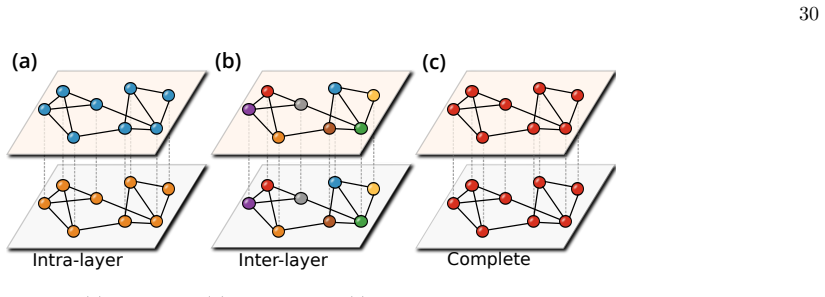
Three mechanisms (structural correlations across layers, dynamical correlations between layer processes, and dynamical interplay of inter- and intra-layer interactions) that produce emergent behaviors absent from single-layer representations.
If this is right
- Models of epidemic spreading must account for multiple contact layers to predict thresholds accurately rather than using averaged networks.
- Synchronization in infrastructure systems can be stabilized or disrupted by interlayer coupling in ways impossible to capture with single-layer approximations.
- Social dynamics and game outcomes on multiplex structures can produce cooperation levels or consensus patterns that depend on cross-layer correlations.
- Coevolution between network structure and dynamics gains new pathways when layers interact, allowing feedback loops absent in static single-layer models.
Where Pith is reading between the lines
- Real-world policy interventions, such as disease control strategies, may fail if they ignore multilayer contact patterns and treat the system as a single network.
- Empirical data from platforms with multiple interaction types could be reanalyzed to test whether the three mechanisms explain observed deviations from single-layer predictions.
- Engineering multilayer systems, such as transportation or communication networks, could deliberately tune interlayer links to suppress or enhance specific collective behaviors.
Load-bearing premise
That the reviewed collective behaviors truly cannot occur in aggregated single-layer networks or isolated layers for the models and parameter regimes examined in the cited studies.
What would settle it
A concrete example in which one of the claimed multiplex-only behaviors, such as a shifted epidemic threshold or a new synchronization state, appears identically when the layers are collapsed into a single network or studied in isolation.
Figures












read the original abstract
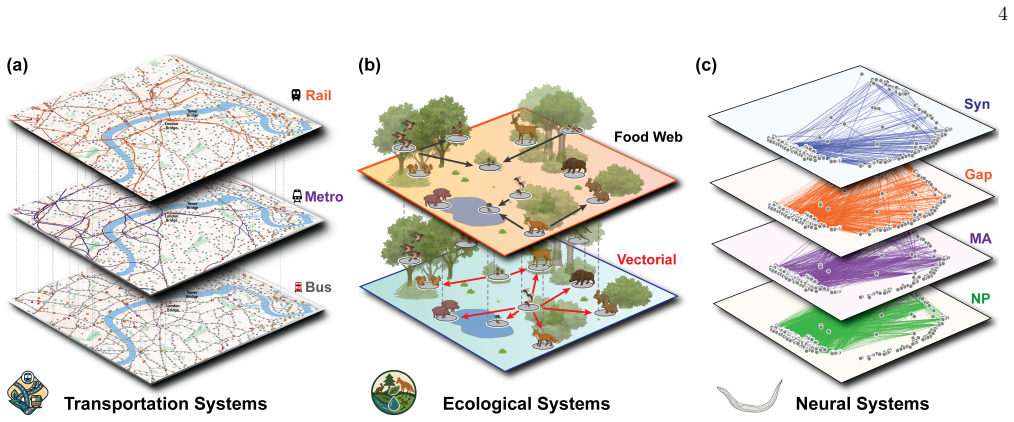
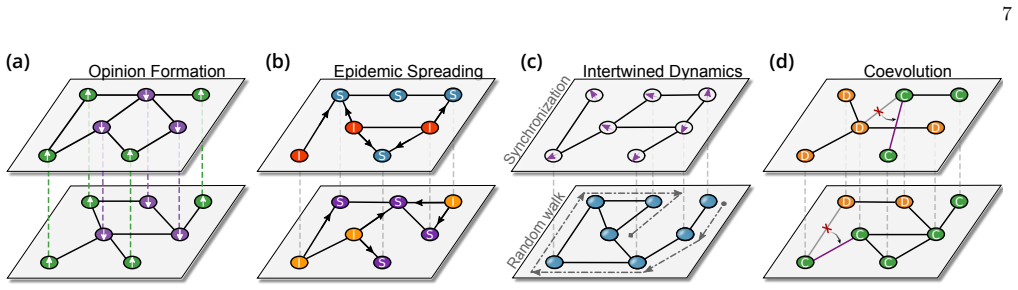
Over the last two decades, network science has greatly advanced our understanding of how the collective behaviors of a complex system emerge from the interactions among its basic units. Multiplex networks, i.e. networks with many layers, whose nodes are in one-to-one correspondence, provide a more realistic description for social, biological and ecological systems where multiple types of interactions coexist. After a brief introduction on how to model the architecture of multiplex networks, we present a complete overview of the different dynamics which can unfold over these structures. We present a unified framework to describe dynamical processes such as percolation, reaction-diffusion, synchronization, epidemic spreading, social dynamics and games on multiplex networks, as well as the coupled evolution of different dynamical processes, and the coevolution of a process with the network structure. Our focus is on truly-multiplex collective behaviors, i.e., all those phenomena which cannot emerge on the corresponding aggregated networks, or when the different layers of these systems are considered in isolation. We identify three main mechanisms leading to new collective behaviors: the existence of structural correlations across layers, the presence of dynamical correlations in the processes taking place at the different layers, and the dynamical interplay of inter- and intra-layer interactions. We conclude with a summary of the main takeaways from a decade of work in the field.
Editorial analysis
A structured set of objections, weighed in public.
Referee Report
Summary. The manuscript is a review synthesizing two decades of work on dynamical processes unfolding on multiplex networks, where nodes are in one-to-one correspondence across layers. After introducing multiplex architecture modeling, it presents a unified framework covering percolation, reaction-diffusion, synchronization, epidemic spreading, social dynamics, games, coupled processes, and network coevolution. The central claim is that the paper focuses on truly multiplex collective behaviors—phenomena absent from aggregated single-layer networks or isolated layers—and identifies three mechanisms responsible: structural correlations across layers, dynamical correlations between layer processes, and the interplay of inter- and intra-layer interactions. It concludes with key takeaways from the field.
Significance. If the synthesis holds, the review is significant for consolidating literature on multiplex dynamics and providing a clear taxonomy of emergent behaviors unique to multi-layer structures. This can inform modeling in social, biological, and ecological systems. The unified framework and explicit identification of the three mechanisms are strengths that organize disparate results; the emphasis on phenomena not reducible to single-layer cases adds value for guiding future research, even though the paper presents no new derivations, data, or machine-checked proofs.
major comments (1)
- [Abstract] Abstract and concluding section: the central claim that the reviewed phenomena 'cannot emerge on the corresponding aggregated networks, or when the different layers of these systems are considered in isolation' is load-bearing for the paper's focus on 'truly-multiplex' behaviors. This is presented as an observed pattern across cited works rather than a universal theorem; the review would be strengthened by explicitly noting the dependence on specific models and parameter regimes (as acknowledged in the reader's weakest assumption), including any counter-examples or boundary cases from the literature where such behaviors appear in aggregated or single-layer settings.
minor comments (2)
- The manuscript could benefit from a brief table or diagram summarizing the three mechanisms with one canonical example each, to improve readability for readers new to the field.
- Some citations appear to stop around 2020; adding a short note on post-2020 developments in multiplex dynamics (e.g., in higher-order or temporal multiplexes) would enhance the 'complete overview' claim without altering the core synthesis.
Simulated Author's Rebuttal
We thank the referee for their careful reading, positive evaluation, and constructive suggestion. We address the major comment below.
read point-by-point responses
-
Referee: [Abstract] Abstract and concluding section: the central claim that the reviewed phenomena 'cannot emerge on the corresponding aggregated networks, or when the different layers of these systems are considered in isolation' is load-bearing for the paper's focus on 'truly-multiplex' behaviors. This is presented as an observed pattern across cited works rather than a universal theorem; the review would be strengthened by explicitly noting the dependence on specific models and parameter regimes (as acknowledged in the reader's weakest assumption), including any counter-examples or boundary cases from the literature where such behaviors appear in aggregated or single-layer settings.
Authors: We agree that the central claim reflects patterns observed across the specific models and results synthesized in the review, rather than a universal theorem. The phenomena discussed are those shown in the cited literature to be absent from the corresponding aggregated networks or isolated layers under the conditions examined. To address the suggestion, we will revise the abstract and concluding section to explicitly note the model- and parameter-specific nature of these observations. We will also indicate that boundary cases or counter-examples may exist in other regimes or models but lie outside the scope of the truly-multiplex behaviors enabled by the three mechanisms (structural correlations, dynamical correlations, and inter-intra layer interplay). This clarification will be added without changing the manuscript's focus or conclusions. revision: yes
Circularity Check
No significant circularity
full rationale
This is a review paper synthesizing external literature on dynamical processes in multiplex networks. It presents an overview and unified framework by summarizing cited works rather than deriving new results from internal equations or assumptions. The three main mechanisms are stated as observed patterns across the literature, with no self-definitional steps, fitted inputs renamed as predictions, or load-bearing self-citations that reduce the central claims to the paper's own inputs. The argument is self-contained as a survey without any derivation chain that collapses by construction.
Axiom & Free-Parameter Ledger
Reference graph
Works this paper leans on
-
[1]
R. J. Mondragon, J. Iacovacci, and G. Bianconi. Multilink communities of multiplex networks.PLoS One, 13(3):e0193821, March 2018
2018
-
[2]
Bennett, A
L. Bennett, A. Kittas, G. Muirhead, L. G. Papageorgiou, and S. Tsoka. Detection of composite communities in multiplex biological networks.Sci. Rep., 5(1):1–12, May 2015
2015
-
[3]
W. H. Weir, B. Walker, L. Zdeborov´ a, and P. J. Mucha. Multilayer modularity belief propagation to assess detectability of community structure.SIAM J. Math. Data Sci., 2(3):872–900, January 2020
2020
-
[4]
Rosvall and C
M. Rosvall and C. T. Bergstrom. Maps of random walks on complex networks reveal community structure.Proc. Natl. Acad. Sci., 105(4):1118–1123, January 2008. 67
2008
-
[5]
Kuncheva and G
Z. Kuncheva and G. Montana. Community detection in multiplex networks using locally adaptive random walks. In Proceedings of the 2015 IEEE/ACM International Conference on Advances in Social Networks Analysis and Mining 2015, pages 1308–1315. ACM, August 2015
2015
-
[6]
L. G. S. Jeub, M. W. Mahoney, P. J. Mucha, and M. A. Porter. A local perspective on community structure in multilayer networks.Network Science, 5(2):144–163, January 2017
2017
-
[7]
Bertagnolli and M
G. Bertagnolli and M. De Domenico. Diffusion geometry of multiplex and interdependent systems.Phys. Rev. E, 103(4):042301, April 2021
2021
-
[8]
T. P. Peixoto. Inferring the mesoscale structure of layered, edge-valued, and time-varying networks.Phys. Rev. E, 92(4):042807, October 2015
2015
-
[9]
Stanley, S
N. Stanley, S. Shai, D. Taylor, and P. J. Mucha. Clustering network layers with the strata multilayer stochastic block model.IEEE Trans. Network Sci. Eng., 3(2):95–105, April 2016
2016
-
[10]
Paul and Y
S. Paul and Y. Chen. Consistent community detection in multi-relational data through restricted multi-layer stochastic blockmodel.Electron. J. Stat., 10(2):3807–3870, January 2016
2016
-
[11]
De Bacco, E
C. De Bacco, E. A. Power, D. B. Larremore, and C. Moore. Community detection, link prediction, and layer interdepen- dence in multilayer networks.Phys. Rev. E, 95(4):042317, April 2017
2017
-
[12]
A. R. Pamfil, S. D. Howison, R. Lambiotte, and M. A. Porter. Relating modularity maximization and stochastic block models in multilayer networks.SIAM J. Math. Data Sci., 1(4):667–698, January 2019
2019
-
[13]
Gauvin, A
L. Gauvin, A. Panisson, and C. Cattuto. Detecting the community structure and activity patterns of temporal networks: A non-negative tensor factorization approach.PLoS ONE, 9(1):e86028, January 2014
2014
-
[14]
Z. Chen, C. Chen, Z. Zhang, Z. Zheng, and Q. Zou. Variational graph embedding and clustering with Laplacian eigenmaps. InProceedings of the Twenty-Eighth International Joint Conference on Artificial Intelligence, volume 33, pages 2144–2150. International Joint Conferences on Artificial Intelligence Organization, August 2019
2019
-
[15]
Aguiar, D
I. Aguiar, D. Taylor, and J. Ugander. A Tensor Factorization Model of Multilayer Network Interdependence.Journal of Machine Learning Research, 25(282):1–54, 2024
2024
-
[16]
W. Liu, T. Suzumura, H. Ji, and G. Hu. Finding overlapping communities in multilayer networks.PLoS One, 13(4):e0188747, April 2018
2018
-
[17]
Contisciani, E
M. Contisciani, E. A. Power, and C. De Bacco. Community detection with node attributes in multilayer networks.Sci. Rep., 10(1):1–16, September 2020
2020
-
[18]
Br´ odka, A
P. Br´ odka, A. Chmiel, M. Magnani, and G. Ragozini. Quantifying layer similarity in multiplex networks: A systematic study.Royal Society Open Science, 5(8):171747, 2018
2018
-
[19]
Iacovacci, Z
J. Iacovacci, Z. Wu, and G. Bianconi. Mesoscopic structures reveal the network between the layers of multiplex data sets. Phys. Rev. E, 92(4):042806, October 2015
2015
-
[20]
Iacovacci and G
J. Iacovacci and G. Bianconi. Extracting information from multiplex networks.Chaos: An Interdisciplinary Journal of Nonlinear Science, 26(6):065306, June 2016
2016
-
[21]
De Domenico and J
M. De Domenico and J. Biamonte. Spectral entropies as information-theoretic tools for complex network comparison. Phys. Rev. X, 6(4):041062, December 2016
2016
-
[22]
S. P. Borgatti and M. G. Everett. Models of core/periphery structures.Soc. Networks, 21(4):375–395, October 2000
2000
-
[23]
Corominas-Murtra and S
B. Corominas-Murtra and S. Thurner. The weak core and the structure of elites in social multiplex networks. In Understanding Complex Systems, pages 165–177. Springer International Publishing, 2016
2016
-
[24]
Galimberti, F
E. Galimberti, F. Bonchi, and F. Gullo. Core decomposition and densest subgraph in multilayer networks. InProceedings of the 2017 ACM on Conference on Information and Knowledge Management, pages 1807–1816. ACM, November 2017
2017
-
[25]
Ma and R
A. Ma and R. J. Mondrag´ on. Rich-cores in networks.PLoS One, 10(3):e0119678, March 2015
2015
-
[26]
Battiston, J
F. Battiston, J. Guillon, M. Chavez, V. Latora, and F. De Vico Fallani. Multiplex core–periphery organization of the human connectome.J. Roy. Soc. . Interface, 15(146):20180514, September 2018
2018
-
[27]
Bergermann, M
K. Bergermann, M. Stoll, and F. Tudisco. A Nonlinear Spectral Core–Periphery Detection Method for Multiplex Networks. Proceedings of the Royal Society A: Mathematical, Physical and Engineering Sciences, 480(2300):20230914, October 2024
2024
-
[28]
J. Nie, Q. Xuan, D. Gao, and Z. Ruan. An Effective Method for Profiling Core–Periphery Structures in Complex Networks. Physica A: Statistical Mechanics and its Applications, 669:130618, July 2025
2025
-
[29]
Pontillo, F
G. Pontillo, F. Prados, A. M. Wink, B. Kanber, A. Bisecco, T. A. A. Broeders, et al. More Than the Sum of Its Parts: Disrupted Core Periphery of Multiplex Brain Networks in Multiple Sclerosis.Human Brain Mapping, 46(1):e70107, 2025
2025
-
[30]
Guillon, M
J. Guillon, M. Chavez, F. Battiston, Y. Attal, V. La Corte, M. Thiebaut de Schotten, et al. Disrupted core-periphery structure of multimodal brain networks in alzheimer’s disease.Network Neuroscience, 3(2):635–652, January 2019
2019
-
[31]
Corsi, M
M.-C. Corsi, M. Chavez, D. Schwartz, N. George, L. Hugueville, A. E. Kahn, et al. BCI learning induces core-periphery reorganization in M/EEG multiplex brain networks.J. Neural Eng., 18(5):056002, April 2021
2021
-
[32]
Vall` es-Catal` a, F
T. Vall` es-Catal` a, F. A. Massucci, R. Guimer` a, and M. Sales-Pardo. Multilayer stochastic block models reveal the multilayer structure of complex networks.Phys. Rev. X, 6(1):011036, March 2016
2016
-
[33]
Lacasa, I
L. Lacasa, I. P. Mari˜ no, J. Miguez, V. Nicosia, E. Rold´ an, A. Lisica, et al. Multiplex decomposition of non-{Markovian} dynamics and the hidden layer reconstruction problem.Phys. Rev. X, 8(3):031038, August 2018
2018
-
[34]
Wang and J
X. Wang and J. Liu. A Layer Reduction Based Community Detection Algorithm on Multiplex Networks.Physica A: Statistical Mechanics and its Applications, 471:244–252, April 2017
2017
-
[35]
Santoro and V
A. Santoro and V. Nicosia. Algorithmic complexity of multiplex networks.Phys. Rev. X, 10(2):021069, June 2020
2020
-
[36]
Aguiar, D
I. Aguiar, D. Taylor, and J. Ugander. A factor model of multilayer network interdependence, June 2022
2022
-
[37]
Baccini, L
F. Baccini, L. Barabesi, and E. Petrovich. Similarity matrix average for aggregating multiplex networks, July 2022
2022
-
[38]
H. Nan, S. Wang, C. Ouyang, Y. Zhou, and W. Gu. Assessing the Robustness and Reducibility of Multiplex Networks 68 with Embedding-Aided Interlayer Similarities.Phys. Rev. E, 111(5):054315, May 2025
2025
-
[39]
Ghavasieh and M
A. Ghavasieh and M. De Domenico. Enhancing transport properties in interconnected systems without altering their structure.Phys. Rev. Research, 2(1):013155, February 2020
2020
-
[40]
Ma, H.-S
C. Ma, H.-S. Chen, X. Li, Y.-C. Lai, and H.-F. Zhang. Data Based Reconstruction of Duplex Networks.SIAM J. Appl. Dyn. Syst., 19(1):124–150, January 2020
2020
-
[41]
Zhang, A
A. Zhang, A. Zeng, Y. Fan, and Z. Di. Detangling the multilayer structure from an aggregated network.New J. Phys., 23(7):073046, jul 2021
2021
-
[42]
J. P. Bagrow and S. Lehmann. Recovering lost and absent information in temporal networks, July 2021
2021
-
[43]
M. Wu, J. Chen, S. He, Y. Sun, S. Havlin, and J. Gao. Discrimination reveals reconstructability of multiplex networks from partial observations.Communications Physics, 5(1):163, Jun 2022
2022
-
[44]
Kaiser, S
D. Kaiser, S. Patwardhan, and F. Radicchi. Multiplex Reconstruction with Partial Information.Phys. Rev. E, 107(2):024309, February 2023
2023
-
[45]
Kaiser, S
D. Kaiser, S. Patwardhan, M. Kim, and F. Radicchi. Reconstruction of Multiplex Networks via Graph Embeddings. Phys. Rev. E, 109(2):024313, February 2024
2024
-
[46]
Park and M
J. Park and M. E. J. Newman. Statistical mechanics of networks.Phys. Rev. E, 70(6):066117, December 2004
2004
-
[47]
Cimini, T
G. Cimini, T. Squartini, F. Saracco, D. Garlaschelli, A. Gabrielli, and G. Caldarelli. The statistical physics of real-world networks.Nature Reviews Physics, 1(1):58–71, January 2019
2019
-
[48]
Menichetti, D
G. Menichetti, D. Remondini, and G. Bianconi. Correlations between weights and overlap in ensembles of weighted multiplex networks.Phys. Rev. E, 90(6):062817, December 2014
2014
-
[49]
A. Halu, S. Mukherjee, and G. Bianconi. Emergence of overlap in ensembles of spatial multiplexes and statistical mechanics of spatial interacting network ensembles.Phys. Rev. E, 89(1):012806, January 2014
2014
-
[50]
Cellai and G
D. Cellai and G. Bianconi. Multiplex networks with heterogeneous activities of the nodes.Phys. Rev. E, 93(3):032302, March 2016
2016
-
[51]
Sagarra, C
O. Sagarra, C. J. P´ erez Vicente, and A. D´ ıaz-Guilera. Role of adjacency-matrix degeneracy in maximum-entropy-weighted network models.Phys. Rev. E, 92(5):052816, November 2015
2015
-
[52]
J. Y. Kim and K.-I. Goh. Coevolution and correlated multiplexity in multiplex networks.Phys. Rev. Lett., 111(5):058702, July 2013
2013
-
[53]
Barab´ asi and R
A.-L. Barab´ asi and R. Albert. Emergence of scaling in random networks.Science, 286(5439):509–512, October 1999
1999
-
[54]
Nicosia, G
V. Nicosia, G. Bianconi, V. Latora, and M. Barthelemy. Growing multiplex networks.Phys. Rev. Lett., 111(5):058701, July 2013
2013
-
[55]
Momeni and B
N. Momeni and B. Fotouhi. Growing multiplex networks with arbitrary number of layers.Phys. Rev. E, 92(6):062812, December 2015
2015
-
[56]
Nicosia, G
V. Nicosia, G. Bianconi, V. Latora, and M. Barthelemy. Nonlinear growth and condensation in multiplex networks.Phys. Rev. E, 90(4):042807, October 2014
2014
-
[57]
Battiston, J
F. Battiston, J. Iacovacci, V. Nicosia, G. Bianconi, and V. Latora. Emergence of multiplex communities in collaboration networks.PLoS One, 11(1):e0147451, January 2016
2016
-
[58]
Santoro, V
A. Santoro, V. Latora, G. Nicosia, and V. Nicosia. Pareto optimality in multilayer network growth.Phys. Rev. Lett., 121(12):128302, September 2018
2018
-
[59]
Criado, J
R. Criado, J. Flores, A. Garc´ ıa del Amo, J. G´ omez-Garde˜ nes, and M. Romance. A mathematical model for networks with structures in the mesoscale.Int. J. Comput. Math., 89(3):291–309, February 2012
2012
-
[60]
P. W. Holland, K. B. Laskey, and S. Leinhardt. Stochastic blockmodels: First steps.Soc. Networks, 5(2):109–137, June 1983
1983
-
[61]
Karrer and M
B. Karrer and M. E. J. Newman. Stochastic blockmodels and community structure in networks.Phys. Rev. E, 83(1):016107, January 2011
2011
-
[62]
B. Ball, B. Karrer, and M. E. J. Newman. Efficient and principled method for detecting communities in networks.Phys. Rev. E, 84:036103, Sep 2011
2011
-
[63]
Bazzi, L
M. Bazzi, L. G. S. Jeub, A. Arenas, S. D. Howison, and M. A. Porter. A framework for the construction of generative models for mesoscale structure in multilayer networks.Phys. Rev. Research, 2(2):023100, April 2020
2020
-
[64]
A. R. Pamfil, S. D. Howison, and M. A. Porter. Inference of edge correlations in multilayer networks.Phys. Rev. E, 102(6):062307, December 2020
2020
-
[65]
Stauffer and A
D. Stauffer and A. Aharony.Introduction To Percolation Theory. Taylor & Francis, December 2018
2018
-
[66]
Ara´ ujo, P
N. Ara´ ujo, P. Grassberger, B. Kahng, K. Schrenk, and R. Ziff. Recent advances and open challenges in percolation.Eur. Phys. J. Special Topics, 223(11):2307–2321, October 2014
2014
-
[67]
Li, R.-R
M. Li, R.-R. Liu, L. L¨ u, M.-B. Hu, S. Xu, and Y.-C. Zhang. Percolation on complex networks: Theory and application. Phys. Rep., 907:1–68, April 2021
2021
-
[68]
S. V. Buldyrev, R. Parshani, G. Paul, H. E. Stanley, and S. Havlin. Catastrophic cascade of failures in interdependent networks.Nature, 464(7291):1025–1028, April 2010
2010
-
[69]
Cohen, K
R. Cohen, K. Erez, D. ben Avraham, and S. Havlin. Resilience of the internet to random breakdowns.Phys. Rev. Lett., 85(21):4626–4628, November 2000
2000
-
[70]
M. E. J. Newman, S. H. Strogatz, and D. J. Watts. Random graphs with arbitrary degree distributions and their applications.Phys. Rev. E, 64(2):026118, July 2001
2001
-
[71]
Albert, H
R. Albert, H. Jeong, and A.-L. Barab´ asi. Error and attack tolerance of complex networks.Nature, 406(6794):378–382, July 2000
2000
-
[72]
Cohen, K
R. Cohen, K. Erez, D. ben Avraham, and S. Havlin. Breakdown of the internet under intentional attack.Phys. Rev. 69 Lett., 86(16):3682–3685, April 2001
2001
-
[73]
Ben-Naim and P
E. Ben-Naim and P. L. Krapivsky. Kinetic theory of random graphs: From paths to cycles.Phys. Rev. E, 71(2):026129, February 2005
2005
-
[74]
Karrer, M
B. Karrer, M. E. J. Newman, and L. Zdeborov´ a. Percolation on sparse networks.Phys. Rev. Lett., 113(20):208702, November 2014
2014
-
[75]
R. M. D’Souza and J. Nagler. Anomalous critical and supercritical phenomena in explosive percolation.Nat. Phys., 11(7):531–538, July 2015
2015
-
[76]
Rosato, L
V. Rosato, L. Issacharoff, F. Tiriticco, S. Meloni, S. D. Porcellinis, and R. Setola. Modelling interdependent infrastructures using interacting dynamical models.Int. J. Crit. Infrastruct., 4(1/2):63, 2008
2008
-
[77]
J. Gao, S. V. Buldyrev, S. Havlin, and H. E. Stanley. Robustness of a network formed by n interdependent networks with a one-to-one correspondence of dependent nodes.Phys. Rev. E, 85(6):066134, June 2012
2012
-
[78]
S.-W. Son, G. Bizhani, C. Christensen, P. Grassberger, and M. Paczuski. Percolation theory on interdependent networks based on epidemic spreading.Europhys. Lett., 97(1):16006, January 2012
2012
-
[79]
Hackett, D
A. Hackett, D. Cellai, S. G´ omez, A. Arenas, and J. P. Gleeson. Bond percolation on multiplex networks.Phys. Rev. X, 6(2):021002, April 2016
2016
-
[80]
I. Kryven. Bond percolation in coloured and multiplex networks.Nat. Commun., 10(1):404, January 2019
2019
discussion (0)
Sign in with ORCID, Apple, or X to comment. Anyone can read and Pith papers without signing in.