Recognition: unknown
Modeling Flare Continuum Emission Observed by Hinode/EIS: Instrument Calibration and Element Composition Results
Pith reviewed 2026-05-08 17:32 UTC · model grok-4.3
The pith
Flare continuum emission from Hinode/EIS provides instrument calibration and evidence for inverse FIP effect in solar plasma.
A machine-rendered reading of the paper's core claim, the machinery that carries it, and where it could break.
Core claim
The ratio of observed to modeled continuum in the Hinode/EIS flare spectra provides effective area curves that show a factor-of-two degradation in the long-wavelength channel relative to the short-wavelength channel without fine-scale variations, and the need to apply an inverse FIP bias of 0.57 for iron to match the data at 10 MK, independently verified by Chandrayaan-2 X-ray spectra giving 0.55.
What carries the argument
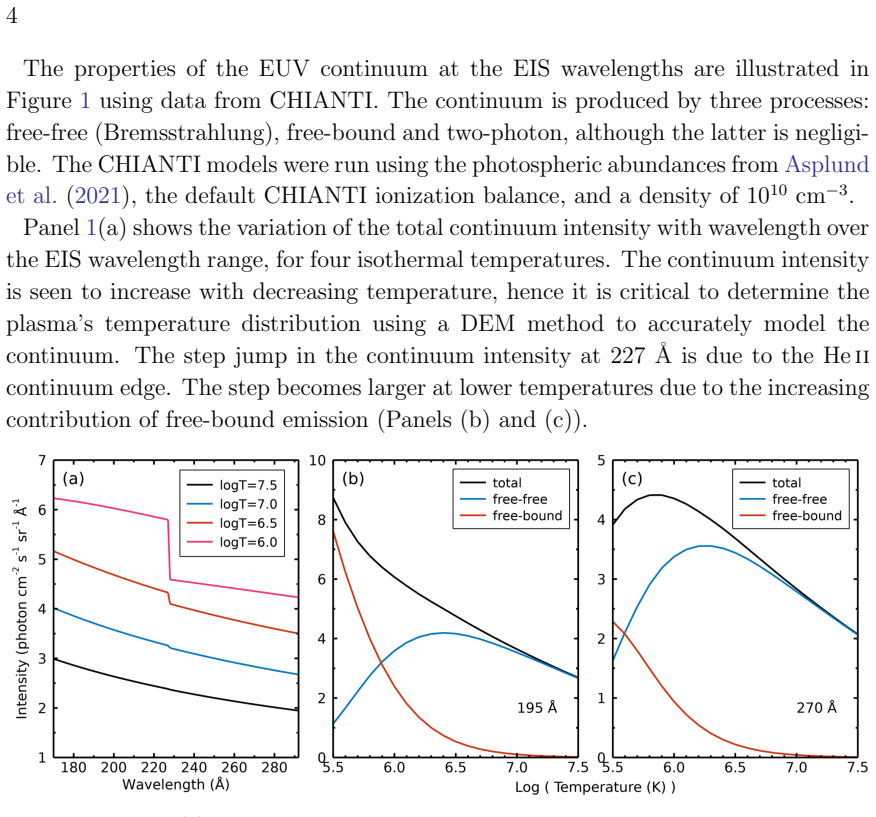
The differential emission measure curve computed from emission lines and used to predict the continuum intensity, from which the observed-to-predicted ratio yields the effective area curves.
If this is right
- The EIS long-wavelength channel has degraded by a factor of two compared to the short-wavelength channel.
- No fine-scale structure exists in the effective area curves.
- The flare plasma must be depleted in low-FIP elements to match both lines and continuum.
- The Fe/H relative abundance is 0.57 times the photospheric value at 10 MK, confirmed at 0.55 by independent soft X-ray spectra.
Where Pith is reading between the lines
- The same continuum-to-line modeling approach could be applied to other flares observed by different EUV spectrometers to monitor their long-term calibration stability.
- The inverse FIP bias in this flare plasma may reflect a physical link between the heating process and element fractionation in the solar atmosphere.
- Repeating the analysis across multiple time intervals during the flare could test whether the abundance depletion varies with the evolution of the event.
Load-bearing premise
The differential emission measure derived solely from emission lines accurately predicts the observed continuum without missing contributions, errors in atomic data, or spatial and temporal variations in the flare plasma.
What would settle it
Spectra from an instrument with independent absolute calibration of the same flare plasma volume would show a continuum level inconsistent with the prediction from the EIS line-based differential emission measure.
Figures


read the original abstract
Continuum emission from a solar flare observed with the Extreme ultraviolet Imaging Spectrometer (EIS) on board the Hinode satellite is used to obtain the radiometric calibration of the instrument. The flare had a GOES class of M8, and peaked at 23:59 UT on 2024 September 30. The continuum is modeled by computing a differential emission measure curve using EIS emission lines and atomic data from the CHIANTI database. The ratio of the observed continuum to model continuum yields effective area curves for the instrument. The new curves confirm earlier findings that the EIS long-wavelength channel has degraded by a factor two compared to the short-wavelength channel. However, no evidence is found for the fine-scale structure in the effective area curves that has been presented by previous authors. In order to reproduce both the emission line intensities and the continuum, it is found that the plasma must be depleted in elements with low first ionization potentials (FIPs), i.e., the so-called inverse FIP-effect. In particular, the Fe/H relative abundance is found to be a factor 0.57 below the photospheric value at a temperature of 10 MK. This is confirmed by analysis of soft X-ray spectra from the Solar X-ray Monitor on Chandrayaan-2, which yields an Fe/H FIP bias of 0.55 averaged over the entire flare.
Editorial analysis
A structured set of objections, weighed in public.
Referee Report
Summary. The paper claims to calibrate the Hinode/EIS instrument using observed flare continuum emission from an M8 event. A DEM is derived from EIS emission lines with CHIANTI atomic data, the expected continuum (free-free + free-bound + two-photon) is modeled, and the ratio of observed to modeled continuum yields effective area curves. These confirm a factor-of-two degradation in the long-wavelength channel with no fine-scale structure. To match both lines and continuum, the plasma is found to exhibit an inverse FIP effect, with Fe/H abundance 0.57 times photospheric at 10 MK; this is corroborated by Chandrayaan-2 SXM spectra giving 0.55.
Significance. If the modeling assumptions hold, the work supplies a useful independent radiometric calibration for EIS and evidence for inverse FIP bias in flare plasma at high temperatures, strengthened by the cross-instrument check. The approach makes effective use of existing atomic databases and multi-instrument data to address both instrumental and compositional questions in solar EUV spectroscopy.
major comments (2)
- [§3] §3 (DEM and continuum modeling): The effective-area curves are obtained from the ratio of observed continuum counts to the CHIANTI-predicted continuum based on a line-derived DEM; however, no sensitivity tests, error propagation, or validation against independent temperature diagnostics are reported to confirm that the model continuum accurately reproduces the observed shape and intensity without missing contributions or atomic-data inaccuracies. This assumption is load-bearing for the calibration result.
- [§4] §4 (Abundance results): The Fe/H relative abundance is adjusted post-hoc to a factor of 0.57 below the photospheric value specifically to reconcile the line-derived DEM with the observed continuum at 10 MK, making the reported inverse-FIP bias a fitted parameter rather than an independent prediction; while the Chandrayaan-2 confirmation (0.55) is noted, it applies only to the final abundance value and does not validate the EIS calibration step.
minor comments (2)
- [Abstract] The abstract and results sections state that 'no evidence is found for the fine-scale structure' but do not quantify the comparison resolution or reference the specific prior claims being tested.
- [§4] Uncertainty estimates or error bars are absent for the derived effective-area curves and the Fe/H factor; adding these would improve quantitative assessment of the claims.
Simulated Author's Rebuttal
We thank the referee for their careful and constructive review of our manuscript. We address each major comment below, indicating where revisions will be made to improve clarity and robustness.
read point-by-point responses
-
Referee: [§3] §3 (DEM and continuum modeling): The effective-area curves are obtained from the ratio of observed continuum counts to the CHIANTI-predicted continuum based on a line-derived DEM; however, no sensitivity tests, error propagation, or validation against independent temperature diagnostics are reported to confirm that the model continuum accurately reproduces the observed shape and intensity without missing contributions or atomic-data inaccuracies. This assumption is load-bearing for the calibration result.
Authors: We agree that additional tests would strengthen confidence in the modeling. The DEM was derived solely from EIS emission lines using CHIANTI atomic data, independent of the continuum. The continuum (free-free, free-bound, and two-photon) was then predicted from this DEM. In the revised manuscript we will add a dedicated subsection with sensitivity tests: we will vary the DEM within its formal uncertainties, recompute the model continuum, and propagate the resulting variations into the derived effective-area curves. We will also show that the observed continuum shape is consistent with the temperature distribution implied by the lines, providing an internal cross-check. While no simultaneous independent temperature diagnostics (e.g., from other instruments) are available for this event, the overall consistency with the Chandrayaan-2 SXM spectra offers external support. These additions will be included in the next version. revision: yes
-
Referee: [§4] §4 (Abundance results): The Fe/H relative abundance is adjusted post-hoc to a factor of 0.57 below the photospheric value specifically to reconcile the line-derived DEM with the observed continuum at 10 MK, making the reported inverse-FIP bias a fitted parameter rather than an independent prediction; while the Chandrayaan-2 confirmation (0.55) is noted, it applies only to the final abundance value and does not validate the EIS calibration step.
Authors: We acknowledge that the Fe/H abundance was determined by enforcing consistency between the line intensities and the continuum. Both the selected emission lines and the free-bound continuum depend on elemental abundances, so a single abundance value is required for a physically consistent DEM. The effective-area curves are obtained from the ratio of observed to modeled continuum once this consistency is achieved. The resulting inverse-FIP bias is therefore a derived result rather than an input assumption. The Chandrayaan-2 SXM measurement, performed with an entirely independent instrument and spectral range, yields a nearly identical value (0.55) and thereby corroborates the abundance we obtained. We will revise the text to describe the procedure more explicitly as an iterative consistency step and to clarify that the calibration and abundance results are coupled but mutually validated by the cross-instrument agreement. No change to the reported numbers is required. revision: partial
Circularity Check
No significant circularity; derivation is self-contained
full rationale
The paper computes a DEM solely from EIS emission lines and CHIANTI atomic data, then generates a model continuum (free-free, free-bound, two-photon) whose ratio to the observed continuum directly supplies the effective-area curves. The inverse-FIP abundance adjustment (Fe/H = 0.57) is presented as the value required for consistency between the line-derived DEM and the observed continuum; it is not claimed as a first-principles prediction and is independently corroborated by Chandrayaan-2 soft X-ray spectra yielding 0.55. No equation or step reduces to its own input by construction, no parameter fitted to a subset is relabeled as a prediction of a related quantity, and no load-bearing premise rests on self-citation. The method is a standard observational calibration plus abundance inference.
Axiom & Free-Parameter Ledger
free parameters (1)
- Fe/H relative abundance factor =
0.57
axioms (1)
- domain assumption CHIANTI database provides accurate atomic data for computing emission lines and continuum from the DEM
Reference graph
Works this paper leans on
-
[1]
Spectral diagnostics with the SDO EVE flare lines. , keywords =. doi:10.1051/0004-6361/201220988 , adsurl =
-
[2]
Benchmarking atomic data for the CHIANTI atomic database: coronal lines observed by Hinode EIS. , keywords =. doi:10.1051/0004-6361/201117592 , adsurl =
-
[3]
CHIANTI An Atomic Database for Emission Lines. X. Spectral Atlas of a Cold Feature Observed with Hinode/EUV Imaging Spectrometer. , keywords =. doi:10.1088/0004-637X/706/1/1 , archivePrefix =. 0907.3490 , primaryClass =
-
[4]
2015 The FIP and Inverse FIP Effects in Solar and Stellar Coronae.Living Rev
The FIP and Inverse FIP Effects in Solar and Stellar Coronae. Living Reviews in Solar Physics , keywords =. doi:10.1007/lrsp-2015-2 , archivePrefix =. 1504.08325 , primaryClass =
-
[5]
Benchmarking atomic data for astrophysics: Fe VII and other cool lines observed by Hinode EIS. , keywords =. doi:10.1051/0004-6361/200913082 , adsurl =
-
[6]
Wavelengths and Intensities of Spectral Lines in the 171-211 and 245-291 A Ranges from Five Solar Regions Recorded by the Extreme-Ultraviolet Imaging Spectrometer (EIS) on Hinode. , keywords =. doi:10.1086/529378 , adsurl =
-
[7]
Time-dependent Density Diagnostics of Solar Flare Plasmas Using SDO/EVE. , keywords =. doi:10.1088/2041-8205/755/1/L16 , archivePrefix =. 1207.1990 , primaryClass =
-
[8]
Reconnection Nanojets in an Erupting Solar Filament with Unprecedented High Speeds. , keywords =. doi:10.3847/2041-8213/add33a , archivePrefix =. 2504.20663 , primaryClass =
-
[9]
A magnetic avalanche as the central engine powering a solar flare. arXiv e-prints , keywords =. doi:10.48550/arXiv.2503.12235 , archivePrefix =. 2503.12235 , primaryClass =
-
[10]
Wavelengths of Forbidden Transitions Arising from Levels Within the Fe ^ +19 2S ^ 2 2P ^ 3 Ground Configuration. , keywords =. doi:10.1086/309109 , adsurl =
-
[11]
Fe XVIII and Fe XX Forbidden Lines Observed by Solar Orbiter/SPICE. , keywords =. doi:10.3847/1538-4357/add339 , archivePrefix =. 2505.00199 , primaryClass =
-
[12]
Departure of High-temperature Iron Lines from the Equilibrium State in Flaring Solar Plasmas. , keywords =. doi:10.3847/0004-637X/826/1/3 , archivePrefix =. 1606.02049 , primaryClass =
-
[13]
Nonthermal Electron Measurements in Solar Flares with Hinode EIS. , keywords =. doi:10.1086/589733 , adsurl =
-
[14]
High-precision density measurements in the solar corona. I. Analysis methods and results for Fe XII and Fe XIII. , keywords =. doi:10.1051/0004-6361:200810143 , archivePrefix =. 0805.0958 , primaryClass =
-
[15]
Hinode EIS: Updated In-flight Radiometric Calibration. , keywords =. doi:10.3847/1538-4365/ad981f , archivePrefix =. 2308.06609 , primaryClass =
-
[16]
doi:10.5281/zenodo.15396769 , url =
Peter Young , title =. doi:10.5281/zenodo.15396769 , url =
-
[17]
Young, Peter R. , title =. doi:10.5281/zenodo.16763258 , url =
-
[18]
6: Warm and hot pixels on the EIS CCDs , author =
EIS Software Note No. 6: Warm and hot pixels on the EIS CCDs , author =. doi:10.5281/zenodo.17193709 , url =
-
[19]
10: CCD Dark Current and Bias , author =
EIS Software Note No. 10: CCD Dark Current and Bias , author =
-
[20]
4: The EIS Slit Tilts , author =
EIS Software Note No. 4: The EIS Slit Tilts , author =
-
[21]
Spatially Resolved Nonthermal Line Broadening during the Impulsive Phase of a Solar Flare. , keywords =. doi:10.1088/0004-637X/740/2/70 , archivePrefix =. 1202.1737 , primaryClass =
-
[22]
The EUV Imaging Spectrometer for Hinode. , keywords =. doi:10.1007/s01007-007-0293-1 , adsurl =
-
[23]
Laboratory calibration of the Extreme-Ultraviolet Imaging Spectrometer for the Solar-B satellite. , keywords =. doi:10.1364/AO.45.008689 , adsurl =
-
[24]
A revised radiometric calibration for the Hinode/EIS instrument. , keywords =. doi:10.1051/0004-6361/201220810 , archivePrefix =. 1211.6771 , primaryClass =
-
[25]
The Absolute Calibration of the EUV Imaging Spectrometer on Hinode. , keywords =. doi:10.1088/0067-0049/213/1/11 , archivePrefix =. 1310.5324 , primaryClass =
-
[26]
On-Orbit Sensitivity Evolution of the EUV Imaging Spectrometer on Hinode. , keywords =. doi:10.1007/s11207-012-0200-9 , archivePrefix =. 1211.3694 , primaryClass =
-
[27]
Non-linear Least-squares Fitting in IDL with MPFIT. Astronomical Data Analysis Software and Systems XVIII , year = 2009, editor =. doi:10.48550/arXiv.0902.2850 , archivePrefix =. 0902.2850 , primaryClass =
-
[28]
The chemical make-up of the Sun: A 2020 vision. , keywords =. doi:10.1051/0004-6361/202140445 , archivePrefix =. 2105.01661 , primaryClass =
-
[29]
Solar Transition Region Features Observed with Hinode/EIS. , keywords =. doi:10.1093/pasj/59.sp3.S727 , archivePrefix =. 0706.1856 , primaryClass =
-
[30]
Dynamics of Reconnection Nanojets in Eruptive and Confined Solar Flares. arXiv e-prints , keywords =. doi:10.48550/arXiv.2507.04639 , archivePrefix =. 2507.04639 , primaryClass =
-
[31]
Reconnection nanojets associated with a prominence eruption observed with Solar Orbiter/EUI-HRI. arXiv e-prints , keywords =. doi:10.48550/arXiv.2510.25068 , archivePrefix =. 2510.25068 , primaryClass =
-
[32]
Extremely diverse coronal jets accompanying an erupting filament captured by Solar Orbiter. , keywords =. doi:10.1051/0004-6361/202555297 , archivePrefix =. 2509.04741 , primaryClass =
-
[33]
Dynamics of Reconnection Nanojets in Eruptive and Confined Solar Flares. , keywords =. doi:10.3847/2041-8213/adef0f , archivePrefix =. 2507.04639 , primaryClass =
-
[34]
The Atmospheric Imaging Assembly (AIA) on the Solar Dynamics Observatory (SDO). , keywords =. doi:10.1007/s11207-011-9776-8 , adsurl =
-
[35]
Data Analysis with the SolarSoft System. , year = 1998, month = oct, volume =. doi:10.1023/A:1005038224881 , adsurl =
-
[36]
SolarSoft: Programming and data analysis environment for solar physics
-
[37]
CHIANTI An Atomic Database for Emission Lines Paper. XVIII. Version 11, Advanced Ionization Equilibrium Models: Density and Charge Transfer Effects. , keywords =. doi:10.3847/1538-4357/ad6765 , archivePrefix =. 2403.16922 , primaryClass =
-
[38]
Markov-Chain Monte Carlo Reconstruction of Emission Measure Distributions: Application to Solar Extreme-Ultraviolet Spectra. , keywords =. doi:10.1086/305964 , adsurl =
-
[39]
Anomalous Relative Ar/Ca Coronal Abundances Observed by the Hinode/EUV Imaging Spectrometer Near Sunspots. , keywords =. doi:10.1088/2041-8205/808/1/L7 , adsurl =
-
[40]
Spectroscopic Constraints on the Cross-sectional Asymmetry and Expansion of Active Region Loops. , keywords =. doi:10.3847/1538-4357/ab449e , adsurl =
-
[41]
Inverse First Ionization Potential Effects in Giant Solar Flares Found from Earth X-Ray Albedo with Suzaku/XIS. , keywords =. doi:10.3847/1538-4357/ab7207 , archivePrefix =. 2001.10643 , primaryClass =
-
[42]
Unveiling Mass Transfer in Solar Flares: Insights from Elemental Abundance Evolutions Observed by Chang'E-2 Solar X-Ray Monitor. , keywords =. doi:10.3847/1538-4357/ad5da3 , archivePrefix =. 2407.02199 , primaryClass =
-
[43]
The Temperature and Density of a Solar Flare Kernel Measured from Extreme-ultraviolet Lines of O IV. , keywords =. doi:10.3847/1538-4357/ad37fc , archivePrefix =. 2401.12390 , primaryClass =
-
[44]
Measurements of Absolute Abundances in Solar Flares. , keywords =. doi:10.1088/2041-8205/786/1/L2 , archivePrefix =. 1310.4765 , primaryClass =
-
[45]
Solar Flare Element Abundances from the Solar Assembly for X-Rays (SAX) on MESSENGER. , keywords =. doi:10.1088/0004-637X/803/2/67 , archivePrefix =. 1503.01602 , primaryClass =
-
[46]
The Instruments and Capabilities of the Miniature X-Ray Solar Spectrometer (MinXSS) CubeSats. , keywords =. doi:10.1007/s11207-018-1243-3 , archivePrefix =. 1801.01261 , primaryClass =
-
[47]
Solar X-Ray Monitor on Board the Chandrayaan-2 Orbiter: In-Flight Performance and Science Prospects. , keywords =. doi:10.1007/s11207-020-01712-1 , archivePrefix =. 2009.09759 , primaryClass =
-
[48]
Evolution of Elemental Abundances during B-Class Solar Flares: Soft X-Ray Spectral Measurements with Chandrayaan-2 XSM. , keywords =. doi:10.3847/1538-4357/ac14c1 , archivePrefix =. 2107.07825 , primaryClass =
-
[49]
Observations of the Quiet Sun during the Deepest Solar Minimum of the Past Century with Chandrayaan-2 XSM: Elemental Abundances in the Quiescent Corona. , keywords =. doi:10.3847/2041-8213/abf35d , archivePrefix =. 2103.16643 , primaryClass =
-
[50]
Multiwavelength Observations by XSM, Hinode, and SDO of an Active Region. Chemical Abundances and Temperatures. , keywords =. doi:10.3847/1538-4357/ac7a9a , archivePrefix =. 2207.06879 , primaryClass =
-
[51]
Evolution of Elemental Abundances in Hot Active Region Cores from Chandrayaan-2 XSM Observations. , keywords =. doi:10.3847/1538-4357/acdeeb , archivePrefix =. 2301.03519 , primaryClass =
-
[52]
Soft X-Ray Spectral Diagnostics of Multithermal Plasma in Solar Flares with Chandrayaan-2 XSM. , keywords =. doi:10.3847/1538-4357/ac98b4 , archivePrefix =. 2210.03364 , primaryClass =
-
[53]
Astronomy and Computing , keywords =
Data processing software for Chandrayaan-2 Solar X-ray Monitor. Astronomy and Computing , keywords =. doi:10.1016/j.ascom.2021.100449 , archivePrefix =. 2007.11371 , primaryClass =
-
[54]
Experimental Astronomy , keywords =
Ground calibration of Solar X-ray Monitor on board the Chandrayaan-2 orbiter. Experimental Astronomy , keywords =. doi:10.1007/s10686-020-09686-5 , archivePrefix =. 2007.07326 , primaryClass =
-
[55]
Multiwavelength Observations of a B-class Flare Using XSM, AIA, and XRT. , keywords =. doi:10.3847/1538-4357/acf46a , archivePrefix =. 2308.14912 , primaryClass =
-
[56]
Coronal Elemental Abundances During A-Class Solar Flares Observed by Chandrayaan-2 XSM. , keywords =. doi:10.1007/s11207-023-02142-5 , archivePrefix =. 2302.11844 , primaryClass =
-
[57]
Flare-Driven Plasma Dynamics and Elemental Abundance Redistribution. arXiv e-prints , keywords =. doi:10.48550/arXiv.2510.02102 , archivePrefix =. 2510.02102 , primaryClass =
-
[58]
and Bug, Monoj and Sharan, Vaishali and Lakshmipathaiah, Kiran and Kushwaha, Ankur and Ramadevi, M C and Verma, Smrati , year =
Sarwade, Abhilash and Sankarasubramanian, K. and Bug, Monoj and Sharan, Vaishali and Lakshmipathaiah, Kiran and Kushwaha, Ankur and Ramadevi, M C and Verma, Smrati , year =. Iron Fluorescence in X-class Solar Flares: Aditya-L1/SoLEXS Observations , doi =
-
[59]
Frontiers in Astronomy and Space Sciences , keywords =
Future Prospects for Solar EUV and Soft X-ray Solar Spectroscopy Missions. Frontiers in Astronomy and Space Sciences , keywords =. doi:10.3389/fspas.2021.662790 , archivePrefix =. 2102.02943 , primaryClass =
-
[60]
The multi-thermal emission in solar active regions. , keywords =. doi:10.1051/0004-6361/201321653 , adsurl =
-
[61]
Composition of the Solar Corona, Solar Wind, and Solar Energetic Particles. , keywords =. doi:10.1088/0004-637X/755/1/33 , adsurl =
-
[62]
Hinode/Extreme-Ultraviolet Imaging Spectrometer Observations of the Temperature Structure of the Quiet Corona. , keywords =. doi:10.1088/0004-637X/705/2/1522 , archivePrefix =. 0905.3603 , primaryClass =
-
[63]
Plasma Composition in a Sigmoidal Anemone Active Region. , keywords =. doi:10.1088/0004-637X/778/1/69 , archivePrefix =. 1310.0999 , primaryClass =
-
[64]
Establishing a Connection Between Active Region Outflows and the Solar Wind: Abundance Measurements with EIS/Hinode. , keywords =. doi:10.1088/2041-8205/727/1/L13 , archivePrefix =. 1009.4291 , primaryClass =
-
[65]
What Determines Active Region Coronal Plasma Composition?. , keywords =. doi:10.3847/1538-4357/ac6e40 , archivePrefix =. 2205.05027 , primaryClass =
-
[66]
Full-Sun observations for identifying the source of the slow solar wind. Nature Communications , keywords =. doi:10.1038/ncomms6947 , archivePrefix =. 1605.09514 , primaryClass =
-
[67]
Underflight Calibration of SOHO/CDS and Hinode/EIS with EUNIS-07. , keywords =. doi:10.1088/0067-0049/197/2/32 , archivePrefix =. 1109.6598 , primaryClass =
-
[68]
, keywords =
A spectroscopic method for calibration of solar extreme ultraviolet instrumentation. , keywords =
-
[69]
CHIANTI: an atomic database for emission lines. II. Comparison with the SERTS-89 active region spectrum. , keywords =
-
[70]
Neon and Oxygen Absolute Abundances in the Solar Corona. , keywords =. doi:10.1086/512035 , adsurl =
-
[71]
A new method for in-flight intensity calibration of high-resolution EUV and FUV spectrometers. , keywords =. doi:10.1051/0004-6361:20053361 , adsurl =
-
[72]
Benchmarking atomic data for astrophysics: new EUV flare lines. , keywords =. doi:10.1093/mnras/staf1791 , adsurl =
-
[73]
Dynamics of the quiescent solar corona. , keywords =. doi:10.1086/155949 , adsurl =
-
[74]
Chromospheric Evaporation in an M1.8 Flare Observed by the Extreme-ultraviolet Imaging Spectrometer on Hinode. , keywords =. doi:10.1088/0004-637X/767/1/55 , archivePrefix =. 1212.4027 , primaryClass =
-
[75]
Photometric and Thermal Cross-calibration of Solar EUV Instruments. , keywords =. doi:10.1007/s11207-013-0452-z , archivePrefix =. 1307.8045 , primaryClass =
-
[76]
Solar Flare Abundances of Potassium, Argon, and Sulphur. , keywords =. doi:10.1086/375853 , adsurl =
-
[77]
Reconnection nanojets associated with a prominence eruption observed with Solar Orbiter/EUI-HRI. , keywords =. doi:10.1093/mnras/staf1879 , archivePrefix =. 2510.25068 , primaryClass =
-
[78]
A magnetic avalanche as the central engine powering a solar flare. , keywords =. doi:10.1051/0004-6361/202557253 , archivePrefix =. 2503.12235 , primaryClass =
discussion (0)
Sign in with ORCID, Apple, or X to comment. Anyone can read and Pith papers without signing in.