Recognition: unknown
Three dimensional, spherically polarized magnetic fields
Pith reviewed 2026-05-08 17:23 UTC · model grok-4.3
The pith
Discontinuities are unavoidable in any three-dimensional spherically polarized magnetic field.
A machine-rendered reading of the paper's core claim, the machinery that carries it, and where it could break.
Core claim
A numerical construction technique enforces the spherical polarization condition exactly on a three-dimensional magnetic field. The resulting fields show that smooth regions in which the field vector rotates while |B| remains constant are necessarily bounded. These bounded regions must be separated by discontinuities, across which the magnitude of B varies and magnetic compressibility appears. Consequently, constant-magnitude field rotations cannot occupy an arbitrarily large spatial domain in three dimensions.
What carries the argument
A numerical method that imposes the spherical polarization condition |B| = constant on a prescribed three-dimensional magnetic field while permitting discontinuities.
If this is right
- Discontinuities must appear in three-dimensional configurations that attempt to satisfy spherical polarization.
- Constant-magnitude field rotations are confined to finite spatial domains.
- Magnetic compressibility becomes essential at the boundaries separating these domains.
- Solar wind fluctuations with large directional changes but nearly constant |B| arise from such limited regions separated by jumps.
Where Pith is reading between the lines
- Real plasma evolution may drive the system toward these discontinuous configurations to satisfy the constant-magnitude condition locally.
- The same geometric restriction could appear for any vector field required to keep fixed length while changing direction in three dimensions.
- Future simulations that include the full induction equation could test whether plasma dynamics naturally produce the predicted discontinuities.
Load-bearing premise
The magnetic field can be prescribed freely without reference to the plasma velocity or the induction equation.
What would settle it
An explicit example of a smooth, continuous three-dimensional magnetic field that rotates through all directions while keeping |B| exactly constant throughout an unbounded volume would disprove the central claim.
Figures


read the original abstract
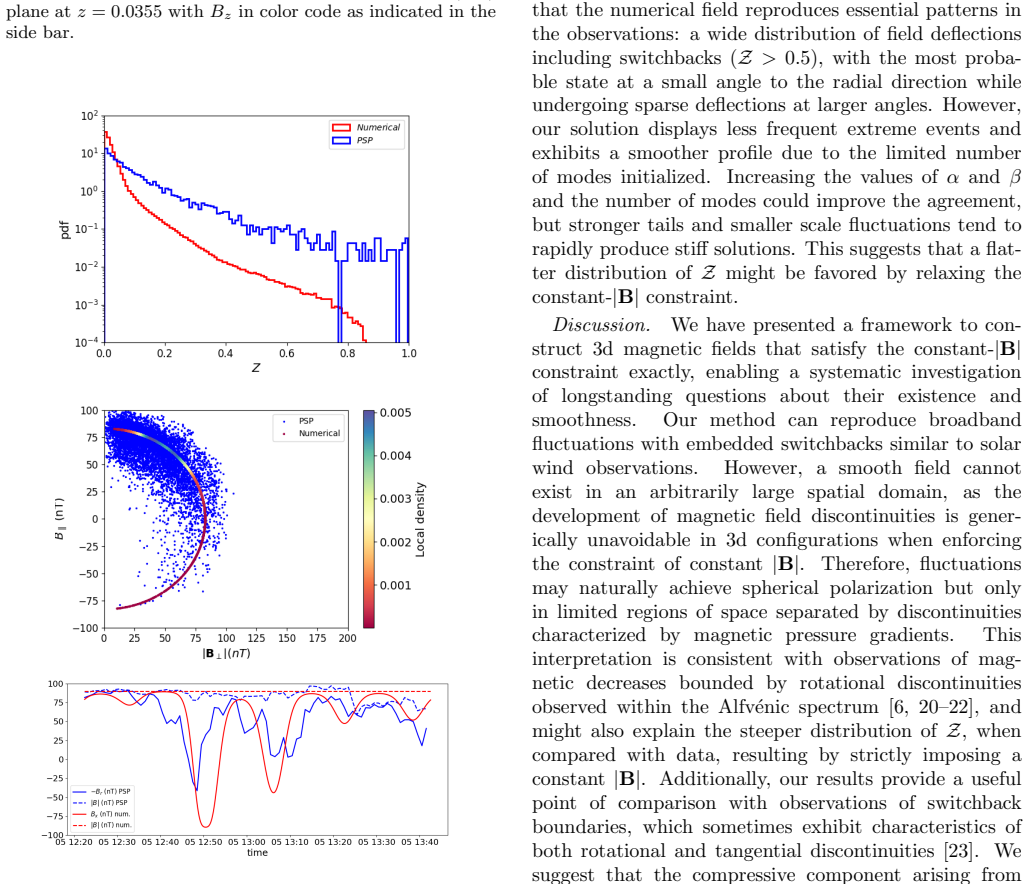
Turbulence in the solar wind is characterized by Alfv\'enic fluctuations that exhibit spherical polarization, a geometric condition resulting in the nearly constant magnitude of the magnetic field. This property persists even during the largest field fluctuations, sometimes leading to local polarity reversals known as switchbacks. A longstanding question is whether three-dimensional smooth magnetic fields can simultaneously satisfy the constant-$|{\bf B}|$ constraint, and how such fields can be constructed analytically or numerically. Here we propose a new numerical method that allows to construct a magnetic field that is exactly spherically polarized, reproducing key features of solar wind fluctuations. Using this framework, we show that discontinuities are generically unavoidable in three-dimensional configurations. Fundamentally, this implies that field rotations cannot maintain exactly constant $|{\bf B}|$ in an arbitrarily large spatial domain. Rather, field rotations with constant magnitude can exist in limited regions of space separated by discontinuities where magnetic compressibility cannot be neglected. These results provide insights into the structure of solar wind turbulence and more generally into the nature of nonlinear magnetic fluctuations in plasmas.
Editorial analysis
A structured set of objections, weighed in public.
Referee Report
Summary. The manuscript proposes a new numerical method for constructing exactly spherically polarized magnetic fields (constant |B|) in three dimensions that reproduce features of solar wind Alfvénic turbulence. Using this construction, the authors conclude that discontinuities are generically unavoidable in 3D, so that smooth constant-|B| field rotations cannot be maintained over arbitrarily large domains and must instead be separated by regions where magnetic compressibility cannot be neglected. The work is motivated by observations of switchbacks and aims to clarify geometric constraints on nonlinear magnetic fluctuations in plasmas.
Significance. If the unavoidability result can be placed on firmer general footing, the paper would provide a useful geometric explanation for the prevalence of discontinuities in solar wind turbulence and the limits of constant-magnitude rotations. The numerical framework itself, which enforces exact spherical polarization, is a constructive contribution that could be adopted for modeling studies.
major comments (2)
- [Abstract] Abstract: the central claim that 'discontinuities are generically unavoidable in three-dimensional configurations' is supported only by results from one specific numerical parametrization. Without a topological, measure-theoretic, or exhaustive classification argument over the space of divergence-free vector fields with |B| = const, it remains possible that other constructions (global analytic solutions, different expansions) avoid discontinuities in large domains; this directly affects the implication for arbitrarily large spatial domains.
- [Numerical construction] Numerical construction section: the method assumes the magnetic field can be prescribed independently of the induction equation and plasma dynamics. The manuscript should demonstrate that the observed discontinuities persist under variations of the parametrization or when additional constraints (e.g., force-free conditions or different boundary conditions) are imposed, to strengthen the 'generic' qualifier.
minor comments (2)
- Clarify in the abstract and introduction which quantitative features of solar wind fluctuations (e.g., specific power spectra or switchback statistics) are reproduced by the construction.
- Ensure figures explicitly mark discontinuity locations and include a direct comparison panel with spacecraft data.
Simulated Author's Rebuttal
We thank the referee for their constructive and insightful comments on our manuscript. We address each major comment below and indicate the revisions that will be incorporated in the next version.
read point-by-point responses
-
Referee: [Abstract] Abstract: the central claim that 'discontinuities are generically unavoidable in three-dimensional configurations' is supported only by results from one specific numerical parametrization. Without a topological, measure-theoretic, or exhaustive classification argument over the space of divergence-free vector fields with |B| = const, it remains possible that other constructions (global analytic solutions, different expansions) avoid discontinuities in large domains; this directly affects the implication for arbitrarily large spatial domains.
Authors: We agree that a complete topological or measure-theoretic classification would provide stronger support for the claim. Our numerical construction is designed to be flexible and spans a broad family of divergence-free, constant-magnitude fields; within this family, discontinuities consistently appear when the domain size is increased. We have revised the abstract to read 'in the three-dimensional configurations constructed by our method, discontinuities are generically unavoidable' and added a dedicated paragraph in the discussion section explaining the topological origin of the discontinuities (arising from the incompatibility between continuous spherical polarization and the divergence-free condition over extended domains). We also explicitly note the limitation that other analytic constructions might exist. This constitutes a partial revision, as a full general proof lies outside the scope of the present work. revision: partial
-
Referee: [Numerical construction] Numerical construction section: the method assumes the magnetic field can be prescribed independently of the induction equation and plasma dynamics. The manuscript should demonstrate that the observed discontinuities persist under variations of the parametrization or when additional constraints (e.g., force-free conditions or different boundary conditions) are imposed, to strengthen the 'generic' qualifier.
Authors: The construction is deliberately kinematic to isolate the geometric constraints of spherical polarization and div B = 0. In the revised manuscript we have added a new subsection with systematic parameter sweeps (varying the number of modes, amplitude distributions, and boundary conditions) that confirm discontinuities remain necessary for large domains. We have also included a short analysis under approximate force-free conditions, showing that the discontinuities persist. These tests strengthen the 'generic' qualifier within the class of fields accessible to our parametrization while preserving the paper's focus on geometric rather than dynamical constraints. revision: yes
- We cannot rule out the existence of other constructions (global analytic solutions or different expansions) that might maintain smooth constant-|B| fields over arbitrarily large domains without discontinuities.
Circularity Check
Numerical construction of spherically polarized fields is independent of the observed discontinuities; no load-bearing step reduces to fitted inputs or self-citation by construction.
full rationale
The paper introduces a new numerical parametrization to enforce exact spherical polarization (|B| constant) on a divergence-free field and then reports that discontinuities appear when the construction is extended to three dimensions. This is a direct constructive observation rather than a derivation that presupposes the result. No equation is shown to be equivalent to its own input by algebraic rearrangement, no parameter is fitted on a subset and then relabeled as a prediction, and the central claim does not rest on a uniqueness theorem or ansatz imported from the authors' prior work. The method is presented as novel and the discontinuities emerge from the numerical realizations themselves, rendering the derivation self-contained against external benchmarks.
Axiom & Free-Parameter Ledger
axioms (1)
- standard math Magnetic field is divergence-free
Reference graph
Works this paper leans on
-
[1]
J. W. Belcher and L. Davis Jr, Large-amplitude alfv´ en waves in the interplanetary medium, 2, Journal of Geo- physical Research76, 3534 (1971)
1971
-
[2]
Bruno, V
R. Bruno, V. Carbone, B. Bavassano, and L. Sorriso- Valvo, Observations of magnetohydrodynamic turbu- lence in the 3d heliosphere, Advances in Space Research 35, 939 (2005)
2005
-
[3]
C. Chen, S. Bale, J. Bonnell, D. Borovikov, T. Bowen, D. Burgess, A. Case, B. Chandran, T. D. de Wit, K. Goetz,et al., The evolution and role of solar wind turbulence in the inner heliosphere, The Astrophysical Journal Supplement Series246, 53 (2020)
2020
-
[4]
C. Shi, M. Velli, O. Panasenco, A. Tenerani, V. R´ eville, S. D. Bale, J. Kasper, K. Korreck, J. Bonnell, T. D. de Wit,et al., Alfv´ enic versus non-alfv´ enic turbulence in the inner heliosphere as observed by parker solar probe, Astronomy & Astrophysics650, A21 (2021)
2021
-
[5]
Barnes and J
A. Barnes and J. V. Hollweg, Large-amplitude hydromag- netic waves, Journal of Geophysical Research79, 2302 (1974)
1974
-
[6]
B. T. Tsurutani, G. S. Lakhina, A. Sen, P. Hellinger, K.- H. Glassmeier, and A. J. Mannucci, A review of alfv´ enic turbulence in high-speed solar wind streams: Hints from cometary plasma turbulence, Journal of Geophysical Re- search: Space Physics123, 2458 (2018)
2018
-
[7]
Matteini, T
L. Matteini, T. Horbury, F. Pantellini, M. Velli, and S. Schwartz, Ion kinetic energy conservation and mag- netic field strength constancy in multi-fluid solar wind alfv´ enic turbulence, The Astrophysical Journal802, 11 (2015)
2015
-
[8]
J. C. Kasper, S. D. Bale, J. W. Belcher, M. Berthomier, A. W. Case, B. D. Chandran, D. Curtis, D. Gallagher, S. Gary, L. Golub,et al., Alfv´ enic velocity spikes and rotational flows in the near-sun solar wind, Nature576, 228 (2019)
2019
-
[9]
S. Bale, S. Badman, J. Bonnell, T. Bowen, D. Burgess, A. Case, C. Cattell, B. Chandran, C. Chaston, C. Chen, et al., Highly structured slow solar wind emerging from an equatorial coronal hole, Nature576, 237 (2019)
2019
-
[10]
Malara and M
F. Malara and M. Velli, Parametric instability of a large- amplitude nonmonochromatic alfv´ en wave, Physics of Plasmas3, 4427 (1996)
1996
-
[11]
Marriott and A
M. Marriott and A. Tenerani, Parametric instability of alfv´ en waves and wave packets in periodic and open sys- tems, The Astrophysical Journal975, 232 (2024)
2024
-
[12]
Primavera, F
L. Primavera, F. Malara, S. Servidio, G. Nigro, and P. Veltri, Parametric instability in two-dimensional alfv´ enic turbulence, The Astrophysical Journal880, 156 (2019)
2019
-
[13]
Tenerani, M
A. Tenerani, M. Velli, L. Matteini, V. R´ eville, C. Shi, S. D. Bale, J. C. Kasper, J. W. Bonnell, A. W. Case, T. D. de Wit,et al., Magnetic field kinks and folds in the solar wind, The Astrophysical Journal Supplement Series 246, 32 (2020)
2020
-
[14]
C. Shi, M. Velli, G. Toth, K. Zhang, A. Tenerani, Z. Huang, N. Sioulas, and B. van der Holst, Analytic model and magnetohydrodynamic simulations of three- dimensional magnetic switchbacks, The Astrophysical Journal Letters964, L28 (2024)
2024
-
[15]
D. A. Roberts, Construction of solar-wind-like magnetic fields, Physical Review Letters109, 231102 (2012)
2012
-
[16]
Valentini, F
F. Valentini, F. Malara, L. Sorriso-Valvo, R. Bruno, and L. Primavera, Building up solar-wind-like 3d uniform- intensity magnetic fields, The Astrophysical Journal Let- ters881, L5 (2019)
2019
-
[17]
Squire and A
J. Squire and A. Mallet, On the construction of general large-amplitude spherically polarised alfv´ en waves, Jour- nal of Plasma Physics88, 175880503 (2022)
2022
- [18]
-
[19]
Dudok de Wit, V
T. Dudok de Wit, V. V. Krasnoselskikh, S. D. Bale, J. W. Bonnell, T. A. Bowen, C. H. Chen, C. Froment, K. Goetz, P. R. Harvey, V. K. Jagarlamudi,et al., Switchbacks in the near-sun magnetic field: long memory and impact on the turbulence cascade, The Astrophysical Journal Sup- plement Series246, 39 (2020)
2020
-
[20]
Tsurutani, C
B. Tsurutani, C. Ho, E. Smith, M. Neugebauer, B. Gold- stein, J. Mok, J. Arballo, A. Balogh, D. Southwood, and W. Feldman, The relationship between interplane- tary discontinuities and alfv´ en waves: Ulysses observa- tions, Geophysical Research Letters21, 2267 (1994)
1994
-
[21]
Tsurutani, C
B. Tsurutani, C. Galvan, J. Arballo, D. Winterhal- ter, R. Sakurai, E. Smith, B. Buti, G. Lakhina, and A. Balogh, Relationship between discontinuities, mag- netic holes, magnetic decreases, and nonlinear alfv´ en waves: Ulysses observations over the solar poles, Geo- physical Research Letters29, 23 (2002)
2002
-
[22]
Gonz´ alez, J
C. Gonz´ alez, J. Verniero, R. Bandyopadhyay, and A. Ten- erani, Local proton heating at magnetic discontinuities in alfv´ enic and non-alfv´ enic solar wind, The Astrophysical Journal963, 148 (2024)
2024
-
[23]
Larosa, V
A. Larosa, V. Krasnoselskikh, T. D. de Wit, O. Agapitov, C. Froment, V. Jagarlamudi, M. Velli, S. Bale, A. Case, K. Goetz,et al., Switchbacks: statistical properties and deviations from alfv´ enicity, Astronomy & Astrophysics 650, A3 (2021)
2021
discussion (0)
Sign in with ORCID, Apple, or X to comment. Anyone can read and Pith papers without signing in.