Recognition: unknown
How Do Ice Shelves Calve? Peridynamic Modeling of Ice Shelf Fracture Driven by Wave Erosion, Basal Melting, and Buoyancy Flexure
Pith reviewed 2026-05-08 16:58 UTC · model grok-4.3
The pith
A peridynamics framework models ice shelf calving driven by the coupled effects of wave erosion, basal melting, and buoyancy flexure.
A machine-rendered reading of the paper's core claim, the machinery that carries it, and where it could break.
Core claim
The central claim is that a physics-based peridynamic framework enables investigation of the coupled effects of self-weight bending, buoyancy-induced foot loosening, and ice calving driven by wave-induced frontal corrosion. This is presented as the first such attempt. The framework captures crack initiation, interaction, and propagation naturally during large deformations and long-term loading. A static first Piola-Kirchhoff virial stress formulation is added to evaluate stress concentration and energy release at evolving crack tips. The model is validated by direct comparisons with finite-element stress fields, analytical beam-theory solutions, and recent field observations of wave-driven冰冰
What carries the argument
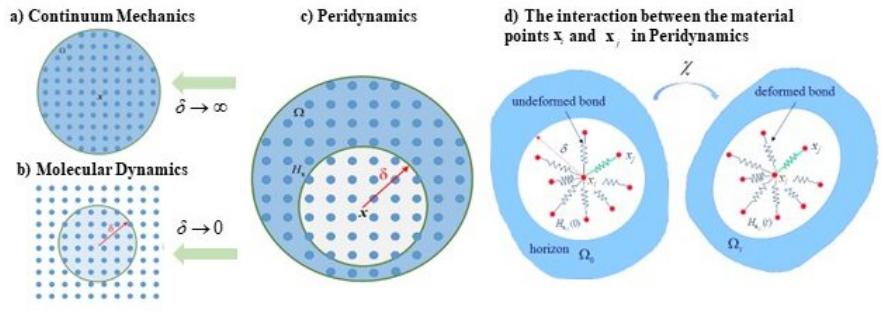
The peridynamic framework, a nonlocal continuum model that treats ice as material points connected by bonds which break when a critical stretch is reached, allowing cracks to initiate and propagate without predefined paths or remeshing.
If this is right
- The model directly shows how buoyancy loosens the ice foot and promotes calving.
- Stress and energy release at crack tips can be quantified while the fracture evolves.
- No special numerical treatments are needed to handle crack growth under large deformations and long-term loads.
- The approach can be applied to study ice shelf response to changing environmental conditions.
Where Pith is reading between the lines
- Coupling the framework to ocean wave and temperature data could allow forecasts of calving frequency under future climate conditions.
- The same nonlocal bond approach might be tested on other fracture-dominated ice features such as crevasses or icebergs.
- Adding temperature dependence to the bond failure threshold would be a direct extension to capture seasonal variations in ice strength.
Load-bearing premise
The peridynamic bond-breakage criteria and material parameters, together with the static virial stress, accurately represent ice fracture under wave erosion, basal melting, and buoyancy flexure without further empirical tuning.
What would settle it
A high-resolution record of crack locations, propagation speeds, and final detachment timing from an observed ice shelf calving event, when compared against model output for the same wave and melt conditions, would confirm or refute the claim if the patterns diverge.
Figures








read the original abstract
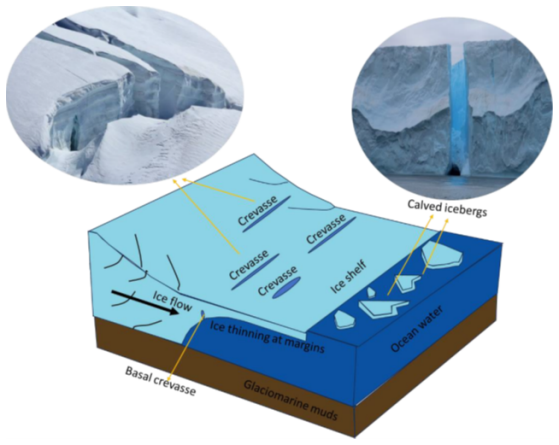
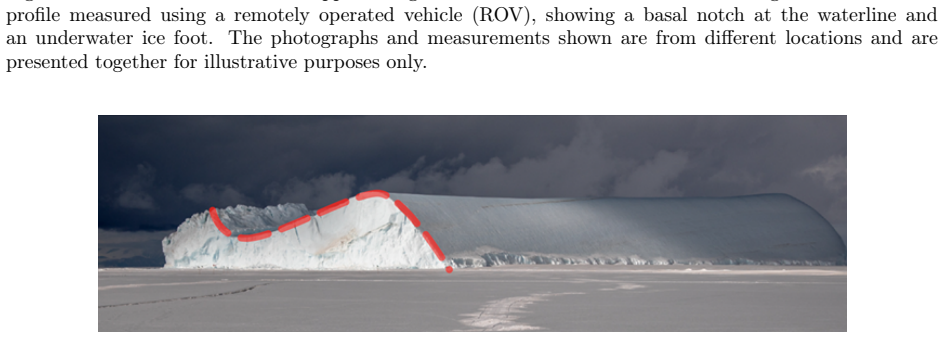
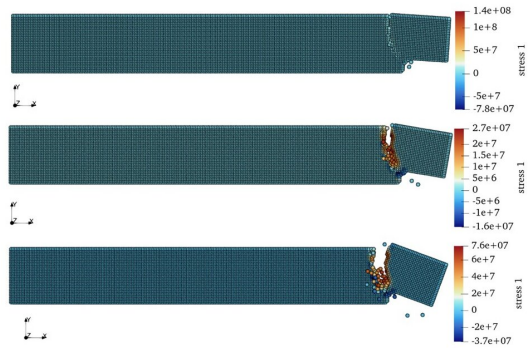
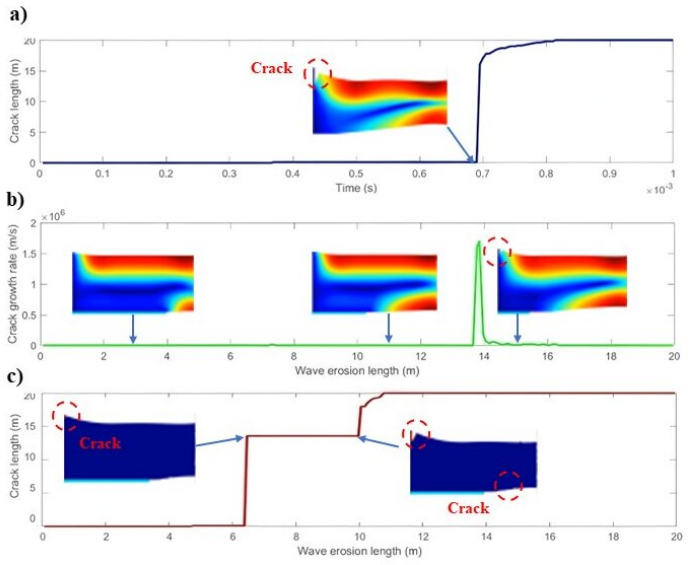
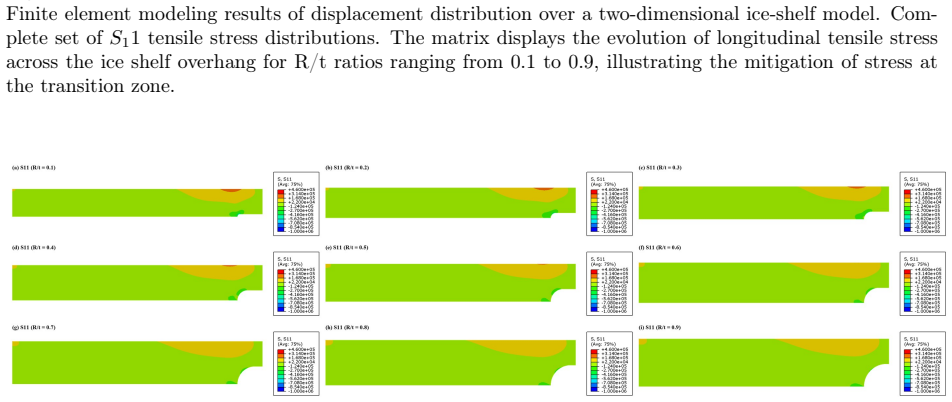
An ice shelf is a floating extension of a land-based ice sheet into the ocean. It plays a crucial role in slowing down the flow of land ice into the sea, thus stabilizing the ice sheet. However, this stabilizing effect can be weakened by ice calving, a process in which large fragments of ice detach from the ice shelf. Although ice calving is widely acknowledged as a major contributor to ice mass loss, and its frequency and magnitude are highly sensitive to the environmental forcing, the underlying physics-based mechanisms remain poorly understood, particularly under ocean wave actions. In this context, we developed a nonlocal peridynamics (PD) framework to model the ice calving process subjected to wave-induced frontal corrosion. The proposed physics-based PD framework enables investigation of the coupled effects of self-weight bending, buoyancy-induced foot loosening, and ice calving process. To authors' best knowledge, this work represents the first attempt to employ a physics-based peridynamics framework for simulating ice calving processes. Compared with conventional finite element methods (FEM), the PD framework naturally captures crack initiation, interaction, and propagation without the need for special numerical treatments, thereby providing a robust tool for simulating fracture phenomena under large deformations and long-term environmental loading. To quantitatively resolve fracture processes, we implemented a static first Piola Kirchhoff virial stress formulation within the PD framework, allowing direct evaluation of stress concentration and energy release at evolving crack tips. Subsequently, the model is rigorously validated through one-to-one comparisons with finite-element stress fields, analytical beam-theory solutions, and recent field observations of wave-driven ice-shelf failure reported by Sartore et al. (2025).
Editorial analysis
A structured set of objections, weighed in public.
Referee Report
Summary. The paper develops a nonlocal peridynamic (PD) framework to model ice-shelf calving under wave-induced frontal corrosion, incorporating the coupled effects of self-weight bending, buoyancy-induced foot loosening, and fracture. It claims to be the first physics-based PD approach for this process, implements a static first Piola-Kirchhoff virial stress formulation to evaluate stress at evolving crack tips, and validates the model via direct comparisons with FEM stress fields, analytical beam-theory solutions, and field observations from Sartore et al. (2025).
Significance. A well-validated PD model that naturally handles crack initiation and propagation under large deformations and long-term environmental loading would be a useful addition to computational glaciology, offering advantages over FEM for fracture problems. The explicit use of virial stress for energy-release assessment and the positioning as parameter-free (beyond the reported validations) are potential strengths if the coupled implementation holds.
major comments (1)
- Validation section (comparisons with FEM, beam theory, and Sartore et al. 2025): the reported one-to-one matches test individual components (stress fields under bending, isolated failure events), but the central claim that the coupled multi-physics model (wave erosion + basal melting + buoyancy flexure) remains parameter-free when all drivers act simultaneously is not directly demonstrated. This is load-bearing for the assertion of no extra empirical tuning.
minor comments (2)
- Abstract and title: basal melting is listed as a driver but the description emphasizes wave-induced frontal corrosion; clarify whether basal melting is implemented as an independent process or subsumed under bond removal.
- Methods: the static virial stress formulation is introduced for fracture evaluation, but the precise mapping from peridynamic bond forces to the first Piola-Kirchhoff tensor (including any horizon-size dependence) should be given explicitly for reproducibility.
Simulated Author's Rebuttal
We thank the referee for their constructive and insightful review of our manuscript. The major comment raises a valid point about the strength of evidence for the coupled model's parameter-free behavior, which we address directly below. We have prepared revisions to clarify and strengthen this aspect of the paper.
read point-by-point responses
-
Referee: Validation section (comparisons with FEM, beam theory, and Sartore et al. 2025): the reported one-to-one matches test individual components (stress fields under bending, isolated failure events), but the central claim that the coupled multi-physics model (wave erosion + basal melting + buoyancy flexure) remains parameter-free when all drivers act simultaneously is not directly demonstrated. This is load-bearing for the assertion of no extra empirical tuning.
Authors: We appreciate the referee's observation, which correctly identifies that our current validation section emphasizes isolated verification of individual mechanisms (FEM stress fields, beam-theory flexure, and field-observed failure events). The PD formulation itself introduces no additional empirical parameters for fracture or coupling beyond the physical drivers and material properties; the coupling of wave erosion, basal melting, and buoyancy flexure is handled natively through the peridynamic equations. The match to Sartore et al. (2025) field observations, which occur under simultaneous environmental forcings, provides supporting evidence that the integrated model requires no extra tuning. However, we agree that an explicit demonstration of the fully coupled simulation would more directly substantiate the parameter-free claim. We will therefore revise the validation section to include a dedicated subsection and accompanying figure that simulates all three drivers acting together, confirming that the same parameter set reproduces the expected calving behavior without further calibration. This change will be made in the next manuscript version. revision: yes
Circularity Check
No significant circularity: physics-based PD model validated externally
full rationale
The derivation chain relies on a peridynamic framework with bond-breakage criteria and static virial stress, validated one-to-one against independent FEM stress fields, analytical beam theory, and external field observations (Sartore et al. 2025). No equations reduce by construction to fitted inputs or self-citations; the model is positioned as parameter-free beyond reported validations, with no self-definitional steps, ansatz smuggling, or renaming of known results. Central claims remain independent of the paper's own outputs.
Axiom & Free-Parameter Ledger
Reference graph
Works this paper leans on
-
[1]
Journal of Geophysical Research: Earth Surface125(6), e2019JF005444 (2020)
Amaral, T., Bartholomaus, T.C., Enderlin, E.M.: Evaluation of iceberg calving models against observations from greenland outlet glaciers. Journal of Geophysical Research: Earth Surface125(6), e2019JF005444 (2020)
2020
-
[2]
Geophysical Research Letters48(8), e2021GL093110 (2021)
Buck, W.R., Lai, C.Y.: Flexural control of basal crevasse opening under ice shelves. Geophysical Research Letters48(8), e2021GL093110 (2021)
2021
-
[3]
In: Ice-Structure Interaction: IU- TAM/IAHRSymposiumSt.Johnâs, NewfoundlandCanada1989, pp.109–145.Springer (1991)
Dempsey, J.P.: The fracture toughness of ice. In: Ice-Structure Interaction: IU- TAM/IAHRSymposiumSt.Johnâs, NewfoundlandCanada1989, pp.109–145.Springer (1991)
1991
-
[4]
Science Advances4(6), p.eaao7212 (2018)
Dow, C., Lee, W., Greenbaum, J., Greene, C., Blankenship, D., Poinar, K., Forrest, A., Young, D., Zappa, C.: Basal channels drive active surface hydrology and transverse ice shelf fracture. Science Advances4(6), p.eaao7212 (2018)
2018
-
[5]
Journal of Glaciol- ogy66(257), 415–429 (2020)
Duddu, R., Jiménez, S., Bassis, J.: A non-local continuum poro-damage mechanics model for hydrofracturing of surface crevasses in grounded glaciers. Journal of Glaciol- ogy66(257), 415–429 (2020)
2020
-
[6]
Computational Mechanics51(6), 961–974 (2013)
Duddu, R., Waisman, H.: A nonlocal continuum damage mechanics approach to simu- lation of creep fracture in ice sheets. Computational Mechanics51(6), 961–974 (2013)
2013
-
[7]
Journal of Ocean Engineering and Science (2025)
Feshalami, B.F., Løset, S., Lubbad, R., Lu, W., Skourup, H., Kashafutdinov, M.: A numerical model for the simulation of wave-induced erosion of floating icebergs: Implementation and validation against wave flume data. Journal of Ocean Engineering and Science (2025)
2025
-
[8]
Journal of Glaciology69(278), 1915–1928 (2023)
Huth, A., Duddu, R., Smith, B., Sergienko, O.: Simulating the processes controlling ice-shelf rift paths using damage mechanics. Journal of Glaciology69(278), 1915–1928 (2023)
1915
-
[9]
The Cryosphere8(6), 2101–2117 (2014)
Krug, J., Weiss, J., Gagliardini, O., Durand, G.: Combining damage and fracture mechanics to model calving. The Cryosphere8(6), 2101–2117 (2014)
2014
-
[10]
Nature584(7822), 574–578 (2020)
Lai, C.Y., Kingslake, J., Wearing, M.G., Chen, P.H.C., Gentine, P., Li, H., Spergel, J.J., van Wessem, J.M.: Vulnerability of antarctica’s ice shelves to meltwater-driven fracture. Nature584(7822), 574–578 (2020)
2020
-
[11]
International Journal of Solids and Structures241, 111478 (2022)
Li, J., Li, S., Lai, X., Liu, L.: Peridynamic stress is the static first piola–kirchhoff virial stress. International Journal of Solids and Structures241, 111478 (2022)
2022
-
[12]
Quaestiones Geographicae43(1), 127–156 (2024) 28
Owczarek, Z., Stachowska-Kaminska, Z., Kostrzewa, O., Szczypinska, M.: Progress in arctic coastal geomorphological research in times of rapid climate warming. Quaestiones Geographicae43(1), 127–156 (2024) 28
2024
-
[13]
The Cryosphere19(1), 249–265 (2025)
Sartore, N.B., Wagner, T.J., Siegfried, M.R., Pujara, N., Zoet, L.K.: Wave erosion, frontal bending, and calving at ross ice shelf. The Cryosphere19(1), 249–265 (2025)
2025
-
[14]
Annual Review of Earth and Planetary Sciences50(1), 323–343 (2022)
Schulson, E., Renshaw, C.: Fracture, friction, and permeability of ice. Annual Review of Earth and Planetary Sciences50(1), 323–343 (2022)
2022
-
[15]
Journal of the Mechanics and Physics of Solids48(1), 175–209 (2000)
Silling, S.A.: Reformulation ofelasticity theoryfor discontinuities and long-rangeforces. Journal of the Mechanics and Physics of Solids48(1), 175–209 (2000)
2000
-
[16]
Journal of Elasticity93(1), 13–37 (2008)
Silling, S.A., Lehoucq, R.B.: Convergence of peridynamics to classical elasticity theory. Journal of Elasticity93(1), 13–37 (2008)
2008
-
[17]
Journal of Geophysical Research: Earth Surface 126(7), e2021JF006191 (2021)
Slater, D., Benn, D., Cowton, T., Bassis, J., Todd, J.: Calving multiplier effect con- trolled by melt undercut geometry. Journal of Geophysical Research: Earth Surface 126(7), e2021JF006191 (2021)
2021
-
[18]
PAMM22(1), e202200256 (2023)
Sondershaus, R., Humbert, A., Müller, R.: A phase field model for fractures in ice shelves. PAMM22(1), e202200256 (2023)
2023
-
[19]
Engineering with Computers39(1), 575–606 (2023)
Song, Y., Li, S., Li, Y.: Peridynamic modeling and simulation of thermo-mechanical fracture in inhomogeneous ice. Engineering with Computers39(1), 575–606 (2023)
2023
-
[20]
Defence Technology17(1), 15–35 (2021)
Song, Y., Li, S., Zhang, S.: Peridynamic modeling and simulation of thermo-mechanical de-icing process with modified ice failure criterion. Defence Technology17(1), 15–35 (2021)
2021
-
[21]
Meccanica55(4), 961–976 (2020)
Song, Y., Liu, R., Li, S., Kang, Z., Zhang, F.: Peridynamic modeling and simulation of coupled thermomechanical removal of ice from frozen structures. Meccanica55(4), 961–976 (2020)
2020
-
[22]
Journal of Geophysical Research: Oceans124(5), 3378–3392 (2019)
Stern, A., Adcroft, A., Sergienko, O.: Modeling ice shelf cavities and tabular icebergs using lagrangian elements. Journal of Geophysical Research: Oceans124(5), 3378–3392 (2019)
2019
-
[23]
Cold regions science and technology60(2), 107–129 (2010)
Timco, G., Weeks, W.: A review of the engineering properties of sea ice. Cold regions science and technology60(2), 107–129 (2010)
2010
-
[24]
Wang, S., Alexander, P., Alley, R., Huang, Z., Parizek, B., Willet, A., Anandakrishnan, S.: Recent variability in fracture characteristics and ice flow of thwaites ice shelf, west antarctica. Journal of Geophysical Research: Earth Surface130(5), p.e2024JF008118 (2025) 29 Appendix In this Appendix, we present the finite element modeling of a two-dimensiona...
2025
discussion (0)
Sign in with ORCID, Apple, or X to comment. Anyone can read and Pith papers without signing in.