Recognition: unknown
Magnetic influence on ion transport in concentrated solid solutions: An analytic investigation
Pith reviewed 2026-05-08 17:36 UTC · model grok-4.3
The pith
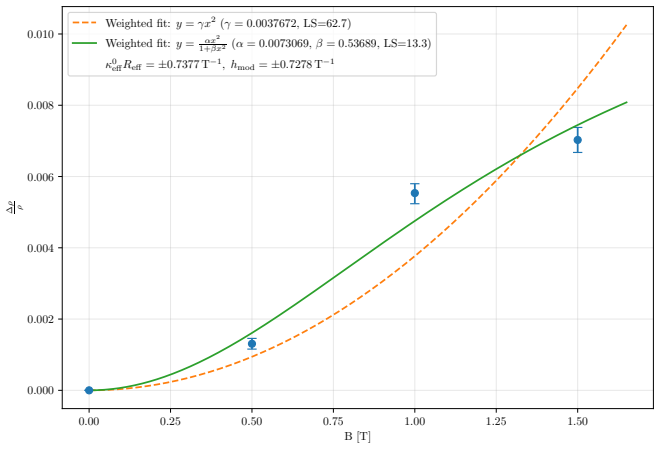
Derived models show magnetic fields affect ion transport in binary solid conductors and fit data for Pb0.66Cd0.34F2 under near-degenerate transport.
A machine-rendered reading of the paper's core claim, the machinery that carries it, and where it could break.
Core claim
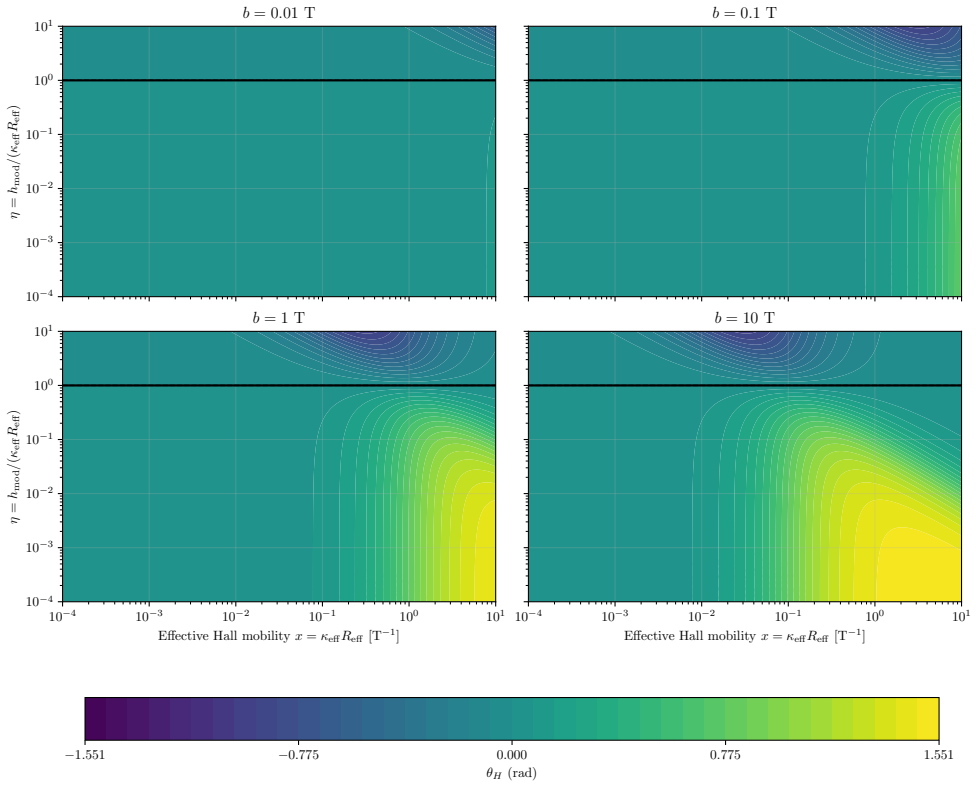
The paper establishes general multi-component transport equations that include magnetic field effects for solid ionic conductors. For isotropic binary conductors, specific models are derived and shown to fit well with experimental magneto-resistance data from Pb0.66Cd0.34F2 under the assumption of near degenerate multi-component transport. Material property combinations are computed where magnetic influence may be significant subject to compositional constraints.
What carries the argument
The analytic transport equations for binary ionic conductors in a magnetic field, which account for magnetic influences on ion movement beyond naive Hall estimates.
If this is right
- Magnetic field effects on transport are significant only for specific material property combinations in concentrated solid solutions.
- The binary conductor model accurately describes magneto-resistance in Pb0.66Cd0.34F2 under near degenerate transport.
- Single ion conductor models indicate generally weaker magnetic influences unless certain conditions are met.
- The approach allows prediction of magnetic field impacts on ionic processes in solids without relying on naive Hall coefficient estimates.
Where Pith is reading between the lines
- This model suggests magnetic fields could be applied to direct or enhance ion transport in solid-state battery electrolytes.
- The analytic framework may extend to other types of ionic conductors beyond the fluoride example studied.
- Direct measurements of individual ion mobilities could test the near-degenerate transport assumption used in the fit.
Load-bearing premise
The model fit to the magneto-resistance data for Pb0.66Cd0.34F2 depends on assuming near degenerate multi-component transport.
What would settle it
Experimental determination of the individual transport coefficients showing they are not near degenerate would falsify the explanation for the observed data fit.
Figures


read the original abstract
It is well established that magnetic fields have a significant effect on transport in certain classes of electronic conductors. Less reported, however, are similar effects in solid ionic conductors. Despite the rarity of Hall mobility measurements in ionic conductors, recent experimental work in batteries and other systems has demonstrated that an applied magnetic field can significantly and beneficially alter ionic transport and electrochemical processes in solid materials in a way that would not be predicted from na\"{\i}ve Hall coefficient estimates. In this work, the influence of a magnetic field on ion transport in solids is investigated analytically, and general multi-component transport equations accounting for magnetic effects are presented. Specific models are then derived for solid, isotropic binary and single ion conductors. Material property combinations for which magnetic field influence may become significant are then computed for certain systems subject to compositional constraints. Finally, it is demonstrated that the derived model for binary conductors in a magnetic field fits experimental magneto-resistance data well for the fluoride ion conducting solid Pb$_{0.66}$Cd$_{0.34}$F$_2$, provided an assumption of near degenerate multi-component transport.
Editorial analysis
A structured set of objections, weighed in public.
Referee Report
Summary. The paper analytically derives general multi-component transport equations for ionic conductors that incorporate magnetic field effects, specializes these to isotropic binary and single-ion conductors, identifies combinations of material properties (under compositional constraints) where magnetic influences on transport may become appreciable, and reports that the binary-conductor model fits experimental magneto-resistance data for the fluoride-ion conductor Pb0.66Cd0.34F2 when an assumption of near-degenerate multi-component transport is imposed.
Significance. If the near-degenerate transport assumption can be independently justified, the work supplies a compact analytic framework extending standard transport theory to magnetic effects in concentrated solid ionic solutions. The identification of property regimes where magnetic terms are non-negligible is potentially useful for electrochemical materials design. The derivations themselves follow conventional linear-response transport theory and contain no free parameters beyond the usual phenomenological coefficients.
major comments (1)
- The reported agreement between the derived binary-conductor model and the magneto-resistance data for Pb0.66Cd0.34F2 is obtained only after imposing the assumption of near-degenerate multi-component transport. No independent experimental or computational support (e.g., separate conductivity, transference-number, or Hall measurements) is cited to establish that this degeneracy holds in the material. The text itself states that relaxing the assumption recovers the standard non-degenerate prediction of negligible magnetoresistance; consequently the fit tests the added degeneracy constraint rather than the magnetic terms derived in the model.
minor comments (1)
- In the general multi-component equations, the notation for the magnetic-field-dependent Onsager coefficients should be introduced with an explicit reference to the underlying linear-response framework to improve traceability for readers unfamiliar with ionic-transport literature.
Simulated Author's Rebuttal
We thank the referee for their careful reading and constructive feedback. We address the major comment below and will revise the manuscript accordingly to improve clarity on the scope and limitations of our results.
read point-by-point responses
-
Referee: The reported agreement between the derived binary-conductor model and the magneto-resistance data for Pb0.66Cd0.34F2 is obtained only after imposing the assumption of near-degenerate multi-component transport. No independent experimental or computational support (e.g., separate conductivity, transference-number, or Hall measurements) is cited to establish that this degeneracy holds in the material. The text itself states that relaxing the assumption recovers the standard non-degenerate prediction of negligible magnetoresistance; consequently the fit tests the added degeneracy constraint rather than the magnetic terms derived in the model.
Authors: We agree that the fit to the Pb0.66Cd0.34F2 data requires the near-degenerate transport assumption, which is explicitly stated in the manuscript. The general multi-component transport equations with magnetic effects are derived from linear response theory without this assumption. The binary-conductor specialization and the computed property regimes demonstrate that appreciable magnetic influence on ionic transport arises specifically under near-degenerate conditions in concentrated solutions, where the two ionic species have comparable transport coefficients. The fit illustrates consistency of the full model (magnetic terms plus degeneracy) with experiment, while the non-degenerate limit correctly recovers negligible magnetoresistance as noted. We acknowledge that independent measurements to confirm degeneracy are not cited and would be needed to isolate the magnetic contributions more definitively. We will revise the text to expand the discussion of the degeneracy assumption, its physical motivation for concentrated solid solutions, and the need for future transference-number or Hall-effect experiments to test it. This will clarify that the current results support the analytic framework and regime identification but do not constitute standalone validation of the magnetic terms. revision: yes
Circularity Check
Data fit for Pb0.66Cd0.34F2 requires the unverified 'near degenerate multi-component transport' assumption
specific steps
-
fitted input called prediction
[Abstract (final demonstration)]
"it is demonstrated that the derived model for binary conductors in a magnetic field fits experimental magneto-resistance data well for the fluoride ion conducting solid Pb$_{0.66}$Cd$_{0.34}$F$_2$, provided an assumption of near degenerate multi-component transport."
The agreement with data is achieved only by imposing the near-degenerate assumption. This assumption is not derived from the transport equations or external benchmarks but is introduced specifically to produce the fit; relaxing it causes the predicted magnetoresistance to become negligible, so the 'demonstration' reduces to the assumption by construction rather than validating the magnetic terms.
full rationale
The analytic derivation of multi-component magnetic transport equations is presented as first-principles. However, the load-bearing claim that the binary-conductor model 'fits experimental magneto-resistance data well' for Pb0.66Cd0.34F2 is explicitly conditioned on an added assumption of near-degenerate transport. No independent verification of this degeneracy (e.g., via separate conductivity or Hall data) is provided; without the assumption the model reverts to predicting negligible magnetoresistance. This makes the reported agreement a direct consequence of the constraint rather than an independent test of the derived equations.
Axiom & Free-Parameter Ledger
axioms (1)
- domain assumption Standard multi-component flux equations can be extended by adding magnetic (Lorentz) contributions to each species velocity without additional coupling terms.
Reference graph
Works this paper leans on
-
[1]
Algebra: Chapter 0
Aluffi, P., 2009. Algebra: Chapter 0. volume 104 ofGraduate Studies in Mathematics. American Mathematical Society, Providence, RI
2009
-
[2]
Constitutive relation- ship and governing physical properties for magnetophoresis
Ayansiji, A.O., Dighe, A.V., Linninger, A.A., Singh, M.R., 2020. Constitutive relation- ship and governing physical properties for magnetophoresis. Proceedings of the National Academy of Sciences 117, 30208–30214
2020
-
[3]
Is the single-ion conductor cubic Li7La3Zr2O12 a binary ionic electrolyte? Materials Horizons
Bai, P., 2025. Is the single-ion conductor cubic Li7La3Zr2O12 a binary ionic electrolyte? Materials Horizons
2025
-
[4]
Elements of Nonequilibrium Statistical Mechanics
Balakrishnan, V., 2021. Elements of Nonequilibrium Statistical Mechanics. Springer Inter- national Publishing
2021
-
[5]
Transport processes in a plasma, in: Leontovich, M.A
Braginskii, S.I., 1965. Transport processes in a plasma, in: Leontovich, M.A. (Ed.), Reviews of Plasma Physics. Consultants Bureau. volume 1, pp. 205–311
1965
-
[6]
A fully coupled, electrochemical-magnetic theory with applications to solid-state battery materials
Carlson, T., Govindjee, S., 2026. A fully coupled, electrochemical-magnetic theory with applications to solid-state battery materials. Journal of the Mechanics and Physics of Solids 209, 106514
2026
-
[7]
Direct calculation of the ionic mobility in superionic conductors
Carvalho, A., Negi, S., Neto, A.H.C., 2022. Direct calculation of the ionic mobility in superionic conductors. Scientific Reports 12, 19930
2022
-
[8]
(Eds.), 1980
Chien, C.L., Westgate, C.R. (Eds.), 1980. The Hall Effect and Its Applications. 1st ed., Springer Science+Business Media New York, NY. 17
1980
-
[9]
Extreme magnetoresistance at high-mobility oxide heteroin- terfaces with dynamic defect tunability
Kalisky, B., Pryds, N., 2024. Extreme magnetoresistance at high-mobility oxide heteroin- terfaces with dynamic defect tunability. Nature Communications 15, 4249
2024
-
[10]
Mag- netically active lithium-ion batteries towards battery performance improvement
Costa, C.M., Merazzo, K.J., Gonçalves, R., Amos, C., Lanceros-Méndez, S., 2021. Mag- netically active lithium-ion batteries towards battery performance improvement. iScience 24
2021
-
[11]
Two-carrier model-fitting of hall effect in semiconductors with dual-band occupation: A case study in gan two-dimensional hole gas
Dill, J.E., Chang, C.F.C., Jena, D., Xing, H.G., 2025. Two-carrier model-fitting of hall effect in semiconductors with dual-band occupation: A case study in gan two-dimensional hole gas. Journal of Applied Physics 137, 025702. Désiré Pomar, T., Erlandsen, R., Zhou, B., Iliushyn, L., Bjørk, R., Christensen, D.V., 2024. Extraordinary magnetometry: A review ...
2025
-
[12]
Updating the inverse of a matrix
Hager, W.W., 1989. Updating the inverse of a matrix. SIAM Review , 221–239
1989
-
[13]
Unravelling the secrets of magnetic field-enhanced Li+ ion conduction in solid-state electrolytes
Kim, D., Chen, Y., Hu, X., Han, Q., Yu, B., Chen, Y., 2025. Unravelling the secrets of magnetic field-enhanced Li+ ion conduction in solid-state electrolytes. Nano Letters 25, 16869–16876
2025
-
[14]
Effects of static magnetic fields on diffusion in solutions
Kinouchi, Y., Tanimoto, S., Ushita, T., Sato, K., Yamaguchi, H., Miyamoto, H., 1988. Effects of static magnetic fields on diffusion in solutions. Bioelectromagnetics 9, 159–166
1988
-
[15]
Electromagnetic Theory
Kovetz, A., 2000. Electromagnetic Theory. Oxford University Press, New York, NY
2000
-
[16]
Self-diffusion in garnet-type Li7La3Zr2O12 solid electrolytes
Kuganathan, N., Rushton, M.J.D., Grimes, R.W., Kilner, J.A., Gkanas, E.I., Chroneos, A., 2021. Self-diffusion in garnet-type Li7La3Zr2O12 solid electrolytes. Scientific Reports 11, 451
2021
-
[17]
Transport of secondary carriers in a solid lithium-ion conductor
Li, G., Monroe, C.W., 2021. Transport of secondary carriers in a solid lithium-ion conductor. Electrochimica Acta 389, 138563
2021
-
[18]
Ionic hall effect in crystals: Independent versus cooperative hopping in AgBr andα-AgI
Liou, Y.J., Hudson, R.A., Wonnell, S.K., Slifkin, L.M., 1990. Ionic hall effect in crystals: Independent versus cooperative hopping in AgBr andα-AgI. Physics Review B 41, 10481– 10485
1990
-
[19]
Electrochemistry in magnetic fields
Luo, S., Elouarzaki, K., Xu, Z.J., 2022. Electrochemistry in magnetic fields. Angewandte Chemie International Edition 61, e202203564
2022
-
[20]
Magnetoresistance and hall effect in n-type indium antimonide in the magnetic freeze-out region
Mansfield, R., Kusztelan, L., 1978. Magnetoresistance and hall effect in n-type indium antimonide in the magnetic freeze-out region. Journal of Physics C: Solid State Physics 11, 4157
1978
-
[21]
On Onsager’s relations in a magnetic field
Mazur, P., de Groot, S., 1953. On Onsager’s relations in a magnetic field. Physica 19, 961–970
1953
-
[22]
The Cayley-Hamilton theorem
Mccarthy, C.A., 1933. The Cayley-Hamilton theorem. American Mathematical Monthly 40, 153–154. 18
1933
-
[23]
Electrochemical Systems
Newman, J., Balsara, N.P., 2021. Electrochemical Systems. 4th ed., Wiley
2021
-
[24]
Reciprocalrelations inirreversible processes.II
Onsager, L., 1931. Reciprocalrelations inirreversible processes.II. Phys.Rev. 38, 2265–2279
1931
-
[25]
A tale of two sites: On defining the carrier concentration in garnet-based ionic conductors for advanced Li batteries
Thompson, T., Sharafi, A., Johannes, M.D., Huq, A., Allen, J.L., Wolfenstine, J., Sakamoto, J., 2015. A tale of two sites: On defining the carrier concentration in garnet-based ionic conductors for advanced Li batteries. Advanced Energy Materials 5, 1500096
2015
-
[26]
Magnetoresistance in superionic conductor
Yakushkin, E.D., 2025. Magnetoresistance in superionic conductor. Crystallography Reports 70, 661–664
2025
-
[27]
The Schur complement and its applications
Zhang, F., 2005. The Schur complement and its applications. Numerical methods and algorithms ; v. 4, Springer, New York
2005
-
[28]
A multi-field coupled mechanical-electric-magnetic- chemical-thermal (MEMCT) theory for material systems
Zhang, X., Wang, Q.J., Shen, H., 2018. A multi-field coupled mechanical-electric-magnetic- chemical-thermal (MEMCT) theory for material systems. Computer Methods in Applied Mechanics and Engineering 341, 133–162
2018
-
[29]
Improving performances of oxide solid electrolytes by a magnetic field for all-solid-state lithium-metal batteries
Zhang, Y., Chen, S., Zhang, Y., Yu, Y., Liu, W., 2022. Improving performances of oxide solid electrolytes by a magnetic field for all-solid-state lithium-metal batteries. Applied Physics Letters 121, 173903. 19 Appendix A Algebraic properties of isotropic tensors Lemma(1).span{I,ϵ·b,b⊗b}is a commutative ring (see e.g., Aluffi, 2009). Proof.Let span{I,ϵ·b,...
2022
discussion (0)
Sign in with ORCID, Apple, or X to comment. Anyone can read and Pith papers without signing in.