Recognition: unknown
Hyperspectral Anomaly Detection Using Einstein Fuzzy Computing and Quantum Neural Network
Pith reviewed 2026-05-08 16:52 UTC · model grok-4.3
The pith
A hybrid quantum-fuzzy framework detects anomalies in hyperspectral images by fusing classical Einstein-based inference with quantum defuzzification.
A machine-rendered reading of the paper's core claim, the machinery that carries it, and where it could break.
Core claim
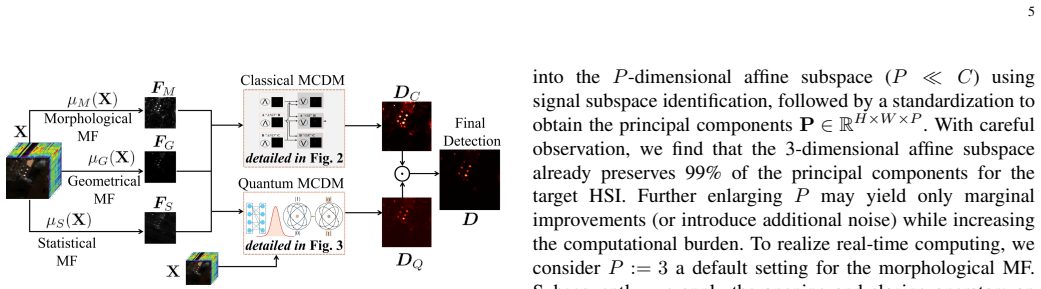
By first fuzzifying every pixel with morphological, geometrical, and statistical membership functions, applying Einstein fuzzy operations for classical inference, and passing aggregated fuzzy features through a quantum defuzzifier, the HyFuHAD framework produces a fused detection map that achieves state-of-the-art performance on hyperspectral anomaly detection tasks without requiring prior target spectra.
What carries the argument
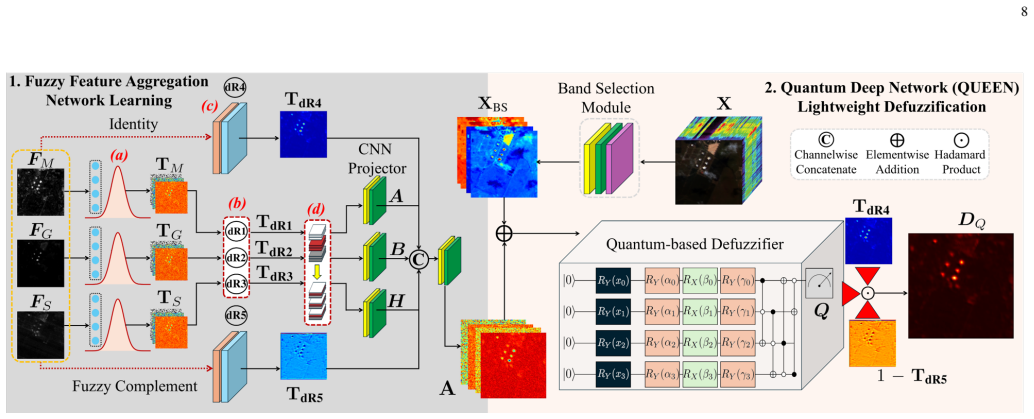
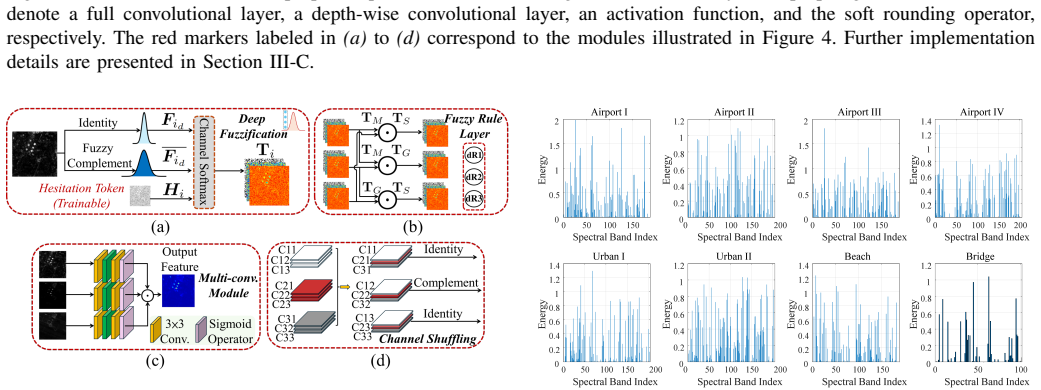
The HyFuHAD hybrid quantum-fuzzy multi-criteria decision framework, which applies Einstein sum and product operations to combine fuzzy membership degrees and uses a quantum defuzzifier on features from a fuzzy aggregation network to generate and fuse classical and quantum detection scores.
If this is right
- The method works without any example of the target spectrum, making it usable in real-world scenes where such priors are unavailable.
- Einstein operations replace abrupt min-max logic with smoother transitions that improve the reliability of the fuzzy inference step.
- The entire pipeline runs at sub-second speeds, supporting practical processing of large hyperspectral cubes.
- Fusion of the quantum and classical paths produces higher detection accuracy than either path used alone.
Where Pith is reading between the lines
- The same membership-function and fusion strategy could be adapted to other remote-sensing tasks such as material classification by swapping the anomaly-focused functions for task-specific ones.
- The quantum path may capture uncertainty patterns in high-dimensional spectra that remain hidden to purely classical fuzzy rules.
- Systematic trials on datasets with varying spatial resolutions and anomaly sizes would test whether the performance gain from fusion remains consistent across different scene types.
Load-bearing premise
The chosen morphological, geometrical, and statistical membership functions, combined via Einstein operations and a quantum defuzzifier, will reliably increase the effective spectral discrepancy between anomalies and background even when no prior target spectrum is available.
What would settle it
A head-to-head test on standard hyperspectral benchmarks in which the fused output of the quantum and classical detectors does not outperform the better of the two separate detectors alone would show that the claimed benefit of fusion does not hold.
Figures



read the original abstract
In the remote sensing (RS) field, hyperspectral imagery provides rich spectral information and facilitates numerous critical applications, such as material identification. Among these applications, hyperspectral anomaly detection (HAD) aims to detect substances whose spectral characteristics deviate from background spectra, which are termed anomalies. However, many widely used HAD algorithms in the RS community identify anomalies by relying on a ``background reconstruction'' strategy. Furthermore, the lack of prior target hyperspectrum and real-world limitations collectively reduces the spectral discrepancy between anomaly and background, limiting the performance of mainstream detections. By exploring the widely applicable fuzzy theory in the RS field, this study develops an unsupervised hybrid quantum-fuzzy multi-criteria decision framework (HyFuHAD) to detect anomalies from multiple perspectives. In our HyFuHAD, each pixel is first fuzzified using multiple HAD-based membership functions (MFs), including morphological, geometrical, and statistical MFs, to obtain various types of fuzzy degrees. Then, a multi-fuzzy-rule system, empowered by Einstein fuzzy computing, infers the classical fuzzy detection from these fuzzy degrees with sub-second-level computing. The Einstein sum and product provide significantly smoother transitions compared to typical min-max-based fuzzy ``OR'' and ``AND'' during the fuzzy matching and inference steps, thereby enabling effective detections. Moreover, a lightweight quantum defuzzifier obtains the quantum fuzzy detection from fuzzy features derived from the proposed fuzzy feature aggregation network. Experiments demonstrate that our HyFuHAD algorithm achieves state-of-the-art performance by fusing the information from the quantum and classical detectors. The demo code will be publicly available at https://github.com/IHCLab/HyFuHAD.
Editorial analysis
A structured set of objections, weighed in public.
Referee Report
Summary. The manuscript proposes HyFuHAD, an unsupervised hybrid quantum-fuzzy multi-criteria decision framework for hyperspectral anomaly detection. Each pixel is fuzzified via morphological, geometrical, and statistical membership functions; Einstein sum/product operations perform fuzzy inference for a classical detection score; fuzzy features are aggregated and passed to a lightweight quantum defuzzifier for a quantum detection score; the final result fuses both detectors. The paper claims this fusion yields state-of-the-art performance and states that demo code will be released publicly.
Significance. If the fusion of Einstein-fuzzy classical detection with the quantum defuzzifier can be shown to reliably enlarge anomaly-background spectral discrepancy without prior target spectra, the work would offer a multi-perspective unsupervised approach that combines established fuzzy theory with quantum-inspired elements, potentially advancing HAD methods in remote sensing. The explicit commitment to public code release is a clear strength supporting reproducibility.
major comments (3)
- [Abstract] Abstract: The claim that 'Experiments demonstrate that our HyFuHAD algorithm achieves state-of-the-art performance by fusing the information from the quantum and classical detectors' is unsupported by any quantitative metrics, baseline comparisons, dataset details, ablation studies, or error bars. Without these, the central assertion that the hybrid construction improves detection margins cannot be evaluated and remains unverified.
- [Method] Method section (quantum defuzzifier): The lightweight quantum defuzzifier is described only as obtaining 'quantum fuzzy detection from fuzzy features derived from the proposed fuzzy feature aggregation network,' with no details on its quantum implementation (circuit vs. simulation, role of entanglement or superposition, measurement protocol, or explicit advantage over classical defuzzification). This omission is load-bearing for the fusion claim.
- [Method] Method section (Einstein operations): The statement that 'The Einstein sum and product provide significantly smoother transitions compared to typical min-max-based fuzzy “OR” and “AND”' is presented without comparative analysis, theoretical justification, or empirical evidence that the smoothness increases effective spectral discrepancy in the unsupervised HAD setting.
minor comments (1)
- [Title and Abstract] The title references a 'Quantum Neural Network' while the abstract and method describe only a 'lightweight quantum defuzzifier'; clarify whether a neural-network component is present and how it relates to the defuzzifier.
Simulated Author's Rebuttal
We thank the referee for the constructive comments, which help clarify key aspects of our hybrid quantum-fuzzy framework. We address each major comment point by point below, indicating the revisions we will incorporate to strengthen the manuscript.
read point-by-point responses
-
Referee: [Abstract] The claim that 'Experiments demonstrate that our HyFuHAD algorithm achieves state-of-the-art performance by fusing the information from the quantum and classical detectors' is unsupported by any quantitative metrics, baseline comparisons, dataset details, ablation studies, or error bars.
Authors: We acknowledge that the abstract as currently written does not include the supporting quantitative details. In the revised version, we will expand the abstract to explicitly reference key metrics (AUC, F1 scores), the specific datasets used (e.g., AVIRIS, HYDICE), baseline comparisons, and the results of ablation studies with error bars that demonstrate the fusion benefit. These elements are present in the experiments section and will be summarized concisely in the abstract to substantiate the state-of-the-art claim. revision: yes
-
Referee: [Method] Method section (quantum defuzzifier): The lightweight quantum defuzzifier is described only as obtaining 'quantum fuzzy detection from fuzzy features derived from the proposed fuzzy feature aggregation network,' with no details on its quantum implementation (circuit vs. simulation, role of entanglement or superposition, measurement protocol, or explicit advantage over classical defuzzification).
Authors: The current description of the quantum defuzzifier is indeed high-level. We will revise the Method section to include a dedicated subsection detailing the implementation: it is a quantum-inspired variational circuit simulated classically using PennyLane, employing superposition via parameterized rotations and a simple entanglement layer (CNOT gates) on aggregated fuzzy features. We will specify the measurement protocol (Pauli-Z expectation values followed by a classical post-processing defuzzification step) and provide a direct comparison table showing improved anomaly-background separation margins relative to a purely classical counterpart. This will clarify the contribution to the fusion claim. revision: yes
-
Referee: [Method] Method section (Einstein operations): The statement that 'The Einstein sum and product provide significantly smoother transitions compared to typical min-max-based fuzzy “OR” and “AND”' is presented without comparative analysis, theoretical justification, or empirical evidence that the smoothness increases effective spectral discrepancy in the unsupervised HAD setting.
Authors: We agree that the current text lacks supporting analysis for the Einstein operations. In the revision, we will add a short theoretical paragraph explaining the differentiability and smoothness properties of Einstein t-norms/t-conorms versus min-max, followed by an empirical subsection with side-by-side detection maps and quantitative discrepancy metrics (e.g., Kullback-Leibler divergence between anomaly and background distributions) on the same datasets. This will demonstrate the practical advantage in the unsupervised HAD context. revision: yes
Circularity Check
No significant circularity; framework composes existing fuzzy/quantum elements without self-referential reduction
full rationale
The provided abstract and description outline a pipeline of fuzzifying pixels via morphological/geometrical/statistical membership functions drawn from prior HAD literature, applying Einstein sum/product operations for inference, aggregating features, and using a quantum defuzzifier before fusion. No equations, derivations, or parameter-fitting steps are exhibited that would make any output (e.g., final anomaly score) equivalent by construction to its own inputs or to a fitted quantity renamed as a prediction. The SOTA claim rests on experimental demonstration rather than tautological definition. No self-citation is shown as load-bearing for a uniqueness theorem, no ansatz is smuggled, and no renaming of known results occurs. This satisfies the default expectation of a self-contained application of established techniques.
Axiom & Free-Parameter Ledger
axioms (2)
- domain assumption Fuzzy membership functions derived from morphological, geometrical, and statistical properties can meaningfully quantify anomaly likelihood in hyperspectral pixels.
- domain assumption Einstein sum and product operations provide smoother and more effective fuzzy inference than standard min-max operators for this detection task.
invented entities (1)
-
lightweight quantum defuzzifier
no independent evidence
Reference graph
Works this paper leans on
-
[1]
Modern trends in hyperspectral image analysis: A review,
M. J. Khan, H. S. Khan, A. Yousaf, K. Khurshid, and A. Abbas, “Modern trends in hyperspectral image analysis: A review,”IEEE Access, vol. 6, pp. 14 118–14 129, 2018
2018
-
[2]
COS2A: Conversion from Sentinel-2 to A VIRIS hyperspectral data using interpretable algo- rithm with spectral–spatial duality,
C.-H. Lin, J.-T. Chen, Z.-C. Leng, and J.-T. Lin, “COS2A: Conversion from Sentinel-2 to A VIRIS hyperspectral data using interpretable algo- rithm with spectral–spatial duality,”IEEE Trans. Geosci. Remote Sens., vol. 63, pp. 1–16, 2025
2025
-
[3]
ADMM-ADAM: A new inverse imaging framework blending the advantages of convex optimization and deep learning,
C.-H. Lin, Y .-C. Lin, and P.-W. Tang, “ADMM-ADAM: A new inverse imaging framework blending the advantages of convex optimization and deep learning,”IEEE Trans. Geosci. Remote Sens., pp. 1–16, Sep. 2021
2021
-
[4]
CODE-IF: A convex/deep image fusion algorithm for efficient hyperspectral super-resolution,
C.-H. Lin, C.-Y . Hsieh, and J.-T. Lin, “CODE-IF: A convex/deep image fusion algorithm for efficient hyperspectral super-resolution,”IEEE Trans. Geosci. Remote Sens., vol. 62, pp. 1–18, 2024
2024
-
[5]
CODE-MM: Convex deep mangrove mapping algorithm based on optical satellite images,
C.-H. Lin, M.-C. Chu, and P.-W. Tang, “CODE-MM: Convex deep mangrove mapping algorithm based on optical satellite images,”IEEE Trans. Geosci. Remote Sens., vol. 61, pp. 1–19, 2023
2023
-
[6]
HyperKING: Quantum-classical generative adversarial networks for hyperspectral image restoration,
C.-H. Lin and S.-S. Young, “HyperKING: Quantum-classical generative adversarial networks for hyperspectral image restoration,”IEEE Trans. Geosci. Remote Sens., pp. 1–1, 2025
2025
-
[7]
PRIME: Unsupervised multispectral unmixing using virtual quantum prism and convex geometry,
C.-H. Lin and J.-T. Lin, “PRIME: Unsupervised multispectral unmixing using virtual quantum prism and convex geometry,”IEEE Trans. Geosci. Remote Sens., vol. 63, pp. 1–15, 2025
2025
-
[8]
DAEN: Deep autoencoder networks for hyperspectral unmixing,
Y . Su, J. Li, A. Plaza, A. Marinoni, P. Gamba, and S. Chakravortty, “DAEN: Deep autoencoder networks for hyperspectral unmixing,”IEEE Trans. Geosci. Remote Sens., vol. 57, no. 7, pp. 4309–4321, 2019
2019
-
[9]
Quantum information- empowered graph neural network for hyperspectral change detection,
C.-H. Lin, T.-H. Lin, and J. Chanussot, “Quantum information- empowered graph neural network for hyperspectral change detection,” IEEE Trans. Geosci. Remote Sens., vol. 62, pp. 1–15, 2024
2024
-
[10]
SuperRPCA: A collaborative superpixel representation prior-aided RPCA for hyperspectral anomaly detection,
J.-T. Lin and C.-H. Lin, “SuperRPCA: A collaborative superpixel representation prior-aided RPCA for hyperspectral anomaly detection,” IEEE Trans. Geosci. Remote Sens., vol. 62, pp. 1–16, 2024
2024
-
[11]
Unsupervised abundance matrix reconstruction transformer-guided fractional attention mechanism for hyperspectral anomaly detection,
S.-S. Young, C.-H. Lin, and Z.-C. Leng, “Unsupervised abundance matrix reconstruction transformer-guided fractional attention mechanism for hyperspectral anomaly detection,”IEEE Trans. Neural Netw. Learn. Syst., pp. 1–15, 2024
2024
-
[12]
Graph and total variation regularized low- rank representation for hyperspectral anomaly detection,
T. Cheng and B. Wang, “Graph and total variation regularized low- rank representation for hyperspectral anomaly detection,”IEEE Trans. Geosci. Remote Sens., vol. 58, no. 1, pp. 391–406, 2020
2020
-
[13]
Hyperspectral anomaly detection with kernel isolation forest,
S. Li, K. Zhang, P. Duan, and X. Kang, “Hyperspectral anomaly detection with kernel isolation forest,”IEEE Trans. Geosci. Remote Sens., vol. 58, no. 1, pp. 319–329, 2019
2019
-
[14]
A robust background regression based score estimation algorithm for hyperspectral anomaly detection,
R. Zhao, B. Du, L. Zhang, and L. Zhang, “A robust background regression based score estimation algorithm for hyperspectral anomaly detection,”ISPRS journal of photogrammetry and remote sensing, vol. 122, pp. 126–144, 2016
2016
-
[15]
Hyperspectral anomaly detection via a sparsity score estimation framework,
R. Zhao, B. Du, and L. Zhang, “Hyperspectral anomaly detection via a sparsity score estimation framework,”IEEE Transactions on Geoscience and Remote Sensing, vol. 55, no. 6, pp. 3208–3222, 2017
2017
-
[16]
A robust nonlinear hyperspectral anomaly detection approach,
——, “A robust nonlinear hyperspectral anomaly detection approach,” IEEE Journal of Selected Topics in Applied Earth Observations and Remote Sensing, vol. 7, no. 4, pp. 1227–1234, 2014
2014
-
[17]
Hyperspectral target detection: An overview of current and future challenges,
N. M. Nasrabadi, “Hyperspectral target detection: An overview of current and future challenges,”IEEE Signal Process. Mag., vol. 31, no. 1, pp. 34–44, 2014
2014
-
[18]
Hy- perspectral anomaly detection through spectral unmixing and dictionary- based low-rank decomposition,
Y . Qu, W. Wang, R. Guo, B. Ayhan, C. Kwan, S. Vance, and H. Qi, “Hy- perspectral anomaly detection through spectral unmixing and dictionary- based low-rank decomposition,”IEEE Trans. Geosci. Remote Sens., vol. 56, no. 8, pp. 4391–4405, 2018
2018
-
[19]
Hyperspectral anomaly de- tection with tensor average rank and piecewise smoothness constraints,
S. Sun, J. Liu, X. Chen, W. Li, and H. Li, “Hyperspectral anomaly de- tection with tensor average rank and piecewise smoothness constraints,” IEEE Trans. Neural Netw. Learn. Syst., pp. 1–14, 2022
2022
-
[20]
Global feature- injected blind-spot network for hyperspectral anomaly detection,
D. Wang, L. Zhuang, L. Gao, X. Sun, and X. Zhao, “Global feature- injected blind-spot network for hyperspectral anomaly detection,”IEEE Geosci. Remote Sens. Lett., vol. 21, pp. 1–5, 2024
2024
-
[21]
GT-HAD: Gated transformer for hyperspectral anomaly detection,
J. Lian, L. Wang, H. Sun, and H. Huang, “GT-HAD: Gated transformer for hyperspectral anomaly detection,”IEEE Trans. Neural Netw. Learn. Syst., pp. 1–15, 2024
2024
-
[22]
Transformer-based autoencoder framework for nonlinear hyperspectral anomaly detection,
Z. Wu and B. Wang, “Transformer-based autoencoder framework for nonlinear hyperspectral anomaly detection,”IEEE Trans. Geosci. Remote Sens., vol. 62, pp. 1–15, 2024
2024
-
[23]
A novel fully convolutional auto-encoder based on dual clustering and latent feature adversarial con- sistency for hyperspectral anomaly detection,
R. Zhao, Z. Yang, X. Meng, and F. Shao, “A novel fully convolutional auto-encoder based on dual clustering and latent feature adversarial con- sistency for hyperspectral anomaly detection,”Remote Sensing, vol. 16, no. 4, p. 717, 2024. 19
2024
-
[24]
Auto-AD: Autonomous hyperspectral anomaly detection network based on fully convolutional autoencoder,
S. Wang, X. Wang, L. Zhang, and Y . Zhong, “Auto-AD: Autonomous hyperspectral anomaly detection network based on fully convolutional autoencoder,”IEEE Trans. Geosci. Remote Sens., vol. 60, pp. 1–14, 2021
2021
-
[25]
Hyperspectral anomaly detection with robust graph autoencoders,
G. Fan, Y . Ma, X. Mei, F. Fan, J. Huang, and J. Ma, “Hyperspectral anomaly detection with robust graph autoencoders,”IEEE Trans. Geosci. Remote Sens., vol. 60, pp. 1–14, 2021
2021
-
[26]
BockNet: Blind-block reconstruction network with a guard window for hyperspectral anomaly detection,
D. Wang, L. Zhuang, L. Gao, X. Sun, M. Huang, and A. Plaza, “BockNet: Blind-block reconstruction network with a guard window for hyperspectral anomaly detection,”IEEE Trans. Geosci. Remote Sens., vol. 61, pp. 1–16, 2023
2023
-
[27]
Non-local and local feature-coupled self-supervised network for hyperspectral anomaly detection,
D. Wang, L. Ren, X. Sun, L. Gao, and J. Chanussot, “Non-local and local feature-coupled self-supervised network for hyperspectral anomaly detection,”IEEE J. Sel. Top. Appl. Earth Obs. Remote Sens., 2025
2025
-
[28]
A multi-scale mask convolution-based blind-spot network for hyperspectral anomaly detection,
Z. Yang, R. Zhao, X. Meng, G. Yang, W. Sun, S. Zhang, and J. Li, “A multi-scale mask convolution-based blind-spot network for hyperspectral anomaly detection,”Remote Sensing, vol. 16, no. 16, p. 3036, 2024
2024
-
[29]
Beyond background feature extraction: An anomaly detection algorithm inspired by slowly varying signal analysis,
R. Zhao, B. Du, L. Zhang, and L. Zhang, “Beyond background feature extraction: An anomaly detection algorithm inspired by slowly varying signal analysis,”IEEE Transactions on Geoscience and Remote Sensing, vol. 54, no. 3, pp. 1757–1774, 2016
2016
-
[30]
Nonnegative blind source separation for ill-conditioned mixtures via John ellipsoid,
C.-H. Lin and J. M. Bioucas-Dias, “Nonnegative blind source separation for ill-conditioned mixtures via John ellipsoid,”IEEE Trans. Neural Netw. Learn. Syst., vol. 32, no. 5, pp. 2209–2223, 2020
2020
-
[31]
Yen and R
J. Yen and R. Langari,Fuzzy Logic: Intelligence, Control, and Informa- tion. Zamin, Pallavaram, Chennai, India, Pearson Education, 1999
1999
-
[32]
Decision fusion for dual-window-based hyperspectral anomaly detector,
W. Li and Q. Du, “Decision fusion for dual-window-based hyperspectral anomaly detector,”Journal of Applied Remote Sensing, vol. 9, no. 1, pp. 097 297–097 297, 2015
2015
-
[33]
Spectral– spatial complementary decision fusion for hyperspectral anomaly detec- tion,
P. Xiang, H. Li, J. Song, D. Wang, J. Zhang, and H. Zhou, “Spectral– spatial complementary decision fusion for hyperspectral anomaly detec- tion,”Remote Sensing, vol. 14, no. 4, p. 943, 2022
2022
-
[34]
Fuzzy multicriteria decision- making: A literature review,
C. Kahraman, S. C. Onar, and B. Oztaysi, “Fuzzy multicriteria decision- making: A literature review,”International journal of computational intelligence systems, vol. 8, no. 4, pp. 637–666, 2015
2015
-
[35]
A fast hyperplane- based minimum-volume enclosing simplex algorithm for blind hyper- spectral unmixing,
C.-H. Lin, C.-Y . Chi, Y .-H. Wang, and T.-H. Chan, “A fast hyperplane- based minimum-volume enclosing simplex algorithm for blind hyper- spectral unmixing,”IEEE Trans. Signal Process., vol. 64, no. 8, pp. 1946–1961, Apr. 2016
1946
-
[36]
A novel correlation coefficient for spherical fuzzy sets and its application in pattern recognition, medical diagnosis, and Mega project selection,
M. Ali, W. Ali, I. Hussain, and R. Shah, “A novel correlation coefficient for spherical fuzzy sets and its application in pattern recognition, medical diagnosis, and Mega project selection,”International Journal of Intelligent Systems, vol. 2025, no. 1, p. 9164932, 2025
2025
-
[37]
Quantum fuzzy neural network for multimodal sentiment and sarcasm detection,
P. Tiwari, L. Zhang, Z. Qu, and G. Muhammad, “Quantum fuzzy neural network for multimodal sentiment and sarcasm detection,”Information Fusion, vol. 103, p. 102085, 2024
2024
-
[38]
A quantum- empowered SPEI drought forecasting algorithm using spatially-aware mamba network,
P.-W. Tang, C.-H. Lin, J.-K. Huang, and A. R. Huete, “A quantum- empowered SPEI drought forecasting algorithm using spatially-aware mamba network,”IEEE Trans. Geosci. Remote Sens., 2025
2025
-
[39]
Quantum feature-empowered deep classification for fast mangrove mapping,
C.-H. Lin, P.-W. Tang, and A. R. Huete, “Quantum feature-empowered deep classification for fast mangrove mapping,”IEEE Trans. Geosci. Remote Sens., vol. 63, pp. 1–13, 2025
2025
-
[40]
HyperQUEEN: Hyperspectral quantum deep network for image restoration,
C.-H. Lin and Y .-Y . Chen, “HyperQUEEN: Hyperspectral quantum deep network for image restoration,”IEEE Trans. Geosci. Remote Sens., vol. 61, pp. 1–20, 2023
2023
-
[41]
Underdetermined blind source separation via weighted simplex shrinkage regularization and quantum deep image prior,
C.-H. Lin and S.-S. Young, “Underdetermined blind source separation via weighted simplex shrinkage regularization and quantum deep image prior,”IEEE Trans. Image Process., vol. 35, pp. 3069–3084, 2026
2026
-
[42]
CFN: A complex-valued fuzzy network for sarcasm detection in conversations,
Y . Zhang, Y . Liu, Q. Li, P. Tiwari, B. Wang, Y . Li, H. M. Pandey, P. Zhang, and D. Song, “CFN: A complex-valued fuzzy network for sarcasm detection in conversations,”IEEE Trans. Fuzzy Syst., vol. 29, no. 12, pp. 3696–3710, 2021
2021
-
[43]
Establishing a new link between fuzzy logic, neuroscience, and quantum mechanics through Bayesian probability: Perspectives in artificial intelligence and unconventional computing,
P. L. Gentili, “Establishing a new link between fuzzy logic, neuroscience, and quantum mechanics through Bayesian probability: Perspectives in artificial intelligence and unconventional computing,” Molecules, vol. 26, no. 19, 2021. [Online]. Available: https: //www.mdpi.com/1420-3049/26/19/5987
2021
-
[44]
Quantum decision, quantum logic, and fuzzy sets,
G. Melnichenko, “Quantum decision, quantum logic, and fuzzy sets,” arXiv Preprint arXiv:0711.1437, 2007
-
[45]
Attribute openings, thinnings, and granulome- tries,
E. J. Breen and R. Jones, “Attribute openings, thinnings, and granulome- tries,”Computer Vision and Image Understanding, vol. 64, no. 3, pp. 377–389, 1996
1996
-
[46]
Morphological attribute profiles for the analysis of very high resolution images,
M. Dalla Mura, J. A. Benediktsson, B. Waske, and L. Bruzzone, “Morphological attribute profiles for the analysis of very high resolution images,”IEEE Trans. Geosci. Remote Sens., vol. 48, no. 10, pp. 3747– 3762, 2010
2010
-
[47]
Random sets and integral geometry,
B. D. Ripley, “Random sets and integral geometry,”Royal Statistical Society. Journal. Series A: General, vol. 139, no. 2, pp. 277–278, 12 2018
2018
-
[48]
Identifiability of the simplex volume minimization criterion for blind hyperspectral unmixing: The no-pure-pixel case,
C.-H. Lin, W.-K. Ma, W.-C. Li, C.-Y . Chi, and A. Ambikapathi, “Identifiability of the simplex volume minimization criterion for blind hyperspectral unmixing: The no-pure-pixel case,”IEEE Trans. Geosci. Remote Sens., vol. 53, no. 10, pp. 5530–5546, 2015
2015
-
[49]
Detection of sources in non-negative blind source separation by minimum description length criterion,
C.-H. Lin, C.-Y . Chi, L. Chen, D. J. Miller, and Y . Wang, “Detection of sources in non-negative blind source separation by minimum description length criterion,”IEEE Trans. Neural Netw. Learn. Syst., vol. 29, no. 9, pp. 4022–4037, 2017
2017
-
[50]
Analysis and optimizations of global and local versions of the RX algorithm for anomaly detection in hyperspectral data,
J. M. Molero, E. M. Garz ´on, I. Garc ´ıa, and A. Plaza, “Analysis and optimizations of global and local versions of the RX algorithm for anomaly detection in hyperspectral data,”IEEE Journal of Selected Topics in Applied Earth Observations and Remote Sensing, vol. 6, no. 2, pp. 801–814, Apr. 2013
2013
-
[51]
Y . L. Tong,The Multivariate Normal Distribution. New York, USA, Springer Science & Business Media, 2012
2012
-
[52]
Intuitionistic fuzzy information aggregation using Einstein operations,
W. Wang and X. Liu, “Intuitionistic fuzzy information aggregation using Einstein operations,”IEEE Trans. Fuzzy Syst., vol. 20, no. 5, pp. 923– 938, 2012
2012
-
[53]
Genetic K-means algorithm,
K. Krishna and M. N. Murty, “Genetic K-means algorithm,”IEEE Transactions on Systems, Man, and Cybernetics, Part B (Cybernetics), vol. 29, no. 3, pp. 433–439, 1999
1999
-
[54]
An overview of gradient descent optimization algorithms,
S. Ruder, “An overview of gradient descent optimization algorithms,” arXiv Preprint arXiv:1609.04747, 2016
-
[55]
Guided image filtering,
K. He, J. Sun, and X. Tang, “Guided image filtering,”IEEE Trans. Pattern Anal. Mach. Intell., vol. 35, no. 6, pp. 1397–1409, 2013
2013
-
[56]
An ultralightweight hybrid CNN based on redundancy removal for hyperspectral image classification,
X. Ma, W. Wang, W. Li, J. Wang, G. Ren, P. Ren, and B. Liu, “An ultralightweight hybrid CNN based on redundancy removal for hyperspectral image classification,”IEEE Trans. Geosci. Remote Sens., vol. 62, pp. 1–12, 2024
2024
-
[57]
Adaptive multiple-band CFAR detection of an optical pattern with unknown spectral distribution,
I. S. Reed and X. Yu, “Adaptive multiple-band CFAR detection of an optical pattern with unknown spectral distribution,”IEEE Trans. Acoust., Speech, Signal Process., vol. 38, no. 10, pp. 1760–1770, 1990
1990
-
[58]
Quantum- driven multihead inland waterbody detection with transformer-encoded CYGNSS delay-Doppler map data,
C.-H. Lin, J.-T. Lin, P.-Y . Chiu, S.-P. Chen, and C. C. Lin, “Quantum- driven multihead inland waterbody detection with transformer-encoded CYGNSS delay-Doppler map data,”IEEE Trans. Geosci. Remote Sens., vol. 63, 2025
2025
-
[59]
A quantum- empowered SPEI drought forecasting algorithm using spatially aware Mamba network,
P.-W. Tang, C.-H. Lin, J.-K. Huang, and A. R. Huete, “A quantum- empowered SPEI drought forecasting algorithm using spatially aware Mamba network,”IEEE Trans. Geosci. Remote Sens., vol. 63, pp. 1–18, 2025
2025
-
[60]
Quantum-assisted hierarchical fuzzy neural network for image classification,
S. Wu, R. Li, Y . Song, S. Qin, Q. Wen, and F. Gao, “Quantum-assisted hierarchical fuzzy neural network for image classification,”IEEE Trans. Fuzzy Syst., vol. 33, no. 1, pp. 491–502, 2025
2025
-
[61]
Expressibility and entan- gling capability of parameterized quantum circuits for hybrid quantum- classical algorithms,
S. Sim, P. D. Johnson, and A. Aspuru-Guzik, “Expressibility and entan- gling capability of parameterized quantum circuits for hybrid quantum- classical algorithms,”Advanced Quantum Technologies, vol. 2, no. 12, p. 1900070, 2019
2019
-
[62]
Quantum supremacy using a programmable superconducting processor,
F. Arute, K. Arya, R. Babbush, D. Bacon, J. C. Bardin, R. Barends, R. Biswas, S. Boixo, F. G. Brandao, D. A. Buellet al., “Quantum supremacy using a programmable superconducting processor,”Nature, vol. 574, no. 7779, pp. 505–510, 2019
2019
-
[63]
Logical quantum processor based on reconfigurable atom arrays,
D. Bluvstein, S. J. Evered, A. A. Geim, S. H. Li, H. Zhou, T. Manovitz, S. Ebadi, M. Cain, M. Kalinowski, D. Hangleiteret al., “Logical quantum processor based on reconfigurable atom arrays,”Nature, vol. 626, no. 7997, pp. 58–65, 2024
2024
-
[64]
High- fidelity parallel entangling gates on a neutral-atom quantum computer,
S. J. Evered, D. Bluvstein, M. Kalinowski, S. Ebadi, T. Manovitz, H. Zhou, S. H. Li, A. A. Geim, T. T. Wang, N. Maskaraet al., “High- fidelity parallel entangling gates on a neutral-atom quantum computer,” Nature, vol. 622, no. 7982, pp. 268–272, 2023
2023
-
[65]
Decoherence and the transition from quantum to classi- cal,
W. H. Zurek, “Decoherence and the transition from quantum to classi- cal,”Physics Today, vol. 44, no. 10, pp. 36–44, 1991
1991
-
[66]
M. A. Nielsen and I. L. Chuang,Quantum computation and quantum information. Cambridge university press Cambridge, 2001, vol. 2
2001
-
[67]
Hyperspectral change detection using semi- supervised graph neural network and convex deep learning,
T.-H. Lin and C.-H. Lin, “Hyperspectral change detection using semi- supervised graph neural network and convex deep learning,”IEEE Trans. Geosci. Remote Sens., vol. 61, pp. 1–18, 2023
2023
-
[68]
Meta pseudo labels,
H. Pham, Z. Dai, Q. Xie, and Q. V . Le, “Meta pseudo labels,” inProc. IEEE/CVF Conference on Computer Vision and Pattern Recognition, Nashville, TN, USA, 2021, pp. 11 557–11 568
2021
-
[69]
TorchMetrics,
“TorchMetrics,” [Online]. Available: https://lightning.ai/docs/ torchmetrics/stable/
-
[70]
A VIRIS USA hyperspectral data cube,
“A VIRIS USA hyperspectral data cube,” [Online]. Available: http:// aviris.jpl.nasa.gov/. 20
-
[71]
A preprocessing method for hyper- spectral target detection based on tensor principal component analysis,
Z. Chen, B. Yang, and B. Wang, “A preprocessing method for hyper- spectral target detection based on tensor principal component analysis,” Remote Sensing, vol. 10, no. 7, p. 1033, 2018
2018
-
[72]
Sliding dual-window-inspired reconstruction network for hyperspectral anomaly detection,
D. Wang, L. Zhuang, L. Gao, X. Sun, X. Zhao, and A. Plaza, “Sliding dual-window-inspired reconstruction network for hyperspectral anomaly detection,”IEEE Trans. Geosci. Remote Sens., vol. 62, pp. 1–15, 2024
2024
-
[73]
BSDM: Background suppression diffusion model for hyperspectral anomaly detection,
J. Ma, W. Xie, Y . Shi, X. Xiang, Y . Li, and L. Fang, “BSDM: Background suppression diffusion model for hyperspectral anomaly detection,”IEEE Transactions on Circuits and Systems for Video Tech- nology, vol. 36, no. 1, pp. 190–204, 2026
2026
-
[74]
OT- AD: Optimal transport-guided transformer for hyperspectral anomaly detection,
M. Wang, L. Li, L. Jiao, X. Liu, F. Liu, P. Chen, and S. Yang, “OT- AD: Optimal transport-guided transformer for hyperspectral anomaly detection,”IEEE Transactions on Geoscience and Remote Sensing, vol. 64, pp. 1–18, 2026
2026
-
[75]
Adam: A method for stochastic optimization,
D. P. Kingma and J. Ba, “Adam: A method for stochastic optimization,” inProc. International Conference on Learning Representations, San Diego, CA, USA, May 7-9, 2015
2015
-
[76]
T test as a parametric statistic,
T. K. Kim, “T test as a parametric statistic,”Korean journal of anesthe- siology, vol. 68, no. 6, pp. 540–546, 2015
2015
-
[77]
Hyper- spectral image denoising: From model-driven, data-driven, to model- data-driven,
Q. Zhang, Y . Zheng, Q. Yuan, M. Song, H. Yu, and Y . Xiao, “Hyper- spectral image denoising: From model-driven, data-driven, to model- data-driven,”IEEE Trans. Neural Netw. Learn. Syst., vol. 35, no. 10, pp. 13 143–13 163, 2023
2023
-
[78]
Two-stream convolutional networks for hyperspectral target detection,
D. Zhu, B. Du, and L. Zhang, “Two-stream convolutional networks for hyperspectral target detection,”IEEE Trans. Geosci. Remote Sens., vol. 59, no. 8, pp. 6907–6921, 2021
2021
-
[79]
MUUFL Gulfport hyperspectral and LiDAR airborne data set,
P. Gader, A. Zare, R. Close, J. Aitken, and G. Tuell, “MUUFL Gulfport hyperspectral and LiDAR airborne data set,”Univ. Florida, Gainesville, FL, USA, Tech. Rep. REP-2013-570, 2013
2013
-
[80]
Cloud-based analysis of large-scale hyperspectral imagery for oil spill detection,
J. M. Haut, S. Moreno-Alvarez, R. Pastor-Vargas, A. Perez-Garcia, and M. E. Paoletti, “Cloud-based analysis of large-scale hyperspectral imagery for oil spill detection,”IEEE J. Sel. Top. Appl. Earth Obs. Remote Sens., vol. 17, pp. 2461–2474, 2023
2023
discussion (0)
Sign in with ORCID, Apple, or X to comment. Anyone can read and Pith papers without signing in.