Recognition: 2 theorem links
· Lean TheoremMedium Characterization with Hard Probes: From Cherenkov Light in QED to Jet Drift in QCD
Pith reviewed 2026-05-15 07:30 UTC · model grok-4.3
The pith
Angular signatures of hard probes characterize media from liquid argon to the quark-gluon plasma.
A machine-rendered reading of the paper's core claim, the machinery that carries it, and where it could break.
Core claim
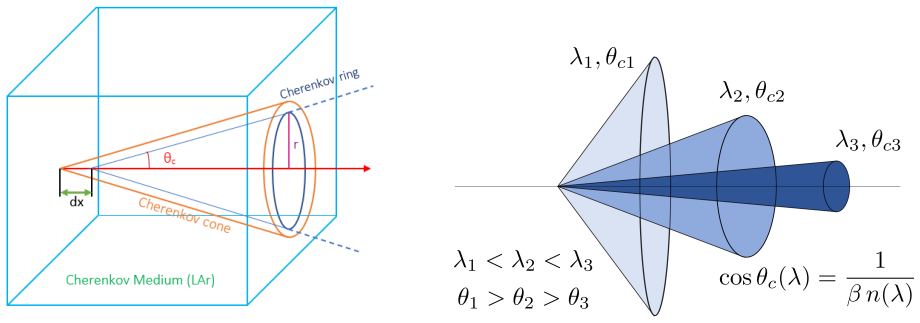
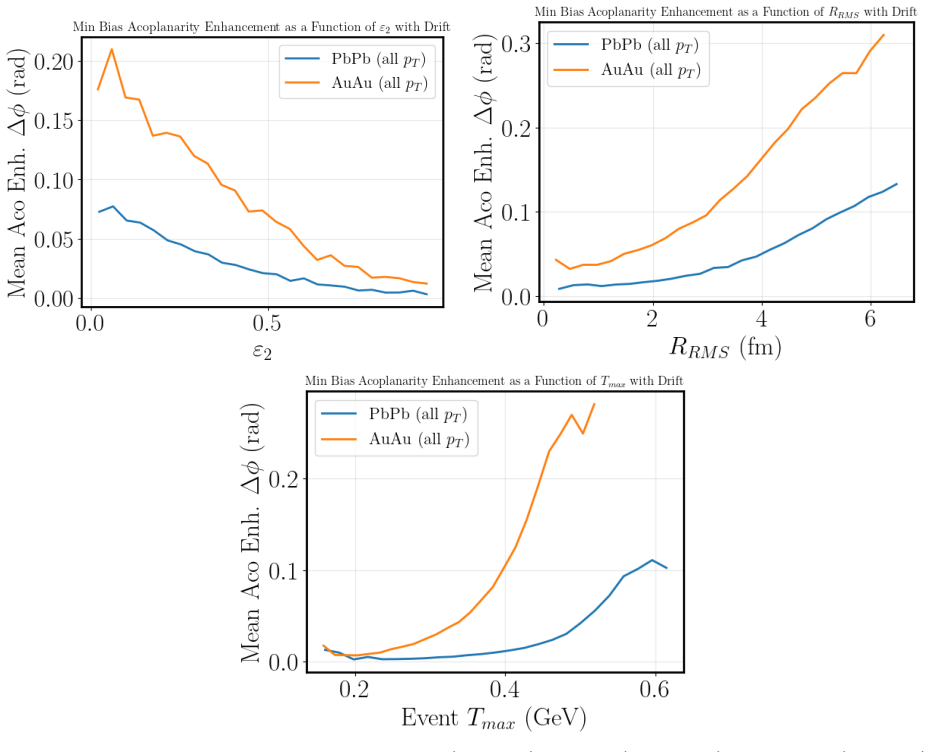
The dissertation establishes that a single framework spanning Cherenkov radiation in QED and jet drift in QCD lets hard probes resolve fundamental medium properties through their angular and kinematic responses. The refractive-index fit for liquid argon shows that Cherenkov light is highly sensitive to the peak value of n(lambda) and supplies an excess signal useful for particle identification. In heavy-ion collisions the jet-drift observable separates medium-size, temperature, and geometry effects from ordinary energy loss in v2 and Delta-phi distributions.
What carries the argument
The angular distribution of Cherenkov radiation, made sensitive to the refractive-index peak by the dispersive fit, and the jet-drift deflection generated inside the Anisotropic Parton Evolution Monte Carlo simulation.
If this is right
- The refractive-index fit supplies an improved input for Cherenkov-based particle identification in DUNE and CCM.
- Jet-drift observables can be used to disentangle medium geometry and flow effects from parton energy loss in heavy-ion data.
- The same angular-kinematic strategy can be applied across additional collision systems to map temperature and size dependence of the quark-gluon plasma.
- Precision angular measurements become a standard tomographic tool for both electromagnetic and strong media.
Where Pith is reading between the lines
- If the Cherenkov excess is confirmed, liquid-argon detectors could achieve higher PID purity at lower energies than currently projected.
- Jet-drift measurements could be combined with existing energy-loss data to place tighter constraints on the shear viscosity of the quark-gluon plasma.
- The framework suggests that analogous deflection signatures might appear in other flowing media, such as strongly coupled plasmas or even non-relativistic fluids, provided a suitable hard probe exists.
Load-bearing premise
The Anisotropic Parton Evolution Monte Carlo accurately reproduces jet-drift systematics without hidden biases arising from medium geometry, temperature parametrization, or parton-evolution details.
What would settle it
A null result in which measured Cherenkov angular bins in liquid argon show no excess over scintillation or in which elliptic flow and acoplanarity data from PbPb, AuAu, and UU collisions display no distinct jet-drift patterns beyond standard energy-loss models would falsify the central claim.
Figures






read the original abstract
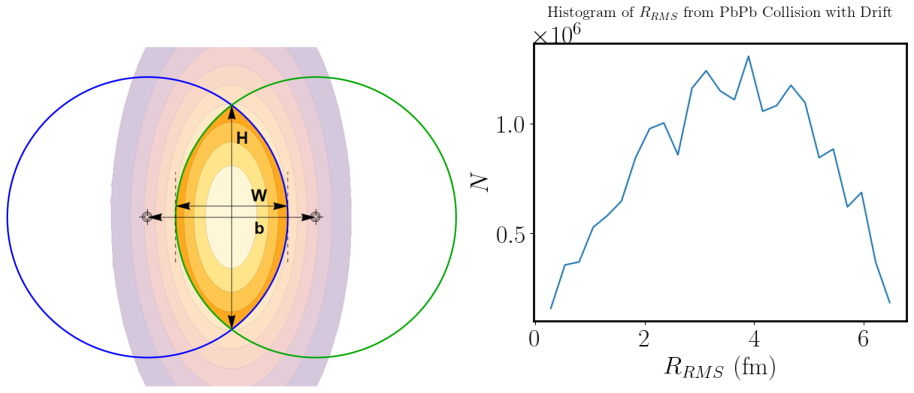
This dissertation presents a unified framework for medium characterization with hard probes spanning from Cherenkov light in quantum electrodynamics (QED) to jet drift in quantum chromodynamics (QCD). We first develop a dispersive fit to the refractive index $n(\lambda)$ of liquid argon (LAr) by incorporating anomalous dispersion at the 106.6 nm resonance for the first time. We show that the angular distribution of Cherenkov radiation is highly sensitive to the peak of the refractive index and contributes a significant excess over isotropic scintillation in certain angular bins. This work is important for precision Particle Identification (PID) for experiments like DUNE and CCM. Transitioning to high-energy nuclear collisions, we utilize ``jet drift'' -- the flow-induced deflection of partons -- as a tomographic probe of the Quark-Gluon Plasma (QGP). Using the Anisotropic Parton Evolution (APE) Monte Carlo simulation across various collision systems (PbPb, AuAu, and UU), we disentangle how the jet modification depends on medium size, temperature, and geometry. We show that jet drift exhibits distinct systematics in observables like the elliptic flow ($v_2$) and dihadron acoplanarity ($\Delta\phi$), which helps disentangle it from conventional energy loss. Together, these studies demonstrate how the angular and kinematic signatures of hard probes revolutionize our ability to resolve the fundamental properties of matter.
Editorial analysis
A structured set of objections, weighed in public.
Referee Report
Summary. The dissertation presents a unified framework for medium characterization with hard probes, from QED Cherenkov radiation in liquid argon to QCD jet drift in the QGP. The QED section develops a dispersive fit to n(λ) incorporating anomalous dispersion at the 106.6 nm resonance and demonstrates angular sensitivity of Cherenkov light to the refractive-index peak, with relevance to PID in DUNE and CCM. The QCD section employs the APE Monte Carlo across PbPb, AuAu, and UU systems to argue that jet drift produces distinct systematics in v2 and dihadron acoplanarity (Δφ) that disentangle it from conventional energy loss, thereby providing tomographic access to medium size, temperature, and geometry.
Significance. If the central claims hold, the QED component supplies a concrete improvement for scintillation-Cherenkov separation in neutrino detectors, while the QCD component offers a new class of flow-sensitive jet observables for QGP tomography. The work is notable for attempting a cross-domain unification and for using multiple collision systems, but the significance is tempered by the absence of demonstrated robustness in the Monte Carlo results.
major comments (1)
- [QCD results section (APE Monte Carlo analysis)] QCD results section (APE Monte Carlo analysis): the assertion that jet drift produces distinct systematics in v2 and Δφ that disentangle it from energy loss is load-bearing for the tomographic claim, yet the manuscript reports no systematic variations of medium geometry, initial temperature distributions, or boost-invariance assumptions inside APE. Without these checks the observed signatures could be artifacts of the default parametrization rather than general features.
minor comments (1)
- [Abstract] Abstract: the phrasing 'we disentangle how the jet modification depends on medium size, temperature, and geometry' should be clarified to indicate whether this dependence is extracted from explicit parameter scans or inferred from the default runs.
Simulated Author's Rebuttal
We thank the referee for the careful reading and constructive comments on our manuscript arXiv:2605.04393. We address the major comment on the QCD Monte Carlo analysis below and outline the changes we will implement.
read point-by-point responses
-
Referee: [QCD results section (APE Monte Carlo analysis)] QCD results section (APE Monte Carlo analysis): the assertion that jet drift produces distinct systematics in v2 and Δφ that disentangle it from energy loss is load-bearing for the tomographic claim, yet the manuscript reports no systematic variations of medium geometry, initial temperature distributions, or boost-invariance assumptions inside APE. Without these checks the observed signatures could be artifacts of the default parametrization rather than general features.
Authors: We agree that explicit systematic variations are required to substantiate the claim that the observed effects in v2 and Δφ are general rather than artifacts of the default APE setup. The current results rely on the default parametrization across PbPb, AuAu, and UU systems, which already sample different geometries and sizes, but do not include dedicated scans. In the revised manuscript we will add new Monte Carlo runs varying the initial geometry (e.g., eccentricity profiles), temperature distributions, and, where computationally feasible, relaxing boost invariance. These additions will directly test the robustness of the jet-drift signatures and strengthen the tomographic interpretation. revision: yes
Circularity Check
APE Monte Carlo jet drift signatures reduce to tuned simulation inputs
specific steps
-
fitted input called prediction
[Abstract]
"Using the Anisotropic Parton Evolution (APE) Monte Carlo simulation across various collision systems (PbPb, AuAu, and UU), we disentangle how the jet modification depends on medium size, temperature, and geometry. We show that jet drift exhibits distinct systematics in observables like the elliptic flow (v2) and dihadron acoplanarity (Δφ), which helps disentangle it from conventional energy loss."
Jet drift observables v2 and Δφ are generated inside the APE simulation whose parameters are tuned to medium properties; the claimed distinction from energy loss is therefore forced by the simulation inputs rather than emerging as an independent prediction.
full rationale
The QED Cherenkov analysis uses an independent dispersive fit to n(λ) with no evident circularity. The QCD half claims that jet drift produces distinct v2 and Δφ systematics disentangling it from energy loss, demonstrated via APE MC runs. Because the simulation generates those observables from parameters tuned to medium properties, the claimed distinctions are not shown to survive variations in geometry or temperature profile and therefore reduce to the simulation's construction rather than independent predictions. This matches the fitted-input-called-prediction pattern at score 6; no self-citation load-bearing or self-definitional steps are present.
Axiom & Free-Parameter Ledger
free parameters (1)
- Dispersive fit parameters for refractive index n(λ)
axioms (1)
- standard math Standard QED and QCD frameworks accurately describe Cherenkov radiation and parton evolution in a medium
Lean theorems connected to this paper
-
IndisputableMonolith/Cost/FunctionalEquation.leanwashburn_uniqueness_aczel unclear?
unclearRelation between the paper passage and the cited Recognition theorem.
Using the Anisotropic Parton Evolution (APE) Monte Carlo simulation across various collision systems (PbPb, AuAu, and UU), we disentangle how the jet modification depends on medium size, temperature, and geometry. We show that jet drift exhibits distinct systematics in observables like the elliptic flow (v2) and dihadron acoplanarity (Δφ)
-
IndisputableMonolith/Foundation/AlexanderDuality.leanalexander_duality_circle_linking unclear?
unclearRelation between the paper passage and the cited Recognition theorem.
develop a dispersive fit to the refractive index n(λ) of liquid argon (LAr) by incorporating anomalous dispersion at the 106.6 nm resonance
What do these tags mean?
- matches
- The paper's claim is directly supported by a theorem in the formal canon.
- supports
- The theorem supports part of the paper's argument, but the paper may add assumptions or extra steps.
- extends
- The paper goes beyond the formal theorem; the theorem is a base layer rather than the whole result.
- uses
- The paper appears to rely on the theorem as machinery.
- contradicts
- The paper's claim conflicts with a theorem or certificate in the canon.
- unclear
- Pith found a possible connection, but the passage is too broad, indirect, or ambiguous to say the theorem truly supports the claim.
Reference graph
Works this paper leans on
-
[1]
The scattering ofαandβparticles by matter and the structure of the atom
E. Rutherford,“The scattering ofαandβparticles by matter and the structure of the atom”, The London, Edinburgh, and Dublin Philosophical Magazine and Journal of Sci- ence21, 669 (1911)
work page 1911
-
[2]
L. D. Landau & I. Pomeranchuk,“Limits of applicability of the theory of bremsstrahlung electrons and pair production at high-energies”, Dokl. Akad. Nauk Ser. Fiz.92, 535 (1953)
work page 1953
-
[3]
Bremsstrahlung and pair production in condensed media at high- energies
A. B. Migdal,“Bremsstrahlung and pair production in condensed media at high- energies”, Phys. Rev.103, 1811 (1956)
work page 1956
-
[4]
Ab Initio Coupling of Jets to Collective Flow in the Opacity Expansion Approach
A. V. Sadofyev, M. D. Sievert & I. Vitev,“Ab Initio Coupling of Jets to Collective Flow in the Opacity Expansion Approach”,arXiv:2104.09513
-
[5]
Grand challenges in High Energy and Astroparticle Physics
J. Valle & J. Boer,“Grand challenges in High Energy and Astroparticle Physics”, Fron- tiers in Physics1, (2013)
work page 2013
-
[6]
New Solar Opacities, Abundances, Helioseis- mology, and Neutrino Fluxes
J. N. Bahcall, A. M. Serenelli & S. Basu,“New Solar Opacities, Abundances, Helioseis- mology, and Neutrino Fluxes”, The Astrophysical Journal621, L85 (2005)
work page 2005
-
[7]
L. M. Brown,“The idea of the neutrino”, Physics Today31, 23 (1978)
work page 1978
-
[8]
Versuch einer Theorie derβ-Strahlen. I
E. Fermi,“Versuch einer Theorie derβ-Strahlen. I”, Zeitschrift f¨ ur Ph88, 161 (1934)
work page 1934
- [9]
-
[10]
The Neutrino Hunters: The chase for the ghost particle and the secrets of the universe
R. Jayawardhana,“The Neutrino Hunters: The chase for the ghost particle and the secrets of the universe”, Oneworld Publications (2015)
work page 2015
-
[11]
Massive neutrinos and cosmology
J. Lesgourgues & S. Pastor,“Massive neutrinos and cosmology”, Physics Reports429, 307 (2006), https://www.sciencedirect.com/science/article/pii/S0370157306001359
work page 2006
-
[12]
Massive neutrinos and cosmology
J. Lesgourgues & S. Pastor,“Massive neutrinos and cosmology”, Phys. Rept.429, 307 (2006),astro-ph/0603494
work page internal anchor Pith review Pith/arXiv arXiv 2006
- [13]
-
[14]
Baryogenesis without grand unification
M. Fukugita & T. Yanagida,“Baryogenesis without grand unification”, Physics Letters B174, 45 (1986), https://www.sciencedirect.com/science/article/pii/0370269386911263
-
[15]
Akeret al.(KATRIN), Science388, adq9592 (2025), arXiv:2406.13516 [nucl-ex]
KATRIN Collaboration, M. Aker et al.,“Direct neutrino-mass measurement based on 259 days of KATRIN data”, Science388, adq9592 (2025),arXiv:2406.13516
-
[16]
The Quantum theory of fields. Vol. 1: Foundations
S. Weinberg,“The Quantum theory of fields. Vol. 1: Foundations”, Cambridge Univer- sity Press (2005)
work page 2005
-
[17]
Coherent effects of a weak neutral current
D. Z. Freedman,“Coherent effects of a weak neutral current”, Phys. Rev. D9, 1389 (1974),https://link.aps.org/doi/10.1103/PhysRevD.9.1389
-
[18]
The COHERENT Experiment at the Spallation Neutron Source
COHERENT Collaboration, D. Akimov et al.,“The COHERENT Experiment at the Spallation Neutron Source”, arXiv1509.08702, v1 (2016), physics.ins-det. 95
work page internal anchor Pith review Pith/arXiv arXiv 2016
-
[19]
Precise quasielastic neu- trino/nucleon cross-section
A. Strumia & F. Vissani,“Precise quasielastic neu- trino/nucleon cross-section”, Physics Letters B564, 42–54 (2003), http://dx.doi.org/10.1016/S0370-2693(03)00616-6
-
[20]
Quasi-elastic Neutrino Scattering—an Overview
J. T. Sobczyk, S. K. Singh, J. G. Morfin, M. Sakuda & K. D. Purohit,“Quasi-elastic Neutrino Scattering—an Overview”, in“AIP Conference Proceedings”, AIP (2011)
work page 2011
-
[21]
Neutrinos and their in- teractions with matter
M. Sajjad Athar, A. Fatima & S. K. Singh,“Neutrinos and their in- teractions with matter”, arXiv preprint2206.13792, 1 (2022), hep-ph, https://arxiv.org/abs/2206.13792
-
[22]
Neutrino-Nucleus Cross Sections for Oscillation Experiments
T. Katori & M. Martini,“Neutrino–nucleus cross sections for oscillation experiments”, J. Phys. G45, 013001 (2018),arXiv:1611.07770
work page internal anchor Pith review Pith/arXiv arXiv 2018
-
[23]
From eV to EeV: Neutrino cross sec- tions across energy scales
J. A. Formaggio & G. P. Zeller,“From eV to EeV: Neutrino cross sec- tions across energy scales”, Reviews of Modern Physics84, 1307–1341 (2012), http://dx.doi.org/10.1103/RevModPhys.84.1307
-
[24]
H. R. Rahman,“Calculating the Total Cherenkov Radiation Emitted by Low Energy Protons in Liquid Argon and Comparing with Argon Scintillation Light at 128 nm”, arXiv preprint2408.00817, v1 (2024),arXiv:2408.00817, https://arxiv.org/abs/2408.00817
-
[25]
Snowmass White Paper: Beyond the Standard Model Effects on Neutrino Flavor
C. A. Arg¨ uelles et al.,“Snowmass White Paper: Beyond the Standard Model Effects on Neutrino Flavor”, Eur. Phys. J. C83, 15 (2023), arXiv:2203.10811 [hep-ph]
-
[26]
A Search for Axion-like Particles at the COHERENT CAPTAIN-Mills Experiment
E. C. Dunton,“A Search for Axion-like Particles at the COHERENT CAPTAIN-Mills Experiment”, PhD Thesis, Columbia University2022, 10.7916/x9x1 (2022)
-
[27]
I. M. Shoemaker & E. Welch,“Sailing the CEνNS Seas of Non-Standard Neutrino Interactions with the COHERENT CAPTAIN-Mills Experiment”, arXiv2103.08401, v1 (2021), hep-ph
-
[28]
The Long-Baseline Neutrino Experiment: Ex- ploring Fundamental Symmetries of the Universe
LBNE Collaboration, C. Adams et al.,“The Long-Baseline Neutrino Experiment: Ex- ploring Fundamental Symmetries of the Universe”, in“Snowmass 2013: Workshop on Energy Frontier”
work page 2013
-
[29]
Visible Radiation Produced by Electrons Moving in a Medium with Velocities Exceeding that of Light
P. A. ˇCerenkov,“Visible Radiation Produced by Electrons Moving in a Medium with Velocities Exceeding that of Light”, Phys. Rev.52, 378 (1937), https://link.aps.org/doi/10.1103/PhysRev.52.378
- [30]
-
[31]
Refractive Indices of the Condensed Inert Gases
A. C. Sinnock & B. L. Smith,“Refractive Indices of the Condensed Inert Gases”, Phys. Rev.181, 1297 (1969)
work page 1969
-
[32]
A measurement of the group velocity of scintillation light in liquid argon
M. Babicz et al.,“A measurement of the group velocity of scintillation light in liquid argon”, JINST15, P09009 (2020),arXiv:2002.09346
-
[33]
Very High-Energy Collisions of Hadrons
R. P. Feynman,“Very High-Energy Collisions of Hadrons”, Phys. Rev. Lett.23, 1415 (1969)
work page 1969
-
[34]
The chiral and deconfinement aspects of the QCD transition
HotQCD Collaboration Collaboration, A. Bazavov et al.,“The chiral and deconfinement aspects of the QCD transition”, Physical Review D85, 054503 (2012). 96
work page 2012
-
[35]
Initial State Fluctuations and Final State Correlations in Relativistic Heavy-Ion Collisions
M. Luzum & H. Petersen,“Initial State Fluctuations and Final State Correlations in Relativistic Heavy-Ion Collisions”, J. Phys.G41, 063102 (2014),arXiv:1312.5503
work page internal anchor Pith review Pith/arXiv arXiv 2014
-
[36]
Hydrodynamic Description of the Quark-Gluon Plasma
U. Heinz & B. Schenke,“Hydrodynamic Description of the Quark-Gluon Plasma”, arXiv:2412.19393
-
[37]
Review of Jet Measurements in Heavy Ion Collisions
M. Connors, C. Nattrass, R. Reed & S. Salur,“Jet measurements in heavy ion physics”, Rev. Mod. Phys.90, 025005 (2018),arXiv:1705.01974
work page internal anchor Pith review Pith/arXiv arXiv 2018
-
[38]
L. D. Landau & I. J. Pomeranchuk,“The limits of applicability of the the- ory of bremsstrahlung by electrons and creation of pairs at high energies”, Dokl. Akad. Nauk Ser. Fiz.92, 535 (1953)
work page 1953
-
[39]
Bremsstrahlung and Pair Production in Condensed Media at High En- ergies
A. B. Migdal,“Bremsstrahlung and Pair Production in Condensed Media at High En- ergies”, Physical Review103, 1811 (1956)
work page 1956
-
[40]
Event-by-event hydrodynamics $+$ jet energy loss: A solution to the $R_{AA} \otimes v_2$ puzzle
J. Noronha-Hostler, B. Betz, J. Noronha & M. Gyulassy,“Event-by-event hydrodynamics +jet energy loss: A solution to theR AA ⊗v 2 puzzle”, Phys. Rev. Lett.116, 252301 (2016),arXiv:1602.03788
work page internal anchor Pith review Pith/arXiv arXiv 2016
-
[41]
D. Molnar & D. Sun,“High-pT suppression and elliptic flow from radiative energy loss with realistic bulk medium expansion”,arXiv:1305.1046
work page internal anchor Pith review Pith/arXiv arXiv
-
[42]
W. Zhao, W. Ke, W. Chen, T. Luo & X.-N. Wang,“From Hydrodynamics to Jet Quench- ing, Coalescence, and Hadron Cascade: A Coupled Approach to Solving the RAA⊗v2 Puzzle”, Phys. Rev. Lett.128, 022302 (2022),arXiv:2103.14657
-
[43]
Jet Quenching and Its Azimuthal Anisotropy in AA and possibly High Multiplicity pA and dA Collisions
X. Zhang & J. Liao,“Jet Quenching and Its Azimuthal Anisotropy in AA and possibly High Multiplicity pA and dA Collisions”,arXiv:1311.5463
work page internal anchor Pith review Pith/arXiv arXiv
-
[44]
Quenching of high-pT hadrons: Energy Loss vs Color Transparency
B. Z. Kopeliovich, J. Nemchik, I. K. Potashnikova & I. Schmidt,“Quenching of high- pT hadrons: Energy Loss vs Color Transparency”, Phys. Rev. C86, 054904 (2012), arXiv:1208.4951
work page internal anchor Pith review Pith/arXiv arXiv 2012
-
[45]
Jet quenching as a probe of the initial stages in heavy-ion collisions
C. Andres, N. Armesto, H. Niemi, R. Paatelainen & C. A. Salgado,“Jet quenching as a probe of the initial stages in heavy-ion collisions”, Phys. Lett. B803, 135318 (2020), arXiv:1902.03231
-
[46]
Overview of high-density QCD studies with the CMS experiment at the LHC
CMS Collaboration, A. Hayrapetyan et al.,“Overview of high-density QCD studies with the CMS experiment at the LHC”,arXiv:2405.10785
-
[47]
High-p_T Tomography of d+Au and Au+Au at SPS, RHIC, and LHC
I. Vitev & M. Gyulassy,“Highp T tomography ofd+ Au and Au+Au at SPS, RHIC, and LHC”, Phys. Rev. Lett.89, 252301 (2002),hep-ph/0209161
work page internal anchor Pith review Pith/arXiv arXiv 2002
-
[48]
Extracting jet transport coefficient from jet quenching at RHIC and LHC
JET Collaboration, K. M. Burke et al.,“Extracting the jet transport coefficient from jet quenching in high-energy heavy-ion collisions”, Phys. Rev. C90, 014909 (2014), arXiv:1312.5003
work page internal anchor Pith review Pith/arXiv arXiv 2014
-
[49]
Jet quenching and medium response in high-energy heavy-ion collisions: a review
S. Cao & X.-N. Wang,“Jet quenching and medium response in high-energy heavy-ion collisions: a review”, Rept. Prog. Phys.84, 024301 (2021),arXiv:2002.04028
-
[50]
Modification of jet shapes in PbPb collisions at sqrt(s[NN]) = 2.76 TeV
CMS Collaboration, S. Chatrchyan et al.,“Modification of Jet Shapes in PbPb Collisions at √sN N = 2.76TeV”, Phys. Lett. B730, 243 (2014),arXiv:1310.0878
work page internal anchor Pith review Pith/arXiv arXiv 2014
-
[51]
Measurement of Jet Nuclear Modification Factor in PbPb Collisions at √sN N = 5.02 TeV with CMS
CMS Collaboration, T. C. Collaboration,“Measurement of Jet Nuclear Modification Factor in PbPb Collisions at √sN N = 5.02 TeV with CMS”. 97
-
[52]
A. J. Larkoski, S. Marzani, G. Soyez & J. Thaler,“Soft Drop”, JHEP1405, 146 (2014), arXiv:1402.2657
work page internal anchor Pith review Pith/arXiv arXiv 2014
-
[53]
Probing the hardest branching of jets in heavy ion collisions
Y.-T. Chien & I. Vitev,“Probing the Hardest Branching within Jets in Heavy-Ion Col- lisions”, Phys. Rev. Lett.119, 112301 (2017),arXiv:1608.07283
work page internal anchor Pith review Pith/arXiv arXiv 2017
-
[54]
Jet Drift and Collective Flow in Heavy-Ion Collisions
L. Antiporda, J. Bahder, H. Rahman & M. D. Sievert,“Jet Drift and Collective Flow in Heavy-Ion Collisions”,arXiv:2110.03590
-
[55]
Signatures of jet drift in quark-gluon plasma hard-probe observables
J. Bahder, H. Rahman, M. D. Sievert & I. Vitev,“Signatures of jet drift in quark-gluon plasma hard-probe observables”, Phys. Rev. Res.8, L012016 (2026),arXiv:2412.05474
-
[56]
A comprehensive guide to the physics and usage of PYTHIA 8.3
C. Bierlich et al.,“A comprehensive guide to the physics and usage of PYTHIA 8.3”, arXiv:2203.11601
work page internal anchor Pith review Pith/arXiv arXiv
-
[57]
J. E. Bernhard, J. S. Moreland, S. A. Bass, J. Liu & U. Heinz,“Applying Bayesian parameter estimation to relativistic heavy-ion collisions: simultaneous characterization of the initial state and quark-gluon plasma medium”, Phys. Rev.C94, 024907 (2016), arXiv:1605.03954
work page internal anchor Pith review Pith/arXiv arXiv 2016
-
[58]
Microscopic Models for Ultrarelativistic Heavy Ion Collisions
S. A. Bass et al.,“Microscopic models for ultrarelativistic heavy ion collisions”, Prog. Part. Nucl. Phys.41, 255 (1998),nucl-th/9803035
work page internal anchor Pith review Pith/arXiv arXiv 1998
-
[59]
UrQMD-2.3 - Changes and Comparisons
H. Petersen, M. Bleicher, S. A. Bass & H. St¨ ocker,“UrQMD-2.3 - Changes and Com- parisons”,arXiv:0805.0567,https://arxiv.org/abs/0805.0567
work page internal anchor Pith review Pith/arXiv arXiv
-
[60]
C. Lippmann,“Particle identification”, Nuclear Instruments and Methods in Physics Re- search Section A: Accelerators, Spectrometers, Detectors and Associated Equipment 666, 148 (2012),https://doi.org/10.1016/j.nima.2011.03.009
-
[61]
Introduction to Electrodynamics
D. J. Griffiths,“Introduction to Electrodynamics”, 4 edition, Cambridge University Press (2017)
work page 2017
-
[63]
Particle Data Group Collaboration, R. L. Workman et al.,“Review of Particle Physics”, PTEP2022, 083C01 (2022)
work page 2022
-
[64]
Liquid Argon Properties (Tables and Calcula- tors)
Brookhaven National Laboratory,“Liquid Argon Properties (Tables and Calcula- tors)”, BNL Technical WebsiteOnline, Accessed 03 (2023),https://lar.bnl.gov/ properties/
work page 2023
-
[65]
J. F. Beacom & S. Palomares-Ruiz,“Neutral Current Atmospheric Neutrino Flux Measurement Using Neutrino Proton Elastic Scattering in Super-Kamiokande”, Phys. Rev. D67, 093001 (2003),hep-ph/0301060
work page internal anchor Pith review Pith/arXiv arXiv 2003
-
[66]
Properties of liquid argon scintillation light emission
E. Segreto,“Properties of liquid argon scintillation light emission”, Physical Review D 103, 043001 (2021),https://doi.org/10.1103/PhysRevD.103.043001
-
[67]
E. Grace & J. A. Nikkel,“Index of refraction, Rayleigh scattering length, and Sellmeier coefficients in solid and liquid argon and xenon”, Nucl. Instrum. Meth. A867, 204 (2017),arXiv:1502.04213. 98
work page internal anchor Pith review Pith/arXiv arXiv 2017
-
[68]
The Color Glass Condensate and High Energy Scattering in QCD
E. Iancu & R. Venugopalan,“The Color Glass Condensate and High Energy Scattering in QCD”,hep-ph/0303204, in“Quark-Gluon Plasma 3”, ed: R. C. Hwa & X.-N. Wang, World Scientific (2004), Singapore, p. 249-336
work page internal anchor Pith review Pith/arXiv arXiv 2004
-
[69]
F. Gelis, E. Iancu, J. Jalilian-Marian & R. Venugopalan,“The Color Glass Condensate”, Ann.Rev.Nucl.Part.Sci.60, 463 (2010),arXiv:1002.0333
work page internal anchor Pith review Pith/arXiv arXiv 2010
-
[70]
T. Lappi & L. McLerran,“Some features of the glasma”, Nucl. Phys.A772, 200 (2006), hep-ph/0602189
work page internal anchor Pith review Pith/arXiv arXiv 2006
-
[71]
QCD thermalization: Ab initio approaches and interdisciplinary connections
J. Berges, M. P. Heller, A. Mazeliauskas & R. Venugopalan,“QCD thermalization: Ab initio approaches and interdisciplinary connections”, Rev. Mod. Phys.93, 035003 (2021),arXiv:2005.12299
-
[72]
Hydrodynamics Beyond the Gradient Expansion: Resurgence and Resummation
M. P. Heller & M. Spalinski,“Hydrodynamics Beyond the Hydrodynamic Gradient Ex- pansion”, Phys. Rev. Lett.115, 072501 (2015),arXiv:1503.07514
work page internal anchor Pith review Pith/arXiv arXiv 2015
-
[73]
High $p_T$ Azimuthal Asymmetry in Non-central A+A at RHIC
M. Gyulassy, I. Vitev & X. N. Wang,“High p(T) azimuthal asymmetry in noncentral A+A at RHIC”, Phys. Rev. Lett.86, 2537 (2001),nucl-th/0012092
work page internal anchor Pith review Pith/arXiv arXiv 2001
-
[74]
Short path length corrections to Djordjevic-Gyulassy-Levai- Vitev energy loss
I. Kolbe & W. A. Horowitz,“Short path length corrections to Djordjevic-Gyulassy-Levai- Vitev energy loss”, Phys. Rev. C100, 024913 (2019),arXiv:1511.09313
-
[75]
Reaction Operator Approach to Non-Abelian Energy Loss
M. Gyulassy, P. Levai & I. Vitev,“Reaction operator approach to nonAbelian energy loss”, Nucl.Phys.B594, 371 (2001),nucl-th/0006010
work page internal anchor Pith review Pith/arXiv arXiv 2001
-
[76]
Energy loss of a heavy quark in the quark - gluon plasma
E. Braaten & M. H. Thoma,“Energy loss of a heavy quark in the quark - gluon plasma”, Phys. Rev. D44, R2625 (1991)
work page 1991
-
[77]
Multiple Collisions and Induced Gluon Bremsstrahlung in QCD
M. Gyulassy & X.-n. Wang,“Multiple collisions and induced gluon Bremsstrahlung in QCD”, Nucl. Phys.B420, 583 (1994),nucl-th/9306003
work page internal anchor Pith review Pith/arXiv arXiv 1994
-
[78]
A complete set of in-medium splitting functions to any order in opacity
M. D. Sievert, I. Vitev & B. Yoon,“A complete set of in-medium splitting functions to any order in opacity”, Phys. Lett. B795, 502 (2019),arXiv:1903.06170
work page internal anchor Pith review Pith/arXiv arXiv 2019
-
[79]
Correlation between mean transverse momen- tum and anisotropic flow in heavy-ion collisions
G. Giacalone, B. Schenke & D. Teaney,“Correlation between mean transverse momen- tum and anisotropic flow in heavy-ion collisions”, Phys. Rev. C103, 024910 (2021), arXiv:2006.15721
-
[80]
ALICE Collaboration,“Characterizing the initial conditions of heavy-ion collisions at the LHC with mean transverse momentum and anisotropic flow correlations”, Phys. Lett. B834, 137393 (2022)
work page 2022
-
[81]
S. Rao, M. Sievert & J. Noronha-Hostler,“Baseline predictions of elliptic flow and fluctuations at the RHIC Beam Energy Scan using response coefficients”, arXiv:1910.03677
discussion (0)
Sign in with ORCID, Apple, or X to comment. Anyone can read and Pith papers without signing in.