Recognition: unknown
Anchored random clusters and SLE excursions
Pith reviewed 2026-05-08 17:30 UTC · model grok-4.3
The pith
Conformal field theory yields exact expressions for SLE passage probabilities and anchored percolation cluster densities.
A machine-rendered reading of the paper's core claim, the machinery that carries it, and where it could break.
Core claim
The paper establishes that observables for Schramm-Loewner Evolution in the upper half-plane, such as left-passage probabilities, Green's functions, densities of anchored critical percolation clusters, and densities of pivotal points between critical Fortuin-Kasteleyn clusters, can be recovered by solving differential equations that arise from bulk-boundary correlation functions involving degenerate boundary operators in conformal field theory.
What carries the argument
Bulk-boundary correlation functions involving degenerate boundary operators that obey differential equations derived from conformal symmetry.
If this is right
- Schramm's left-passage probability for an SLE curve passing to the left of a marked point is recovered as the solution to a first-order differential equation.
- The SLE Green's function, giving the density of points visited by the curve, follows directly from the same correlation-function setup.
- Generalized densities of anchored critical percolation clusters touching the boundary at two points match earlier results by Kleban, Simmons, and Ziff.
- New explicit formulas appear for the density of pivotal points that lie between distinct critical Fortuin-Kasteleyn clusters.
Where Pith is reading between the lines
- The same differential-equation technique could be adapted to compute crossing probabilities or arm exponents in domains with multiple boundary segments.
- Direct Monte Carlo sampling of large Fortuin-Kasteleyn configurations could test the new pivotal-point density formulas against the analytic expressions.
- The method suggests that other geometric questions about random interfaces can be turned into boundary-value problems solvable by standard conformal techniques.
- Extensions to the disk or to models with different central charges might follow by changing the operator content while keeping the correlation-function structure.
Load-bearing premise
The desired observables for SLE and percolation can be represented exactly as correlation functions of degenerate boundary operators whose differential equations yield the probabilities and densities.
What would settle it
If the explicit solution of the differential equation for the left-passage probability fails to match Schramm's known formula, or if numerical sampling of critical percolation configurations in the half-plane does not reproduce the derived cluster densities, the method would not hold.
Figures





read the original abstract
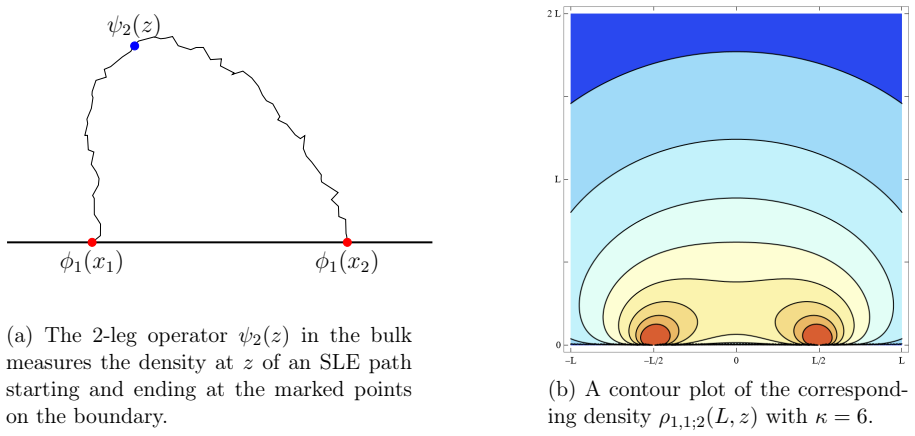
We provide a pedagogical review of CFT techniques to compute certain Schramm-Loewner Evolution (SLE) observables in the upper half-plane. The approach relies on the ability to express the observables as bulk-boundary correlation functions that involve degenerate boundary operators and, therefore, obey certain differential equations. In particular, we recover Schramm's left-passage probability for SLE, the SLE Green's functions, and the generalized densities of ``anchored'' critical percolation clusters first obtained by Kleban, Simmons, and Ziff. We also obtain new formulas corresponding to the densities of pivotal points between critical Fortuin-Kasteleyn (FK) clusters.
Editorial analysis
A structured set of objections, weighed in public.
Referee Report
Summary. The manuscript is a pedagogical review of CFT techniques for computing SLE observables in the upper half-plane. Observables are expressed as bulk-boundary correlation functions involving degenerate boundary operators; the resulting differential equations are solved to recover Schramm's left-passage probability, SLE Green's functions, the anchored critical percolation cluster densities of Kleban-Simmons-Ziff, and new formulas for the densities of pivotal points between critical FK clusters.
Significance. If the derivations hold, the work supplies a unified, accessible CFT framework for these observables. Recovery of multiple independently known results (Schramm, Kleban et al.) provides internal validation of the operator identifications and solution selections. The extension to FK pivotal densities is a concrete new contribution that may be useful for random-cluster models and conformal invariance studies.
minor comments (3)
- [Abstract] The abstract states that new formulas for FK pivotal densities are obtained but does not indicate the section or equation number where the explicit expressions appear; adding this cross-reference would improve readability.
- Notation for the degenerate boundary operators (e.g., the specific null-vector conditions) should be introduced once and used consistently; occasional redefinition risks confusion in the differential-equation steps.
- [References] The bibliography entries for Kleban, Simmons, and Ziff and for Schramm should be checked for completeness and uniform formatting.
Simulated Author's Rebuttal
We are grateful to the referee for their careful reading and for recommending acceptance of the manuscript. The referee's summary accurately reflects the content: a pedagogical review expressing SLE observables in the upper half-plane as bulk-boundary correlators with degenerate boundary operators, recovering Schramm's left-passage probability, SLE Green's functions, the anchored percolation densities of Kleban-Simmons-Ziff, and providing new formulas for pivotal-point densities in critical FK clusters. We appreciate the note that recovery of independently known results supplies internal validation and that the FK extension is a concrete new contribution.
Circularity Check
No significant circularity identified
full rationale
The derivation expresses SLE observables as bulk-boundary CFT correlators involving degenerate boundary operators whose null-vector conditions produce solvable differential equations. This recovers Schramm's left-passage probability, SLE Green's functions, and Kleban-Simmons-Ziff anchored percolation densities as explicit checks against independently known external results. The extension to new FK pivotal densities follows the same operator identification without introducing fitted parameters, self-definitional loops, or load-bearing self-citations that reduce the central claim to its inputs. The approach rests on standard CFT axioms and prior SLE literature that are externally verifiable, rendering the chain self-contained.
Axiom & Free-Parameter Ledger
axioms (2)
- domain assumption Bulk-boundary correlation functions involving degenerate operators satisfy differential equations that encode the desired SLE observables
- domain assumption SLE curves in the upper half-plane correspond to CFT correlation functions with appropriate boundary conditions
Reference graph
Works this paper leans on
-
[1]
Kleban, J
P. Kleban, J. J. H. Simmons, and R. M. Ziff. Anchored Critical Percolation Clusters and 2-D Electrostatics.Phys. Rev. Lett., 97:115702, 2006
2006
-
[2]
Fortuin and P.W
C.M. Fortuin and P.W. Kasteleyn. On the random-cluster model.Physica, 57(4):536 – 564, 1972
1972
-
[3]
Scaling limits of loop-erased random walks and uniform spanning trees, 1999
Oded Schramm. Scaling limits of loop-erased random walks and uniform spanning trees, 1999
1999
-
[4]
A. A. Belavin, Alexander M. Polyakov, and A. B. Zamolodchikov. Infinite Conformal Symmetry in Two-Dimensional Quantum Field Theory.Nucl. Phys., B241:333–380,
-
[5]
Critical percolation in finite geometries.Journal of Physics A: Mathe- matical and General, 25(4):L201–L206, February 1992
J L Cardy. Critical percolation in finite geometries.Journal of Physics A: Mathe- matical and General, 25(4):L201–L206, February 1992
1992
-
[6]
Critical percolation in the plane: conformal invariance, cardy’s formula, scaling limits.Comptes Rendus de l’Académie des Sciences - Series I - Mathematics, 333(3):239–244, 2001
Stanislav Smirnov. Critical percolation in the plane: conformal invariance, cardy’s formula, scaling limits.Comptes Rendus de l’Académie des Sciences - Series I - Mathematics, 333(3):239–244, 2001
2001
-
[7]
Conformal invariance in random cluster models
Stanislav Smirnov. Conformal invariance in random cluster models. i. holomorphic fermions in the ising model, 2007. 30
2007
-
[8]
Universality in the 2d ising model and con- formal invariance of fermionic observables.Inventiones mathematicae, 189(3):515– 580, 2012
Dmitry Chelkak and Stanislav Smirnov. Universality in the 2d ising model and con- formal invariance of fermionic observables.Inventiones mathematicae, 189(3):515– 580, 2012
2012
-
[9]
On the denisty of 2d critical percolation gaskets and anchored clusters.Letters in Mathematical Physics, 114(2):1–10, April 2024
Federico Camia. On the denisty of 2d critical percolation gaskets and anchored clusters.Letters in Mathematical Physics, 114(2):1–10, April 2024
2024
-
[10]
Path-crossing expo- nents and the external perimeter in 2d percolation.Phys
Michael Aizenman, Bertrand Duplantier, and Amnon Aharony. Path-crossing expo- nents and the external perimeter in 2d percolation.Phys. Rev. Lett., 83:1359–1362, Aug 1999
1999
-
[11]
Almost All Words Are Seen In Critical Site Percolation On The Triangular Lattice.Electronic Journal of Probabil- ity, 3(none):1 – 75, 1998
Harry Kesten, Vladas Sidoravicius, and Yu Zhang. Almost All Words Are Seen In Critical Site Percolation On The Triangular Lattice.Electronic Journal of Probabil- ity, 3(none):1 – 75, 1998
1998
-
[12]
Crossing probabilities in topological rectangles for the critical planar FK-Ising model.Electronic Journal of Probability, 21(none):1 – 28, 2016
Dmitry Chelkak, Hugo Duminil-Copin, and Clément Hongler. Crossing probabilities in topological rectangles for the critical planar FK-Ising model.Electronic Journal of Probability, 21(none):1 – 28, 2016
2016
-
[13]
Planar random-cluster model: fractal properties of the critical phase.Probability Theory and Related Fields, 181(1?3):401–449, June 2021
Hugo Duminil-Copin, Ioan Manolescu, and Vincent Tassion. Planar random-cluster model: fractal properties of the critical phase.Probability Theory and Related Fields, 181(1?3):401–449, June 2021
2021
-
[14]
Exact critical point and critical exponents ofO(n)models in two dimensions.Phys
Bernard Nienhuis. Exact critical point and critical exponents ofO(n)models in two dimensions.Phys. Rev. Lett., 49:1062–1065, Oct 1982
1982
-
[15]
Equivalence of the potts model or whitney polynomialwithanice-typemodel.Journal of Physics A: Mathematical and General, 9(3):397, mar 1976
R J Baxter, S B Kelland, and F Y Wu. Equivalence of the potts model or whitney polynomialwithanice-typemodel.Journal of Physics A: Mathematical and General, 9(3):397, mar 1976
1976
-
[16]
Relations between the coulomb gas picture and conformal invariance of two-dimensional critical models
Philippe Di Francesco, Hubert Saleur, and Jean-Bernard Zuber. Relations between the coulomb gas picture and conformal invariance of two-dimensional critical models. Journal of statistical physics, 49(1-2):57–79, 1987
1987
-
[17]
Benoît Laslier and Eyal Lubetzky. Tilted solid-on-solid is liquid: scaling limit of sos with a potential on a slope.arXiv preprint arXiv:2409.08745, 2024
-
[18]
Federico Camia and Charles M. Newman. Critical percolation exploration path and sle(6): a proof of convergence, 2006
2006
-
[19]
Convergence of Ising interfaces to Schramm’s SLE curves
Dmitry Chelkak, Hugo Duminil-Copin, Clément Hongler, Antti Kemppainen, and Stanislav Smirnov. Convergence of Ising interfaces to Schramm’s SLE curves. Comptes Rendus. Mathématique, 352(2):157–161, 2014
2014
-
[20]
Monte carlo tests of stochastic loewner evolution predictions for the 2d self-avoiding walk.Phys
Tom Kennedy. Monte carlo tests of stochastic loewner evolution predictions for the 2d self-avoiding walk.Phys. Rev. Lett., 88:130601, Mar 2002
2002
-
[21]
Lawler, Oded Schramm, and Wendelin Werner
Gregory F. Lawler, Oded Schramm, and Wendelin Werner. On the scaling limit of planar self-avoiding walk, 2002
2002
-
[22]
Critical exponents for two-dimensional percolation.Mathematical Research Letters, 8(6):729 – 744, 2001
Stanislav Smirnov and Wendelin Werner. Critical exponents for two-dimensional percolation.Mathematical Research Letters, 8(6):729 – 744, 2001. 31
2001
-
[23]
Euler integrals for commuting sles.Journal of statistical physics, 123(6):1183–1218, 2006
Julien Dubédat. Euler integrals for commuting sles.Journal of statistical physics, 123(6):1183–1218, 2006
2006
-
[24]
Conformal invariance of spin correlations in the planar Ising model.Ann
Dmitry Chelkak, Clément Hongler, and Konstantin Izyurov. Conformal invariance of spin correlations in the planar Ising model.Ann. Math. (2), 181(3):1087–1138, 2015
2015
-
[25]
Federico Camia, Christoph Garban, and Charles M. Newman. Planar ising magneti- zation i. uniqueness of the critical scaling limit.Annals of Probability, 43(2):528–571, 2015
2015
-
[26]
Federico Camia, Jianping Jiang, and Charles M. Newman. Exponential decay for the near-critical scaling limit of the planar ising model.Communications on Pure and Applied Mathematics, 73:1371–1405, 2020
2020
-
[27]
A guide to stochastic löwner evolution and its applications.Journal of statistical physics, 115(5):1149–1229, 2004
Wouter Kager and Bernard Nienhuis. A guide to stochastic löwner evolution and its applications.Journal of statistical physics, 115(5):1149–1229, 2004
2004
-
[28]
Amer- ican Mathematical Soc., 2008
Gregory F Lawler.Conformally invariant processes in the plane, volume 114. Amer- ican Mathematical Soc., 2008
2008
-
[29]
Random planar curves and schramm-loewner evolutions
Wendelin Werner. Random planar curves and schramm-loewner evolutions. InLec- tures on Probability Theory and Statistics: Ecole D’Eté de Probabilités de Saint-Flour XXXII-2002. Springer, 2004
2002
-
[30]
Sle for theoretical physicists.Annals of Physics, 318(1):81–118, July 2005
John Cardy. Sle for theoretical physicists.Annals of Physics, 318(1):81–118, July 2005
2005
-
[31]
Sleκ growth processes and conformal field theories
Michel Bauer and Denis Bernard. Sleκ growth processes and conformal field theories. Physics Letters B, 543(1?2):135–138, September 2002
2002
-
[32]
2d growth processes: Sle and loewner chains
Michel Bauer and Denis Bernard. 2d growth processes: Sle and loewner chains. Physics Reports, 432(3?4):115–221, October 2006
2006
-
[33]
Lattice coulomb gas representations of two-dimensional problems
L P Kadanoff. Lattice coulomb gas representations of two-dimensional problems. Journal of Physics A: Mathematical and General, 11(7):1399, jul 1978
1978
-
[34]
Critical behavior of two-dimensional spin models and charge asymmetry in the coulomb gas.Journal of Statistical Physics, 34(5):731–761, 1984
Bernard Nienhuis. Critical behavior of two-dimensional spin models and charge asymmetry in the coulomb gas.Journal of Statistical Physics, 34(5):731–761, 1984
1984
-
[35]
Di Francesco, P
P. Di Francesco, P. Mathieu, and D. Sénéchal.Conformal field theory. Springer- Verlag New York, Inc., 1997
1997
-
[36]
The o(n) model on the annulus.Journal of Statistical Physics, 125(1):1– 21, August 2006
John Cardy. The o(n) model on the annulus.Journal of Statistical Physics, 125(1):1– 21, August 2006
2006
-
[37]
Springer Netherlands, Dordrecht, 2009
Jesper Lykke Jacobsen.Conformal Field Theory Applied to Loop Models, pages 347–424. Springer Netherlands, Dordrecht, 2009
2009
-
[38]
Two-dimensional fractal geometry, critical phenomena and conformal invariance.Physics Reports, 184(2):229–257, 1989
Bertrand Duplantier. Two-dimensional fractal geometry, critical phenomena and conformal invariance.Physics Reports, 184(2):229–257, 1989
1989
-
[39]
The dimension of the SLE curves.The Annals of Probability, 36(4):1421 – 1452, 2008
Vincent Beffara. The dimension of the SLE curves.The Annals of Probability, 36(4):1421 – 1452, 2008. 32
2008
-
[40]
From combinatorial maps to correlation functions in loop models.SciPost Phys., 15(4):147, 2023
Linnea Grans-Samuelsson, Jesper Lykke Jacobsen, Rongvoram Nivesvivat, Sylvain Ribault, and Hubert Saleur. From combinatorial maps to correlation functions in loop models.SciPost Phys., 15(4):147, 2023
2023
-
[41]
John L. Cardy. Conformal Invariance and Surface Critical Behavior.Nucl. Phys. B, 240:514–532, 1984
1984
-
[42]
Explicit expressions for virasoro singular vectors, 2024
Gérard M T Watts. Explicit expressions for virasoro singular vectors, 2024
2024
-
[43]
Logarithmic M(2,p) minimal models, their loga- rithmic couplings, and duality.Nucl
Pierre Mathieu and David Ridout. Logarithmic M(2,p) minimal models, their loga- rithmic couplings, and duality.Nucl. Phys. B, 801:268–295, 2008
2008
-
[44]
Logarithmic correlation functions in 2d critical per- colation.Journal of High Energy Physics, 2024(103), August 2024
Federico Camia and Yu Feng. Logarithmic correlation functions in 2d critical per- colation.Journal of High Energy Physics, 2024(103), August 2024
2024
-
[45]
Conformally covariant probabilities, operator prod- uct expansions, ans logarithmic correlations in two-dimensional critical percolation, 2024
Federico Camia and Yu Feng. Conformally covariant probabilities, operator prod- uct expansions, ans logarithmic correlations in two-dimensional critical percolation, 2024
2024
-
[46]
V. Gurarie. Logarithmic operators in conformal field theory.Nuclear Physics B, 410(3):535–549, 1993
1993
-
[47]
Logarithmic observ- ables in critical percolation.Journal of Statistical Mechanics: Theory and Experi- ment, 2012(07):L07001, jul 2012
Romain Vasseur, Jesper Lykke Jacobsen, and Hubert Saleur. Logarithmic observ- ables in critical percolation.Journal of Statistical Mechanics: Theory and Experi- ment, 2012(07):L07001, jul 2012
2012
-
[48]
Boundary liouville field theory i
V Fateev, Alexander Zamolodchikov, and Al Zamolodchikov. Boundary liouville field theory i. boundary state and boundary two-point function.arXiv preprint hep- th/0001012, 2000
-
[49]
Dotsenko and V.A
Vl.S. Dotsenko and V.A. Fateev. Conformal algebra and multipoint correlation functions in 2d statistical models.Nuclear Physics B, 240(3):312–348, 1984
1984
-
[50]
Conformalsymmetryintwodimensions: anexplicitrecurrence formula for the conformal partial wave amplitude.Commun.Math.Phys., 96:419–422, 1984
Al.B.Zamolodchikov. Conformalsymmetryintwodimensions: anexplicitrecurrence formula for the conformal partial wave amplitude.Commun.Math.Phys., 96:419–422, 1984
1984
-
[51]
Analytic conformal bootstrap and virasoro primary fields in the ashkin-teller model.SciPost Physics, 11(5), November 2021
Nikita Nemkov and Sylvain Ribault. Analytic conformal bootstrap and virasoro primary fields in the ashkin-teller model.SciPost Physics, 11(5), November 2021
2021
-
[52]
The scaling limit of two cluster boundaries in critical lattice models.Journal of Statistical Mechanics: Theory and Experiment, 2005(12):P12009–P12009, December 2005
Adam Gamsa and John Cardy. The scaling limit of two cluster boundaries in critical lattice models.Journal of Statistical Mechanics: Theory and Experiment, 2005(12):P12009–P12009, December 2005
2005
-
[53]
Correlation functions of twist operators applied to single self-avoiding loops.Journal of Physics A: Mathematical and General, 39(41):12983–13003, 2006
Adam Gamsa and John Cardy. Correlation functions of twist operators applied to single self-avoiding loops.Journal of Physics A: Mathematical and General, 39(41):12983–13003, 2006
2006
-
[54]
Lawler and Mohammad A
Gregory F. Lawler and Mohammad A. Rezaei. Minkowski content and natural pa- rameterization for the schramm-loewner evolution.The Annals of Probability, 43(3), May 2015. 33
2015
-
[55]
Lewellen
David C. Lewellen. Sewing constraints for conformal field theories on surfaces with boundaries.Nucl. Phys., B372:654–682, 1992
1992
-
[56]
Jacob J. H. Simmons, Peter Kleban, and Robert M. Ziff. Exact factorization of correlation functions in two-dimensional critical percolation.Physical Review E, 76(4), October 2007
2007
-
[57]
A Percolation Formula.Electronic Communications in Probability, 6(none):115 – 120, 2001
Oded Schramm. A Percolation Formula.Electronic Communications in Probability, 6(none):115 – 120, 2001
2001
-
[58]
Logarithmic CFT at generic central charge: from Liouville theory to theQ-state Potts model.SciPost Phys., 10(1):021, 2021
Rongvoram Nivesvivat and Sylvain Ribault. Logarithmic CFT at generic central charge: from Liouville theory to theQ-state Potts model.SciPost Phys., 10(1):021, 2021
2021
-
[59]
Read and H
N. Read and H. Saleur. Exact spectra of conformal supersymmetric nonlinear sigma models in two-dimensions.Nucl. Phys., B613:409, 2001
2001
-
[60]
Logarithmic conformal field theories as limits of ordinary CFTs and some physical applications.J
John Cardy. Logarithmic conformal field theories as limits of ordinary CFTs and some physical applications.J. Phys., A46:494001, 2013
2013
-
[61]
Logarithmic minimal models.Journal of Statistical Mechanics: Theory and Experiment, 2006(11):P11017, nov 2006
Paul A Pearce, Jørgen Rasmussen, and Jean-Bernard Zuber. Logarithmic minimal models.Journal of Statistical Mechanics: Theory and Experiment, 2006(11):P11017, nov 2006. 34
2006
discussion (0)
Sign in with ORCID, Apple, or X to comment. Anyone can read and Pith papers without signing in.