Recognition: 3 theorem links
· Lean TheoremSpinTune: Improving the Reliability of Quantum Sensor Networks for Practical Quantum-Classical Utility
Pith reviewed 2026-05-08 18:25 UTC · model grok-4.3
The pith
SpinTune uses reinforcement learning to discover adaptive dynamical decoupling sequences that preserve coherence longer than standard methods in simulated quantum sensor environments.
A machine-rendered reading of the paper's core claim, the machinery that carries it, and where it could break.
Core claim
SpinTune is a reinforcement learning software approach that autonomously discovers adaptive, piecewise dynamical decoupling sequences tailored to specific environments, and using a simulation model of a Carbon-13 spin bath it significantly outperforms standard DD sequences in preserving coherence.
What carries the argument
SpinTune, a reinforcement learning algorithm for discovering adaptive piecewise dynamical decoupling sequences tailored to noise environments.
If this is right
- Quantum sensors can achieve greater reliability by using environment-specific pulse sequences.
- Hybrid quantum-classical computing benefits from extended coherence in sensing components.
- Reinforcement learning can automate the optimization of dynamical decoupling for varied conditions.
- Practical applications in machine learning and cyber-physical systems become more feasible.
Where Pith is reading between the lines
- The method could be tested on real quantum hardware to confirm simulation results.
- Similar reinforcement learning techniques might improve noise resilience in quantum computing.
- Integration with sensor networks could allow for distributed adaptive control.
Load-bearing premise
The simulation model of a Carbon-13 spin bath accurately represents the noise and decoherence processes present in real quantum sensor hardware and environments.
What would settle it
Implementation and testing of SpinTune sequences on physical quantum sensors to measure if coherence times exceed those of standard sequences under actual environmental noise.
Figures


read the original abstract
Emerging quantum sensors are increasingly envisioned as components of hybrid quantum-classical high-performance computing, enabling new capabilities in scientific, cyber-physical, and machine-learning pipelines. However, their practical utility is limited by environmental decoherence, which degrades sensing reliability. While dynamical decoupling (DD) pulse sequences can mitigate this, standard methods are often suboptimal in the presence of realistic noise. We present SpinTune, a reinforcement learning software approach that autonomously discovers adaptive, piecewise DD sequences tailored to specific environments. Using a simulation model of a Carbon-13 spin bath, we show that SpinTune significantly outperforms standard DD sequences in preserving coherence.
Editorial analysis
A structured set of objections, weighed in public.
Referee Report
Summary. The manuscript introduces SpinTune, a reinforcement learning approach to autonomously discover adaptive, piecewise dynamical decoupling (DD) pulse sequences tailored to specific noise environments in quantum sensors. Using a simulation model of a Carbon-13 spin bath, it claims that SpinTune significantly outperforms standard DD sequences in preserving coherence, with the aim of enabling more reliable quantum-classical hybrid systems.
Significance. If the simulation results prove robust and transferable, SpinTune could provide an automated, environment-specific optimization tool for DD sequences, addressing a practical bottleneck in quantum sensing applications. The RL-based discovery method represents a potentially useful contribution to adaptive control in noisy quantum systems, though its significance remains prospective given the simulation-only evaluation.
major comments (3)
- [Abstract] Abstract: The headline claim that SpinTune 'significantly outperforms standard DD sequences' is stated without any quantitative metrics (e.g., coherence time ratios, improvement factors, or error bars), training stability details, or statistical tests. This omission makes it impossible to assess whether the reported advantage is load-bearing or marginal for the central claim of practical utility.
- [Simulation results] Simulation results section: The evaluation is performed exclusively inside an idealized Carbon-13 spin bath model. No cross-validation against measured T2 times, filter functions, or pulse-error data from real quantum sensor hardware is presented, which directly undermines the transferability argument required for the stated goal of 'practical quantum-classical utility'.
- [Methods] Methods: The reward function, state representation, and convergence criteria for the RL agent are not specified with sufficient detail to allow reproduction or to evaluate whether the discovered sequences are genuinely adaptive rather than overfit to the simulation assumptions.
minor comments (2)
- [Abstract] The abstract mentions 'quantum sensor networks' while the described experiments appear to address single-sensor coherence; clarify whether and how the method extends to networked sensors.
- [Notation] Notation for the piecewise DD sequences and the RL policy parameterization should be defined explicitly in the main text rather than deferred to supplementary material.
Simulated Author's Rebuttal
Thank you for the referee's constructive comments. We address each major point below and indicate the revisions we will make to strengthen the manuscript.
read point-by-point responses
-
Referee: [Abstract] Abstract: The headline claim that SpinTune 'significantly outperforms standard DD sequences' is stated without any quantitative metrics (e.g., coherence time ratios, improvement factors, or error bars), training stability details, or statistical tests. This omission makes it impossible to assess whether the reported advantage is load-bearing or marginal for the central claim of practical utility.
Authors: We agree that the abstract would benefit from quantitative support. Although the results section already contains coherence time ratios, improvement factors with error bars from multiple independent runs, and training stability metrics, we will revise the abstract to include representative numerical values (e.g., average coherence extension factor and standard deviation) and a brief mention of statistical robustness to make the central claim immediately evaluable. revision: yes
-
Referee: [Simulation results] Simulation results section: The evaluation is performed exclusively inside an idealized Carbon-13 spin bath model. No cross-validation against measured T2 times, filter functions, or pulse-error data from real quantum sensor hardware is presented, which directly undermines the transferability argument required for the stated goal of 'practical quantum-classical utility'.
Authors: The manuscript presents a simulation study using a standard, literature-validated Carbon-13 bath model as a controlled demonstration of the RL method. We acknowledge that the lack of direct experimental cross-validation limits immediate claims of hardware transferability. In revision we will add an explicit Limitations and Outlook subsection that (i) compares simulated T2 values to published experimental benchmarks for the same model, (ii) discusses the idealized assumptions (perfect pulses, no control errors), and (iii) outlines concrete next steps for hardware validation. This will temper the practical-utility language while preserving the simulation-based contribution. revision: partial
-
Referee: [Methods] Methods: The reward function, state representation, and convergence criteria for the RL agent are not specified with sufficient detail to allow reproduction or to evaluate whether the discovered sequences are genuinely adaptive rather than overfit to the simulation assumptions.
Authors: We thank the referee for highlighting this gap. The revised Methods section will provide: the precise reward function (integrated coherence over the sensing interval), the state vector (estimated noise correlation function plus pulse history), convergence criteria (policy-gradient variance below threshold over consecutive episodes), full hyperparameter table, and training curves. We will also add an analysis showing that sequences adapt when bath parameters are varied, thereby addressing the overfitting concern and enabling reproduction. revision: yes
Circularity Check
No circularity: empirical RL optimization result on external simulation benchmark
full rationale
The paper introduces SpinTune as a reinforcement learning method that discovers adaptive DD sequences and evaluates them via direct comparison to standard sequences inside a Carbon-13 spin bath simulation model. No derivation chain, equation, or claim reduces to its own inputs by construction; the performance result is an independent empirical outcome generated by running the optimizer on the simulation and measuring coherence preservation. No self-citations, uniqueness theorems, or ansatzes are invoked as load-bearing steps in the abstract or described approach. The simulation serves as an external benchmark rather than a self-referential fit, rendering the central claim self-contained against that benchmark.
Axiom & Free-Parameter Ledger
axioms (1)
- domain assumption The simulation model of a Carbon-13 spin bath accurately captures realistic decoherence and noise for quantum sensors.
Lean theorems connected to this paper
-
IndisputableMonolith/Cost (Jcost), IndisputableMonolith/Foundation/LogicAsFunctionalEquationwashburn_uniqueness_aczel unclear?
unclearRelation between the paper passage and the cited Recognition theorem.
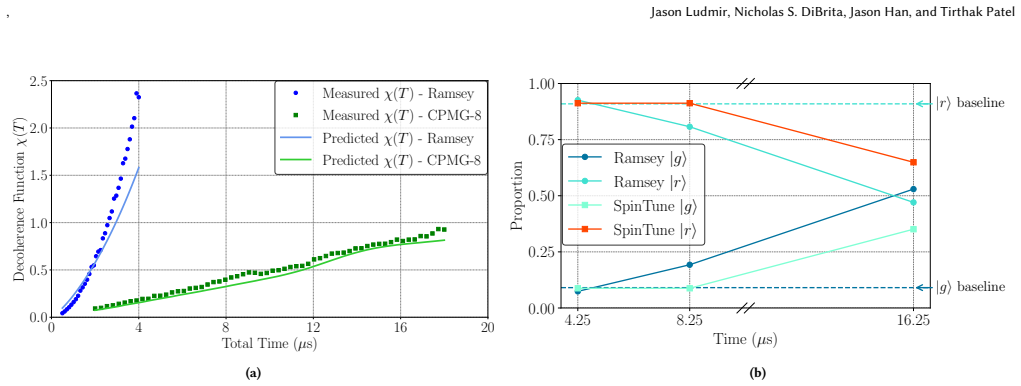
W(T) = exp(−χ(T)), χ(T) = (1/π)∫₀^∞ S(ω)/ω² · F(ω,T) dω; F(ω,T) = |Y(ω,T)|²
What do these tags mean?
- matches
- The paper's claim is directly supported by a theorem in the formal canon.
- supports
- The theorem supports part of the paper's argument, but the paper may add assumptions or extra steps.
- extends
- The paper goes beyond the formal theorem; the theorem is a base layer rather than the whole result.
- uses
- The paper appears to rely on the theorem as machinery.
- contradicts
- The paper's claim conflicts with a theorem or certificate in the canon.
- unclear
- Pith found a possible connection, but the passage is too broad, indirect, or ambiguous to say the theorem truly supports the claim.
Reference graph
Works this paper leans on
-
[1]
Bloqade.jl: Package for the quantum computation and quantum simulation based on the neutral-atom architecture
2023. Bloqade.jl: Package for the quantum computation and quantum simulation based on the neutral-atom architecture. https://github.com/QuEraComputing/ Bloqade.jl/
2023
-
[2]
McGuinness, Fedor Jelezko, Alex Retzker, and Zohar Ringel
Nati Aharon, Amit Rotem, Liam P. McGuinness, Fedor Jelezko, Alex Retzker, and Zohar Ringel. 2019. NV Center Based Nano-NMR Enhanced by Deep Learning. Scientific Reports9, 1 (Nov. 2019). https://doi.org/10.1038/s41598-019-54119-9
-
[3]
Álvarez and Dieter Suter
Gonzalo A. Álvarez and Dieter Suter. 2011. Measuring the Spectrum of Colored Noise by Dynamical Decoupling.Phys. Rev. Lett.107 (Nov 2011), 230501. Issue
2011
-
[4]
https://doi.org/10.1103/PhysRevLett.107.230501
-
[5]
Gopalakrishnan Balasubramanian, Andrii Lazariev, Sri Ranjini Arumugam, and De wen Duan. 2014. Nitrogen-Vacancy Color Center in Diamond—Emerging Nanoscale Applications in Bioimaging and Biosensing.Current Opinion in Chemi- cal Biology20 (2014), 69–77. https://doi.org/10.1016/j.cbpa.2014.04.014 Molecular imaging
-
[6]
Gopalakrishnan Balasubramanian, Philipp Neumann, Daniel Twitchen, Matthew Markham, Roman Kolesov, Norikazu Mizuochi, Junichi Isoya, Jocelyn Achard, Johannes Beck, Julia Tissler, et al . 2009. Ultralong Spin Coherence Time in Isotopically Engineered Diamond.Nature materials8, 5 (2009), 383–387
2009
-
[7]
Nir Bar-Gill, Linh M Pham, Andrejs Jarmola, Dmitry Budker, and Ronald L Walsworth. 2013. Solid-State Electronic Spin Coherence Time Approaching One Second.Nature communications4, 1 (2013), 1743
2013
-
[8]
Erik Bauch, Swati Singh, Junghyun Lee, Connor A Hart, Jennifer M Schloss, Matthew J Turner, John F Barry, Linh M Pham, Nir Bar-Gill, Susanne F Yelin, et al. 2020. Decoherence of Ensembles of Nitrogen-Vacancy Centers in Diamond. Physical Review B102, 13 (2020), 134210
2020
-
[9]
Michael J Biercuk, Hermann Uys, Aaron P VanDevender, Nobuyasu Shiga, Wayne M Itano, and John J Bollinger. 2009. Optimized Dynamical Decou- pling in a Model Quantum Memory.Nature458, 7241 (2009), 996–1000. https: //doi.org/10.1038/nature07951
-
[10]
Marin Bukov, Alexandre G. R. Day, Dries Sels, Phillip Weinberg, Anatoli Polkovnikov, and Pankaj Mehta. 2018. Reinforcement Learning in Different Phases of Quantum Control.Phys. Rev. X8 (Sep 2018), 031086. Issue 3. https://doi.org/10.1103/PhysRevX.8.031086
-
[11]
Miao Cai and Keyu Xia. 2022. Optimizing Continuous Dynamical Decoupling with Machine Learning.Phys. Rev. A106 (Oct 2022), 042434. Issue 4. https: //doi.org/10.1103/PhysRevA.106.042434
-
[12]
Francesco Casola, Toeno van der Sar, and Amir Yacoby. 2018. Probing Con- densed Matter Physics with Magnetometry Based on Nitrogen-Vacancy Cen- tres in Diamond.Nature Reviews Materials3, 1 (04 Jan 2018), 17088. https: //doi.org/10.1038/natrevmats.2017.88
-
[13]
Israel Cohen, Yiteng Huang, Jingdong Chen, Jacob Benesty, Jacob Benesty, Jing- dong Chen, Yiteng Huang, and Israel Cohen. 2009. Pearson Correlation Coeffi- cient.Noise reduction in speech processing(2009), 1–4
2009
-
[14]
Crawford, Roman A
Scott E. Crawford, Roman A. Shugayev, Hari P. Paudel, Ping Lu, Madhava Syam- lal, Paul R. Ohodnicki, Benjamin Chorpening, Randall Gentry, and Yuhua Duan
-
[15]
Quantum Sensing for Energy Applications: Review and Perspective.Ad- vanced Quantum Technologies4, 8 (2021), 2100049. https://doi.org/10.1002/qute. 202100049
-
[16]
Łukasz Cywiński, Roman M Lutchyn, C P Nave, and S Das Sarma. 2008. How to Enhance Dephasing Time in Superconducting Qubits.Physical Review B77, 17 (2008), 174509. https://doi.org/10.1103/PhysRevB.77.174509
-
[17]
G. de Lange, Z. H. Wang, D. Ristè, V. V. Dobrovitski, and R. Hanson. 2010. Univer- sal Dynamical Decoupling of a Single Solid-State Spin from a Spin Bath.Science 330, 6000 (2010), 60–63. https://doi.org/10.1126/science.1192739
-
[18]
C. L. Degen, F. Reinhard, and P. Cappellaro. 2017. Quantum Sensing.Reviews of Modern Physics89, 3 (July 2017). https://doi.org/10.1103/revmodphys.89.035002
-
[19]
Marcus W Doherty, Neil B Manson, Paul Delaney, Fedor Jelezko, Jörg Wrachtrup, and Lloyd C L Hollenberg. 2013. The Nitrogen-Vacancy Colour Centre in Dia- mond.Physics Reports528, 1 (2013), 1–45. https://doi.org/10.1016/j.physrep.2013. 02.001
-
[20]
D. Farfurnik, A. Jarmola, L. M. Pham, Z. H. Wang, V. V. Dobrovitski, R. L. Walsworth, D. Budker, and N. Bar-Gill. 2015. Optimizing a Dynamical Decoupling Protocol for Solid-State Electronic Spin Ensembles in Diamond.Phys. Rev. B92 (Aug 2015), 060301. Issue 6. https://doi.org/10.1103/PhysRevB.92.060301
-
[21]
E L Hahn. 1950. Spin Echoes.Physical Review80, 4 (1950), 580–594. https: //doi.org/10.1103/PhysRev.80.580
-
[22]
L. T. Hall, C. D. Hill, J. H. Cole, and L. C. L. Hollenberg. 2010. Ultrasensitive Diamond Magnetometry Using Optimal Dynamic Decoupling.Phys. Rev. B82 (Jul 2010), 045208. Issue 4. https://doi.org/10.1103/PhysRevB.82.045208
-
[23]
Shuo Han, Xiangyu Ye, Xu Zhou, Zhaoxin Liu, Yuhang Guo, Mengqi Wang, Wentao Ji, Ya Wang, and Jiangfeng Du. 2025. Solid-State Spin Coherence Time Approaching the Physical Limit.Science Ad- vances11, 9 (2025), eadr9298. https://doi.org/10.1126/sciadv.adr9298 arXiv:https://www.science.org/doi/pdf/10.1126/sciadv.adr9298
-
[24]
Charles R. Harris, K. Jarrod Millman, Stéfan J. van der Walt, Ralf Gommers, Pauli Virtanen, David Cournapeau, Eric Wieser, Julian Taylor, Sebastian Berg, Nathaniel J. Smith, Robert Kern, Matti Picus, Stephan Hoyer, Marten H. van Kerkwijk, Matthew Brett, Allan Haldane, Jaime Fernández del Río, Mark Wiebe, Pearu Peterson, Pierre Gérard-Marchant, Kevin Shepp...
-
[25]
S. Hernández-Gómez, F. Poggiali, P. Cappellaro, and N. Fabbri. 2018. Noise Spectroscopy of a Quantum-Classical Environment with a Diamond Qubit.Phys. Rev. B98 (Dec 2018), 214307. Issue 21. https://doi.org/10.1103/PhysRevB.98.214307
-
[26]
Grinolds, Linh M
Sungkun Hong, Michael S. Grinolds, Linh M. Pham, David Le Sage, Lan Luan, Ronald L. Walsworth, and Amir Yacoby. 2013. Nanoscale Magnetometry with NV Centers in Diamond.MRS Bulletin38, 2 (2013), 155–161. https://doi.org/10. 1557/mrs.2013.23
2013
-
[27]
Takayuki Iwasaki, Wataru Naruki, Kosuke Tahara, Toshiharu Makino, Hi- romitsu Kato, Masahiko Ogura, Daisuke Takeuchi, Satoshi Yamasaki, and Mutsuko Hatano. 2017. Direct Nanoscale Sensing of the Internal Elec- tric Field in Operating Semiconductor Devices Using Single Electron Spins. ACS Nano11, 2 (2017), 1238–1245. https://doi.org/10.1021/acsnano.6b04460 ...
-
[28]
Yuechun Jiao, Jinlian Hu, Zitong Lan, Fusang Zhang, Jie Xiong, Jingxu Bai, Zhaoxin Chang, Yuqi Su, Beihong Jin, Daqing Zhang, Jianming Zhao, and Suotang Jia. 2024. Exploring quantum sensing for fine-grained liquid recog- nition. arXiv:2407.19656 [physics.app-ph] https://arxiv.org/abs/2407.19656
-
[29]
Eric Jones, Travis Oliphant, Pearu Peterson, et al . 2016. SciPy: Open Source Scientific Tools for Python, 2001
2016
-
[30]
Kaveh Khodjasteh and Lorenza Viola. 2009. Dynamically Error-Corrected Gates for Universal Quantum Computation.Physical Review Letters102, 8 (2009), 080501. https://doi.org/10.1103/PhysRevLett.102.080501
-
[31]
Aashutosh Kumar, Maxime Colson, Richard Al Hadi, and Bora Ung. 2024. Radio- Frequency Excitation for Quantum Sensing Based on Diamond NV Center Using Coplanar Waveguide Transmission Lines. In2024 IEEE International Conference on Quantum Computing and Engineering (QCE), Vol. 02. 600–601. https://doi.org/ 10.1109/QCE60285.2024.10424
-
[32]
Ziqi Ma, Pranav Gokhale, Tian-Xing Zheng, Sisi Zhou, Xiaofei Yu, Liang Jiang, Peter Maurer, and Frederic T. Chong. 2021. Adaptive Circuit Learning for Quan- tum Metrology. In2021 IEEE International Conference on Quantum Computing and Engineering (QCE). 419–430. https://doi.org/10.1109/QCE52317.2021.00063
-
[33]
Large language models encode clinical knowledge
Christian D. Marciniak, Thomas Feldker, Ivan Pogorelov, Raphael Kaubruegger, Denis V. Vasilyev, Rick van Bijnen, Philipp Schindler, Peter Zoller, Rainer Blatt, and Thomas Monz. 2022. Optimal Metrology with Programmable Quantum Sensors.Nature603, 7902 (March 2022), 604–609. https://doi.org/10.1038/s41586- 022-04435-4
-
[34]
Stefano Martina, Santiago Hernández-Gómez, Stefano Gherardini, Filippo Caruso, and Nicole Fabbri. 2023. Deep Learning Enhanced Noise Spectroscopy of a Spin Qubit Environment.Machine Learning: Science and Technology4, 2 (May 2023), 02LT01. https://doi.org/10.1088/2632-2153/acd2a6
-
[35]
S Meiboom and D Gill. 1958. Modified Spin-Echo Method for Measuring Nuclear Relaxation Times.Review of Scientific Instruments29, 8 (1958), 688–691. https: //doi.org/10.1063/1.1716296
-
[36]
Aldona Mzyk, Alina Sigaeva, and Romana Schirhagl. 2022. Relaxometry with Nitrogen Vacancy (NV) Centers in Diamond.Accounts of Chemical Re- search55, 24 (2022), 3572–3580. https://doi.org/10.1021/acs.accounts.2c00520 arXiv:https://doi.org/10.1021/acs.accounts.2c00520 PMID: 36475573
- [37]
-
[38]
Pinilla and Steven J
Jose P. Pinilla and Steven J. E. Wilton. 2022. Positive-Phase Temperature Scal- ing for Quantum-Assisted Boltzmann Machine Training. InProceedings of the International Conference on High Performance Computing, Networking, Storage and Analysis(Dallas, Texas)(SC ’22). IEEE Press, Article 68, 12 pages
2022
-
[39]
Gregory Quiroz and Daniel A. Lidar. 2013. Optimized Dynamical Decoupling via Genetic Algorithms.Phys. Rev. A88 (Nov 2013), 052306. Issue 5. https: //doi.org/10.1103/PhysRevA.88.052306
-
[40]
Romach, C
Y. Romach, C. Müller, T. Unden, L. J. Rogers, T. Isoda, K. M. Itoh, M. Markham, A. Stacey, J. Meijer, S. Pezzagna, B. Naydenov, L. P. McGuinness, N. Bar-Gill, and F. Jelezko. 2015. Spectroscopy of Surface-Induced Noise Using Shallow Spins in Diamond.Phys. Rev. Lett.114 (Jan 2015), 017601. Issue 1. https://doi.org/10.1103/ PhysRevLett.114.017601
2015
-
[41]
Romana Schirhagl, Kevin Chang, Michael Loretz, and Christian L. Degen. 2014. Nitrogen-Vacancy Centers in Diamond: Nanoscale Sensors for Physics and Bi- ology.Annual Review of Physical Chemistry65, Volume 65, 2014 (2014), 83–105. https://doi.org/10.1146/annurev-physchem-040513-103659
-
[42]
Alexandre M Souza, Gonzalo A Álvarez, and Dieter Suter. 2011. Robust Dynamical Decoupling for Quantum Computing and Quantum Sensing.Physical Review Letters106, 24 (2011), 240501. https://doi.org/10.1103/PhysRevLett.106.240501
-
[43]
Dylan G Stone and Carlo Bradac. 2023. Machine and Quantum Learning for Diamond-Based Quantum Applications.Materials for Quantum Technology3, 1 (mar 2023), 012001. https://doi.org/10.1088/2633-4356/acb30a 13 , Jason Ludmir, Nicholas S. DiBrita, Jason Han, and Tirthak Patel
-
[44]
P Szańkowski, G Ramon, J Krzywda, D Kwiatkowski, and Ł Cywiński. 2017. Environmental Noise Spectroscopy with Qubits Subjected to Dynamical Decou- pling.Journal of Physics: Condensed Matter29, 33 (jul 2017), 333001. https: //doi.org/10.1088/1361-648X/aa7648
-
[45]
J. M. Taylor, P. Cappellaro, L. Childress, L. Jiang, D. Budker, P. R. Hemmer, A. Yacoby, R. Walsworth, and M. D. Lukin. 2008. High-Sensitivity Diamond Magnetometer with Nanoscale Resolution.Nature Physics4, 10 (Sept. 2008), 810–816. https://doi.org/10.1038/nphys1075
-
[46]
G S Uhrig. 2007. Keeping a Quantum Bit Alive by Optimized 𝜋-Pulse Sequences. Physical Review Letters98, 10 (2007), 100504. https://doi.org/10.1103/PhysRevLett. 98.100504
-
[47]
Lorenza Viola, Emanuel Knill, and Seth Lloyd. 1999. Dynamical Decoupling of Open Quantum Systems.Phys. Rev. Lett.82 (Mar 1999), 2417–2421. Issue 12. https://doi.org/10.1103/PhysRevLett.82.2417
-
[48]
Jingcheng Wang, Dongxiao Li, Ralf Betzholz, and Jianming Cai. 2022. Real-Time Adaptive Sensing of Nuclear Spins by a Single-Spin Quantum Sensor.Phys. Rev. Appl.18 (Aug 2022), 024040. Issue 2. https://doi.org/10.1103/PhysRevApplied.18. 024040
-
[49]
Christopher JCH Watkins and Peter Dayan. 1992. Q-Learning.Machine learning 8, 3 (1992), 279–292
1992
-
[50]
Jonathan Wurtz, Alexei Bylinskii, Boris Braverman, Jesse Amato-Grill, Sergio H. Cantu, Florian Huber, Alexander Lukin, Fangli Liu, Phillip Weinberg, John Long, Sheng-Tao Wang, Nathan Gemelke, and Alexander Keesling. 2023. Aquila: QuEra’s 256-qubit neutral-atom quantum computer. arXiv:2306.11727 [quant-ph] https://arxiv.org/abs/2306.11727
-
[51]
Wen Yang, Zhen-Yu Wang, and Ren-Bao Liu. 2011. Preserving Qubit Coherence by Dynamical Decoupling.Frontiers of Physics in China6, 1 (01 Mar 2011), 2–14. https://doi.org/10.1007/s11467-010-0113-8
-
[52]
Fusang Zhang, Beihong Jin, Zitong Lan, Zhaoxin Chang, Daqing Zhang, Yuechun Jiao, Meng Shi, and Jie Xiong. 2023. Quantum Wireless Sensing: Principle, Design and Implementation. InProceedings of the 29th Annual International Conference on Mobile Computing and Networking(Madrid, Spain)(ACM MobiCom ’23). As- sociation for Computing Machinery, New York, NY, U...
-
[53]
Nan Zhao, Sai-Wah Ho, and Ren-Bao Liu. 2012. Decoherence and Dynamical Decoupling Control of Nitrogen Vacancy Center Electron Spins in Nuclear Spin Baths.Phys. Rev. B85 (Mar 2012), 115303. Issue 11. https://doi.org/10.1103/ PhysRevB.85.115303 14
2012
discussion (0)
Sign in with ORCID, Apple, or X to comment. Anyone can read and Pith papers without signing in.