Recognition: unknown
Implementation of the Habegger--Lin decision algorithm
Pith reviewed 2026-05-08 17:26 UTC · model grok-4.3
The pith
Implementation of the Habegger-Lin algorithm decides link-homotopy for four- and five-component links and finds new examples beyond Milnor invariants.
A machine-rendered reading of the paper's core claim, the machinery that carries it, and where it could break.
Core claim
The Habegger-Lin decision procedure, which determines whether two links are link-homotopic by testing equivalence of associated string links under the computed group actions, has been implemented for four- and five-component links. When run on sample inputs, the procedure yields new pairs of links that are not link-homotopic but cannot be separated by any of Milnor's μ-bar invariants.
What carries the argument
The Habegger-Lin decision algorithm that reduces link-homotopy of links to equivalence of string links modulo explicit group actions.
If this is right
- The implementation supplies a practical test for link-homotopy of any given four- or five-component links.
- Milnor's μ-bar invariants fail to classify link-homotopy classes completely once the number of components reaches four or five.
- The code base makes it feasible to search systematically for further examples where the invariants are insufficient.
- Any two links declared non-homotopic by the program are genuinely non-homotopic provided the prior group-action tables are accurate.
Where Pith is reading between the lines
- Once analogous group actions are computed for six or more components, the same implementation strategy would decide link-homotopy in those cases as well.
- The concrete pairs found here could be used to test whether other proposed invariants or geometric constructions detect the same distinctions.
- Public availability of the code allows independent verification and extension by researchers studying low-dimensional link problems.
Load-bearing premise
The explicit computations of the group actions on string links for the four- and five-component cases reported in the prior work are correct and complete.
What would settle it
An independent check, by hand or by another program, showing that one of the exhibited pairs is actually link-homotopic or that the implementation returns the wrong answer on a pair whose status is already known.
Figures
read the original abstract
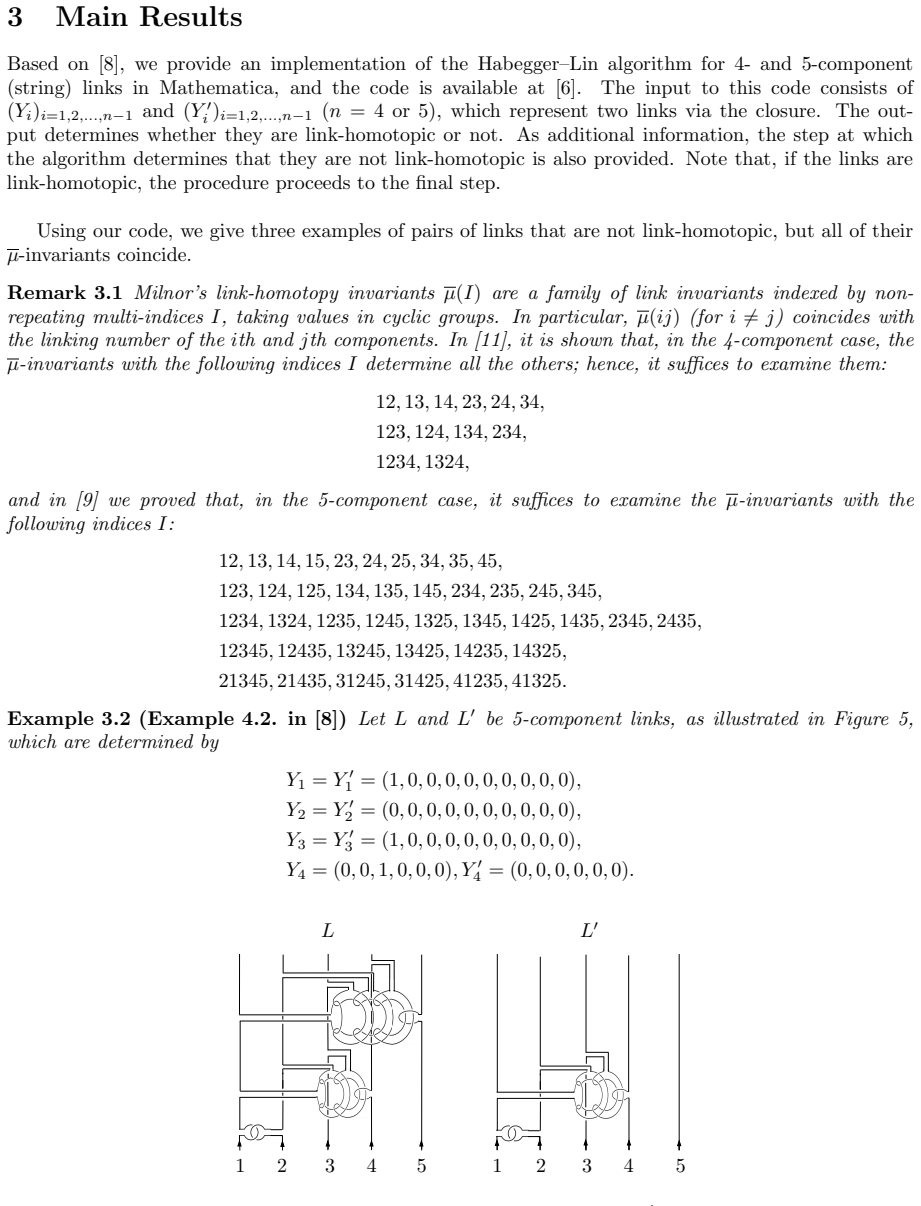
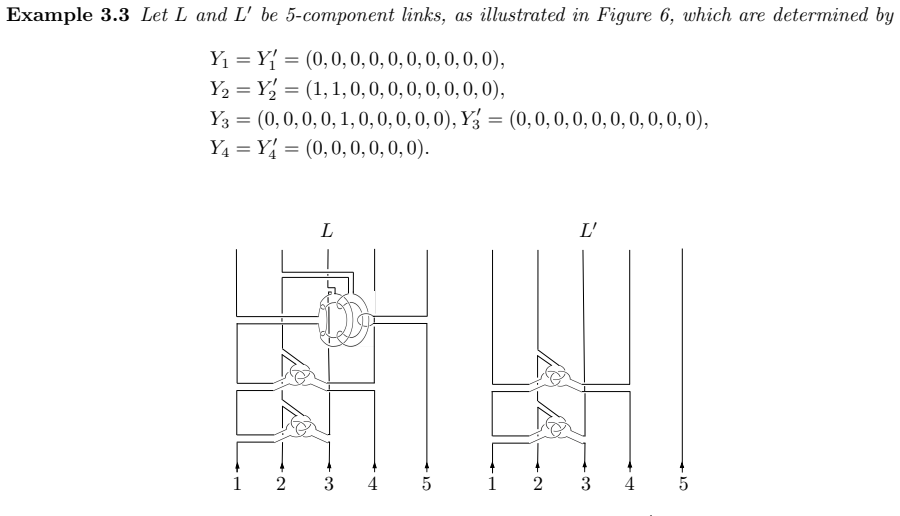
Habegger and Lin gave a classification of link-homotopy classes of links in terms of that of string links modulo certain group actions. As an application, they constructed an algorithm for determining whether given two links are link-homotopic. In \cite{KM4}, we explicitly computed these group actions for the 4- and 5-component cases. Consequently, the Habegger--Lin algorithm can be effectively applied in these cases. In this paper, we present an implementation of this algorithm, which is available at \cite{KMcode}, and exhibit new pairs of links that are not link-homotopic yet cannot be distinguished by Milnor's link-homotopy invariants, called $\overline{\mu}$-invariants.
Editorial analysis
A structured set of objections, weighed in public.
Referee Report
Summary. The paper presents an implementation of the Habegger-Lin decision algorithm for determining whether two links are link-homotopic, based on the classification of string links modulo certain group actions. Building on the authors' explicit computations of these group actions for the 4- and 5-component cases in their prior work [KM4], the implementation is made publicly available at [KMcode], and the paper exhibits new pairs of links that are claimed to be link-homotopy inequivalent yet indistinguishable by all Milnor μ-bar invariants.
Significance. If the implementation is correct, the work is significant because it makes the Habegger-Lin procedure effective and computable for links with 4 or 5 components and supplies concrete examples showing that Milnor's μ-bar invariants do not classify link-homotopy classes in these cases. The public code availability is a positive feature that enables independent checks and further applications in geometric topology.
major comments (2)
- [Abstract and implementation description] The abstract asserts that the implementation works and that new pairs exist, but the manuscript supplies no verification data, no description of test cases, no error analysis, and no comparison with independent methods. This is load-bearing for the central claim that the exhibited pairs are not link-homotopic.
- [Introduction and reliance on [KM4]] The central result depends on the authors' own prior computation of the group actions on string links for the 4- and 5-component cases, reported in [KM4]. The overall claim inherits whatever verification status that earlier calculation possesses, with no independent derivation or cross-check against known low-complexity cases appearing here.
minor comments (2)
- [References and code availability] The citation for the code repository [KMcode] would benefit from a specific version, commit hash, or stable URL to ensure long-term reproducibility.
- [Introduction] A brief recap of the Habegger-Lin framework and the role of the group actions would improve accessibility for readers unfamiliar with the prior work [KM4].
Simulated Author's Rebuttal
We thank the referee for their careful reading and constructive comments on our manuscript. We address each major comment point by point below and indicate the revisions we plan to make.
read point-by-point responses
-
Referee: [Abstract and implementation description] The abstract asserts that the implementation works and that new pairs exist, but the manuscript supplies no verification data, no description of test cases, no error analysis, and no comparison with independent methods. This is load-bearing for the central claim that the exhibited pairs are not link-homotopic.
Authors: We agree that additional verification details would strengthen the presentation of the central claims. The implementation is deterministic, being a direct realization of the Habegger--Lin procedure once the group actions are known, and the code is publicly available at [KMcode] for independent inspection. In the revised manuscript we will add a dedicated verification section that describes test cases on links with previously known link-homotopy status, supplies sample output for the new pairs, and notes that the algebraic nature of the computations eliminates floating-point error concerns. We will also record explicit comparisons with the Milnor invariants on these examples. revision: yes
-
Referee: [Introduction and reliance on [KM4]] The central result depends on the authors' own prior computation of the group actions on string links for the 4- and 5-component cases, reported in [KM4]. The overall claim inherits whatever verification status that earlier calculation possesses, with no independent derivation or cross-check against known low-complexity cases appearing here.
Authors: The present work is an implementation paper that applies the explicit group-action computations already obtained in [KM4]; a full re-derivation would lie outside its scope. To address the referee's concern we will insert a short subsection of cross-checks that applies the implementation to low-complexity cases (including 3-component links, where the classification is known to coincide with the Milnor invariants) and confirms that the output matches established theoretical expectations. This provides an independent sanity check on the code without duplicating the prior group-action calculations. revision: partial
Circularity Check
Implementation and new link examples depend on unverified self-computed group actions from prior paper [KM4]
specific steps
-
self citation load bearing
[Abstract]
"In cite{KM4}, we explicitly computed these group actions for the 4- and 5-component cases. Consequently, the Habegger--Lin algorithm can be effectively applied in these cases. In this paper, we present an implementation of this algorithm, which is available at cite{KMcode}, and exhibit new pairs of links that are not link-homotopic yet cannot be distinguished by Milnor's link-homotopy invariants, called overline{mu}-invariants."
The implementation and exhibition of new pairs are presented as a direct consequence of the group actions computed in the authors' prior self-cited paper [KM4]. The current work provides no independent derivation or verification of those actions, so the validity of the decision procedure and the new examples reduces to the correctness of the self-citation.
full rationale
The paper's central contribution is an implementation of the Habegger-Lin algorithm together with concrete 4- and 5-component examples. This rests directly on the explicit group-action computations reported in the authors' own earlier work [KM4], which is cited as the enabling step without re-derivation, machine verification, or external cross-check in the present manuscript. The abstract explicitly states that the algorithm 'can be effectively applied' as a consequence of those prior computations. This creates a self-citation load-bearing dependency: if the action tables or orbit representatives in [KM4] contain an error, both the implementation's outputs and the claimed new link pairs become unreliable. No other circular patterns (self-definitional, fitted predictions, ansatz smuggling, etc.) are present.
Axiom & Free-Parameter Ledger
axioms (1)
- domain assumption Habegger-Lin classification of link-homotopy classes via string links modulo group actions
Reference graph
Works this paper leans on
-
[1]
Graff,On braids and links up to link-homotopy, J
E. Graff,On braids and links up to link-homotopy, J. Math. Soc. Japan76(2024), no.3, 755–790. 6
2024
-
[2]
M. N. Gusarov,Variations of knotted graphs.The geometric technique of n-equivalence. (Russian), Algebra i Analiz 12 (2000), no. 4, 79–125; translation in St. Petersburg Math. J.12(2001), no. 4, 569–604
2000
-
[3]
Habegger and X.-S
N. Habegger and X.-S. Lin,The classification of links up to link-homotopy, J. Amer. Math. Soc.3 (1990), no.2, 389–419
1990
-
[4]
Habiro,Claspers and finite type invariants of links, Geom
K. Habiro,Claspers and finite type invariants of links, Geom. Topol.4(2000), 1–83
2000
-
[5]
J. R. Hughes,Partial conjugations suffice, Topology Appl.148(2005), 55–62
2005
-
[6]
Kotorii, Web page: https://drive.google.com/drive/folders/1B-1YQMqihq6PhyLzPZ3D2BA3x9 DxXzUT?usp=sharing
Y. Kotorii, Web page: https://drive.google.com/drive/folders/1B-1YQMqihq6PhyLzPZ3D2BA3x9 DxXzUT?usp=sharing
-
[7]
Kotorii and A
Y. Kotorii and A. Mizusawa,Link-homotopy classes of 4-component links, claspers and the Habegger– Lin algorithm, J. Knot Theory Ramifications32(2023), no.6, 2350045, 26 pp
2023
-
[8]
Kotorii and A
Y. Kotorii and A. Mizusawa,Clasper Presentations of Habegger–Lin’s Action on String Links, Ex- perimental Mathematics34(2025), no. 4, 623–667
2025
-
[9]
Kotorii and A
Y. Kotorii and A. Mizusawa,The number of independent Milnor invariants for link-homotopy with length 5, in preparation
-
[10]
J. P. Levine,Surgery on links and the¯µ-invariants, Topology,26, (1987), 45–61
1987
-
[11]
J. P. Levine,An approach to homotopy classification of links, Trans. Amer. Math. Soc.306(1988), 361–387
1988
-
[12]
Meilhan, Y
J-B. Meilhan, Y. Yasuhara,Milnor invariants and the HOMFLYPT polynomial, Geom. Topol.16 (2012), no.2, 889–917
2012
-
[13]
Milnor,Link groups, Annals of Mathematics (2),59(1954), 177–195
J. Milnor,Link groups, Annals of Mathematics (2),59(1954), 177–195
1954
-
[14]
Milnor,Isotopy of links, Algebraic geometry and topology, A symposium in honor of S
J. Milnor,Isotopy of links, Algebraic geometry and topology, A symposium in honor of S. Lefschetz, pp. 280–306, Princeton University Press, Princeton, N. J., 1957. 7
1957
discussion (0)
Sign in with ORCID, Apple, or X to comment. Anyone can read and Pith papers without signing in.