Recognition: unknown
Nonlinear steepening of a fast magnetoacoustic wave in the vicinity of a coronal magnetic null point
Pith reviewed 2026-05-08 17:19 UTC · model grok-4.3
The pith
Fast magnetoacoustic waves steepen nonlinearly and dissipate before reaching a coronal magnetic null point.
A machine-rendered reading of the paper's core claim, the machinery that carries it, and where it could break.
Core claim
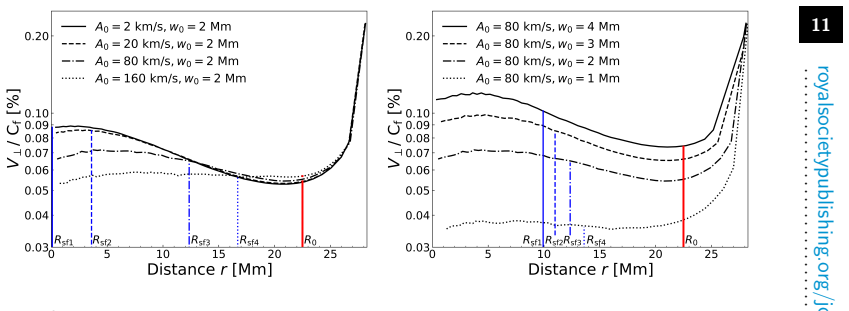
The incoming fast wave approaches the null point along the bisector of the magnetic configuration, i.e., across the local field. The fast-speed non-uniformity around the null point causes the refraction of the incident fast wave. However, the segment of the incoming wave which approaches the null point is locally plane. The decrease in the fast speed towards the null point amplifies the nonlinear deformation of the incoming wave. Hence, the fast wave can become subject to nonlinear dissipation at a distance from the null point and not reach it.
What carries the argument
The non-uniform fast magnetoacoustic speed, which decreases toward the null and amplifies nonlinear deformation of the incoming wave.
If this is right
- Wave energy can be deposited through shock formation away from the null point.
- Nonlinear deformation can override linear refraction in setting the wave's final fate.
- Sympathetic flare models must include possible dissipation of incoming waves before they reach a null.
- The distance of dissipation depends on the initial wave amplitude and the magnetic geometry.
Where Pith is reading between the lines
- Realistic density or temperature gradients could shift the dissipation distance either inward or outward.
- The same speed-gradient mechanism may operate in other coronal magnetic structures that lack a true null.
- Higher-resolution observations of wave fronts approaching active-region nulls could measure the predicted pre-null steepening.
Load-bearing premise
The equilibrium plasma density and temperature are taken to be constant, so all non-uniformity in wave speed arises from the magnetic field geometry alone.
What would settle it
A numerical simulation or coronal observation that tracks wave amplitude and shows a discontinuity forming at a clear distance before the wave reaches the modeled null point.
Figures



read the original abstract
The interaction of a fast magnetoacoustic wave with a magnetic null point is studied in the context of the sympathetic flare phenomenon. Attention is paid to steepening the wave caused by the finite-amplitude effects in a non-uniform plasma environment. The null point is modelled by a potential magnetic configuration without a guiding field. The equilibrium plasma density and temperature are taken to be constant. The fast wave is excited by an impulsive point source outside the distance at which the local Alfv\'en and sound speeds are equal to each other. The incoming fast wave approaches the null point along the bisector of the magnetic configuration, i.e., across the local field. The fast-speed non-uniformity around the null point causes the refraction of the incident fast wave. However, the segment of the incoming wave, which approaches the null point is locally plane. The decrease in the fast speed towards the null point amplifies the nonlinear deformation of the incoming wave. Hence, the fast wave can become subject to nonlinear dissipation at a distance from the null point and not reach it.
Editorial analysis
A structured set of objections, weighed in public.
Referee Report
Summary. The paper studies the nonlinear steepening of a fast magnetoacoustic wave near a coronal magnetic null point modeled as a 2D potential field without guide field, with constant density and temperature. An impulsive source excites the wave outside the c_s = v_A surface, and the wave approaches along the bisector. Due to refraction from the non-uniform fast speed, the wave's locally planar segment steepens nonlinearly, leading to dissipation before reaching the null point. This is linked to sympathetic flare phenomena.
Significance. If the result holds, it demonstrates that nonlinear effects can cause fast waves to dissipate at a distance from null points due to magnetic geometry alone, which could explain limited wave propagation in the corona and has implications for energy dissipation and flare initiation. The constant density/temperature assumption is a deliberate choice to isolate geometry effects, and the scoping to the model avoids overgeneralization.
major comments (2)
- The manuscript does not describe the numerical scheme, grid resolution, artificial dissipation terms, or any convergence tests and comparisons to linear theory. Without these, it is impossible to confirm that the reported steepening and dissipation distance arise from the physical nonlinear term rather than numerical effects. This directly bears on the central claim in the abstract.
- No analytical estimate of the nonlinear steepening length (based on local fast-speed gradient and wave amplitude) is provided to compare against the simulated dissipation distance. This leaves the mechanism of amplification of the nonlinear deformation (due to the decrease in fast speed) unverified quantitatively.
minor comments (2)
- The abstract would benefit from a single sentence summarizing the numerical approach and key parameters (e.g., wave amplitude relative to local fast speed).
- Figure captions should explicitly state the plotted quantities (velocity perturbation, density, etc.) and color scales to improve clarity.
Simulated Author's Rebuttal
We thank the referee for the positive assessment of our work and the constructive major comments. We address each point below and will revise the manuscript to incorporate the requested details and analysis.
read point-by-point responses
-
Referee: The manuscript does not describe the numerical scheme, grid resolution, artificial dissipation terms, or any convergence tests and comparisons to linear theory. Without these, it is impossible to confirm that the reported steepening and dissipation distance arise from the physical nonlinear term rather than numerical effects. This directly bears on the central claim in the abstract.
Authors: We agree that the numerical methodology section is insufficiently detailed and that this information is essential to substantiate the physical nature of the steepening. In the revised manuscript we will add a dedicated subsection describing the MHD numerical scheme (including the solver, spatial and temporal discretization, and boundary conditions), the grid resolution and domain configuration, the form and coefficients of any artificial dissipation terms, results of convergence tests performed at multiple resolutions, and direct comparisons of the nonlinear runs against the corresponding linear solutions. These additions will confirm that the reported dissipation distance is produced by the physical nonlinear term. revision: yes
-
Referee: No analytical estimate of the nonlinear steepening length (based on local fast-speed gradient and wave amplitude) is provided to compare against the simulated dissipation distance. This leaves the mechanism of amplification of the nonlinear deformation (due to the decrease in fast speed) unverified quantitatively.
Authors: We accept that a quantitative analytical estimate would strengthen the verification of the proposed mechanism. In the revised manuscript we will derive and present an estimate for the nonlinear steepening length that incorporates the local gradient of the fast magnetoacoustic speed and the initial wave amplitude. This estimate will be compared directly with the dissipation distance measured in the simulations, thereby confirming that the decrease in fast speed is responsible for amplifying the nonlinear deformation. revision: yes
Circularity Check
No significant circularity identified
full rationale
The paper performs forward modeling of an impulsive fast magnetoacoustic wave in a 2D potential null-point field with constant equilibrium density and temperature. The refraction, local planar segment, and nonlinear steepening follow directly from the MHD equations under the stated geometry and source location outside the c_s = v_A surface. No fitted parameters are relabeled as predictions, no self-citation chain supplies the central mechanism, and the conclusion that dissipation can occur before the null is reached is a direct consequence of the model assumptions rather than a self-definitional reduction. The derivation chain is self-contained against the external MHD framework.
Axiom & Free-Parameter Ledger
axioms (3)
- standard math Ideal MHD equations govern the plasma dynamics
- domain assumption Potential magnetic field configuration without guiding field
- domain assumption Equilibrium density and temperature are spatially constant
Reference graph
Works this paper leans on
-
[1]
2002 Statistical Evidence for Sympathetic Flares.Astrophys
Moon YJ, Choe GS, Park YD, Wang H, Gallagher PT, Chae J, Yun HS, Goode PR. 2002 Statistical Evidence for Sympathetic Flares.Astrophys. J.574, 434–439. (10.1086/340945)
-
[2]
Schrijver CJ, Higgins PA. 2015 A Statistical Study of Distant Consequences of Large Solar Energetic Events.Solar Phys.290, 2943–2950. (10.1007/s11207-015-0785-x)
-
[4]
Astronomy and Astrophysics , author =
Guité LS, Strugarek A, Charbonneau P. 2025 Flaring together: A preferred angular separation between sympathetic flares on the Sun.Astron. Astrophys.694, A74. (10.1051/0004-6361/202452381)
-
[5]
2007 Global Coronal Mass Ejections.Astrophys
Zhukov AN, Veselovsky IS. 2007 Global Coronal Mass Ejections.Astrophys. J. Lett664, L131–L134. (10.1086/520928)
-
[6]
2017 The Interaction of Successive Coronal Mass Ejections: A Review.Solar Phys.292, 64
Lugaz N, Temmer M, Wang Y, Farrugia CJ. 2017 The Interaction of Successive Coronal Mass Ejections: A Review.Solar Phys.292, 64. (10.1007/s11207-017-1091-6)
-
[7]
2009 Driving major solar flares and eruptions: A review.Advances in Space Research43, 739–755
Schrijver CJ. 2009 Driving major solar flares and eruptions: A review.Advances in Space Research43, 739–755. (10.1016/j.asr.2008.11.004)
-
[8]
2025 Avalanching Together: A Model for Sympathetic Flaring.Solar Phys.300, 82
Guité LS, Charbonneau P, Strugarek A. 2025 Avalanching Together: A Model for Sympathetic Flaring.Solar Phys.300, 82. (10.1007/s11207-025-02501-4)
-
[9]
2011 A Model for Magnetically Coupled Sympathetic Eruptions.Astrophys
Török T, Panasenco O, Titov VS, Mikić Z, Reeves KK, Velli M, Linker JA, De Toma G. 2011 A Model for Magnetically Coupled Sympathetic Eruptions.Astrophys. J. Lett739, L63. (10.1088/2041-8205/739/2/L63)
-
[10]
2016 A Numerical Study of Long-range Magnetic Impacts during Coronal Mass Ejections.Astrophys
Jin M, Schrijver CJ, Cheung MCM, DeRosa ML, Nitta NV, Title AM. 2016 A Numerical Study of Long-range Magnetic Impacts during Coronal Mass Ejections.Astrophys. J.820,
2016
-
[11]
(10.3847/0004-637X/820/1/16)
-
[12]
Nakariakov VM, Foullon C, Verwichte E, Young NP. 2006 Quasi-periodic modulation of solar and stellar flaring emission by magnetohydrodynamic oscillations in a nearby loop. Astron. Astrophys.452, 343–346. (10.1051/0004-6361:20054608) 14royalsocietypublishing.org/journal/rsta Phil. Trans. R. Soc0000000
-
[13]
Büchner J, Elkina N. 2006 Anomalous resistivity of current-driven isothermal plasmas due to phase space structuring.Physics of Plasmas13, 082304. (10.1063/1.2209611)
-
[14]
2022 Direct observations of anomalous resistivity and diffusion in collisionless plasma
Graham DB, Khotyaintsev YV, André M, Vaivads A, Divin A, Drake JF, Norgren C, Le Contel O, Lindqvist PA, Rager AC, Gershman DJ, Russell CT, Burch JL, Hwang KJ, Dokgo K. 2022 Direct observations of anomalous resistivity and diffusion in collisionless plasma. Nature Communications13, 2954. (10.1038/s41467-022-30561-8)
-
[15]
B., Cozzani, G., Khotyaintsev, Y
Graham DB, Cozzani G, Khotyaintsev YV, Wilder VD, Holmes JC, Nakamura TKM, Büchner J, Dokgo K, Richard L, Steinvall K, Norgren C, Chen LJ, Ji H, Drake JF, Stawarz JE, Eriksson S. 2025 The Role of Kinetic Instabilities and Waves in Collisionless Magnetic Reconnection.Space Sci. Rev.221, 20. (10.1007/s11214-024-01133-7)
-
[16]
1994 What is the Condition for Fast Magnetic Reconnection?
Yokoyama T, Shibata K. 1994 What is the Condition for Fast Magnetic Reconnection?. Astrophys. J. Lett436, L197. (10.1086/187666)
-
[17]
2011, Living Reviews in Solar Physics, 8, 6, doi: 10.12942/lrsp-2011-6
Shibata K, Magara T. 2011 Solar Flares: Magnetohydrodynamic Processes.Living Reviews in Solar Physics8, 6. (10.12942/lrsp-2011-6)
-
[18]
Færder ØH, Nóbrega-Siverio D, Carlsson M. 2024 A comparative study of resistivity models for simulations of magnetic reconnection in the solar atmosphere. II. Plasmoid formation. Astron. Astrophys.683, A95. (10.1051/0004-6361/202348046)
-
[19]
Chen PF, Priest ER. 2006 Transition-Region Explosive Events: Reconnection Modulated by p-Mode Waves.Solar Phys.238, 313–327. (10.1007/s11207-006-0215-1)
-
[20]
2011 Slow Magnetoacoustic Waves in Two-ribbon Flares
Nakariakov VM, Zimovets IV. 2011 Slow Magnetoacoustic Waves in Two-ribbon Flares. Astrophys. J. Lett730, L27. (10.1088/2041-8205/730/2/L27)
-
[21]
Kumar P, Nakariakov VM, Cho KS. 2017 Quasi-periodic Radio Bursts Associated with Fast-mode Waves near a Magnetic Null Point.Astrophys. J.844, 149. (10.3847/1538- 4357/aa7d53)
-
[22]
2021 Quasi-Periodic Pulsations in Solar and Stellar Flares: A Review of Underpinning Physical Mechanisms and Their Predicted Observational Signatures.Space Sci
Zimovets IV, McLaughlin JA, Srivastava AK, Kolotkov DY, Kuznetsov AA, Kupriyanova EG, Cho IH, Inglis AR, Reale F, Pascoe DJ, Tian H, Yuan D, Li D, Zhang QM. 2021 Quasi-Periodic Pulsations in Solar and Stellar Flares: A Review of Underpinning Physical Mechanisms and Their Predicted Observational Signatures.Space Sci. Rev.217,
2021
-
[23]
(10.1007/s11214-021-00840-9)
-
[24]
2004 MHD wave propagation in the neighbourhood of a two- dimensional null point.Astron
McLaughlin JA, Hood AW. 2004 MHD wave propagation in the neighbourhood of a two- dimensional null point.Astron. Astrophys.420, 1129–1140. (10.1051/0004-6361:20035900)
-
[25]
McLaughlinJA,HoodAW,deMoortelI.2011ReviewArticle:MHDWavePropagationNear Coronal Null Points of Magnetic Fields.Space Sci. Rev.158, 205–236. (10.1007/s11214-010- 9654-y)
-
[26]
2006 MHD mode coupling in the neighbourhood of a 2D null point.Astron
McLaughlin JA, Hood AW. 2006 MHD mode coupling in the neighbourhood of a 2D null point.Astron. Astrophys.459, 641–649. (10.1051/0004-6361:20065558)
-
[27]
Afanasyev AN, Uralov AM. 2016 Slow-Mode MHD Wave Penetration into a Coronal Null Point due to the Mode Transmission.Solar Phys.291, 3185–3193. (10.1007/s11207-016- 0899-9)
-
[28]
2017 Magnetoacoustic Waves in a Stratified Atmosphere with a Magnetic Null Point.Astrophys
Tarr LA, Linton M, Leake J. 2017 Magnetoacoustic Waves in a Stratified Atmosphere with a Magnetic Null Point.Astrophys. J.837, 94. (10.3847/1538-4357/aa5e4e)
-
[29]
2024 Wave transformations near a coronal magnetic null point.Astron
Yadav N, Keppens R. 2024 Wave transformations near a coronal magnetic null point.Astron. Astrophys.681, A43. (10.1051/0004-6361/202347417)
-
[30]
Kumar P, Nakariakov VM, Karpen JT, Cho KS. 2024 Direct imaging of magnetohydrodynamic wave mode conversion near a 3D null point on the sun.Nature Communications15, 2667. (10.1038/s41467-024-46736-4)
-
[31]
McLaughlin JA, De Moortel I, Hood AW, Brady CS. 2009 Nonlinear fast magnetoacoustic wave propagation in the neighbourhood of a 2D magnetic X-point: oscillatory reconnection. Astron. Astrophys.493, 227–240. (10.1051/0004-6361:200810465)
-
[33]
Afanasyev AN, Uralov AM. 2012 Modelling the Propagation of a Weak Fast-Mode MHD Shock Wave near a 2D Magnetic Null Point Using Nonlinear Geometrical Acoustics.Solar Phys.280, 561–574. (10.1007/s11207-012-0022-9)
-
[34]
2013 Nonlinear Alfvén wave dynamics at a 2D magnetic null point: ponderomotive force.Astron
Thurgood JO, McLaughlin JA. 2013 Nonlinear Alfvén wave dynamics at a 2D magnetic null point: ponderomotive force.Astron. Astrophys.555, A86. (10.1051/0004-6361/201321338)
-
[35]
2018 High frequency generation in the corona: Resonant cavities.Astron
Santamaria IC, Van Doorsselaere T. 2018 High frequency generation in the corona: Resonant cavities.Astron. Astrophys.611, A10. (10.1051/0004-6361/201731016) 15royalsocietypublishing.org/journal/rsta Phil. Trans. R. Soc0000000
-
[36]
McLaughlin JA, Ferguson JSL, Hood AW. 2008 3D MHD Coronal Oscillations about a Magnetic Null Point: Application of WKB Theory.Solar Phys.251, 563–587. (10.1007/s11207-007-9107-2)
-
[37]
Sahade A, Cécere M, Sieyra MV, Krause G, Cremades H, Costa A. 2022 Pseudostreamer influence on flux rope evolution.Astron. Astrophys.662, A113. (10.1051/0004- 6361/202243618)
-
[38]
1974Linear and Nonlinear Waves
Whitham GB. 1974Linear and Nonlinear Waves. John Wiley & Sons. (10.1002/9781118032954)
-
[39]
2010 FLASH: Adaptive Mesh Hydrodynamics Code for Modeling Astrophysical Thermonuclear Flashes
Fryxell B, Olson K, Ricker P, Timmes FX, Zingale M, Lamb DQ, MacNeice P, Rosner R, Truran JW, Tufo H. 2010 FLASH: Adaptive Mesh Hydrodynamics Code for Modeling Astrophysical Thermonuclear Flashes. Astrophysics Source Code Library, record ascl:1010.082
2010
-
[40]
Patsourakos S, Vourlidas A. 2012 On the Nature and Genesis of EUV Waves: A Synthesis of Observations from SOHO, STEREO, SDO, and Hinode (Invited Review).Solar Phys.281, 187–222. (10.1007/s11207-012-9988-6)
-
[41]
1987 Current Loop Coalescence Model of Solar Flares.Astrophys
Tajima T, Sakai J, Nakajima H, Kosugi T, Brunel F, Kundu MR. 1987 Current Loop Coalescence Model of Solar Flares.Astrophys. J.321, 1031. (10.1086/165694)
discussion (0)
Sign in with ORCID, Apple, or X to comment. Anyone can read and Pith papers without signing in.