Recognition: unknown
Stability and dynamics of dark-bright solitons in spin-orbit- and Rabi-coupled binary Bose-Einstein condensates
Pith reviewed 2026-05-08 17:18 UTC · model grok-4.3
The pith
Binary Bose-Einstein condensates admit exact dark-bright soliton solutions in the absence of spin-orbit coupling by mapping to the Manakov model.
A machine-rendered reading of the paper's core claim, the machinery that carries it, and where it could break.
Core claim
The central discovery is that the absence of spin-orbit coupling allows the coupled Gross-Pitaevskii equations to be mapped to the Manakov system, yielding exact dark-bright soliton solutions. With spin-orbit coupling present, the system loses integrability, resulting in spin-component separation and intrinsic oscillations. Rabi coupling restores robustness by phase locking, enabling breather-like states. These are characterized for ground states, excitations, and far-from-equilibrium dynamics in trapped and untrapped geometries.
What carries the argument
Mapping the coupled Gross-Pitaevskii equations to the integrable Manakov model, which provides exact dark-bright soliton solutions as a benchmark for the effects of spin-orbit and Rabi couplings.
If this is right
- Exact dark-bright soliton solutions are available when spin-orbit coupling is zero.
- Spin-orbit coupling causes spatial separation of spin components and density oscillations.
- Rabi coupling supports robust breather-like excitations via phase locking.
- Diverse nonlinear phenomena including multi-soliton fragmentation and breathing stripes arise from gauge fields and interaction quenches.
- Ground-state phases and spectra are systematically characterized in symmetric and asymmetric regimes for homogeneous and trapped systems.
Where Pith is reading between the lines
- Controlling the strength of spin-orbit coupling could allow switching between stable soliton propagation and oscillatory behavior in experiments with binary condensates.
- The phase-locking effect of Rabi coupling may enable the creation of long-lived nonlinear excitations useful for quantum simulation applications.
- The results for trapped systems suggest that harmonic confinement can be combined with these couplings to stabilize specific soliton configurations not possible in homogeneous cases.
Load-bearing premise
The exact mapping to the Manakov model and resulting soliton solutions hold only when spin-orbit coupling is precisely zero and the interaction parameters satisfy the required equal-strength conditions under the mean-field approximation.
What would settle it
Numerical integration of the coupled Gross-Pitaevskii equations with zero spin-orbit coupling should produce dark-bright soliton profiles that match the analytical Manakov solutions exactly; discrepancies in density or phase would falsify the integrability claim.
Figures




read the original abstract
We investigate the stability and nonlinear dynamics of dark-bright solitons in a one-dimensional binary Bose-Einstein condensate subjected to synthetic spin-orbit and Rabi couplings. In the absence of spin-orbit coupling, we map the coupled Gross-Pitaevskii equations onto the integrable Manakov model and obtain exact dark-bright soliton solutions, providing a rigorous theoretical benchmark. We demonstrate that finite spin-orbit coupling breaks integrability by inducing spin-dependent phase gradients, which result in spatial separation of the spin components and the emergence of intrinsic density oscillations. By contrast, Rabi coupling enforces phase locking between components and supports robust breather-like excitations. Using imaginary-time propagation together with Bogoliubov-de Gennes analysis, we systematically characterise ground-state phases and excitation spectra for both symmetric and asymmetric interaction regimes in homogeneous and harmonically trapped systems. Real-time simulations further demonstrate that finite gauge fields and interaction quenches drive the system far from equilibrium, giving rise to diverse nonlinear phenomena, including multi-soliton fragmentation, breathing stripe patterns, and soliton dynamics. Our results highlight the interplay of synthetic gauge fields, external confinement, and interaction engineering as powerful tools for controlling the stability and dynamical behaviour of nonlinear excitations in multicomponent quantum gases.
Editorial analysis
A structured set of objections, weighed in public.
Referee Report
Summary. The manuscript investigates the stability and nonlinear dynamics of dark-bright solitons in one-dimensional binary Bose-Einstein condensates with synthetic spin-orbit and Rabi couplings. In the absence of spin-orbit coupling, the coupled Gross-Pitaevskii equations are mapped onto the integrable Manakov model to derive exact dark-bright soliton solutions as a rigorous benchmark. Finite spin-orbit coupling is shown to break integrability via spin-dependent phase gradients, causing spatial separation and intrinsic density oscillations, whereas Rabi coupling enforces phase locking and supports robust breather-like excitations. The work employs imaginary-time propagation and Bogoliubov-de Gennes analysis to characterize ground-state phases and excitation spectra across symmetric and asymmetric interaction regimes in both homogeneous and harmonically trapped geometries, with real-time simulations illustrating quench-induced phenomena such as multi-soliton fragmentation and breathing stripe patterns.
Significance. If the exact soliton solutions are derived under the appropriate integrability conditions, they provide a valuable analytical benchmark for validating numerical methods in multicomponent BECs. The systematic numerical characterization of stability and dynamics under spin-orbit and Rabi couplings, including both symmetric and asymmetric cases, contributes to understanding how synthetic gauge fields control soliton behavior in quantum gases. Strengths include the use of standard, well-established techniques (imaginary-time propagation and BdG linearization) and the exploration of experimentally relevant quenches and confinement effects.
major comments (1)
- [Abstract] Abstract: The claim that the coupled Gross-Pitaevskii equations map onto the integrable Manakov model (yielding exact dark-bright soliton solutions as a rigorous benchmark) omits the necessary condition g11 = g22 = g12 (after rescaling). This reduction holds only under equal coupling strengths; the manuscript separately reports results for asymmetric interaction regimes, rendering the scope and applicability of the claimed exact benchmark ambiguous.
minor comments (2)
- The introduction should explicitly delineate the parameter regimes (symmetric vs. asymmetric interactions) when referencing the Manakov benchmark to avoid reader confusion.
- Consider adding a brief statement in the methods or results sections confirming that the BdG spectra were checked for numerical convergence with respect to grid size and imaginary-time propagation steps.
Simulated Author's Rebuttal
We thank the referee for the careful reading of our manuscript and the constructive comment. We agree that the abstract should explicitly state the condition under which the exact dark-bright soliton solutions are obtained, to clarify the scope of the analytical benchmark relative to the numerical results for asymmetric interactions.
read point-by-point responses
-
Referee: [Abstract] Abstract: The claim that the coupled Gross-Pitaevskii equations map onto the integrable Manakov model (yielding exact dark-bright soliton solutions as a rigorous benchmark) omits the necessary condition g11 = g22 = g12 (after rescaling). This reduction holds only under equal coupling strengths; the manuscript separately reports results for asymmetric interaction regimes, rendering the scope and applicability of the claimed exact benchmark ambiguous.
Authors: We thank the referee for pointing this out. The exact dark-bright soliton solutions are derived only in the integrable limit where the intra- and inter-component interaction strengths are equal (g11 = g22 = g12 after rescaling), allowing the mapping onto the Manakov system; this condition is stated explicitly in Section II of the manuscript where the analytical solutions are presented. The asymmetric interaction cases (g11 ≠ g12) are treated separately via numerical methods (imaginary-time propagation and Bogoliubov-de Gennes analysis) and do not rely on the Manakov integrability. To remove any ambiguity, we will revise the abstract to specify that the exact solutions apply to the symmetric interaction regime while the asymmetric results are obtained numerically. This is a minor clarification that does not alter the manuscript's conclusions or scope. revision: yes
Circularity Check
No significant circularity; central mapping and solutions follow from standard parameter conditions on the coupled GP equations
full rationale
The paper's strongest claim reduces the coupled Gross-Pitaevskii system to the Manakov model only when spin-orbit coupling vanishes and the interaction coefficients satisfy the equal-strength condition g11 = g22 = g12 (after rescaling). This is a standard, externally verifiable reduction to a known integrable system whose dark-bright soliton family is independently documented in the literature; the paper then applies established numerical methods (imaginary-time propagation, Bogoliubov-de Gennes spectra, real-time evolution) to the general case including asymmetric interactions and finite gauge fields. No step defines a quantity in terms of itself, renames a fitted parameter as a prediction, or relies on a load-bearing self-citation whose validity is presupposed. The derivation chain therefore remains self-contained against external benchmarks and does not collapse by construction.
Axiom & Free-Parameter Ledger
axioms (2)
- domain assumption Coupled Gross-Pitaevskii equations govern the mean-field dynamics of the binary condensate
- standard math The Manakov system is integrable when spin-orbit coupling vanishes and interaction coefficients satisfy specific equalities
Reference graph
Works this paper leans on
-
[1]
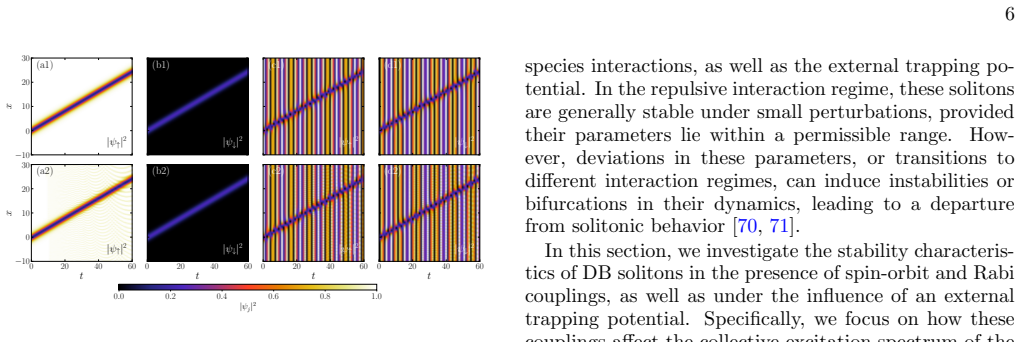
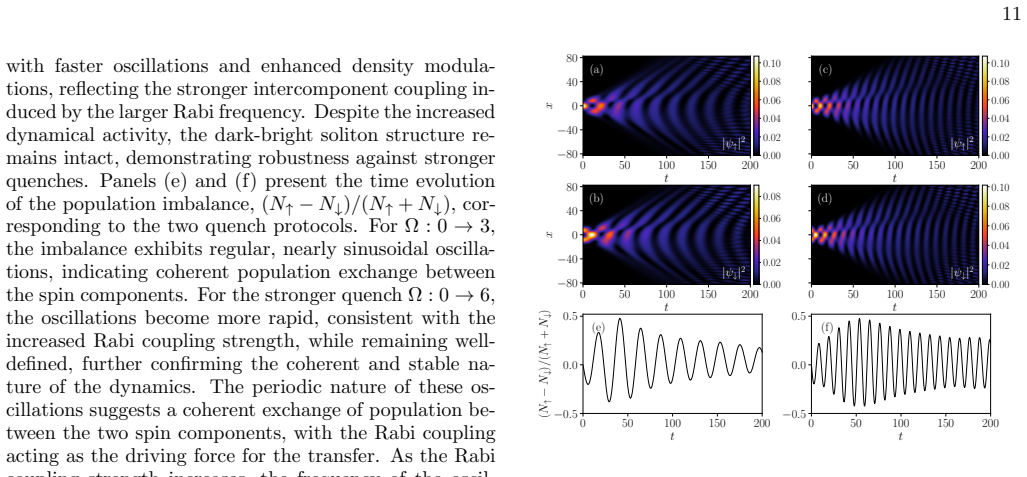
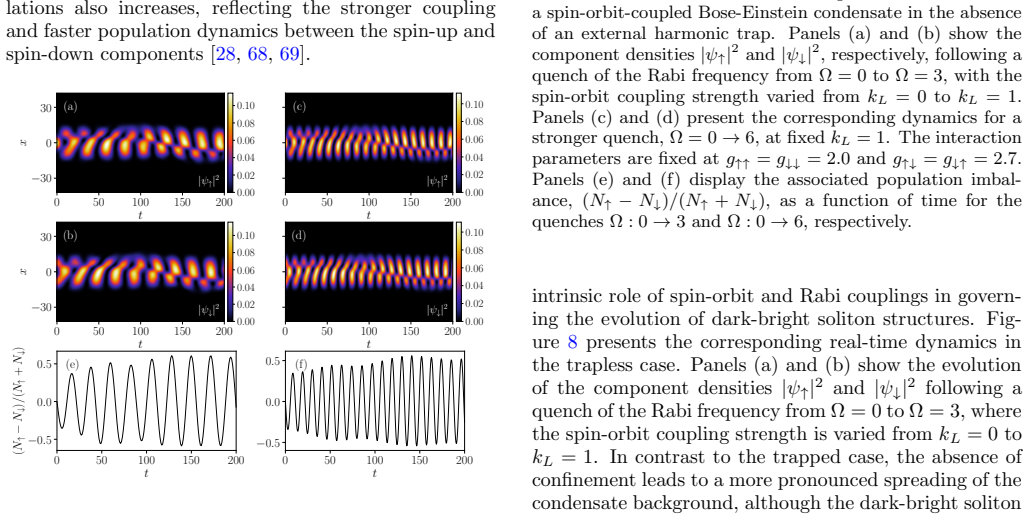
Dynamics of the dark-bright soliton for Symmetric interactions We now examine the dynamics under fully symmetric nonlinear interactions, withg ↑↑ =g ↓↓ andg ↑↓ =g ↓↑. Unless otherwise stated, the initial state is obtained via imaginary-time propagation with repulsive interactions, and the subsequent dynamics are studied in real time following a sudden que...
-
[2]
The left two columns correspond to the trapped system, while the right two columns represent the trap-free case
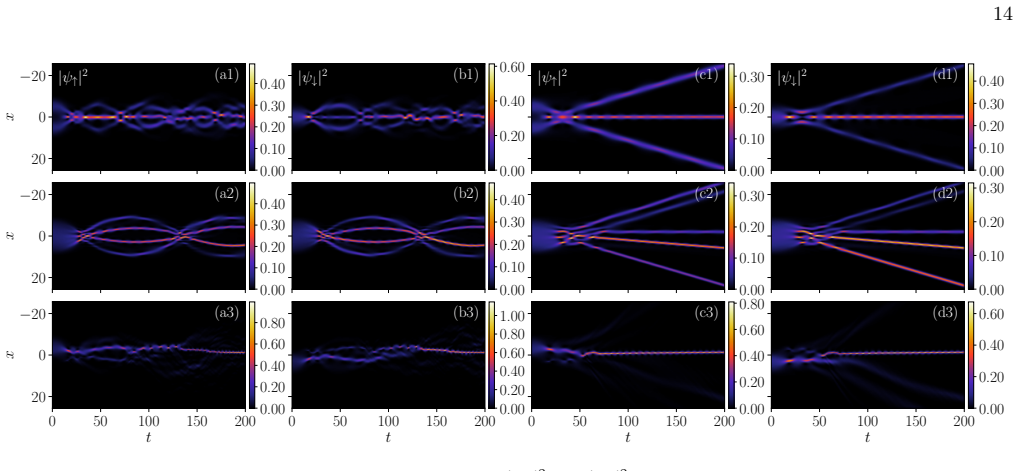
Attractive intra- and interspecies interactions Figure 11 shows the time evolution of the densities |ψ↑|2 and|ψ ↓|2 for three representative parameter sets: (kL,Ω) = (1,0), (2,5), and (4,5). The left two columns correspond to the trapped system, while the right two columns represent the trap-free case. In each case, the upper (lower) panel within a column...
2022
-
[3]
C. J. Pethick and H. Smith,Bose-Einstein Condensation in Dilute Gases(Cambridge University Press, 2008)
2008
-
[4]
D. M. Stamper-Kurn and M. Ueda, Spinor Bose gases: Symmetries, magnetism, and quantum dynamics, Rev. Mod. Phys.85, 1191 (2013)
2013
-
[5]
L. P. Pitaevskij and S. Stringari,Bose-Einstein conden- sation, repr. ed., Oxford science publications (Clarendon Press, Oxford [u.a.], 2010)
2010
-
[6]
A. J. Leggett, Bose-Einstein condensation in the alkali gases: Some fundamental concepts, Rev. Mod. Phys.73, 17 307 (2001)
2001
-
[7]
Kawaguchi and M
Y. Kawaguchi and M. Ueda, Spinor Bose-Einstein con- densates, Phys. Rep.520, 253 (2012)
2012
-
[8]
Pitaevskii and S
L. Pitaevskii and S. Stringari,Bose-Einstein Condensa- tion and Superfluidity, 1st ed. (Oxford University Press, New York, 2016)
2016
-
[9]
Y.-J. Lin, K. Jim´ enez-Garc´ ıa, and I. B. Spielman, Spin- orbit-coupled Bose-Einstein condensates, Nature471, 83 (2011)
2011
-
[10]
Galitski and I
V. Galitski and I. B. Spielman, Spin-orbit coupling in quantum gases, Nature494, 49 (2013)
2013
-
[11]
H. Deng, J. Li, Z. Chen, Y. Liu, D. Liu, C. Jiang, C. Kong, and B. A. Malomed, Semivortex solitons and their excited states in spin-orbit-coupled binary bosonic condensates, Phys. Rev. E109, 064201 (2024)
2024
-
[12]
M. Z. Hasan and C. L. Kane, Colloquium: Topological insulators, Rev. Mod. Phys.82, 3045 (2010)
2010
-
[13]
Bloch, J
I. Bloch, J. Dalibard, and S. Nascimb` ene, Quantum sim- ulations with ultracold quantum gases, Nat. Phys.8, 267 (2012)
2012
-
[14]
V. P. Amin and M. D. Stiles, Spin transport at interfaces with spin-orbit coupling: Phenomenology, Phys. Rev. B 94, 104420 (2016)
2016
-
[15]
J. Cui, P. Li, J. Zhou, W.-Y. He, X. Huang, J. Yi, J. Fan, Z. Ji, X. Jing, F. Qu, Z. G. Cheng, C. Yang, L. Lu, K. Suenaga, J. Liu, K. T. Law, J. Lin, Z. Liu, and G. Liu, Transport evidence of asymmetric spin-orbit coupling in few-layer superconducting 1T d-MoTe2, Nat. Commun.10, 2044 (2019)
2044
-
[16]
Z. Chen, Y. Li, and B. A. Malomed, Josephson oscilla- tions of chirality and identity in two-dimensional solitons in spin-orbit-coupled condensates, Phys. Rev. Research 2, 033214 (2020)
2020
-
[17]
Zhang, M
Y. Zhang, M. E. Mossman, T. Busch, P. Engels, and C. Zhang, Properties of spin-orbit-coupled Bose-Einstein condensates, Front. Phys.11, 118103 (2016)
2016
-
[18]
Zhang, C
Y. Zhang, C. Hang, and G. Huang, Matter-wave solitons in an array of spin-orbit-coupled Bose-Einstein conden- sates, Phys. Rev. E108, 0142208 (2023)
2023
-
[19]
Becker, S
C. Becker, S. Stellmer, P. Soltan-Panahi, S. D¨ orscher, M. Baumert, E.-M. Richter, J. Kronj¨ ager, K. Bongs, and K. Sengstock, Oscillations and interactions of dark and dark-bright solitons in Bose-Einstein condensates, Nat. Phys.4, 496 (2008)
2008
-
[20]
P. G. Kevrekidis, R. Carretero-Gonz´ alez, and D. J. Frantzeskakis, eds.,Emergent Nonlinear Phenomena in Bose-Einstein Condensates, SpringerLink (Springer Berlin Heidelberg, Berlin, Heidelberg, 2008)
2008
-
[22]
Wang and P
W. Wang and P. G. Kevrekidis, Two-component dark- bright solitons in three-dimensional atomic Bose-Einstein condensates, Phys. Rev. E95, 032201 (2017)
2017
-
[23]
A. P. Sheppard and Y. S. Kivshar, Polarized dark solitons in isotropic Kerr media, Phys. Rev. A95, 4773 (1997)
1997
-
[24]
Achilleos, D
V. Achilleos, D. Yan, P. G. Kevrekidis, and D. J. Frantzeskakis, Dark-bright solitons in Bose-Einstein con- densates at finite temperatures, New J. Phys.14, 055006 (2012)
2012
-
[25]
P. G. Kevrekidis, D. J. Frantzeskakis, and R. Carretero- Gonz´ alez, eds.,Emergent Nonlinear Phenomena in Bose- Einstein Condensates(Springer-Verlag GmbH, 2007)
2007
-
[26]
Achilleos, D
V. Achilleos, D. J. Frantzekakis, and P. G. Kevrekidis, Beating dark-dark solitons and Zitterbewegungin spin- orbit-coupled Bose-Einstein condensates, Phys. Rev. A 89, 033636 (2014)
2014
-
[27]
W. Bao, Q. Tang, and Z. Xu, Numerical methods and comparison for computing dark and bright solitons in the nonlinear Schr¨ odinger equation, J. Comput. Phys.235, 423 (2013)
2013
-
[28]
M. O. D. Alotaibi and L. D. Carr, Dynamics of dark- bright vector solitons in Bose-Einstein condensates, Phys. Rev. A96, 013601 (2017)
2017
-
[29]
N. V. Hung, P. Sza´ nkowski, V. V. Konotop, and M. Trip- penbach, Four-wave mixing in spin-orbit coupled Bose- Einstein condensates, New J. Phys.22, 053019 (2020)
2020
-
[30]
Ravisankar, T
R. Ravisankar, T. Sriraman, L. Salasnich, and P. Muru- ganandam, Quenching dynamics of the bright solitons and other localized states in spin-orbit coupled Bose- Einstein condensates, J. Phys. B53, 195301 (2020)
2020
-
[31]
He and J
J. He and J. Lin, Stationary and moving bright solitons in Bose-Einstein condensates with spin-orbit coupling in a Zeeman field, New J. Phys.25, 093041 (2023)
2023
-
[32]
H. Guo, X. Qiu, Y. Ma, H.-F. Jiang, and X.-F. Zhang, Dynamics of bright soliton in a spin-orbit coupled spin- 1 Bose-Eisntein condensate, Chin. Phys. B30, 060310 (2021)
2021
-
[33]
Q. Wang, J. Qin, J. Zhao, L. Qin, Y. Zhang, X. Feng, L. Zhou, C. Yang, Y. Zhou, Z. Zhu, W. Liu, and X. Zhao, Bright solitons in a spin-orbit-coupled dipo- lar Bose-Einstein condensate trapped within a double- lattice, Opt. Express32, 6658 (2024)
2024
-
[34]
Yang and Y
J. Yang and Y. Zhang, Spin-orbit-coupled spinor gap soli- tons in Bose-Einstein condensates, Phys. Rev. A107, 023316 (2023)
2023
-
[35]
Belobo Belobo and T
D. Belobo Belobo and T. Meier, Manipulation of nonau- tonomous nonlinear wave solutions of the generalized coupled Gross-Pitaevskii equations with spin-orbit in- teraction and weak Raman couplings, Results Phys.51, 106655 (2023)
2023
-
[36]
Ravisankar, K
R. Ravisankar, K. Rajaswathi, R. Radha, P. Muruganan- dam, and G. Xianlong, Instability-driven dynamics of spin-orbit and rabi-coupled Bose-Einstein condensates, Chaos Solit. Fractals.195, 116287 (2025)
2025
-
[37]
F.-Y. Liu, H. Triki, and Q. Zhou, Oscillatory nondegener- ate solitons in spin-orbit coupled spin-1/2 Bose-Einstein condensates with weak Raman coupling, Chaos Solit. Fractals.186, 115257 (2024)
2024
-
[38]
Vinayagam and R
P. Vinayagam and R. Radha, Robust dynamics of rogue waves, breathers and mixed bound state solutions in spin- orbit and Rabi coupled condensates, Phys. Lett.A531, 130169 (2025)
2025
-
[39]
S. K. Sarkar, S. Mardonov, E. Ya Sherman, P. Muru- ganandam, and P. K. Mishra, Spin-dependent localiza- tion of spin-orbit and Rabi-coupled Bose-Einstein con- densates in a random potential, New J. Phys.27, 023018 (2025)
2025
-
[40]
Ravisankar, H
R. Ravisankar, H. Fabrelli, A. Gammal, P. Muruganan- dam, and P. K. Mishra, Effect of rashba spin-orbit and rabi couplings on the excitation spectrum of binary bose- einstein condensates, Phys. Rev. A104, 053315 (2021)
2021
-
[41]
Gerbier, Quasi-1D Bose-Einstein condensates in the dimensional crossover regime, Europhys
F. Gerbier, Quasi-1D Bose-Einstein condensates in the dimensional crossover regime, Europhys. Lett.66, 771 (2004)
2004
-
[42]
G¨ orlitz, J
A. G¨ orlitz, J. M. Vogels, A. E. Leanhardt, C. Raman, T. L. Gustavson, J. R. Abo-Shaeer, A. P. Chikkatur, 18 S. Gupta, S. Inouye, T. Rosenband, and W. Ketterle, Realization of Bose-Einstein condensates in lower dimen- sions, Phys. Rev. Lett.87, 130402 (2001)
2001
-
[43]
Moritz, T
H. Moritz, T. St¨ oferle, M. K¨ ohl, and T. Esslinger, Ex- citing collective oscillations in a trapped 1D gas, Phys. Rev. Lett.91, 250402 (2003)
2003
-
[44]
D’Errico, M
C. D’Errico, M. Zaccanti, M. Fattori, G. Roati, M. Ingus- cio, G. Modugno, and A. Simoni, Feshbach resonances in ultracold 39K, New J. Phys.9, 223 (2007)
2007
-
[45]
Roati, M
G. Roati, M. Zaccanti, C. D’Errico, J. Catani, M. Mod- ugno, A. Simoni, M. Inguscio, and G. Modugno, 39 Bose- Einstein condensate with tunable interactions, Phys. Rev. Lett.99, 010403 (2007)
2007
-
[46]
S. V. Manakov, Complete integrability and stochastiza- tion of discrete dynamical systems, Sov. Phys. JETP.40, 269 (1975)
1975
-
[47]
C. R. Menyuk, Stability of solitons in birefringent optical fibers. II. Arbitrary amplitudes, J. Opt. Soc. Am. B5, 392 (1988)
1988
-
[48]
Evangelides, L
S. Evangelides, L. Mollenauer, J. Gordon, and N. Bergano, Polarization multiplexing with solitons, J. Light. Technol.10, 28 (1992)
1992
-
[49]
Rajendran, P
S. Rajendran, P. Muruganandam, and M. Lakshmanan, Bright and dark solitons in a quasi-1d Bose-Einstein con- densates modelled by 1d Gross-Pitaevskii equation with time-dependent parameters, Physica D239, 366 (2010)
2010
-
[50]
O. V. Borovkova, Y. V. Kartashov, L. Torner, and B. A. Malomed, Bright solitons from defocusing nonlinearities, Phys. Rev. E84, 035602 (2011)
2011
-
[51]
Radhakrishnan and M
R. Radhakrishnan and M. Lakshmanan, Bright and dark soliton solutions to coupled nonlinear Schr¨ odinger equa- tions, J. Phys. A28, 2683 (1995)
1995
-
[52]
Radhakrishnan, M
R. Radhakrishnan, M. Lakshmanan, and J. Hietarinta, Inelastic collision and switching of coupled bright solitons in optical fibers, Phys. Rev. E56, 2213 (1997)
1997
-
[53]
Kevrekidis and D
P. Kevrekidis and D. Frantzeskakis, Solitons in coupled nonlinear Schr¨ odinger models: A survey of recent devel- opments, Rev. Phys.1, 140 (2016)
2016
-
[54]
K. E. Strecker, G. B. Partridge, A. G. Truscott, and R. G. Hulet, Formation and propagation of matter-wave soliton trains, Nature417, 150 (2002)
2002
-
[55]
Y. Ohta, D. Wang, and J. Yang, General N-dark-dark solitons in the coupled nonlinear Schr¨ odinger equations, Stud. Appl. Math.127, 345 (2011)
2011
-
[56]
M. A. Ablowitz and P. A. Clarkson,Solitons, Nonlin- ear Evolution Equations and Inverse Scattering, London Mathematical Society Lecture Note Series (Cambridge University Press, Cambridge, 1991)
1991
-
[57]
Hirota,The Direct Method in Soliton Theory, Cam- bridge Tracts in Mathematics (Cambridge University Press, Cambridge, 2004)
R. Hirota,The Direct Method in Soliton Theory, Cam- bridge Tracts in Mathematics (Cambridge University Press, Cambridge, 2004)
2004
-
[58]
Hietarinta, Hirota’s bilinear method and its general- ization, Int
J. Hietarinta, Hirota’s bilinear method and its general- ization, Int. J. Mod. Phys. A12, 43 (1997)
1997
-
[59]
J.-J. Qi, D. Zhao, and W.-M. Liu, Soliton collisions in spin-orbit coupled spin-1 Bose-Einstein condensates, J. Phys. A: Math. Theor.56, 255702 (2023)
2023
-
[60]
Song, X.-Y
L.-J. Song, X.-Y. Xu, and Y. Wang, Four-soliton solution and soliton interactions of the generalized coupled non- linear Schr¨ odinger equation, Chin. Phys. B29, 064211 (2020)
2020
-
[61]
Rajendran, P
S. Rajendran, P. Muruganandam, and M. Lakshmanan, Interaction of dark-bright solitons in two-component Bose-Einstein condensates, J. Phys. B: At. Mol. Opt. Phys.42, 145307 (2009)
2009
-
[62]
V. R. Kumar, R. Radha, and M. Wadati, Collision of bright vector solitons in two component Bose-Einstein condensates, Phys. Lett.A374, 3685 (2010)
2010
-
[63]
Zhang, L
Y. Zhang, L. Mao, and C. Zhang, Mean-field dynamics of spin-orbit coupled Bose-Einstein condensates, Phys. Rev. Lett.108, 035302 (2012)
2012
-
[64]
P. S. Vinayagam, R. Radha, S. Bhuvaneswari, R. Rav- isankar, and P. Muruganandam, Bright soliton dynam- ics in spin orbit-Rabi coupled Bose-Einstein condensates, Commun. Nonlinear Sci. Numer. Simul.50, 68 (2017)
2017
-
[65]
Y. V. Kartashov, V. V. Konotop, M. Modugno, and E. Y. Sherman, Solitons in inhomogeneous gauge potentials: Integrable and nonintegrable dynamics, Phys. Rev. Lett. 122, 064101 (2019)
2019
-
[66]
Liu and Q
F.-Y. Liu and Q. Zhou, Oscillatory soliton pairs in spin- orbit coupled spin-1/2 Bose-Einstein condensates, New J. Phys.27, 023019 (2025)
2025
-
[67]
D. B. Belobo and T. Meier, Approximate nonlinear wave solutions of the coupled two-component Gross-Pitaevskii equations with spin-orbit interaction, New J. Phys.23, 043045 (2021)
2021
-
[68]
Eiermann, T
B. Eiermann, T. Anker, M. Albiez, M. Taglieber, P. Treutlein, K.-P. Marzlin, and M. K. Oberthaler, Bright Bose-Einstein gap solitons of atoms with repulsive inter- action, Phys. Rev. Lett.92, 230401 (2004)
2004
-
[69]
Ravisankar, D
R. Ravisankar, D. Vudragovi´ c, P. Muruganandam, A. Balaˇ z, and S. K. Adhikari, Spin-1 spin-orbit- and Rabi-coupled Bose-Einstein condensate solver, Comput. Phys. Commun.259, 107657 (2021)
2021
-
[70]
Gangwar, R
S. Gangwar, R. Ravisankar, P. Muruganandam, and P. K. Mishra, Dynamics of quantum solitons in Lee- Huang-Yang spin-orbit-coupled Bose-Einstein conden- sates, Phys. Rev. A106, 053315 (2022)
2022
-
[71]
Gangwar, R
S. Gangwar, R. Ravisankar, S. I. Mistakidis, P. Mu- ruganandam, and P. K. Mishra, Spectrum and quench-induced dynamics of spin-orbit-coupled quantum droplets, Phys. Rev. A109, 013321 (2023)
2023
-
[72]
G. C. Katsimiga, P. G. Kevrekidis, B. Prinari, G. Bion- dini, and P. Schmelcher, Dark-bright soliton pairs: Bifur- cations and collisions, Phys. Rev. A97, 043623 (2018)
2018
-
[73]
Gao, L.-Z
X. Gao, L.-Z. Meng, and L.-C. Zhao, Dark-bright soli- tons with positive mass in manakov cases with repulsive interactions, Phys. Rev. E111, 054209 (2025)
2025
-
[74]
Y. Li, G. I. Martone, L. P. Pitaevskii, and S. Stringari, Superstripes and the excitation spectrum of a spin-orbit- coupled Bose-Einstein condensate, Phys. Rev. Lett.110, 235302 (2013)
2013
-
[75]
Mivehvar and D
F. Mivehvar and D. L. Feder, Enhanced stripe phases in spin-orbit-coupled bose-einstein condensates in ring cav- ities, Phys. Rev. A92, 023611 (2015)
2015
-
[76]
Q. Wang, P. Tu, J. Ma, K. Shao, X. Zhao, B. Xi, and Y. Shi, Gap solitons of spin-orbit-coupled Bose-Einstein condensates in a Jacobian elliptic sine potential, Physica A651, 130019 (2024)
2024
-
[77]
W.-L. Xia, L. Chen, T.-T. Li, Y. Zhang, and Q. Zhu, Metastable supersolid in spin-orbit-coupled Bose-Einstein condensates, Phys. Rev. A107, 053302 (2023)
2023
discussion (0)
Sign in with ORCID, Apple, or X to comment. Anyone can read and Pith papers without signing in.