Recognition: unknown
Thermodynamic efficiency of self-organisation in nonequilibrium steady states
Pith reviewed 2026-05-08 03:08 UTC · model grok-4.3
The pith
Nonequilibrium self-organizing systems maximize thermodynamic efficiency at phase transitions.
A machine-rendered reading of the paper's core claim, the machinery that carries it, and where it could break.
Core claim
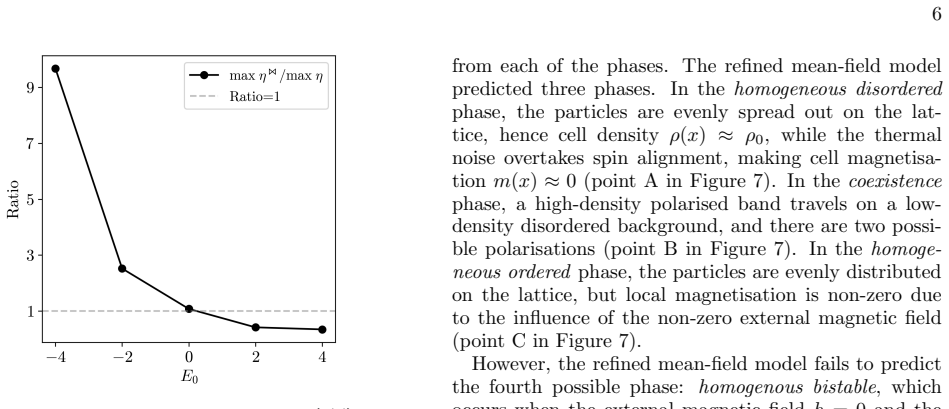
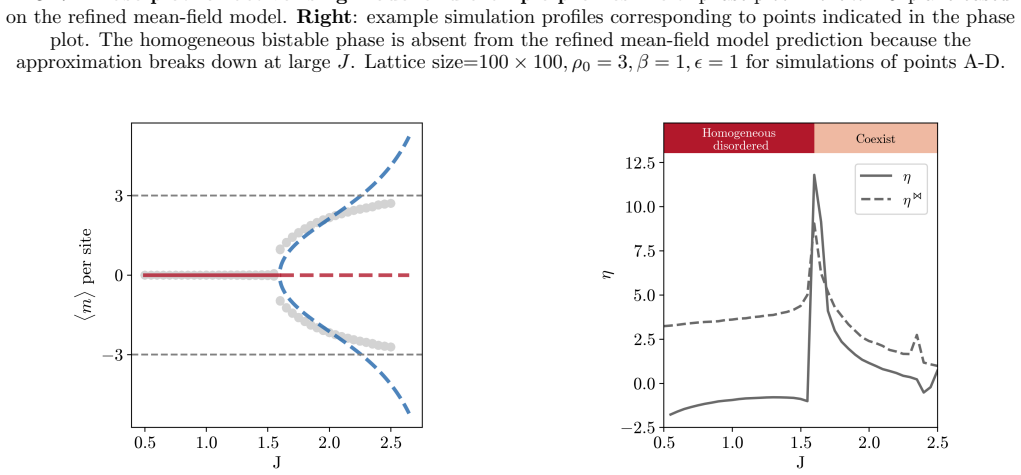
We extend an information-theoretic efficiency measure to nonequilibrium steady states and apply it to persistent and active Ising models. The measure, defined as the entropy reduction induced by a small control-parameter perturbation relative to the generalized work required for the perturbation, maximises at phase transitions. Thermodynamic efficiency and inferential efficiency are equal in equilibrium as a consequence of the fluctuation-dissipation theorem, but they diverge out of equilibrium and the gap reflects how far the system is from equilibrium.
What carries the argument
The information-theoretic efficiency quantity defined as the ratio of entropy reduction from a small control-parameter perturbation to the generalised work cost of that perturbation.
If this is right
- Thermodynamic efficiency of self-organisation maximises at phase transitions in nonequilibrium systems.
- Thermodynamic efficiency equals inferential efficiency in equilibrium systems.
- The divergence between thermodynamic and inferential efficiencies grows with increasing distance from equilibrium.
Where Pith is reading between the lines
- Phase transitions may mark the most energy-efficient operating points for designing artificial self-organizing systems.
- The size of the efficiency gap could serve as a direct, equilibrium-independent indicator of how nonequilibrium a steady state is.
- The same efficiency peak at transitions may appear in other classes of active matter such as flocking or reaction-diffusion systems.
Load-bearing premise
The information-theoretic efficiency quantity remains a valid and physically meaningful measure when applied directly to far-from-equilibrium steady states without additional corrections.
What would settle it
A simulation of the active Ising model in which thermodynamic efficiency does not reach a maximum exactly at the known phase-transition point.
Figures





read the original abstract
Active matter generates order or patterns through nonequilibrium dynamics. An open research challenge is to determine how efficiently a nonequilibrium self-organising system can convert consumed energy into macroscopic order. We study an information-theoretic quantity that directly addresses this challenge by estimating the entropy reduction induced by a small control-parameter perturbation, relative to the generalised work required for the perturbation. This quantity has previously been considered mainly in an equilibrium or near-equilibrium context, and here we extend this framework and apply it to two nonequilibrium self-organising systems: persistent and active Ising models. We observe that the thermodynamic efficiency of nonequilibrium systems maximises at phase transitions, as in equilibrium systems. Furthermore, we compare thermodynamic efficiency and inferential efficiency across control parameters. While these two quantities are equal in equilibrium as a consequence of the fluctuation-dissipation theorem, we report that they diverge out of equilibrium, and the gap reflects how far the system is from equilibrium.
Editorial analysis
A structured set of objections, weighed in public.
Referee Report
Summary. The manuscript claims that an information-theoretic measure of thermodynamic efficiency—defined as the entropy reduction induced by a small control-parameter perturbation relative to the generalized work required—maximizes at phase transitions in two nonequilibrium self-organizing systems (persistent and active Ising models). It further reports that this thermodynamic efficiency diverges from inferential efficiency out of equilibrium, with the size of the gap reflecting the system's distance from equilibrium, in contrast to their equality in equilibrium via the fluctuation-dissipation theorem.
Significance. If the central claims hold after validation, the work would usefully extend efficiency concepts from equilibrium statistical mechanics to far-from-equilibrium active matter, emphasizing the special role of phase transitions for self-organization efficiency. The explicit comparison of thermodynamic and inferential efficiencies across control parameters, applied to two distinct models, provides a clear empirical contrast and could serve as a template for analyzing other nonequilibrium systems.
major comments (2)
- [Results] Results section (figures showing efficiency vs. control parameter): the reported maximization of the information-theoretic efficiency at phase transitions lacks any direct comparison to an explicit thermodynamic dissipation measure, such as the entropy production rate obtained from the master equation or trajectory-level irreversibility. This validation is load-bearing because the quantity was previously derived under linear-response assumptions, and without it the peak cannot be confirmed as a thermodynamic rather than purely informational feature.
- [Discussion] Discussion of the efficiency gap: the statement that the divergence between thermodynamic and inferential efficiencies 'reflects how far the system is from equilibrium' is presented without a quantitative correlation to any independent nonequilibrium metric (e.g., magnitude of probability currents or steady-state entropy production). This leaves the interpretation of the gap as a distance-from-equilibrium indicator unsupported by the reported data.
minor comments (2)
- [Abstract] The abstract refers to results from 'two models' without naming them; specifying 'persistent and active Ising models' would improve immediate clarity for readers.
- [Notation and Results] Notation for the efficiency quantity, generalized work, and control parameters is introduced but not always restated consistently when results are presented; a brief recap table or equation reference in the results would aid readability.
Simulated Author's Rebuttal
We appreciate the referee's insightful comments on our manuscript. We have carefully considered each point and provide our responses below. Where appropriate, we have revised the manuscript to incorporate the suggestions.
read point-by-point responses
-
Referee: Results section (figures showing efficiency vs. control parameter): the reported maximization of the information-theoretic efficiency at phase transitions lacks any direct comparison to an explicit thermodynamic dissipation measure, such as the entropy production rate obtained from the master equation or trajectory-level irreversibility. This validation is load-bearing because the quantity was previously derived under linear-response assumptions, and without it the peak cannot be confirmed as a thermodynamic rather than purely informational feature.
Authors: The efficiency is defined directly in terms of the entropy reduction (a thermodynamic quantity) divided by the generalized work (also thermodynamic), so it is constructed as a thermodynamic efficiency by definition. The linear-response approximation applies only to the small control-parameter perturbation used to compute the response, not to the underlying nonequilibrium steady state. Nevertheless, to provide additional validation, we will include in the revised manuscript the entropy production rate computed via the master equation for the persistent Ising model, showing that dissipation is present and the efficiency peak occurs in a regime of significant entropy production. For the active Ising model, we add a discussion noting the challenges in computing exact trajectory irreversibility but argue that the information-theoretic measure remains valid as an estimator. revision: partial
-
Referee: Discussion of the efficiency gap: the statement that the divergence between thermodynamic and inferential efficiencies 'reflects how far the system is from equilibrium' is presented without a quantitative correlation to any independent nonequilibrium metric (e.g., magnitude of probability currents or steady-state entropy production). This leaves the interpretation of the gap as a distance-from-equilibrium indicator unsupported by the reported data.
Authors: We agree that a quantitative demonstration would be beneficial. In the revised manuscript, we have added a supplementary analysis that plots the efficiency gap against the steady-state entropy production rate for varying control parameters in both models. This reveals a clear correlation, with larger gaps corresponding to higher entropy production, thereby supporting the claim that the divergence reflects the distance from equilibrium. We have updated the discussion section to include this evidence. revision: yes
Circularity Check
No significant circularity in derivation chain
full rationale
The paper extends a previously defined information-theoretic efficiency quantity to nonequilibrium steady states in persistent and active Ising models, reporting that it maximizes at phase transitions and diverges from inferential efficiency (with the gap reflecting distance from equilibrium). The fluctuation-dissipation theorem is cited as an external standard result explaining equality in equilibrium, while the divergence is presented as an empirical observation rather than a definitional identity or forced outcome. No self-definitional reductions, fitted inputs renamed as predictions, load-bearing self-citations, or ansatz smuggling appear in the abstract or claims; the central results rely on direct application and comparison across control parameters without reducing to input definitions by construction.
Axiom & Free-Parameter Ledger
axioms (2)
- standard math Fluctuation-dissipation theorem holds in equilibrium and equates thermodynamic and inferential efficiencies
- domain assumption The information-theoretic efficiency quantity remains physically meaningful when applied to far-from-equilibrium steady states
Reference graph
Works this paper leans on
-
[1]
We note that the original study by Kumar and Dasgupta
Using the coupling strengthJas the control pa- rameter, we identify the average spin-spin interaction, ⟨P ⟨ij⟩ σiσj/N⟩, as the conjugate order parameter. We note that the original study by Kumar and Dasgupta
-
[2]
In both equilibrium and NESS, the system undergoes a phase transition when the control parameterJcrosses a critical value
considered temperatureTas the control parameter and average magnetisation|m|as the order parameter. In both equilibrium and NESS, the system undergoes a phase transition when the control parameterJcrosses a critical value. Figure 3a shows how the order parameter changes with the control parameter, for selected values ofE 0. In each case, we observe a shar...
-
[3]
Schaller, C
V. Schaller, C. Weber, C. Semmrich, E. Frey, and A. R. Bausch, Polar patterns of driven filaments, Nature467, 73 (2010)
2010
-
[4]
Sanchez, D
T. Sanchez, D. T. N. Chen, S. J. DeCamp, M. Heymann, and Z. Dogic, Spontaneous motion in hierarchically as- sembled active matter, Nature491, 431 (2012). 13 (a) 100×100 (b) 200×100 (c) 100×200 (d) 200×200 FIG. 13:Snapshots of steady state systems in the coexistence phase, for different lattice sizes. ρ0 = 3, β= 1, ϵ= 1 for all lattice sizes
2012
-
[5]
Deglincerti, G
A. Deglincerti, G. F. Croft, L. N. Pietila, M. Zernicka- Goetz, E. D. Siggia, and A. H. Brivanlou, Self- organization of the in vitro attached human embryo, Na- ture533, 251 (2016)
2016
-
[6]
M. N. Shahbazi, E. D. Siggia, and M. Zernicka-Goetz, Self-organization of stem cells into embryos: A win- dow on early mammalian development, Science364, 948 (2019)
2019
-
[7]
Niwa, Self-organizing dynamic model of fish school- ing, Journal of theoretical Biology171, 123 (1994)
H.-S. Niwa, Self-organizing dynamic model of fish school- ing, Journal of theoretical Biology171, 123 (1994)
1994
-
[8]
Vicsek and A
T. Vicsek and A. Zafeiris, Collective motion, Physics Re- ports517, 71 (2012)
2012
-
[9]
Cavagna, A
A. Cavagna, A. Cimarelli, I. Giardina, G. Parisi, R. San- tagati, F. Stefanini, and M. Viale, Scale-free correlations in starling flocks, Proceedings of the National Academy of Sciences107, 11865 (2010)
2010
-
[10]
Committee on Biological Physics/Physics of Living Sys- tems: A Decadal Survey, Board on Physics and Astron- omy, Board on Life Sciences, Division on Engineering and Physical Sciences, Division on Earth and Life Studies, and National Academies of Sciences, Engineering, and Medicine,Physics of Life(National Academies Press,
-
[11]
Shiraishi,An Introduction to Stochastic Thermody- namics: From Basic to Advanced, Fundamental Theories of Physics, Vol
N. Shiraishi,An Introduction to Stochastic Thermody- namics: From Basic to Advanced, Fundamental Theories of Physics, Vol. 212 (Springer Nature Singapore, 2023)
2023
-
[12]
D. L. Barton, S. Henkes, C. J. Weijer, and R. Sknepnek, Active Vertex Model for cell-resolution description of ep- ithelial tissue mechanics, PLOS Computational Biology 13, e1005569 (2017)
2017
-
[13]
J¨ ulicher, S
F. J¨ ulicher, S. W. Grill, and G. Salbreux, Hydrodynamic theory of active matter, Reports on Progress in Physics 81, 076601 (2018)
2018
-
[14]
Crosato, M
E. Crosato, M. Prokopenko, and R. E. Spinney, Irre- versibility and emergent structure in active matter, Phys- ical Review E100, 042613 (2019)
2019
-
[15]
Van Den Broeck, Thermodynamic Efficiency at Maxi- mum Power, Physical Review Letters95, 190602 (2005)
C. Van Den Broeck, Thermodynamic Efficiency at Maxi- mum Power, Physical Review Letters95, 190602 (2005)
2005
-
[16]
Benenti, K
G. Benenti, K. Saito, and G. Casati, Thermodynamic Bounds on Efficiency for Systems with Broken Time- Reversal Symmetry, Physical Review Letters106, 230602 (2011)
2011
-
[17]
Brandner, K
K. Brandner, K. Saito, and U. Seifert, Strong Bounds on Onsager Coefficients and Efficiency for Three-Terminal Thermoelectric Transport in a Magnetic Field, Physical Review Letters110, 070603 (2013)
2013
-
[18]
Pietzonka and U
P. Pietzonka and U. Seifert, Universal Trade-Off between Power, Efficiency, and Constancy in Steady-State Heat Engines, Physical Review Letters120, 190602 (2018)
2018
-
[19]
R. D. Vale, The Molecular Motor Toolbox for Intracellu- lar Transport, Cell112, 467 (2003)
2003
-
[20]
Seifert,Stochastic Thermodynamics, 1st ed
U. Seifert,Stochastic Thermodynamics, 1st ed. (Cam- bridge University Press, 2025)
2025
-
[21]
H. V. Westerhoff, K. J. Hellingwerf, and K. V. Dam, Thermodynamic efficiency of microbial growth is low but optimal for maximal growth rate, Proceedings of the Na- tional Academy of Sciences80, 305 (1983)
1983
-
[22]
C. P. Kempes, D. Wolpert, Z. Cohen, and J. P´ erez- Mercader, The thermodynamic efficiency of computa- tions made in cells across the range of life, Philosophi- cal Transactions of the Royal Society A: Mathematical, Physical and Engineering Sciences375, 20160343 (2017)
2017
-
[23]
Crosato, R
E. Crosato, R. E. Spinney, R. Nigmatullin, J. T. Lizier, and M. Prokopenko, Thermodynamics and computation during collective motion near criticality, Physical Review E97, 1 (2018)
2018
-
[24]
Nigmatullin and M
R. Nigmatullin and M. Prokopenko, Thermodynamic effi- ciency of interactions in self-organizing systems, Entropy 23, 757 (2021)
2021
-
[25]
Chen and M
Q. Chen and M. Prokopenko, Why collective behaviours self-organize to criticality: A primer on information- theoretic and thermodynamic utility measures, Royal So- ciety Open Science12, 241655 (2025)
2025
-
[26]
Q. Chen, N. Ay, and M. Prokopenko, Generalising thermodynamic efficiency of interactions: Inferential, information-geometric and computational perspectives, Journal of Physics: Complexity7, 025002 (2026)
2026
-
[27]
Crosato, R
E. Crosato, R. Nigmatullin, and M. Prokopenko, On crit- ical dynamics and thermodynamic efficiency of urban transformations, Royal Society Open Science5, 180863 (2018)
2018
-
[28]
Harding, R
N. Harding, R. Nigmatullin, and M. Prokopenko, Ther- modynamic efficiency of contagions: A statistical me- chanical analysis of the SIS epidemic model, Interface Focus8, 20180036 (2018)
2018
-
[29]
A. E. Allahverdyan, D. Janzing, and G. Mahler, Thermo- dynamic efficiency of information and heat flow, Journal of Statistical Mechanics: Theory and Experiment2009, P09011 (2009)
2009
-
[30]
Peliti and S
L. Peliti and S. Pigolotti,Stochastic Thermodynamics: An Introduction(Princeton University Press, 2021)
2021
-
[31]
Seifert, Stochastic thermodynamics, fluctuation the- orems and molecular machines, Reports on Progress in Physics75, 126001 (2012)
U. Seifert, Stochastic thermodynamics, fluctuation the- orems and molecular machines, Reports on Progress in Physics75, 126001 (2012)
2012
-
[32]
Kumar and C
M. Kumar and C. Dasgupta, Nonequilibrium phase tran- sition in an Ising model without detailed balance, Phys- ical Review E102, 052111 (2020)
2020
-
[33]
A. P. Solon and J. Tailleur, Revisiting the Flocking Tran- 14 sition Using Active Spins, Physical Review Letters111, 078101 (2013)
2013
-
[34]
A. P. Solon and J. Tailleur, Flocking with discrete sym- metry: The two-dimensional active Ising model, Physical Review E92, 042119 (2015)
2015
-
[35]
G. E. Crooks, Measuring Thermodynamic Length, Phys- ical Review Letters99, 100602 (2007)
2007
-
[36]
R. J. Glauber, Time-Dependent Statistics of the Ising Model, Journal of Mathematical Physics4, 294 (1963)
1963
-
[37]
Harada and S.-i
T. Harada and S.-i. Sasa, Equality Connecting Energy Dissipation with a Violation of the Fluctuation-Response Relation, Physical Review Letters95, 130602 (2005)
2005
-
[38]
Tom´ e and M
T. Tom´ e and M. J. De Oliveira, Dynamic phase transi- tion in the kinetic Ising model under a time-dependent oscillating field, Physical Review A41, 4251 (1990)
1990
-
[39]
B. K. Chakrabarti and M. Acharyya, Dynamic transi- tions and hysteresis, Reviews of Modern Physics71, 847 (1999)
1999
-
[40]
D. S. Seara, B. B. Machta, and M. P. Murrell, Irreversibil- ity in dynamical phases and transitions, Nature Commu- nications12, 392 (2021)
2021
-
[41]
Quintana and A
M. Quintana and A. Berger, Experimental Observation of Critical Scaling in Magnetic Dynamic Phase Transitions, Physical Review Letters131, 116701 (2023)
2023
-
[42]
Kim, M.-S
K. Kim, M.-S. Chang, S. Korenblit, R. Islam, E. E. Edwards, J. K. Freericks, G.-D. Lin, L.-M. Duan, and C. Monroe, Quantum simulation of frustrated Ising spins with trapped ions, Nature465, 590 (2010)
2010
-
[43]
Y. Avni, M. Fruchart, D. Martin, D. Seara, and V. Vitelli, Nonreciprocal Ising Model, Physical Review Letters134, 117103 (2025)
2025
-
[44]
Mangeat, S
M. Mangeat, S. Chatterjee, J. D. Noh, and H. Rieger, Emergent complex phases in a discrete flocking model with reciprocal and non-reciprocal interactions, Commu- nications Physics8, 186 (2025)
2025
-
[45]
Kikuchi, A Theory of Cooperative Phenomena, Phys- ical Review81, 988 (1951)
R. Kikuchi, A Theory of Cooperative Phenomena, Phys- ical Review81, 988 (1951)
1951
discussion (0)
Sign in with ORCID, Apple, or X to comment. Anyone can read and Pith papers without signing in.