Recognition: unknown
Second quantization of anyons and spin-anyon duality
Pith reviewed 2026-05-08 17:28 UTC · model grok-4.3
The pith
An algebraic framework for 1D Abelian anyons with phase π/N yields an exact Jordan-Wigner duality mapping π/3 anyons to spin-1 operators.
A machine-rendered reading of the paper's core claim, the machinery that carries it, and where it could break.
Core claim
We develop an algebraic framework for Abelian anyons in one dimension with statistical phase θ = π/N that enforces a finite on-site occupancy of N-1 anyons with the exchange phase θ between different sites. Moreover, we introduce an exact Jordan-Wigner duality between π/3 anyons and spin-1 operators, allowing us to map a tight-binding anyon model to an XY-like spin-1 model. The model exhibits anyon-density-dependent flux, incompressible or gapless regions, and critical points with level crossings that appear as discontinuities in ground-state currents, momenta, fidelities, and correlation functions.
What carries the argument
The exact Jordan-Wigner duality between π/3 anyon operators and spin-1 operators, which converts the anyon hopping term into an XY interaction accompanied by density-dependent phase factors.
If this is right
- The anyon hopping model maps to an XY spin-1 chain whose flux depends on local anyon density.
- The phase diagram contains incompressible and gapless regions separated by critical points.
- Level crossings at those critical points produce jumps in ground-state currents, momenta, fidelities, and correlation functions.
- Anyons can be realized by engineering appropriate spin-1 Hamiltonians rather than by direct anyon creation.
Where Pith is reading between the lines
- Existing spin-1 materials or optical lattices could be tuned to display signatures of anyonic statistics through the mapped Hamiltonian.
- The algebraic construction may generalize to other rational phases θ = π/N if similar occupancy-constrained commutation rules can be found.
- Device proposals could use spin chains as simulators for anyon transport and braiding without requiring fractional quantum Hall platforms.
Load-bearing premise
A consistent commutation algebra exists for Abelian anyons in 1D that simultaneously enforces the finite on-site occupancy N-1 and the non-local exchange phase θ between different sites.
What would settle it
Numerical diagonalization of the XY spin-1 chain that fails to reproduce discontinuities in ground-state current or momentum at the densities where the anyon model predicts level crossings would falsify the duality.
Figures


read the original abstract
Anyons exhibit a non-trivial interplay between local exclusion rules and non-local braiding and exchange phases, making a consistent commutation algebra and second-quantized formulation challenging. We develop an algebraic framework for Abelian anyons in one dimension with statistical phase $\theta$ = $\pi$/N that enforces a finite on-site occupancy of N-1 anyons with the exchange phase $\theta$ between different sites. Moreover, we introduce an exact Jordan-Wigner duality between $\pi$/3 anyons and spin-1 operators, allowing us to map a tight-binding anyon model to an XY-like spin-1 model. The model exhibits anyon-density-dependent flux, incompressible or gapless regions, and critical points with level crossings that appear as discontinuities in ground-state currents, momenta, fidelities, and correlation functions. Our second-quantization formalism establishes a novel spin anyon duality, offering a conceptually new route to realize anyons from spin Hamiltonians and to engineer corresponding device architectures.
Editorial analysis
A structured set of objections, weighed in public.
Referee Report
Summary. The manuscript develops an algebraic framework for Abelian anyons in one dimension with statistical phase θ=π/N that enforces a finite on-site occupancy of N-1 anyons per site together with the non-local exchange phase θ between different sites. It introduces an exact Jordan-Wigner duality between π/3 anyons and spin-1 operators that maps a tight-binding anyon Hamiltonian to an XY-like spin-1 model. The mapped model is shown to exhibit anyon-density-dependent flux, incompressible or gapless regions, and critical points whose level crossings appear as discontinuities in ground-state currents, momenta, fidelities, and correlation functions.
Significance. If the claimed exact duality and consistent algebra hold, the work supplies a novel spin-anyon duality that offers a conceptually new route to realize anyonic physics from spin Hamiltonians. This could facilitate quantum simulation and device engineering by translating anyonic models into experimentally accessible spin systems, while the reported density-dependent phenomena and current discontinuities provide concrete, falsifiable signatures.
major comments (2)
- [Algebraic framework for anyons (section introducing commutation relations)] The central claim requires a closed, associative commutation algebra for the anyon operators that simultaneously enforces the local occupancy constraint (a_i^N = 0) and the non-local phase factor e^{iθ} with θ=π/3. The manuscript asserts this algebra exists and enables an exact mapping, but does not provide an explicit check of associativity or a faithful representation on the constrained local Hilbert space of dimension N. This verification is load-bearing for the exactness of the Jordan-Wigner duality and the subsequent physical predictions.
- [Jordan-Wigner duality section] The Jordan-Wigner mapping to spin-1 operators is stated to be exact, yet the manuscript does not demonstrate that the non-local phase factors are fully absorbed into the spin operators without residual terms that would alter the XY-like Hamiltonian. An explicit operator-level derivation (including the action on the constrained space) is needed to confirm the mapping preserves the spectrum and observables.
minor comments (2)
- [Abstract and introduction] Notation for the anyon operators and the precise definition of the local constraint (e.g., whether it is a_i^3=0 or a more general projector) should be stated uniformly in the abstract and main text to avoid ambiguity for N=3.
- [Results section] The figures showing discontinuities in currents and fidelities would benefit from explicit labeling of the critical points and the corresponding anyon densities to make the connection to the level crossings clearer.
Simulated Author's Rebuttal
We thank the referee for the careful and constructive review of our manuscript. The two major comments identify important points where additional explicit verification would strengthen the presentation of the algebraic framework and the duality mapping. We address each comment below and have revised the manuscript to incorporate the requested details.
read point-by-point responses
-
Referee: [Algebraic framework for anyons (section introducing commutation relations)] The central claim requires a closed, associative commutation algebra for the anyon operators that simultaneously enforces the local occupancy constraint (a_i^N = 0) and the non-local phase factor e^{iθ} with θ=π/3. The manuscript asserts this algebra exists and enables an exact mapping, but does not provide an explicit check of associativity or a faithful representation on the constrained local Hilbert space of dimension N. This verification is load-bearing for the exactness of the Jordan-Wigner duality and the subsequent physical predictions.
Authors: We agree that an explicit verification of associativity and the faithful representation is necessary for rigor. In the revised manuscript we have added a dedicated appendix that (i) derives the full set of commutation relations for general θ=π/N, (ii) verifies associativity by direct computation on triple products of operators, and (iii) constructs the explicit matrix representation on the N-dimensional local Hilbert space (states |0⟩ to |N−1⟩) that enforces a_i^N=0 while reproducing the non-local phase e^{iθ} for i≠j. These checks confirm that the algebra is consistent and closed on the constrained space. revision: yes
-
Referee: [Jordan-Wigner duality section] The Jordan-Wigner mapping to spin-1 operators is stated to be exact, yet the manuscript does not demonstrate that the non-local phase factors are fully absorbed into the spin operators without residual terms that would alter the XY-like Hamiltonian. An explicit operator-level derivation (including the action on the constrained space) is needed to confirm the mapping preserves the spectrum and observables.
Authors: We accept that the original text lacked a fully expanded operator-level derivation. The revised manuscript now contains a step-by-step derivation of the duality for θ=π/3. Starting from the anyon operators, we define the spin-1 operators S_i^α via the generalized Jordan-Wigner string that incorporates the phase factors. We then show explicitly that all non-local phases are absorbed into the definition of the spin operators, leaving a purely local XY-like Hamiltonian with no residual terms. The mapping is verified to be unitary on the constrained space, preserving the spectrum and all observables; this is illustrated by direct computation on small chains (L=2,3) and by showing that the anyon number operator maps to the appropriate spin projection. revision: yes
Circularity Check
No significant circularity; derivation chain is self-contained
full rationale
The paper introduces a new algebraic framework for Abelian anyons in 1D that enforces both finite on-site occupancy (N-1) and the exchange phase θ=π/N, then presents an exact Jordan-Wigner duality mapping π/3 anyons to spin-1 operators. These are described as original constructions in the abstract and title, with the duality allowing a mapping of the tight-binding anyon Hamiltonian to an XY-like spin-1 model. No load-bearing steps reduce by construction to prior inputs, self-citations, or fitted parameters renamed as predictions. The central claims rest on the consistency of the newly developed algebra and duality rather than redefinitions or external uniqueness theorems from the same authors. The reported phenomena (density-dependent flux, level crossings, current discontinuities) follow from the mapped model without evident circular reduction.
Axiom & Free-Parameter Ledger
axioms (1)
- domain assumption Abelian anyons in 1D with statistical phase θ = π/N enforce a finite on-site occupancy of N-1 anyons together with the exchange phase θ between different sites.
Reference graph
Works this paper leans on
-
[1]
Assumingi < j, this state is created byb † i b† j|0⟩
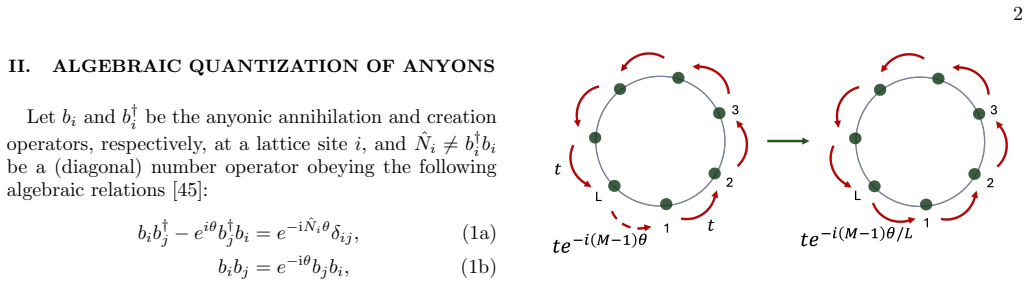
Three-Site Two-Anyon Processes We label the two anyon states as (ij), where the first anyon occupies siteiand the second occupies sitej, wherei, j∈ {1,2,3}. Assumingi < j, this state is created byb † i b† j|0⟩. We focus on two distinct exchange processes that take the anyons initially located at sites 1 and 2 to the final configuration at sites 2 and 3 as...
-
[2]
anyon-like
Four-Site Two-Anyon Processes Next, we examine the following four processes on a four-site lattice containing two anyons, A: (13)− →(14)− →(24)− →(21)− →(31), B: (13)− →(14)− →(24)− →(21)− →(31) − →(32)− →(42)− →(43)− →(13), C: (13)− →(23)− →(22)− →(12)− →(13), D: (13)− →(12)− →(22)− →(23)− →(13).(A3) Each of these processes involves two anyons initially ...
-
[3]
J. M. Leinaas and J. Myrheim, On the theory of identical particles, Nuovo Cimento B37, 1 (1977)
1977
-
[4]
G. A. Goldin, R. Menikoff, and D. H. Sharp, Represen- tations of a local current algebra in nonsimply connected space and the Aharonov–Bohm effect, J. Math. Phys.22, 1664 (1981)
1981
-
[5]
Wilczek, Quantum mechanics of fractional-spin parti- cles, Phys
F. Wilczek, Quantum mechanics of fractional-spin parti- cles, Phys. Rev. Lett.49, 957 (1982)
1982
-
[6]
Wilczek, Magnetic flux, angular momentum, and statistics, Phys
F. Wilczek, Magnetic flux, angular momentum, and statistics, Phys. Rev. Lett.48, 1144 (1982)
1982
-
[7]
D. C. Tsui, H. L. Stormer, and A. C. Gossard, Two- dimensional magnetotransport in the extreme quantum limit, Phys. Rev. Lett.48, 1559 (1982)
1982
-
[8]
R. B. Laughlin, Anomalous quantum Hall effect: An in- compressible quantum fluid with fractionally charged ex- citations, Phys. Rev. Lett.50, 1395 (1983)
1983
-
[9]
B. I. Halperin, Statistics of quasiparticles and the hierar- chy of fractional quantized Hall states, Phys. Rev. Lett. 52, 1583 (1984)
1984
-
[10]
Arovas, J
D. Arovas, J. R. Schrieffer, and F. Wilczek, Fractional statistics and the quantum Hall effect, Phys. Rev. Lett. 53, 722 (1984)
1984
-
[11]
Wen, Chiral luttinger liquid and the edge excita- tions in the fractional quantum Hall states, Phys
X.-G. Wen, Chiral luttinger liquid and the edge excita- tions in the fractional quantum Hall states, Phys. Rev. B41, 12838 (1990)
1990
-
[12]
Nayak, S
C. Nayak, S. H. Simon, A. Stern, M. Freedman, and S. Das Sarma, Non-Abelian anyons and topological quan- tum computation, Rev. Mod. Phys.80, 1083 (2008)
2008
-
[13]
Kundu, Exact solution of doubleδ-function Bose gas through an interacting anyon gas, Phys
A. Kundu, Exact solution of doubleδ-function Bose gas through an interacting anyon gas, Phys. Rev. Lett.83, 1275 (1999)
1999
-
[14]
M. T. Batchelor, X.-W. Guan, and N. Oelkers, One- dimensional interacting anyon gas: Low-energy proper- ties and Haldane exclusion statistics, Phys. Rev. Lett. 96, 210402 (2006)
2006
-
[15]
Keilmann, S
T. Keilmann, S. Lanzmich, I. McCulloch, and M. Roncaglia, Statistically induced phase transitions and anyons in 1d optical lattices, Nature Communications2, 361 (2011)
2011
-
[16]
Greschner and L
S. Greschner and L. Santos, Anyon hubbard model in one-dimensional optical lattices, Phys. Rev. Lett.115, 053002 (2015)
2015
-
[17]
G. Tang, S. Eggert, and A. Pelster, Ground-state proper- ties of anyons in a one-dimensional lattice, New J. Phys. 17, 123016 (2015)
2015
-
[18]
Cardarelli, S
L. Cardarelli, S. Greschner, and L. Santos, Engineering interactions and anyon statistics by multicolor lattice- depth modulations, Phys. Rev. A94, 023615 (2016)
2016
-
[19]
Str¨ ater, S
C. Str¨ ater, S. C. Srivastava, and A. Eckardt, Floquet realization and signatures of one-dimensional anyons in an optical lattice, Phys. Rev. Lett.117, 205303 (2016)
2016
-
[20]
Agarwala, G
A. Agarwala, G. K. Gupta, V. B. Shenoy, and S. Bhat- tacharjee, Statistics-tuned phases of pseudofermions in one dimension, Phys. Rev. B99, 165125 (2019)
2019
-
[21]
Aditya and D
S. Aditya and D. Sen, Bosonization study of a generalized statistics model with four Fermi points, Phys. Rev. B 103, 235162 (2021)
2021
-
[22]
Brollo, A
A. Brollo, A. Veronese, and L. Salasnich, Two-site any- onic Josephson junction, Phys. Rev. A106, 023308 (2022)
2022
-
[23]
Fractional statistics
F. D. M. Haldane, “Fractional statistics” in arbitrary dimensions: A generalization of the Pauli principle, Phys. 11 Rev. Lett.67, 937 (1991)
1991
-
[24]
A. P. Polychronakos, Probabilities and path-integral re- alization of exclusion statistics, Physics Letters B365, 202 (1996)
1996
-
[25]
Bartolomei, M
H. Bartolomei, M. Kumar, R. Bisognin, A. Marguerite, J.-M. Berroir, E. Bocquillon, B. Placais, A. Cavanna, Q. Dong, U. Gennser,et al., Fractional statistics in anyon collisions, Science368, 173 (2020)
2020
-
[26]
S. J. Rabello, A gauge theory of one-dimensional anyons, Physics Letters B363, 180 (1995)
1995
-
[27]
S. J. B. Rabello, 1d generalized statistics gas: A gauge theory approach, Phys. Rev. Lett.76, 4007 (1996)
1996
-
[28]
J. Kwan, P. Segura, Y. Li, S. Kim, A. V. Gorshkov, A. Eckardt, B. Bakkali-Hassani, and M. Greiner, Realiza- tion of one-dimensional anyons with arbitrary statistical phase, Science386, 1055 (2024)
2024
-
[29]
Roushan, C
P. Roushan, C. Neill, A. Megrant, Y. Chen, R. Bab- bush, R. Barends, B. Campbell, Z. Chen, B. Chiaro, A. Dunsworth,et al., Chiral ground-state currents of in- teracting photons in a synthetic magnetic field, Nature Physics13, 146 (2017)
2017
-
[30]
L. W. Clark, B. M. Anderson, L. Feng, A. Gaj, K. Levin, and C. Chin, Observation of density-dependent gauge fields in a Bose-Einstein condensate based on micromo- tion control in a shaken two-dimensional lattice, Phys. Rev. Lett.121, 030402 (2018)
2018
-
[31]
Lienhard, P
V. Lienhard, P. Scholl, S. Weber, D. Barredo, S. de L´ es´ eleuc, R. Bai, N. Lang, M. Fleischhauer, H. P. B¨ uchler, T. Lahaye,et al., Realization of a density- dependent Peierls phase in a synthetic, spin-orbit coupled Rydberg system, Phys. Rev. X10, 021031 (2020)
2020
-
[32]
K.-X. Yao, Z. Zhang, and C. Chin, Domain-wall dynam- ics in Bose–Einstein condensates with synthetic gauge fields, Nature602, 68 (2022)
2022
-
[33]
Fr¨ olian, C
A. Fr¨ olian, C. S. Chisholm, E. Neri, C. R. Cabrera, R. Ramos, A. Celi, and L. Tarruell, Realizing a 1d topo- logical gauge theory in an optically dressed BEC, Nature 608, 293 (2022)
2022
-
[34]
Arik and D
M. Arik and D. D. Coon, Hilbert spaces of analytic func- tions and generalized coherent states, J. Math. Phys.17, 524 (1976)
1976
-
[35]
Biedenharn, The quantum groupSU q(2) and aq- analogue of the boson operators, J
L. Biedenharn, The quantum groupSU q(2) and aq- analogue of the boson operators, J. Phys. A22, L873 (1989)
1989
-
[36]
Zagier, Realizability of a model in infinite statis- tics, Communications in Mathematical Physics147, 199 (1992)
D. Zagier, Realizability of a model in infinite statis- tics, Communications in Mathematical Physics147, 199 (1992)
1992
-
[37]
Greenberg, Example of infinite statistics, Phys
O. Greenberg, Example of infinite statistics, Phys. Rev. Lett.64, 705 (1990)
1990
-
[38]
D. I. Fivel, Interpolation between Fermi and Bose statis- tics using generalized commutators, Phys. Rev. Lett.65, 3361 (1990)
1990
-
[39]
Greenberg, Particles with small violations of Fermi or Bose statistics, Phys
O. Greenberg, Particles with small violations of Fermi or Bose statistics, Phys. Rev. D43, 4111 (1991)
1991
-
[40]
Bo˙ zejko and R
M. Bo˙ zejko and R. Speicher, An example of a general- ized Brownian motion, Communications in Mathematical Physics137, 519 (1991)
1991
-
[41]
Chaturvedi, A
S. Chaturvedi, A. Kapoor, R. Sandhya, V. Srinivasan, and R. Simon, Generalized commutation relations for a single-mode oscillator, Phys. Rev. A43, 4555 (1991)
1991
-
[42]
Macfarlane, Onq-analogues of the quantum harmonic oscillator and the quantum groupSU q(2), J
A. Macfarlane, Onq-analogues of the quantum harmonic oscillator and the quantum groupSU q(2), J. Phys. A22, 4581 (1989)
1989
-
[43]
Yan,q-deformed oscillator algebra as a quantum group, J
H. Yan,q-deformed oscillator algebra as a quantum group, J. Phys. A23, L1155 (1990)
1990
-
[44]
Chaichian, R
M. Chaichian, R. G. Felipe, and C. Montonen, Statistics ofq-oscillators, quons and relations to fractional statis- tics, J. Phys. A26, 4017 (1993)
1993
-
[45]
Narayana Swamy, Interpolating statistics andq- deformed oscillator algebras, Int
P. Narayana Swamy, Interpolating statistics andq- deformed oscillator algebras, Int. J. Mod. Phys. B20, 697 (2006)
2006
-
[46]
Bhasin and T
P. Bhasin and T. Das, A Hermitian bypass to the non- Hermitian quantum theory, J. Phys. A58, 125303 (2025)
2025
-
[47]
Using polar decomposition, we can writeC i =U i|Ci|, where |Ci|= q C † i Ci is invertible, andU i is a unitary operator
The prescribed algebra stems from a more general consid- eration ofb ib† j −eiθb† jbi =C iδij whereC i ̸=C † i ̸=I. Using polar decomposition, we can writeC i =U i|Ci|, where |Ci|= q C † i Ci is invertible, andU i is a unitary operator. WritingU i =e −iθ ˆNi whereN i is a Hermitian operator and rescalingb i → |C i|−1/2bi, we arrive at Eq. (1a)
-
[48]
Kalmeyer and R
V. Kalmeyer and R. Laughlin, Equivalence of the resonating-valence-bond and fractional quantum hall states, Physical review letters59, 2095 (1987)
2095
-
[49]
X.-G. Wen, F. Wilczek, and A. Zee, Chiral spin states and superconductivity, Physical Review B39, 11413 (1989)
1989
-
[50]
Gorohovsky, R
G. Gorohovsky, R. G. Pereira, and E. Sela, Chiral spin liquids in arrays of spin chains, Physical Review B91, 245139 (2015)
2015
-
[51]
Ferraz, F
G. Ferraz, F. B. Ramos, R. Egger, and R. G. Pereira, Spin chain network construction of chiral spin liquids, Physical Review Letters123, 137202 (2019)
2019
-
[52]
Wen, Quantum field theory of many-body systems: From the origin of sound to an origin of light and elec- trons (Oxford University Press, 2004)
X.-G. Wen, Quantum field theory of many-body systems: From the origin of sound to an origin of light and elec- trons (Oxford University Press, 2004)
2004
-
[53]
Yang, J.-H
S. Yang, J.-H. Zheng, and T. Yang, Fidelity study of the quantum phase transition in the one-dimensional spin- 1 xxz model in the thermodynamic limit, Phys. Rev. B 111, 134436 (2025)
2025
-
[54]
H.-K. Tang, M. A. Marashli, and W. C. Yu, Unveiling quantum phase transitions by fidelity mapping, Phys. Rev. B104, 075142 (2021)
2021
-
[55]
M. J. Edmonds, M. Valiente, G. Juzeli¯ unas, L. Santos, and P. ¨Ohberg, Simulating an interacting gauge theory with ultracold Bose gases, Phys. Rev. Lett.110, 085301 (2013)
2013
-
[56]
Wang and K
Z. Wang and K. R. A. Hazzard, Particle exchange statis- tics beyond fermions and bosons, Nature637, 314 (2025)
2025
-
[57]
Jordan and E
P. Jordan and E. Wigner, ¨Uber das Paulische ¨Aquivalenzverbot, Zeitschrift f¨ ur Physik47, 631 (1928)
1928
-
[58]
D. J. Thouless and Q. Li, Ring exchange and the frac- tional quantum hall effect, Phys. Rev. B36, 4581 (1987)
1987
discussion (0)
Sign in with ORCID, Apple, or X to comment. Anyone can read and Pith papers without signing in.