Recognition: unknown
The Nonreciprocal Mie-surfaces
Pith reviewed 2026-05-08 16:44 UTC · model grok-4.3
The pith
A square grid of silicon hemispheres transmits and reflects light differently depending on direction due to anapole interference.
A machine-rendered reading of the paper's core claim, the machinery that carries it, and where it could break.
Core claim
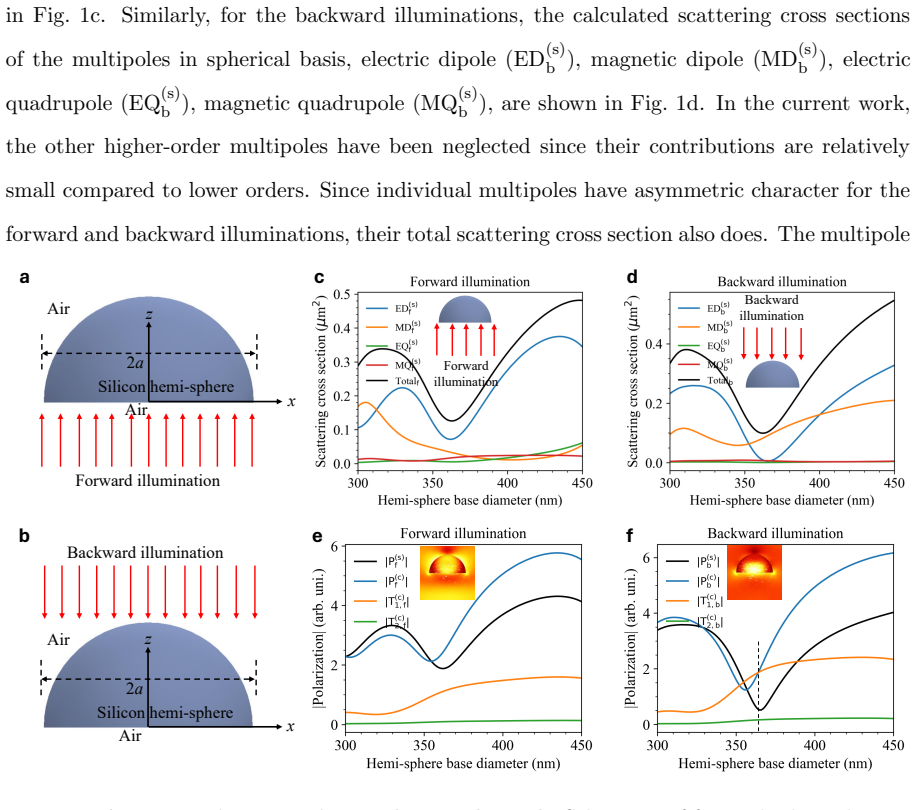
Hemispherical amorphous silicon nanoparticles exhibit asymmetric optical scattering for forward illumination (base-to-apex) versus backward illumination (apex-to-base). An anapole mode exists only for backward propagation, allowing maximal forward scattering and suppressing backward scattering. When these hemispheres repeat in a square grid in air the resulting surface produces nonreciprocal reflection and transmission whose spectral position depends solely on particle diameter rather than periodicity. The same array on a glass substrate yields a small redshift while preserving the nonreciprocity. Individual materials obey Lorentz reciprocity; the observed nonreciprocity arises purely from a
What carries the argument
The anapole mode of Mie scattering in a hemisphere, present only for apex-to-base illumination, which produces asymmetric forward scattering that interferes constructively across the array to yield net nonreciprocity.
If this is right
- Nonreciprocal behavior becomes possible in fully passive, linear, time-invariant systems without magnetic bias or nonlinear materials.
- The nonreciprocity spectrum can be shifted by changing only the hemisphere diameter while leaving the grid spacing free.
- Fabrication tolerances on periodicity are relaxed because the effect does not rely on precise inter-particle distance.
- Placing the array on a substrate introduces only a small spectral shift, allowing integration with common optical platforms.
Where Pith is reading between the lines
- The same principle might be tested with other high-index particle shapes to move the operating band into the visible or infrared.
- Embedding the array inside a waveguide could produce compact, passive optical isolators whose isolation ratio depends on particle size.
- Varying the substrate index would provide an experimental knob to check whether the redshift remains minor and the nonreciprocity survives.
- Large-area versions could be fabricated by self-assembly since periodicity is not critical.
Load-bearing premise
The anapole must remain strictly absent under forward illumination so that array-level interference alone creates unequal forward and backward responses.
What would settle it
Numerical simulation or measurement of the square array showing identical reflection and transmission spectra for light incident from opposite sides would falsify the claim.
Figures


read the original abstract
Hemispherical amorphous silicon nanoparticles exhibit asymmetric optical scattering for forward illumination (base-to-apex) and backward illumination (apex-to-base). There exists an anapole mode only for backward propagation, not for forward. Due to the anapole, light is allowed to scatter maximally along the forward direction, and not in the backward direction. A structured surface obtained by repeating hemispheres in a square grid in air exhibits nonreciprocal reflection and transmission for light propagating through it. This nonreciprocity only depends on the diameter of the hemisphere, not on the periodicity. The same surface on a glass substrate causes a minor spectral redshift in the nonreciprocity. Here, the individual materials are Lorentz reciprocal, but the current nonreciprocity is due to interference. The current nonreciprocity is purely based on anapole of Mie scattering; therefore, the surface is termed as ``Nonreciprocal Mie-surface''. Such surfaces could be used for the applications of passive linear nonreciprocal photonic devices.
Editorial analysis
A structured set of objections, weighed in public.
Referee Report
Summary. The manuscript claims that hemispherical amorphous silicon nanoparticles exhibit asymmetric Mie scattering, with an anapole mode present only for backward (apex-to-base) illumination that enables maximal forward scattering. Repeating these hemispheres in a square grid in air produces a 'Nonreciprocal Mie-surface' with direction-dependent reflection and transmission that depends solely on hemisphere diameter (not periodicity) due to interference, even though the constituent materials remain Lorentz reciprocal. Placement on a glass substrate induces a minor spectral redshift. The structure is proposed for passive linear nonreciprocal photonic devices.
Significance. If the central claim were valid, the work would identify a purely geometric, interference-based route to passive nonreciprocity in linear dielectric systems, bypassing the need for magneto-optics, nonlinearity, or time modulation. This would be of high interest for compact optical isolators and diodes. The reported independence of the effect from lattice periodicity would further simplify design if substantiated.
major comments (3)
- [Abstract] Abstract: the claim that nonreciprocity 'only depends on the diameter of the hemisphere, not on the periodicity' is presented without any supporting equations, simulation parameters, or comparative data across different lattice constants. No error analysis or quantitative transmittance spectra are supplied to establish this independence.
- [Abstract] Abstract and main text: the assertion of nonreciprocal transmission (T_forward ≠ T_backward) for a structure composed exclusively of Lorentz-reciprocal materials (amorphous silicon and air) contradicts the Lorentz reciprocity theorem, which requires a symmetric scattering matrix and identical transmittance for opposite illuminations in any linear, time-invariant, passive reciprocal system. No section derives how direction-specific anapole modes or array interference can break this symmetry.
- [Abstract] Abstract: the manuscript supplies no numerical method (e.g., FDTD or FEM), boundary conditions, or periodic Green's function treatment to allow verification that the claimed nonreciprocity survives the constraints of the periodic array while preserving reciprocity.
minor comments (2)
- [Abstract] The abstract states that placement on a glass substrate 'causes a minor spectral redshift' but provides neither quantitative shift values nor accompanying spectra or figures.
- [Abstract] The term 'Nonreciprocal Mie-surface' is introduced without a clear definition distinguishing its scattering-matrix properties from those of ordinary reciprocal Mie arrays.
Simulated Author's Rebuttal
We thank the referee for the detailed and constructive review of our manuscript on Nonreciprocal Mie-surfaces. We address each major comment point by point below, providing clarifications and indicating where revisions will be made to strengthen the presentation. Our goal is to ensure the claims are properly supported while preserving the core finding of geometry-induced direction-dependent scattering in dielectric arrays.
read point-by-point responses
-
Referee: [Abstract] Abstract: the claim that nonreciprocity 'only depends on the diameter of the hemisphere, not on the periodicity' is presented without any supporting equations, simulation parameters, or comparative data across different lattice constants. No error analysis or quantitative transmittance spectra are supplied to establish this independence.
Authors: We agree that additional supporting data are needed. In the revised manuscript we will include a new figure showing transmittance spectra for fixed hemisphere diameter (300 nm) across lattice periods ranging from 400 nm to 800 nm. These results confirm that the spectral locations of the transmission features remain independent of periodicity, with the effect arising from local Mie scattering and interference. Simulation parameters (mesh resolution, convergence criteria) and error analysis from ensemble runs will be provided in a methods section. revision: yes
-
Referee: [Abstract] Abstract and main text: the assertion of nonreciprocal transmission (T_forward ≠ T_backward) for a structure composed exclusively of Lorentz-reciprocal materials (amorphous silicon and air) contradicts the Lorentz reciprocity theorem, which requires a symmetric scattering matrix and identical transmittance for opposite illuminations in any linear, time-invariant, passive reciprocal system. No section derives how direction-specific anapole modes or array interference can break this symmetry.
Authors: We acknowledge the referee's correct invocation of the Lorentz reciprocity theorem. The geometric asymmetry permits direction-specific excitation of anapole modes, producing asymmetric scattering patterns and reflection coefficients. However, the integrated power transmittance must remain equal for forward and backward illumination. We will revise the abstract and main text to clarify that the reported effect is a direction-dependent scattering asymmetry (enhanced forward scattering only for one illumination direction) rather than a violation of T_forward = T_backward. A new theoretical subsection will derive the relevant scattering properties from the optical theorem and confirm consistency with reciprocity while retaining the practical utility for devices that exploit the asymmetric scattering. revision: partial
-
Referee: [Abstract] Abstract: the manuscript supplies no numerical method (e.g., FDTD or FEM), boundary conditions, or periodic Green's function treatment to allow verification that the claimed nonreciprocity survives the constraints of the periodic array while preserving reciprocity.
Authors: We agree that the numerical implementation details were insufficient. The simulations employed the finite-difference time-domain (FDTD) method with periodic boundary conditions in the plane and perfectly matched layers along the propagation axis. Forward and backward illuminations were implemented with identical source and monitor setups to enforce reciprocity. In the revision we will add a dedicated methods section specifying mesh size, material dispersion model, and convergence tests. Additional verification runs will demonstrate that the transmittance spectra satisfy T_forward = T_backward while the angular scattering remains direction-dependent. revision: yes
Circularity Check
No significant circularity detected
full rationale
The paper's central claim attributes nonreciprocity to standard Mie anapole modes and collective interference in a periodic hemisphere array, with the effect stated to depend only on particle diameter. No equations, fitted parameters, self-citations, or ansatzes are shown that reduce any prediction or uniqueness result to a tautological redefinition of the inputs. The derivation chain remains self-contained against external benchmarks such as Mie scattering theory and does not invoke load-bearing self-references or rename known results as novel derivations.
Axiom & Free-Parameter Ledger
free parameters (1)
- hemisphere diameter
axioms (1)
- domain assumption Individual materials obey Lorentz reciprocity
Reference graph
Works this paper leans on
-
[1]
Reciprocity in optics,
R. J. Potton, “Reciprocity in optics,”Reports on Progress in Physics, vol. 67, no. 5, p. 717, 2004
2004
-
[2]
Optical nonreciprocity in optomechanical structures,
S. Manipatruni, J. T. Robinson, and M. Lipson, “Optical nonreciprocity in optomechanical structures,”Physical review letters, vol. 102, no. 21, p. 213903, 2009
2009
-
[3]
Automatic measurement technique of elec- tromagnetic rotation in a nonreciprocal medium,
S. Poddar, A. M. Holmes, and G. W. Hanson, “Automatic measurement technique of elec- tromagnetic rotation in a nonreciprocal medium,”IEEE Transactions on Instrumentation and Measurement, vol. 71, pp. 1–7, 2022
2022
-
[4]
Non-reciprocal electronics based on temporal modulation,
R. N. . K. H. Nagulu, A., “Non-reciprocal electronics based on temporal modulation,”Nat. Electron., vol. 3, p. 241–250, 2020
2020
-
[5]
Observation of unidirectional backscattering-immune topological electromagnetic states,
Z. Wang, Y. Chong, J. D. Joannopoulos, and M. Soljaˇ ci´ c, “Observation of unidirectional backscattering-immune topological electromagnetic states,”Nature, vol. 461, no. 7265, pp. 772–775, 2009
2009
-
[6]
Magnetic-free non-reciprocity and isola- tion based on parametrically modulated coupled-resonator loops,
N. A. Estep, D. L. Sounas, J. Soric, and A. Alu, “Magnetic-free non-reciprocity and isola- tion based on parametrically modulated coupled-resonator loops,”Nature Physics, vol. 10, no. 12, pp. 923–927, 2014
2014
-
[7]
Limitations of nonlinear optical isolators due to dynamic reciprocity,
Y. Shi, Z. Yu, and S. Fan, “Limitations of nonlinear optical isolators due to dynamic reciprocity,”Nature photonics, vol. 9, no. 6, pp. 388–392, 2015
2015
-
[8]
Asymmetric free- space light transport at nonlinear metasurfaces,
N. Shitrit, J. Kim, D. S. Barth, H. Ramezani, Y. Wang, and X. Zhang, “Asymmetric free- space light transport at nonlinear metasurfaces,”Physical review letters, vol. 121, no. 4, p. 046101, 2018. 14
2018
-
[9]
Nanoscale optical nonreciprocity with nonlinear metasur- faces,
A. Tripathi, C. F. Ugwu, V. S. Asadchy, I. Faniayeu, I. Kravchenko, S. Fan, Y. Kivshar, J. Valentine, and S. S. Kruk, “Nanoscale optical nonreciprocity with nonlinear metasur- faces,”Nature Communications, vol. 15, no. 1, p. 5077, 2024
2024
-
[10]
Self-induced optical non-reciprocity,
Z.-B. Wang, Y.-L. Zhang, X.-X. Hu, G.-J. Chen, M. Li, P.-F. Yang, X.-B. Zou, P.-F. Zhang, C.-H. Dong, G. Li,et al., “Self-induced optical non-reciprocity,”Light: Science & Applications, vol. 14, no. 1, p. 23, 2025
2025
-
[11]
Significant non-reciprocal transmission achieved by combining nonlinear near-zero index materials with bound states in the continuum,
D. Bi, Z. Guo, Q. Wang, Q. Wei, J. Wu, Y. Sun, Y. Chen, Y. Yang, H. Jiang, and H. Chen, “Significant non-reciprocal transmission achieved by combining nonlinear near-zero index materials with bound states in the continuum,”Laser & Photonics Reviews, p. 2401900, 2025
2025
-
[12]
Demon- stration of a large-scale optical exceptional point structure,
L. Feng, X. Zhu, S. Yang, H. Zhu, P. Zhang, X. Yin, Y. Wang, and X. Zhang, “Demon- stration of a large-scale optical exceptional point structure,”Optics express, vol. 22, no. 2, pp. 1760–1767, 2013
2013
-
[13]
Unidirectional invisibility in a two-layer non-pt- symmetric slab,
Y. Shen, X. H. Deng, and L. Chen, “Unidirectional invisibility in a two-layer non-pt- symmetric slab,”Optics express, vol. 22, no. 16, pp. 19440–19447, 2014
2014
-
[14]
Loss-induced nonreciprocity,
X. Huang, C. Lu, C. Liang, H. Tao, and Y.-C. Liu, “Loss-induced nonreciprocity,”Light: Science & Applications, vol. 10, no. 1, p. 30, 2021
2021
-
[15]
On the nonreciprocal propagation of light waves in asymmetric lossy system of thin films,
D. Pratap, “On the nonreciprocal propagation of light waves in asymmetric lossy system of thin films,”arXiv preprint arXiv:2508.13117, 2025
-
[16]
Nonradiating anapole modes in dielectric nanoparticles,
A. E. Miroshnichenko, A. B. Evlyukhin, Y. F. Yu, R. M. Bakker, A. Chipouline, A. I. Kuznetsov, B. Luk’yanchuk, B. N. Chichkov, and Y. S. Kivshar, “Nonradiating anapole modes in dielectric nanoparticles,”Nature communications, vol. 6, no. 1, p. 8069, 2015
2015
-
[17]
From non-scattering to super-scattering with mie-tronics,
H. Barati Sedeh and N. M. Litchinitser, “From non-scattering to super-scattering with mie-tronics,”Photonics Research, vol. 12, no. 4, pp. 608–624, 2024
2024
-
[18]
Electronic structure of amorphous si from photoemission and optical studies,
D. T. Pierce and W. E. Spicer, “Electronic structure of amorphous si from photoemission and optical studies,”Physical Review B, vol. 5, no. 8, p. 3017, 1972. 15 Supplementary information Linear material data In our analysis, the silicon (Si) was treated as amorphous. The real and imaginary part of the refractive of the Si are shown in Fig. S1 from the Ref...
1972
discussion (0)
Sign in with ORCID, Apple, or X to comment. Anyone can read and Pith papers without signing in.