Recognition: unknown
Neural-Guided Domain Restriction to Accelerate Pseudospectra Computation for Structured Non-normal Banded Matrices
Pith reviewed 2026-05-08 16:25 UTC · model grok-4.3
The pith
A neural network trained on matrix features predicts sensitive regions to restrict pseudospectra computation on non-normal banded matrices.
A machine-rendered reading of the paper's core claim, the machinery that carries it, and where it could break.
Core claim
A neural network can be trained to map matrix features directly to a mask of spectrally sensitive locations in the complex plane; when the mask is used to restrict the computational grid, full pseudospectra evaluation occurs only at the predicted points, yielding substantial runtime reduction while preserving the ability to identify regions of interest for structured non-normal banded matrices.
What carries the argument
Neural network predictor that ingests matrix features and produces a calibrated binary mask over candidate grid points, thereby restricting the domain of the subsequent full pseudospectra solver.
If this is right
- Pseudospectra analysis of large banded matrices in fluid dynamics and control becomes feasible at scales where exhaustive grids were previously prohibitive.
- The same trained network can be reused across many matrices of similar structure, amortizing the training cost.
- Accuracy in locating sensitive regions remains comparable to exhaustive methods while computational effort drops markedly.
- The preprocessing step integrates directly with existing pseudospectra libraries without altering their internal solvers.
Where Pith is reading between the lines
- If feature extraction can be generalized, the same guidance strategy might apply to other structured non-normal matrices such as those arising from discretized differential operators.
- The threshold calibration procedure could be automated per matrix family to balance coverage against speed for specific applications.
- Hybrid pipelines that first use the network mask and then refine only near detected boundaries could further reduce residual error at modest extra cost.
Load-bearing premise
The neural network trained on features from the targeted class of structured non-normal banded matrices will flag every spectrally sensitive region without critical omissions.
What would settle it
Run the full grid-based pseudospectra computation on a held-out banded test matrix and check whether any region the network left unmarked nevertheless exhibits large transient amplification or strong perturbation sensitivity.
Figures


read the original abstract
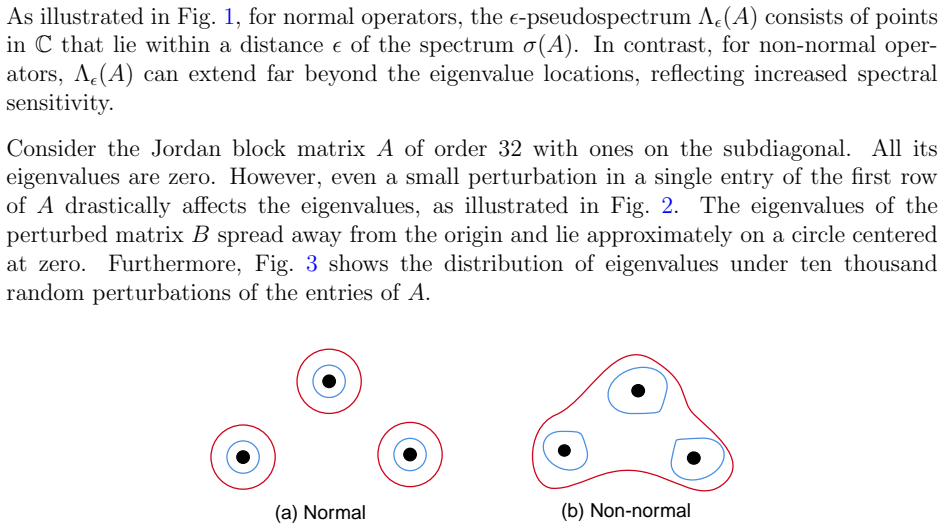
Computing pseudospectra of non-normal matrices is essential for understanding the stability and transient behavior of dynamical systems. Such analysis is critical in applications including fluid dynamics, control systems, and differential operators, where non-normality can lead to significant transient amplification and sensitivity to perturbations that are not captured by eigenvalue analysis alone. At large scales, commonly used numerical approaches for pseudospectra computation can become computationally demanding, as they require repeated auxiliary computations to identify spectrally sensitive regions in the complex plane. We present a neural network-based approach that predicts sensitive regions directly from matrix features, thereby avoiding exhaustive pseudospectra evaluation across the entire complex plane. We calibrate the prediction threshold on validation data to ensure reliable coverage of sensitive regions. The trained neural network guides the selection of grid points requiring full computation, enabling focused computation only where necessary. The approach provides a practical preprocessing strategy for efficient pseudospectra computation. Numerical experiments on non-normal banded matrices demonstrate substantial speedup compared to full grid-based numerical evaluation while maintaining high accuracy in identifying sensitive regions.
Editorial analysis
A structured set of objections, weighed in public.
Referee Report
Summary. The paper proposes a neural network-based preprocessing method to accelerate pseudospectra computation for structured non-normal banded matrices. The NN is trained on matrix features to predict regions of high resolvent norm sensitivity in the complex plane; a threshold is calibrated on validation data to select a restricted set of grid points for full numerical evaluation, avoiding exhaustive grid search. Numerical experiments on non-normal banded matrices are reported to show substantial speedup relative to full-grid methods while preserving high accuracy in identifying sensitive regions.
Significance. If the coverage of sensitive regions is reliable, the approach could provide a practical acceleration technique for pseudospectra analysis at scale, with relevance to stability and transient behavior studies in fluid dynamics, control systems, and differential operators. The hybrid NN-numerical strategy is a timely contribution to numerical linear algebra, but its utility hinges on empirical or theoretical assurance that the feature set and calibration do not omit critical regions.
major comments (2)
- [§4] §4 (Numerical Experiments): The reported speedups and accuracy rest on the NN with calibrated threshold never omitting regions where the resolvent norm exceeds the threshold. No systematic search for counter-example matrices (where chosen features fail to detect non-normality) or completeness argument is provided; an omission would force either full-grid fallback (erasing speedup) or incomplete pseudospectra. This is load-bearing for the central claim.
- [§3.2] §3.2 (Threshold Calibration): The prediction threshold is a free parameter tuned on validation data with no demonstrated robustness or worst-case coverage guarantee for the targeted class of structured banded matrices; the experiments do not quantify how often or under what conditions the NN prediction requires fallback.
minor comments (2)
- [§2.3] The description of the matrix feature vector in §2.3 could include an explicit list or table of the features used, to aid reproducibility.
- [Figure 3] Figure 3 (pseudospectrum plots) would benefit from a side-by-side comparison with the full-grid reference on the same scale to visually confirm coverage.
Simulated Author's Rebuttal
We thank the referee for the constructive feedback highlighting the importance of reliability in our neural-guided approach. We address the concerns on potential omissions and threshold robustness below, clarifying the empirical basis of the method while proposing targeted revisions to the experiments and discussion sections.
read point-by-point responses
-
Referee: [§4] §4 (Numerical Experiments): The reported speedups and accuracy rest on the NN with calibrated threshold never omitting regions where the resolvent norm exceeds the threshold. No systematic search for counter-example matrices (where chosen features fail to detect non-normality) or completeness argument is provided; an omission would force either full-grid fallback (erasing speedup) or incomplete pseudospectra. This is load-bearing for the central claim.
Authors: We agree that a theoretical completeness argument is absent, as the method is heuristic and relies on learned mappings from matrix features (bandwidth, off-diagonal norms, and local non-normality indicators) to sensitive regions. For the class of structured non-normal banded matrices considered, our validation and test sets (drawn from fluid dynamics and control applications) showed no omissions of regions with resolvent norm above the threshold. We will revise §4 to include a new subsection on failure-mode testing: we will generate and evaluate additional counter-example candidates with localized or atypical non-normality (e.g., matrices with isolated high-norm subblocks) and report any cases requiring fallback. If omissions occur, the manuscript will explicitly state the fallback to full-grid evaluation. This strengthens the empirical evidence without claiming universality. revision: partial
-
Referee: [§3.2] §3.2 (Threshold Calibration): The prediction threshold is a free parameter tuned on validation data with no demonstrated robustness or worst-case coverage guarantee for the targeted class of structured banded matrices; the experiments do not quantify how often or under what conditions the NN prediction requires fallback.
Authors: The threshold is chosen on a held-out validation set to achieve a user-specified coverage level (e.g., 99% inclusion of high-resolvent-norm points) while minimizing grid points evaluated. We will expand §3.2 with a sensitivity study showing how coverage and speedup vary with small threshold perturbations, plus explicit statistics from the reported experiments on fallback frequency (which was zero for the tested ensemble). However, we cannot supply a worst-case guarantee over all possible structured banded matrices, as the approach is data-driven rather than analytically bounded; this limitation will be stated clearly in the revised text. revision: yes
- A theoretical completeness argument or worst-case coverage guarantee for arbitrary structured non-normal banded matrices.
Circularity Check
No circularity: neural predictions and threshold calibration are independent of the pseudospectra results they accelerate.
full rationale
The paper trains a neural network on matrix features to predict sensitive regions and calibrates its threshold on separate validation data; the reported speedup and accuracy are then shown via numerical experiments on banded matrices. No equations, self-citations, or fitted quantities are invoked such that the central claim reduces by construction to its own inputs. The method is presented as an empirical preprocessing heuristic whose validity rests on observed performance rather than a self-referential derivation.
Axiom & Free-Parameter Ledger
free parameters (1)
- prediction threshold
axioms (1)
- standard math Pseudospectra of non-normal matrices are computed via repeated resolvent-norm evaluations on a grid in the complex plane.
Reference graph
Works this paper leans on
-
[1]
Trefethen
Lloyd N. Trefethen. Pseudospectra of linear operators.SIAM Review, 39(3):383–406, 1997
1997
-
[2]
Trefethen and Mark Embree.Spectra and Pseudospectra: The Behavior of Nonnormal Matrices and Operators
Lloyd N. Trefethen and Mark Embree.Spectra and Pseudospectra: The Behavior of Nonnormal Matrices and Operators. Princeton University Press, Princeton, NJ, 2005
2005
-
[3]
Trefethen, Anne E
Lloyd N. Trefethen, Anne E. Trefethen, Satish C. Reddy, and Tobin A. Driscoll. Hy- drodynamic stability without eigenvalues.Science, 261(5121):578–584, 1993
1993
-
[4]
Schmid and Dan S
Peter J. Schmid and Dan S. Henningson.Stability and Transition in Shear Flows, volume 142 ofApplied Mathematical Sciences. Springer, New York, 2001
2001
-
[5]
Peter J. Schmid. Nonmodal stability theory.Annual Review of Fluid Mechanics, 39(Vol- ume 39, 2007):129–162, 2007
2007
-
[6]
How descriptive are gmres convergence bounds? Technical report, Oxford University Computing Laboratory, 1999
Mark Embree. How descriptive are gmres convergence bounds? Technical report, Oxford University Computing Laboratory, 1999
1999
-
[7]
Trefethen
Lloyd N. Trefethen. Finite difference and spectral methods for ordinary and partial differential equations, 1996. Unpublished text, available athttps://people.maths. ox.ac.uk/trefethen/pdetext.html
1996
-
[8]
Springer, Berlin, 1996
Ernst Hairer and Gerhard Wanner.Solving Ordinary Differential Equations II: Stiff and Differential-Algebraic Problems, volume 14 ofSpringer Series in Computational Mathematics. Springer, Berlin, 1996
1996
-
[9]
Light fields in complex media: Mesoscopic scattering meets wave control.Reviews of Modern Physics, 89:015005, Mar 2017
Stefan Rotter and Sylvain Gigan. Light fields in complex media: Mesoscopic scattering meets wave control.Reviews of Modern Physics, 89:015005, Mar 2017
2017
-
[10]
MIT Press, Cambridge, MA, 2016
Ian Goodfellow, Yoshua Bengio, and Aaron Courville.Deep Learning. MIT Press, Cambridge, MA, 2016
2016
-
[11]
Karniadakis, Ioannis G
George E. Karniadakis, Ioannis G. Kevrekidis, Lu Lu, Paris Perdikaris, Sifan Wang, and Liu Yang. Physics-informed machine learning.Nature Reviews Physics, 3(6):422–440, 2021
2021
-
[12]
Karniadakis
Lu Lu, Pengzhan Jin, Guofei Pang, Zhongqiang Zhang, and George E. Karniadakis. Learning nonlinear operators via deeponet based on the universal approximation theo- rem of operators.Nature Machine Intelligence, 3(3):218–229, 2021. 21
2021
-
[13]
Zettl.Sturm-Liouville Theory
A. Zettl.Sturm-Liouville Theory. Mathematical surveys and monographs. American Mathematical Society, 2005
2005
-
[14]
Wright and Lloyd N
Thomas G. Wright and Lloyd N. Trefethen. Large-scale computation of pseudospectra using arpack and eigs.SIAM Journal on Scientific Computing, 23(2):591–605, 2001
2001
-
[15]
Thomas G. Wright. Eigtool: A graphical tool for nonsymmetric eigenproblems,
-
[16]
MATLAB software package available athttp://www.comlab.ox.ac.uk/ pseudospectra/eigtool
-
[17]
Pritchard.Mathematical Systems Theory I: Mod- elling, State Space Analysis, Stability and Robustness, volume 48 ofTexts in Applied Mathematics
Diederich Hinrichsen and Anthony J. Pritchard.Mathematical Systems Theory I: Mod- elling, State Space Analysis, Stability and Robustness, volume 48 ofTexts in Applied Mathematics. Springer, Berlin, 2005
2005
-
[18]
Farrell and Petros J
Brian F. Farrell and Petros J. Ioannou. Generalized stability theory. part i: Autonomous operators.Journal of the Atmospheric Sciences, 53(14):2025–2040, 1996
2025
-
[19]
Thomas Braconnier and Nicholas J. Higham. Computing the field of values and pseu- dospectra using the lanczos method with continuation.BIT Numerical Mathematics, 36(3):422–440, 1996
1996
-
[20]
S. H. Lui. Computation of pseudospectra by continuation.SIAM Journal on Scientific Computing, 18(2):565–573, 1997
1997
-
[21]
Golub and Charles F
Gene H. Golub and Charles F. Van Loan.Matrix Computations - 4th Edition. Johns Hopkins University Press, Philadelphia, PA, 2013
2013
-
[22]
Higham.Accuracy and Stability of Numerical Algorithms
Nicholas J. Higham.Accuracy and Stability of Numerical Algorithms. Society for Industrial and Applied Mathematics, second edition, 2002
2002
-
[23]
Bauer and Charles T
Friedrich L. Bauer and Charles T. Fike. Norms and exclusion theorems.Numerische Mathematik, 2:137–141, 1960
1960
-
[24]
Srinivasan, Ben Mildenhall, Sara Fridovich-Keil, Nithin Raghavan, Utkarsh Singhal, Ravi Ramamoorthi, Jonathan T
Matthew Tancik, Pratul P. Srinivasan, Ben Mildenhall, Sara Fridovich-Keil, Nithin Raghavan, Utkarsh Singhal, Ravi Ramamoorthi, Jonathan T. Barron, and Ren Ng. Fourier features let networks learn high frequency functions in low dimensional domains. InAdvances in Neural Information Processing Systems (NeurIPS), 2020
2020
-
[25]
Deep residual learning for image recognition
Kaiming He, Xiangyu Zhang, Shaoqing Ren, and Jian Sun. Deep residual learning for image recognition. In2016 IEEE Conference on Computer Vision and Pattern Recognition (CVPR), pages 770–778, 2016
2016
-
[26]
Prajit Ramachandran, Barret Zoph, and Quoc V. Le. Searching for activation functions. ArXiv, abs/1710.05941, 2017
work page internal anchor Pith review arXiv 2017
-
[27]
Haibo He and Edwardo A. Garcia. Learning from imbalanced data.IEEE Transactions on Knowledge and Data Engineering, 21(9):1263–1284, 2009
2009
-
[28]
Mazurowski
Mateusz Buda, Atsuto Maki, and Maciej A. Mazurowski. A systematic study of the class imbalance problem in convolutional neural networks.Neural Networks, 106:249– 259, 2018
2018
-
[29]
Adam: A Method for Stochastic Optimization
Diederik P. Kingma and Jimmy Ba. Adam: A method for stochastic optimization. CoRR, abs/1412.6980, 2014. 22
work page internal anchor Pith review arXiv 2014
-
[30]
Berger and P
M.J. Berger and P. Colella. Local adaptive mesh refinement for shock hydrodynamics. Journal of Computational Physics, 82(1):64–84, 1989
1989
-
[31]
Serra and J
J.P. Serra and J. Serra.Image Analysis and Mathematical Morphology. Image analysis and mathematical morphology. Academic Press, 1982
1982
-
[32]
Haralick and L.G
R.M. Haralick and L.G. Shapiro.Computer and Robot Vision. Number v. 1 in Computer and Robot Vision. Addison-Wesley Publishing Company, 1992. 23
1992
discussion (0)
Sign in with ORCID, Apple, or X to comment. Anyone can read and Pith papers without signing in.