Recognition: unknown
Effects of event-by-event hydrodynamic fluctuations on bottomonium dynamics in Pb--Pb collisions at sqrt{s_{NN}} = 5.02 TeV
Pith reviewed 2026-05-08 17:06 UTC · model grok-4.3
The pith
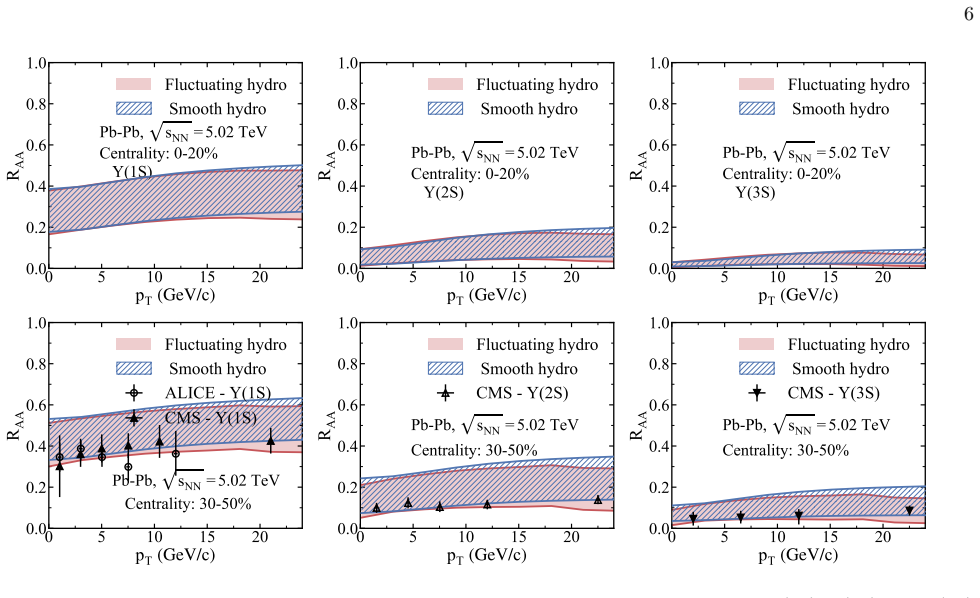
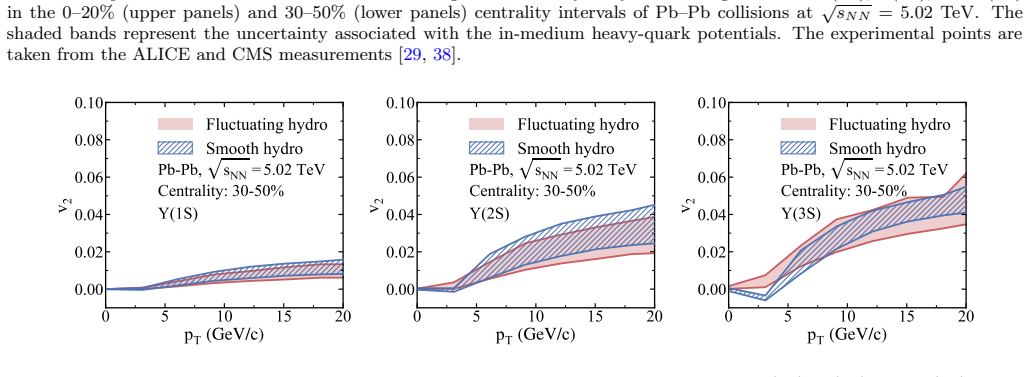
Event-by-event hydrodynamic fluctuations have only marginal effects on bottomonium R_AA and v2 in Pb-Pb collisions.
A machine-rendered reading of the paper's core claim, the machinery that carries it, and where it could break.
Core claim
Simulations of bottomonium dynamics in Pb-Pb collisions at 5.02 TeV using both fluctuating event-by-event viscous hydrodynamics and smooth media show that the nuclear modification factor R_AA and elliptic flow v2 for various bottomonium states are only marginally affected by the medium fluctuations.
What carries the argument
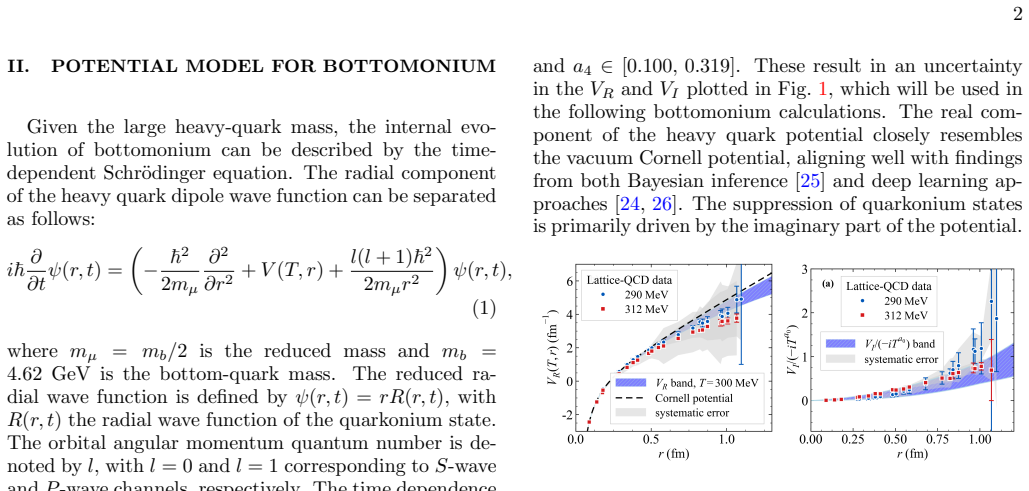
The iEBE-VISHNU event-by-event viscous hydrodynamic framework for medium evolution combined with a time-dependent Schrödinger equation using a temperature-dependent complex heavy-quark potential for bottomonium internal evolution.
Load-bearing premise
The iEBE-VISHNU hydrodynamic model and the chosen temperature-dependent complex potential fully capture the relevant physics of medium evolution and bottomonium interactions.
What would settle it
A calculation with a different hydrodynamic model or an extended potential that includes additional fluctuation-driven dissociation channels producing large shifts in R_AA or v2 would falsify the claim of only marginal effects.
Figures


read the original abstract
We investigate the effects of event-by-event hydrodynamic fluctuations on bottomonium nuclear modification factors and elliptic flow in Pb--Pb collisions at $\sqrt{s_{NN}}=5.02$ TeV. The internal evolution of the heavy quarkonium is described by a time-dependent Schr\"odinger equation with a temperature-dependent complex heavy-quark potential, while the hot QCD medium evolution is simulated using the iEBE-VISHNU event-by-event viscous hydrodynamic framework. By incorporating both fluctuating and smooth hot media, we observe that both $R_{AA}$ and $v_2$ of various bottomonium states are marginally affected by the medium fluctuations. By realistically simulating the dynamical evolution of bottomonium within a large set of event-by-event fluctuating hot QCD medium, this work provides key insights into the behavior of heavy-quarkonium observables in relativistic heavy-ion collisions.
Editorial analysis
A structured set of objections, weighed in public.
Referee Report
Summary. The paper studies the effects of event-by-event hydrodynamic fluctuations on bottomonium R_AA and v2 in Pb-Pb collisions at 5.02 TeV. It evolves the medium with the iEBE-VISHNU viscous hydrodynamic framework and propagates bottomonium states via the time-dependent Schrödinger equation using a temperature-dependent complex heavy-quark potential. Direct comparison of fluctuating versus smooth (non-fluctuating) hydrodynamic backgrounds shows that both R_AA and v2 for various bottomonium states are only marginally affected by the fluctuations.
Significance. If the marginal-effect conclusion holds under improved statistical controls, the result would indicate that bottomonium observables are robust against hydrodynamic fluctuations, supporting the use of averaged hydrodynamic profiles in quarkonium suppression calculations and simplifying modeling of heavy-quarkonium dynamics in heavy-ion collisions.
major comments (1)
- [Results] Results section (comparison of fluctuating vs. smooth media): the assertion that R_AA and v2 are 'marginally affected' is not accompanied by error bars, statistical uncertainties, or quantitative measures of the differences between the two classes of hydrodynamic evolution. Without these, it is not possible to determine whether the observed differences lie within numerical precision or represent a genuine small effect.
minor comments (2)
- [Hydrodynamic framework] The definition and construction of the smooth hydrodynamic background (e.g., whether it is an event-averaged profile or a single representative profile) should be stated explicitly with a reference to the relevant equation or procedure in the iEBE-VISHNU implementation.
- [Results] Figure captions and text should clarify the number of events used for the fluctuating ensemble and the statistics accumulated for each bottomonium state to allow assessment of numerical convergence.
Simulated Author's Rebuttal
We thank the referee for the careful reading of our manuscript and the constructive comment. We address the major point below and will incorporate the requested improvements.
read point-by-point responses
-
Referee: [Results] Results section (comparison of fluctuating vs. smooth media): the assertion that R_AA and v2 are 'marginally affected' is not accompanied by error bars, statistical uncertainties, or quantitative measures of the differences between the two classes of hydrodynamic evolution. Without these, it is not possible to determine whether the observed differences lie within numerical precision or represent a genuine small effect.
Authors: We agree that the presentation would benefit from explicit statistical uncertainties and quantitative measures. In the revised manuscript we will add error bars to the R_AA and v_2 results, computed from the ensemble variance of the event-by-event hydrodynamic profiles. We will also report the maximum relative differences between the fluctuating and smooth cases together with their uncertainties, allowing a direct assessment that the observed effects remain within the statistical precision of the calculation. revision: yes
Circularity Check
No significant circularity in derivation chain
full rationale
The paper's central result is obtained by explicit numerical simulation: bottomonium states are evolved via the time-dependent Schrödinger equation inside both event-by-event fluctuating iEBE-VISHNU hydrodynamic backgrounds and their smooth averaged counterparts, using the same temperature-dependent complex potential in both cases. The reported marginal impact on R_AA and v2 is a direct computational output of this side-by-side comparison across many events, not a redefinition, a fitted parameter renamed as a prediction, or a quantity forced by self-citation. All load-bearing steps (hydrodynamic evolution, potential insertion, and observable extraction) remain independent of the target observables and are externally specified by the cited frameworks and potential parametrization.
Axiom & Free-Parameter Ledger
axioms (2)
- domain assumption The iEBE-VISHNU viscous hydrodynamic framework with event-by-event fluctuations accurately models the hot QCD medium evolution in Pb-Pb collisions.
- domain assumption The temperature-dependent complex heavy-quark potential correctly describes the internal evolution of bottomonium states in the medium.
Reference graph
Works this paper leans on
-
[1]
A. Bazavovet al., Phys. Rev. D85, 054503 (2012), arXiv:1111.1710 [hep-lat]
-
[2]
Matsui and H
T. Matsui and H. Satz, Phys. Lett. B178, 416 (1986)
1986
-
[3]
A. Andronicet al., Eur. Phys. J. C76, 107 (2016), arXiv:1506.03981 [nucl-ex]
-
[4]
A. Rothkopf, Phys. Rept.858, 1 (2020), arXiv:1912.02253 [hep-ph]
- [5]
- [6]
-
[7]
N. Brambilla, A. Pineda, J. Soto, and A. Vairo, Nucl. Phys. B566, 275 (2000), arXiv:hep-ph/9907240
-
[8]
N. Brambilla, M. A. Escobedo, J. Soto, and A. Vairo, Phys. Rev. D96, 034021 (2017), arXiv:1612.07248 [hep- ph]
-
[9]
M. Margotta, K. McCarty, C. McGahan, M. Strick- land, and D. Yager-Elorriaga, Phys. Rev. D83, 105019 (2011), [Erratum: Phys.Rev.D 84, 069902 (2011)], arXiv:1101.4651 [hep-ph]
-
[10]
N. Brambilla, M. ´A. Escobedo, M. Strickland, A. Vairo, 6 /uni00000013/uni00000018/uni00000014/uni00000013/uni00000014/uni00000018/uni00000015/uni00000013 /uni00000053/uni00000037(GeV//uni00000046) /uni00000013/uni00000011/uni00000013 /uni00000013/uni00000011/uni00000015 /uni00000013/uni00000011/uni00000017 /uni00000013/uni00000011/uni00000019 /uni0000001...
- [11]
-
[12]
B. Schenke, S. Jeon, and C. Gale, Phys. Rev. C82, 014903 (2010), arXiv:1004.1408 [hep-ph]
- [13]
-
[14]
Collective flow and viscosity in relativistic heavy-ion collisions,
U. Heinz and R. Snellings, Ann. Rev. Nucl. Part. Sci.63, 123 (2013), arXiv:1301.2826 [nucl-th]
- [15]
-
[16]
B. Alver and G. Roland, Phys. Rev. C81, 054905 (2010), [Erratum: Phys.Rev.C 82, 039903 (2010)], arXiv:1003.0194 [nucl-th]
-
[17]
Fluctuating Glasma initial conditions and flow in heavy ion collisions
B. Schenke, P. Tribedy, and R. Venugopalan, Phys. Rev. Lett.108, 252301 (2012), arXiv:1202.6646 [nucl-th]
work page Pith review arXiv 2012
- [18]
- [19]
-
[20]
T. Song, K. C. Han, and C. M. Ko, Nucl. Phys. A897, 141 (2013)
2013
-
[21]
A. Islam and M. Strickland, JHEP03, 235, arXiv:2010.05457 [hep-ph]. 7
-
[22]
H. Alalawi, J. Boyd, C. Shen, and M. Strickland, Phys. Rev. C107, L031901 (2023), arXiv:2211.06363 [hep-ph]
- [23]
-
[24]
J. Liu, K. Zhou, and B. Chen, arXiv e-prints (2026), arXiv:2604.09198 [nucl-th]
work page internal anchor Pith review Pith/arXiv arXiv 2026
-
[25]
Zheng, B
S. Zheng, B. Chen, X. Du, and S. Shi, Phys. Rev. C (2026)
2026
- [26]
-
[27]
Y. Burnier and A. Rothkopf, Phys. Rev. D95, 054511 (2017), arXiv:1607.04049 [hep-lat]
- [28]
- [29]
-
[30]
J.-P. Lansberg, Phys. Rept.889, 1 (2020), arXiv:1903.09185 [hep-ph]
-
[31]
S. Chatrchyanet al.(CMS), Phys. Lett. B727, 101 (2013), arXiv:1303.5900 [hep-ex]
- [32]
-
[33]
J. Adamet al.(ALICE), Phys. Rev. Lett.116, 222302 (2016), arXiv:1512.06104 [nucl-ex]
-
[34]
G. S. Denicol, H. Niemi, E. Molnar, and D. H. Rischke, Phys. Rev. D85, 114047 (2012), [Erratum: Phys.Rev.D 91, 039902 (2015)], arXiv:1202.4551 [nucl-th]
work page Pith review arXiv 2012
-
[35]
P. Huovinen and P. Petreczky, Nucl. Phys. A837, 26 (2010), arXiv:0912.2541 [hep-ph]
-
[36]
Cooper and G
F. Cooper and G. Frye, Phys. Rev. D10, 186 (1974)
1974
-
[37]
Acharyaet al.(ALICE), JHEP09, 006, arXiv:1805.04390 [nucl-ex]
S. Acharyaet al.(ALICE), JHEP09, 006, arXiv:1805.04390 [nucl-ex]
-
[38]
S. Acharyaet al.(ALICE), Phys. Lett. B822, 136579 (2021), arXiv:2011.05758 [nucl-ex]
discussion (0)
Sign in with ORCID, Apple, or X to comment. Anyone can read and Pith papers without signing in.