Recognition: unknown
Regulating oxygen content and superconductivity in La₃Ni₂O_{7+δ}
Pith reviewed 2026-05-08 17:00 UTC · model grok-4.3
The pith
Oxygen content in La3Ni2O7+δ controls both phase purity and the upper critical field of bilayer superconductivity
A machine-rendered reading of the paper's core claim, the machinery that carries it, and where it could break.
Core claim
Precise tuning of oxygen content δ in La3Ni2O7+δ yields samples whose microstructures range from pure bilayer to hybrid bilayer-single-layer to bilayer with trilayer intergrowths; each microstructure produces a characteristic superconducting transition under pressure. Beyond phase selection, the oxygen level directly alters the upper critical field Hc2 of the bilayer phase, allowing construction of a phase diagram that maps both Tc and Hc2 as functions of δ.
What carries the argument
Oxygen stoichiometry δ, which selects intergrowth phases and directly adjusts the upper critical field Hc2 of the bilayer superconductivity
Load-bearing premise
That the measured differences in Tc and Hc2 arise only from the identified phases and oxygen content without significant contributions from impurities, pressure inhomogeneities, or measurement artifacts.
What would settle it
High-pressure transport data on samples with differing oxygen content but identical confirmed phase purity that show no corresponding change in Hc2 would contradict the direct modulation claim.
Figures




read the original abstract
The synthesis of high-quality Ruddlesden-Popper (RP) nickelates remains challenging due to variations in oxygen content and the prevalence of intergrown RP phases. Precisely controlling the stoichiometry and characterizing the resulting physical properties are essential for understanding the mechanism of high-$T_c$ superconductivity in these materials. In this work, we synthesize a series of La$_3$Ni$_2$O$_{7+\delta}$ samples with systematically controlled oxygen content and perform comprehensive structural and compositional analyses. Precise oxygen tuning enables us to tailor the microstructure, yielding a pure bilayer phase, a mixture of bilayer and hybrid single-layer-bilayer phases, and a predominantly bilayer phase containing trilayer intergrowths. High-pressure transport measurements reveal distinct superconducting transitions with contrasting $T_c$ values, corresponding to the bilayer phase, the hybrid phase, and trilayer inclusions. Notably, we find that oxygen content not only governs the phase purity$-$i.e., the presence of intergrowth phases$-$but also directly modulates the upper critical field ($H_{c2}$) of the bilayer superconductivity. By establishing a phase diagram of $T_c$ and $H_{c2}$ as functions of oxygen content in La$_3$Ni$_2$O$_{7+\delta}$, this work advances synthetic control and provides new insights into the superconducting mechanism of RP nickelates.
Editorial analysis
A structured set of objections, weighed in public.
Referee Report
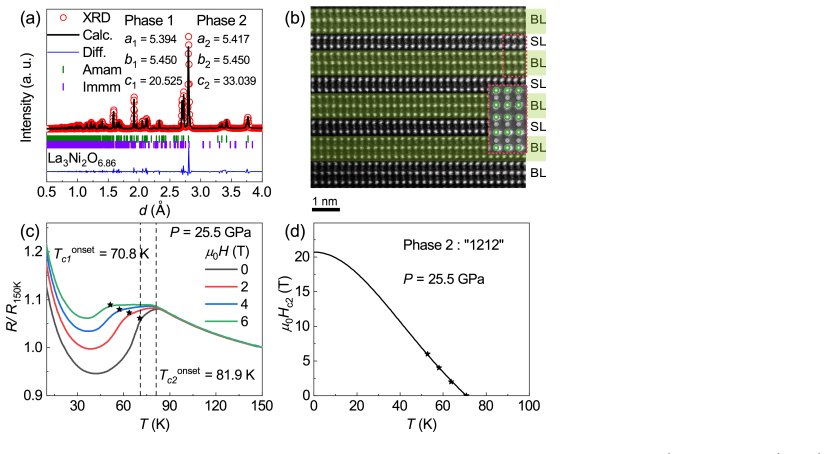
Summary. The manuscript reports synthesis of La₃Ni₂O₇₊δ samples with systematically varied oxygen content δ, followed by structural (XRD, TEM) and compositional analyses that identify pure bilayer RP phase, bilayer-hybrid single-layer mixtures, and bilayer phases containing trilayer intergrowths. High-pressure transport measurements show distinct superconducting transitions with different Tc values tied to these phases. The central claim is that oxygen content governs phase purity and additionally directly modulates the upper critical field Hc2 of the bilayer superconductivity, as summarized in a phase diagram of Tc and Hc2 versus δ.
Significance. If the Hc2 modulation with δ is shown to be intrinsic to the bilayer phase, the work would offer valuable synthetic control over oxygen stoichiometry in Ruddlesden-Popper nickelates and new experimental constraints on how doping influences the superconducting state beyond mere phase purity, contributing to mechanistic understanding of high-Tc superconductivity in these systems.
major comments (1)
- [Abstract and high-pressure transport results] Abstract and high-pressure transport results: The claim that δ directly modulates Hc2 of the bilayer phase (distinct from its effect on phase purity) is load-bearing for the phase-diagram conclusion. However, the manuscript provides no details on the resistivity criterion used to define Hc2 (e.g., 50 % or 90 % drop), pressure calibration, choice of pressure medium, hydrostaticity verification, or checks for inhomogeneity and contact resistance. These omissions leave open the possibility that apparent Hc2 variations arise from non-hydrostatic conditions or measurement artifacts rather than intrinsic oxygen dependence, as is common in high-pressure nickelate studies.
minor comments (2)
- [Methods section] Methods section: The description of oxygen-content control and quantification lacks explicit information on the technique employed (e.g., thermogravimetric analysis, iodometric titration, or neutron diffraction) and any reported uncertainties or error bars on the δ values.
- [Phase diagram figure and associated text] Phase diagram figure and associated text: Data points for Tc and Hc2 versus δ should include error bars reflecting measurement reproducibility and sample-to-sample variation; the number of independent samples or runs per δ value is not stated.
Simulated Author's Rebuttal
We thank the referee for the careful reading of our manuscript and the constructive feedback on the high-pressure transport section. We address the concerns about missing experimental details and the interpretation of the Hc2 modulation below.
read point-by-point responses
-
Referee: [Abstract and high-pressure transport results] Abstract and high-pressure transport results: The claim that δ directly modulates Hc2 of the bilayer phase (distinct from its effect on phase purity) is load-bearing for the phase-diagram conclusion. However, the manuscript provides no details on the resistivity criterion used to define Hc2 (e.g., 50 % or 90 % drop), pressure calibration, choice of pressure medium, hydrostaticity verification, or checks for inhomogeneity and contact resistance. These omissions leave open the possibility that apparent Hc2 variations arise from non-hydrostatic conditions or measurement artifacts rather than intrinsic oxygen dependence, as is common in high-pressure nickelate studies.
Authors: We agree that the manuscript would benefit from explicit documentation of the high-pressure protocols. In the revised version we will add a methods subsection and supplementary figures that specify: the Hc2 criterion (field at which resistivity reaches 50% of the normal-state value, with 10% and 90% criteria shown for comparison); pressure calibration via ruby fluorescence (accuracy ±0.05 GPa); the pressure-transmitting medium (Daphne 7373 oil); hydrostaticity assessment through the sharpness of the superconducting transition (ΔTc < 0.5 K) and ruby R1 linewidth; and checks for inhomogeneity and contact resistance via repeated four-probe measurements on multiple contacts and samples, including reversal of current direction. With these additions, the data show that, within the pure-bilayer regime, Hc2 varies systematically with δ while the transition remains sharp and reproducible, supporting an intrinsic oxygen dependence rather than an artifact. Raw resistivity curves under pressure will be provided to allow independent evaluation. revision: yes
Circularity Check
No circularity: purely experimental observations and direct measurements
full rationale
The paper reports synthesis of La3Ni2O7+δ samples with controlled oxygen content, followed by structural/compositional analysis and high-pressure transport measurements. Central claims (phase purity control, distinct Tc values for bilayer/hybrid/trilayer phases, and δ-dependent Hc2 modulation) are presented as direct experimental results plotted in a phase diagram. No equations, derivations, fitted parameters, or predictions appear in the provided text. No self-citations are invoked as load-bearing uniqueness theorems or ansatzes. All steps are independent empirical observations that can be replicated or falsified externally without reference to the paper's own inputs.
Axiom & Free-Parameter Ledger
axioms (1)
- domain assumption Ruddlesden-Popper phases can be reliably distinguished by structural and compositional analysis
Reference graph
Works this paper leans on
-
[1]
V. I. Anisimov, D. Bukhvalov, T. M. Rice, Phys. Rev. B1999, 59 7901
-
[2]
M. Wang, H. H. Wen, T. Wu, D.-X. Yao, T. Xiang, Chin. Phys. Lett.2024, 41, 7 077402
2024
-
[3]
D. Li, K. Lee, B. Y. Wang, M. Osada, S. Crossley, H. R. Lee, Y. Cui, Y. Hikita, H. Y. Hwang, Nature 2019, 572, 7771 624
2019
-
[4]
Gu, H.-H
Q. Gu, H.-H. Wen, The Innovation2022, 3, 1 100202
-
[5]
H. Sun, M. Huo, X. Hu, J. Li, Z. Liu, Y. Han, L. Tang, Z. Mao, P. Yang, B. Wang, J. Cheng, D.-X. Yao, G.-M. Zhang, M. Wang, Nature2023, 621, 7979 493
-
[6]
Zhang, D
Y. Zhang, D. Su, Y. Huang, Z. Shan, H. Sun, M. Huo, K. Ye, J. Zhang, Z. Yang, Y. Xu, Y. Su, R. Li, M. Smidman, M. Wang, L. Jiao, H. Yuan, Nat. Phys.2024, 20 1269
2024
-
[7]
G. Wang, N. N. Wang, X. L. Shen, J. Hou, L. Ma, L. F. Shi, Z. A. Ren, Y. D. Gu, H. M. Ma, P. T. Yang, Z. Y. Liu, H. Z. Guo, J. P. Sun, G. M. Zhang, S. Calder, J. Q. Yan, B. S. Wang, Y. Uwatoko, J. G. Cheng, Phys. Rev. X2024, 14, 1 011040
-
[8]
Y. Zhu, D. Peng, E. Zhang, B. Pan, X. Chen, L. Chen, H. Ren, F. Liu, Y. Hao, N. Li, Z. Xing, F. Lan, J. Han, J. Wang, D. Jia, H. Wo, Y. Gu, Y. Gu, L. Ji, W. Wang, H. Gou, Y. Shen, T. Ying, X. Chen, W. Yang, H. Cao, C. Zheng, Q. Zeng, J. G. Guo, J. Zhao, Nature2024, 631, 8021 531. 6
-
[9]
Li, C.-Q
J. Li, C.-Q. Chen, C. Huang, Y. Han, M. Huo, X. Huang, P. Ma, Z. Qiu, J. Chen, X. Hu, L. Chen, T. Xie, B. Shen, H. Sun, D.-X. Yao, M. Wang, Sci. China Phys. Mech. Astron.2024, 67, 11 117403
2024
-
[10]
Zhang, C
M. Zhang, C. Pei, D. Peng, X. Du, W. Hu, Y. Cao, Q. Wang, J. Wu, Y. Li, H. Liu, C. Wen, J. Song, Y. Zhao, C. Li, W. Cao, S. Zhu, Q. Zhang, N. Yu, P. Cheng, L. Zhang, Z. Li, J. Zhao, Y. Chen, C. Jin, H. Guo, C. Wu, F. Yang, Q. Zeng, S. Yan, L. Yang, Y. Qi, Phys. Rev. X2025, 15, 2 021005
-
[11]
F. Li, N. Guo, Q. Zheng, Y. Shen, S. Wang, Q. Cui, C. Liu, S. Wang, X. Tao, G. M. Zhang, J. Zhang, Phys. Rev. Mater.2024, 8 053401
2024
-
[12]
M. Shi, D. Peng, K. Fan, Z. Xing, S. Yang, Y. Wang, H. Li, R. Wu, M. Du, B. Ge, Z. Zeng, Q. Zeng, J. Ying, T. Wu, X. Chen, Nat. Phys.2025
2025
-
[13]
H. Wang, L. Chen, A. Rutherford, H. Zhou, W. Xie, Inorg. Chem.2024, 63 5020
2024
-
[14]
X. Chen, J. Zhang, A. S. Thind, S. Sharma, H. Labollita, G. Peterson, H. Zheng, D. P. Phelan, A. S. Botana, R. F. Klie, J. F. Mitchell, J. Am. Chem. Soc.2024, 146, 6 3640
2024
- [15]
-
[16]
E. K. Ko, Y. Yu, Y. Liu, L. Bhatt, J. Li, V. Thampy, C. T. Kuo, B. Y. Wang, Y. Lee, K. Lee, J. S. Lee, B. H. Goodge, D. A. Muller, H. Y. Hwang, Nature2025, 638 935
-
[17]
G. Zhou, W. Lv, H. Wang, Z. Nie, Y. Chen, Y. Li, H. Huang, W.-Q. Chen, Y.-J. Sun, Q.-K. Xue, Z. Chen, Nature2025, 640 641
-
[18]
B. Hao, M. Wang, W. Sun, Y. Yang, Z. Mao, S. Yan, H. Sun, H. Zhang, L. Han, Z. Gu, J. Zhou, D. Ji, Y. Nie, Nat. Mater.2025, 24, 11
2025
-
[19]
K. Wang, M. Wang, W. Wei, B. Hao, M. Liu, Q. Xiang, X. Zhou, Q. Hou, Y. Sun, Z. Zhu, S. Li, Y. Nie, Z. Shi, Mater. Today2026, 95 103269
-
[20]
Zhang, M
Z. Zhang, M. Greenblatt, J. Goodenough, J. Solid State Chem.1994, 108, 2 402
1994
-
[21]
H. Sakurai, Y. Takano, Superconducting lanthanum nickel oxides with bilayered and trilayered crystal structures, URLhttps://arxiv.org/abs/2603.17657
-
[22]
G. Zhou, H. Huang, F. Wang, H. Wang, Q. Yang, Z. Nie, W. Lv, C. Ding, Y. Li, J. Lin, C. Yue, D. Li, Y. Sun, J. Lin, G.-M. Zhang, Q.-K. Xue, Z. Chen, Natl. Sci. Rev.2025, 12, 4 nwae429
2025
-
[23]
Z. Nie, Y. Li, W. Lv, L. Xu, Z. Jiang, P. Fu, G. Zhou, W. Song, Y. Chen, H. Wang, H. Huang, J. Lin, J.-F. Jia, D. Shen, P. Li, Q.-K. Xue, Z. Chen, Nature2026
-
[24]
Z. Dong, M. Huo, J. Li, J. Li, P. Li, H. Sun, L. Gu, Y. Lu, M. Wang, Y. Wang, Z. Chen, Nature 2024, 630, 8018 847
2024
-
[25]
Puphal, T
P. Puphal, T. Schafer, B. Keimer, M. Hepting, Nat. Rev. Phy.2026, 8, 2 70
2026
-
[26]
Y. Wang, K. Jiang, J. Ying, T. Wu, J. Cheng, J. Hu, X. Chen, Natl. Sci. Rev.2025, 12, 10 nwaf373
2025
-
[27]
Z. Luo, X. Hu, M. Wang, W. W´ u, D.-X. Yao, Phys. Rev. Lett.2023, 131 126001
2023
-
[28]
N. Wang, G. Wang, X. Shen, J. Hou, J. Luo, X. Ma, H. Yang, L. Shi, J. Dou, J. Feng, J. Yang, Y. Shi, Z. Ren, H. Ma, P. Yang, Z. Liu, Y. Liu, H. Zhang, X. Dong, Y. Wang, K. Jiang, J. Hu, S. Nagasaki, K. Kitagawa, S. Calder, J. Yan, J. Sun, B. Wang, R. Zhou, Y. Uwatoko, J. Cheng, Nature2024, 634 579
-
[29]
J. Li, D. Peng, P. Ma, H. Zhang, Z. Xing, X. Huang, C. Huang, M. Huo, D. Hu, Z. Dong, X. Chen, T. Xie, H. Dong, H. Sun, Q. Zeng, H.-k. Mao, M. Wang, Natl. Sci. Rev.2025, 12, 10 nwaf220. 7
2025
-
[30]
X. Chen, J. Choi, Z. Jiang, J. Mei, K. Jiang, J. Li, S. Agrestini, M. Garcia-Fernandez, X. Huang, H. Sun, D. Shen, M. Wang, J. Hu, Y. Lu, K.-J. Zhou, D. Feng, Nat. Commun.2024, 15 9597
2024
-
[31]
T. Xie, M. Huo, X. Ni, F. Shen, X. Huang, H. Sun, H. C. Walker, D. Adroja, D. Yu, B. Shen, L. He, K. Cao, M. Wang, Sci. Bull.2024, 69, 20 3221
2024
-
[32]
K. Wang, Q. Hou, Y. Shi, S. Zhang, Z. Liang, W. Liu, X. Zhou, W. Wei, Z. Ren, S. Li, Z. Shi, J. Alloys Compd.2026, 1061
2026
-
[33]
F. Li, Z. Xing, D. Peng, J. Dou, N. Guo, L. Ma, Y. Zhang, L. Wang, J. Luo, J. Yang, J. Zhang, T. Chang, Y.-S. Chen, W. Cai, J. Cheng, Y. Wang, Y. Liu, T. Luo, N. Hirao, T. Matsuoka, H. Kadobayashi, Z. Zeng, Q. Zheng, R. Zhou, Q. Zeng, X. Tao, J. Zhang, Nature2026, 649, 8098
-
[34]
Z. Liu, H. Sun, M. Huo, X. Ma, Y. Ji, E. Yi, L. Li, H. Liu, J. Yu, Z. Zhang, Z. Chen, F. Liang, H. Dong, H. Guo, D. Zhong, B. Shen, S. Li, M. Wang, Sci. China-Phys. Mech. Astron.2023, 66 217411
2023
-
[35]
Zhang, H
J. Zhang, H. Zheng, Y.-S. Chen, Y. Ren, M. Yonemura, A. Huq, J. F. Mitchell, Phys. Rev. Mater. 2020, 4, 8 083402
2020
-
[36]
Huang, H
X. Huang, H. Zhang, J. Li, M. Huo, J. Chen, Z. Qiu, P. Ma, C. Huang, H. Sun, M. Wang, Chin. Phys. Lett.2024, 41, 12 127403
2024
-
[37]
Puri, Lisa xas database,2024, URLhttps://doi.org/10.5281/zenodo.10778098
A. Puri, Lisa xas database,2024, URLhttps://doi.org/10.5281/zenodo.10778098
-
[38]
M. Li, Y. Wang, C. Pei, M. Zhang, N. Li, J. Guan, M. Amboage, N.-D. Adama, Q. Kong, Y. Qi, W. Yang, Distinguishing electronic band structure of single-layer and bilayer Ruddlesden- Popper nickelates probed by in situ high pressure x-ray absorption near-edge spectroscopy, URL https://arxiv.org/abs/2410.04230
- [39]
-
[40]
E. Mijit, P. Ma, C. J. Sahle, A. D. Rosa, Z. Hu, F. De Angelis, A. Lopez, S. Amatori, G. Tchoudinov, Y. Joly, T. Irifune, J. E. F. S. Rodrigues, G. Garbarino, S. G. Parra, M. Wang, R. Yu, O. Mathon, Local electronic properties of La 3Ni2O7 under pressure, URLhttp://arxiv.org/abs/2412.08269
-
[41]
S. Cai, Y. Zhou, H. Sun, K. Zhang, J. Zhao, M. Huo, L. Nataf, Y. Wang, J. Li, J. Guo, K. Jiang, M. Wang, Y. Ding, W. Yang, Y. Lu, Q. Kong, Q. Wu, J. Hu, T. Xiang, H. K. Mao, L. Sun, Phys. Rev. B2025, 111 104511
-
[42]
Sakakibara, N
H. Sakakibara, N. Kitamine, M. Ochi, K. Kuroki, Phys. Rev. Lett.2024, 132, 10 106002
2024
-
[43]
Zhang, L
Y. Zhang, L. F. Lin, A. Moreo, T. A. Maier, E. Dagotto, Phys. Rev. B2024, 109 045151
-
[44]
Wang, H.-J
Z. Wang, H.-J. Zhang, K. Jiang, F.-C. Zhang, Natl. Sci. Rev.2025, 12, 10 nwaf353
2025
-
[45]
Y. Ueki, H. Sakurai, H. Nagata, K. Yamane, R. Matsumoto, K. Terashima, K. Hirose, H. Ohta, M. Kato, Y. Takano, J. Phys. Soc. Jpn.2025, 94, 1 013703
2025
-
[46]
Z. Dong, G. Wang, N. Wang, W.-H. Dong, L. Gu, Y. Xu, J. Cheng, Z. Chen, Y. Wang, Nat. Mater. 2025
2025
-
[47]
Rodr´ ıguez-Carvajal,Phys
J. Rodr´ ıguez-Carvajal,Phys. B Condens. Matter1993, 192, 1 55
-
[48]
d’Acapito, G
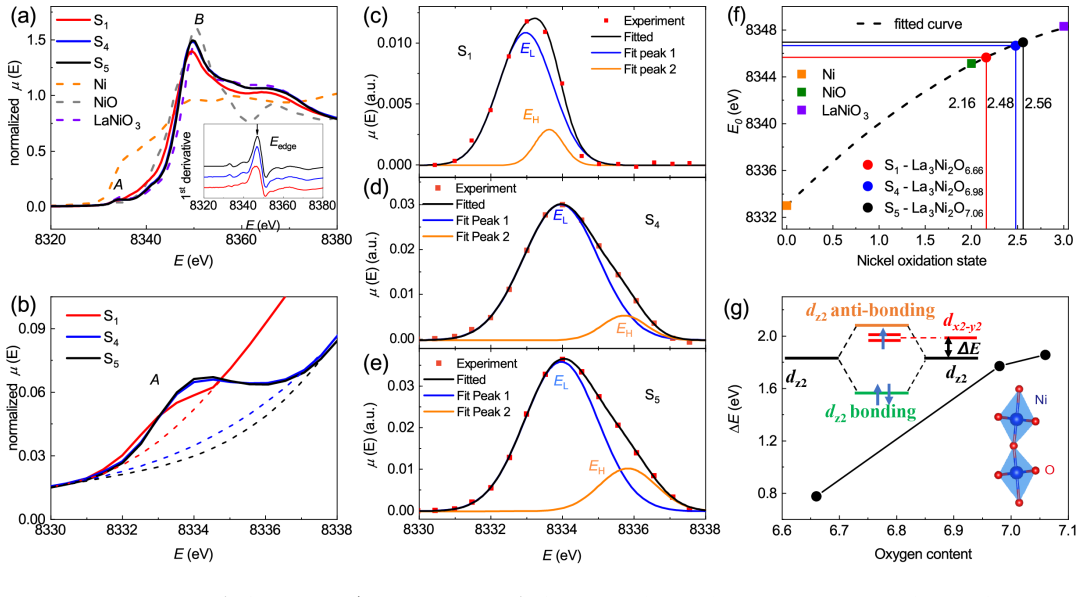
F. d’Acapito, G. O. Lepore, A. Puri, A. Laloni, F. La Manna, E. Dettona, A. De Luisa, A. Martin, J. Synchrotron Radiat.2019, 26, 2 551. 8 Figure 1: NiK-edge XAFS spectra. a) Experimental XAFS spectra of the reference samples Ni, NiO, LaNiO 3 and the experimental samples La 3Ni2O7+δ (S1 S4 and S5). Alphabets ofAandBindicate main features. Inset illustratin...
2019
-
[49]
R. A. Saha, A. Bandyopadhyay, I. Schiesaro, A. Bera, M. Mondal, C. Meneghini, S. Ray, Phy. Rev. B2021, 104, 4
-
[50]
Bandyopadhyay, S
A. Bandyopadhyay, S. K. Neogi, A. Paul, C. Meneghini, I. Dasgupta, S. Bandyopadhyay, S. Ray, Phys. Rev. B2017, 95 024432
-
[51]
Meneghini, F
C. Meneghini, F. Bardelli, S. Mobilio, Nucl. Instrum. Meth. Phys. Res. B2012, 285 153
-
[52]
Bandyopadhyay, European Synchrotron Radiation Facility2027
A. Bandyopadhyay, European Synchrotron Radiation Facility2027. 9 Figure 2: The thermogravimetric change curve of La 3Ni2O7+δ. TGA curve of samples a) S 2 (La3Ni2O6.86), b) S 3 (La3Ni2O6.95), c) S 5 (La3Ni2O7.06) and d) S 6 (La3Ni2O7.08). Figure 3: Temperature-dependent resistance of La 3Ni2O7+δ samples under various pressures. The oxygen content of the sa...
2006
discussion (0)
Sign in with ORCID, Apple, or X to comment. Anyone can read and Pith papers without signing in.