Recognition: unknown
Delay-Aware Large-Small Model Collaboration over LEO Satellite Networks
Pith reviewed 2026-05-08 17:28 UTC · model grok-4.3
The pith
Large-small model collaboration reduces service delays in LEO satellite networks by up to 31.85%.
A machine-rendered reading of the paper's core claim, the machinery that carries it, and where it could break.
Core claim
The central claim is that the proposed delay-aware large-small model collaboration scheme, solved via a multi-agent reinforcement learning algorithm with offline policy training and online bisection search, can reduce the service delay by up to 31.85% compared with benchmarks in LEO satellite networks.
What carries the argument
The multi-agent reinforcement learning algorithm with offline policy training for routing strategies and online bisection search for offloading decisions, applied to the joint optimization formulated as a decentralized partially observable Markov decision process.
Load-bearing premise
The simulation environment accurately represents the delays of inter-satellite links, the differences in satellite computing power, and the patterns of traffic without important real-world factors like changing orbits or signal interference.
What would settle it
Running the scheme on actual LEO satellites and measuring the resulting service delays against those from standard offloading methods would determine if the delay reduction holds.
Figures


read the original abstract
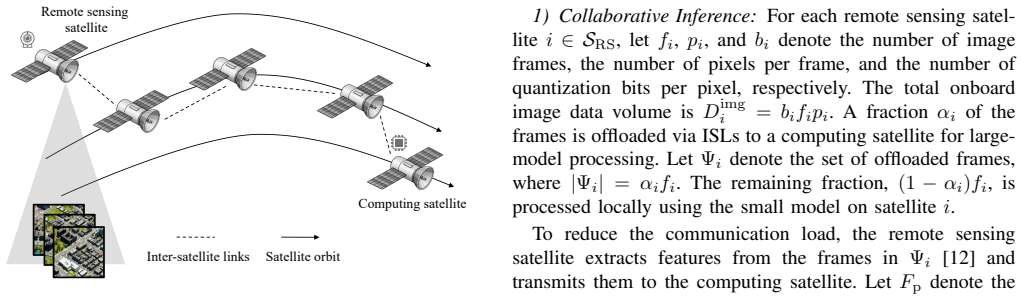
In this paper, we introduce a delay-aware largesmall model collaboration scheme for low Earth orbit (LEO) satellite networks, which can balance the computational load among satellites and the communication load across inter-satellite links. Specifically, computational resource constrained remote sensing satellites are responsible for data collection and local processing using small models, while collaborating with computing satellites that provide large model processing. To minimize the service delay, we formulate a joint optimization problem for offloading decision and routing strategy design, which is transformed into a decentralized partially observable Markov decision process. To solve the problem, we develop a multi-agent reinforcement learning (MARL)-based algorithm with offline policy training and online bisection search. The offline trained policy determines routing strategies, while online bisection search iteratively adjusts the offloading decisions. Simulation results demonstrate that the proposed scheme can reduce the service delay by up to 31.85% compared with the benchmarks.
Editorial analysis
A structured set of objections, weighed in public.
Referee Report
Summary. The paper proposes a delay-aware large-small model collaboration scheme for LEO satellite networks in which remote-sensing satellites use small models for local data collection and processing while offloading to computing satellites equipped with large models. The joint optimization of offloading decisions and routing strategies is formulated as a decentralized partially observable Markov decision process (Dec-POMDP) and solved by a MARL algorithm that performs offline policy training for routing combined with online bisection search for offloading ratios. Simulation results are reported to achieve up to 31.85% lower service delay relative to benchmarks.
Significance. If the simulation results hold under realistic conditions, the work could advance distributed AI processing in space networks by showing how MARL can jointly manage computational heterogeneity and inter-satellite communication loads, offering a practical approach to latency reduction in remote-sensing and edge-computing satellite constellations.
major comments (2)
- [Abstract and Simulation Results] Abstract and Simulation Results: The central claim of up to 31.85% service-delay reduction rests entirely on simulation outcomes, yet the manuscript provides no quantitative details on LEO constellation parameters, time-varying ISL delay models that incorporate orbital motion, satellite compute/storage heterogeneity, traffic patterns, benchmark definitions, or statistical validation (e.g., number of runs or variance). This absence directly weakens support for the performance gain and leaves open the possibility that idealized assumptions inflate the reported improvement.
- [Problem Formulation] Problem Formulation: The transformation of the joint offloading-and-routing optimization into a Dec-POMDP is stated at a high level, but without explicit definitions of the state space, action space, observation model, or reward function that encode the delay components, it is not possible to verify that the MARL solution correctly addresses the original objective.
minor comments (1)
- [Abstract] Abstract: The phrase 'large-small model collaboration' is introduced without a brief definition of what distinguishes the small and large models in terms of parameter count, inference latency, or accuracy.
Simulated Author's Rebuttal
We thank the referee for the constructive comments, which help improve the clarity and rigor of our work. We address each major comment below and will incorporate the suggested revisions.
read point-by-point responses
-
Referee: The central claim of up to 31.85% service-delay reduction rests entirely on simulation outcomes, yet the manuscript provides no quantitative details on LEO constellation parameters, time-varying ISL delay models that incorporate orbital motion, satellite compute/storage heterogeneity, traffic patterns, benchmark definitions, or statistical validation (e.g., number of runs or variance). This absence directly weakens support for the performance gain and leaves open the possibility that idealized assumptions inflate the reported improvement.
Authors: We agree that the simulation setup requires more explicit quantitative details to substantiate the reported gains. In the revised manuscript, we will add a dedicated subsection detailing the LEO constellation parameters (satellite count, altitudes, and orbital periods), time-varying ISL delay models that incorporate orbital motion and visibility constraints, satellite compute/storage heterogeneity, traffic generation patterns, precise benchmark definitions, and statistical validation including the number of independent runs and variance measures. These additions will allow readers to assess the realism of the assumptions and the robustness of the 31.85% improvement. revision: yes
-
Referee: The transformation of the joint offloading-and-routing optimization into a Dec-POMDP is stated at a high level, but without explicit definitions of the state space, action space, observation model, or reward function that encode the delay components, it is not possible to verify that the MARL solution correctly addresses the original objective.
Authors: We acknowledge that the Dec-POMDP formulation is currently described at a high level. In the revised version, we will expand the Problem Formulation section with explicit definitions: the state space will capture local delay observations, queue lengths, and link loads; the action space will include offloading ratios and routing decisions; the observation model will reflect partial observability due to intermittent ISL visibility; and the reward function will be defined as the negative of the weighted sum of computation, transmission, and queuing delays. These will be directly tied to the original delay-minimization objective, enabling verification of the MARL approach. revision: yes
Circularity Check
No significant circularity; simulation-validated empirical gains are independent of inputs
full rationale
The paper models the joint offloading and routing problem as a Dec-POMDP, solves it via MARL (offline policy training for routing plus online bisection search for offloading), and reports up to 31.85% delay reduction from simulations against benchmarks. No load-bearing step reduces by construction to its own inputs: there are no self-definitional equations, no fitted parameters renamed as predictions, no uniqueness theorems imported from self-citations, and no ansatz smuggled via prior work. The central claim rests on external simulation comparison rather than an internal derivation that collapses to the model assumptions.
Axiom & Free-Parameter Ledger
free parameters (2)
- Objective weights for delay components
- MARL training hyperparameters
axioms (1)
- domain assumption LEO satellite network dynamics and delays can be accurately represented as a decentralized partially observable Markov decision process.
Reference graph
Works this paper leans on
-
[1]
Holistic network virtualization and pervasive network intelligence for 6G,
X. Shen, J. Gao, W. Wu, M. Li, C. Zhou, and W. Zhuang, “Holistic network virtualization and pervasive network intelligence for 6G,”IEEE Commun. Surveys Tut., vol. 24, no. 1, pp. 1–30, 2022
2022
-
[2]
Collabo- rative LLM inference over LEO satellite networks: Model splitting and pipeline parallelism,
S. Zhang, W. Wu, S. Wu, W. Yuan, L. Song, and X. S. Shen, “Collabo- rative LLM inference over LEO satellite networks: Model splitting and pipeline parallelism,” inProc. Int. Conf. on Wireless Commun. Signal Process. (WCSP), 2025 , pp. 1–6
2025
-
[3]
Performance annaly- sis of IoT-based overlay satellite-terrestrial networks under interference,
P. K. Sharma, B. Yogesh, D. Gupta, and D. I. Kim, “Performance annaly- sis of IoT-based overlay satellite-terrestrial networks under interference,” IEEE Trans. Cogn. Commun. Netw., vol. 7, no. 3, pp. 985–1001, 2021
2021
-
[4]
Age-critical joint communication and computation offloading for satellite-integrated Internet,
K. Li, J. Jiao, J. Huang, Z. Xu, Q. Sun, and X. Xu et al., “Age-critical joint communication and computation offloading for satellite-integrated Internet,”IEEE Trans. Cogn. Commun. Netw., vol. 12, pp. 4387–4403, 2026
2026
-
[5]
On-orbit DNN distributed inference for remote sensing images in satellite Internet of things,
Y . Qiao, S. Teng, J. Luo, P. Sun, F. Li, and F. Tang, “On-orbit DNN distributed inference for remote sensing images in satellite Internet of things,”IEEE Internet Things J., vol. 12, no. 5, pp. 5687–5703, 2025
2025
-
[6]
Efficient model training in edge networks with hierarchical split learning,
S. Zhang, W. Wu, L. Song, and X. Shen, “Efficient model training in edge networks with hierarchical split learning,”IEEE Trans. Mobile Comput., vol. 24, no. 10, pp. 10 214–10 229, 2025
2025
-
[7]
Split learning over wireless networks: Parallel design and resource management,
W. Wu, M. Li, K. Qu, C. Zhou, X. Shen, and W. Zhuang et al., “Split learning over wireless networks: Parallel design and resource management,”IEEE J. Sel. Areas Commun., vol. 41, no. 4, pp. 1051– 1066, 2023
2023
-
[8]
Woodfisher: efficient second-order approx- imation for neural network compression,
S. P. Singh and D. Alistarh, “Woodfisher: efficient second-order approx- imation for neural network compression,” inProc. NeurIPS, 2020, pp. 18 098–18 109
2020
-
[9]
Rigging the lottery: Making all tickets winners,
U. Evci, T. Gale, J. Menick, P. S. Castro, and E. Elsen, “Rigging the lottery: Making all tickets winners,” inProc. Int. Conf. Mach. Learn., 2020, pp. 2943–3952
2020
-
[10]
High-throughput energy-efficient accelerator with collaborative- trainable sparse-quantization method for on-board remote sensing pro- cessing,
T. Wang, H. Chen, N. Zhang, S. Ni, X. Zhang, and L. Chen et al., “High-throughput energy-efficient accelerator with collaborative- trainable sparse-quantization method for on-board remote sensing pro- cessing,”IEEE Trans. Geosci. Remote Sens., vol. 63, pp. 1–18, 2025
2025
-
[11]
Nas-based CNN channel pruning for remote sensing scene classification,
X. Wei, N. Zhang, W. Liu, and H. Chen, “Nas-based CNN channel pruning for remote sensing scene classification,”IEEE Geosci. Remote Sens. Lett., vol. 19, pp. 1–5, 2022
2022
-
[12]
Large models for aerial edges: An edge-cloud model evolution and communication paradigm,
S. Zhang, Q. Liu, K. Chen, B. Di, H. Zhang, and W. Yang et al., “Large models for aerial edges: An edge-cloud model evolution and communication paradigm,”IEEE J. Sel. Areas Commun., vol. 43, no. 1, pp. 21–35, 2025
2025
-
[13]
Video coding for machines: Compact visual representation compression for intelligent collaborative analytics,
W. Yang, H. Huang, Y . Hu, L.-Y . Duan, and J. Liu, “Video coding for machines: Compact visual representation compression for intelligent collaborative analytics,”IEEE Trans. Pattern Anal. and Mach. Intell., vol. 46, no. 7, pp. 5174–5191, 2024
2024
-
[14]
Machine learning-based resource allocation in satellite networks supporting Internet of remote things,
D. Zhou, M. Sheng, Y . Wang, J. Li, and Z. Han, “Machine learning-based resource allocation in satellite networks supporting Internet of remote things,”IEEE Trans. Wireless Commun., vol. 20, no. 10, pp. 6606–6621, 2021
2021
-
[15]
Service-aware resource orchestration in ultra-dense LEO satellite-terrestrial integrated 6G: A service function chain approach,
X. Qin, T. Ma, Z. Tang, X. Zhang, H. Zhou, and L. Zhao, “Service-aware resource orchestration in ultra-dense LEO satellite-terrestrial integrated 6G: A service function chain approach,”IEEE Trans. Wireless Commun., vol. 22, no. 9, pp. 6003–6017, 2023
2023
discussion (0)
Sign in with ORCID, Apple, or X to comment. Anyone can read and Pith papers without signing in.