Recognition: unknown
The Impact of Spin Priors on Parameterized Tests of General Relativity
Pith reviewed 2026-05-08 16:12 UTC · model grok-4.3
The pith
Spin prior choices can propagate into parameterized tests of general relativity in a non-trivial and model-dependent manner.
A machine-rendered reading of the paper's core claim, the machinery that carries it, and where it could break.
Core claim
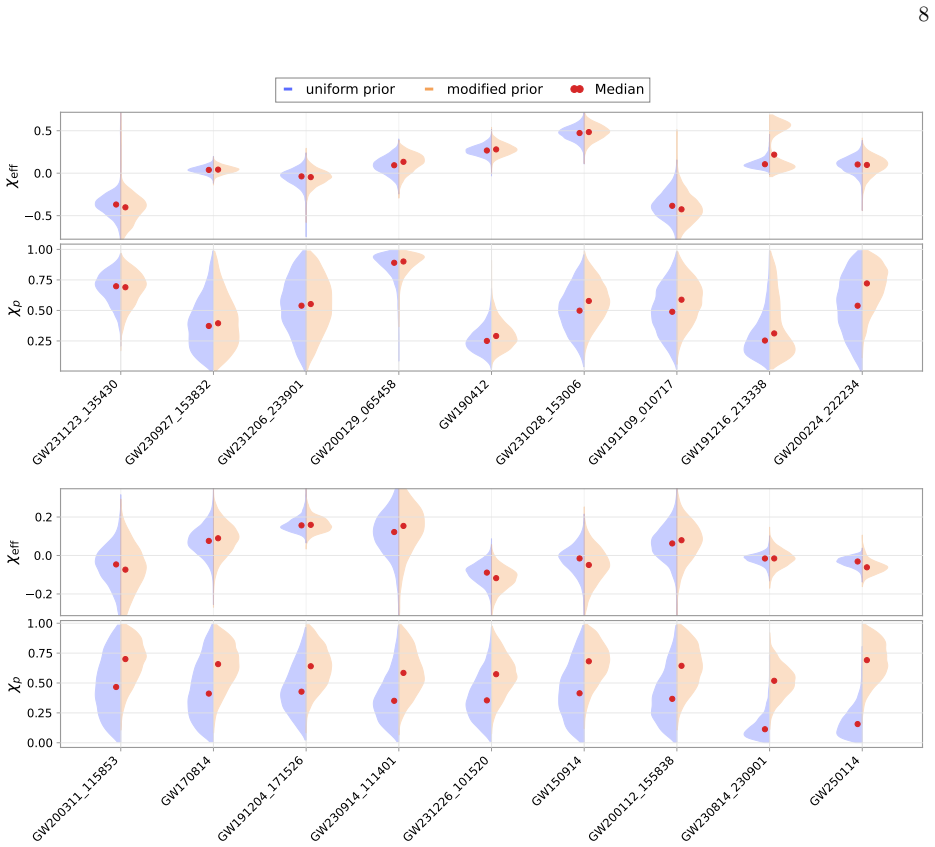
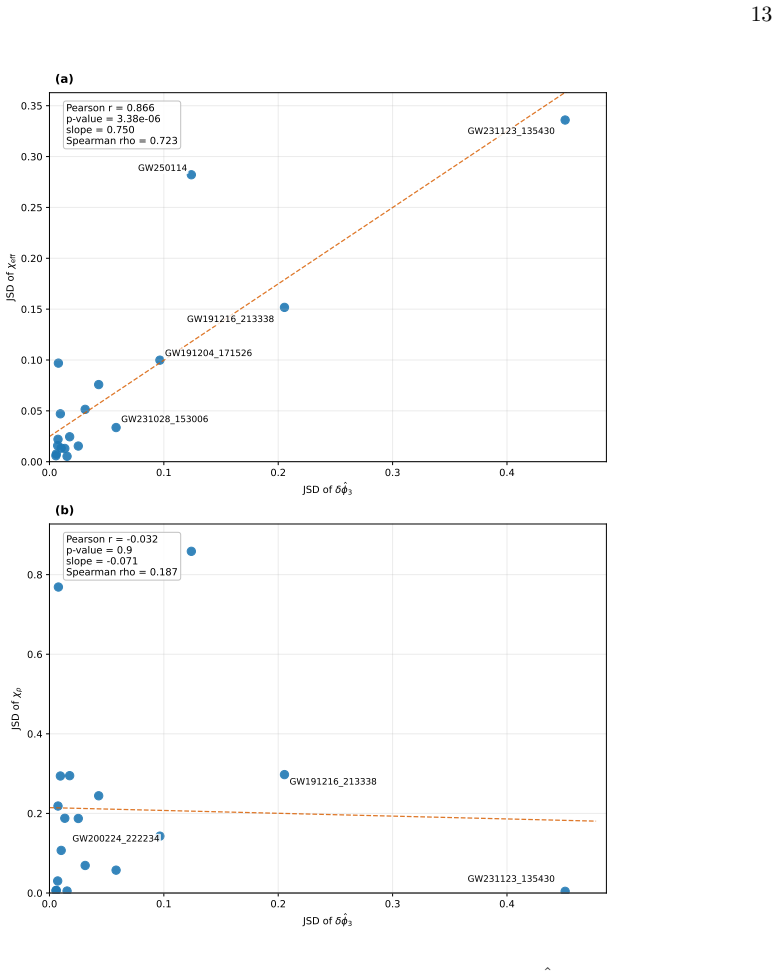
By analyzing real gravitational-wave events, we show that the effective precession spin parameter exhibits stronger prior sensitivity than the effective inspiral spin. While the 1.5PN deviation parameter is generally robust, some events with short inspiral durations display noticeable discrepancies quantified by Jensen-Shannon divergence around 0.4 and median shifts. When the deviation parameter is included in the fit, a strong correlation emerges with the effective inspiral spin due to partial degeneracy at 1.5PN order, and leave-one-out tests indicate this correlation depends on a subset of sensitive events.
What carries the argument
The 1.5PN deviation parameter δφ̂3, whose posterior sensitivity to spin priors is quantified via Jensen-Shannon divergence and median shifts to reveal model-dependent effects and parameter degeneracies.
If this is right
- Events with very short inspiral durations exhibit more pronounced median shifts in the deviation parameter.
- No significant correlation exists between spin prior sensitivity and deviation parameter sensitivity under standard general relativity assumptions.
- Including the deviation parameter induces a strong correlation with effective inspiral spin attributable to 1.5PN degeneracy.
- Leave-one-out analysis shows the correlation is driven by a subset of high-sensitivity events.
- Spin prior choices may mimic or reshape apparent deviations from general relativity depending on the model.
Where Pith is reading between the lines
- Analyses of future events might benefit from explicitly marginalizing over multiple spin prior choices to avoid biasing deviation constraints.
- The observed degeneracy suggests similar prior effects could appear in tests at other post-Newtonian orders when applied to short-duration signals.
- Population-level studies combining many events could dilute or amplify these prior-induced shifts depending on the fraction of short signals.
- Extending the approach to neutron star binaries or higher-mass systems might test whether the sensitivity pattern generalizes beyond black hole mergers.
Load-bearing premise
That the chosen set of real events and focus on the 1.5PN deviation parameter are representative enough for the observed prior sensitivities and correlations to apply more broadly.
What would settle it
A reanalysis of the same or additional events that finds no Jensen-Shannon divergence differences above 0.1 and no correlation between effective inspiral spin and the deviation parameter when included would falsify the claim of non-trivial propagation.
Figures



read the original abstract
Spin priors play a fundamental role in gravitational-wave parameter estimation, yet their impact on parameterized tests of General Relativity (GR) remains insufficiently understood. In this work, we systematically investigate how spin prior choices affect the 1.5PN deviation parameter $\delta \hat{\phi}_3$ using real gravitational-wave events. We quantify prior-induced effects through the Jensen--Shannon divergence (JSD) and median shifts of posterior distributions. We find that the effective precession spin parameter $\chi_p$ exhibits significantly stronger prior sensitivity than the effective inspiral spin $\chi_{\rm eff}$. While $\delta \hat{\phi}_3$ is generally robust across most events, GW231123\_135430 exhibits a noticeable discrepancy, with a JSD at the $\mathcal{O}(0.4)$ level. Examining the median shift, we note that events with very short inspiral durations, such as GW231028\_153006, GW231123\_135430, and GW191109\_010717, show more pronounced shifts, indicating increased sensitivity in low-information regimes. We further explore the relationship between the prior sensitivity of spin parameters and that of $\delta \hat{\phi}_3$. No significant correlation is observed when spin parameters are inferred within the standard GR framework. However, when $\delta \hat{\phi}_3$ is included in the analysis, a strong correlation emerges between $\chi_{\rm eff}$ and $\delta \hat{\phi}_3$, which we attribute to partial parameter degeneracy at the 1.5PN order. A leave-one-out test shows that the observed correlation is sensitive to the inclusion of specific events, indicating that it is partially driven by a subset of high-sensitivity events. Our results demonstrate that spin-prior choices can propagate into parameterized tests of GR in a non-trivial and model-dependent manner, and may mimic or reshape apparent deviations from GR.
Editorial analysis
A structured set of objections, weighed in public.
Referee Report
Summary. The manuscript examines how choices of spin priors influence the posteriors of the 1.5PN parameterized deviation parameter δ̂φ3 in tests of GR using real GW events. Using JSD and median shifts, it finds stronger sensitivity for χp than χeff, notable effects in certain short-inspiral events such as GW231123_135430 (JSD ~0.4), and a correlation between χeff and δ̂φ3 that appears only when the deviation parameter is fitted, attributed to degeneracy at 1.5PN order. A leave-one-out test indicates the correlation is driven by a subset of events. The results indicate that spin priors can non-trivially affect GR tests in a model-dependent way and may mimic apparent deviations.
Significance. If the findings hold, this work is significant for gravitational-wave astronomy because it identifies a concrete systematic that can propagate from spin priors into parameterized GR tests, potentially leading to misinterpretation of deviations. The use of real events from the catalog, quantitative metrics like JSD, and the leave-one-out validation provide direct evidence that the effect is event-dependent and tied to the inclusion of the deviation parameter, strengthening the model-dependent claim. This has implications for robust analysis pipelines with current and future detectors.
major comments (3)
- The data selection criteria for the real gravitational-wave events analyzed and the specific waveform approximants employed for the parameterized tests (including how δ̂φ3 is implemented) are not detailed. This is load-bearing for the central claim, as the observed JSD values, median shifts, and leave-one-out sensitivity cannot be independently verified or generalized without this information.
- The emergence of a 'strong correlation' between χeff and δ̂φ3 only when the deviation parameter is included is attributed to partial degeneracy at 1.5PN order, but no quantitative measures (such as Pearson coefficients, posterior overlap integrals, or explicit degeneracy diagnostics) are provided to support the attribution or to distinguish it from prior-induced effects.
- Error propagation and uncertainty quantification for the reported JSD values and median shifts are not described. Given that the central results rest on differences at the O(0.4) level for specific events, the absence of these details undermines assessment of whether the prior sensitivities are statistically significant or dominated by sampling noise.
minor comments (2)
- The abstract and results refer to events such as GW231123_135430 and GW231028_153006 but do not state the total number of events or the GW catalog version used, which would improve clarity and allow readers to assess representativeness.
- Notation for the deviation parameter should include an explicit reference to the standard parameterized post-Einsteinian framework (e.g., the definition of δφ̂3 at 1.5PN order) upon first use to aid readers unfamiliar with the specific implementation.
Simulated Author's Rebuttal
We thank the referee for their thorough review and valuable comments, which have helped improve the clarity and robustness of our manuscript. Below, we provide a point-by-point response to the major comments. We have revised the manuscript accordingly to address the concerns.
read point-by-point responses
-
Referee: The data selection criteria for the real gravitational-wave events analyzed and the specific waveform approximants employed for the parameterized tests (including how δ̂φ3 is implemented) are not detailed. This is load-bearing for the central claim, as the observed JSD values, median shifts, and leave-one-out sensitivity cannot be independently verified or generalized without this information.
Authors: We agree with the referee that providing detailed information on data selection and waveform approximants is essential for the reproducibility of our results. In the revised manuscript, we have expanded the 'Data and Methods' section to include: (1) the specific selection criteria for the gravitational-wave events (e.g., network SNR > 10, exclusion of events with known data quality issues, and the list of events from the GWTC catalog used in our analysis); (2) the waveform approximant used (IMRPhenomXPHM); and (3) the implementation of the parameterized deviation δ̂φ3, which follows the ppE framework as implemented in the LIGO-Virgo-KAGRA analysis pipelines, with the deviation parameter introduced at the 1.5PN order in the phase. These additions enable independent verification of our JSD calculations and other findings. revision: yes
-
Referee: The emergence of a 'strong correlation' between χeff and δ̂φ3 only when the deviation parameter is included is attributed to partial degeneracy at 1.5PN order, but no quantitative measures (such as Pearson coefficients, posterior overlap integrals, or explicit degeneracy diagnostics) are provided to support the attribution or to distinguish it from prior-induced effects.
Authors: We acknowledge that quantitative measures were not provided in the original submission to support the degeneracy attribution. In the revised manuscript, we have included Pearson correlation coefficients between χ_eff and δ̂φ3 for both the standard GR analysis and the analysis including δ̂φ3. Additionally, we report the mutual information and posterior overlap integrals to better characterize the degeneracy. These additions confirm that the correlation strengthens significantly only when the deviation parameter is fitted, consistent with the expected partial degeneracy at 1.5PN order, and help distinguish it from prior-induced effects alone. revision: yes
-
Referee: Error propagation and uncertainty quantification for the reported JSD values and median shifts are not described. Given that the central results rest on differences at the O(0.4) level for specific events, the absence of these details undermines assessment of whether the prior sensitivities are statistically significant or dominated by sampling noise.
Authors: We agree that uncertainty quantification is important for assessing the significance of the reported JSD values and median shifts. In the revised manuscript, we have added a description of our uncertainty estimation procedure using bootstrap resampling of the posterior samples to compute standard errors on the JSD and median values. These estimates indicate that the O(0.4) JSD for events like GW231123_135430 is robust and not dominated by sampling noise. We have updated the relevant figures and text to include these uncertainty measures. revision: yes
Circularity Check
No significant circularity
full rationale
The paper conducts an empirical study on real gravitational-wave events, computing standard quantities (JSD, posterior medians, correlations) from parameter estimation runs under different spin priors. No equations or definitions reduce the reported sensitivities or correlations to quantities defined by the deviation parameter itself. The central claims are scoped to observable differences in the analyzed catalog and are directly evidenced by the data comparisons and leave-one-out tests rather than by construction or self-citation chains. The analysis relies on external data and conventional statistical tools without load-bearing self-references or fitted inputs renamed as predictions.
Axiom & Free-Parameter Ledger
axioms (2)
- domain assumption Standard GR waveform models and Bayesian inference framework accurately capture the likelihood for the selected events.
- domain assumption Jensen-Shannon divergence and median shifts are appropriate and sufficient metrics for quantifying prior-induced changes.
Reference graph
Works this paper leans on
-
[1]
B. P. Abbottet al.(LIGO Scientific, Virgo), Phys. Rev. Lett.116, 061102 (2016), arXiv:1602.03837 [gr-qc]
work page internal anchor Pith review arXiv 2016
- [2]
- [3]
-
[4]
B. P. Abbottet al.(LIGO Scientific, Virgo), Phys. Rev. X9, 031040 (2019), arXiv:1811.12907 [astro- ph.HE]
work page internal anchor Pith review arXiv 2019
-
[5]
T. G. F. Li, W. Del Pozzo, S. Vitale, C. Van Den Broeck, M. Agathos, J. Veitch, K. Grover, T. Sidery, R. Sturani, and A. Vecchio, Phys. Rev. D85, 082003 (2012)
2012
- [6]
- [7]
-
[8]
N. Yunes and F. Pretorius, Phys. Rev. D80, 122003 (2009), arXiv:0909.3328 [gr-qc]
work page Pith review arXiv 2009
-
[9]
Ajith et al., A Template bank for gravitational wave- forms from coalescing binary black holes
P. Ajith, S. Babak, Y. Chen, M. Hewitson, B. Krishnan, A. M. Sintes, C. Van Den Broeck, J. C. Bustillo, E. N. Dorband, G. Gonz´ alez, M. Hannam, S. Husa, D. Keppel, S. T. McWilliams, D. M¨ uller, F. Ohme, J. Palamos, M. P¨ urrer, C. Reisswig, and L. Santamaria, Phys. Rev. D77, 104017 (2008), arXiv:0710.2335 [gr-qc]
- [10]
-
[11]
Post-Newtonian Theory for Gravitational Waves
L. Blanchet, Living Rev. Rel.17, 2 (2014), arXiv:1310.1528 [gr-qc]
work page internal anchor Pith review arXiv 2014
-
[12]
Maggiore,Gravitational Waves
M. Maggiore,Gravitational Waves. Vol. 1: Theory and Experiments(Oxford University Press, 2007)
2007
-
[13]
A. Buonanno and T. Damour, Phys. Rev. D59, 084006 (1999), arXiv:gr-qc/9811091 [gr-qc]
-
[14]
N. Yunes and X. Siemens, Living Rev. Relativ.16(2013), 10.12942/lrr-2013-9
- [15]
- [16]
-
[17]
A. G. Abacet al.(LIGO Scientific, VIRGO, KAGRA), (2025), arXiv:2508.18083 [astro-ph.HE]
work page internal anchor Pith review arXiv 2025
-
[18]
K. Kobayashi, M. Iwaya, S. Morisaki, K. Hotokezaka, and T. Kinugawa, J. Phys. Conf. Ser.3177, 012078 (2026), arXiv:2602.12509 [gr-qc]
-
[19]
V. Prasad and B. S. Sathyaprakash, (2026), arXiv:2602.12859 [gr-qc]
-
[20]
Analysis of spin precession in binary black hole systems including quadrupole-monopole interaction
E. Racine, Phys. Rev. D78, 044021 (2008), arXiv:0803.1820 [gr-qc]
work page Pith review arXiv 2008
- [21]
- [22]
-
[23]
P. Schmidt, M. Hannam, and S. Husa, Phys. Rev. D86, 104063 (2012), arXiv:1207.3088 [gr-qc]
-
[24]
J. Petersen, J. Volz, and A. Rauschenbeutel, Science346, 1257671 (2014), arXiv:1406.2184 [quant-ph]
-
[25]
G. Sch¨ afer and P. Jaranowski, Living Rev. Rel.21, 7 (2018), arXiv:1805.07240 [gr-qc]
-
[26]
Testing General Relativity with Present and Future Astrophysical Observations
E. Bertiet al., Class. Quant. Grav.32, 243001 (2015), arXiv:1501.07274 [gr-qc]
work page internal anchor Pith review arXiv 2015
-
[27]
M. Vallisneri, Phys. Rev. D86, 082001 (2012), arXiv:1207.4759 [gr-qc]
- [28]
-
[29]
Lin, IEEE Trans
J. Lin, IEEE Trans. Info. Theor.37, 145 (1991)
1991
-
[30]
D. M. Endres and J. E. Schindelin, IEEE Trans. Inf. Theory49, 1858 (2003)
2003
-
[31]
E. Thrane and C. Talbot, Publ. Astron. Soc. Austral.36, e010 (2019), [Erratum: Publ.Astron.Soc.Austral. 37, e036 (2020)], arXiv:1809.02293 [astro-ph.IM]
-
[32]
J. Veitchet al., Phys. Rev. D91, 042003 (2015), arXiv:1409.7215 [gr-qc]
-
[33]
B. P. Abbottet al.(LIGO Scientific Collaboration and Virgo Collaboration), Phys. Rev. X11, 021053 (2021), arXiv:2010.14527 [gr-qc]
work page internal anchor Pith review arXiv 2021
-
[34]
Fuglede and F
B. Fuglede and F. Topsøe, inProceedings of the IEEE International Symposium on Information Theory (ISIT)(IEEE, 2004) pp. 31–31
2004
-
[35]
C. E. Shannon, Bell Syst. Tech. J.27, 379 (1948)
1948
-
[36]
Bilby: A user-friendly Bayesian inference library for gravitational-wave astronomy
G. Ashtonet al., Astrophys. J. Suppl.241, 27 (2019), arXiv:1811.02042 [astro-ph.IM]
work page internal anchor Pith review arXiv 2019
- [37]
- [38]
-
[39]
K. Wette, SoftwareX12, 100634 (2020), arXiv:2012.09552 [astro-ph.IM]
-
[40]
G. Pratten, C. Garc´ ıa-Quir´ os, M. Colleoni, A. Ramos-Buades, H. Estell´ es, M. Mateu-Lucena, R. Jaume, M. Haney, D. Keitel, J. E. Thompson, and S. Husa, Phys. Rev. D103, 104056 (2021), arXiv:2004.06503 [gr-qc]
work page internal anchor Pith review arXiv 2021
- [41]
-
[42]
M. Piarulli, S. Marsat, E. M. S¨ anger, A. Buonanno, J. Steinhoff, and N. Tamanini, (2025), arXiv:2510.06330 [gr-qc]
-
[43]
T. Narikawa, H. Tagoshi, T. Tanaka, S. Sakon, and T. Takahashi, Prog. Theor. Exp. Phys. (2016), 10.1093/ptep/ptw016, arXiv:1601.07691 [gr-qc]
-
[44]
C. Talbot and E. Thrane, Phys. Rev. D100, 043030 (2019), arXiv:1811.09144 [astro-ph.HE]
-
[45]
R. Abbottet al.(LIGO Scientific Collaboration and Virgo Collaboration), Astrophys. J. Lett.913, L7 (2021), arXiv:2010.14533 [astro-ph.HE]
-
[46]
Poisson and C
E. Poisson and C. M. Will, Phys. Rev. D52, 848 (1995)
1995
-
[47]
Cutler and E
C. Cutler and E. E. Flanagan, Phys. Rev. D49, 2658 (1994)
1994
-
[48]
L. Copparoni, R. S. Chandramouli, and E. Barausse, (2025), arXiv:2510.06948 [gr-qc]. 19 TABLE III. Posterior medians with symmetric 90% credible intervals, Jensen–Shannon divergence (JSD), absolute median shifts|∆med|, and absolute JSD differences|∆JSD|forχ p andχ eff. Events χp χeff uniform prior modified prior JSD|∆med| |∆JSD|uniform prior modified prio...
discussion (0)
Sign in with ORCID, Apple, or X to comment. Anyone can read and Pith papers without signing in.