Recognition: unknown
The magnetic fields in Be stars are stronger than previously suggested
Pith reviewed 2026-05-08 16:57 UTC · model grok-4.3
The pith
Magnetic fields in Be stars reach hundreds of gauss, stronger than prior estimates suggested.
A machine-rendered reading of the paper's core claim, the machinery that carries it, and where it could break.
Core claim
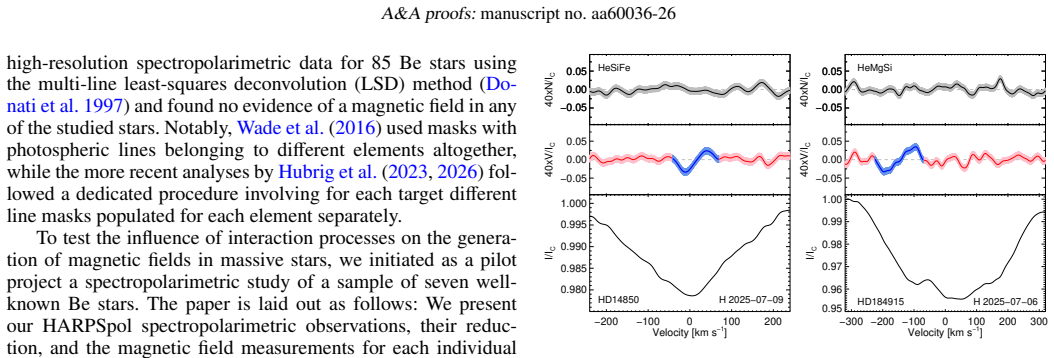
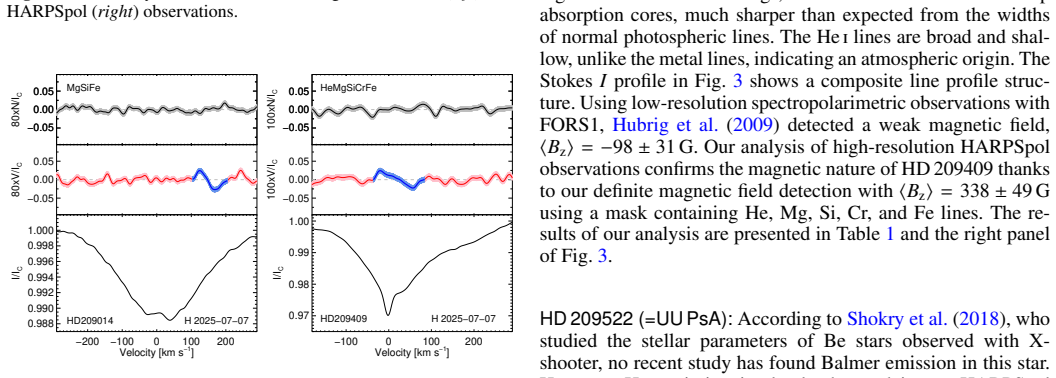
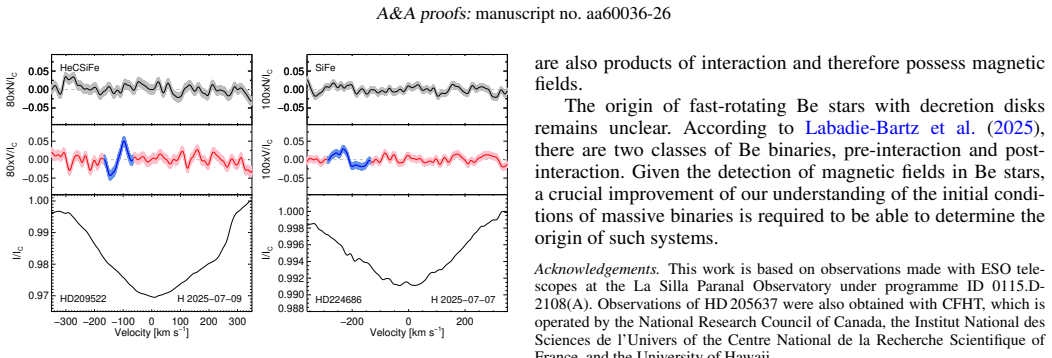
Using high-resolution HARPSpol spectra and a dedicated least-squares deconvolution procedure, the authors measured mean longitudinal magnetic fields in seven Be stars and detected fields in every case. The strongest value is approximately -460 G for the B0.5 III star HD 184915, while three others show absolute values between 338 and 380 G. This constitutes the first observational evidence that magnetic fields in Be stars can reach a few hundred gauss.
What carries the argument
Least-squares deconvolution applied to HARPSpol spectra to extract mean longitudinal magnetic field measurements.
If this is right
- Magnetic fields in Be stars are typically hundreds of gauss rather than weak and below 100 G.
- Magnetic fields are present in all studied Be stars.
- Models of massive binary formation must incorporate stronger initial magnetic fields to explain the origin of Be stars.
- The role of binary interaction in generating magnetic fields in radiative-envelope stars requires re-examination.
Where Pith is reading between the lines
- Stronger fields could affect the dynamics of the circumstellar disks that define the Be phenomenon.
- If confirmed across a larger sample, this would imply that magnetic braking or field-disk interactions play a larger part in the evolution of rapidly rotating B stars.
- Future surveys could test whether field strength correlates with Be-star properties such as rotation rate or disk size.
Load-bearing premise
The dedicated least-squares deconvolution procedure applied to the spectra produces accurate magnetic field measurements even though circumstellar disks can distort the spectral lines.
What would settle it
An independent spectropolarimetric observation of HD 184915 with a different instrument that returns a mean longitudinal field much weaker than 460 G in absolute value.
Figures

read the original abstract
Recent observational studies suggest that Be stars most likely are formed through the process of mass transfer in binary systems. In view of the wide consensus that the origin of the magnetic field in stars with radiative envelopes involves binary interaction processes, searching for magnetic fields in Be stars appears especially promising. As a pilot project, we searched for the presence of magnetic fields in a sample of seven well-known Be stars. We used high-resolution HARPSpol spectra to measure the mean longitudinal magnetic field, employing the least squares deconvolution technique. A dedicated measurement procedure introduced by our group in recent years was applied. Opposite to previous spectropolarimetric studies reporting that magnetic fields in Be stars are weak and usually below 100 G, our study presents the first observational evidence that magnetic fields in Be stars can be as strong as a few hundred gauss. Magnetic fields are detected in all studied Be stars, with the strongest magnetic field being about -460 G for the B0.5 III star HD 184915. Magnetic fields in the range between 338 and 380 G (in absolute values) are detected in three other Be stars, HD 209409, HD 209522, and HD 224686. Due to the fact that magnetic fields in Be stars are stronger than previously believed, we must re-evaluate our understanding of the initial conditions of massive binaries to be able to determine the origin of such systems.
Editorial analysis
A structured set of objections, weighed in public.
Referee Report
Summary. The manuscript reports a pilot spectropolarimetric study of seven Be stars using HARPSpol spectra. Applying a dedicated least-squares deconvolution (LSD) procedure, the authors detect mean longitudinal magnetic fields in every target, with the largest value of approximately -460 G in the B0.5 III star HD 184915 and absolute values of 338-380 G in three additional stars (HD 209409, HD 209522, HD 224686). This is presented as the first observational evidence that magnetic fields in Be stars reach a few hundred gauss, in contrast to earlier work reporting fields typically below 100 G. The authors conclude that the stronger fields require re-evaluation of the initial conditions of massive binaries to explain Be-star formation via mass transfer.
Significance. If the reported field strengths are confirmed to be photospheric, the result would materially revise current understanding of magnetism in stars with radiative envelopes and strengthen the link between binary interaction and both field generation and Be-star disk formation. It would also motivate larger surveys and updated evolutionary models for massive binaries.
major comments (1)
- [LSD measurement procedure (abstract and methods description)] The headline claim that magnetic fields of several hundred gauss are present in all seven Be stars rests entirely on the accuracy of the mean longitudinal field values extracted by the group's dedicated LSD procedure. The manuscript supplies no quantitative demonstration that circumstellar-disk contributions (emission, shell absorption, or line-profile distortions in the lines fed to LSD) have been suppressed or excluded. No tests are shown for the stability of the reported B_l values (e.g., -460 G for HD 184915) when disk-affected lines are down-weighted or removed from the mask, nor are error budgets or detection-significance thresholds provided. Because prior studies obtained weaker fields, the discrepancy could originate in differences in disk handling rather than in intrinsically stronger stellar magnetism; this validation is therefore load-bearing for the central result.
minor comments (2)
- [Abstract] The abstract would be strengthened by a brief statement of the sample selection criteria, the typical S/N of the spectra, and the formal detection thresholds used.
- [Results] A summary table listing each star, the measured B_l with uncertainty, and the detection significance would improve readability and allow immediate comparison with earlier work.
Simulated Author's Rebuttal
We thank the referee for the careful and constructive review of our pilot spectropolarimetric study. We address the single major comment below and will revise the manuscript to incorporate additional methodological validations.
read point-by-point responses
-
Referee: LSD measurement procedure (abstract and methods description): The headline claim that magnetic fields of several hundred gauss are present in all seven Be stars rests entirely on the accuracy of the mean longitudinal field values extracted by the group's dedicated LSD procedure. The manuscript supplies no quantitative demonstration that circumstellar-disk contributions (emission, shell absorption, or line-profile distortions in the lines fed to LSD) have been suppressed or excluded. No tests are shown for the stability of the reported B_l values (e.g., -460 G for HD 184915) when disk-affected lines are down-weighted or removed from the mask, nor are error budgets or detection-significance thresholds provided. Because prior studies obtained weaker fields, the discrepancy could originate in differences in disk handling rather than in intrinsically stronger stellar magnetism; this valida
Authors: We agree that the manuscript would benefit from explicit quantitative tests of disk contributions, which are not currently included. Our dedicated LSD procedure (developed and applied in our prior publications on Be and related stars) uses line masks and weighting schemes specifically chosen to reduce the impact of disk emission, shell absorption, and profile distortions. Nevertheless, to directly respond to this load-bearing concern, the revised version will add: (i) a detailed description of the line mask construction and exclusion criteria for disk-affected lines, (ii) stability tests of the reported B_l values (including for HD 184915) when down-weighting or removing suspect lines, and (iii) full error budgets together with detection-significance thresholds. These additions will allow readers to evaluate whether the stronger fields reflect photospheric magnetism rather than differences in disk handling. We maintain that the discrepancy with earlier studies is unlikely to arise solely from disk treatment, given the tailored nature of our procedure, but the requested tests will strengthen the presentation. revision: yes
Circularity Check
No circularity in direct observational magnetic field measurements
full rationale
The paper is a straightforward observational study reporting mean longitudinal magnetic field detections from HARPSpol spectra of seven Be stars via the LSD technique. No mathematical derivation chain, equations, model fits, or predictions exist that could reduce to inputs by construction. The central claims rest on reported field values (e.g., -460 G for HD 184915) extracted from spectra, which are externally falsifiable by independent observations or re-analysis of the same data. The mention of a 'dedicated measurement procedure introduced by our group' is a self-citation to a prior methodological paper but functions as a tool description rather than a load-bearing premise that justifies the results circularly; the measurements themselves provide the evidence. Prior studies are contrasted but not used to derive the new values. This matches the default expectation for non-circular observational work.
Axiom & Free-Parameter Ledger
axioms (1)
- domain assumption The least-squares deconvolution technique applied to high-resolution circularly polarized spectra accurately recovers the mean longitudinal magnetic field even in the presence of circumstellar disks.
Reference graph
Works this paper leans on
-
[1]
1969, MNRAS, 144, 1
Buscombe, W. 1969, MNRAS, 144, 1
1969
-
[2]
P., Brown, J
Cassinelli, J. P., Brown, J. C., Maheswaran, M., Miller, N. A., & Telfer, D. C. 2002, ApJ, 578, 951
2002
-
[3]
Corbally, C. J. 1984, ApJS, 55, 657
1984
-
[4]
R., Przybilla, N., & Hubrig, S
Cowley, C. R., Przybilla, N., & Hubrig, S. 2015, A&A, 578, A26 de Burgos, A., Simón-Díaz, S., Urbaneja, M. A., & Puls, J. 2024, A&A, 687, A228
2015
-
[5]
F., Semel, M., Carter, B
Donati, J. F., Semel, M., Carter, B. D., Rees, D. E., & Collier Cameron, A. 1997, MNRAS, 291, 658
1997
-
[6]
F., Semel, M., & Rees, D
Donati, J. F., Semel, M., & Rees, D. E. 1992, A&A, 265, 669
1992
-
[7]
E., Tout, C
Ferrario, L., Pringle, J. E., Tout, C. A., & Wickramasinghe, D. T. 2009, MNRAS, 400, L71
2009
-
[8]
Hanuschik, R. W. 1995, A&A, 295, 423
1995
-
[9]
P., et al
Hubrig, S., Abdul-Masih, M., Järvinen, S. P., et al. 2026, A&A, 707, A3
2026
-
[10]
F., Ilyin, I., et al
Hubrig, S., González, J. F., Ilyin, I., et al. 2012, A&A, 547, A90
2012
-
[11]
P., Ilyin, I., & Schöller, M
Hubrig, S., Järvinen, S. P., Ilyin, I., & Schöller, M. 2025, A&A, 701, A255
2025
-
[12]
P., Ilyin, I., Schöller, M., & Jayaraman, R
Hubrig, S., Järvinen, S. P., Ilyin, I., Schöller, M., & Jayaraman, R. 2023, MN- RAS, 521, 6228
2023
-
[13]
P., Madej, J., et al
Hubrig, S., Järvinen, S. P., Madej, J., et al. 2018, MNRAS, 477, 3791
2018
-
[14]
W., Bagnulo, S., et al
Hubrig, S., Kurtz, D. W., Bagnulo, S., et al. 2004, A&A, 415, 661
2004
-
[15]
2017, MNRAS, 471, 1543
Hubrig, S., Przybilla, N., Korhonen, H., et al. 2017, MNRAS, 471, 1543
2017
-
[16]
2009, Astronomische Nachrichten, 330, 708
Hubrig, S., Schöller, M., Savanov, I., et al. 2009, Astronomische Nachrichten, 330, 708
2009
-
[17]
V ., Pogodin, M., Schöller, M., & Peters, G
Hubrig, S., Yudin, R. V ., Pogodin, M., Schöller, M., & Peters, G. J. 2007, As- tronomische Nachrichten, 328, 1133 Järvinen, S. P., Hubrig, S., Ilyin, I., et al. 2018, A&A, 618, L2
2007
-
[18]
2019, A&A, 623, A72
Kervella, P., Arenou, F., Mignard, F., & Thévenin, F. 2019, A&A, 623, A72
2019
-
[19]
L., & V AMDC Collaboration
Kupka, F., Dubernet, M. L., & V AMDC Collaboration. 2011, Baltic Astronomy, 20, 503
2011
-
[20]
C., Henrique de Amorim, T., et al
Labadie-Bartz, J., Carciofi, A. C., Henrique de Amorim, T., et al. 2022, AJ, 163, 226
2022
-
[21]
2025, Ap&SS, 370, 134
Labadie-Bartz, J., Suffak, M., Jones, C., et al. 2025, Ap&SS, 370, 134
2025
-
[22]
& Cassinelli, J
Maheswaran, M. & Cassinelli, J. P. 2009, MNRAS, 394, 415
2009
-
[23]
1978, A&A, 63, 305
Pedersen, H. 1978, A&A, 63, 305
1978
-
[24]
B., Wehlau, W
Rice, J. B., Wehlau, W. H., & Holmgren, D. E. 1997, A&A, 326, 988
1997
-
[25]
2006, A&A, 459, 137
Rivinius, T., Štefl, S., & Baade, D. 2006, A&A, 459, 137
2006
-
[26]
2024, in The BRITE Side of Stars
Saio, H. 2024, in The BRITE Side of Stars. Celebrating the 10th Anniversary of BRITE Constellation, 76
2024
-
[27]
Schneider, F. R. N., Podsiadlowski, P., Langer, N., Castro, N., & Fossati, L. 2016, MNRAS, 457, 2355
2016
-
[28]
2018, A&A, 609, A108
Shokry, A., Rivinius, T., Mehner, A., et al. 2018, A&A, 609, A108
2018
-
[29]
A., Rivinius, T., et al
Shultz, M., Wade, G. A., Rivinius, T., et al. 2017, MNRAS, 471, 2286
2017
-
[30]
E., Wade, G
Shultz, M. E., Wade, G. A., Rivinius, T., et al. 2018, MNRAS, 475, 5144
2018
-
[31]
M., & Bertram, R
Slettebak, A., Wagner, R. M., & Bertram, R. 1997, PASP, 109, 1
1997
-
[32]
2008, in Society of Photo-Optical Instru- mentation Engineers (SPIE) Conference Series, V ol
Snik, F., Jeffers, S., Keller, C., et al. 2008, in Society of Photo-Optical Instru- mentation Engineers (SPIE) Conference Series, V ol. 7014, Ground-based and Airborne Instrumentation for Astronomy II, ed. I. S. McLean & M. M. Casali, 70140O
2008
-
[33]
A., Wickramasinghe, D
Tout, C. A., Wickramasinghe, D. T., Liebert, J., Ferrario, L., & Pringle, J. E. 2008, MNRAS, 387, 897
2008
-
[34]
A., Petit, V ., Grunhut, J
Wade, G. A., Petit, V ., Grunhut, J. H., Neiner, C., & MiMeS Collaboration. 2016, in Astronomical Society of the Pacific Conference Series, V ol. 506, Bright Emissaries: Be Stars as Messengers of Star-Disk Physics, ed. T. A. A. Sigut & C. E. Jones, 207
2016
-
[35]
2026, arXiv e-prints, arXiv:2602.06259 Article number, page 4 of 6 S
Xing, Z., Fragos, T., Kalogera, V ., et al. 2026, arXiv e-prints, arXiv:2602.06259 Article number, page 4 of 6 S. Hubrig et al.: Magnetic fields of Be stars 6450 6500 6550 6600 6650 Wavelength [Å] 0.5 1.0 1.5 2.0 2.5 3.0Normalised Flux HD14850 Hα 6562.8 Å 6440 6460 6480 6500 6520 Wavelength [Å] 0.7 0.8 0.9 1.0 1.1 1.2 1.3 Fe II 6456.4 Å Fe II 6516.1 Å Fig...
discussion (0)
Sign in with ORCID, Apple, or X to comment. Anyone can read and Pith papers without signing in.