Recognition: no theorem link
Multiscale Euclidean Network Trajectories: Second-Moment Geometry, Attribution, and Change Points
Pith reviewed 2026-05-12 02:19 UTC · model grok-4.3
The pith
Isotropic normalization on anchor latent positions reduces ambiguity to orthogonal transformations and preserves second-moment geometry for temporal network trajectories.
A machine-rendered reading of the paper's core claim, the machinery that carries it, and where it could break.
Core claim
The authors establish that isotropic normalization of anchor latent positions yields a canonical representation in which second-moment geometry is invariant to orthogonal transformations. Within this representation they introduce a trace variation distance together with its mode-wise orthogonal decompositions, then apply multidimensional scaling to derive low-dimensional trajectories of the time points. These trajectories are shown to be consistent estimators and to support node attribution of temporal changes as well as change-point detection on the one-dimensional projections.
What carries the argument
The isotropic normalization of anchor latent positions, which canonicalizes the embedding so that second-moment geometry supports well-defined temporal variation distances.
If this is right
- Global and mode-wise temporal changes can be attributed to specific nodes.
- Change points can be detected by projecting the trajectories to one dimension.
- The method is consistent for both the embeddings and the derived trajectories.
- Multiscale analysis is possible at global and directional levels.
Where Pith is reading between the lines
- Similar normalizations might improve temporal analysis in other latent variable models for networks.
- The orthogonal invariance could link this approach to classical methods for aligning configurations in multivariate statistics.
Load-bearing premise
The second-moment geometry after isotropic normalization captures all relevant information for temporal attribution and change-point detection in the original network.
What would settle it
Demonstrating a dynamic network where known change points are missed by the MENT trajectories but detected by other methods would falsify the claim that the normalized second-moment distances suffice for temporal inference.
Figures

read the original abstract
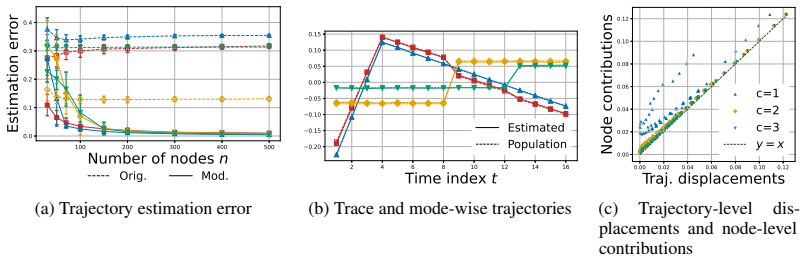
A central challenge in dynamic network analysis is to represent temporal evolution in a way that is both geometrically meaningful and statistically identifiable. One approach embeds a sequence of network snapshots as trajectories in a Euclidean space and relates these trajectories to node embeddings. In multilayer and unfolded spectral constructions, however, node embeddings and their underlying latent positions are identifiable only up to general linear transformations. Although this ambiguity preserves edge probabilities, it can distort geometry and invalidate distance based temporal comparisons at both the trajectory and node-levels. We develop Multiscale Euclidean Network Trajectories (MENT), a framework for multiscale temporal trajectories based on second-moment geometry. By imposing an isotropic normalization on the anchor latent positions, we reduce the relevant ambiguity to orthogonal transformations and prevent distortion of the second-moment geometry. In this canonical representation, we define a trace variation distance and mode-wise variation distances along orthogonal directions, and use multidimensional scaling to obtain low-dimensional trajectories of time points at both global and mode-wise levels. The resulting trajectories support interpretation and inference. They admit mode-wise decompositions, support attribution of global and mode-wise temporal changes to nodes, and enable change point detection through 1D trajectories. We prove consistency of the proposed unfolded spectral embedding and of the induced temporal trajectories. Experiments on two synthetic and two real dynamic networks illustrate stable and interpretable recovery of temporal structure and show strong performance against existing change point detection baselines.
Editorial analysis
A structured set of objections, weighed in public.
Referee Report
Summary. The paper proposes the Multiscale Euclidean Network Trajectories (MENT) framework for dynamic networks. It embeds sequences of network snapshots as trajectories in Euclidean space by applying isotropic normalization to anchor latent positions (reducing identifiability ambiguity to orthogonal transformations), defines a trace variation distance and mode-wise variation distances, obtains low-dimensional trajectories via multidimensional scaling, proves consistency of the unfolded spectral embedding and induced trajectories, and demonstrates empirical performance on synthetic and real data for temporal structure recovery, node attribution, and change-point detection.
Significance. If the consistency results hold and the normalization step preserves the relevant temporal signals, the framework would provide a geometrically interpretable, statistically consistent approach to multiscale trajectory analysis in dynamic networks, with direct support for attribution and 1D change-point detection. The explicit handling of second-moment geometry and the claimed proofs of consistency are potential strengths.
major comments (2)
- [Abstract and isotropic normalization section] Abstract and the section introducing isotropic normalization: the central claim that this normalization reduces ambiguity to orthogonal transformations while preserving second-moment geometry for temporal comparisons is load-bearing for the trace variation distance and subsequent MDS trajectories. However, if the network sequence exhibits scale changes (e.g., global density shifts not captured by second moments), the normalization step may remove those signals before distances are formed; the consistency proofs must explicitly establish convergence of the normalized objects to the true temporal structure under such conditions.
- [Consistency proofs] The consistency proofs for the unfolded spectral embedding and induced trajectories (referenced in the abstract): without detailed error bounds or analysis showing that normalization does not bias attribution or change-point detection when scale varies, it is unclear whether the trajectories remain faithful to the original network sequence. Please supply the key steps addressing how the normalized second-moment geometry converges in the presence of potential scale evolution.
minor comments (2)
- [Experiments] The experimental section briefly mentions two synthetic and two real datasets; additional details on data generation processes, parameter choices for baselines, and quantitative metrics beyond 'strong performance' would improve reproducibility and allow direct comparison of the change-point detection results.
- [Notation and definitions] Notation for 'anchor latent positions' versus other embeddings in the multiscale construction could be clarified with a small diagram or explicit mapping to avoid ambiguity when relating node-level attributions to the global trajectories.
Simulated Author's Rebuttal
We thank the referee for the constructive comments highlighting the importance of the isotropic normalization and the need for explicit treatment of scale in the consistency analysis. We address each major comment below and will make targeted revisions to clarify assumptions and expand the proof details.
read point-by-point responses
-
Referee: [Abstract and isotropic normalization section] Abstract and the section introducing isotropic normalization: the central claim that this normalization reduces ambiguity to orthogonal transformations while preserving second-moment geometry for temporal comparisons is load-bearing for the trace variation distance and subsequent MDS trajectories. However, if the network sequence exhibits scale changes (e.g., global density shifts not captured by second moments), the normalization step may remove those signals before distances are formed; the consistency proofs must explicitly establish convergence of the normalized objects to the true temporal structure under such conditions.
Authors: The isotropic normalization standardizes the second-moment matrix of the anchor latent positions to be isotropic, thereby reducing identifiability ambiguity to orthogonal transformations while preserving the directional geometry and relative variations that define our trace variation distance. Global uniform scale changes (e.g., overall density shifts) are intentionally factored out because they do not alter the second-moment shape; the framework is explicitly designed around second-moment geometry rather than absolute scale. Under the model assumptions of our consistency theorems, the unfolded spectral embedding converges to the true latent positions up to linear transformation, after which normalization yields convergence of the normalized objects. We agree that the interaction with non-uniform scale evolution requires explicit statement; we will revise the abstract and normalization section to clarify the assumptions and note that uniform scale signals are removed by design while non-uniform scale evolution would require separate modeling. revision: partial
-
Referee: [Consistency proofs] The consistency proofs for the unfolded spectral embedding and induced trajectories (referenced in the abstract): without detailed error bounds or analysis showing that normalization does not bias attribution or change-point detection when scale varies, it is unclear whether the trajectories remain faithful to the original network sequence. Please supply the key steps addressing how the normalized second-moment geometry converges in the presence of potential scale evolution.
Authors: The proof first invokes standard perturbation bounds for unfolded spectral embeddings to obtain Frobenius-norm convergence of the estimated latent positions to the true positions up to a linear transformation. The isotropic normalization, being a continuous map on the second-moment matrix, then produces normalized estimates that converge to the normalized true positions. The trace variation distance and mode-wise distances are continuous functionals of these normalized matrices, so they converge as well; the induced MDS trajectories therefore converge in the appropriate metric. Attribution and change-point procedures operate directly on the consistent trajectories and thus inherit the guarantees. When scale evolves, the normalization removes only the isotropic component, preserving directional second-moment changes; bias is avoided under the separability assumption that scale and shape variations are distinguishable. We will expand the main proof section (and appendix) with these key steps and an explicit discussion of scale evolution. revision: yes
Circularity Check
No significant circularity detected in derivation chain
full rationale
The paper's core construction imposes isotropic normalization on anchor latent positions as an explicit modeling choice to reduce identifiability ambiguity to orthogonal transformations. Trace variation distances and mode-wise distances are then defined directly on the resulting canonical representation, followed by MDS for trajectories. Consistency of the unfolded spectral embedding and induced trajectories is claimed via separate proofs. No load-bearing step reduces by construction to a fitted parameter, self-referential definition, or self-citation chain; the steps remain independent of the target outputs.
Axiom & Free-Parameter Ledger
axioms (1)
- domain assumption Unfolded spectral constructions yield node embeddings identifiable only up to general linear transformations while preserving edge probabilities
Reference graph
Works this paper leans on
-
[1]
Spectral embedding for dynamic networks with stability guarantees
Ian Gallagher, Andrew Jones, and Patrick Rubin-Delanchy. Spectral embedding for dynamic networks with stability guarantees. In Advances in Neural Information Processing Systems , volume 34, pages 10158–10170, 2021
work page 2021
-
[2]
Haruka Ezoe, Hiroki Matsumoto, and Ryohei Hisano. Unfolded laplacian spectral embedding: A theoretically grounded approach to dynamic network representation. In Proceedings of the International Conference on Machine Learning , 2026
work page 2026
-
[3]
The multilayer random dot product graph
Andrew Jones and Patrick Rubin-Delanchy. The multilayer random dot product graph. arXiv,
-
[4]
Avanti Athreya, Zachary Lubberts, Y oungser Park, and Carey E. Priebe. Euclidean mirrors and dynamics in network time series. Journal of the American Statistical Association , 120(550): 1025–1036, 2025
work page 2025
- [5]
- [6]
-
[7]
Ingwer Borg and Patrick J. F. Groenen. Modern Multidimensional Scaling: Theory and Appli- cations. Springer Series in Statistics. Springer New Y ork, 2 edition, 2005
work page 2005
-
[8]
V ogelstein, Brian Gallagher, and Christos Faloutsos
Danai Koutra, Neil Shah, Joshua T. V ogelstein, Brian Gallagher, and Christos Faloutsos. Delta- Con: A principled massive-graph similarity function with attribution. ACM Transactions on Knowledge Discovery from Data, 10(3):1–43, 2016
work page 2016
-
[9]
NetSimile: A scalable approach to size-independent network similarity
Michele Berlingerio, Danai Koutra, Tina Eliassi-Rad, and Christos Faloutsos. NetSimile: A scalable approach to size-independent network similarity. arXiv, 2012. arXiv:1209.2684
-
[10]
Laplacian change point detection for dynamic graphs
Shenyang Huang, Y asmeen Hitti, Guillaume Rabusseau, and Reihaneh Rabbany. Laplacian change point detection for dynamic graphs. In Proceedings of the 26th ACM SIGKDD Interna- tional Conference on Knowledge Discovery & Data Mining , pages 349–358, 2020
work page 2020
-
[11]
Change point estimation in a dynamic stochastic block model
Monika Bhattacharjee, Moulinath Banerjee, and George Michailidis. Change point estimation in a dynamic stochastic block model. Journal of Machine Learning Research , 21(107):1–59, 2020
work page 2020
-
[12]
Holland, Kathryn Blackmond Laskey, and Samuel Leinhardt
Paul W. Holland, Kathryn Blackmond Laskey, and Samuel Leinhardt. Stochastic blockmodels: First steps. Social Networks, 5(2):109–137, 1983. 10
work page 1983
-
[13]
Change-point detection in dynamic networks via graphon estimation
Zifeng Zhao, Li Chen, and Lizhen Lin. Change-point detection in dynamic networks via graphon estimation. arXiv, 2019. arXiv:1908.01823
-
[14]
Change-point detection in dynamic networks with missing links
Farida Enikeeva and Olga Klopp. Change-point detection in dynamic networks with missing links. Operations Research, 73(5):2417–2429, 2025
work page 2025
-
[15]
Change point localization and inference in dynamic multilayer networks
Fan Wang, Kyle Ritscher, Yik Lun Kei, Xin Ma, and Oscar Hernan Madrid Padilla. Change point localization and inference in dynamic multilayer networks. In Proceedings of the Inter- national Conference on Learning Representations , 2026
work page 2026
-
[16]
Detecting hierarchical changes in latent variable models
Shintaro Fukushima and Kenji Y amanishi. Detecting hierarchical changes in latent variable models. In Proceedings of the IEEE International Conference on Data Mining , pages 1028– 1033, 2020
work page 2020
-
[17]
Fréchet-statistics-based change point detection in dy- namic social networks
Rui Luo and Vikram Krishnamurthy. Fréchet-statistics-based change point detection in dy- namic social networks. IEEE Transactions on Computational Social Systems , 11(2):2863– 2871, 2023
work page 2023
-
[18]
Change point detection in dynamic graphs with decoder-only latent space model
Yik Lun Kei, Jialiang Li, Hangjian Li, Y anzhen Chen, and Oscar Hernan Madrid Padilla. Change point detection in dynamic graphs with decoder-only latent space model. Transac- tions on Machine Learning Research , 2025
work page 2025
-
[19]
Topics in Random Matrix Theory, volume 132 of Graduate Studies in Mathemat- ics
Terence Tao. Topics in Random Matrix Theory, volume 132 of Graduate Studies in Mathemat- ics. American Mathematical Society, 2012. ISBN 978-0-8218-7430-1
work page 2012
-
[20]
Free Law Project. Bulk legal data. https://wiki.free.law/c/courtlistener/help/ api/bulk-data/bulk-legal-data , 2025. CourtListener bulk legal data; accessed 2026- 04-04
work page 2025
-
[21]
The enron corpus: A new dataset for email classification research
Bryan Klimt and Yiming Y ang. The enron corpus: A new dataset for email classification research. In Machine Learning: ECML 2004 , volume 3201 of Lecture Notes in Computer Science, pages 217–226. Springer, 2004
work page 2004
-
[22]
William W. Cohen. Enron email dataset. https://www.cs.cmu.edu/~enron/, 2015. Hosted by Carnegie Mellon University; accessed 2026-04-24
work page 2015
-
[23]
Statsmodels: Econometric and statistical modeling with python
Skipper Seabold and Josef Perktold. Statsmodels: Econometric and statistical modeling with python. In Proceedings of the 9th Python in Science Conference , pages 92–96, 2010
work page 2010
-
[24]
Doubly unfolded adjacency spectral embedding of dynamic multiplex graphs
Maximilian Baum, Francesco S. Passino, and Axel Gandy. Doubly unfolded adjacency spectral embedding of dynamic multiplex graphs. arXiv, 2024. arXiv:2410.09810
work page internal anchor Pith review Pith/arXiv arXiv 2024
-
[25]
Gephi: An open source software for exploring and manipulating networks
Mathieu Bastian, Sébastien Heymann, and Mathieu Jacomy. Gephi: An open source software for exploring and manipulating networks. In Proceedings of the International AAAI Conference on Web and Social Media , volume 3, pages 361–362, 2009
work page 2009
-
[26]
Mark E. J. Newman. Modularity and community structure in networks. Proceedings of the National Academy of Sciences , 103(23):8577–8582, 2006
work page 2006
-
[27]
Blondel, Jean-Loup Guillaume, Renaud Lambiotte, and Etienne Lefebvre
Vincent D. Blondel, Jean-Loup Guillaume, Renaud Lambiotte, and Etienne Lefebvre. Fast unfolding of communities in large networks. Journal of Statistical Mechanics: Theory and Experiment, 2008(10):P10008, 2008
work page 2008
-
[28]
Mathieu Jacomy, Tommaso V enturini, Sébastien Heymann, and Mathieu Bastian. ForceAtlas2, a continuous graph layout algorithm for handy network visualization designed for the gephi software. PLoS ONE, 9(6):e98679, 2014
work page 2014
-
[29]
eyecite: A tool for parsing legal citations
Jack Cushman, Matthew Dahl, and Michael Lissner. eyecite: A tool for parsing legal citations. Journal of Open Source Software , 6(66):3617, 2021
work page 2021
-
[30]
Hiroki Matsumoto, Takahiro Y oshida, Ryoma Kondo, and Ryohei Hisano. Hypergraph change point detection using adapted cardinality-based gadgets: Applications in dynamic legal struc- tures. In Complex Networks & Their Applications XIII , volume 1188 of Studies in Computa- tional Intelligence, pages 3–15. Springer Cham, 2025. 11
work page 2025
-
[31]
Supreme Court of the United States. Anderson v. Creighton. Legal decision, 1987. 483 U.S. 635
work page 1987
-
[32]
The decline of the right of locomotion: The fourth amendment on the streets
Tracey Maclin. The decline of the right of locomotion: The fourth amendment on the streets. Cornell Law Review, 75(6):1257–1336, 1989
work page 1989
-
[33]
Supreme Court of the United States. California v. Acevedo. Legal decision, 1991. 500 U.S. 565
work page 1991
- [34]
- [35]
-
[36]
Paul W. Hughes. Not a failed experiment: Wilson–Saucier sequencing and the articulation of constitutional rights. University of Colorado Law Review , 80(2):401–430, 2009
work page 2009
-
[37]
The supreme court’s quiet expansion of qualified immunity
Kit Kinports. The supreme court’s quiet expansion of qualified immunity. Minnesota Law Review Headnotes, 100(1):62–78, 2016
work page 2016
-
[38]
Arne H. Schulz. Enron-mails for MySQL5 and R. https://github.com/ahr85/enron,
-
[39]
Auxiliary employee metadata file E-Mails-updated.csv; accessed 2026-04-24
work page 2026
-
[40]
Securities and Exchange Commission
U.S. Securities and Exchange Commission. Complaint: Jeffrey k. skilling and richard a. causey. https://www.sec.gov/litigation/complaints/comp18582.htm, 2004. Ac- cessed 2026-04-24
work page 2004
-
[41]
TIME. Chronology of a collapse. https://content.time.com/time/specials/ packages/article/0,28804,2021097_2023262_2023247,00.html , 2002. Part of Be- hind the Enron Scandal ; accessed 2026-04-24
work page 2002
-
[42]
Enron executive may face perjury charge, says in- vestigator
David Teather and Patrick Wintour. Enron executive may face perjury charge, says in- vestigator. The Guardian , https://www.theguardian.com/business/2002/feb/11/ corporatefraud.enron1, 2002. Published February 11, 2002; accessed 2026-04-24
work page 2002
-
[43]
John arnold made a fortune at enron
Sam Apple. John arnold made a fortune at enron. now he’s de- clared war on bad science. WIRED, https://www.wired.com/2017/01/ john-arnold-waging-war-on-bad-science/ , 2017. Published January 22, 2017; accessed 2026-04-24
work page 2017
-
[44]
Robert K. Herdman. Testimony concerning recent events relating to enron corporation. U.S. Securities and Exchange Commission, https://www.sec.gov/news/testimony/ 121201tsrkh.htm, 2001. Before the Subcommittee on Capital Markets, Insurance and Gov- ernment Sponsored Enterprises and the Subcommittee on Oversight and Investigation, Com- mittee on Financial S...
work page 2001
-
[45]
Jr. Hunt, Isaac C. Testimony concerning the enron bankruptcy, the functioning of energy markets and repeal of the public utility holding company act of 1935. U.S. Securities and Ex- change Commission, https://www.sec.gov/news/testimony/021302tsich.htm, 2002. Before the Subcommittee on Energy and Air Quality, Committee on Energy and Commerce, U.S. House of...
work page 1935
-
[46]
Court picks up the tab for enron wit- nesses
Matthew Goldstein. Court picks up the tab for enron wit- nesses. TheStreet, https://www.thestreet.com/markets/ court-picks-up-the-tab-for-enron-witnesses-10042313 , 2002. Published September 16, 2002; accessed 2026-04-24
work page 2002
- [47]
-
[48]
Joel A. Tropp. An introduction to matrix concentration inequalities. F oundations and Trends in Machine Learning, 8(1–2):1–230, 2015. 12 A Appendix Guide and Notation This appendix collects the technical material supporting the main text and situates the proposed framework within a broader probabilistic, geometric, and inferential context. Its purpose is ...
work page 2015
-
[49]
Figure I.3 (d), however, shows that the standard basis also fails to converge
In contrast, the proposed method substantially reduces this mismatch and achieves stable conver- gence to 0 for the MV , TV , and mode-wise distances when the latter are expressed in the canonical basis, as shown in Figure I.3 (a) to (c). Figure I.3 (d), however, shows that the standard basis also fails to converge. This highlights that GL(d) transformati...
-
[50]
Thus, for each mode, the population target is a well defined 1D change point. We estimate 36 2 4 6 8 10 12 14 16 Time index t −0.20 −0.15 −0.10 −0.05 0.00 0.05 0.10 Estimated P opulation (a) MV 2 4 6 8 10 12 14 16 Time index t −0.20 −0.15 −0.10 −0.05 0.00 0.05 0.10 0.15 Estimated P opulation (b) TV 2 4 6 8 10 12 14 16 Time index t −0.20 −0.15 −0.10 −0.05 0...
-
[51]
75 Agg egated esidual ×10 −4 Empi ical esidual CMDS esidual bound (b) Mode 1 2 4 6 8 10 12 14 16 Trajectory dimension c 0.0
-
[52]
2 0.4 0.6 0.8 1.0 Aggrega ed residual ×10 −4 Empirical residual CMDS residual bound (c) Mode 2 2 4 6 8 10 12 14 16 Trajectory dimension c 0.0
-
[53]
2 Aggrega ed residual ×10 −4 Empirical residual CMDS residual bound (d) Mode 3 Figure I.9: Aggregated discrepancy between trajectory-level variation and node-level attribution as a function of the trajectory dimension c. The empirical residual (solid line) is compared with the theoretical upper bound (dashed line) from Theorems H.3 and H.4. Each panel cor...
work page 2024
-
[54]
Its three largest level changes occur in the weeks of 2001-04-09, 2001-04-30, and 2001-06-
work page 2001
-
[55]
These dates fall during Jeffrey Skilling’s short tenure as Enron CEO and precede the firm’s more 58 visible public collapse period later in 2001 [ 39, 40]. We therefore interpret Mode 1 as a descriptive signal of early internal communication reorganization, rather than as a direct response to bankruptcy or later public investigations. The April 30 peak pro...
work page 2001
-
[56]
t∗ X t=k (a∗ + b∗ Lt a bt)2 + TX t=t∗+1 (a∗ + b∗ Lt∗ + b∗ R(t t∗) a bt)2 # = min a,b
F or allt, s 2 T , kM(ϕ(t), ϕ(s))k2 is finite. 2. sup t,s∈T ˆM (Y(t), Y(s)) M (ϕ(t), ϕ(s)) 2 = O(n−1/2 log n) a.s. 3. sup t,s∈T ˆM (Y(t), Y(s)) 2 = O(1) a.s. Proof. We prove each statement in turn. (1) Since χ and ϕ(t) have bounded support, there exists a constant β > 0 such that kϕ(t)k β almost surely for all t 2 T . By the triangle inequality, E (ϕ(t) ϕ(...
discussion (0)
Sign in with ORCID, Apple, or X to comment. Anyone can read and Pith papers without signing in.