Recognition: unknown
Scalable Structural Estimation of Networked Infrastructure: Exact Decomposition for Localized Coordination
Pith reviewed 2026-05-08 16:48 UTC · model grok-4.3
The pith
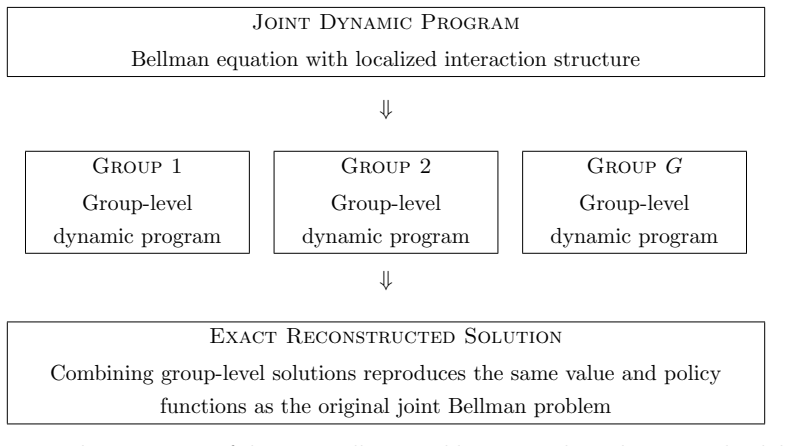
Fixed local groups let the Bellman operator split into exact independent subproblems, making structural estimation feasible for thousands of interacting units.
A machine-rendered reading of the paper's core claim, the machinery that carries it, and where it could break.
Core claim
Under fixed group membership and sparse within-group interaction structure, the Bellman operator admits a block-diagonal decomposition that allows high-dimensional dynamic programs to be solved through independent group-level subproblems while preserving the original structural problem exactly. The result applies to dynamic discrete choice models in which interactions are confined within stable local groups and state transitions depend only on within-group conditions.
What carries the argument
The block-diagonal decomposition of the Bellman operator that converts the joint dynamic program into independent group subproblems.
If this is right
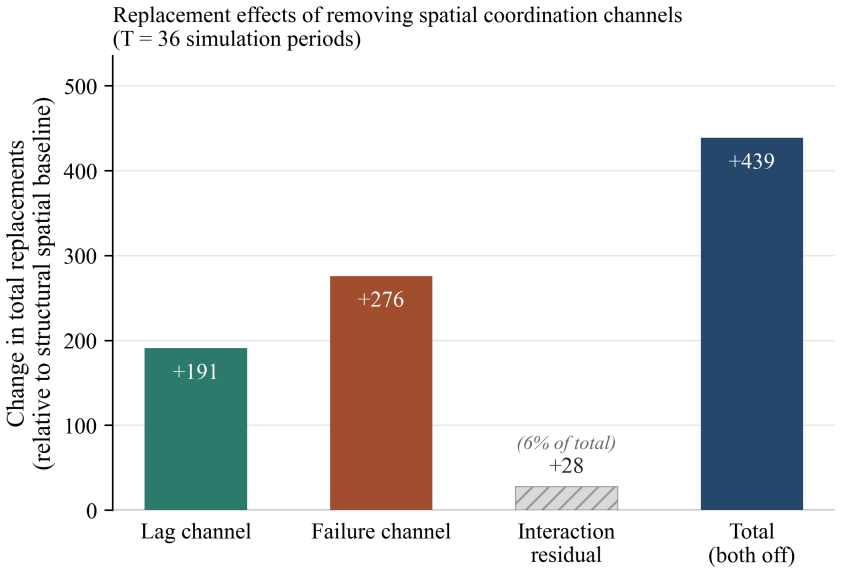
- Predicted replacement timing shifts once spatial coordination is included.
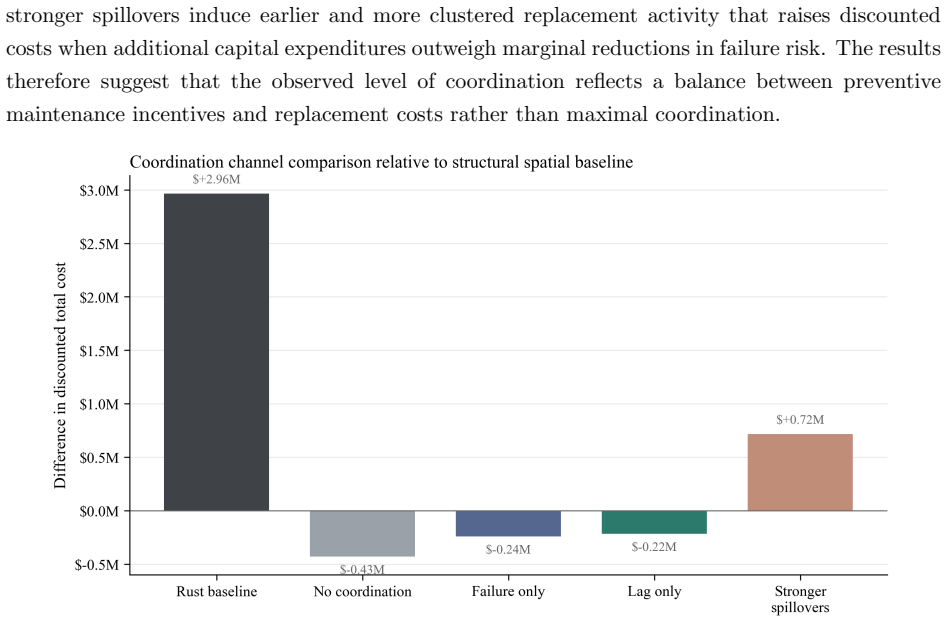
- Models that assume conditional independence produce large measured costs of misoptimization.
- Fully structural estimation becomes feasible for networked systems with thousands of units.
- The method requires no simulation-based auxiliary moments or numerical approximation.
Where Pith is reading between the lines
- Similar group-based decompositions could make exact structural models practical for other distributed systems such as power grids or vehicle fleets.
- The approach opens the possibility of estimating localized coordination effects in datasets far larger than those previously handled by full dynamic programming.
- Researchers could test whether the same sparsity pattern appears in non-infrastructure settings like supply-chain maintenance or local public-goods decisions.
Load-bearing premise
Interactions and state transitions must stay strictly inside fixed, stable groups with no cross-group effects.
What would settle it
Finding that a node failure or replacement in one group changes choice probabilities for nodes assigned to a different group would show the decomposition does not hold exactly.
Figures

read the original abstract
Interaction effects are often economically central in environments where structural dynamic estimation becomes computationally infeasible. Under fixed group membership and sparse within-group interaction structure, the Bellman operator admits a block-diagonal decomposition that allows high-dimensional dynamic programs to be solved through independent group-level subproblems while preserving the original structural problem exactly. The result applies to a class of dynamic discrete choice models in which interactions are confined within stable local groups and state transitions depend only on within-group conditions. We apply the framework to replacement decisions across 14,344 GPU node locations in the Titan supercomputer, where operating environments differ systematically across cage positions. The structural estimates reveal significant spatial coordination: both neighboring failures and recent local replacement activity increase replacement incentives. Accounting for these interaction effects materially shifts predicted replacement timing and reveals significant misoptimization costs in benchmarks that assume conditional independence. More broadly, the results show how exploiting sparsity in interaction structures can make fully structural estimation feasible in large-scale networked systems without relying on simulation-based auxiliary moments or numerical approximation.
Editorial analysis
A structured set of objections, weighed in public.
Referee Report
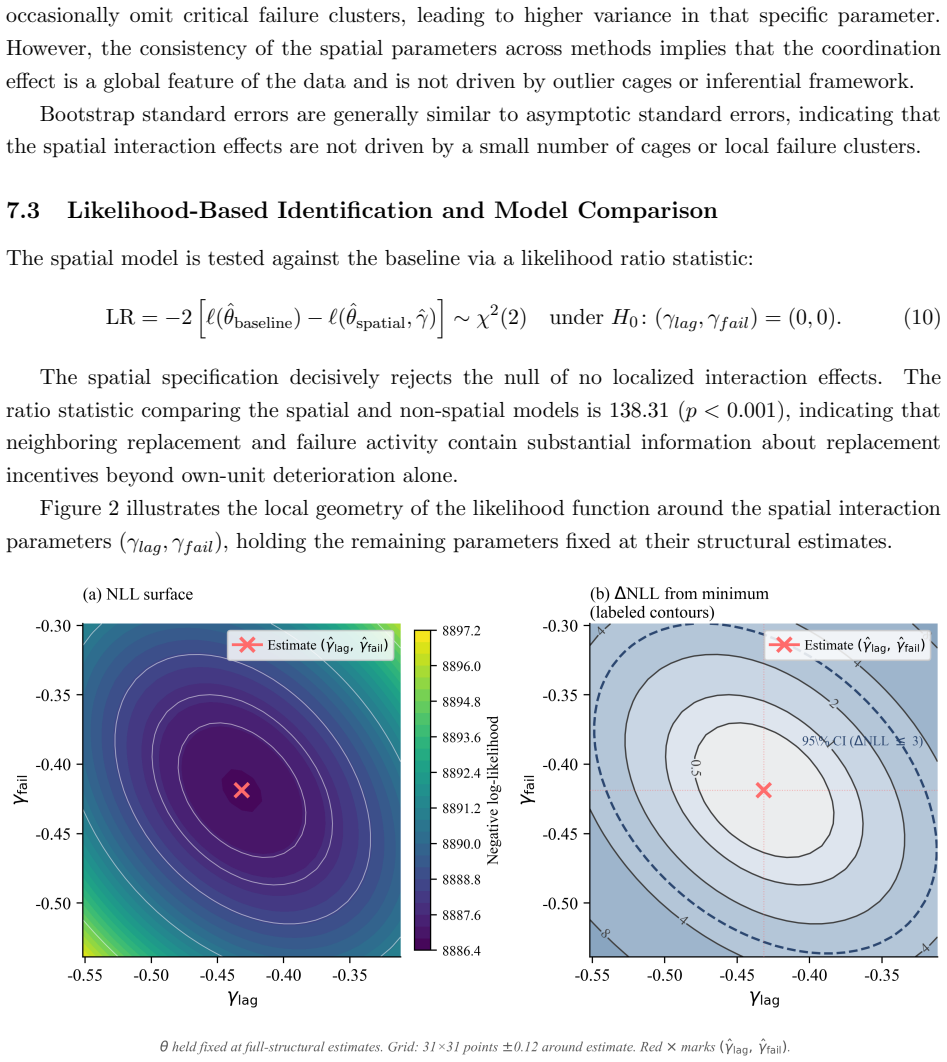
Summary. The paper claims that under fixed group membership and sparse within-group interactions, the Bellman operator for a class of dynamic discrete choice models admits an exact block-diagonal decomposition. This permits solving the high-dimensional DP exactly as a collection of independent group-level subproblems. The framework is applied to structural estimation of replacement decisions for 14,344 GPU nodes in the Titan supercomputer, where the estimates indicate significant spatial coordination (neighboring failures and recent local replacements raise replacement incentives) and that ignoring interactions produces materially different timing predictions and understates misoptimization costs.
Significance. If the exactness result holds, the decomposition provides a parameter-free way to scale fully structural dynamic estimation to networked settings without simulation-based auxiliary moments or numerical approximation. The Titan application demonstrates the payoff in a real infrastructure context with plausible locality, and the finding that coordination effects shift predicted replacement timing has direct implications for maintenance policy in high-performance computing and analogous networked systems.
major comments (2)
- [§3] §3, Theorem 1 (or equivalent statement of the decomposition): the manuscript asserts that the Bellman operator is exactly block-diagonal when state transitions and payoffs depend only on within-group variables. The provided conditions are stated clearly, but the derivation steps that establish the absence of cross-block terms in the choice-specific value function should be expanded with explicit intermediate equalities so that exact preservation of the original structural problem can be verified without reconstruction.
- [§4.3] §4.3, empirical implementation: the paper treats cage membership as fixed and interactions as strictly within-cage. While the physical layout supports this, the systematic differences in operating environments across cage positions (noted in the data description) raise the possibility of unmodeled cross-cage spillovers in failure transitions; a robustness check re-estimating under alternative groupings or adding a small cross-group term would strengthen the claim that the decomposition is applied without material violation of the maintained assumptions.
minor comments (2)
- [Table 1] Table 1 and Figure 2: the reported standard errors on the interaction coefficients should be accompanied by a note on whether they are obtained from the block-diagonal Hessian or from a joint estimation that ignores the decomposition; this affects interpretation of precision.
- [Introduction] The abstract and introduction use 'exact' repeatedly; a single sentence in the introduction clarifying that exactness holds only under the listed separability conditions (and not as a general property) would prevent misreading.
Simulated Author's Rebuttal
We thank the referee for the constructive comments, which help clarify the presentation of the decomposition result and strengthen the empirical application. We address each major comment below.
read point-by-point responses
-
Referee: [§3] §3, Theorem 1 (or equivalent statement of the decomposition): the manuscript asserts that the Bellman operator is exactly block-diagonal when state transitions and payoffs depend only on within-group variables. The provided conditions are stated clearly, but the derivation steps that establish the absence of cross-block terms in the choice-specific value function should be expanded with explicit intermediate equalities so that exact preservation of the original structural problem can be verified without reconstruction.
Authors: We agree that additional detail will make the exactness result easier to verify. In the revised manuscript we will expand the proof of Theorem 1 by inserting explicit intermediate equalities. Starting from the Bellman equation, we will show step-by-step how the maintained assumptions on within-group state transitions and payoffs cause all cross-block terms in the choice-specific value functions to vanish, thereby confirming that the original structural problem is preserved exactly. revision: yes
-
Referee: [§4.3] §4.3, empirical implementation: the paper treats cage membership as fixed and interactions as strictly within-cage. While the physical layout supports this, the systematic differences in operating environments across cage positions (noted in the data description) raise the possibility of unmodeled cross-cage spillovers in failure transitions; a robustness check re-estimating under alternative groupings or adding a small cross-group term would strengthen the claim that the decomposition is applied without material violation of the maintained assumptions.
Authors: We acknowledge that systematic differences across cage positions could in principle induce unmodeled cross-cage spillovers. To address this concern, the revised version will add a dedicated robustness subsection in §4.3. We will re-estimate the model under two alternative groupings (by rack and by row) and will also report results from a specification that introduces a small cross-group interaction term, allowing readers to assess the sensitivity of the main estimates to possible violations of the strict within-group assumption. revision: yes
Circularity Check
No significant circularity
full rationale
The paper derives an exact block-diagonal decomposition of the Bellman operator from the explicit assumptions of fixed group membership, sparse within-group interactions, and state transitions depending only on within-group conditions. This follows immediately from additive separability of per-period payoffs and conditional expectations when the state and action spaces factorize across groups, without any reduction to fitted parameters, self-referential definitions, or load-bearing self-citations. The application to GPU node replacement data applies the stated structure directly and preserves the original problem exactly. No circular steps are present in the derivation chain.
Axiom & Free-Parameter Ledger
axioms (2)
- domain assumption Fixed group membership and sparse within-group interaction structure
- domain assumption State transitions depend only on within-group conditions
Reference graph
Works this paper leans on
-
[1]
Econometrica , volume =
Rust, John , title =. Econometrica , volume =
-
[2]
Joseph and Miller, Robert A
Hotz, V. Joseph and Miller, Robert A. , title =. Review of Economic Studies , volume =
-
[3]
Journal of Econometrics , volume =
Aguirregabiria, Victor and Mira, Pedro , title =. Journal of Econometrics , volume =
-
[4]
, title =
Arcidiacono, Peter and Miller, Robert A. , title =. Econometrica , volume =
-
[5]
and Wolpin, Kenneth I
Keane, Michael P. and Wolpin, Kenneth I. , title =. Journal of Political Economy , volume =
-
[6]
, title =
Su, Che-Lin and Judd, Kenneth L. , title =. Econometrica , volume =
-
[7]
Journal of Economic Dynamics and Control , volume=
Solving dynamic programming problems with continuous state and action spaces by adaptive sparse grid methods , author=. Journal of Economic Dynamics and Control , volume=
-
[8]
Econometrica , volume =
McFadden, Daniel , title =. Econometrica , volume =
-
[9]
Econometrica , volume =
Berry, Steven and Levinsohn, James and Pakes, Ariel , title =. Econometrica , volume =
-
[10]
Anselin, Luc , title =
-
[11]
and Pace, R
LeSage, James P. and Pace, R. Kelley , title =
-
[12]
Paul , title =
Elhorst, J. Paul , title =
-
[13]
, title =
Pinkse, Joris and Slade, Margaret E. , title =. Journal of Econometrics , volume =
-
[14]
, title =
Klier, Thomas and McMillen, Daniel P. , title =. Journal of Business & Economic Statistics , volume =
-
[15]
, title =
Smirnov, Oleg A. , title =. Regional Science and Urban Economics , volume =
-
[16]
, title =
Manski, Charles F. , title =. Review of Economic Studies , volume =
-
[17]
, title =
Jackson, Matthew O. , title =
-
[18]
Identification of Peer Effects through Social Networks , journal =
Bramoull. Identification of Peer Effects through Social Networks , journal =
-
[19]
Econometrica , volume =
Bayer, Patrick and McMillan, Robert and Murphy, Alvin and Timmins, Christopher , title =. Econometrica , volume =
-
[20]
American Economic Review , volume =
Morris, Stephen and Shin, Hyun Song , title =. American Economic Review , volume =
-
[21]
Econometrica , volume =
Angeletos, George-Marios and Pavan, Alessandro , title =. Econometrica , volume =
-
[22]
Econometrica , volume =
Griliches, Zvi , title =. Econometrica , volume =
-
[23]
and Udry, Christopher R
Conley, Timothy G. and Udry, Christopher R. , title =. American Economic Review , volume =
-
[24]
Economic Journal , volume =
Bandiera, Oriana and Rasul, Imran , title =. Economic Journal , volume =
-
[25]
American Economic Review , volume =
Fowlie, Meredith , title =. American Economic Review , volume =
-
[26]
Review of Environmental Economics and Policy , volume =
Gillingham, Kenneth and Rapson, David and Wagner, Gernot , title =. Review of Environmental Economics and Policy , volume =
-
[27]
and Engelmann, Christian and Shankar, Mallikarjun and Rogers, James H
Ostrouchov, George and Maxwell, Don and Ashraf, Rizwan A. and Engelmann, Christian and Shankar, Mallikarjun and Rogers, James H. , title =. Proceedings of the International Conference for High Performance Computing, Networking, Storage and Analysis , year =
-
[28]
Technometrics , pages =
Min, Jie and others , title =. Technometrics , pages =
-
[29]
Econometrica , year =
Aguirregabiria, Victor , title =. Econometrica , year =
-
[30]
Annals of Economics and Statistics , number =
Aguirregabiria, Victor and Gu, Jinhong and Luo, Yao and Mira, Pedro , title =. Annals of Economics and Statistics , number =
-
[31]
and Siegel, Ron , title =
Olszewski, Wojciech and Reny, Philip J. and Siegel, Ron , title =. Econometrica , year =
-
[32]
, title =
Bertsekas, Dimitri P. , title =. IEEE Transactions on Automatic Control , year =
-
[33]
Journal of Artificial Intelligence Research , year =
Guestrin, Carlos and Koller, Daphne and Parr, Ronald and Venkataraman, Shobha , title =. Journal of Artificial Intelligence Research , year =
-
[34]
and Stearley, Jon and Gurumurthi, Sudhanva and Cannon, Richard and Rogers, Jim , title =
Sridharan, Vijaykumar and DeBardeleben, Nathan and Blanchard, Sean and Ferreira, Kurt B. and Stearley, Jon and Gurumurthi, Sudhanva and Cannon, Richard and Rogers, Jim , title =. Proceedings of the 20th International Conference on Architectural Support for Programming Languages and Operating Systems (ASPLOS) , year =
-
[35]
Proceedings of the International Conference for High Performance Computing, Networking, Storage and Analysis (SC) , year =
Tiwari, Devesh and Gupta, Saurabh and Rogers, Jim and Maxwell, Don and Schroeder, Bianca and Snir, Marc , title =. Proceedings of the International Conference for High Performance Computing, Networking, Storage and Analysis (SC) , year =
-
[36]
and Durlauf, Steven N
Brock, William A. and Durlauf, Steven N. , title =. Review of Economic Studies , volume =. 2001 , doi =
2001
-
[37]
Lanier and Levin, Jonathan , title =
Bajari, Patrick and Benkard, C. Lanier and Levin, Jonathan , title =. Econometrica , volume =. 2007 , doi =
2007
-
[38]
Review of Economic Studies , volume=
Asymptotic Least Squares Estimators for Dynamic Games , author=. Review of Economic Studies , volume=
-
[39]
Econometrica , volume=
Sequential Estimation of Dynamic Discrete Games , author=. Econometrica , volume=
-
[40]
Journal of Economic Dynamics and Control , volume=
Dynamic Programming with Hermite Approximation , author=. Journal of Economic Dynamics and Control , volume=
-
[41]
International Journal of Production Economics , volume=
Maintenance Optimization Models and Criteria , author=. International Journal of Production Economics , volume=
-
[42]
and Tarraf, Danielle C
Tsakiris, Manolis C. and Tarraf, Danielle C. , title =. Systems & Control Letters , volume =. 2015 , doi =
2015
-
[43]
Biometrics , volume=
Akaike's Information Criterion in Generalized Estimating Equations , author=. Biometrics , volume=. 2001 , publisher=
2001
-
[44]
Biometrika , volume=
A note on composite likelihood information criteria , author=. Biometrika , volume=. 2005 , publisher=
2005
-
[45]
Journal of the American Statistical Association , volume=
Composite Likelihood Bayesian Information Criterion for Model Selection in High-Dimensional Data , author=. Journal of the American Statistical Association , volume=. 2010 , publisher=
2010
-
[46]
Econometrica , volume=
Estimation when a Parameter is on a Boundary , author=. Econometrica , volume=. 1999 , publisher=
1999
-
[47]
arXiv preprint arXiv:2511.03091 , year=
The Economics of Spatial Coordination in Critical Infrastructure Investment , author=. arXiv preprint arXiv:2511.03091 , year=
-
[48]
American Economic Review , volume=
Learning and forgetting: The dynamics of aircraft production , author=. American Economic Review , volume=. 2000 , publisher=
2000
discussion (0)
Sign in with ORCID, Apple, or X to comment. Anyone can read and Pith papers without signing in.