Recognition: unknown
HeterSEED: Semantics-Structure Decoupling for Heterogeneous Graph Learning under Heterophily
Pith reviewed 2026-05-08 17:29 UTC · model grok-4.3
The pith
HeterSEED decouples semantics and structure to reduce bias from heterophilic neighbors in heterogeneous graphs.
A machine-rendered reading of the paper's core claim, the machinery that carries it, and where it could break.
Core claim
HeterSEED decouples representation learning into a heterogeneous semantic channel that captures type- and relation-aware local semantics and a structure-aware heterophily channel that separates homophilic and heterophilic neighborhoods via pseudo-label-guided partitioning and aggregates them using metapath-based structural weights. A node-level adaptive fusion mechanism then combines the two channels to produce context-dependent node representations. On heterogeneous graphs under heterophily, this makes HeterSEED strictly more expressive than standard heterogeneous graph neural networks that rely primarily on feature similarity and provably reduces the prediction bias introduced by heterophi
What carries the argument
The semantics-structure decoupling into dual channels, where the structure-aware heterophily channel performs pseudo-label-guided partitioning of neighborhoods followed by metapath-weighted aggregation and node-level adaptive fusion.
Load-bearing premise
Pseudo-label-guided partitioning reliably separates homophilic and heterophilic neighborhoods without introducing new errors, and node-level adaptive fusion correctly balances the two channels in practice.
What would settle it
A controlled test on a strongly heterophilic heterogeneous graph where pseudo labels used for partitioning are replaced by random assignments and performance falls to or below standard heterogeneous GNN baselines.
Figures
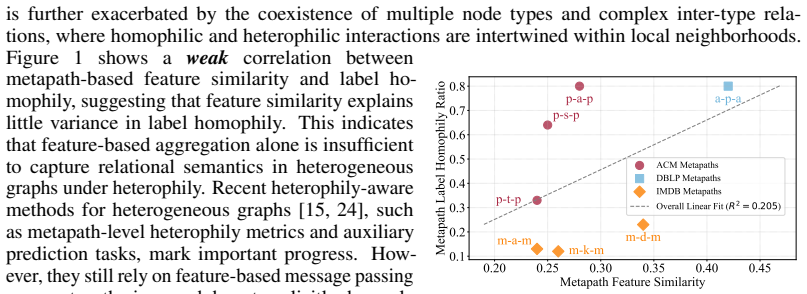


read the original abstract
Many real-world heterogeneous graphs exhibit pronounced heterophily, where connected nodes often have dissimilar labels or play different semantic roles. In such settings, standard heterogeneous graph neural networks that aggregate messages along metapaths or meta-relations primarily based on feature similarity can propagate misleading information, since feature similarity may be misaligned with underlying relational semantics. In this paper, we propose HeterSEED, a semantics-structure decoupling framework for heterogeneous graph learning under heterophily. HeterSEED decouples representation learning into a heterogeneous semantic channel that captures type- and relation-aware local semantics and a structure-aware heterophily channel that separates homophilic and heterophilic neighborhoods via pseudo-label-guided partitioning and aggregates them using metapath-based structural weights. A node-level adaptive fusion mechanism then combines the two channels to produce context-dependent node representations. Theoretically, we establish that, on heterogeneous graphs under heterophily, HeterSEED is strictly more expressive than standard heterogeneous graph neural networks that rely primarily on feature similarity and provably reduces the prediction bias introduced by heterophilic neighbors. Experiments on five real-world heterogeneous graphs, including two large-scale networks at the million-node and hundred-million-edge scale, demonstrate that HeterSEED consistently outperforms representative heterogeneous graph neural networks and recent heterophily-aware baselines, especially in strongly heterophilic regimes.
Editorial analysis
A structured set of objections, weighed in public.
Referee Report
Summary. The manuscript proposes HeterSEED, a semantics-structure decoupling framework for heterogeneous graph learning under heterophily. It decouples representation learning into a heterogeneous semantic channel capturing type- and relation-aware local semantics and a structure-aware heterophily channel that separates homophilic and heterophilic neighborhoods via pseudo-label-guided partitioning before metapath-weighted aggregation, followed by a node-level adaptive fusion mechanism. The central claims are that HeterSEED is strictly more expressive than standard heterogeneous GNNs relying on feature similarity and that it provably reduces prediction bias from heterophilic neighbors, with supporting experiments on five real-world heterogeneous graphs including two large-scale networks.
Significance. If the theoretical guarantees can be established without relying on error-free partitioning, the work would meaningfully advance handling of heterophily in heterogeneous graphs by providing an explicit decoupling mechanism. The reported scalability to million-node and hundred-million-edge graphs is a concrete strength that supports practical relevance in domains such as social networks and knowledge graphs.
major comments (2)
- [Abstract] Abstract: the claim that HeterSEED is 'strictly more expressive' than standard HGNNs and 'provably reduces the prediction bias introduced by heterophilic neighbors' is load-bearing for the contribution, yet the abstract provides no derivation or proof sketch. The guarantees appear to rest on the assumption that pseudo-label-guided partitioning cleanly isolates homophilic versus heterophilic neighborhoods; under strong heterophily this assumption is not obviously satisfied because the initial model used for pseudo-labels will itself suffer from the same misalignment.
- [Abstract] Abstract: the structure-aware heterophily channel description does not specify how the initial pseudo-label model is obtained or trained independently of the final model, leaving open the possibility of circularity. If partitioning errors propagate, the claimed strict expressiveness gain and bias bound become conditional on partitioning accuracy rather than guaranteed by the architecture, and the node-level adaptive fusion cannot retroactively correct systematic partition noise.
minor comments (1)
- [Abstract] Abstract: the five real-world graphs are not named and no heterophily statistics or partitioning-accuracy metrics are mentioned, which would help readers assess whether the reported gains are attributable to the decoupling mechanism.
Simulated Author's Rebuttal
We are grateful to the referee for their thorough review and valuable suggestions. The comments have prompted us to enhance the clarity of our abstract and theoretical discussion. We provide point-by-point responses to the major comments and indicate the revisions made to the manuscript.
read point-by-point responses
-
Referee: [Abstract] Abstract: the claim that HeterSEED is 'strictly more expressive' than standard HGNNs and 'provably reduces the prediction bias introduced by heterophilic neighbors' is load-bearing for the contribution, yet the abstract provides no derivation or proof sketch. The guarantees appear to rest on the assumption that pseudo-label-guided partitioning cleanly isolates homophilic versus heterophilic neighborhoods; under strong heterophily this assumption is not obviously satisfied because the initial model used for pseudo-labels will itself suffer from the same misalignment.
Authors: The complete proofs of strict expressiveness and bias reduction are presented in Section 4 of the manuscript, where we derive the conditions under which HeterSEED outperforms standard HGNNs. These proofs explicitly account for the partitioning step and provide bounds that depend on the partitioning accuracy rather than assuming error-free separation. We recognize that under extreme heterophily, initial pseudo-label accuracy may be limited; however, our analysis shows that even with moderate partitioning quality, the decoupling provides benefits, and the adaptive fusion further reduces sensitivity to errors. To improve the abstract, we have added a short phrase directing readers to the theoretical analysis in the paper. revision: partial
-
Referee: [Abstract] Abstract: the structure-aware heterophily channel description does not specify how the initial pseudo-label model is obtained or trained independently of the final model, leaving open the possibility of circularity. If partitioning errors propagate, the claimed strict expressiveness gain and bias bound become conditional on partitioning accuracy rather than guaranteed by the architecture, and the node-level adaptive fusion cannot retroactively correct systematic partition noise.
Authors: We appreciate this observation. In the detailed description (Section 3.2), the pseudo-labels are generated using a preliminary model consisting of a basic heterogeneous graph embedding method (e.g., a simple metapath-based aggregator) trained separately on available labels or via unsupervised objectives before the main HeterSEED training begins, ensuring no circularity. The partitioning occurs as a preprocessing step. We have updated the abstract to include a brief clarification on this independent initialization. While the guarantees are indeed conditional on partitioning quality, the paper's theory formalizes this dependency, and empirical results on strongly heterophilic graphs validate the approach. We will expand the discussion on error propagation in the revised manuscript. revision: yes
Circularity Check
No significant circularity detected
full rationale
The paper's central theoretical claims establish strict expressiveness and bias reduction for HeterSEED relative to feature-similarity-based HGNNs via the semantics-structure decoupling architecture. The pseudo-label-guided partitioning is presented as a practical mechanism within the structure-aware channel rather than a definitional input or fitted quantity renamed as output. No equations, self-citations, or steps in the abstract or context reduce the claimed results to the inputs by construction (e.g., no self-definitional loop where Y is defined in terms of Y, no uniqueness theorem imported from prior author work, and no ansatz smuggled via citation). The derivation chain remains self-contained against external benchmarks with independent architectural content.
Axiom & Free-Parameter Ledger
axioms (1)
- domain assumption Heterogeneous graphs can be represented using node types, relations, and metapaths
invented entities (2)
-
heterogeneous semantic channel
no independent evidence
-
structure-aware heterophily channel
no independent evidence
Reference graph
Works this paper leans on
-
[1]
Rademacher and gaussian complexities: Risk bounds and structural results.Journal of Machine Learning Research, 3(Nov):463–482, 2002
Peter L Bartlett and Shahar Mendelson. Rademacher and gaussian complexities: Risk bounds and structural results.Journal of Machine Learning Research, 3(Nov):463–482, 2002
2002
-
[2]
Spectrally-normalized margin bounds for neural networks
Peter L Bartlett, Dylan J Foster, and Matus J Telgarsky. Spectrally-normalized margin bounds for neural networks. pages 6241–6250, 2017
2017
-
[3]
Heterogeneous graph neural networks analysis: a survey of techniques, evaluations and applications.Artificial Intelligence Review, 56(8):8003–8042, 2023
Rui Bing, Guan Yuan, Mu Zhu, Fanrong Meng, Huifang Ma, and Shaojie Qiao. Heterogeneous graph neural networks analysis: a survey of techniques, evaluations and applications.Artificial Intelligence Review, 56(8):8003–8042, 2023
2023
-
[4]
Beyond low-frequency information in graph convolutional networks
Deyu Bo, Xiao Wang, Chuan Shi, and Huawei Shen. Beyond low-frequency information in graph convolutional networks. InAAAI, pages 3950–3957, 2021
2021
-
[5]
Adaptive heterogeneous graph neural networks: Bridging het- erophily and heterogeneity
Qin Chen and Guojie Song. Adaptive heterogeneous graph neural networks: Bridging het- erophily and heterogeneity. InCIKM, page 312–321, 2025
2025
-
[6]
metapath2vec: Scalable representation learning for heterogeneous networks
Yuxiao Dong, Nitesh V Chawla, and Ananthram Swami. metapath2vec: Scalable representation learning for heterogeneous networks. InKDD, pages 135–144, 2017
2017
-
[7]
Seq-HGNN: learning sequential node representation on heterogeneous graph
Chenguang Du, Kaichun Yao, Hengshu Zhu, Deqing Wang, Fuzhen Zhuang, and Hui Xiong. Seq-HGNN: learning sequential node representation on heterogeneous graph. InSIGIR, pages 1721–1730, 2023
2023
-
[8]
MAGNN: Metapath aggregated graph neural network for heterogeneous graph embedding
Xinyu Fu, Jiani Zhang, Ziqiao Meng, and Irwin King. MAGNN: Metapath aggregated graph neural network for heterogeneous graph embedding. InWWW, pages 2331–2341, 2020
2020
-
[9]
Understanding the difficulty of training deep feedforward neural networks
Xavier Glorot and Yoshua Bengio. Understanding the difficulty of training deep feedforward neural networks. InAISTATS, pages 249–256, 2010
2010
-
[10]
Towards learning from graphs with heterophily: Progress and future.Frontiers of Computer Science, 20: 2002314, 2026
Chenghua Gong, Yao Cheng, Xiang Li, Caihua Shan, Siqiang Luo, and Chuan Shi. Towards learning from graphs with heterophily: Progress and future.Frontiers of Computer Science, 20: 2002314, 2026
2026
-
[11]
Heterogeneous graph transformer
Ziniu Hu, Yuxiao Dong, Kuansan Wang, and Yizhou Sun. Heterogeneous graph transformer. In WWW, pages 2704–2710, 2020
2020
-
[12]
Relation-aware graph attention networks with relational position encodings for emotion recognition in conversations
Taichi Ishiwatari, Yuki Yasuda, Taro Miyazaki, and Jun Goto. Relation-aware graph attention networks with relational position encodings for emotion recognition in conversations. In Proceedings of the 2020 Conference on Empirical Methods in Natural Language Processing (EMNLP), pages 7360–7370, 2020
2020
-
[13]
On the complexity of linear prediction: Risk bounds, margin bounds, and regularization
Sham M Kakade, Karthik Sridharan, and Ambuj Tewari. On the complexity of linear prediction: Risk bounds, margin bounds, and regularization. InNeurIPS, pages 793–800, 2008
2008
-
[14]
Semi-supervised classification with graph convolutional networks
TN Kipf. Semi-supervised classification with graph convolutional networks. InICLR, 2017
2017
-
[15]
Heterophily-aware representation learning on heterogeneous graphs.IEEE Transactions on Pattern Analysis and Machine Intelligence, 47(9):7852–7866, 2025
Jintang Li, Zheng Wei, Yuchang Zhu, Ruofan Wu, Huizhe Zhang, Liang Chen, and Zibin Zheng. Heterophily-aware representation learning on heterogeneous graphs.IEEE Transactions on Pattern Analysis and Machine Intelligence, 47(9):7852–7866, 2025
2025
-
[16]
DiffGraph: Heterogeneous graph diffusion model
Zongwei Li, Lianghao Xia, Hua Hua, Shijie Zhang, Shuangyang Wang, and Chao Huang. DiffGraph: Heterogeneous graph diffusion model. InWSDM, pages 40–49, 2025
2025
-
[17]
Large scale learning on non-homophilous graphs: New benchmarks and strong simple methods.NeurIPS, pages 20887–20902, 2021
Derek Lim, Felix Hohne, Xiuyu Li, Sijia Linda Huang, Vaishnavi Gupta, Omkar Bhalerao, and Ser Nam Lim. Large scale learning on non-homophilous graphs: New benchmarks and strong simple methods.NeurIPS, pages 20887–20902, 2021
2021
-
[18]
Datasets and interfaces for benchmarking heterogeneous graph neural networks
Yijian Liu, Hongyi Zhang, Cheng Yang, Ao Li, Yugang Ji, Luhao Zhang, Tao Li, Jinyu Yang, Tianyu Zhao, Juan Yang, Hai Huang, and Chuan Shi. Datasets and interfaces for benchmarking heterogeneous graph neural networks. InCIKM, page 5346–5350, 2023
2023
-
[19]
Revisiting heterophily for graph neural networks
Sitao Luan, Chenqing Hua, Qincheng Lu, Jiaqi Zhu, Mingde Zhao, Shuyuan Zhang, Xiao-Wen Chang, and Doina Precup. Revisiting heterophily for graph neural networks. InNeurIPS, pages 1362–1375, 2022. 10
2022
-
[20]
Are we really making much progress? revisiting, benchmarking and refining heterogeneous graph neural networks
Qingsong Lv, Ming Ding, Qiang Liu, Yuxiang Chen, Wenzheng Feng, Siming He, Chang Zhou, Jianguo Jiang, Yuxiao Dong, and Jie Tang. Are we really making much progress? revisiting, benchmarking and refining heterogeneous graph neural networks. InKDD, pages 1150–1160, 2021
2021
-
[21]
HINormer: Representation learning on heterogeneous information networks with graph transformer
Qiheng Mao, Zemin Liu, Chenghao Liu, and Jianling Sun. HINormer: Representation learning on heterogeneous information networks with graph transformer. InWWW, pages 599–610, 2023
2023
-
[22]
Geom-gcn: Geometric graph convolutional networks
Hongbin Pei, Bingzhe Wei, Kevin Chen-Chuan Chang, Yu Lei, and Bo Yang. Geom-gcn: Geometric graph convolutional networks. InICLR, 2020
2020
-
[23]
Modeling relational data with graph convolutional networks
Michael Schlichtkrull, Thomas N Kipf, Peter Bloem, Rianne Van Den Berg, Ivan Titov, and Max Welling. Modeling relational data with graph convolutional networks. InEuropean Semantic Web Conference, pages 593–607, 2018
2018
-
[24]
Zhixiang Shen and Zhao Kang. When heterophily meets heterogeneous graphs: Latent graphs guided unsupervised representation learning.IEEE Transactions on Neural Networks and Learning Systems, 36(6):10283–10296, 2025
2025
-
[25]
Singapore: Springer, 2022
Chuan Shi, Xiao Wang, and S Yu Philip.Heterogeneous graph representation learning and applications. Singapore: Springer, 2022
2022
-
[26]
Morgan & Claypool Publishers, 2012
Yizhou Sun and Jiawei Han.Mining Heterogeneous Information Networks: Principles and Methodologies. Morgan & Claypool Publishers, 2012
2012
-
[27]
On the cross-type homophily of heterogeneous graphs: Understanding and unleashing
Zhen Tao, Ziyue Qiao, Chaoqi Chen, Zhengyi Yang, Lun Du, and Qingqiang Sun. On the cross-type homophily of heterogeneous graphs: Understanding and unleashing. InCIKM, page 2842–2852, 2025
2025
-
[28]
Graph attention networks
Petar Veliˇckovi´c, Guillem Cucurull, Arantxa Casanova, Adriana Romero, Pietro Lio, and Yoshua Bengio. Graph attention networks. InICLR, 2018
2018
-
[29]
Microsoft academic graph: When experts are not enough.Quantitative Science Studies, 1(1):396–413, 2020
Kuansan Wang, Zhihong Shen, Chiyuan Huang, Chieh-Han Wu, Yuxiao Dong, and Anshul Kanakia. Microsoft academic graph: When experts are not enough.Quantitative Science Studies, 1(1):396–413, 2020
2020
-
[30]
Heteroge- neous Graph Attention Network
Xiao Wang, Houye Ji, Chuan Shi, Bai Wang, Yanfang Ye, Peng Cui, and Philip S Yu. Heteroge- neous Graph Attention Network. InWWW, pages 2022–2032, 2019
2022
-
[31]
A survey on heterogeneous graph embedding: methods, techniques, applications and sources.IEEE Transactions on Big Data, 9(2):415–436, 2022
Xiao Wang, Deyu Bo, Chuan Shi, Shaohua Fan, Yanfang Ye, and Philip S Yu. A survey on heterogeneous graph embedding: methods, techniques, applications and sources.IEEE Transactions on Big Data, 9(2):415–436, 2022
2022
-
[32]
Graph transformer networks
Seongjun Yun, Minbyul Jeong, Raehyun Kim, Jaewoo Kang, and Hyunwoo J Kim. Graph transformer networks. InNeurIPS, pages 11983–11993, 2019
2019
-
[33]
Hetero- geneous graph neural network
Chuxu Zhang, Dongjin Song, Chao Huang, Ananthram Swami, and Nitesh V Chawla. Hetero- geneous graph neural network. InKDD, pages 793–803, 2019
2019
-
[34]
GRAIN: Multi-granular and implicit information aggregation graph neural network for heterophilous graphs
Songwei Zhao, Yuan Jiang, Zijing Zhang, Yang Yu, and Hechang Chen. GRAIN: Multi-granular and implicit information aggregation graph neural network for heterophilous graphs. InAAAI, pages 13383–13391, 2025
2025
-
[35]
Graph Neural Networks for Graphs with Heterophily: A Survey
Xin Zheng, Yi Wang, Yixin Liu, Ming Li, Miao Zhang, Di Jin, Philip S Yu, and Shirui Pan. Graph neural networks for graphs with heterophily: A survey.arXiv preprint arXiv:2202.07082, 2022
work page internal anchor Pith review Pith/arXiv arXiv 2022
-
[36]
Beyond homophily in graph neural networks: Current limitations and effective designs
Jiong Zhu, Yujun Yan, Lingxiao Zhao, Mark Heimann, Leman Akoglu, and Danai Koutra. Beyond homophily in graph neural networks: Current limitations and effective designs. In NeurIPS, pages 7793–7804, 2020
2020
-
[37]
Jiong Zhu, Yujun Yan, Mark Heimann, Lingxiao Zhao, Leman Akoglu, and Danai Koutra. Heterophily and graph neural networks: Past, present and future.IEEE Data Engineering Bulletin, 47(2):10–32, 2023. 11 A Summary of Notation Table 3 summarizes the main notation used throughout the main text. Table 3: Summary of main notation used in this paper. Symbol Descr...
discussion (0)
Sign in with ORCID, Apple, or X to comment. Anyone can read and Pith papers without signing in.