Recognition: unknown
A Physics-Constrained Learning Framework for Wave Propagation in Complex Poroelastic Multilayered Media
Pith reviewed 2026-05-08 16:55 UTC · model grok-4.3
The pith
A framework fuses poroelastic physics with neural networks to correct wave distortions in multilayered media
A machine-rendered reading of the paper's core claim, the machinery that carries it, and where it could break.
Core claim
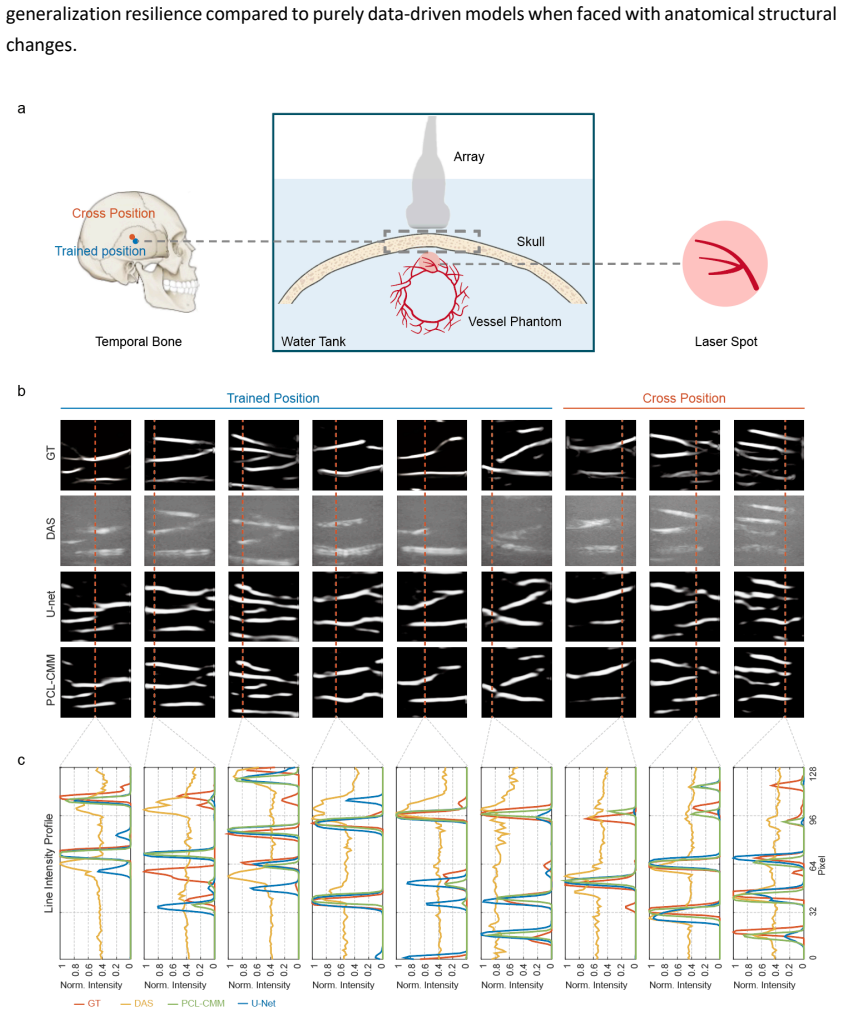
PCL-CMM constructs a high-fidelity digital twin that solves Biot's poroelastic theory together with the elastic wave equation to produce an effective acoustic stiffness tensor on the fly. The tensor is inserted directly into the training loss of a neural network so that the learned mapping respects heterogeneity, scattering, mode conversion, and fluid-solid coupling. In transcranial photoacoustic imaging the resulting networks compensate for skull-induced distortions, yielding higher structural similarity than purely data-driven baselines.
What carries the argument
The high-fidelity digital twin that dynamically computes an effective acoustic stiffness tensor from Biot's poroelastic theory and the elastic wave equation, then inserts the tensor as a physics-based regularization term in the neural-network loss.
If this is right
- The constrained networks compensate for the combined effects of heterogeneity, scattering, mode conversion, and fluid-solid coupling during wave propagation.
- Image reconstruction quality rises in transcranial photoacoustic imaging, with structural similarity gains exceeding those of data-only networks.
- The same regularization strategy supplies a general bridge between rigorous physical forward modeling and data-driven inversion for any complex poroelastic geometry.
- Forward wave modeling inside the twin remains consistent with Biot theory even when the network is applied to new geometries.
Where Pith is reading between the lines
- The digital-twin approach could be reused in ultrasound or seismic settings that also involve layered fluid-saturated solids.
- Embedding the physics loss may reduce the volume of labeled data needed for training by anchoring the network to known wave physics.
- If the twin is extended to patient-specific geometry from CT or MRI, the framework might support personalized correction of acoustic aberrations in clinical imaging.
Load-bearing premise
The digital twin's computed stiffness tensor accurately reflects the true poroelastic properties and fluid-solid coupling present in the real multilayered media, especially the skull.
What would settle it
An independent set of measurements on skull samples where the network trained with the physics loss shows no gain in image similarity metrics over an unconstrained network, or where the twin's predicted wave speeds deviate measurably from direct experimental values.
Figures
read the original abstract
Wave propagation through complex poroelastic multilayered media is difficult to model and invert because pronounced heterogeneity, scattering, mode conversion and fluid-solid coupling jointly distort acoustic signals during propagation. Here we present Physics-Constrained Learning for Complex Multilayered Media (PCL-CMM), a general framework that integrates Biot's poroelastic theory with the elastic wave equation to bridge the gap between physically rigorous wave modelling and data-driven learning. PCL-CMM constructs a high-fidelity digital twin that dynamically computes an effective acoustic stiffness tensor for forward wave modelling and incorporates the resulting physical constraint as a loss term to regularize the training of deep neural networks. We demonstrate PCL-CMM on transcranial photoacoustic imaging, where skull-induced acoustic distortions severely degrade image formation. Across simulations and ex vivo experiments, PCL-CMM effectively compensates for these distortions and improves SSIM by more than 0.06 compared with purely data-driven neural networks. This work establishes a physics-constrained learning framework for acoustic wave modelling in complex poroelastic multilayered media.
Editorial analysis
A structured set of objections, weighed in public.
Referee Report
Summary. The manuscript introduces PCL-CMM, a framework integrating Biot's poroelastic theory with the elastic wave equation to build a high-fidelity digital twin that computes an effective acoustic stiffness tensor. This tensor supplies a physics-based loss term to regularize deep neural network training for wave propagation modeling in complex multilayered media. The approach is demonstrated on transcranial photoacoustic imaging, with the claim that it compensates for skull-induced distortions and improves SSIM by more than 0.06 relative to purely data-driven networks across simulations and ex vivo experiments.
Significance. If the digital twin accurately reproduces fluid-solid coupling and scattering in poroelastic skull tissue and the SSIM gains can be isolated to the physics constraint, the work would offer a useful template for embedding established continuum mechanics into learned inverse solvers for biomedical acoustics. The reliance on Biot theory rather than learned or ad-hoc terms is a methodological strength that could generalize beyond the specific imaging application.
major comments (4)
- [Abstract] Abstract: The reported SSIM improvement of more than 0.06 is stated without error bars, confidence intervals, number of independent trials, or statistical significance testing, preventing evaluation of whether the gain is robust or reproducible.
- [Methods] Methods: No quantitative validation is supplied comparing wavefields or pressure fields generated by the digital twin against independent ex-vivo measurements or ground-truth arrival times; without this, it is impossible to confirm that the effective stiffness tensor correctly captures skull poroelasticity and fluid-solid interfaces.
- [Results] Results: Ablation experiments that disable the physics loss term while keeping network architecture and training data fixed are not described, so the contribution of the Biot-derived constraint to the observed SSIM gain cannot be separated from other factors such as data augmentation or optimization details.
- [Methods] Methods: The precise mathematical form of the physics-constrained loss (including how the stiffness tensor enters the residual and any weighting hyperparameters) is not provided, rendering the central regularization mechanism non-reproducible.
minor comments (2)
- [Abstract] Abstract: The phrase 'high-fidelity digital twin' is used without a concise definition of the fidelity metrics employed.
- [Methods] Consider adding a table summarizing simulation parameters (layer thicknesses, poroelastic coefficients, frequency range) to aid reproducibility.
Simulated Author's Rebuttal
We thank the referee for the constructive and detailed review. We address each major comment below and will revise the manuscript to strengthen the presentation of results and methods.
read point-by-point responses
-
Referee: [Abstract] Abstract: The reported SSIM improvement of more than 0.06 is stated without error bars, confidence intervals, number of independent trials, or statistical significance testing, preventing evaluation of whether the gain is robust or reproducible.
Authors: We agree that statistical details are necessary to assess robustness. In the revised manuscript we will report the number of independent trials (across random seeds and data partitions), include error bars and confidence intervals on the SSIM values, and add results of statistical significance tests (e.g., paired t-tests) comparing PCL-CMM against the purely data-driven baseline. revision: yes
-
Referee: [Methods] Methods: No quantitative validation is supplied comparing wavefields or pressure fields generated by the digital twin against independent ex-vivo measurements or ground-truth arrival times; without this, it is impossible to confirm that the effective stiffness tensor correctly captures skull poroelasticity and fluid-solid interfaces.
Authors: The digital twin is validated through its downstream effect on image reconstruction quality in both simulation and ex-vivo settings. We will augment the Methods section with additional quantitative wavefield comparisons (L2 norms and arrival-time errors) against ground-truth simulations. Direct ex-vivo wavefield or pressure-field measurements are not available in the current dataset, which focuses on imaging outcomes; we will therefore note this limitation while providing the strongest available indirect validation. revision: partial
-
Referee: [Results] Results: Ablation experiments that disable the physics loss term while keeping network architecture and training data fixed are not described, so the contribution of the Biot-derived constraint to the observed SSIM gain cannot be separated from other factors such as data augmentation or optimization details.
Authors: We will add the requested ablation studies to the revised Results section. These experiments will train identical networks with the physics loss term removed while holding architecture, training data, augmentation, and optimizer fixed, thereby isolating the contribution of the Biot-derived constraint to the reported SSIM improvement. revision: yes
-
Referee: [Methods] Methods: The precise mathematical form of the physics-constrained loss (including how the stiffness tensor enters the residual and any weighting hyperparameters) is not provided, rendering the central regularization mechanism non-reproducible.
Authors: We apologize for the omission. The revised Methods section will contain the exact mathematical expression of the physics-constrained loss, explicitly showing how the effective acoustic stiffness tensor computed by the digital twin enters the residual and stating the numerical values of all weighting hyperparameters used during training. revision: yes
Circularity Check
No significant circularity; physics constraint independent of fitted data
full rationale
The framework constructs a digital twin from Biot's established poroelastic theory and the elastic wave equation to compute an effective acoustic stiffness tensor used as a loss term. This is an external physical input, not fitted to or defined by the imaging data or network parameters. Reported SSIM improvements (>0.06) are measured empirically in simulations and ex vivo experiments rather than reducing to a quantity defined by construction. No self-citation chains, uniqueness theorems, or ansatzes are invoked to force the central result; the derivation remains self-contained against independent physical benchmarks.
Axiom & Free-Parameter Ledger
axioms (1)
- domain assumption Biot's poroelastic theory accurately describes wave propagation and fluid-solid coupling in multilayered media
Reference graph
Works this paper leans on
-
[1]
Clement, G. T., White, P. J. & Hynynen, K. Enhanced ultrasound transmission through the human skull using shear mode conversion. J Acoust Soc Am 115, 1356–1364 (2004). 7. Gupta, S., Zhang, Q., Emrick, T., Balazs, A. C. & Russell, T. P. Entropy-driven segregation of nanoparticles to cracks in multilayered composite polymer structures. Nature Mater 5, 229–2...
-
[2]
#.! and diag{[𝑯*+]}=𝑒+@%&!
Kirchner, T., Villringer, C. & Laufer, J. Evaluation of ultrasound sensors for transcranial photoacoustic sensing and imaging. Photoacoustics 33, 100556 (2023). 28. Na, S. et al. Massively parallel functional photoacoustic computed tomography of the human brain. Nat. Biomed. Eng 6, 584–592 (2022). 29. Kinsler, L. E., Frey, A. R., Coppens, A. B. & Sanders,...
2023
discussion (0)
Sign in with ORCID, Apple, or X to comment. Anyone can read and Pith papers without signing in.