Recognition: unknown
Spectro-Polarimetric Observations of TeV Sources (SPOTS): First results
Pith reviewed 2026-05-08 17:09 UTC · model grok-4.3
The pith
TeV blazars exhibit low average optical polarization from turbulent jet regions
A machine-rendered reading of the paper's core claim, the machinery that carries it, and where it could break.
Core claim
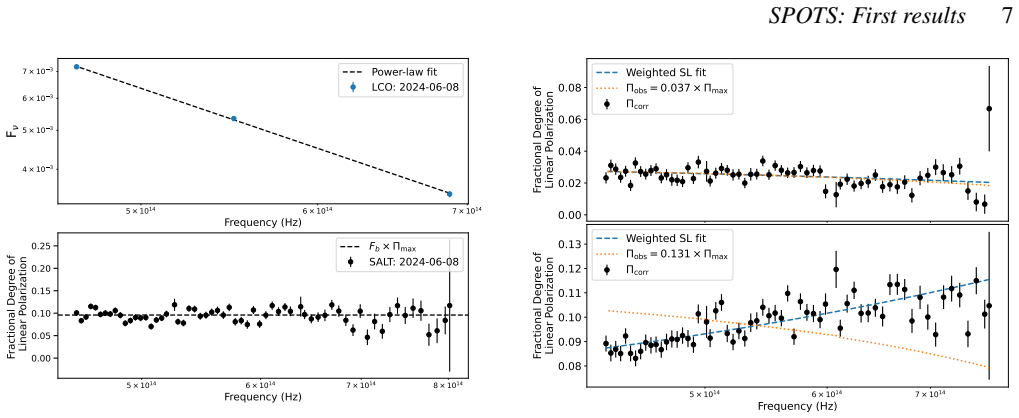
The first results from the SPOTS campaign show that the sample of TeV blazars has low average optical polarization (Π ≲ 10%) and low magnetic field ordering (F_B ≲ 0.10). This is consistent with emission coming from extended turbulent regions in the jet. While some sources have smooth polarization angle rotations and others stochastic variations, the frequency dependence of polarization varies between observations, meaning that F_B must be wavelength dependent and simple one-zone models are insufficient.
What carries the argument
The magnetic field ordering parameter F_B, derived from measured polarization degree across wavelengths, which quantifies how ordered the jet magnetic field is in the emitting region.
Load-bearing premise
The observed optical polarization is dominated by jet emission without significant dilution from the accretion disk, broad-line region, or host galaxy, and F_B accurately reflects magnetic field ordering across the observed wavelengths and epochs.
What would settle it
Detection of polarization degrees above 20 percent in multiple sources with clearly jet-dominated emission and no host contamination, or multi-epoch data where a single wavelength-independent F_B fits all frequency dependence, would falsify the low-ordering and model-insufficiency claims.
Figures



read the original abstract
Blazars are jetted active galactic nuclei, with the jet aligned along the observer's line of sight. Their spectral energy distributions are dominated by non-thermal emission, with an underlying thermal component at optical/ultraviolet wavelengths. However, the underlying jet magnetic field structure and particle acceleration mechanisms requirements for the non-thermal emission are still under debate. Polarization measurements can provide critical insights, and we investigate the optical polarization properties of TeV-emitting blazars using long-term optical monitoring. We present results from the first 21-months of the Spectro-Polarimetric Observations of TeV Sources (SPOTS) campaign, using the Southern African Large Telescope, of 14 blazars. Overall, observations of the sample during this campaign showed a low average optical polarization ($\Pi\lesssim10\%$). While some sources exhibited smooth polarization angle rotations on timescales of days to weeks, others showed stochastic variations consistent with turbulent magnetic fields. The average ordering of the magnetic field was low ($F_B\lesssim0.10$), consistent with emission arising in extended, turbulent regions of the jet. For individual sources, correlations between polarization and its frequency dependence were found, but were not found across the entire sample. The nature of the frequency dependence varied between observations, indicating that simple one-zone models are insufficient and that $F_B$ must be wavelength dependent. This study highlights the complex nature of blazar jets and underscores the importance of long-term, multi-wavelength polarimetric monitoring. This comprehensive dataset enables detailed modelling of individual sources, and provides valuable context for future X-ray polarimetry observations.
Editorial analysis
A structured set of objections, weighed in public.
Referee Report
Summary. The manuscript reports the first 21 months of results from the SPOTS campaign, presenting optical spectro-polarimetric observations of 14 TeV-emitting blazars obtained with the Southern African Large Telescope. Key findings include a low sample-average optical polarization degree (Π ≲ 10 %) and low magnetic-field ordering parameter (F_B ≲ 0.10), interpreted as evidence that the emission arises in extended, turbulent jet regions. Frequency dependence of polarization is reported to vary between sources and epochs, leading to the conclusion that simple one-zone models are insufficient and that F_B must be wavelength-dependent. The work emphasizes the value of long-term multi-wavelength polarimetric monitoring for understanding blazar jet physics.
Significance. If the central measurements and interpretations hold after addressing potential systematics, the paper supplies a valuable long-term spectro-polarimetric dataset for TeV blazars that can directly inform models of jet magnetic-field structure and particle acceleration. The multi-epoch, frequency-resolved approach is a clear strength and provides useful context for upcoming X-ray polarimetry missions. The dataset itself enables future detailed source modeling, which is explicitly noted as an intended use.
major comments (3)
- [Abstract] Abstract: The central claim that F_B ≲ 0.10 indicates emission from extended turbulent jet regions rests on the untested assumption that the measured Stokes parameters are dominated by jet synchrotron emission. No quantitative assessment or correction for dilution by unpolarized thermal light from the accretion disk, broad-line region, or host galaxy is presented; such dilution would lower both Π and F_B without requiring turbulence, directly undermining the argument that one-zone models are insufficient.
- [Methods / Data Reduction (Section 2)] The manuscript provides no detailed description of the data-reduction pipeline, error budget for the derived Stokes parameters and polarization quantities, or the precise definition and computation of the F_B parameter. These omissions prevent verification of the reported sample averages (Π ≲ 10 %, F_B ≲ 0.10) and their uncertainties, which are load-bearing for all quantitative conclusions.
- [Abstract / Results] Abstract: The statements that correlations between polarization and frequency dependence exist for individual sources but not the full sample, and that the nature of the frequency dependence varies between epochs, are presented without accompanying statistical tests, significance thresholds, or sample sizes per correlation. This weakens the claim that one-zone models are ruled out.
minor comments (2)
- Ensure consistent use of the symbol Π for polarization degree and explicit definition of F_B (including any wavelength dependence) in all figure captions and tables.
- Add a brief table or text summary of the number of epochs and wavelength coverage per source to support the variability and frequency-dependence claims.
Simulated Author's Rebuttal
We thank the referee for the careful and constructive review of our manuscript. We have addressed each major comment below and will incorporate revisions to strengthen the presentation of our results and methods.
read point-by-point responses
-
Referee: [Abstract] Abstract: The central claim that F_B ≲ 0.10 indicates emission from extended turbulent jet regions rests on the untested assumption that the measured Stokes parameters are dominated by jet synchrotron emission. No quantitative assessment or correction for dilution by unpolarized thermal light from the accretion disk, broad-line region, or host galaxy is presented; such dilution would lower both Π and F_B without requiring turbulence, directly undermining the argument that one-zone models are insufficient.
Authors: We agree that dilution by unpolarized thermal emission is a relevant systematic that must be considered. In the revised manuscript we will add a new paragraph in the discussion section that uses available multi-wavelength SED information for the 14 sources to estimate the fractional contribution of host-galaxy, accretion-disk, and broad-line-region light in the observed optical band. For the majority of epochs the jet synchrotron component dominates, but we will explicitly quantify the possible dilution range and show that even after a conservative correction the inferred F_B remains ≲0.15, preserving the conclusion that the magnetic field is poorly ordered. We will also note that any residual dilution would only strengthen the requirement for a turbulent field geometry. revision: yes
-
Referee: [Methods / Data Reduction (Section 2)] The manuscript provides no detailed description of the data-reduction pipeline, error budget for the derived Stokes parameters and polarization quantities, or the precise definition and computation of the F_B parameter. These omissions prevent verification of the reported sample averages (Π ≲ 10 %, F_B ≲ 0.10) and their uncertainties, which are load-bearing for all quantitative conclusions.
Authors: We acknowledge the omission. The revised Section 2 will contain a complete description of the SALT spectro-polarimetric reduction pipeline (bias subtraction, flat-fielding, wavelength calibration, and Stokes-parameter extraction), together with the full error budget that includes photon-noise, instrumental-polarization, and calibration uncertainties. We will also state the exact definition of F_B used in the paper (the ratio of the observed polarization degree to the theoretical maximum for a uniform synchrotron-emitting field) and provide the explicit formula and propagation of uncertainties applied to obtain the sample averages and their errors. revision: yes
-
Referee: [Abstract / Results] Abstract: The statements that correlations between polarization and frequency dependence exist for individual sources but not the full sample, and that the nature of the frequency dependence varies between epochs, are presented without accompanying statistical tests, significance thresholds, or sample sizes per correlation. This weakens the claim that one-zone models are ruled out.
Authors: We will expand the results section and abstract to include the requested statistical information. For each source we will report the number of epochs, the Spearman rank-correlation coefficient between polarization degree and wavelength slope, and the associated p-value. For the full sample we will present a combined test demonstrating the absence of a significant overall correlation. These additions will make the source-to-source and epoch-to-epoch variability explicit and will reinforce the argument that simple one-zone models cannot account for the observed behavior. revision: yes
Circularity Check
No circularity; purely observational reporting with no derivation chain
full rationale
The paper presents first results from the SPOTS monitoring campaign, reporting measured quantities such as average optical polarization Π ≲10% and magnetic field ordering F_B ≲0.10 across 14 blazars over 21 months. No equations, fitted parameters, predictions, or self-citations are invoked to derive these values; they are direct observational outputs. Interpretations about turbulent jet regions and wavelength-dependent F_B follow from the data under standard synchrotron polarization assumptions without any reduction to inputs by construction. The analysis is self-contained against external benchmarks and contains no load-bearing steps that qualify as circular under the enumerated patterns.
Axiom & Free-Parameter Ledger
axioms (1)
- domain assumption Optical polarization measurements primarily trace the magnetic field structure in the relativistic jet rather than other emission components
Reference graph
Works this paper leans on
-
[1]
Completion and commissioning of the Southern African Large Telescope - art
Buckley, David and Swart, Gerhard and Meiring, Jacobus , year =. Completion and commissioning of the Southern African Large Telescope - art. no. 62670Z , volume =. Proceedings of SPIE - The International Society for Optical Engineering , doi =
-
[2]
Prime Focus Imaging Spectrograph for the Southern African Large Telescope: optical design. Instrument Design and Performance for Optical/Infrared Ground-based Telescopes , year = 2003, editor =. doi:10.1117/12.460312 , adsurl =
-
[3]
Prime focus imaging spectrograph for the Southern African large telescope: operational modes. Instrument Design and Performance for Optical/Infrared Ground-based Telescopes , year = 2003, editor =. doi:10.1117/12.460315 , adsurl =
-
[4]
Las Cumbres Observatory Global Telescope Network. , keywords =. doi:10.1086/673168 , archivePrefix =. 1305.2437 , primaryClass =
-
[5]
, archivePrefix = "arXiv", eprint =
Active galactic nuclei: what's in a name?. , keywords =. doi:10.1007/s00159-017-0102-9 , archivePrefix =. 1707.07134 , primaryClass =
-
[6]
Unified Schemes for Radio-Loud Active Galactic Nuclei. , keywords =. doi:10.1086/133630 , archivePrefix =. astro-ph/9506063 , primaryClass =
work page internal anchor Pith review doi:10.1086/133630
-
[7]
2020, ApJS, 247, 33, doi: 10.3847/1538-4365/ab6bcb
Fermi Large Area Telescope Fourth Source Catalog. , keywords =. doi:10.3847/1538-4365/ab6bcb , archivePrefix =. 1902.10045 , primaryClass =
-
[8]
Simultaneous multiwavelength observations of the second exceptional -ray flare of PKS 2155-304 in July 2006. , keywords =. doi:10.1051/0004-6361/200912128 , archivePrefix =. 0906.2002 , primaryClass =
-
[9]
A Multiwavelength View of the TeV Blazar Markarian 421: Correlated Variability, Flaring, and Spectral Evolution. , keywords =. doi:10.1086/431925 , archivePrefix =. astro-ph/0505325 , primaryClass =
-
[10]
2007, ApJ, 669, 862, doi: 10.1086/521382 Astropy Collaboration, Price-Whelan, A
Variable Very High Energy -Ray Emission from Markarian 501. , keywords =. doi:10.1086/521382 , archivePrefix =. astro-ph/0702008 , primaryClass =
-
[11]
Astronomy Reports , year = 2019, month = apr, volume =
Variability of the Blazar J1504+1029 on Timescales from Hours to Years. Astronomy Reports , year = 2019, month = apr, volume =. doi:10.1134/S1063772919030053 , adsurl =
-
[12]
Ten-year optical monitoring of PKS 0735+178: historical comparison, multiband behavior, and variability timescales. , keywords =. doi:10.1051/0004-6361:20052646 , archivePrefix =. astro-ph/0701420 , primaryClass =
-
[13]
A numerical study of long-term multiwavelength blazar variability. , keywords =. doi:10.1093/mnras/stab1618 , archivePrefix =. 2105.07030 , primaryClass =
-
[14]
7737, Observatory Operations: Strategies, Processes, and Systems III, ed
PySALT: the SALT science pipeline. Observatory Operations: Strategies, Processes, and Systems III , year = 2010, editor =. doi:10.1117/12.857000 , adsurl =
-
[15]
arXiv , author =:1304.0605 , journal =
Leptonic and Hadronic Modeling of Fermi-detected Blazars. , keywords =. doi:10.1088/0004-637X/768/1/54 , archivePrefix =. 1304.0605 , primaryClass =
-
[16]
2019, Galaxies, 7, 85, doi: 10.3390/galaxies7040085
Blazar Optical Polarimetry: Current Progress in Observations and Theories. Galaxies , keywords =. doi:10.3390/galaxies7040085 , adsurl =
-
[17]
Model for the High-Energy Emission from Blazars. , keywords =. doi:10.1086/173251 , adsurl =
-
[18]
1993, A&A, 269, 67, doi: 10.48550/arXiv.astro-ph/9302006
The proton blazar. , keywords =. doi:10.48550/arXiv.astro-ph/9302006 , archivePrefix =. astro-ph/9302006 , primaryClass =
-
[19]
2003, Astroparticle Physics, 18, 593, doi: 10.1016/S0927-6505(02)00185-8
BL Lac objects in the synchrotron proton blazar model. Astroparticle Physics , keywords =. doi:10.1016/S0927-6505(02)00185-8 , archivePrefix =. astro-ph/0206164 , primaryClass =
-
[20]
External Compton Scattering in Blazar Jets and the Location of the Gamma-Ray Emitting Region. , keywords =. doi:10.3847/0004-637X/830/2/94 , adsurl =
-
[21]
SALT Spectropolarimetry and Self-Consistent SED and Polarization Modeling of Blazars. Galaxies , keywords =. doi:10.3390/galaxies5030052 , archivePrefix =. 1707.09764 , primaryClass =
-
[22]
R., Nelemans, G., & Steeghs, D
A physical classification scheme for blazars. , keywords =. doi:10.1111/j.1365-2966.2004.07750.x , archivePrefix =. astro-ph/0402494 , primaryClass =
-
[23]
A unifying view of the spectral energy distributions of blazars. , keywords =. doi:10.1046/j.1365-8711.1998.01828.x , archivePrefix =. astro-ph/9804103 , primaryClass =
-
[24]
1995, ApJ, 444, 567, doi: 10.1086/175631
The Connection between X-Ray-- and Radio-selected BL Lacertae Objects. , keywords =. doi:10.1086/175631 , archivePrefix =. astro-ph/9412073 , primaryClass =
-
[25]
Models for the Spectral Energy Distributions and Variability of Blazars. arXiv e-prints , keywords =. doi:10.48550/arXiv.1006.5048 , archivePrefix =. 1006.5048 , primaryClass =
-
[26]
The power of blazar jets. , keywords =. doi:10.1111/j.1365-2966.2007.12758.x , archivePrefix =. 0711.4112 , primaryClass =
-
[27]
An Exceptional Very High Energy Gamma-Ray Flare of PKS 2155-304. , keywords =. doi:10.1086/520635 , archivePrefix =. 0706.0797 , primaryClass =
-
[28]
The Astronomer's Telegram , keywords =
Fermi-LAT detection of increased gamma-ray activity of TXS 0506+056, located inside the IceCube-170922A error region. The Astronomer's Telegram , keywords =
-
[29]
2013, ApJ, 774, 18, doi: 10.1088/0004-637X/774/1/18
X-Ray and Gamma-Ray Polarization in Leptonic and Hadronic Jet Models of Blazars. , keywords =. doi:10.1088/0004-637X/774/1/18 , archivePrefix =. 1307.4187 , primaryClass =
-
[30]
Synchrotron Polarization in Blazars. , keywords =. doi:10.1088/0004-637X/789/1/66 , archivePrefix =. 1401.7138 , primaryClass =
-
[31]
Probing shock acceleration in BL Lac jets through X-ray polarimetry: the time-dependent view. , keywords =. doi:10.1093/mnras/staa2457 , archivePrefix =. 2007.08353 , primaryClass =
-
[32]
Modeling the Spectral Energy Distributions and Spectropolarimetry of Blazars-Application to 4C+01.02 in 2016-2017. , keywords =. doi:10.3847/1538-4357/ac3cb5 , archivePrefix =. 2112.08871 , primaryClass =
-
[33]
The optical spectropolarimetric behaviour of a selection of high-energy blazars. , keywords =. doi:10.1093/mnras/stae1576 , archivePrefix =. 2406.17412 , primaryClass =
-
[34]
Multiwavelength Observations of Strong Flares from the TeV Blazar 1ES 1959+650. , keywords =. doi:10.1086/380393 , archivePrefix =. astro-ph/0310158 , primaryClass =
-
[35]
35th International Cosmic Ray Conference (ICRC2017) , year = 2017, series =
Target of Opportunity Observations of Blazars with H.E.S.S. 35th International Cosmic Ray Conference (ICRC2017) , year = 2017, series =. doi:10.22323/1.301.0652 , archivePrefix =. 1708.01083 , primaryClass =
-
[36]
6th International Symposium on High Energy Gamma-Ray Astronomy , year = 2017, series =
Target of opportunity observations of blazars with H.E.S.S. 6th International Symposium on High Energy Gamma-Ray Astronomy , year = 2017, series =. doi:10.1063/1.4968975 , archivePrefix =. 1610.05523 , primaryClass =
-
[37]
2022, ApJS, 260, 53, doi: 10.3847/1538-4365/ac6751
Incremental Fermi Large Area Telescope Fourth Source Catalog. , keywords =. doi:10.3847/1538-4365/ac6751 , archivePrefix =. 2201.11184 , primaryClass =
-
[38]
Research in Astronomy and Astrophysics , keywords =
The Optical Variability Properties of TeV Blazars. Research in Astronomy and Astrophysics , keywords =. doi:10.1088/1674-4527/ad6db4 , adsurl =
-
[39]
International Cosmic Ray Conference , year = 2008, series =
TeVCat: An online catalog for Very High Energy Gamma-Ray Astronomy. International Cosmic Ray Conference , year = 2008, series =
2008
-
[40]
Measuring Reddening with Sloan Digital Sky Survey Stellar Spectra and Recalibrating SFD. , keywords =. doi:10.1088/0004-637X/737/2/103 , archivePrefix =. 1012.4804 , primaryClass =
-
[41]
Research in Astronomy and Astrophysics , keywords =
Comparison between TeV and non-TeV BL Lac Objects. Research in Astronomy and Astrophysics , keywords =. doi:10.1088/1674-4527/16/7/103 , archivePrefix =. 1604.06320 , primaryClass =
-
[42]
Comparison Between TeV and Non-TeV Fermi-detected BL Lacertae Objects. , keywords =. doi:10.1088/1538-3873/acf074 , adsurl =
-
[43]
Investigating the origin of optical flares from the TeV blazar S4 0954+65. , keywords =. doi:10.1051/0004-6361/202347545 , archivePrefix =. 2310.05104 , primaryClass =
-
[44]
A Decade of Multiwavelength Observations of the TeV Blazar 1ES 1215+303: Extreme Shift of the Synchrotron Peak Frequency and Long-term Optical-Gamma-Ray Flux Increase. , keywords =. doi:10.3847/1538-4357/ab765d , archivePrefix =. 2002.04119 , primaryClass =
-
[45]
Multiwavelength temporal and spectral study of TeV blazar 1ES 1727+502 during 2014-2021. , keywords =. doi:10.1093/mnras/stac1866 , archivePrefix =. 2206.12506 , primaryClass =
-
[46]
Relativistic Jet Properties of GeV-TeV Blazars and Possible Implications for the Jet Formation, Composition, and Cavity Kinematics. , keywords =. doi:10.1088/0004-637X/788/2/104 , adsurl =
-
[47]
2015, MNRAS, 453, 1669, doi: 10.1093/mnras/stv1723
RoboPol: first season rotations of optical polarization plane in blazars. , keywords =. doi:10.1093/mnras/stv1723 , archivePrefix =. 1505.07467 , primaryClass =
-
[48]
Probing the Inner Jet of the Quasar PKS 1510-089 with Multi-Waveband Monitoring During Strong Gamma-Ray Activity. , keywords =. doi:10.1088/2041-8205/710/2/L126 , archivePrefix =. 1001.2574 , primaryClass =
-
[49]
2016, MNRAS, 463, 3365, doi: 10.1093/mnras/stw2217
RoboPol: the optical polarization of gamma-ray-loud and gamma-ray-quiet blazars. , keywords =. doi:10.1093/mnras/stw2217 , archivePrefix =. 1609.00640 , primaryClass =
-
[50]
Magellan Spectroscopy of Low-Redshift Active Galactic Nuclei. , keywords =. doi:10.1088/0067-0049/184/2/398 , archivePrefix =. 0909.0054 , primaryClass =
-
[51]
H.E.S.S. discovery of very-high-energy emission from the blazar PKS 0736+017: on the location of the -ray emitting region in FSRQs. 35th International Cosmic Ray Conference (ICRC2017) , year = 2017, series =. doi:10.22323/1.301.0627 , archivePrefix =. 1708.00658 , primaryClass =
-
[52]
detection of very high-energy -ray emission from the quasar PKS 0736+017
H.E.S.S. detection of very high-energy -ray emission from the quasar PKS 0736+017. , keywords =. doi:10.1051/0004-6361/201935906 , archivePrefix =. 1911.04761 , primaryClass =
-
[53]
arXiv e-prints , keywords =
The Fourth Catalog of Active Galactic Nuclei Detected by the Fermi Large Area Telescope -- Data Release 2. arXiv e-prints , keywords =
-
[54]
The Fourth Catalog of Active Galactic Nuclei Detected by the Fermi Large Area Telescope. , keywords =. doi:10.3847/1538-4357/ab791e , archivePrefix =. 1905.10771 , primaryClass =
-
[55]
Astronomische Nachrichten , author =
Remarks on statistical errors in equivalent widths. Astronomische Nachrichten , keywords =. doi:10.1002/asna.200610645 , archivePrefix =. astro-ph/0606341 , primaryClass =
-
[56]
The optical spectral features of 27 Fermi blazars. , keywords =. doi:10.1093/mnras/stac3795 , archivePrefix =. 2212.12331 , primaryClass =
-
[57]
Long-term optical variability properties of blazars in the SDSS Stripe 82. , keywords =. doi:10.1007/s10509-016-2934-6 , adsurl =
-
[58]
A., Ackermann, M., Ajello, M., et al
Gamma-ray Light Curves and Variability of Bright Fermi-detected Blazars. , keywords =. doi:10.1088/0004-637X/722/1/520 , archivePrefix =. 1004.0348 , primaryClass =
-
[59]
Characterizing the Emission Region Properties of Blazars. , keywords =. doi:10.3847/1538-4365/ace7c8 , archivePrefix =. 2307.07163 , primaryClass =
-
[60]
Astronomical Time Series , year = 1997, editor =
Is AGN Variability Correlated with Other AGN Properties? ZDCF Analysis of Small Samples of Sparse Light Curves. Astronomical Time Series , year = 1997, editor =. doi:10.1007/978-94-015-8941-3_14 , adsurl =
-
[61]
Discovery of very high energy -ray emission from the BL Lacertae object PKS 0301-243 with H.E.S.S. , keywords =. doi:10.1051/0004-6361/201321639 , archivePrefix =. 1309.6174 , primaryClass =
-
[62]
Spectroscopy of high-energy BL Lacertae objects with X-shooter on the VLT. , keywords =. doi:10.1051/0004-6361/201323071 , archivePrefix =. 1311.3809 , primaryClass =
-
[63]
Optical flux and spectral variability of blazars. , keywords =. doi:10.1111/j.1365-2966.2012.21583.x , archivePrefix =. 1207.5943 , primaryClass =
-
[64]
Multi-color Optical Monitoring of 10 Blazars from 2005 to 2011. , keywords =. doi:10.3847/1538-4365/aacffe , archivePrefix =. 1807.02926 , primaryClass =
-
[65]
Interstellar polarization and the position-angle orientations of type 1 Seyfert galaxies. , keywords =. doi:10.1111/j.1365-2966.2005.09513.x , archivePrefix =. astro-ph/0505568 , primaryClass =
-
[66]
Wavelength dependence of interstellar polarization and ratio of total to selective extinction. , keywords =. doi:10.1086/153410 , adsurl =
-
[67]
R., Nelemans, G., & Steeghs, D
Seyferts on the edge: polar scattering and orientation-dependent polarization in Seyfert 1 nuclei. , keywords =. doi:10.1111/j.1365-2966.2004.07610.x , archivePrefix =. astro-ph/0401496 , primaryClass =
-
[68]
doi:10.3390/galaxies10010035 , archiveprefix =
The Blazar Sequence and Its Physical Understanding. Galaxies , keywords =. doi:10.3390/galaxies10010035 , archivePrefix =. 2202.07490 , primaryClass =
-
[69]
Towards a TeV blazar sequence and its physical interpretation. arXiv e-prints , keywords =. doi:10.48550/arXiv.2506.18500 , archivePrefix =. 2506.18500 , primaryClass =
-
[70]
The ``Blazar Sequence'' in the TeV Band. , keywords =. doi:10.3847/1538-4357/acc329 , archivePrefix =. 2303.09845 , primaryClass =
-
[71]
The blazar sequence: validity and predictions. , keywords =. doi:10.1007/s10509-007-9455-2 , archivePrefix =. astro-ph/0610545 , primaryClass =
-
[72]
2017, MNRAS, 469, 255, doi: 10.1093/mnras/stx806
The Fermi blazar sequence. , keywords =. doi:10.1093/mnras/stx806 , archivePrefix =. 1702.02571 , primaryClass =
-
[73]
MOJAVE. XV. VLBA 15 GHz Total Intensity and Polarization Maps of 437 Parsec-scale AGN Jets from 1996 to 2017. , keywords =. doi:10.3847/1538-4365/aa9c44 , archivePrefix =. 1711.07802 , primaryClass =
-
[74]
The programme, calibration and calibrator data products
POLAMI: Polarimetric Monitoring of AGN at Millimetre Wavelengths - I. The programme, calibration and calibrator data products. , keywords =. doi:10.1093/mnras/stx2435 , archivePrefix =. 1709.08742 , primaryClass =
-
[75]
A., Becerra Gonz´ alez, J., et al
Variability and evolution of the optical polarization of a sample of gamma-ray blazars. , keywords =. doi:10.1093/mnras/stad1722 , archivePrefix =. 2306.03919 , primaryClass =
-
[76]
Electromagnetic extraction of energy from Kerr black holes. , keywords =. doi:10.1093/mnras/179.3.433 , adsurl =
-
[77]
A multizone view on the multiwavelength emission of blazars. , keywords =. doi:10.1093/mnras/stad2911 , archivePrefix =. 2309.12171 , primaryClass =
-
[78]
Models for high-frequency radio outbursts in extragalactic sources, with application to the early 1983 millimeter-to-infrared flare of 3C 273. , keywords =. doi:10.1086/163592 , adsurl =
-
[79]
Timing Signatures of the Internal-Shock Model for Blazars. , keywords =. doi:10.1088/0004-637X/711/1/445 , archivePrefix =. 1001.1606 , primaryClass =
-
[80]
Spine-sheath layer radiative interplay in subparsec-scale jets and the TeV emission from M87. , keywords =. doi:10.1111/j.1745-3933.2008.00441.x , archivePrefix =. 0801.0593 , primaryClass =
discussion (0)
Sign in with ORCID, Apple, or X to comment. Anyone can read and Pith papers without signing in.