Recognition: 3 theorem links
· Lean TheoremRevealing the cold skeleton of the Magellanic Clouds and the Magellanic Bridge with ASKAP
Pith reviewed 2026-05-08 17:43 UTC · model grok-4.3
The pith
Cold neutral hydrogen gas is detected across the Magellanic Bridge, concentrated near the Small Magellanic Cloud.
A machine-rendered reading of the paper's core claim, the machinery that carries it, and where it could break.
Core claim
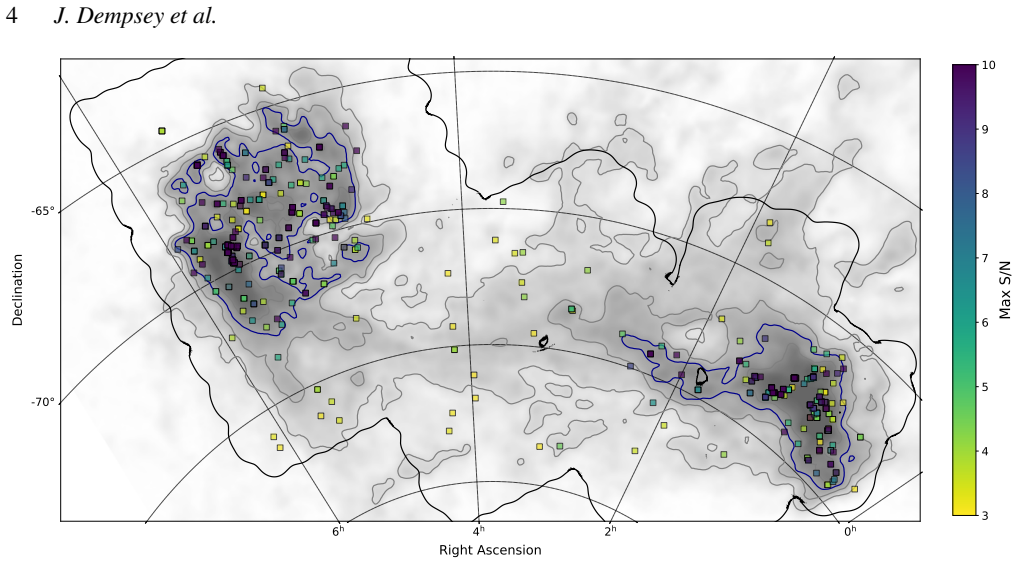
The GASKAP-HI pilot absorption survey provides 3219 sightlines across the LMC, SMC and MB. We find 344 candidate detections of cold gas at Magellanic velocities (vLSRK >= 90 km/s) with SNR > 3, detection rates of 44 percent in the LMC, 73 percent in the SMC and 4 percent in the MB. Gaussian decomposition of the Bridge detections shows most cold gas lies closer to the SMC, with possible recent formation on the outskirts of a shell. The mean cold gas fraction in the MB is fCNM = 0.12 plus or minus 0.08, very similar to the SMC and lower than the LMC value of 0.14. Overall we reveal cold gas distributed extensively across the Magellanic system, including within the MB, and surmise that the cold
What carries the argument
The GASKAP-HI absorption survey against continuum sources combined with Gaussian decomposition of spectra to isolate cold neutral medium components at Magellanic velocities.
If this is right
- Cold gas is distributed extensively across the entire Magellanic system including the Bridge.
- The majority of cold gas detections in the Bridge are found closer to the SMC.
- Potential evidence exists for recent formation of cold gas on the outskirts of a shell within the MB.
- The cold gas fraction in the MB is very similar to the SMC and lower than the LMC.
Where Pith is reading between the lines
- If the Bridge gas truly traces SMC material, its velocity and spatial distribution could constrain the timing and geometry of the Clouds' interaction.
- The low but nonzero detection rate in the Bridge suggests cold gas can survive or form quickly in low-density tidal structures.
- Similar absorption surveys toward other interacting galaxy pairs might reveal whether cold gas reservoirs are a common outcome of such encounters.
Load-bearing premise
The 344 SNR greater than 3 absorption features are genuine cold neutral medium gas at Magellanic velocities without significant contamination, misidentification or projection effects, and Gaussian decomposition reliably isolates components in the Bridge.
What would settle it
Independent higher-resolution spectra or observations at a different frequency that fail to recover absorption at the same vLSRK greater than or equal to 90 km/s velocities would show the features are not real cold gas.
Figures



read the original abstract
We present the GASKAP-HI pilot absorption survey of neutral hydrogen (HI) in the Magellanic system. This survey provides 3219 sightlines across the Large (LMC) and Small Magellanic Clouds (SMC) and the Magellanic Bridge (MB) towards 1.4-GHz continuum sources, representing a 15-fold increase on pre--GASKAP-HI sampling of the Magellanic System. We find 344 candidate detections of cold gas at Magellanic velocities (vLSRK >= 90 km s-1), with signal-to-noise ratio > 3 detection rates of 44% (LMC; 192 of 438), 73% (SMC; 85 of 117) and 4% (MB; 35 of 793). We examine the candidate detections within the MB, Gaussian decompose these and examine the cold gas across the MB. Here we find that the majority of cold gas detections are found closer to the SMC. We also find potential evidence of the recent formation of cold gas on the outskirts of a shell within the MB. We find a mean cold gas fraction of fCNM = 0.12 +- 0.08 for the MB, which is very similar to the SMC and lower than the LMC value of 0.14. Overall, we reveal cold gas distributed extensively across the Magellanic system, including within the MB, and surmise that the cold gas in the MB is either pulled from the SMC as part of the formation of the MB, or formed in the turbulence of those same interactions.
Editorial analysis
A structured set of objections, weighed in public.
Referee Report
Summary. The paper presents the GASKAP-HI pilot absorption survey of HI in the Magellanic system using ASKAP, delivering 3219 sightlines toward 1.4 GHz continuum sources (a 15-fold increase over prior sampling). It reports 344 candidate cold-gas absorptions at Magellanic velocities (v_LSRK >= 90 km/s) with SNR > 3, yielding detection rates of 44% (LMC; 192/438), 73% (SMC; 85/117), and 4% (MB; 35/793). Focusing on the MB, the authors Gaussian-decompose the candidates, note that most lie closer to the SMC, identify possible recent cold-gas formation on a shell outskirts, and derive a mean cold neutral medium fraction f_CNM = 0.12 ± 0.08 (similar to the SMC, lower than the LMC). They conclude that cold gas is distributed extensively across the system and surmise that MB cold gas was either stripped from the SMC during Bridge formation or formed in the turbulence of the interactions.
Significance. If the MB detections hold, the work provides a substantial observational advance through its large, uniform sample, enabling the first statistical view of CNM across the entire Magellanic system including the Bridge. The reported f_CNM similarity between MB and SMC, together with the spatial concentration near the SMC, supplies direct constraints on tidal-stripping and in-situ formation scenarios in low-metallicity, tidally perturbed gas. The 15-fold increase in sightlines and the pilot nature of the survey also lay groundwork for future wide-field ASKAP studies of multiphase gas in interacting galaxies.
major comments (2)
- [Abstract and MB analysis section] Abstract and MB analysis section: the headline claim of extensive cold gas in the MB (and the subsequent origin surmise) rests on only 35 SNR>3 candidates out of 793 sightlines. No quantitative assessment of false-positive rates, Galactic high-velocity-cloud contamination within the v_LSRK >= 90 km/s cut, or the performance of Gaussian decomposition in the complex, multi-phase Bridge velocity field is provided; without these, the spatial distribution and formation inference cannot be considered robust.
- [Abstract] Abstract: the reported f_CNM = 0.12 ± 0.08 for the MB is given without any description of the derivation (e.g., how absorption optical depths or column densities are obtained from the candidates, how non-detections are treated as upper limits, or the propagation of uncertainties), making it impossible to evaluate whether the quoted error bar fully captures systematic effects from baseline subtraction or sightline selection.
minor comments (2)
- [Abstract] The abstract would benefit from explicitly stating the total sightline count (3219) and the per-region breakdowns early in the text for immediate context.
- [Throughout] Notation for velocity (v_LSRK) and the precise SNR threshold definition should be introduced consistently on first use and cross-referenced to the methods section.
Simulated Author's Rebuttal
We thank the referee for their constructive and positive review, which highlights the value of our expanded sample for studying the multiphase gas in the Magellanic system. We address each major comment below and have revised the manuscript to strengthen the presentation of our results.
read point-by-point responses
-
Referee: [Abstract and MB analysis section] Abstract and MB analysis section: the headline claim of extensive cold gas in the MB (and the subsequent origin surmise) rests on only 35 SNR>3 candidates out of 793 sightlines. No quantitative assessment of false-positive rates, Galactic high-velocity-cloud contamination within the v_LSRK >= 90 km/s cut, or the performance of Gaussian decomposition in the complex, multi-phase Bridge velocity field is provided; without these, the spatial distribution and formation inference cannot be considered robust.
Authors: We agree that the modest number of MB detections (35) requires careful scrutiny to support claims of extensive cold gas and inferences on its origin. While these detections constitute a substantial increase over prior sampling, we acknowledge the absence of explicit false-positive quantification and contamination checks in the submitted version. In the revised manuscript we have added a quantitative estimate of the false-positive rate based on the measured noise statistics of the spectra, a cross-check against known Galactic HVC catalogs to assess contamination within the v_LSRK >= 90 km/s selection, and validation of the Gaussian decomposition using simulated multi-component spectra that replicate the Bridge's velocity complexity. These additions bolster the reported spatial concentration near the SMC and the formation discussion, although the small sample size remains an inherent limitation of the pilot survey. revision: yes
-
Referee: [Abstract] Abstract: the reported f_CNM = 0.12 ± 0.08 for the MB is given without any description of the derivation (e.g., how absorption optical depths or column densities are obtained from the candidates, how non-detections are treated as upper limits, or the propagation of uncertainties), making it impossible to evaluate whether the quoted error bar fully captures systematic effects from baseline subtraction or sightline selection.
Authors: We accept that the abstract omitted a concise description of the f_CNM derivation, even though the full procedure (conversion from optical depth to column density, treatment of non-detections as 3-sigma upper limits, and uncertainty propagation) is presented in the methods and results sections. We have revised the abstract to include a brief outline of these steps and have expanded the main text with an explicit discussion of systematic contributions from baseline fitting and sightline selection. The quoted uncertainty primarily captures the observed scatter; the added material now addresses whether additional systematics are fully reflected. revision: yes
Circularity Check
No circularity: purely observational survey of HI absorption with direct empirical results
full rationale
The paper is an observational survey reporting counts of candidate absorption features (344 total, with region-specific rates), Gaussian decomposition of MB sightlines, and a computed mean fCNM fraction from the data. These are direct measurements from ASKAP spectra at Magellanic velocities, with no equations, models, fitted parameters presented as predictions, or derivations that reduce to inputs by construction. The spatial distribution analysis and interpretive surmise on MB gas origin follow from the observed positions and velocities without self-referential steps or self-citation load-bearing claims. The analysis stands as self-contained empirical reporting against standard observational benchmarks.
Axiom & Free-Parameter Ledger
free parameters (2)
- velocity threshold =
90 km/s
- SNR threshold =
3
axioms (2)
- domain assumption HI 21 cm absorption traces cold neutral medium gas
- domain assumption Gaussian decomposition separates distinct velocity components in the spectra
Reference graph
Works this paper leans on
-
[1]
Audit E., Hennebelle P., 2005, @doi [ ] 10.1051/0004-6361:20041474 , https://ui.adsabs.harvard.edu/abs/2005A&A...433....1A 433, 1
-
[2]
Belokurov V., Erkal D., Deason A. J., Koposov S. E., De Angeli F., Evans D. W., Fraternali F., Mackey D., 2017, @doi [ ] 10.1093/mnras/stw3357 , https://ui.adsabs.harvard.edu/abs/2017MNRAS.466.4711B 466, 4711
-
[3]
Bialy S., Sternberg A., 2019, @doi [ ] 10.3847/1538-4357/ab2fd1 , https://ui.adsabs.harvard.edu/abs/2019ApJ...881..160B 881, 160
-
[4]
423, Galaxy Wars: Stellar Populations and Star Formation in Interacting Galaxies
Bournaud F., 2010, in Smith B., Higdon J., Higdon S., Bastian N., eds, Astronomical Society of the Pacific Conference Series Vol. 423, Galaxy Wars: Stellar Populations and Star Formation in Interacting Galaxies. p. 177 ( @eprint arXiv 0909.1812 ), @doi 10.48550/arXiv.0909.1812
-
[5]
Br \"u ns C., et al., 2005, @doi [ ] 10.1051/0004-6361:20040321 , https://ui.adsabs.harvard.edu/abs/2005A&A...432...45B 432, 45
-
[6]
Chen H., et al., 2025, @doi [ ] 10.3847/1538-3881/adc67c , https://ui.adsabs.harvard.edu/abs/2025AJ....169..284C 169, 284
-
[7]
in preparation
Chen H., et al., 2026, p. in preparation
2026
-
[8]
Dempsey J., et al., 2022, @doi [ ] 10.1017/pasa.2022.18 , https://ui.adsabs.harvard.edu/abs/2022PASA...39...34D 39, e034
-
[9]
Dempsey J., Mcclure-Griffiths N., Nguyen H., 2026, GASKAP-HI Pilot Survey HI Absorption Spectra, https://doi.org/10.25919/3dgk-7d61, @doi 10.25919/3dgk-7d61
-
[10]
M., Mebold U., Marx M., Amy S., Haynes R
Dickey J. M., Mebold U., Marx M., Amy S., Haynes R. F., Wilson W., 1994, , https://ui.adsabs.harvard.edu/abs/1994A&A...289..357D 289, 357
1994
-
[11]
Dickey J. M., Mebold U., Stanimirovic S., Staveley-Smith L., 2000, @doi [ ] 10.1086/308953 , https://ui.adsabs.harvard.edu/abs/2000ApJ...536..756D 536, 756
-
[12]
Dickey J. M., et al., 2013, @doi [ ] 10.1017/pasa.2012.003 , https://ui.adsabs.harvard.edu/abs/2013PASA...30....3D 30, e003
-
[13]
Dickey J. M., et al., 2022, @doi [ ] 10.3847/1538-4357/ac3a89 , https://ui.adsabs.harvard.edu/abs/2022ApJ...926..186D 926, 186
-
[14]
861, Lecture Notes in Physics, Berlin Springer Verlag
Duc P.-A., Renaud F., 2013, in Souchay J., Mathis S., Tokieda T., eds, , Vol. 861, Lecture Notes in Physics, Berlin Springer Verlag. p. 327, @doi 10.1007/978-3-642-32961-6_9
-
[15]
, year = 1965, month = aug, volume =
Field G. B., 1965, @doi [ ] 10.1086/148317 , 142, 531
-
[16]
Glover S. C. O., Clark P. C., 2012, @doi [ ] 10.1111/j.1365-2966.2011.19648.x , https://ui.adsabs.harvard.edu/abs/2012MNRAS.421....9G 421, 9
-
[17]
Haud U., 2000, , https://ui.adsabs.harvard.edu/abs/2000A&A...364...83H 364, 83
2000
-
[18]
H., 2003, @doi [ ] 10.1086/367785 , 145, 329
Heiles C., Troland T. H., 2003, @doi [ ] 10.1086/367785 , 145, 329
-
[19]
Hotan A. W., et al., 2021, @doi [ ] 10.1017/pasa.2021.1 , https://ui.adsabs.harvard.edu/abs/2021PASA...38....9H 38, e009
-
[20]
Irwin M. J., Kunkel W. E., Demers S., 1985, @doi [ ] 10.1038/318160a0 , https://ui.adsabs.harvard.edu/abs/1985Natur.318..160I 318, 160
-
[21]
Jameson K. E., et al., 2019, @doi [ ] 10.3847/1538-4365/ab3576 , https://ui.adsabs.harvard.edu/abs/2019ApJS..244....7J 244, 7
-
[22]
Kalberla P. M. W., Haud U., 2015, @doi [ ] 10.1051/0004-6361/201525859 , https://ui.adsabs.harvard.edu/abs/2015A&A...578A..78K 578, A78
-
[23]
Kalberla P. M. W., et al., 2010, @doi [ ] 10.1051/0004-6361/200913979 , https://ui.adsabs.harvard.edu/abs/2010A&A...521A..17K 521, A17
-
[24]
submitted
Kim S.-J., et al., 2025, , p. submitted
2025
-
[25]
Kobulnicky H. A., Dickey J. M., 1999, @doi [ ] 10.1086/300741 , https://ui.adsabs.harvard.edu/abs/1999AJ....117..908K 117, 908
-
[26]
Krumholz M. R., 2012, @doi [ ] 10.1088/0004-637X/759/1/9 , https://ui.adsabs.harvard.edu/abs/2012ApJ...759....9K 759, 9
-
[27]
Lehner N., Howk J. C., Keenan F. P., Smoker J. V., 2008, @doi [ ] 10.1086/529574 , https://ui.adsabs.harvard.edu/abs/2008ApJ...678..219L 678, 219
-
[28]
E., Morel R., Allys E., Butsky I
Lei M., Clark S. E., Morel R., Allys E., Butsky I. S., Redshaw C., Fielding D. B., 2025, @doi [ ] 10.3847/1538-4357/ae044a , https://ui.adsabs.harvard.edu/abs/2025ApJ...993....4L 993, 4
-
[29]
Liszt H., 2001, @doi [ ] 10.1051/0004-6361:20010395 , https://ui.adsabs.harvard.edu/abs/2001A&A...371..698L 371, 698
-
[30]
Liu B., 2021, PhD thesis, The University of Western Australia, @doi 10.26182/ecpa-x533
-
[31]
Mackey A. D., Koposov S. E., Da Costa G. S., Belokurov V., Erkal D., Fraternali F., McClure-Griffiths N. M., Fraser M., 2017, @doi [ ] 10.1093/mnras/stx2035 , https://ui.adsabs.harvard.edu/abs/2017MNRAS.472.2975M 472, 2975
-
[32]
Marchal A., Miville-Desch \^e nes M.-A., Orieux F., Gac N., Soussen C., Lesot M.-J., d'Allonnes A. R., Salom \'e Q., 2019, @doi [ ] 10.1051/0004-6361/201935335 , https://ui.adsabs.harvard.edu/abs/2019A&A...626A.101M 626, A101
-
[33]
G., Miville-Desch \^e nes M.-A., McClure-Griffiths N
Marchal A., Martin P. G., Miville-Desch \^e nes M.-A., McClure-Griffiths N. M., Lynn C., Bracco A., Vujeva L., 2024, @doi [ ] 10.3847/1538-4357/ad0f21 , https://ui.adsabs.harvard.edu/abs/2024ApJ...961..161M 961, 161
-
[34]
M., Zimmer F., Staveley-Smith L., Mebold U., 2000, , https://ui.adsabs.harvard.edu/abs/2000A&A...354..787M 354, 787
Marx-Zimmer M., Herbstmeier U., Dickey J. M., Zimmer F., Staveley-Smith L., Mebold U., 2000, , https://ui.adsabs.harvard.edu/abs/2000A&A...354..787M 354, 787
2000
-
[35]
Matthews D., Staveley-Smith L., Dyson P., Muller E., 2009, @doi [ ] 10.1088/0004-637X/691/2/L115 , https://ui.adsabs.harvard.edu/abs/2009ApJ...691L.115M 691, L115
-
[36]
McClure-Griffiths N. M., Stanimirovi\' c S., Rybarczyk D. R., 2023, @doi [Annual Review of Astronomy and Astrophysics] 10.1146/annurev-astro-052920-104851 , 61, null
-
[37]
W., Wilson W., Haynes R
Mebold U., Greisen E. W., Wilson W., Haynes R. F., Herbstmeier U., Kalberla P. M. W., 1991, , https://ui.adsabs.harvard.edu/abs/1991A&A...251L...1M 251, L1
1991
-
[38]
Misawa T., Charlton J. C., Kobulnicky H. A., Wakker B. P., Bland-Hawthorn J., 2009, @doi [ ] 10.1088/0004-637X/695/2/1382 , https://ui.adsabs.harvard.edu/abs/2009ApJ...695.1382M 695, 1382
-
[39]
Morelli A. P. M., et al., 2025, @doi [ ] 10.1051/0004-6361/202555015 , https://ui.adsabs.harvard.edu/abs/2025A&A...702L..11M 702, L11
-
[40]
Muller E., Stanimirovi \'c S., Rosolowsky E., Staveley-Smith L., 2004, @doi [ ] 10.1086/425154 , https://ui.adsabs.harvard.edu/abs/2004ApJ...616..845M 616, 845
-
[41]
E., Stanimirovi \'c S., Kim C.-G., Ostriker E
Murray C. E., Stanimirovi \'c S., Kim C.-G., Ostriker E. C., Lindner R. R., Heiles C., Dickey J. M., Babler B., 2017, @doi [ ] 10.3847/1538-4357/aa5d12 , https://ui.adsabs.harvard.edu/abs/2017ApJ...837...55M 837, 55
-
[42]
Murray C. E., Peek J. E. G., Kim C.-G., 2020, @doi [ ] 10.3847/1538-4357/aba19b , https://ui.adsabs.harvard.edu/abs/2020ApJ...899...15M 899, 15
-
[43]
Murray C. E., et al., 2024, @doi [ ] 10.3847/1538-4357/ad1591 , https://ui.adsabs.harvard.edu/abs/2024ApJ...962..120M 962, 120
-
[44]
Nguyen H., et al., 2024, @doi [ ] 10.1093/mnras/stae2274 , https://ui.adsabs.harvard.edu/abs/2024MNRAS.534.3478N 534, 3478
-
[45]
Nidever D. L., Majewski S. R., Butler Burton W., 2008, @doi [ ] 10.1086/587042 , https://ui.adsabs.harvard.edu/abs/2008ApJ...679..432N 679, 432
-
[46]
M., Dempsey, J., McClure-Griffiths, N
Pingel N. M., et al., 2022, @doi [ ] 10.1017/pasa.2021.59 , https://ui.adsabs.harvard.edu/abs/2022PASA...39....5P 39, e005
-
[47]
Poudel S., et al., 2025, @doi [ ] 10.3847/1538-4357/adc099 , https://ui.adsabs.harvard.edu/abs/2025ApJ...984..161P 984, 161
-
[48]
Richter P., de Boer K. S., Werner K., Rauch T., 2015, @doi [ ] 10.1051/0004-6361/201527451 , https://ui.adsabs.harvard.edu/abs/2015A&A...584L...6R 584, L6
-
[49]
Shapley H., 1940, Harvard College Observatory Bulletin, https://ui.adsabs.harvard.edu/abs/1940BHarO.914....8S 914, 8
1940
-
[50]
2003, MNRAS, 340, 1214, doi: 10.1046/j.1365-8711.2003.06380.x
Staveley-Smith L., Kim S., Calabretta M. R., Haynes R. F., Kesteven M. J., 2003, @doi [ ] 10.1046/j.1365-8711.2003.06146.x , https://ui.adsabs.harvard.edu/abs/2003MNRAS.339...87S 339, 87
-
[51]
Wolfire M. G., McKee C. F., Hollenbach D., Tielens A. G. G. M., 2003, @doi [ ] 10.1086/368016 , https://ui.adsabs.harvard.edu/abs/2003ApJ...587..278W 587, 278
discussion (0)
Sign in with ORCID, Apple, or X to comment. Anyone can read and Pith papers without signing in.