A spectroscopic map of the Galactic centre: Integrated light and dynamical modelling
Pith reviewed 2026-05-08 17:37 UTC · model grok-4.3
The pith
Triaxial orbit modelling of integrated-light kinematic maps recovers the mass of the Milky Way's central black hole.
A machine-rendered reading of the paper's core claim, the machinery that carries it, and where it could break.
Core claim
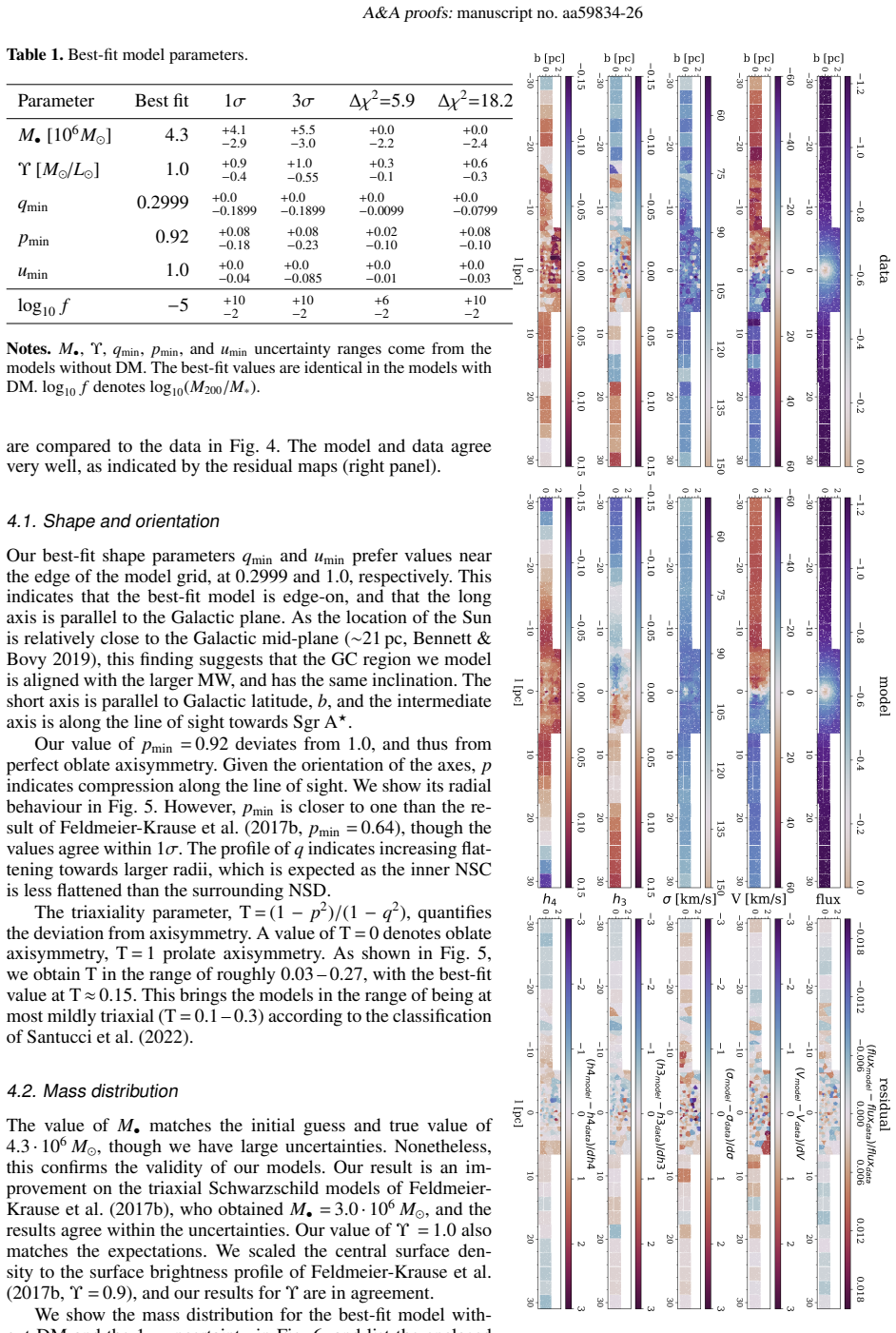
We recover the correct mass of Sgr A*, and our stellar mass distributions are in agreement with the literature, albeit with larger uncertainties. The stellar structures are at most mildly triaxial and close to oblate. The stellar orbit distribution in the inner region is dominated by dynamically warm and hot orbits. At larger scales, dynamically cold, that is, highly rotating orbits, have the largest weights.
What carries the argument
The DYNAMITE code, which calculates an orbit library in a given gravitational potential and computes model kinematic maps that are compared to observed line-of-sight velocity maps to constrain the potential and orbit distribution.
Load-bearing premise
The gravitational potential is assumed to be time-independent and the observed kinematics can be reproduced by a steady-state orbit library in a triaxial potential.
What would settle it
An independent high-precision measurement of the mass within the inner few parsecs that deviates significantly from the modelled black hole plus stellar mass profile would challenge the results.
Figures




read the original abstract
The centre of the Milky Way is occupied by a nuclear star cluster, which contains the supermassive black hole Sgr A*. The cluster is embedded in the larger surrounding nuclear stellar disc. These three components dominate the mass budget of the Galactic centre at different radial scales. The mass distribution of the Galactic centre has been studied extensively using observations of individual bright stars and various dynamical modelling approaches. The situation differs for external galaxies, where observations are often limited to the integrated line-of-sight kinematics. For such systems, triaxial orbit-based dynamical modelling has become a standard method to derive mass distributions and stellar orbit distributions. We aim to apply and test this method on the Galactic centre. We extract stellar line-of-sight kinematic maps of the inner ~3 pc x 66 pc region of the Galactic centre. We use the DYNAMITE code, which calculates an orbit library in a given gravitational potential and computes model kinematic maps. These maps are then compared to the observed kinematic maps, and the gravitational potential and orbit distribution of the Galactic centre are constrained. We recover the correct mass of Sgr A*, and our stellar mass distributions are in agreement with the literature, albeit with larger uncertainties. The stellar structures are at most mildly triaxial and close to oblate. The stellar orbit distribution in the inner region is dominated by dynamically warm and hot orbits. At larger scales, dynamically cold, that is, highly rotating orbits, have the largest weights. The dominance of hot and warm orbits is a consequence of short dynamical timescales in the inner Galactic centre, causing dynamical heating. The presence of cold orbits at large radii may be explained by the longer heating timescales in this region, and if the stars in the outer nuclear stellar disc are younger.[abridged]
Editorial analysis
A structured set of objections, weighed in public.
Referee Report
Summary. The paper extracts stellar line-of-sight kinematic maps over the inner ~3 pc × 66 pc of the Galactic centre and applies the DYNAMITE triaxial orbit-superposition code to fit a gravitational potential (including Sgr A* mass) and orbit weights to the observed maps. It reports recovering the accepted Sgr A* mass, obtaining stellar mass profiles consistent with the literature (with larger uncertainties), finding the stellar structures to be at most mildly triaxial and near-oblate, and showing that hot/warm orbits dominate inside ~few pc while cold, rotating orbits gain weight at larger radii, which the authors attribute to local dynamical timescales.
Significance. If the results hold, the work provides a useful end-to-end validation of integrated-light triaxial orbit modelling on a system where independent constraints from individual stars exist. Successful recovery of the known Sgr A* mass and consistency of the stellar mass distribution (despite the expected increase in uncertainty) supports the reliability of the method for external galaxies. The orbit-type analysis and explicit discussion of dynamical heating timescales add physical context that is directly testable in the Milky Way.
major comments (2)
- [Abstract and §4] Abstract and §4 (modelling results): the central claim that the recovered Sgr A* mass 'matches the known value' and stellar masses 'agree with the literature' is presented without any reported goodness-of-fit statistic (e.g., reduced χ², residual maps, or posterior widths), parameter uncertainties, or mock-data recovery tests. This information is load-bearing for assessing whether the modelling actually constrains the potential or merely reproduces the data by construction.
- [§3–4] §3–4 (orbit library and potential): the modelling assumes a time-independent triaxial potential and a steady-state orbit library whose parameters are adjusted to fit the data. While standard, the short dynamical times in the inner region (explicitly mentioned in the abstract) require an explicit test that the recovered orbit distribution is not an artifact of the steady-state assumption; no such test is described.
minor comments (2)
- [Abstract] The abstract is labelled 'abridged'; the full version should retain the quantitative statements about mass recovery and uncertainties rather than deferring them entirely to the main text.
- [Figures] Figure captions and axis labels for the kinematic maps should explicitly state the spatial scale, velocity range, and whether the maps are luminosity-weighted or mass-weighted.
Simulated Author's Rebuttal
We thank the referee for their positive assessment of the work and the recommendation for minor revision. We address each major comment below and will revise the manuscript to improve clarity and transparency.
read point-by-point responses
-
Referee: [Abstract and §4] Abstract and §4 (modelling results): the central claim that the recovered Sgr A* mass 'matches the known value' and stellar masses 'agree with the literature' is presented without any reported goodness-of-fit statistic (e.g., reduced χ², residual maps, or posterior widths), parameter uncertainties, or mock-data recovery tests. This information is load-bearing for assessing whether the modelling actually constrains the potential or merely reproduces the data by construction.
Authors: We thank the referee for highlighting the need for greater transparency in the presentation of the modelling results. In the revised manuscript we will add the reduced χ² value of the best-fit model to §4, include residual maps comparing the observed and modelled kinematic maps, and explicitly report the posterior widths on the Sgr A* mass and the stellar mass parameters. We will also include a concise description of the mock-data recovery tests performed to validate that the modelling pipeline recovers the input potential parameters. revision: yes
-
Referee: [§3–4] §3–4 (orbit library and potential): the modelling assumes a time-independent triaxial potential and a steady-state orbit library whose parameters are adjusted to fit the data. While standard, the short dynamical times in the inner region (explicitly mentioned in the abstract) require an explicit test that the recovered orbit distribution is not an artifact of the steady-state assumption; no such test is described.
Authors: We agree that the short dynamical timescales in the inner Galactic centre make the steady-state assumption particularly relevant. The DYNAMITE modelling follows the standard orbit-superposition framework, which is time-independent by construction. In the revised §4 we will expand the discussion to explicitly address this point, explaining why the recovered orbit distribution is physically plausible given the expected dynamical heating on short timescales and the consistency of the mass recovery with independent constraints. We will also note the absence of a dedicated time-dependent test as a limitation of the present study. revision: partial
Circularity Check
No significant circularity in the derivation chain
full rationale
The paper applies the established DYNAMITE code for triaxial orbit-based dynamical modeling: an orbit library is generated in a parameterized gravitational potential, model kinematic maps are computed, and the potential parameters plus orbit weights are adjusted to match the observed integrated-light kinematic maps. The reported recovery of the accepted Sgr A* mass and agreement (within larger uncertainties) of the stellar mass distribution with independent literature values are direct outputs of this fitting procedure, functioning as a validation test on a known system rather than a self-referential derivation. No self-definitional steps, fitted inputs relabeled as predictions, load-bearing self-citations, uniqueness theorems imported from the authors' prior work, or ansatzes smuggled via citation appear in the abstract or described method. The time-independent and steady-state assumptions are the standard ones for the technique and are discussed with reference to local dynamical times.
Axiom & Free-Parameter Ledger
free parameters (2)
- Sgr A* mass
- stellar density profile parameters
axioms (2)
- domain assumption The system is in dynamical equilibrium and can be described by a time-independent gravitational potential.
- domain assumption The observed line-of-sight velocity distributions can be reproduced by a linear combination of orbits in the trial potential.
Reference graph
Works this paper leans on
-
[1]
2005, Phys
Alexander, T. 2005, Phys. Rep., 419, 65 Arca Sedda, M., Gualandris, A., Do, T., et al. 2020, ApJ, 901, L29 Astropy Collaboration, Price-Whelan, A. M., Sip˝ocz, B. M., et al. 2018, AJ, 156, 123 Astropy Collaboration, Robitaille, T. P., Tollerud, E. J., et al. 2013, A&A, 558, A33
2005
-
[2]
1992, MNRAS, 259, 328
Athanassoula, E. 1992, MNRAS, 259, 328
1992
-
[3]
J., Strigari, L
Barth, A. J., Strigari, L. E., Bentz, M. C., Greene, J. E., & Ho, L. C. 2009, ApJ, 690, 1031
2009
-
[4]
2015, SIAM Journal on Scientific Computing, 37, A1111
Benamou, J.-D., Carlier, G., Cuturi, M., Nenna, L., & Peyré, G. 2015, SIAM Journal on Scientific Computing, 37, A1111
2015
-
[5]
& Bovy, J
Bennett, M. & Bovy, J. 2019, MNRAS, 482, 1417
2019
-
[6]
A., et al
Bittner, A., Sánchez-Blázquez, P., Gadotti, D. A., et al. 2020, A&A, 643, A65
2020
-
[7]
D., Sellgren, K., & Depoy, D
Blum, R. D., Sellgren, K., & Depoy, D. L. 1996, AJ, 112, 1988
1996
-
[8]
2023, MNRAS, 519, 5202 Article number, page 10 of 16 A
Boecker, A., Neumayer, N., Pillepich, A., et al. 2023, MNRAS, 519, 5202 Article number, page 10 of 16 A. Feldmeier-Krause et al.: A spectroscopic map of the Galactic centre
2023
-
[9]
M., Schödel, R., et al
Boehle, A., Ghez, A. M., Schödel, R., et al. 2016, ApJ, 830, 17
2016
-
[10]
2024, A&A, 692, L10
Breda, I., van de Ven, G., Thater, S., et al. 2024, A&A, 692, L10
2024
-
[11]
Tracing the dynamical and structural complexity of spiral galaxy centres
Breda, I., van de Ven, G., Thater, S., et al. 2026, A&A accepted, arXiv:2604.07297
work page internal anchor Pith review Pith/arXiv arXiv 2026
-
[12]
2002, MNRAS, 333, 400
Cappellari, M. 2002, MNRAS, 333, 400
2002
-
[13]
2023, MNRAS, 526, 3273
Cappellari, M. 2023, MNRAS, 526, 3273
2023
-
[14]
& Copin, Y
Cappellari, M. & Copin, Y . 2003, MNRAS, 342, 345
2003
-
[15]
& Emsellem, E
Cappellari, M. & Emsellem, E. 2004, PASP, 116, 138
2004
-
[16]
K., van der Marel, R
Cappellari, M., Verolme, E. K., van der Marel, R. P., et al. 2002, ApJ, 578, 787 Chanamé, J., Kleyna, J., & van der Marel, R. 2008, ApJ, 682, 841
2002
-
[17]
K., Gerhard, O., et al
Chatzopoulos, S., Fritz, T. K., Gerhard, O., et al. 2015, MNRAS, 447, 948
2015
-
[18]
G., & Lind, K
Conroy, C., Villaume, A., van Dokkum, P. G., & Lind, K. 2018, ApJ, 854, 139
2018
-
[19]
Davidge, T. J. 2020, AJ, 160, 146 den Brok, M., Krajnovi´c, D., Emsellem, E., Brinchmann, J., & Maseda, M. 2021, MNRAS, 508, 4786
2020
-
[20]
2019, Science, 365, 664
Do, T., Hees, A., Ghez, A., et al. 2019, Science, 365, 664
2019
-
[21]
Dutton, A. A. & Macciò, A. V . 2014, MNRAS, 441, 3359
2014
-
[22]
S., Elston, R., Raines, S
Eikenberry, S. S., Elston, R., Raines, S. N., et al. 2004, in Society of Photo- Optical Instrumentation Engineers (SPIE) Conference Series, V ol. 5492, Ground-based Instrumentation for Astronomy, ed. A. F. M. Moorwood & M. Iye, 1196–1207
2004
-
[23]
1994, A&A, 285, 723
Emsellem, E., Monnet, G., & Bacon, R. 1994, A&A, 285, 723
1994
-
[24]
2019, A&A, 628, A92 Falcón-Barroso, J
Fahrion, K., Lyubenova, M., van de Ven, G., et al. 2019, A&A, 628, A92 Falcón-Barroso, J. & Martig, M. 2021, A&A, 646, A31
2019
-
[25]
2014, A&A, 570, A2
Feldmeier, A., Neumayer, N., Seth, A., et al. 2014, A&A, 570, A2
2014
-
[26]
2022, MNRAS, 513, 5920
Feldmeier-Krause, A. 2022, MNRAS, 513, 5920
2022
-
[27]
2006, ApJ, 644, L21
Ferrarese, L., Côté, P., Dalla Bontà, E., et al. 2006, ApJ, 644, L21
2006
-
[28]
& Merritt, D
Ferrarese, L. & Merritt, D. 2000, ApJ, 539, L9
2000
-
[29]
Kinematic diagnostics for non-axisymmetry in the Milky Way's nuclear stellar disc
Fiteni, K., Li, X., Sormani, M. C., et al. 2026, A&A accepted, arXiv:2603.18738
work page internal anchor Pith review Pith/arXiv arXiv 2026
-
[30]
2021, Journal of Machine Learning Research, 22, 1
Flamary, R., Courty, N., Gramfort, A., et al. 2021, Journal of Machine Learning Research, 22, 1
2021
-
[31]
2024, POT Python Optimal Transport (version 0.9.5)
Flamary, R., Vincent-Cuaz, C., Courty, N., et al. 2024, POT Python Optimal Transport (version 0.9.5)
2024
-
[32]
K., Chatzopoulos, S., Gerhard, O., et al
Fritz, T. K., Chatzopoulos, S., Gerhard, O., et al. 2016, ApJ, 821, 44
2016
-
[33]
K., Gillessen, S., Dodds-Eden, K., et al
Fritz, T. K., Gillessen, S., Dodds-Eden, K., et al. 2011, ApJ, 737, 73
2011
-
[34]
2020, A&A, 634, A71
Gallego-Cano, E., Schödel, R., Nogueras-Lara, F., et al. 2020, A&A, 634, A71
2020
-
[35]
2000, ApJ, 539, L13
Gebhardt, K., Bender, R., Bower, G., et al. 2000, ApJ, 539, L13
2000
-
[36]
Y ., Böker, T., Leigh, N., Lützgendorf, N., & Neumayer, N
Georgiev, I. Y ., Böker, T., Leigh, N., Lützgendorf, N., & Neumayer, N. 2016, MNRAS, 457, 2122
2016
-
[37]
M., Eisenhauer, F., et al
Gillessen, S., Plewa, P. M., Eisenhauer, F., et al. 2017, ApJ, 837, 30
2017
-
[38]
A., Rejkuba, M., Minniti, D., et al
Gonzalez, O. A., Rejkuba, M., Minniti, D., et al. 2011, A&A, 534, L14 GRA VITY Collaboration, Abuter, R., Aimar, N., et al. 2022, A&A, 657, L12
2011
-
[39]
R., Millman, K
Harris, C. R., Millman, K. J., van der Walt, S. J., et al. 2020, Nature, 585, 357
2020
-
[40]
D., Longmore, S
Henshaw, J. D., Longmore, S. N., Kruijssen, J. M. D., et al. 2016, MNRAS, 457, 2675 Hermosa Muñoz, L., Márquez, I., Cazzoli, S., Masegosa, J., & Agís-González, B. 2022, A&A, 660, A133
2016
-
[41]
Hunter, J. D. 2007, Computing In Science & Engineering, 9, 90
2007
-
[42]
Hussein, A., Necib, L., Kaplinghat, M., et al. 2025, arXiv e-prints, arXiv:2501.14868
-
[43]
2023, A&A, 674, A70
Ishchenko, M., Sobolenko, M., Kuvatova, D., Panamarev, T., & Berczik, P. 2023, A&A, 674, A70
2023
-
[44]
Jeans, J. H. 1922, MNRAS, 82, 122
1922
-
[45]
2020, DYNAMITE: DYnam- ics, Age and Metallicity Indicators Tracing Evolution, Astrophysics Source Code Library, record ascl:2011.007
Jethwa, P., Thater, S., Maindl, T., & Van de Ven, G. 2020, DYNAMITE: DYnam- ics, Age and Metallicity Indicators Tracing Evolution, Astrophysics Source Code Library, record ascl:2011.007
2020
-
[46]
J., et al
Jin, Y ., Zhu, L., Long, R. J., et al. 2020, MNRAS, 491, 1690
2020
-
[47]
J., et al
Jin, Y ., Zhu, L., Long, R. J., et al. 2019, MNRAS, 486, 4753
2019
-
[48]
2025, A&A, 700, A249
Jin, Y ., Zhu, L., Tahmasebzadeh, B., et al. 2025, A&A, 700, A249
2025
-
[49]
Kormendy, J. & Ho, L. C. 2013, ARA&A, 51, 511
2013
-
[50]
2026, A&A, 706, A373
Lamprecht, J., Feldmeier-Krause, A., Lyubenova, M., et al. 2026, A&A, 706, A373
2026
-
[51]
Launhardt, R., Zylka, R., & Mezger, P. G. 2002, A&A, 384, 112
2002
-
[52]
Lyubenova, M., van den Bosch, R. C. E., Côté, P., et al. 2013, MNRAS, 431, 3364
2013
-
[53]
2019, MNRAS, 484, 1166
Magorrian, J. 2019, MNRAS, 484, 1166
2019
-
[54]
2019, ApJ, 887, 195
Mehrgan, K., Thomas, J., Saglia, R., et al. 2019, ApJ, 887, 195
2019
-
[55]
F., Frenk, C
Navarro, J. F., Frenk, C. S., & White, S. D. M. 1996, ApJ, 462, 563
1996
-
[56]
2020, A&A Rev., 28, 4
Neumayer, N., Seth, A., & Böker, T. 2020, A&A Rev., 28, 4
2020
-
[57]
2023, MNRAS, 519, 2004
Neureiter, B., de Nicola, S., Thomas, J., et al. 2023, MNRAS, 519, 2004
2023
-
[58]
2021, MNRAS, 500, 1437
Neureiter, B., Thomas, J., Saglia, R., et al. 2021, MNRAS, 500, 1437
2021
-
[59]
D., Seth, A
Nguyen, D. D., Seth, A. C., Neumayer, N., et al. 2018, ApJ, 858, 118
2018
-
[60]
2024, A&A, 685, A93
Nieuwmunster, N., Schultheis, M., Sormani, M., et al. 2024, A&A, 685, A93
2024
-
[61]
T., Dong, H., et al
Nogueras-Lara, F., Gallego-Calvente, A. T., Dong, H., et al. 2018, A&A, 610, A83
2018
-
[62]
T., et al
Nogueras-Lara, F., Schödel, R., Gallego-Calvente, A. T., et al. 2019, A&A, 631, A20
2019
-
[63]
2023, A&A, 671, L10
Nogueras-Lara, F., Schultheis, M., Najarro, F., et al. 2023, A&A, 671, L10
2023
-
[64]
M., & Stone, N
Penoyre, Z., Rossi, E. M., & Stone, N. C. 2025, MNRAS, 542, 322
2025
-
[65]
B., Hopman, C., & Alexander, T
Perets, H. B., Hopman, C., & Alexander, T. 2007, ApJ, 656, 709 Pérez, F. & Granger, B. E. 2007, Computing in Science and Engineering, 9, 21
2007
-
[66]
G., et al
Philipp, S., Zylka, R., Mezger, P. G., et al. 1999, A&A, 348, 768
1999
-
[67]
M., Zhu, L., & van de Ven, G
Poci, A., McDermid, R. M., Zhu, L., & van de Ven, G. 2019, MNRAS, 487, 3776
2019
-
[68]
2017, MNRAS, 465, 1621
Portail, M., Gerhard, O., Wegg, C., & Ness, M. 2017, MNRAS, 465, 1621
2017
-
[69]
K., Hempel, M., Minniti, D., et al
Saito, R. K., Hempel, M., Minniti, D., et al. 2012, A&A, 537, A107
2012
-
[70]
2022, ApJ, 930, 153 Schödel, R., Merritt, D., & Eckart, A
Santucci, G., Brough, S., van de Sande, J., et al. 2022, ApJ, 930, 153 Schödel, R., Merritt, D., & Eckart, A. 2009, A&A, 502, 91
2022
-
[71]
1979, ApJ, 232, 236
Schwarzschild, M. 1979, ApJ, 232, 236
1979
-
[72]
& Graham, A
Scott, N. & Graham, A. W. 2013, ApJ, 763, 76
2013
-
[73]
C., Sanders, J
Sormani, M. C., Sanders, J. L., Fritz, T. K., et al. 2022, MNRAS, 512, 1857
2022
-
[74]
2024, MNRAS, 534, 861
Tahmasebzadeh, B., Zhu, L., Shen, J., et al. 2024, MNRAS, 534, 861
2024
-
[75]
2025, A&A submitted
Thater, S., Chaturvedi, A., Krajnovi´c, D., et al. 2025, A&A submitted
2025
-
[76]
2023, A&A, 675, A18
Thater, S., Lyubenova, M., Fahrion, K., et al. 2023, A&A, 675, A18
2023
-
[77]
2017, MNRAS, 464, 3720 van den Bosch, R
Tsatsi, A., Mastrobuono-Battisti, A., van de Ven, G., et al. 2017, MNRAS, 464, 3720 van den Bosch, R. C. E. & de Zeeuw, P. T. 2010, MNRAS, 401, 1770 van den Bosch, R. C. E., van de Ven, G., Verolme, E. K., Cappellari, M., & de
2017
-
[78]
Zeeuw, P. T. 2008, MNRAS, 385, 647
2008
-
[79]
2013, MNRAS, 434, 3174
Vasiliev, E. 2013, MNRAS, 434, 3174
2013
-
[80]
Vasiliev, E., Feldmeier-Krause, A., & Sormani, M. C. 2026, ApJ, 1002, 71
2026
discussion (0)
Sign in with ORCID, Apple, or X to comment. Anyone can read and Pith papers without signing in.