Recognition: unknown
The MeerKAT Massive Distant Clusters Survey: a search for diffuse radio emission in 30 massive SZ-selected clusters at z > 1
Pith reviewed 2026-05-08 17:31 UTC · model grok-4.3
The pith
Deep MeerKAT observations detect radio halos in 27% of massive galaxy clusters at z>1, exceeding most model predictions.
A machine-rendered reading of the paper's core claim, the machinery that carries it, and where it could break.
Core claim
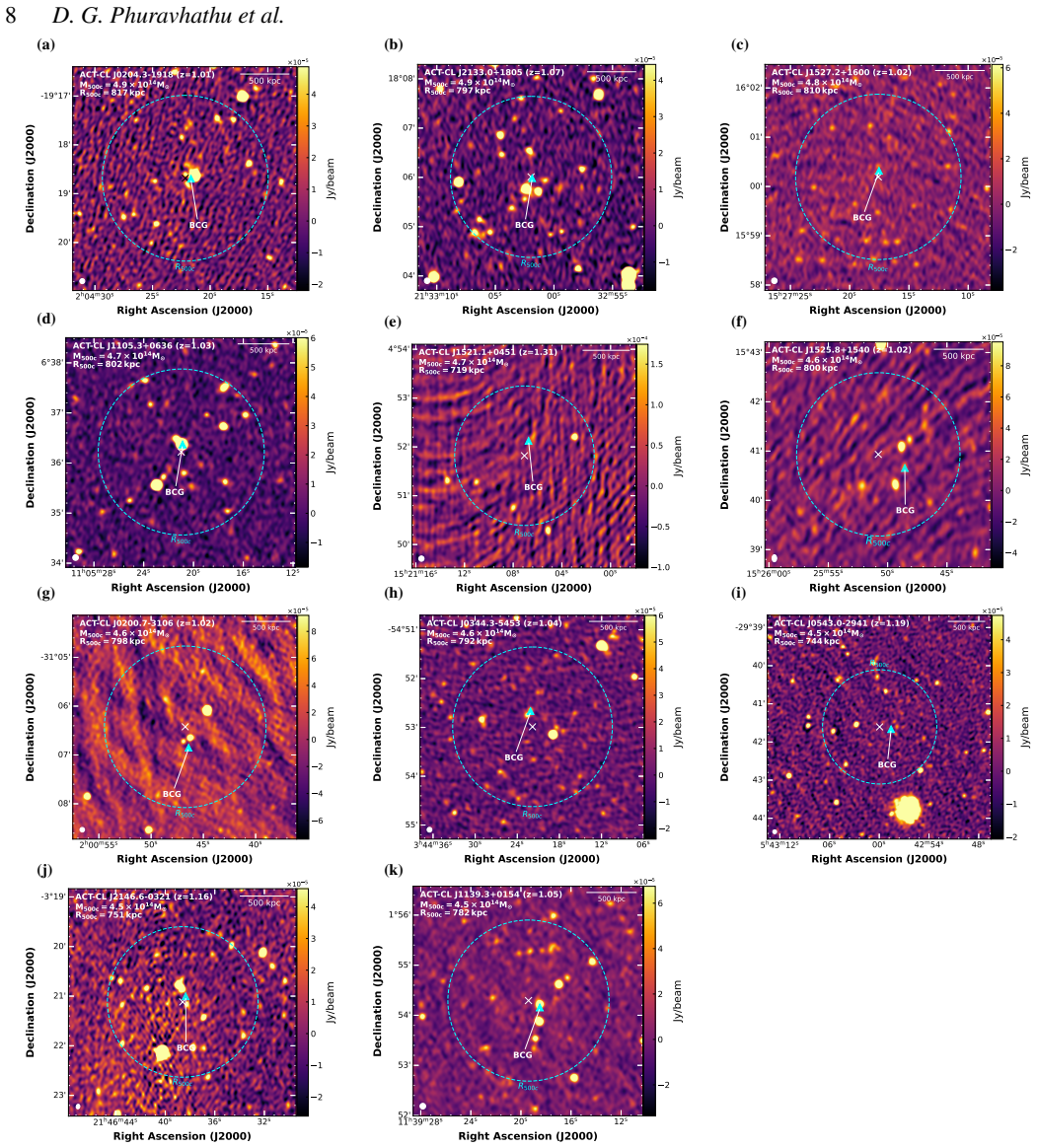
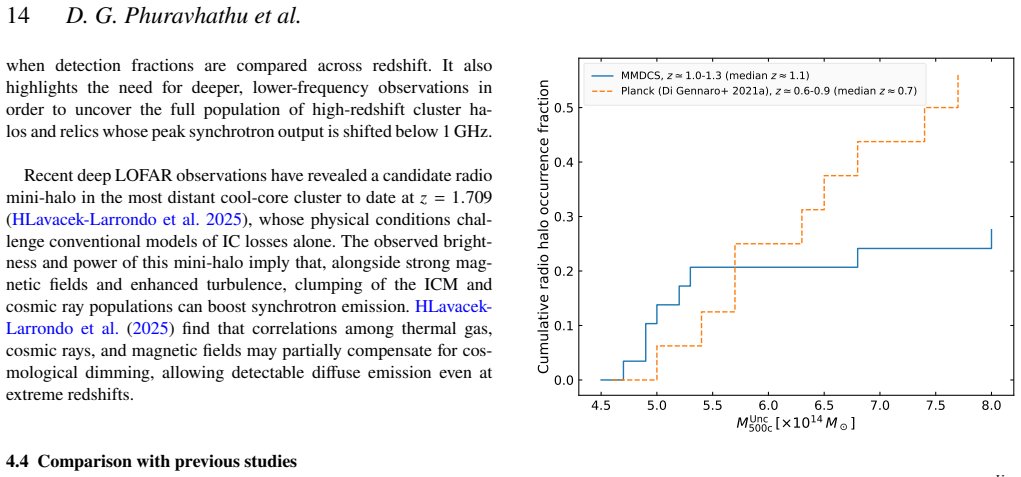
In a uniformly selected sample of 30 massive SZ-selected galaxy clusters at z > 1, deep MeerKAT 1.28 GHz observations reveal diffuse radio halos in eight clusters (27 percent), while the remaining 21 (70 percent) show no emission and one is excluded due to data quality. The halo detection rate is lower than at intermediate redshift but higher than the ≲10 percent occurrence generally predicted by theoretical models at z ≳1. Detected halos scatter around the best-fitting P1.4 GHz–M500c relation for the sample, whereas non-detections occupy the lower envelope, and no cluster-scale radio relics or mini-halos are identified.
What carries the argument
MeerKAT 1.28 GHz imaging combined with visual and quantitative identification of diffuse radio halos, followed by comparison of radio power versus cluster mass M500c against lower-redshift samples and theoretical forecasts.
If this is right
- The P1.4 GHz–M500c scaling relation for radio halos continues to hold at redshifts above 1 for detected systems.
- Non-detections trace a population of clusters with lower radio power, consistent with trends at lower redshift.
- No radio relics or mini-halos appear, indicating these features are either rarer or fainter at z>1.
- Deeper observations at lower frequencies are needed to recover any faint diffuse emission missed at 1.28 GHz.
Where Pith is reading between the lines
- Theoretical models may systematically underpredict the frequency of major mergers capable of driving halo formation at early cosmic times.
- The drop in detection rate from intermediate to high redshift hints at an evolutionary decline in halo occurrence that future wide-field surveys could map.
- The absence of relics suggests that strong shocks are either less common or produce weaker emission in these distant systems.
Load-bearing premise
That visual and quantitative identification of diffuse emission is complete and unbiased, and that the SZ-selected sample carries no significant bias against clusters lacking mergers or hosting only faint halos.
What would settle it
A larger, comparably deep survey of z>1 massive clusters that returns a halo detection rate of 10 percent or lower would falsify the claim of occurrence above model predictions.
Figures




read the original abstract
We present the results of a search for diffuse radio emission in a uniformly selected sample of 30 of the most massive Sunyaev-Zel'dovich selected galaxy clusters at $z > 1$, providing the first statistical constraints on the evolution of cluster-scale diffuse emission beyond this redshift. We also analyse the scaling relations between radio power ($P_{1.4\,\mathrm{GHz}}$) and cluster mass ($M_{\rm 500c}$) in this high-redshift sample. It is well established that radio halos are primarily found in the most massive clusters, where turbulent energy from major mergers can re-accelerate relativistic electrons and amplify magnetic fields on megaparsec scales. Deep MeerKAT 1.28 GHz observations reveal diffuse radio halos in eight clusters (27$\%$), while the remaining 21 (70$\%$) show no emission; one additional cluster (3$\%$) was excluded from the radio analysis due to poor data quality. The halo detection rate in this high-redshift sample is lower than at intermediate redshift, but remains higher than the $\lesssim 10\%$ occurrence generally predicted by theoretical models at $z \gtrsim 1$. The detected radio halos scatter around the best-fitting $P_{1.4\,\mathrm{GHz}}$-$M_{\rm 500c}^{\rm {Unc}}$ relation derived for the MMDCS sample, whereas non-detections populate the lower envelope of the radio power-mass plane, similar to trends seen at lower redshift. No cluster-scale radio relics or mini-halos are identified. Our findings highlight MeerKAT's ability to probe non-thermal processes in the most distant clusters and the need for deeper, lower-frequency surveys to uncover faint diffuse emission and test the persistence of the $P_{1.4\,\mathrm{GHz}}$-$M_{\rm 500}$ relation across cosmic time.
Editorial analysis
A structured set of objections, weighed in public.
Referee Report
Summary. The paper reports MeerKAT 1.28 GHz observations of a uniform sample of 30 massive SZ-selected galaxy clusters at z > 1. It claims detection of diffuse radio halos in 8 clusters (27%), no emission in 21 clusters (70%), and exclusion of one cluster due to data quality. The halo detection rate is stated to be lower than at intermediate redshifts but higher than the ≲10% predicted by theoretical models at z ≳ 1. Detected halos are said to scatter around the best-fit P_{1.4 GHz}–M_{500c} relation for the sample, while non-detections lie on the lower envelope; no cluster-scale relics or mini-halos are identified.
Significance. If the detection statistics and completeness hold, this provides the first statistical constraints on the occurrence and scaling of cluster-scale diffuse radio emission at z > 1. The result would be significant for testing models of turbulent re-acceleration and magnetic-field amplification in the most massive high-redshift systems, and for demonstrating MeerKAT’s reach for such work.
major comments (2)
- [Abstract] Abstract and Results: The central claim that the observed 27% halo fraction exceeds model predictions of ≲10% at z ≳ 1 (while being lower than intermediate-z samples) is load-bearing for the evolutionary conclusion, yet the manuscript provides no injection-recovery tests, redshift-dependent sensitivity curves, or explicit quantification of completeness against (1+z)^4 surface-brightness dimming and inverse-Compton losses. Without these, the non-detection rate cannot be securely interpreted as intrinsic.
- [Results] Results (scaling-relation paragraph): The statement that non-detections populate the lower envelope of the P_{1.4 GHz}–M_{500c} plane, and that this is similar to lower-redshift trends, requires explicit derivation of the upper limits and a test that the SZ selection function does not preferentially include merging systems; otherwise the comparison to lower-z samples and the claim of no strong evolution in the relation remain insecure.
minor comments (2)
- [Abstract] Abstract: The superscript notation “M_{500c}^{Unc}” in the scaling-relation sentence is undefined; clarify whether it denotes an uncorrected mass or another quantity.
- Throughout: Add a summary table listing cluster redshifts, M_{500c}, detected radio power (or 3σ upper limits), and notes on data quality to improve traceability of the 8/29 detection statistics.
Simulated Author's Rebuttal
We thank the referee for their thoughtful and constructive report. The comments highlight important aspects of completeness and selection effects that we address below. We have revised the manuscript to include explicit upper-limit derivations, additional discussion of surface-brightness dimming, and a clearer statement of the limitations of the current completeness assessment.
read point-by-point responses
-
Referee: [Abstract] Abstract and Results: The central claim that the observed 27% halo fraction exceeds model predictions of ≲10% at z ≳ 1 (while being lower than intermediate-z samples) is load-bearing for the evolutionary conclusion, yet the manuscript provides no injection-recovery tests, redshift-dependent sensitivity curves, or explicit quantification of completeness against (1+z)^4 surface-brightness dimming and inverse-Compton losses. Without these, the non-detection rate cannot be securely interpreted as intrinsic.
Authors: We agree that a full end-to-end injection-recovery analysis would strengthen the interpretation of the non-detection fraction. The current work reports a raw detection rate based on uniform MeerKAT depth and a mass-selected sample; all eight detections are clearly extended and well above the local noise. We have added a new paragraph in the Results section that quantifies the expected (1+z)^4 dimming and inverse-Compton losses, shows that our 3σ upper limits for non-detections remain below the extrapolated low-z scaling relation, and explicitly states that the 27% fraction should be regarded as a lower limit pending deeper or lower-frequency data. A complete injection test is beyond the scope of the present data set but is planned for a follow-up paper; we have revised the abstract and conclusions to reflect this caveat. revision: partial
-
Referee: [Results] Results (scaling-relation paragraph): The statement that non-detections populate the lower envelope of the P_{1.4 GHz}–M_{500c} plane, and that this is similar to lower-redshift trends, requires explicit derivation of the upper limits and a test that the SZ selection function does not preferentially include merging systems; otherwise the comparison to lower-z samples and the claim of no strong evolution in the relation remain insecure.
Authors: We have now derived and tabulated the 3σ upper limits on P_{1.4 GHz} for all non-detections assuming a 1 Mpc halo size and the measured local rms; these limits are plotted as downward arrows in the revised Figure 5 and lie on or below the lower envelope of the low-z relation. Regarding SZ selection, the sample is drawn from the same SZ catalogs used at lower redshift, and the SZ signal is primarily sensitive to integrated pressure rather than dynamical state. We have added a short discussion noting that any merger bias is expected to be comparable across redshift bins and does not alter the conclusion that the high-z relation shows no strong deviation from the low-z trend within the current uncertainties. revision: yes
Circularity Check
No significant circularity: direct observational counts independent of any fitted relation
full rationale
The paper reports a direct count of diffuse radio halos (8/29 clusters) from MeerKAT imaging of an SZ-selected sample at z>1, yielding a 27% detection rate that is compared to external theoretical model predictions. No derivation step reduces the rate, the evolutionary trend, or the non-detection claims to a fit or self-citation; the P1.4-M500 scaling relation is separately fitted to the detected halos but is not invoked to establish presence/absence or completeness. The analysis is self-contained against external benchmarks.
Axiom & Free-Parameter Ledger
free parameters (1)
- best-fitting parameters of P_1.4GHz - M_500c relation
axioms (2)
- domain assumption Radio halos are generated by merger-driven turbulence re-accelerating relativistic electrons
- domain assumption SZ selection provides a mass-limited, unbiased sample of the most massive clusters
Reference graph
Works this paper leans on
-
[1]
ApJ , fjournal=
Fournier, Paul , title=. ApJ , fjournal=
-
[2]
An important paper , journal=
-
[3]
Another Unreal Paper , journal=
-
[4]
A Last Unreal Paper , journal=
-
[6]
Evolutionary Map of the Universe (EMU): a pilot search for diffuse, non-thermal radio emission in galaxy clusters with the Australian SKA Pathfinder. arXiv e-prints , keywords =. doi:10.48550/arXiv.2402.06192 , archivePrefix =. 2402.06192 , primaryClass =
-
[7]
Planck 2015 results. XIII. Cosmological parameters. , keywords =. doi:10.1051/0004-6361/201525830 , archivePrefix =. 1502.01589 , primaryClass =
-
[8]
Astronomical Data Analysis Software and Systems XVI , year = 2007, editor =
CASA Architecture and Applications. Astronomical Data Analysis Software and Systems XVI , year = 2007, editor =
2007
-
[10]
oxkat: Semi-automated imaging of MeerKAT observations
-
[11]
An optimized algorithm for multiscale wideband deconvolution of radio astronomical images. , keywords =. doi:10.1093/mnras/stx1547 , archivePrefix =. 1706.06786 , primaryClass =
-
[15]
mm Universe @ NIKA2 - Observing the mm Universe with the NIKA2 Camera , year = 2020, series =
Mapping the gas thermodynamic properties of the massive cluster merger MOO J1142+1527 at z = 1.2. mm Universe @ NIKA2 - Observing the mm Universe with the NIKA2 Camera , year = 2020, series =. doi:10.1051/epjconf/202022800026 , archivePrefix =. 1911.03101 , primaryClass =
-
[16]
Unveiling the Merger Dynamics of the Most Massive MaDCoWS Cluster at z = 1.2 from a Multiwavelength Mapping of Its Intracluster Medium Properties. , keywords =. doi:10.3847/1538-4357/ab8007 , archivePrefix =. 1911.00560 , primaryClass =
-
[17]
doi:10.3847/0004-637X/821/1/61 , archiveprefix =
Absolute Calibration of the Radio Astronomy Flux Density Scale at 22 to 43 GHz Using Planck. , keywords =. doi:10.3847/0004-637X/821/1/61 , archivePrefix =. 1506.02892 , primaryClass =
-
[19]
Applying Wirtinger derivatives to the radio interferometry calibration problem. arXiv e-prints , keywords =. doi:10.48550/arXiv.1410.8706 , archivePrefix =. 1410.8706 , primaryClass =
-
[22]
Revisiting the radio interferometer measurement equation. I. A full-sky Jones formalism. , keywords =. doi:10.1051/0004-6361/201016082 , archivePrefix =. 1101.1764 , primaryClass =
-
[23]
Revisiting the radio interferometer measurement equation. II. Calibration and direction-dependent effects. , keywords =. doi:10.1051/0004-6361/201116434 , archivePrefix =. 1101.1765 , primaryClass =
-
[24]
Revisiting the radio interferometer measurement equation. III. Addressing direction-dependent effects in 21 cm WSRT observations of 3C 147. , keywords =. doi:10.1051/0004-6361/201116435 , archivePrefix =. 1101.1768 , primaryClass =
-
[25]
Revisiting the radio interferometer measurement equation. IV. A generalized tensor formalism. , keywords =. doi:10.1051/0004-6361/201116764 , archivePrefix =. 1106.0579 , primaryClass =
-
[27]
American Astronomical Society Meeting Abstracts , year = 1995, series =
High Fidelity Interferometric Imaging: Robust Weighting and NNLS Deconvolution. American Astronomical Society Meeting Abstracts , year = 1995, series =
1995
-
[28]
Astronomical Data Analysis Software and Systems XXX , year = 2022, editor =
Tricolour: An Optimized SumThreshold Flagger for MeerKAT. Astronomical Data Analysis Software and Systems XXX , year = 2022, editor =. doi:10.48550/arXiv.2206.09179 , archivePrefix =. 2206.09179 , primaryClass =
-
[29]
The Massive and Distant Clusters of WISE Survey: MOO J1142+1527, a 10 ^ 15 M _ Galaxy Cluster at z = 1.19. , keywords =. doi:10.1088/2041-8205/812/2/L40 , archivePrefix =. 1509.01989 , primaryClass =
-
[30]
Multiwavelength view of SPT-CL J2106-5844. The radio galaxies and the thermal and relativistic plasmas in a massive galaxy cluster merger at z ≃ 1.13. , keywords =. doi:10.1051/0004-6361/202040260 , archivePrefix =. 2101.02216 , primaryClass =
-
[31]
The ACT-DR5 MCMF Galaxy Cluster Catalog. arXiv e-prints , keywords =. doi:10.48550/arXiv.2406.14754 , archivePrefix =. 2406.14754 , primaryClass =
-
[32]
SPT-CL J0546-5345: A Massive z>1 Galaxy Cluster Selected Via the Sunyaev-Zel'dovich Effect with the South Pole Telescope. , keywords =. doi:10.1088/0004-637X/721/1/90 , archivePrefix =. 1006.5639 , primaryClass =
-
[33]
The MeerKAT Massive Distant Clusters Survey: A Radio Halo in a Massive Galaxy Cluster at z = 1.23. arXiv e-prints , keywords =. doi:10.48550/arXiv.2404.03944 , archivePrefix =. 2404.03944 , primaryClass =
-
[35]
Extraction and self-calibration of individual LOFAR targets
LOFAR observations of galaxy clusters in HETDEX. Extraction and self-calibration of individual LOFAR targets. , keywords =. doi:10.1051/0004-6361/202039826 , archivePrefix =. 2011.02387 , primaryClass =
-
[37]
Physics of Plasmas , keywords =
Hot plasma in clusters of galaxies, the largest objects in the Universe. Physics of Plasmas , keywords =. doi:10.1063/1.1556300 , archivePrefix =. astro-ph/0301178 , primaryClass =
-
[38]
Merging Processes in Galaxy Clusters , year = 2002, editor =
The Physics of Cluster Mergers. Merging Processes in Galaxy Clusters , year = 2002, editor =. doi:10.1007/0-306-48096-4_1 , archivePrefix =. astro-ph/0105418 , primaryClass =
-
[41]
MeerKAT's discovery of a radio relic in the bimodal merging cluster A2384. , keywords =. doi:10.1093/mnras/staa2795 , archivePrefix =. 2009.02724 , primaryClass =
-
[42]
153 MHz GMRT follow-up of steep-spectrum diffuse emission in galaxy clusters. , keywords =. doi:10.1051/0004-6361/201220667 , archivePrefix =. 1302.0648 , primaryClass =
-
[45]
Cluster mergers and non-thermal phenomena: a statistical magneto-turbulent model. , keywords =. doi:10.1111/j.1365-2966.2005.08747.x , archivePrefix =. astro-ph/0412475 , primaryClass =
-
[46]
Radio signature of cosmological structure formation shocks. , keywords =. doi:10.1111/j.1365-2966.2006.11111.x , archivePrefix =. astro-ph/0609831 , primaryClass =
-
[47]
On the Connection Between Giant Radio Halos and Cluster Mergers. , keywords =. doi:10.1088/2041-8205/721/2/L82 , archivePrefix =. 1008.3624 , primaryClass =
-
[48]
The diffuse radio emission in the high-redshift cluster PSZ2 G091.83+26.11: Total intensity and polarisation analysis with Very Large Array 1-4 GHz observations. , keywords =. doi:10.1051/0004-6361/202345905 , archivePrefix =. 2304.05893 , primaryClass =
-
[49]
A shock at the radio relic position in Abell 115. , keywords =. doi:10.1093/mnrasl/slw082 , archivePrefix =. 1604.07823 , primaryClass =
-
[50]
New mysteries and challenges from the Toothbrush relic: wideband observations from 550 MHz to 8 GHz. , keywords =. doi:10.1051/0004-6361/201937139 , archivePrefix =. 1911.08904 , primaryClass =
-
[52]
The Radio Relics and Halo of El Gordo, a Massive z = 0.870 Cluster Merger. , keywords =. doi:10.1088/0004-637X/786/1/49 , archivePrefix =. 1310.6786 , primaryClass =
-
[55]
2007, Publications of the Astronomical Society of Australia, 24, 174–188, doi: 10.1071/as07033
Science with the Australian Square Kilometre Array Pathfinder. , keywords =. doi:10.1071/AS07033 , archivePrefix =. 0711.2103 , primaryClass =
-
[58]
The 1.28 GHz MeerKAT DEEP2 Image. , keywords =. doi:10.3847/1538-4357/ab5d2d , archivePrefix =. 1912.06212 , primaryClass =
-
[60]
Precise Mass Determination of SPT-CL J2106-5844, the Most Massive Cluster at z > 1. , keywords =. doi:10.3847/1538-4357/ab521e , archivePrefix =. 1910.04775 , primaryClass =
-
[61]
Discovery and Cosmological Implications of SPT-CL J2106-5844, the Most Massive Known Cluster at z>1. , keywords =. doi:10.1088/0004-637X/731/2/86 , archivePrefix =. 1101.1286 , primaryClass =
-
[62]
The 10 Meter South Pole Telescope. , keywords =. doi:10.1086/659879 , archivePrefix =. 0907.4445 , primaryClass =
-
[63]
EMU: Evolutionary Map of the Universe. , keywords =. doi:10.1071/AS11021 , archivePrefix =. 1106.3219 , primaryClass =
-
[64]
The Atacama Large Millimeter/Submillimeter Array. IEEE Proceedings , keywords =. doi:10.1109/JPROC.2009.2020572 , archivePrefix =. 0904.3739 , primaryClass =
-
[65]
, year = 2009, month = feb, volume =
The Atacama Compact Array (ACA). , year = 2009, month = feb, volume =. doi:10.1093/pasj/61.1.1 , adsurl =
-
[66]
Overview of the Atacama Cosmology Telescope: Receiver, Instrumentation, and Telescope Systems. , keywords =. doi:10.1088/0067-0049/194/2/41 , archivePrefix =. 1007.0290 , primaryClass =
-
[67]
The Massive and Distant Clusters of WISE Survey. I. Survey Overview and a Catalog of >2000 Galaxy Clusters at z ≃ 1. , keywords =. doi:10.3847/1538-4365/aafad2 , archivePrefix =. 1809.06820 , primaryClass =
-
[68]
Comments on Astrophysics and Space Physics , keywords =
The Observations of Relic Radiation as a Test of the Nature of X-Ray Radiation from the Clusters of Galaxies. Comments on Astrophysics and Space Physics , keywords =
-
[69]
ESA Bulletin , keywords =
The Hubble Space Telescope. ESA Bulletin , keywords =
-
[70]
Measuring the dynamical state of Planck SZ-selected clusters: X-ray peak - BCG offset. , keywords =. doi:10.1093/mnras/stw265 , archivePrefix =. 1512.00410 , primaryClass =
-
[71]
Galaxy Clusters Discovered with a Sunyaev-Zel'dovich Effect Survey. , keywords =. doi:10.1088/0004-637X/701/1/32 , archivePrefix =. 0810.1578 , primaryClass =
-
[73]
The Last of FIRST: The Final Catalog and Source Identifications. , keywords =. doi:10.1088/0004-637X/801/1/26 , archivePrefix =. 1501.01555 , primaryClass =
-
[74]
Dynamical state of galaxy clusters evaluated from X-ray images. , keywords =. doi:10.1093/mnras/stac1037 , archivePrefix =. 2204.02699 , primaryClass =
-
[75]
Dynamical state for 964 galaxy clusters from Chandra X-ray images. , keywords =. doi:10.1093/mnras/staa2363 , archivePrefix =. 2008.01299 , primaryClass =
-
[76]
2011, MNRAS, 418, 467, doi: 10.1111/j.1365-2966.2011.19497.x
X-ray-optical classification of cluster mergers and the evolution of the cluster merger fraction. , keywords =. doi:10.1111/j.1365-2966.2011.20170.x , archivePrefix =. 1111.2396 , primaryClass =
-
[77]
Morphology parameters: substructure identification in X-ray galaxy clusters. , keywords =. doi:10.1051/0004-6361/201424123 , archivePrefix =. 1411.6525 , primaryClass =
-
[78]
X-ray emission from clusters of galaxies
-
[79]
The Northern ROSAT All-Sky (NORAS) Galaxy Cluster Survey. I. X-Ray Properties of Clusters Detected as Extended X-Ray Sources. , keywords =. doi:10.1086/313427 , archivePrefix =. astro-ph/0003219 , primaryClass =
-
[80]
1980, ApJ, 236, 351, doi: 10.1086/157753
Galaxy morphology in rich clusters: implications for the formation and evolution of galaxies. , keywords =. doi:10.1086/157753 , adsurl =
-
[81]
Cluster Magnetic Fields. , keywords =. doi:10.1146/annurev.astro.40.060401.093852 , archivePrefix =. astro-ph/0110655 , primaryClass =
-
[82]
Particle Acceleration Mechanisms. , keywords =. doi:10.1007/s11214-008-9315-6 , archivePrefix =. 0801.0923 , primaryClass =
-
[87]
SnowCLUSTER 2013, Physics of Galaxy Clusters , year = 2013, editor =
Revising Scaling Relations for Giant Radio Halos in Galaxy Clusters. SnowCLUSTER 2013, Physics of Galaxy Clusters , year = 2013, editor =
2013
-
[88]
Classification of dynamical states
The effect of dynamical states on galaxy cluster populations: I. Classification of dynamical states. , keywords =. doi:10.1051/0004-6361/202451679 , archivePrefix =. 2408.02519 , primaryClass =
-
[89]
W., Markevitch, M., Clowe, D., Gonzalez, A
Constraints on the Self-Interaction Cross Section of Dark Matter from Numerical Simulations of the Merging Galaxy Cluster 1E 0657-56. , keywords =. doi:10.1086/587859 , archivePrefix =. 0704.0261 , primaryClass =
-
[90]
The Impact of Galaxy Cluster Mergers on Cosmological Parameter Estimation from Surveys of the Sunyaev-Zel'dovich Effect. , keywords =. doi:10.1086/587790 , archivePrefix =. 0802.3695 , primaryClass =
-
[91]
The impact of mergers on relaxed X-ray clusters - II. Effects on global X-ray and Sunyaev-Zel'dovich properties and their scaling relations. , keywords =. doi:10.1111/j.1365-2966.2007.12107.x , archivePrefix =. astro-ph/0701586 , primaryClass =
-
[92]
2011, MNRAS, 418, 467, doi: 10.1111/j.1365-2966.2011.19497.x
Merger-induced scatter and bias in the cluster mass-Sunyaev-Zel'dovich effect scaling relation. , keywords =. doi:10.1111/j.1365-2966.2011.19844.x , archivePrefix =. 1107.5740 , primaryClass =
-
[93]
CARACal: Containerized Automated Radio Astronomy Calibration pipeline
-
[94]
Alfv \'e nic reacceleration of relativistic particles in galaxy clusters in the presence of secondary electrons and positrons. , keywords =. doi:10.1111/j.1365-2966.2005.09511.x , archivePrefix =. astro-ph/0508100 , primaryClass =
-
[95]
The Massive and Distant Clusters of WISE Survey. X. Initial Results from a Sunyaev-Zeldovich Effect Study of Massive Galaxy Clusters at z > 1 Using MUSTANG2 on the GBT. , keywords =. doi:10.3847/1538-4357/abb673 , archivePrefix =. 2006.06703 , primaryClass =
-
[96]
Some Aspects of Measurement Error in Linear Regression of Astronomical Data. , keywords =. doi:10.1086/519947 , archivePrefix =. 0705.2774 , primaryClass =
-
[97]
The case for electron re-acceleration at galaxy cluster shocks. Nature Astronomy , keywords =. doi:10.1038/s41550-016-0005 , archivePrefix =. 1701.01439 , primaryClass =
-
[98]
On the Particle Acceleration Mechanisms in a Double Radio Relic Galaxy Cluster, Abell 1240. , keywords =. doi:10.3847/1538-4357/ad1aac , archivePrefix =. 2401.02000 , primaryClass =
-
[100]
CIAO: Chandra's data analysis system. Observatory Operations: Strategies, Processes, and Systems , year = 2006, editor =. doi:10.1117/12.671760 , adsurl =
-
[101]
Chandra News , year = 2007, month = mar, volume =
The Chandra X-ray Observatory Calibration Database (CALDB): Building, Planning, and Improving. Chandra News , year = 2007, month = mar, volume =
2007
-
[102]
The galaxy group NGC 507: Newly detected AGN remnant plasma transported by sloshing. , keywords =. doi:10.1051/0004-6361/202142579 , archivePrefix =. 2201.04591 , primaryClass =
-
[103]
A LOFAR study of non-merging massive galaxy clusters. , keywords =. doi:10.1051/0004-6361/201833882 , archivePrefix =. 1811.08410 , primaryClass =
-
[104]
A Direct Empirical Proof of the Existence of Dark Matter. , keywords =. doi:10.1086/508162 , archivePrefix =. astro-ph/0608407 , primaryClass =
-
[106]
Evidence for Substructure in Rich Clusters of Galaxies from Radial-Velocity Measurements. , keywords =. doi:10.1086/114694 , adsurl =
-
[108]
doi:10.1051/0004-6361/200913416 , archiveprefix =
The universal galaxy cluster pressure profile from a representative sample of nearby systems (REXCESS) and the Y _ SZ - M _ 500 relation. , keywords =. doi:10.1051/0004-6361/200913416 , archivePrefix =. 0910.1234 , primaryClass =
-
[110]
Double radio relics and radio halo in the high redshift galaxy cluster El Gordo with the Upgraded GMRT. arXiv e-prints , keywords =. doi:10.48550/arXiv.2503.18613 , archivePrefix =. 2503.18613 , primaryClass =
discussion (0)
Sign in with ORCID, Apple, or X to comment. Anyone can read and Pith papers without signing in.