Recognition: unknown
Compact, AGN-hosting Dwarf Galaxies with "Little Red Dots"-like SEDs in the Local Universe
Pith reviewed 2026-05-08 17:27 UTC · model grok-4.3
The pith
Local AGN-hosting dwarf galaxies with V-shaped SEDs are more evolved than high-redshift Little Red Dots, showing larger sizes and different ionization.
A machine-rendered reading of the paper's core claim, the machinery that carries it, and where it could break.
Core claim
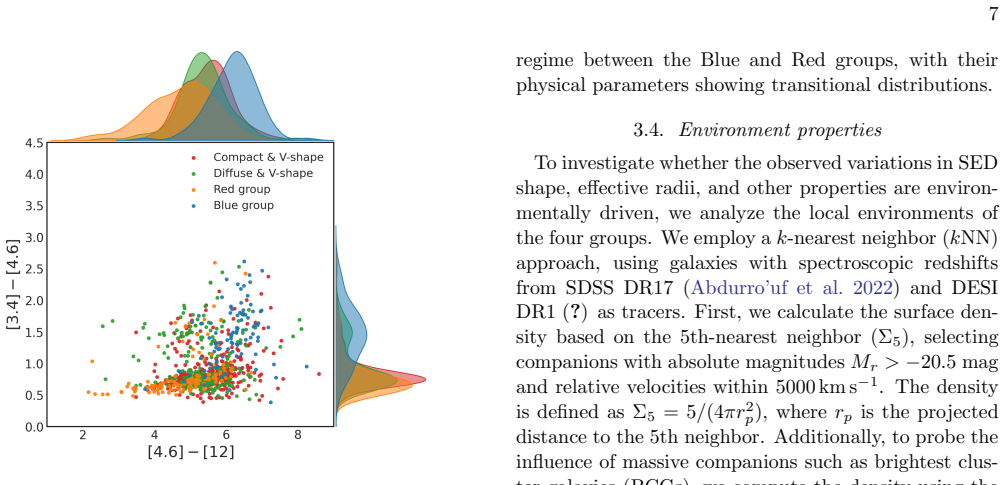
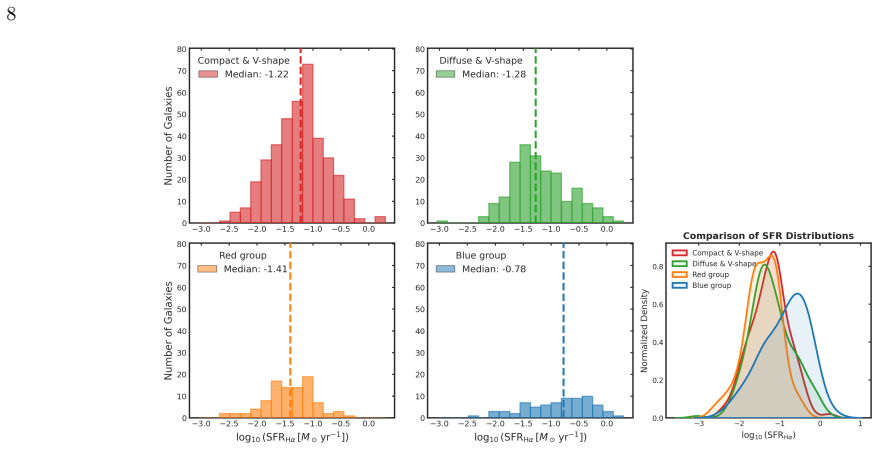
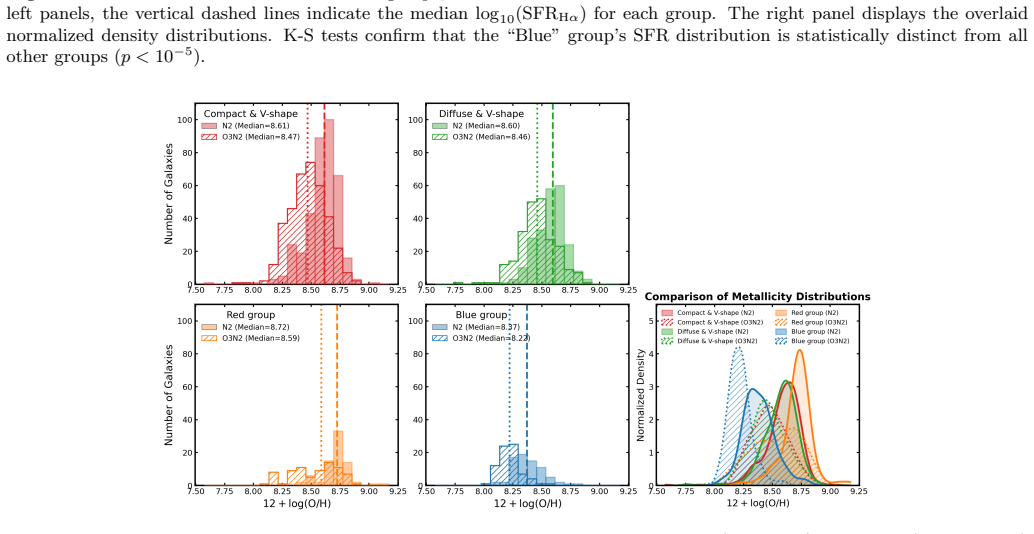
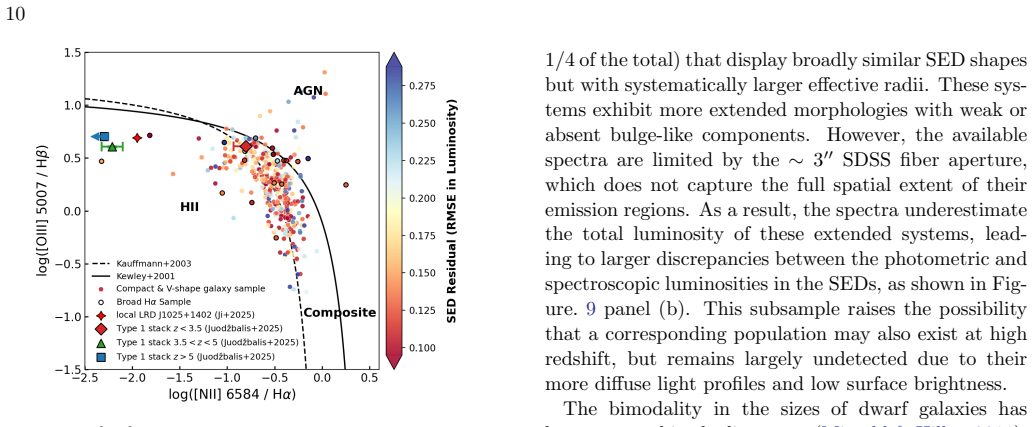
K-means clustering on SED shapes and morphological sizes divides local AGN-hosting dwarf galaxies into four groups that follow sequences in metallicity, star formation rate, and dust emission, driven mainly by UV-optical slopes. About half the sample displays V-shaped SEDs and relatively compact morphologies. Direct comparison, however, shows these local V-shaped compact ADGs possess systematically larger effective radii and distinct ionization states than high-z LRDs. The results indicate that local compact ADGs follow a different formation pathway from LRDs, underscoring the complexity of black hole-galaxy co-evolution across cosmic time.
What carries the argument
K-means clustering on SED shapes and morphological sizes that groups local AGN-hosting dwarf galaxies into sequences for comparison against high-redshift Little Red Dots.
If this is right
- Local V-shaped ADGs trace evolutionary sequences in metallicity, star formation, and dust content set by their UV-optical slopes.
- Local compact ADGs are more evolved than high-z LRDs, with larger effective radii.
- Ionization states in local compact ADGs differ from those in high-redshift LRDs.
- Black hole-galaxy co-evolution follows distinct pathways at different cosmic epochs.
Where Pith is reading between the lines
- High-redshift LRDs may represent a short-lived evolutionary stage that has no exact surviving counterpart in the local universe.
- Searches for closer analogs could target systems even smaller or younger than the current local sample.
- Models of early black-hole seeding may need separate tracks to accommodate the observed mismatch between local and distant populations.
Load-bearing premise
The sample of local ADGs with comparable luminosities is representative of the broader population and K-means clustering on SED shapes and sizes cleanly separates physically distinct groups without major selection biases.
What would settle it
Discovery of local AGN-hosting dwarf galaxies at similar luminosities that match high-z LRDs in both effective radius and ionization state would undermine the claim of fundamental physical differences.
Figures





read the original abstract
Local active galactic nuclei (AGNs) in dwarf galaxies are often considered as analogs for the earliest supermassive black holes, although their connections require more comprehensive examinations. Motivated by finding the local analogs of "Little Red Dots" (LRDs), the compact, red galaxies discovered by JWST at z > 5 characterized by "V-shaped" SEDs, we compile a sample of local AGN-hosting dwarf galaxies (ADGs) with comparable luminosities to statistically evaluate this connection. By applying K-means clustering to SED shapes and morphological sizes, we classified four groups which trace a sequence in physical properties, including metallicity, star formation rate, and dust emission, mainly driven by their distinct UV-optical slopes. Within these groups, we find that about half of the ADGs exhibit "V-shaped" SEDs and relatively compact morphologies. However, a direct comparison reveals fundamental physical differences: local "V-shaped", compact ADGs appear significantly more evolved than high-z LRDs, characterized by systematically larger effective radii and distinct ionization states. Our results suggest that local compact ADGs likely follow a different formation pathway from LRDs, highlighting the complexity of black hole-galaxy co-evolution across cosmic time.
Editorial analysis
A structured set of objections, weighed in public.
Referee Report
Summary. The paper compiles a sample of local AGN-hosting dwarf galaxies (ADGs) with luminosities matched to high-z Little Red Dots (LRDs), applies K-means clustering to SED shapes and morphological sizes to identify four groups tracing a sequence in metallicity, SFR, and dust properties, finds roughly half exhibit V-shaped SEDs and compact sizes, and concludes that these local V-shaped compact ADGs are more evolved than high-z LRDs (larger effective radii, distinct ionization states), implying different formation pathways.
Significance. If the sample is representative and the clustering robust, the work would be significant for JWST-era studies of early BH growth by demonstrating that local dwarf AGN hosts are imperfect analogs to LRDs and by highlighting diversity in BH-galaxy co-evolution across redshift. The clustering approach to link SED morphology with physical properties is a useful methodological contribution.
major comments (3)
- [§2] §2 (Sample Compilation): The selection of local ADGs with 'comparable luminosities' is not accompanied by a quantitative description of the parent catalogs, completeness limits, or tests for biases (e.g., AGN detection thresholds favoring less-obscured systems or dwarf-galaxy stellar-mass cuts). This is load-bearing because the central claim of 'fundamental physical differences' rests on the local sample being a fair, unbiased analog to the high-z LRD population.
- [§3] §3 (K-means Clustering): The manuscript reports four groups but provides no details on the choice of k, feature normalization (SED slopes vs. sizes), silhouette scores, or stability tests against noise or scaling. Without these, it is unclear whether the reported sequence in physical properties is robust or sensitive to implementation choices.
- [§4] §4 (Direct Comparison): The statements that local V-shaped ADGs have 'systematically larger effective radii' and 'distinct ionization states' lack reported uncertainties, sample sizes for each subsample, and statistical tests (e.g., KS-test p-values). This quantitative gap prevents assessment of whether the differences are significant enough to support the 'different formation pathway' conclusion.
minor comments (2)
- [Abstract] Abstract: The fraction 'about half' of ADGs with V-shaped SEDs should be replaced by an exact number and total sample size for precision.
- Figure captions and text: Ensure consistent terminology between 'V-shaped' SEDs, 'compact morphologies', and the four cluster labels to avoid reader confusion.
Simulated Author's Rebuttal
We thank the referee for their constructive and detailed comments, which have helped us improve the clarity and rigor of the manuscript. We address each major comment below and have revised the paper to incorporate additional details on sample selection, clustering methodology, and quantitative comparisons.
read point-by-point responses
-
Referee: [§2] The selection of local ADGs with 'comparable luminosities' is not accompanied by a quantitative description of the parent catalogs, completeness limits, or tests for biases (e.g., AGN detection thresholds favoring less-obscured systems or dwarf-galaxy stellar-mass cuts). This is load-bearing because the central claim of 'fundamental physical differences' rests on the local sample being a fair, unbiased analog to the high-z LRD population.
Authors: We agree that the original §2 provided insufficient detail on the sample construction. In the revised manuscript we have expanded this section with a quantitative description of the parent catalogs, the precise luminosity-matching criteria (including the adopted luminosity range and matching procedure), completeness estimates derived from the survey selection functions, and an explicit discussion of potential biases including AGN detection thresholds and stellar-mass cuts. We also add a comparison of the selected sample to the parent population to demonstrate that it is representative within the luminosity range relevant to the LRD comparison. revision: yes
-
Referee: [§3] The manuscript reports four groups but provides no details on the choice of k, feature normalization (SED slopes vs. sizes), silhouette scores, or stability tests against noise or scaling. Without these, it is unclear whether the reported sequence in physical properties is robust or sensitive to implementation choices.
Authors: We acknowledge the lack of methodological transparency in the original §3. The revised version now specifies the choice of k=4, justified by the elbow method and silhouette scores (which we report), describes the feature normalization (standardization of SED slopes and sizes to zero mean and unit variance), and includes stability tests based on bootstrap resampling and the addition of Gaussian noise to the input features. These tests confirm that the four-group solution and the associated sequence in physical properties remain robust. revision: yes
-
Referee: [§4] The statements that local V-shaped ADGs have 'systematically larger effective radii' and 'distinct ionization states' lack reported uncertainties, sample sizes for each subsample, and statistical tests (e.g., KS-test p-values). This quantitative gap prevents assessment of whether the differences are significant enough to support the 'different formation pathway' conclusion.
Authors: We have revised §4 to supply the missing quantitative information. The updated text reports the sample sizes of the V-shaped compact ADG subsample and the high-z LRD comparison sample, presents effective radii with uncertainties, and includes the results of Kolmogorov-Smirnov tests (with p-values) on both the effective-radius and ionization-state distributions. These additions allow a direct assessment of the statistical significance of the reported differences. revision: yes
Circularity Check
No circularity: purely observational sample analysis and comparison
full rationale
The paper compiles a luminosity-matched sample of local AGN-hosting dwarf galaxies, applies K-means clustering directly to observed SED shapes and morphological sizes to define groups, and reports measured differences in effective radii and ionization states versus high-z LRDs. No equations, fitted parameters renamed as predictions, self-definitional relations, or load-bearing self-citations appear in the derivation; the sequence in metallicity/SFR/dust follows from the clustering on independent observables, and the evolutionary contrast is a direct data comparison rather than a constructed identity.
Axiom & Free-Parameter Ledger
axioms (1)
- domain assumption Standard assumptions in SED fitting models and morphological size measurements from imaging data
Reference graph
Works this paper leans on
-
[1]
Abdurro’uf, Accetta, K., Aerts, C., et al. 2022, ApJS, 259, 35, doi: 10.3847/1538-4365/ac4414
-
[2]
Akins, H. B., Casey, C. M., Lambrides, E., et al. 2025, ApJ, 991, 37, doi: 10.3847/1538-4357/ade984
-
[3]
F., Argudo-Fern´ andez, M., et al
Almeida, A., Anderson, S. F., Argudo-Fern´ andez, M., et al. 2023, ApJS, 267, 44, doi: 10.3847/1538-4365/acda98 Amor´ ın, R. O., P´ erez-Montero, E., & V´ ılchez, J. M. 2010, ApJL, 715, L128, doi: 10.1088/2041-8205/715/2/L128
-
[4]
X-Ray View of Little Red Dots: Do They Host Supermassive Black Holes?
Ananna, T. T., Bogd´ an,´A., Kov´ acs, O. E., Natarajan, P., & Hickox, R. C. 2024, ApJL, 969, L18, doi: 10.3847/2041-8213/ad5669
-
[5]
Baldassare, V. F., Geha, M., & Greene, J. 2018, ApJ, 868, 152, doi: 10.3847/1538-4357/aae6cf —. 2020, ApJ, 896, 10, doi: 10.3847/1538-4357/ab8936
-
[6]
Baldassare, V. F., Reines, A. E., Gallo, E., & Greene, J. E. 2017, ApJ, 836, 20, doi: 10.3847/1538-4357/836/1/20
-
[7]
Baldassare, V. F., Reines, A. E., Gallo, E., et al. 2016, ApJ, 829, 57, doi: 10.3847/0004-637X/829/1/57
-
[8]
Baldwin, J. A., Phillips, M. M., & Terlevich, R. 1981, PASP, 93, 5, doi: 10.1086/130766
-
[9]
2025, ApJ, 992, 117, doi: 10.3847/1538-4357/ae019e
Bao, L., Tsai, C.-W., Wu, J., et al. 2025, ApJ, 992, 117, doi: 10.3847/1538-4357/ae019e
-
[10]
Birchall, K. L., Watson, M. G., & Aird, J. 2020, MNRAS, 492, 2268, doi: 10.1093/mnras/staa040
-
[11]
Boller, T., Freyberg, M. J., Tr¨ umper, J., et al. 2016, A&A, 588, A103, doi: 10.1051/0004-6361/201525648
-
[12]
CIGALE: a python Code Investigating GALaxy Emission
Boquien, M., Burgarella, D., Roehlly, Y., et al. 2019, A&A, 622, A103, doi: 10.1051/0004-6361/201834156
-
[13]
2024, Monthly Notices of the Royal Astronomical Society, 527, 1962, doi: 2024MNRAS.527.1962B
Bykov, S., Gilfanov, M., & Sunyaev, R. 2024, Monthly Notices of the Royal Astronomical Society, 527, 1962, doi: 2024MNRAS.527.1962B
2024
-
[14]
The Dust Content and Opacity of Actively Star-Forming Galaxies
Calzetti, D., Armus, L., Bohlin, R. C., et al. 2000, ApJ, 533, 682, doi: 10.1086/308692
-
[15]
2009, MNRAS, 396, 1383, doi:10.1111/j.1365-2966.2009.14843.x
Cardamone, C., Schawinski, K., Sarzi, M., et al. 2009, MNRAS, 399, 1191, doi: 10.1111/j.1365-2966.2009.15383.x
-
[16]
Casey, C. M., Kartaltepe, J. S., Drakos, N. E., et al. 2023, ApJ, 954, 31, doi: 10.3847/1538-4357/acc2bc
-
[17]
Casey, C. M., Akins, H. B., Finkelstein, S. L., et al. 2025, arXiv e-prints, arXiv:2505.18873, doi: 10.48550/arXiv.2505.18873
-
[18]
Cutri, R. M., Wright, E. L., Conrow, T., et al. 2021, VizieR Online Data Catalog: AllWISE Data Release (Cutri+ 2013), VizieR On-line Data Catalog: II/328. Originally published in: IPAC/Caltech (2013) De Almeida, A. P., Mamon, G. A., Dekel, A., & Lima Neto, G. B. 2024, A&A, 687, A131, doi: 10.1051/0004-6361/202449939
-
[19]
Dey, A., Schlegel, D. J., Lang, D., et al. 2019, AJ, 157, 168, doi: 10.3847/1538-3881/ab089d
-
[20]
Ding, W., Kong, X., Guo, W.-J., et al. 2026, arXiv e-prints, arXiv:2604.14551, doi: 10.48550/arXiv.2604.14551
work page internal anchor Pith review Pith/arXiv arXiv doi:10.48550/arxiv.2604.14551 2026
-
[21]
Dong, X.-B., Ho, L. C., Yuan, W., et al. 2012, ApJ, 755, 167, doi: 10.1088/0004-637X/755/2/167
-
[22]
S., Abraham, R
Dunlop, J. S., Abraham, R. G., Ashby, M. L. N., et al. 2021, PRIMER: Public Release IMaging for Extragalactic
2021
-
[23]
Fan, X., Ba˜ nados, E., & Simcoe, R. A. 2023, ARA&A, 61, 373, doi: 10.1146/annurev-astro-052920-102455
-
[24]
Finkelstein, S. L., Bagley, M. B., Arrabal Haro, P., et al. 2022, ApJL, 940, L55, doi: 10.3847/2041-8213/ac966e Flammini Dotti, F., Capuzzo-Dolcetta, R., Carraro, G.,
-
[25]
The long-term evolution of Ultra Faint Dwarf Galaxies and observational implications
Trani, A. A., & Spurzem, R. 2026, arXiv e-prints, arXiv:2601.13049, doi: 10.48550/arXiv.2601.13049
work page internal anchor Pith review Pith/arXiv arXiv doi:10.48550/arxiv.2601.13049 2026
-
[26]
Giavalisco, M., Ferguson, H. C., Koekemoer, A. M., et al. 2004, ApJL, 600, L93, doi: 10.1086/379232
-
[27]
Graham, A. W. 2020, MNRAS, 492, 3263, doi: 10.1093/mnras/stz3547
-
[28]
Greene, J. E., & Ho, L. C. 2007, ApJ, 670, 92, doi: 10.1086/522082
-
[29]
Greene, J. E., Strader, J., & Ho, L. C. 2020, ARA&A, 58, 257, doi: 10.1146/annurev-astro-032620-021835
-
[30]
Greene, J. E., Labb´ e, I., Goulding, A. D., et al. 2024, The Astrophysical Journal, 964, 39, doi: 10.3847/1538-4357/ad1e5f
-
[31]
Groves, B. A., Heckman, T. M., & Kauffmann, G. 2006, MNRAS, 371, 1559, doi: 10.1111/j.1365-2966.2006.10812.x
-
[32]
2018, PyQSOFit: Python code to fit the spectrum of quasars, Astrophysics Source Code Library, record ascl:1809.008
Guo, H., Shen, Y., & Wang, S. 2018, PyQSOFit: Python code to fit the spectrum of quasars, Astrophysics Source Code Library, record ascl:1809.008
2018
-
[33]
Nine-Year Wilkinson Microwave Anisotropy Probe (WMAP) Observations: Cosmological Parameter Results
Hinshaw, G., Larson, D., Komatsu, E., et al. 2013, ApJS, 208, 19, doi: 10.1088/0067-0049/208/2/19 14
-
[34]
Hviding, R. E., de Graaff, A., Miller, T. B., et al. 2025, arXiv e-prints, arXiv:2506.05459, doi: 10.48550/arXiv.2506.05459
-
[35]
2025, arXiv e-prints, arXiv:2503.05537, doi: 10.48550/arXiv.2503.05537
Inayoshi, K. 2025, arXiv e-prints, arXiv:2503.05537, doi: 10.48550/arXiv.2503.05537
-
[36]
2020, ARA&A, 58, 27, doi: 10.1146/annurev-astro-120419-014455
Inayoshi, K., Visbal, E., & Haiman, Z. 2020, ARA&A, 58, 27, doi: 10.1146/annurev-astro-120419-014455
-
[37]
2025a, arXiv e-prints, arXiv:2507.23774
Ji, X., D’Eugenio, F., Juodˇ zbalis, I., et al. 2025, arXiv e-prints, arXiv:2507.23774, doi: 10.48550/arXiv.2507.23774
-
[38]
Jiang, Y.-F., Greene, J. E., Ho, L. C., Xiao, T., & Barth, A. J. 2011, ApJ, 742, 68, doi: 10.1088/0004-637X/742/2/68 Juodˇ zbalis, I., Ji, X., Maiolino, R., et al. 2024, MNRAS, 535, 853, doi: 10.1093/mnras/stae2367 Juodˇ zbalis, I., Maiolino, R., Baker, W. M., et al. 2025, arXiv e-prints, arXiv:2504.03551, doi: 10.48550/arXiv.2504.03551
-
[39]
Kauffmann, G., Heckman, T. M., Tremonti, C., et al. 2003, MNRAS, 346, 1055, doi: 10.1111/j.1365-2966.2003.07154.x
-
[40]
Kennicutt, Jr., R. C. 1998, ARA&A, 36, 189, doi: 10.1146/annurev.astro.36.1.189
work page Pith review doi:10.1146/annurev.astro.36.1.189 1998
-
[41]
Kewley, L. J., Dopita, M. A., Sutherland, R. S., Heisler, C. A., & Trevena, J. 2001, ApJ, 556, 121, doi: 10.1086/321545
-
[42]
Kido, D., Ioka, K., Hotokezaka, K., Inayoshi, K., & Irwin, C. M. 2025, arXiv e-prints, arXiv:2505.06965, doi: 10.48550/arXiv.2505.06965
-
[43]
2021, The Astrophysical Journal, 911, 134, doi: 10.3847/1538-4357/abec40
Geha, M. 2021, ApJ, 911, 134, doi: 10.3847/1538-4357/abec40
-
[44]
Kocevski, D. D., Finkelstein, S. L., Barro, G., et al. 2024, arXiv preprint arXiv:2404.03576, doi: 10.48550/arXiv.2404.03576
-
[45]
Kokorev, V., Caputi, K. I., Greene, J. E., et al. 2024, The Astrophysical Journal, 968, 38, doi: 10.3847/1538-4357/ad4265
-
[46]
Labbe, I., Greene, J. E., Bezanson, R., et al. 2025, ApJ, 978, 92, doi: 10.3847/1538-4357/ad3551
-
[47]
Latimer, L. J., Reines, A. E., Bogdan, A., & Kraft, R. 2021, ApJL, 922, L40, doi: 10.3847/2041-8213/ac3af6
-
[48]
Lee, J. C., Gil de Paz, A., Tremonti, C., et al. 2009, ApJ, 706, 599, doi: 10.1088/0004-637X/706/1/599
-
[49]
Greene, J. E. 2015, ApJ, 805, 12, doi: 10.1088/0004-637X/805/1/12
-
[50]
Leung, G. C., Finkelstein, S. L., P´ erez-Gonz´ alez, P. G., et al. 2024, arXiv preprint arXiv:2411.12005, doi: arXiv:2411.12005
-
[51]
Li, Z., Inayoshi, K., Chen, K., Ichikawa, K., & Ho, L. C. 2025, ApJ, 980, 36, doi: 10.3847/1538-4357/ada5fb
-
[52]
2025, ApJL, 980, L34, doi: 10.3847/2041-8213/adaaf1
Lin, R., Zheng, Z.-Y., Jiang, C., et al. 2025, ApJL, 980, L34, doi: 10.3847/2041-8213/adaaf1
-
[53]
2026, arXiv e-prints, arXiv:2603.01473
Lin, R., Zheng, Z.-Y., Wang, J., et al. 2026, arXiv e-prints, arXiv:2603.01473, doi: 10.48550/arXiv.2603.01473
-
[54]
2025, arXiv e-prints, arXiv:2507.10659
Lin, X., Fan, X., Cai, Z., et al. 2025, arXiv e-prints, arXiv:2507.10659, doi: 10.48550/arXiv.2507.10659
-
[55]
2025, arXiv e-prints, arXiv:2506.12141, doi: 10.48550/arXiv.2506.12141
Loiacono, F., Gilli, R., Mignoli, M., et al. 2025, arXiv e-prints, arXiv:2506.12141, doi: 10.48550/arXiv.2506.12141
-
[56]
Ma, Y., Greene, J. E., Setton, D. J., et al. 2025a, ApJ, 981, 191, doi: 10.3847/1538-4357/ada613
-
[57]
Ma, Y., Greene, J. E., Volonteri, M., et al. 2025b, arXiv e-prints, arXiv:2509.02662, doi: 10.48550/arXiv.2509.02662
-
[58]
Ma, Y., Greene, J. E., Setton, D. J., et al. 2025c, arXiv e-prints, arXiv:2504.08032, doi: 10.48550/arXiv.2504.08032
-
[59]
Maiolino, R., Risaliti, G., Signorini, M., et al. 2024, arXiv preprint arXiv:2405.00504, doi: 10.48550/arXiv.2405.00504
-
[60]
Maiolino, R., Scholtz, J., Curtis-Lake, E., et al. 2024, A&A, 691, A145, doi: 10.1051/0004-6361/202347640
-
[61]
Marocco, F., Eisenhardt, P. R. M., Fowler, J. W., et al. 2021, ApJS, 253, 8, doi: 10.3847/1538-4365/abd805
-
[62]
The Galaxy Evolution Explorer: A Space Ultraviolet Survey Mission
Martin, D. C., Fanson, J., Schiminovich, D., et al. 2005, ApJL, 619, L1, doi: 10.1086/426387
-
[63]
Matthee, J., Naidu, R. P., Brammer, G., et al. 2024, The Astrophysical Journal, 963, 129, doi: 10.3847/1538-4357/ad2345
-
[64]
2018, Monthly Notices of the Royal Astronomical Society, 478, 2576, doi: 10.1093/mnras/sty1163
Mezcua, M., Civano, F., Marchesi, S., et al. 2018, MNRAS, 478, 2576, doi: 10.1093/mnras/sty1163
-
[65]
2020, The Astrophysical Journal Letters, 898, L30, doi: 10.3847/2041-8213/aba199
Mezcua, M., & Dom´ ınguez S´ anchez, H. 2020, ApJL, 898, L30, doi: 10.3847/2041-8213/aba199
-
[66]
2011, MNRAS, 418, 467, doi: 10.1111/j.1365-2966.2011.19497.x
Misgeld, I., & Hilker, M. 2011, MNRAS, 414, 3699, doi: 10.1111/j.1365-2966.2011.18669.x
-
[67]
2021, The Astrophysical Journal, 922, 155, doi: 10.3847/1538-4357/ac1ffa
Salehirad, S. 2021, ApJ, 922, 155, doi: 10.3847/1538-4357/ac1ffa
-
[68]
P., Matthee, J., Katz, H., et al
Naidu, R. P., Matthee, J., Katz, H., et al. 2025, arXiv e-prints, arXiv:2503.16596, doi: 10.48550/arXiv.2503.16596
-
[69]
Oh, K., Koss, M., Markwardt, C. B., et al. 2018, ApJS, 235, 4, doi: 10.3847/1538-4365/aaa7fd
-
[70]
2023, ApJL, 957, L3, doi:10.3847/2041-8213/ad0158
Pacucci, F., Nguyen, B., Carniani, S., Maiolino, R., & Fan, X. 2023, ApJL, 957, L3, doi: 10.3847/2041-8213/ad0158
-
[71]
Pardo, K., Goulding, A. D., Greene, J. E., et al. 2016, ApJ, 831, 203, doi: 10.3847/0004-637X/831/2/203 15
-
[72]
Scikit-learn: Machine Learning in Python
Pedregosa, F., Varoquaux, G., Gramfort, A., et al. 2011, Journal of Machine Learning Research, 12, 2825, doi: 10.48550/arXiv.1201.0490
-
[73]
Peng, C. Y., Ho, L. C., Impey, C. D., & Rix, H.-W. 2002, AJ, 124, 266, doi: 10.1086/340952 —. 2010, AJ, 139, 2097, doi: 10.1088/0004-6256/139/6/2097
-
[74]
Pettini, M., & Pagel, B. E. J. 2004, MNRAS, 348, L59, doi: 10.1111/j.1365-2966.2004.07591.x
-
[75]
2025, ApJ, 982, 10, doi: 10.3847/1538-4357/adb1dd
Pucha, R., Juneau, S., Dey, A., et al. 2025, ApJ, 982, 10, doi: 10.3847/1538-4357/adb1dd
-
[76]
Reines, A. E. 2022, Nature Astronomy, 6, 26, doi: 10.1038/s41550-021-01556-0
-
[77]
Reines, A. E., & Comastri, A. 2016, PASA, 33, e054, doi: 10.1017/pasa.2016.46
-
[78]
Reines, A. E., Greene, J. E., & Geha, M. 2013, ApJ, 775, 116, doi: 10.1088/0004-637X/775/2/116
-
[79]
Reines, A. E., & Volonteri, M. 2015, ApJ, 813, 82, doi: 10.1088/0004-637X/813/2/82
-
[80]
2025, arXiv e-prints, arXiv:2505.09669, doi: 10.48550/arXiv.2505.09669
Sacchi, A., & Bogdan, A. 2025, arXiv e-prints, arXiv:2505.09669, doi: 10.48550/arXiv.2505.09669
discussion (0)
Sign in with ORCID, Apple, or X to comment. Anyone can read and Pith papers without signing in.