Recognition: no theorem link
Distributed Energy System Design including Unbalanced AC Power Flow for Large LV Networks with ADMM
Pith reviewed 2026-05-11 02:22 UTC · model grok-4.3
The pith
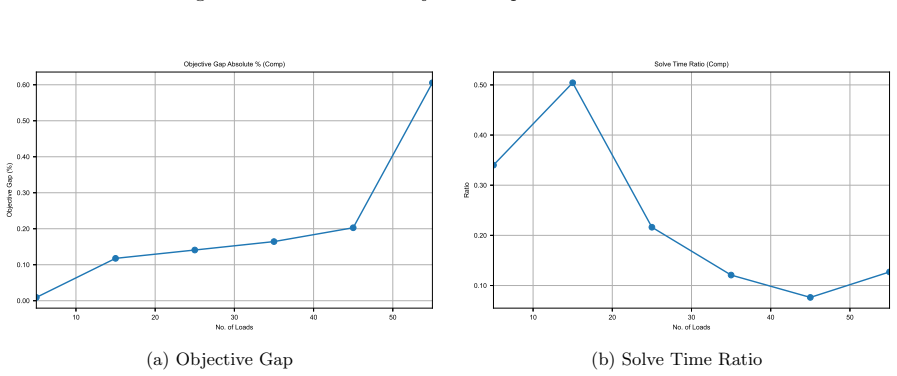
Decomposing the DES design MINLP into MILP then ADMM-solved NLP and complementarity steps solves unbalanced AC power flow problems for 55-load LV networks up to 13 times faster with gaps below 0.61 percent.
A machine-rendered reading of the paper's core claim, the machinery that carries it, and where it could break.
Core claim
The authors claim that an initial mixed-integer linear program without power-flow constraints, followed by binary fixing and alternating direction method of multipliers solution of the nonlinear program and complementarity reformulation steps, produces solutions whose quality remains acceptable for the original non-convex mixed-integer nonlinear program even as network size and time horizon increase.
What carries the argument
The hybrid spatial/temporal decomposition with the alternating direction method of multipliers applied to the nonlinear program and complementarity reformulation after binary fixing from the initial mixed-integer linear program.
If this is right
- The method scales to networks with 55 loads and 120 time points while respecting unbalanced AC power flow constraints.
- Parallel computation of the decomposed subproblems produces speed-ups reaching 13 times.
- Optimality gaps stay at or below 0.61 percent across the tested instances.
- The complementarity reformulation allows removal of operational binary variables without destroying solvability under the alternating direction method of multipliers.
Where Pith is reading between the lines
- The same decomposition pattern could be applied to other mixed-integer nonlinear programs in energy systems that combine discrete decisions with continuous network constraints.
- Further parallelisation across more processors might push the method to networks several times larger than 55 loads.
- Testing the fixed-binary solutions against a full mixed-integer nonlinear program solver on a handful of medium-sized instances would quantify how often the early fixing misses better configurations.
- If the approach is embedded in a rolling-horizon planner, the small observed gaps suggest it could support real-time operational adjustments in distribution networks.
Load-bearing premise
Fixing binary variables from the initial network-unconstrained mixed-integer linear program and then solving the power-flow-inclusive nonlinear program via alternating direction method of multipliers still yields acceptable quality solutions to the full non-convex mixed-integer nonlinear program as network size and time horizon grow.
What would settle it
A larger network test in which the final solution violates safety constraints or exceeds a one percent optimality gap relative to a global solver on the original mixed-integer nonlinear program would show the decomposition fails to preserve quality.
Figures







read the original abstract
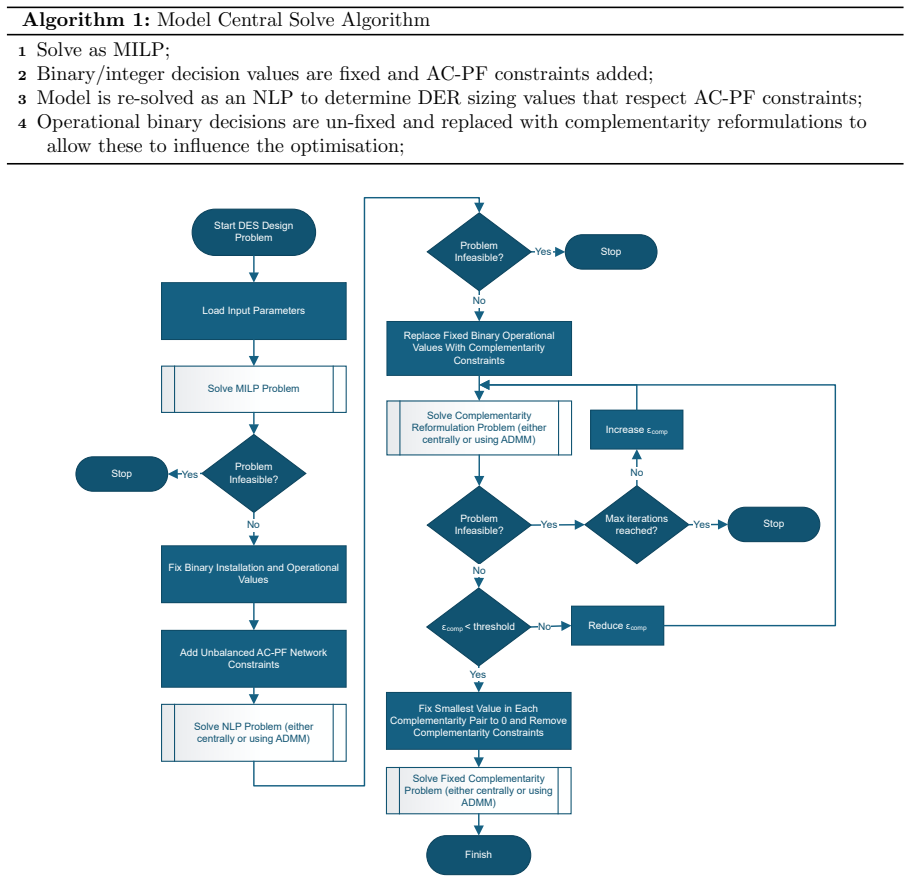
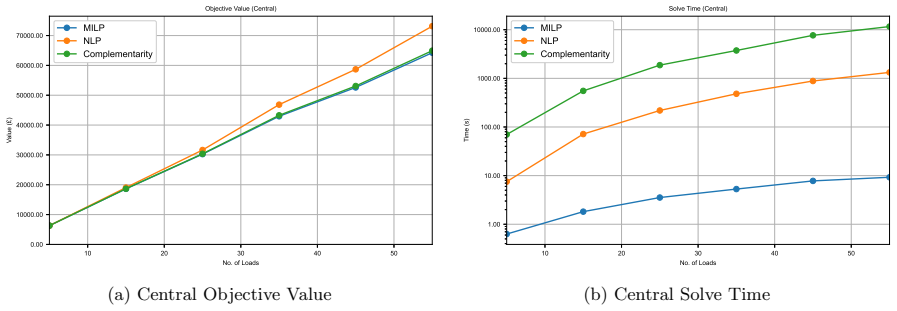
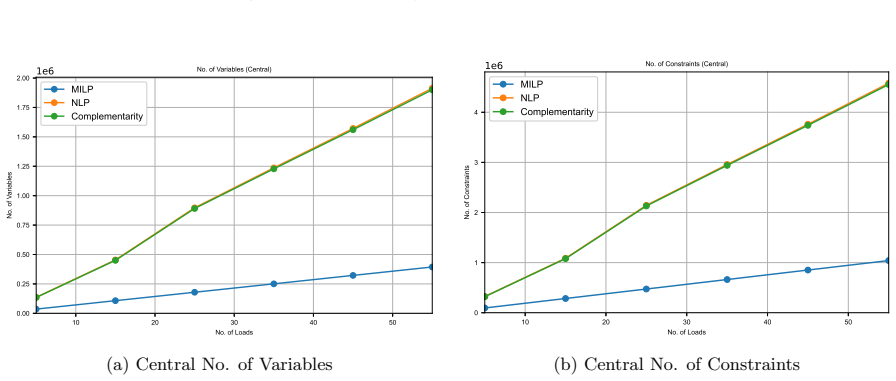
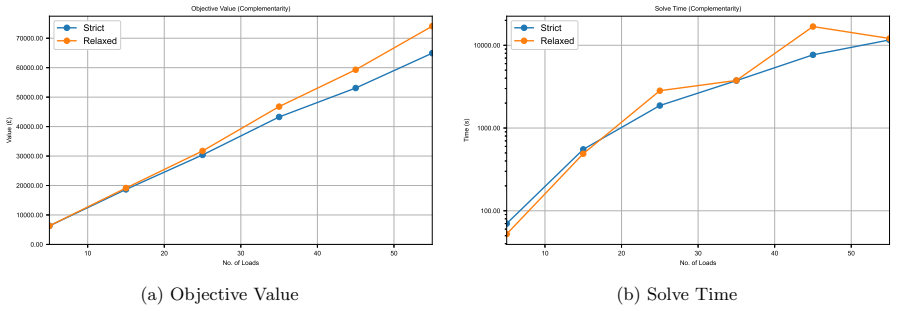
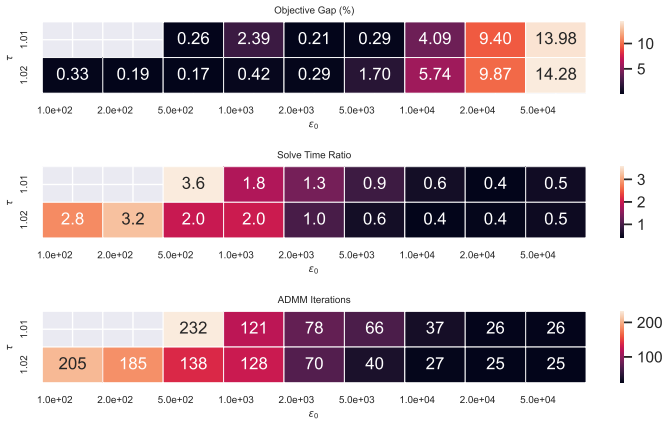
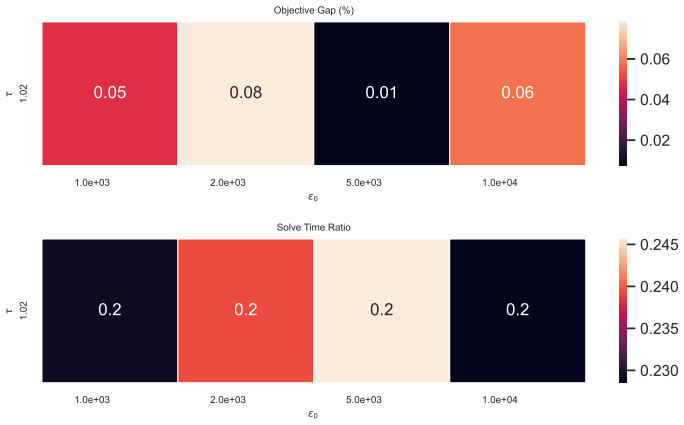
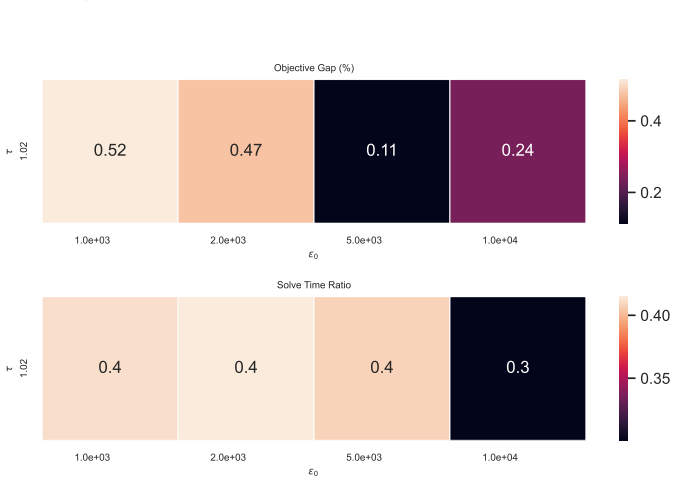
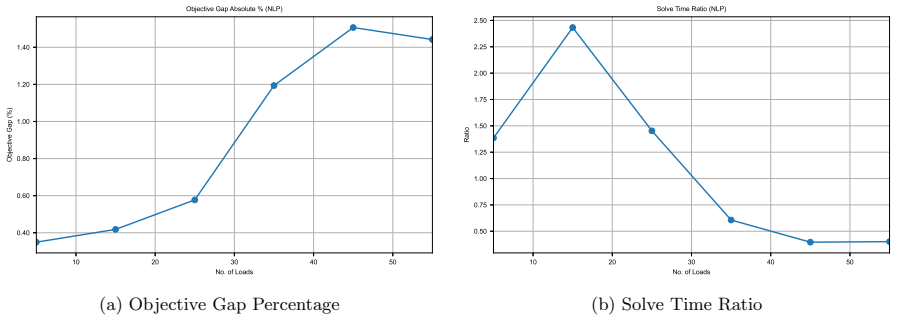
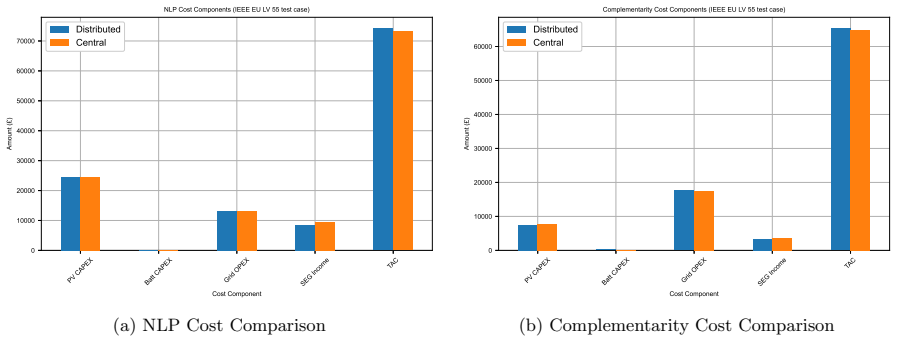
With the addition of large numbers of distributed energy resources (DERs) to distribution networks comes the increasing risk that their operation may violate the safety constraints of these networks. The problem considered in this paper is that of combined siting, sizing and dispatch of these DERs, also known as distributed energy system (DES) design, to help meet electrical and heat loads within the network. Here, the operation of these DERs is modelled, along with the unbalanced three-phase alternating current (AC) power flow in the network. When this network power flow is considered, this admits a non-convex mixed-integer nonlinear program (MINLP) model formulation which scales poorly with network size in terms of solve time. To address this, the problem is decomposed into a series of algorithmic steps, starting with a mixed-integer linear program (MILP) formulation that does not consider network constraints, then fixing binary variables, adding power flow constraints and solving as a nonlinear program (NLP) and finally removing operational binary variables and replacing them with a complementarity reformulation. As the main contributors to the overall solve time, the NLP and Complementarity steps are solved using a hybrid spatial/temporal decomposition strategy and the alternating direction method of multipliers (ADMM) distributed optimisation method. Results are presented for networks based on the European low voltage test feeder with up to 55 loads and 120 timepoints, with the ADMM approach showing speed-ups of up to 13x when considering parallel computation of the subproblems, for a maximum observed optimality gap of 0.61%.
Editorial analysis
A structured set of objections, weighed in public.
Referee Report
Summary. The manuscript presents a multi-step decomposition algorithm for solving a non-convex mixed-integer nonlinear program (MINLP) for distributed energy system (DES) design in large low-voltage (LV) networks, incorporating unbalanced three-phase AC power flow. The approach begins with a mixed-integer linear program (MILP) that ignores network constraints to determine binary decisions, fixes those binaries, solves a nonlinear program (NLP) with power flow constraints, and uses a complementarity reformulation solved via the alternating direction method of multipliers (ADMM) for the operational aspects. Empirical results on European LV test feeders with up to 55 loads and 120 time points demonstrate speed-ups of up to 13x with parallel ADMM and a maximum optimality gap of 0.61%.
Significance. If the reported performance holds and generalizes, this work provides a practical method to optimize DER siting, sizing, and dispatch while respecting network safety constraints in unbalanced networks, which is significant for renewable integration in distribution systems. The hybrid decomposition and ADMM application to this MINLP is a notable contribution, with concrete speed-up numbers on standard test cases.
major comments (2)
- [Abstract] Abstract: The claim of a 'maximum observed optimality gap of 0.61%' is load-bearing for the central performance claim but provides no details on the gap measurement method (e.g., comparison to a global MINLP solver, relaxation bound, or specific metric), limiting verification of solution quality for the original non-convex problem.
- [Methods (decomposition strategy)] The decomposition fixes binary variables (siting/sizing/dispatch) from the network-ignorant MILP before restoring unbalanced AC power flow constraints in the NLP and complementarity steps; this assumption is load-bearing for claiming near-optimality of the final solution, yet no sensitivity analysis, bound, or results for networks larger than 55 loads are provided to confirm the gap remains small as coupling effects grow.
minor comments (2)
- [Methods] The description of the complementarity reformulation replacing operational binary variables could be expanded with explicit equations for clarity.
- [Results] Convergence plots or tables for the ADMM subproblems would strengthen the presentation of the 13x speedup claim under parallel computation.
Simulated Author's Rebuttal
Thank you for the constructive referee report. We address each major comment point-by-point below, proposing revisions to improve clarity and acknowledge limitations where appropriate.
read point-by-point responses
-
Referee: [Abstract] Abstract: The claim of a 'maximum observed optimality gap of 0.61%' is load-bearing for the central performance claim but provides no details on the gap measurement method (e.g., comparison to a global MINLP solver, relaxation bound, or specific metric), limiting verification of solution quality for the original non-convex problem.
Authors: We thank the referee for this observation. The 0.61% figure represents the maximum relative difference between the objective value of the final decomposed solution and the objective value obtained from the initial network-ignorant MILP (used as a reference point, since solving the full non-convex MINLP to global optimality is intractable for these instances). To improve verifiability, we will revise the abstract to briefly state the measurement method and add a short paragraph in Section 3 (Methods) detailing the exact metric, including that it is an observed gap relative to the MILP reference rather than a proven bound. revision: yes
-
Referee: [Methods (decomposition strategy)] The decomposition fixes binary variables (siting/sizing/dispatch) from the network-ignorant MILP before restoring unbalanced AC power flow constraints in the NLP and complementarity steps; this assumption is load-bearing for claiming near-optimality of the final solution, yet no sensitivity analysis, bound, or results for networks larger than 55 loads are provided to confirm the gap remains small as coupling effects grow.
Authors: We agree that the binary-fixing step is a key modeling choice whose impact on solution quality merits explicit discussion. The manuscript reports empirical gaps no larger than 0.61% across the tested European LV feeders (up to 55 loads), but does not include sensitivity studies on larger networks or theoretical bounds. We will expand the discussion in Section 5 to note that stronger network coupling in larger systems could increase the gap and to recommend this as future work. However, generating new results for networks substantially larger than 55 loads is not feasible within the scope of this revision. revision: partial
- Providing sensitivity analysis, bounds, or computational results for networks larger than 55 loads
Circularity Check
No significant circularity; decomposition relies on standard primitives with empirical validation
full rationale
The paper describes a sequential decomposition heuristic (MILP without network constraints, binary fixing, NLP with unbalanced AC power flow, complementarity reformulation solved via ADMM) for a non-convex MINLP. All performance claims (up to 13x speedup, 0.61% observed gap) are presented as empirical results on test networks up to 55 loads and 120 timepoints. No equations or steps reduce a claimed result to its own inputs by construction, no self-citations justify load-bearing uniqueness or ansatzes, and no fitted parameters are relabeled as predictions. The approach is a procedural algorithm using established optimization methods, with the central contribution being computational scaling rather than a closed-form derivation.
Axiom & Free-Parameter Ledger
axioms (1)
- domain assumption Unbalanced three-phase AC power flow can be represented by a set of nonlinear equality constraints that remain tractable once binary variables are fixed.
Reference graph
Works this paper leans on
-
[1]
UN DESA.The Sustainable Development Goals Report 2023: Special Edition - July 2023. Tech. rep. UN DESA, 2023.url:https://unstats.un.org/sdgs/report/2023/
work page 2023
-
[2]
M. Pathak et al. “Technical Summary”. In:Climate Climate Change 2022: Mitigation of Climate Change. Contribution of Working Group III to the Sixth Assessment Report of the Intergovern- mental Panel on Climate Change. Ed. by P.R. Shukla et al. Cambridge University Press, 2022, pp. 51–148.doi:10.1017/9781009157926.002
-
[3]
William H. Kersting. “Distribution Systems”. In:Electric Power Generation, Transmission, and Distribution. Ed. by L. L. Grigsby. 3rd ed. CRC Press, 2012, pp. 420–581.isbn: 9781439856376. url:https://ebookcentral.proquest.com/lib/surrey/detail.action?docID=911986
work page 2012
-
[4]
Distribution system optimization to manage DERs for grid services
Anamika Dubey and Sumit Paudyal. “Distribution System Optimization to Manage Distributed Energy Resources (DERs) for Grid Services”. In:Foundations and Trends®in Electric Energy Systems6 (3-4 June 2023), pp. 120–264.issn: 2332-6557.doi:10.1561/3100000030
-
[5]
Newton Power Flow Methods for Un- balanced Three-Phase Distribution Networks
Baljinnyam Sereeter, Kees Vuik, and Cees Witteveen. “Newton Power Flow Methods for Un- balanced Three-Phase Distribution Networks”. In:Energies10 (10 Oct. 2017), p. 1658.issn: 1996-1073.doi:10.3390/en10101658
-
[6]
An introduction to optimal power flow: Theory, formu- lation, and examples
Stephen Frank and Steffen Rebennack. “An introduction to optimal power flow: Theory, formu- lation, and examples”. In:IIE Transactions48 (12 Dec. 2016), pp. 1172–1197.issn: 0740-817X. doi:10.1080/0740817X.2016.1189626
-
[7]
Ofgem.Smart Export Guarantee (SEG).url:https://www.ofgem.gov.uk/environmental- and-social-schemes/smart-export-guarantee-seg. (accessed: 18/11/2024)
work page 2024
-
[8]
Advancing sustainable distribution networks: Technologies and strategies
Robert Steven, Oleksiy V. Klymenko, and Michael Short. “Advancing sustainable distribution networks: Technologies and strategies”. In:Reference Module in Materials Science and Materials Engineering. Elsevier, 2025.doi:10.1016/B978-0-443-29210-1.00030-3
-
[9]
Ishanki De Mel, Oleksiy V Klymenko, and Michael Short. “Balancing accuracy and complexity in optimisation models of distributed energy systems and microgrids with optimal power flow: A review”. In:Sustainable Energy Technologies and Assessments52 (2022), p. 102066.issn: 2213- 1388.doi:10.1016/j.seta.2022.102066
-
[10]
Ishanki De Mel, Oleksiy V. Klymenko, and Michael Short. “Complementarity reformulations for the optimal design of distributed energy systems with multiphase optimal power flow”. In:Interna- tional Journal of Electrical Power & Energy Systems155 (Jan. 2024), p. 109610.issn: 0142-0615. doi:10.1016/j.ijepes.2023.109610
-
[11]
M. Papadimitrakis et al. “Metaheuristic search in smart grid: A review with emphasis on plan- ning, scheduling and power flow optimization applications”. In:Renewable and Sustainable Energy Reviews145 (July 2021), p. 111072.issn: 1364-0321.doi:10.1016/j.rser.2021.111072
-
[12]
Zero Duality Gap in Optimal Power Flow Problem
J Lavaei and S H Low. “Zero Duality Gap in Optimal Power Flow Problem”. In:IEEE Transactions on Power Systems27 (1 2012), pp. 92–107.issn: 1558-0679.doi:10.1109/TPWRS.2011.2160974
-
[13]
Convex relaxations and linear approximation for optimal power flow in multiphase radial networks
Lingwen Gan and Steven H. Low. “Convex relaxations and linear approximation for optimal power flow in multiphase radial networks”. In:2014 Power Systems Computation Conference. IEEE, Aug. 2014, pp. 1–9.isbn: 978-83-935801-3-2.doi:10.1109/PSCC.2014.7038399. 30
-
[14]
Lucien Bobo, Andreas Venzke, and Spyros Chatzivasileiadis. “Second-order cone relaxations of the optimal power flow for active distribution grids: Comparison of methods”. In:International Journal of Electrical Power & Energy Systems127 (2021), p. 106625.issn: 0142-0615.doi:10. 1016/j.ijepes.2020.106625
-
[15]
A distributed approach to the OPF problem
Tomaso Erseghe. “A distributed approach to the OPF problem”. In:EURASIP Journal on Ad- vances in Signal Processing2015 (1 May 2015), pp. 45–58.issn: 1687-6180.doi:10.1186/s13634- 015-0226-x
-
[16]
A Survey of Distributed Optimization and Control Algorithms for Electric Power Systems
Daniel K. Molzahn et al. “A Survey of Distributed Optimization and Control Algorithms for Electric Power Systems”. In:IEEE Transactions on Smart Grid8 (6 Nov. 2017), pp. 2941–2962. issn: 1949-3061.doi:10.1109/TSG.2017.2720471
-
[17]
Foundations and Trends® in Machine Learning , author =
Stephen Boyd et al. “Distributed Optimization and Statistical Learning via the Alternating Direc- tion Method of Multipliers”. In:Foundations and Trends®in Machine Learning3 (1 Jan. 2011), pp. 1–122.issn: 1935-8237.doi:10.1561/2200000016
-
[18]
Amin Kargarian et al. “Toward Distributed/Decentralized DC Optimal Power Flow Implementa- tion in Future Electric Power Systems”. In:IEEE Transactions on Smart Grid9 (4 July 2018), pp. 2574–2594.issn: 1949-3061.doi:10.1109/TSG.2016.2614904
-
[19]
PowerModelsADA: A Framework for Solving Optimal Power Flow Using Distributed Algorithms
Mohannad Alkhraijah et al. “PowerModelsADA: A Framework for Solving Optimal Power Flow Using Distributed Algorithms”. In:IEEE Transactions on Power Systems39 (1 2024), pp. 2357– 2360.doi:10.1109/TPWRS.2023.3318858
-
[20]
Machine learning-accelerated dis- tributed optimisation methods for optimal power flow: A review
Robert Steven, Oleksiy V. Klymenko, and Michael Short. “Machine learning-accelerated dis- tributed optimisation methods for optimal power flow: A review”. In:Renewable and Sustainable Energy Reviews226 (Jan. 2026), p. 116190.issn: 13640321.doi:10.1016/j.rser.2025.116190
-
[21]
Toward Distributed OPF Using ALADIN
Alexander Engelmann et al. “Toward Distributed OPF Using ALADIN”. In:IEEE Transactions on Power Systems34 (1 Jan. 2019), pp. 584–594.issn: 1558-0679.doi:10.1109/TPWRS.2018. 2867682
-
[22]
Junyao Guo, Gabriela Hug, and Ozan K. Tonguz. “A Case for Nonconvex Distributed Optimization in Large-Scale Power Systems”. In:IEEE Transactions on Power Systems32 (5 Sept. 2017), pp. 3842–3851.issn: 1558-0679.doi:10.1109/TPWRS.2016.2636811
-
[23]
Mostafa Nick, Rachid Cherkaoui, and Mario Paolone. “Optimal siting and sizing of distributed energy storage systems via alternating direction method of multipliers”. In:International Journal of Electrical Power & Energy Systems72 (2015), pp. 33–39.issn: 0142-0615.doi:10.1016/j. ijepes.2015.02.008
work page doi:10.1016/j 2015
-
[24]
Tianqi Liu et al. “Joint planning for PV-SESS-MESS in distribution network towards 100% self-consumption of PV via consensus-based ADMM”. In:Journal of Energy Storage90 (2024), p. 111747.issn: 2352-152X.doi:10.1016/j.est.2024.111747
-
[25]
Timur Sayfutdinov, Mazhar Ali, and Oleg Khamisov. “Alternating direction method of multipliers for the optimal siting, sizing, and technology selection of Li-ion battery storage”. In:Electric Power Systems Research185 (2020), p. 106388.issn: 0378-7796.doi:10.1016/j.epsr.2020.106388
-
[26]
Solving Combined Sizing and Dispatch of PV and Battery Storage for a Microgrid using ADMM
Robert Steven, Oleksiy Klymenko, and Michael Short. “Solving Combined Sizing and Dispatch of PV and Battery Storage for a Microgrid using ADMM”. In:34th European Symposium on Computer Aided Process Engineering / 15th International Symposium on Process Systems Engi- neering. Ed. by Flavio Manenti and Gintaras V Reklaitis. Vol. 53. Elsevier, 2024, pp. 2299–...
-
[27]
An Improved ADMM-based Approach for Decentralized Planning of Distribution Network
Y Liu et al. “An Improved ADMM-based Approach for Decentralized Planning of Distribution Network”. In:2023 Panda Forum on Power and Energy (PandaFPE). 2023, pp. 231–236.doi: 10.1109/PandaFPE57779.2023.10140909
-
[28]
Haojie Shi et al. “Fully distributed planning method for coordinated distribution and urban trans- portation networks considering three-phase unbalance mitigation”. In:Applied Energy377 (2025), p. 124449.issn: 0306-2619.doi:10.1016/j.apenergy.2024.124449
-
[29]
Jinghua Zhu et al. “Coordinated Planning of Unbalanced Flexible Interconnected Distribution Networks Based on Distributed Optimization”. In:Energies19 (7 Apr. 2026), p. 1769.doi:10. 3390/en19071769
work page 2026
-
[30]
C Gu, J Wang, and L Wu. “Distributed Energy Resource and Energy Storage Investment for Enhancing Flexibility Under a TSO-DSO Coordination Framework”. In:IEEE Transactions on Automation Science and Engineering21 (3 2024), pp. 2961–2973.issn: 1558-3783.doi:10.1109/ TASE.2023.3272532
-
[31]
Optimizing residential heating and energy storage flexibility for frequency re- serves
Olli Kilkki et al. “Optimizing residential heating and energy storage flexibility for frequency re- serves”. In:International Journal of Electrical Power & Energy Systems100 (2018), pp. 540–549. issn: 0142-0615.doi:10.1016/j.ijepes.2018.02.047
-
[32]
A decision-support framework for residential heating decarbonisation pol- icymaking
Ishanki De Mel et al. “A decision-support framework for residential heating decarbonisation pol- icymaking”. In:Energy268 (Apr. 2023), p. 126651.issn: 0360-5442.doi:10.1016/j.energy. 2023.126651
-
[33]
Mitsubishi Electric.Ecodan Data Book Vol 6.0. Tech. rep. Nov. 2023.url:https://library. mitsubishielectric . co . uk / pdf / book / Ecodan _ ATW _ Databook _ Vol . 6 _ .0 _ .pdf. (accessed: 11/02/2026)
work page 2023
-
[34]
SciPy 1.0: fundamental algorithms for scientific computing in Python
Pauli Virtanen et al. “SciPy 1.0: fundamental algorithms for scientific computing in Python”. In: Nature Methods17 (3 Mar. 2020), pp. 261–272.issn: 1548-7091.doi:10 .1038/ s41592- 019- 0686-2
work page 2020
-
[35]
K. W. Vugrin et al. “Confidence region estimation techniques for nonlinear regression in ground- water flow: Three case studies”. In:Water Resources Research43 (3 Mar. 2007).issn: 0043-1397. doi:10.1029/2005WR004804
-
[36]
Gurobi Optimization LLC.Gurobi Optimizer Reference Manual. 2024.url:https : / / www . gurobi.com
work page 2024
-
[37]
Three-phase cogenerator and transformer models for distribution system anal- ysis
T.-H. Chen et al. “Three-phase cogenerator and transformer models for distribution system anal- ysis”. In:IEEE Transactions on Power Delivery6 (4 1991), pp. 1671–1681.issn: 08858977.doi: 10.1109/61.97706
-
[38]
2026.url:https://www.epri.com/pages/sa/ opendss
Electric Power Research Institute.OpenDSS. 2026.url:https://www.epri.com/pages/sa/ opendss. (accessed: 26/03/2026)
work page 2026
-
[39]
2021.url: https://www.ovoenergy.com/guides/energy- guides/smart- export- guarantee
Aimee Tweedale.Smart Export Guarantee explained: how much could you save?Apr. 2021.url: https://www.ovoenergy.com/guides/energy- guides/smart- export- guarantee. (accessed: 18/11/2024)
work page 2021
-
[40]
Analytic Considerations and Design Basis for the IEEE Distribution Test Feeders
K. P. Schneider et al. “Analytic Considerations and Design Basis for the IEEE Distribution Test Feeders”. In:IEEE Transactions on Power Systems33 (3 2018), pp. 3181–3188.doi:10.1109/ TPWRS.2017.2760011. 32
-
[41]
Stefan Pfenninger and Iain Staffell. “Long-term patterns of European PV output using 30 years of validated hourly reanalysis and satellite data”. In:Energy114 (2016), pp. 1251–1265.issn: 0360-5442.doi:10.1016/j.energy.2016.08.060.url:https://www.renewables.ninja/
work page doi:10.1016/j.energy.2016.08.060.url:https://www.renewables.ninja/ 2016
-
[42]
Using bias-corrected reanalysis to simulate current and future wind power output
Iain Staffell and Stefan Pfenninger. “Using bias-corrected reanalysis to simulate current and future wind power output”. In:Energy114 (2016), pp. 1224–1239.issn: 0360-5442.doi:j.energy.2016. 08.068.url:https://www.renewables.ninja/
work page 2016
-
[43]
Stefan Pfenninger and Iain Staffell.Renewables.ninja. 2016.url:https : / / www . renewables . ninja/. (accessed: 07/05/2026)
work page 2016
-
[44]
Matthew Li, David Allinson, and Miaomiao He. “Seasonal variation in household electricity de- mand: A comparison of monitored and synthetic daily load profiles”. In:Energy and Buildings179 (2018), pp. 292–300.issn: 0378-7788.doi:https://doi.org/10.1016/j.enbuild.2018.09.018
-
[45]
Jeff Bezanson et al. “Julia: A Fresh Approach to Numerical Computing”. In:SIAM Review59 (1 Jan. 2017), pp. 65–98.issn: 0036-1445.doi:10.1137/141000671
-
[46]
JuMP 1.0: recent improvements to a modeling language for mathematical optimization
Miles Lubin et al. “JuMP 1.0: recent improvements to a modeling language for mathematical optimization”. In:Mathematical Programming Computation15 (3 Sept. 2023), pp. 581–589.issn: 1867-2949.doi:10.1007/s12532-023-00239-3
-
[47]
CONOPT: A GRG code for large sparse dynamic nonlinear optimization prob- lems
Arne Drud. “CONOPT: A GRG code for large sparse dynamic nonlinear optimization prob- lems”. In:Mathematical Programming31 (2 1985), pp. 153–191.issn: 1436-4646.doi:10.1007/ BF02591747
work page 1985
-
[48]
Michael R. Bussieck and Arne S. Drud.SBB: A New Solver for Mixed Integer Nonlinear Program- ming. Tech. rep. 2001
work page 2001
- [49]
-
[50]
Mathematical Programming 106, 25-57 (2006)
Andreas W¨ achter and Lorenz T. Biegler. “On the implementation of an interior-point filter line- search algorithm for large-scale nonlinear programming”. In:Mathematical Programming106 (1 Mar. 2006), pp. 25–57.issn: 1436-4646.doi:10.1007/s10107-004-0559-y
-
[51]
UKRI Science and Technology Facilities Council.HSL, a collection of Fortran codes for large-scale scientific computation. Apr. 2018.url:https://www.hsl.rl.ac.uk/
work page 2018
-
[52]
CreateSpace, 2009.isbn: 1441412697
Guido Van Rossum and Fred L Drake.Python 3 Reference Manual. CreateSpace, 2009.isbn: 1441412697
work page 2009
-
[53]
2024.url:https://www.mathworks
The MathWorks Inc.MATLAB version: 24.2.0 (R2024b). 2024.url:https://www.mathworks. com
work page 2024
-
[54]
James Fairbanks et al.JuliaGraphs/Graphs.jl: an optimized graphs package for the Julia pro- gramming language. 2021.url:https : / / github . com / JuliaGraphs / Graphs . jl/. (accessed: 24/03/2026)
work page 2021
-
[55]
2016.url:https://juliapackages.com/p/graphrecipes
Thomas Breloff.GraphRecipes.jl. 2016.url:https://juliapackages.com/p/graphrecipes
work page 2016
-
[56]
The Pandas Development Team.pandas-dev/pandas: Pandas. Sept. 2024.doi:10.5281/zenodo. 13819579
-
[57]
Wes McKinney. “Data Structures for Statistical Computing in Python”. In:Proceedings of the 9th Python in Science Conference. Ed. by St´ efan van der Walt and Jarrod Millman. 2010, pp. 56–61. doi:10.25080/Majora-92bf1922-00a. 33
-
[58]
Computing in Science and Engineering , keywords =
J. D. Hunter. “Matplotlib: A 2D Graphics Environment”. In:Computing in Science & Engineering 9 (3 2007), pp. 90–95.doi:10.1109/MCSE.2007.55
-
[59]
Michael L Waskom. “Seaborn: Statistical Data Visualization”. In:Journal of Open Source Software 6 (60 2021), p. 3021.doi:10.21105/joss.03021
-
[60]
2026.url:https://copilot.cloud.microsoft
Microsoft.Copilot. 2026.url:https://copilot.cloud.microsoft
work page 2026
-
[61]
Optimally Managing the Impacts of Convergence Tolerance for Distributed Optimal Power Flow
R Harris, M Alkhraijah, and D K Molzahn. “Optimally Managing the Impacts of Convergence Tolerance for Distributed Optimal Power Flow”. In:IEEE Transactions on Power Systems(2025), pp. 1–12.issn: 1558-0679.doi:10.1109/TPWRS.2025.3538500
-
[62]
Leon Thurner et al. “Pandapower—An Open-Source Python Tool for Convenient Modeling, Anal- ysis, and Optimization of Electric Power Systems”. In:IEEE Transactions on Power Systems33 (6 Nov. 2018), pp. 6510–6521.issn: 1558-0679.doi:10.1109/TPWRS.2018.2829021
-
[63]
Steven G. Johnson.PyCall.jl. 2023.url:https://github.com/JuliaPy/PyCall.jl. (accessed: 24/03/2026)
work page 2023
-
[64]
Robert Steven, Oleksiy Klymenko, and Michael Short.Dataset for ”Distributed Energy System Design including Unbalanced AC Power Flow for Large LV Networks with ADMM”. Mar. 2026. doi:10.15126/surreydata.902032
-
[65]
Optimal Design of Distributed Energy Systems Considering the Impacts on Electrical Power Networks
Ishanki De Mel, Oleksiy V. Klymenko, and Michael Short. “Optimal Design of Distributed Energy Systems Considering the Impacts on Electrical Power Networks”. In:arXiv(2022).doi:10.48550/ arXiv.2109.11228.url:https://arxiv.org/abs/2109.11228v2
- [66]
-
[67]
2025.url:https://heatable.co.uk/
Heatable.Heatable. 2025.url:https://heatable.co.uk/. (accessed: 18/03/2025)
work page 2025
-
[68]
City Plumbing.Mitsubishi Ecodan PUZ-WM50VHA 5kW Heat Pump Unit Only 497740.url: https://www.cityplumbing.co.uk/p/mitsubishi- ecodan- puz- wm50vha- 5kw- heat- pump- unit-only-497740/p/202264. (accessed: 11/02/2026)
work page 2026
-
[69]
City Plumbing.Mitsubishi Ecodan PUZ-WM60VAA 6KW Heat Pump Unit Only 499782.url: https://www.cityplumbing.co.uk/p/mitsubishi- ecodan- puz- wm60vaa- 6kw- heat- pump- unit-only-499782/p/101792. (accessed: 11/02/2026)
work page 2026
-
[70]
City Plumbing.Mitsubishi Ecodan R290 Heat Pump PUZ-WZ80VAA 8Kw Heat Pump Unit Only 676734.url:https://www.cityplumbing.co.uk/p/mitsubishi- ecodan- r290- heat- pump- puz-wz80vaa-8kw-heat-pump-unit-only-676734/p/794581. (accessed: 11/02/2026)
work page 2026
-
[71]
City Plumbing.Mitsubishi Ecodan R290 Heat Pump PUZ-WZ60VAA 6Kw Heat Pump Unit Only 676733.url:https://www.cityplumbing.co.uk/p/mitsubishi- ecodan- r290- heat- pump- puz-wz60vaa-6kw-heat-pump-unit-only-676733/p/794769. (accessed: 11/02/2026)
work page 2026
-
[72]
City Plumbing.Mitsubishi Ecodan R290 Heat Pump PUZ-WZ50VAA 5Kw Heat Pump Unit Only 676732.url:https://www.cityplumbing.co.uk/p/mitsubishi- ecodan- r290- heat- pump- puz-wz50vaa-5kw-heat-pump-unit-only-676732/p/794821. (accessed: 11/02/2026)
work page 2026
-
[73]
co.uk/Mitsubishi-Ecodan-Heat-Pump-PUZ-HWM140VHA.html
Saturn Sales.Mitsubishi Ecodan Heat Pump PUZ-HWM140VHA.url:https://www.saturnsales. co.uk/Mitsubishi-Ecodan-Heat-Pump-PUZ-HWM140VHA.html. (accessed: 11/02/2026). 34
work page 2026
-
[74]
A new approach to retrofitting FHE campus buildings using a whole life carbon assessment
Robert Steven et al. “A new approach to retrofitting FHE campus buildings using a whole life carbon assessment”. In:Energy335 (Oct. 2025), p. 138101.issn: 03605442.doi:10 . 1016 / j . energy.2025.138101. Appendix A DES Model Parameters & Variables 35 A.1 Parameters A.1.1 General Table 8: General Model Parameters Name V alue Unit Description Source nyears ...
discussion (0)
Sign in with ORCID, Apple, or X to comment. Anyone can read and Pith papers without signing in.