Recognition: unknown
Quantum Magic in early FTQC: From Diagonal Clifford Hierarchy No-Go Theorems to Architecture Design Blueprints
Pith reviewed 2026-05-08 17:12 UTC · model grok-4.3
The pith
In early fault-tolerant quantum computing, hierarchy level alone cannot order operational magic and no state-independent sequence guarantees its monotonic improvement.
A machine-rendered reading of the paper's core claim, the machinery that carries it, and where it could break.
Core claim
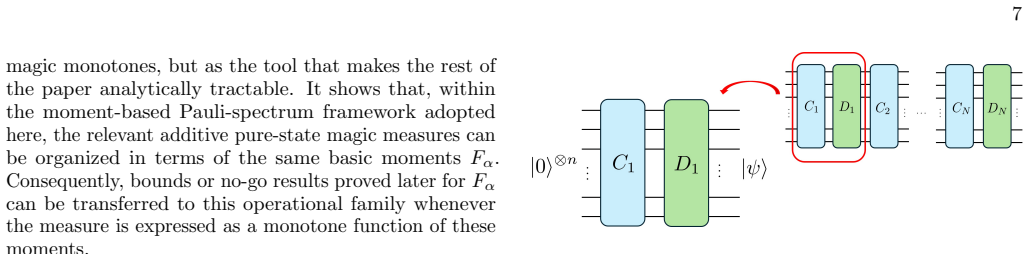
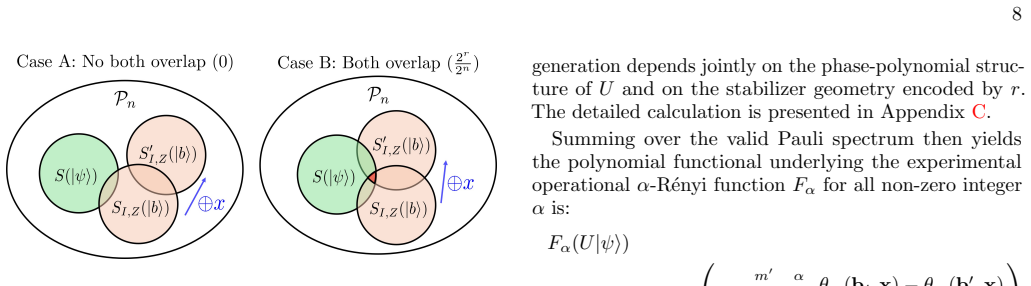
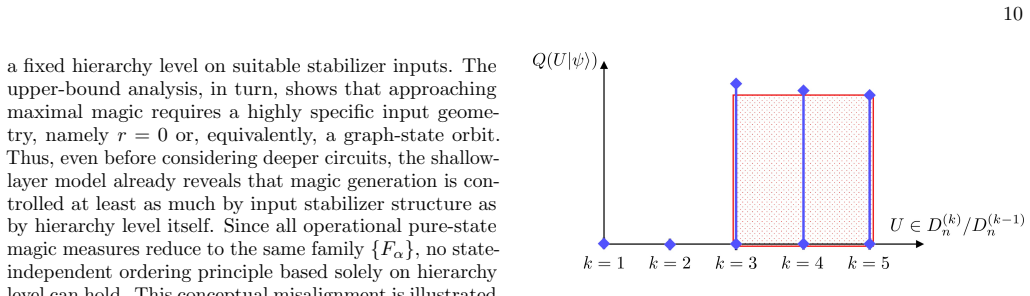
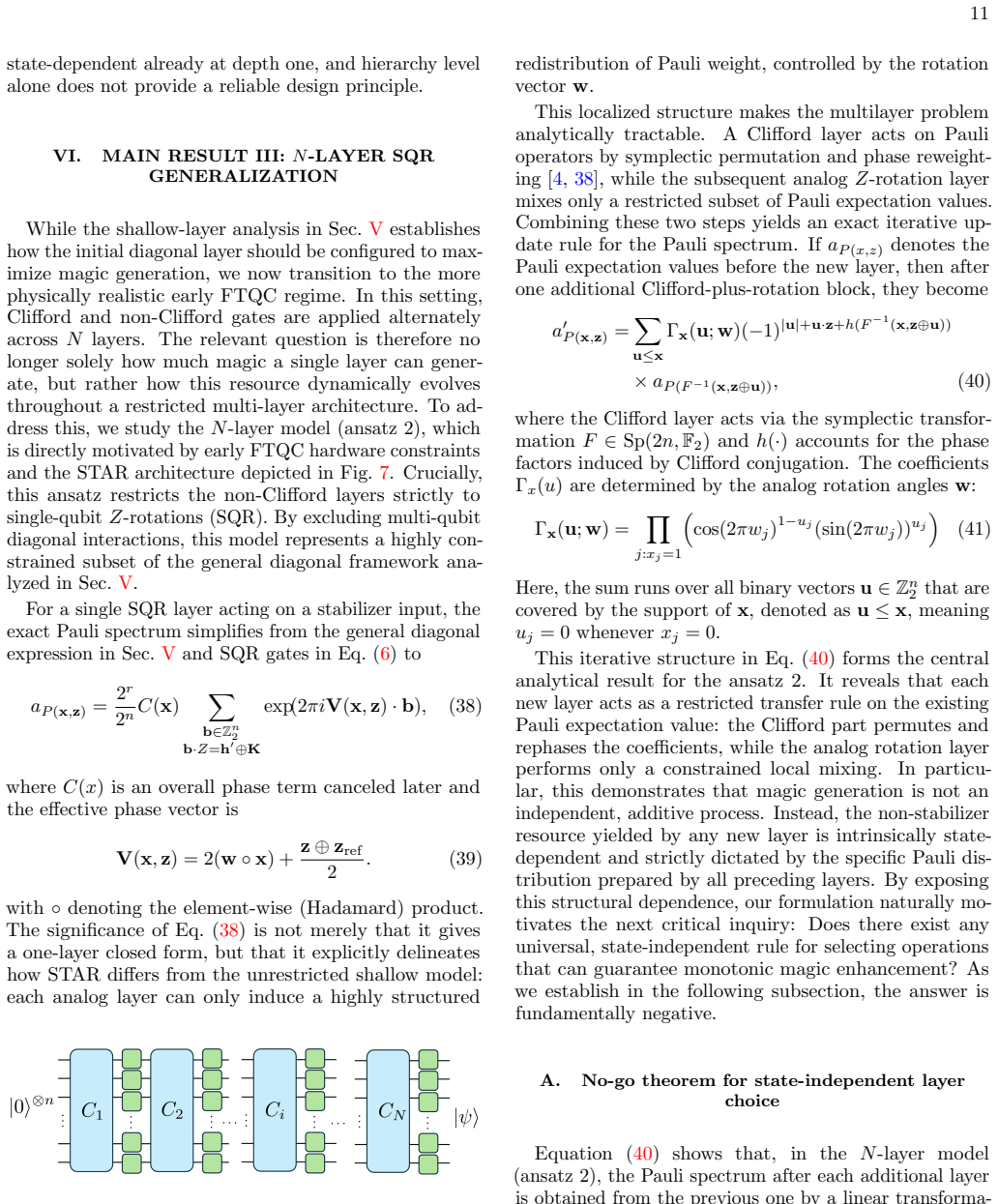
For any operational magic functional constructed from Pauli expectations, the axioms of faithfulness and tensor-product additivity force a Rényi-type dependence on the Pauli spectrum. Using the closed phase-polynomial description of the diagonal Clifford hierarchy, exact spectrum expressions and tight bounds are obtained for a shallow-layer model; these bounds expose a zero-magic mechanism and prove that maximal magic strictly requires graph-state preconditioning, yielding the first no-go theorem that hierarchy level alone cannot universally order operational magic. Extending to the N-layer model, an exact iterative update rule for the spectrum is derived, yielding the second no-go theorem:
What carries the argument
The uniqueness theorem that faithfulness and tensor-product additivity force Rényi-type dependence on the Pauli spectrum, applied via the closed phase-polynomial description of diagonal Clifford hierarchy layers to obtain exact spectrum expressions and iterative update rules.
If this is right
- Hierarchy level alone cannot serve as a universal ordering for operational magic.
- No state-independent sequence of operations can guarantee monotonic magic improvement.
- Maximal magic in shallow diagonal layers strictly requires graph-state preconditioning.
- Architectures limited to single-qubit Z-rotations face a severe kinematic expressibility bottleneck.
- Gate selection must be reframed as state-aware differentiable optimization over continuous analog parameters.
Where Pith is reading between the lines
- Early FTQC hardware evaluation should include support for multi-qubit diagonal phases as a scalability criterion.
- Magic-generation benchmarks for architectures must incorporate state preparation and continuous optimization rather than discrete gate sets alone.
- The Pauli-spectrum update rules could be applied to analyze resource generation in other layered quantum models beyond the STAR architecture.
Load-bearing premise
That any operational magic functional built from Pauli expectation values must obey faithfulness and tensor-product additivity, which restricts it to a Rényi-type function of the Pauli spectrum.
What would settle it
A concrete sequence of diagonal non-Clifford operations, independent of the input state, that produces strictly monotonic increase in a valid operational magic measure across all initial states would falsify the second no-go theorem.
Figures


read the original abstract
We address the circuit-design problem of maximizing quantum magic in early fault-tolerant quantum computing (early FTQC), where logical dynamics natively take the form of alternating Clifford layers and diagonal non-Clifford layers. To render this optimization analytically tractable, we first prove a uniqueness theorem: for operational magic functionals built from Pauli expectation values, the axioms of faithfulness and tensor-product additivity force a R\'enyi-type dependence on the Pauli-spectrum. Leveraging the closed phase-polynomial description of the diagonal Clifford hierarchy, we derive exact Pauli-spectrum expressions and tight bounds for a shallow-layer model. These bounds expose a zero-magic mechanism and prove that maximal magic strictly requires graph-state preconditioning. Consequently, we establish our first no-go theorem: hierarchy level alone cannot universally order operational magic. Extending our framework to the $N$-layer model motivated by the Space-Time Efficient Analog Rotation (STAR) architecture, we obtain an exact iterative update rule for the Pauli spectrum. This yields a second no-go theorem: no state-independent sequence of operations can guarantee monotonic magic improvement. Together, these theorems demonstrate that algebraic gate structures are fundamentally insufficient to dictate resource generation. To overcome this, we reframe early FTQC gate selection as a state-aware, differentiable optimization over continuous analog parameters. Finally, we identify a severe kinematic expressibility bottleneck in architectures restricted to single-qubit $Z$-rotations and show that introducing nonlinear diagonal phases, such as multi-qubit $Z$-rotation, shatters this bottleneck. This provides a fundamental principle for demonstrating early FTQC, establishing scalable magic generation as a foundational benchmark for evaluating early FTQC architectures.
Editorial analysis
A structured set of objections, weighed in public.
Referee Report
Summary. The paper proves a uniqueness theorem: operational magic functionals constructed from Pauli expectation values are forced by the axioms of faithfulness and tensor-product additivity to take a Rényi-type form depending only on the Pauli spectrum. Using the closed phase-polynomial representation of diagonal Clifford-hierarchy layers, it derives exact Pauli-spectrum expressions and bounds for a shallow-layer model, revealing a zero-magic mechanism that requires graph-state preconditioning for maximal magic. This yields the first no-go theorem that Clifford hierarchy level alone cannot order operational magic. For the N-layer model motivated by the STAR architecture, an exact iterative update rule for the spectrum is obtained, implying the second no-go theorem that no state-independent sequence of operations guarantees monotonic magic improvement. The work then reframes gate selection as state-aware differentiable optimization over continuous analog parameters and shows that single-qubit Z-rotations suffer a kinematic expressibility bottleneck that is removed by introducing nonlinear multi-qubit diagonal phases.
Significance. If the uniqueness theorem and the exact spectrum calculations hold, the results supply rigorous, axiomatically grounded constraints on magic generation in early FTQC. The demonstration that algebraic hierarchy structure is insufficient by itself, together with the necessity of graph-state preconditioning and the iterative update rule, supplies concrete design principles and a quantitative benchmark (scalable magic generation) for evaluating FTQC architectures. The shift to state-aware analog optimization and the identification of nonlinear phases as a route to higher expressibility are actionable for circuit designers.
minor comments (4)
- [Uniqueness theorem section] The uniqueness theorem is stated clearly in the abstract and introduction, but the manuscript would benefit from an explicit statement of the precise functional form (e.g., the Rényi parameter range) immediately after the theorem statement so that later spectrum calculations can be checked against it without back-referencing.
- [Phase-polynomial model section] The phase-polynomial description of diagonal Clifford layers is used to obtain closed-form spectra; a short self-contained paragraph or appendix recalling the basic phase-polynomial representation for a single diagonal layer would make the exact expressions in the shallow-layer model accessible to readers outside the subfield.
- [N-layer model section] The iterative update rule for the N-layer Pauli spectrum is presented as exact; the manuscript should include a brief verification that the rule preserves the normalization and positivity properties of the spectrum at each step, even if this is immediate from the derivation.
- [Architecture design section] The final discussion of the expressibility bottleneck for single-qubit Z-rotations versus multi-qubit nonlinear phases would be strengthened by a short quantitative comparison (e.g., magic growth rate or reachable spectrum volume) between the two cases.
Simulated Author's Rebuttal
We thank the referee for their positive and accurate summary of our manuscript, which correctly identifies the uniqueness theorem for operational magic functionals, the exact Pauli-spectrum calculations for shallow and N-layer models, the two no-go theorems, and the reframing toward state-aware differentiable optimization with nonlinear phases. We appreciate the recognition that these results supply concrete, axiomatically grounded constraints and design principles for early FTQC architectures. The recommendation for minor revision is noted; we are happy to incorporate any editorial suggestions.
Circularity Check
Derivation self-contained under stated axioms
full rationale
The paper first proves a uniqueness theorem directly from the explicitly stated axioms of faithfulness and tensor-product additivity for Pauli-spectrum functionals, yielding a Rényi-type form. It then uses the closed phase-polynomial description of diagonal Clifford layers to derive exact spectrum expressions and bounds for the shallow-layer and N-layer models. The two no-go theorems follow immediately from these calculations without any reduction to fitted parameters, self-citations, or imported uniqueness results. All steps remain within the scoped class of functionals and models, with no load-bearing step collapsing to its own inputs by construction.
Axiom & Free-Parameter Ledger
axioms (2)
- domain assumption Axioms of faithfulness and tensor-product additivity for operational magic functionals built from Pauli expectation values force Rényi-type dependence on the Pauli spectrum
- standard math Closed phase-polynomial description of the diagonal Clifford hierarchy
Reference graph
Works this paper leans on
-
[1]
In other words, for allx ̸=0 satisfy |aP(x,z) |2 = 2−n.(32)
The non-identity Pauli spectrum is as flat as the constraints allow. In other words, for allx ̸=0 satisfy |aP(x,z) |2 = 2−n.(32)
-
[2]
The input stabilizer must satisfy r= 0.(33) Equivalently, the input has no pure-Zstabilizers. Consequently, for every α≥ 2, the magic generation is strictly bounded by Fα(U|ψ⟩)≥1 + (2 n −1)2 n(1−α),(34) with equality if and only if the accessible non-identity Pauli spectrum is exactly flat. Proof sketch. For fixedP |aP |2 = 2n, the quantity Fα =P |aP |2α ...
-
[3]
Wu, W.-S
Y. Wu, W.-S. Bao, S. Cao, F. Chen, M.-C. Chen, X. Chen, T.-H. Chung, H. Deng, Y. Du, and D. Fan, Strong quan- tum computational advantage using a superconducting quantum processor, Phys. Rev. Lett.127, 180501 (2021)
2021
-
[4]
F. Aruteet al., Quantum supremacy using a pro- grammable superconducting processor, Nature574, 505 (2019), arXiv:1910.11333 [quant-ph]
-
[5]
H.-S. Zhong, H. Wang, Y.-H. Deng, M.-C. Chen, L.-C. Peng, Y.-H. Luo, J. Qin, D. Wu, X. Ding, Y. Hu, P. Hu, X.-Y. Yang, W.-J. Zhang, H. Li, Y. Li, X. Jiang, L. Gan, G. Yang, L. You, Z. Wang, L. Li, N.-L. Liu, C.-Y. Lu, and J.-W. Pan, Quantum computational advantage using photons, Science370, 1460 (2020), https://www.science.org/doi/pdf/10.1126/science.abe8770
-
[6]
The Heisenberg Representation of Quantum Computers
D. Gottesman, The heisenberg representation of quantum computers, arXiv preprint quant-ph/9807006 (1998)
work page internal anchor Pith review arXiv 1998
-
[7]
Bravyi and A
S. Bravyi and A. Kitaev, Universal quantum computa- tion with ideal clifford gates and noisy ancillas, Physical Review A71, 022316 (2005)
2005
-
[9]
Horsman, A
D. Horsman, A. G. Fowler, S. Devitt, and R. V. Meter, Surface code quantum computing by lattice surgery, New Journal of Physics14, 123011 (2012)
2012
-
[10]
Litinski, A game of surface codes: Large-scale quantum computing with lattice surgery, Quantum3, 128 (2019)
D. Litinski, A game of surface codes: Large-scale quantum computing with lattice surgery, Quantum3, 128 (2019)
2019
-
[12]
L. Heyfron and E. T. Campbell, An efficient quantum compiler that reduces t count (2018), arXiv:1712.01557 [quant-ph]
-
[13]
Veitch, C
V. Veitch, C. Ferrie, D. Gross, and J. Emerson, Negative quasi-probability as a resource for quantum computation, New Journal of Physics14, 113011 (2012)
2012
-
[15]
Beverland, E
M. Beverland, E. Campbell, M. Howard, and V. Kli- uchnikov, Lower bounds on the non-clifford resources for quantum computations, Quantum Science and Technology 5, 035009 (2020)
2020
-
[16]
Bravyi, D
S. Bravyi, D. Browne, P. Calpin, E. Campbell, D. Gosset, and M. Howard, Simulation of quantum circuits by low- rank stabilizer decompositions, Quantum3, 181 (2019)
2019
-
[17]
M. E. Beverland, P. Murali, M. Troyer, K. M. Svore, T. Hoefler, V. Kliuchnikov, G. H. Low, M. Soeken, A. Sun- daram, and A. Vaschillo, Assessing requirements to scale to practical quantum advantage (2022), arXiv:2211.07629 [quant-ph]
work page internal anchor Pith review arXiv 2022
-
[18]
Gottesman and I
D. Gottesman and I. L. Chuang, Demonstrating the viabil- ity of universal quantum computation using teleportation and single-qubit operations, Nature402, 390–393 (1999)
1999
- [19]
-
[20]
Akahoshi, K
Y. Akahoshi, K. Maruyama, H. Oshima, S. Sato, and K. Fujii, Partially fault-tolerant quantum computing ar- chitecture with error-corrected clifford gates and space- time efficient analog rotations, PRX Quantum5, 010337 (2024)
2024
- [21]
-
[22]
Exponentially Accelerated Sampling of Pauli Strings for Nonstabilizerness
Z. Xiao and S. Ryu, Exponentially accelerated sam- pling of pauli strings for nonstabilizerness, arXiv preprint arXiv:2601.00761 (2026)
work page internal anchor Pith review Pith/arXiv arXiv 2026
-
[23]
Operational interpretation of the Stabilizer Entropy
L. Bittel and L. Leone, Operational interpretation of the stabilizer entropy (2025), arXiv:2507.22883 [quant-ph]
work page internal anchor Pith review Pith/arXiv arXiv 2025
-
[24]
S. X. Cui, D. Gottesman, and A. Krishna, Diagonal gates in the clifford hierarchy, Physical Review A95, 10.1103/physreva.95.012329 (2017)
-
[25]
Leone, S
L. Leone, S. F. E. Oliviero, Y. Zhou, and A. Hamma, Quantum chaos is quantum, Quantum5, 453 (2021)
2021
-
[26]
R. J. Garcia, K. Bu, and A. Jaffe, Resource theory of quan- tum scrambling, Proceedings of the National Academy of Sciences120, 10.1073/pnas.2217031120 (2023). 16
-
[27]
A. Ahmadi and E. Greplova, Quantifying non- stabilizerness via information scrambling, SciPost Physics 16, 10.21468/scipostphys.16.2.043 (2024)
-
[28]
R. Ismail, I.-C. Chen, C. Zhao, R. Weiss, F. Liu, H. Zhou, S.-T. Wang, A. Sornborger, and M. Kornjaˇ ca, Transversal star architecture for megaquop-scale quantum simulation with neutral atoms (2025), arXiv:2509.18294 [quant-ph]
-
[29]
M.-Z. Chung, A. H. Z. Kavaki, A. Scherer, A. Khalid, X. Kong, T. Kawakubo, N. Anand, G. A. Dagnew, Z. Webb, A. Silva, G. Gyawali, T. Yan, K. Fujii, A. Ho, M. Mohseni, P. Ronagh, and J. Martinis, Partially fault- tolerant quantum computation for megaquop applications (2026), arXiv:2603.13093 [quant-ph]
- [30]
-
[31]
Here subadditivity is understood as a property of a stabilizer-decomposition cost, rather than as a statement about physical magic generation by superposition. If |ϕ⟩ and|ψ⟩are decomposed separately into stabilizer states, then concatenating the two decompositions gives a valid stabilizer decomposition of |ϕ⟩+|ψ⟩, which naturally leads toQ(|ϕ⟩+|ψ⟩)≤Q(|ϕ⟩) +Q(|ψ⟩)
-
[32]
Heimendahl, F
A. Heimendahl, F. Montealegre-Mora, F. Vallentin, and D. Gross, Stabilizer extent is not multiplicative, Quantum 5, 400 (2021)
2021
-
[33]
Bravyi, G
S. Bravyi, G. Smith, and J. A. Smolin, Trading classical and quantum computational resources, Phys. Rev. X6, 021043 (2016)
2016
-
[34]
L. Leone and L. Bittel, Stabilizer entropies are monotones for magic-state resource theory, Physical Review A110, 10.1103/physreva.110.l040403 (2024)
-
[35]
Shepherd and M
D. Shepherd and M. J. Bremner, Temporally unstructured quantum computation, Proceedings of the Royal Society A: Mathematical, Physical and Engineering Sciences465, 1413–1439 (2009)
2009
-
[36]
M. J. Bremner, A. Montanaro, and D. J. Shepherd, Average-case complexity versus approximate simulation of commuting quantum computations, Phys. Rev. Lett. 117, 080501 (2016)
2016
-
[37]
Stabilizer Codes and Quantum Error Correction
D. Gottesman, Stabilizer codes and quantum error cor- rection (1997), arXiv:quant-ph/9705052 [quant-ph]
work page internal anchor Pith review arXiv 1997
-
[38]
G. Park, J. Chang, Y. Kim, Y. S. Teo, and H. Jeong, Sample- and hardware-efficient fidelity estimation by strip- ping phase-dominated magic (2026), arXiv:2602.09710 [quant-ph]
work page internal anchor Pith review Pith/arXiv arXiv 2026
-
[40]
S. Aaronson and D. Gottesman, Improved simulation of stabilizer circuits, Physical Review A70, 10.1103/phys- reva.70.052328 (2004)
-
[41]
Nocedal, Updating quasi-newton matrices with limited storage, Mathematics of Computation35, 773 (1980)
J. Nocedal, Updating quasi-newton matrices with limited storage, Mathematics of Computation35, 773 (1980)
1980
-
[42]
D. P. Kingma and J. Ba, Adam: A method for stochastic optimization (2017), arXiv:1412.6980 [cs.LG]
work page internal anchor Pith review arXiv 2017
-
[43]
Hamaguchi, K
H. Hamaguchi, K. Hamada, and N. Yoshioka, Handbook for quantifying robustness of magic, Quantum8, 1461 (2024)
2024
-
[44]
Peleg, A
S. Peleg, A. Shpilka, and B. L. Volk, Lower bounds on stabilizer rank, Quantum6, 652 (2022)
2022
-
[45]
Regula, Convex geometry of quantum resource quan- tification, Journal of Physics A: Mathematical and Theo- retical51, 045303 (2017)
B. Regula, Convex geometry of quantum resource quan- tification, Journal of Physics A: Mathematical and Theo- retical51, 045303 (2017)
2017
-
[46]
M. H. Stone, Applications of the theory of boolean rings to general topology, Transactions of the American Math- ematical Society41, 375 (1937)
1937
- [47]
-
[48]
Clifford group, stabilizer states, and linear and quadratic operations over GF(2).Phys
J. Dehaene and B. De Moor, Clifford group, stabi- lizer states, and linear and quadratic operations over gf(2), Physical Review A68, 10.1103/physreva.68.042318 (2003)
-
[49]
M. Amy, D. Maslov, M. Mosca, and M. Roetteler, A meet- in-the-middle algorithm for fast synthesis of depth-optimal quantum circuits, IEEE Transactions on Computer-Aided Design of Integrated Circuits and Systems32, 818–830 (2013)
2013
-
[50]
D. Gross, Hudson’s theorem for finite-dimensional quan- tum systems, Journal of Mathematical Physics47, 10.1063/1.2393152 (2006)
-
[51]
Bengtsson and K
I. Bengtsson and K. Zyczkowski,Geometry of Quantum States: An Introduction to Quantum Entanglement(Cam- bridge University Press, 2006). SUPPLEMENTAL MATERIAL Appendix A: AnL p hierarchy of stabilizer-expansion quantifiers Several standard magic quantifiers, including the robustness of magic (RoM) [ 41], stabilizer extent [30], and stabilizer rank [42], ar...
2006
-
[52]
Normalization Condition We first verify that the calculated quantities strictly satisfy the Pauli spectrum normalization condition,P (x,z)∈F2n 2 |aP(x,z) |2 = 2n, across the entire parameter space. Starting from our derived amplitude: X (x,z)∈F2n 2 |aP(x,z) |2 = X x∈Lx X b,b′∈Zn 2 ei(θ(b)−θ(b⊕x)−θ(b ′)+θ(b′⊕x)) × 22r 22n rY i=1 δ0, si⊕(b·zi)⊕ki rY j=1 δ0,...
-
[53]
Consistency with Pure-ZOperators Since a diagonal gate U commutes with pure-Z Pauli strings P (0, z), their expectation values should trivially match those of the unperturbed stabilizer state |ψ⟩. Settingx=0in our general formula naturally eliminates the diagonal phase polynomial: aP(0,z) = X b∈Zn 2 2r 2n (−1)b·z rY i=1 δ0, si⊕(b·zi).(D5) This exactly mat...
-
[54]
Without loss of generality, let Uk = diag(1, e2πi/2k ) be a phase shift gate acting on the nth qubit
Limiting Case: Single-Qubit Rotations and Multi-Control Z Gates We further benchmark our formula against previously known bounds for specific diagonal gates. Without loss of generality, let Uk = diag(1, e2πi/2k ) be a phase shift gate acting on the nth qubit. The generalized Pauli strings can be factored as P = Q⊗P nth, where Q∈ P n−1. Under similarity tr...
-
[55]
25 Our analytical polynomial identically recovers this behavior
Anticommuting Set( A): For Pnth ∈ {X, Y} , the similarity transformation generates a continuous rotation in theX-Yplane: U † k XnUk = cos 2π 2k Xn −sin 2π 2k Yn.(D8) This yields expectation values strictly proportional to cos2(2π/2k) or sin2(2π/2k) depending on whether Q⊗X n orQ⊗Y n resides in the stabilizer group. 25 Our analytical polynomial identically...
-
[56]
Theorem E.1(Stabilizer Maximum bounds and Zero-Magic).Let |ψ⟩ ∈STAB n be an n-qubit stabilizer state with r independent pure-Zgenerators
Lower Bound: Zero Magic Remains Possible Zero magic generation here implies that U maps a stabilizer to another stabilizer state, which is the upper bound of Fα. Theorem E.1(Stabilizer Maximum bounds and Zero-Magic).Let |ψ⟩ ∈STAB n be an n-qubit stabilizer state with r independent pure-Zgenerators
-
[57]
State-to-gate direction.If r≥k− 2, then there exists a diagonal hierarchy gate U∈ D (k) n \ D(k−1) n such that U|ψ⟩ ∈STAB n
-
[58]
If n≥k− 1, then there exists a nontrivial stabilizer state|ψ⟩ ∈STAB n,(not computational basis) such thatU|ψ⟩ ∈STAB n
Gate-to-state direction.Conversely, let U∈ D (k) n \ D(k−1) n . If n≥k− 1, then there exists a nontrivial stabilizer state|ψ⟩ ∈STAB n,(not computational basis) such thatU|ψ⟩ ∈STAB n. Proof. We first observe that the number of pure- Z generators, r, restricts the dimension of the state’s coherent superposition. Any n-qubit stabilizer state with r independe...
-
[59]
Upper Bound: Maximal Magic Requires Graph-State Geometry We now invert this perspective to investigate the maximum possible magic generation within this shallow-layer model. For any given experimental measure within our operational family, this corresponds to identifying the absolute upper bound of the quantum magic Q(U|ψ⟩ ), which is mathematically drive...
-
[60]
Generator Constraint:The initial stabilizer state must strictly satisfy r = 0, meaning the stabilizer group S contains no non-trivial pureZ-elements
-
[61]
, n,(E9) where the adjacency matrix satisfies A = AT ∈ M n(Z2)
Graph-State Equivalence:Under a change of stabilizer generators, the initial state admits generators of the canonical form gi = (−1)si Xi nY j=1 Z Aij j , i= 1, . . . , n,(E9) where the adjacency matrix satisfies A = AT ∈ M n(Z2). Consequently, the initial state is strictly of graph-state type, and in particular, is local-Clifford equivalent to a graph st...
-
[62]
Support maximality: the unitary evolution must possess sufficient geometric expressibility to distribute weight over all 4n −2 n non-identity Pauli operators
-
[63]
These two requirements correspond, respectively, to thePauli rank(support size) and theflatness(uniformity of amplitudes) of the Pauli spectrum
Amplitude compatibility: the resulting Pauli coefficients must obey the rigid integer constraints imposed by probability normalization. These two requirements correspond, respectively, to thePauli rank(support size) and theflatness(uniformity of amplitudes) of the Pauli spectrum. In this section, we first analyze the former by determining the maximal achi...
-
[64]
Hence, exactly one valid choice remains, namelyz j = 0
If xj = 0, the condition reduces to zj 2 ≡ 1 2 (mod 1), which is satisfied only by zj = 1. Hence, exactly one valid choice remains, namelyz j = 0
-
[65]
Let Sw denote the set of indices j such that 4 wj /∈Z
Ifx j = 1, the condition becomes 2wj + zj 2 ≡ 1 2 (mod 1).(H4) The number of admissible values of zj depends on wj: If 4 wj ∈Z , exactly one choice of zj satisfies the condition, leaving one valid option; If 4 wj /∈Z, neither zj = 0 nor zj = 1 satisfies the condition, and both choices remain valid. Let Sw denote the set of indices j such that 4 wj /∈Z. Eq...
discussion (0)
Sign in with ORCID, Apple, or X to comment. Anyone can read and Pith papers without signing in.