Recognition: unknown
Elicitation Matters: How Prompts and Query Protocols Shape LLM Surrogates under Sparse Observations
Pith reviewed 2026-05-08 16:09 UTC · model grok-4.3
The pith
The protocol for eliciting information from an LLM determines the surrogate beliefs it forms under sparse observations and alters optimization outcomes.
A machine-rendered reading of the paper's core claim, the machinery that carries it, and where it could break.
Core claim
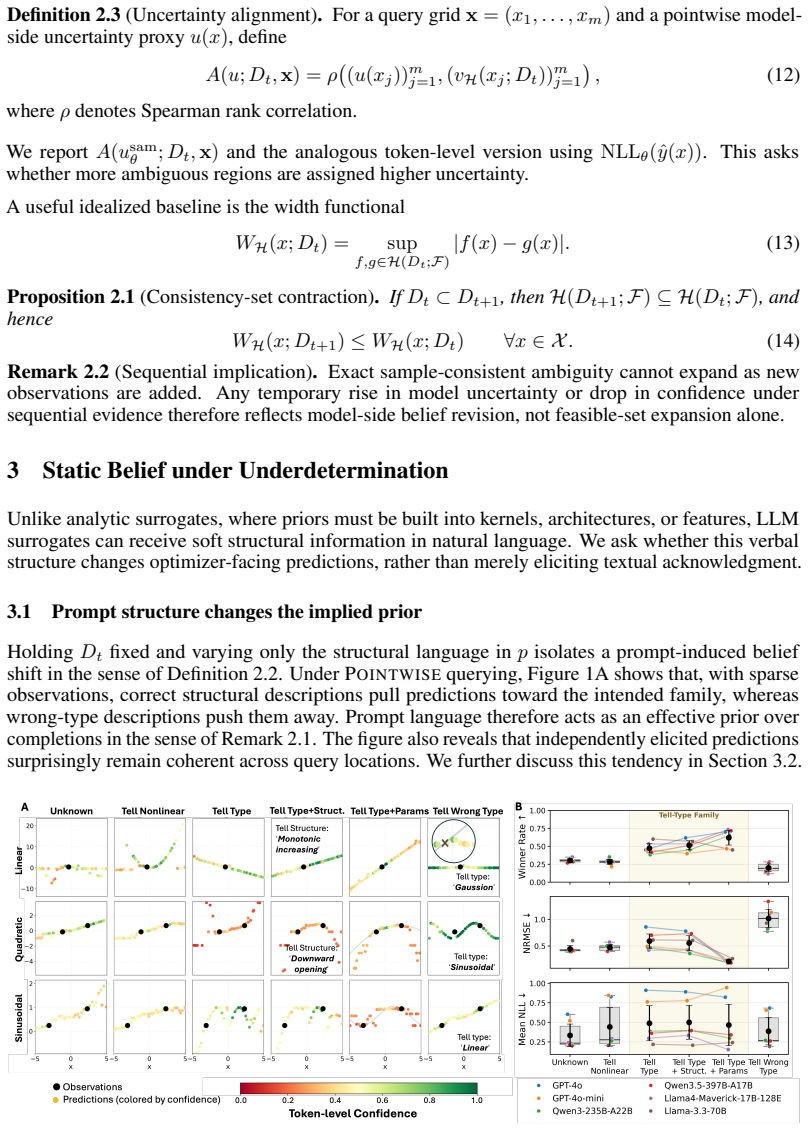
The surrogate belief elicited from an LLM under sparse observations depends strongly on prompt text and query protocol. Structural prompts act as effective priors. Pointwise and joint querying induce different beliefs. Sequential evidence leads to non-monotonic, order-sensitive confidence updates. These effects change downstream acquisition decisions and regret, showing that elicitation protocol is part of the LLM surrogate specification.
What carries the argument
Elicitation protocol, consisting of prompt structure and query methods such as pointwise versus joint querying, which together determine the surrogate belief formed from limited data.
If this is right
- Structural prompts serve as effective priors that influence the surrogate's responses even with few observations.
- Pointwise and joint querying protocols generate measurably different beliefs about the underlying function.
- Sequential addition of evidence produces non-monotonic and order-dependent shifts in model confidence.
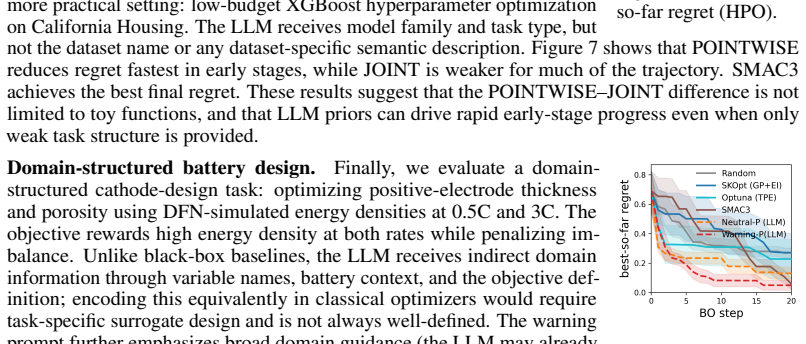
- These shifts alter which points are selected for acquisition and change the regret achieved in optimization runs.
Where Pith is reading between the lines
- Optimization pipelines using LLM surrogates may achieve more consistent results by fixing or tuning the elicitation protocol in advance.
- Order sensitivity in sequential updates points to possible advantages of re-eliciting beliefs after new data arrives rather than updating incrementally.
- The findings suggest exploring hybrid approaches that combine LLM elicitation with explicit uncertainty calibration steps from traditional surrogate modeling.
Load-bearing premise
The uncertainty-alignment criterion correctly measures whether the model's uncertainty matches the remaining ambiguity among functions consistent with the samples, and the controlled tasks represent real sparse-observation surrogate applications.
What would settle it
If the same LLM under pointwise and joint querying protocols produces identical posterior beliefs, acquisition functions, and regret values across repeated sparse-observation sequences in a controlled inference task, the claim that elicitation protocol shapes surrogate behavior would be falsified.
Figures


read the original abstract
Large language models are increasingly used as surrogate models for low-data optimization, but their optimizer-facing prediction and its uncertainty remain poorly understood. We study the surrogate belief elicited from an LLM under sparse observations, showing that it depends strongly on prompt text and query protocol. We introduce an uncertainty-alignment criterion that measures whether model uncertainty tracks residual ambiguity among sample-consistent functions. Across controlled inference tasks and Bayesian optimization studies, we find that structural prompts act as effective priors, POINTWISE and JOINT querying induce different beliefs, and sequential evidence leads to non-monotonic, order-sensitive confidence updates. These effects change downstream acquisition decisions and regret, showing that elicitation protocol is part of the LLM surrogate specification, not a formatting detail.
Editorial analysis
A structured set of objections, weighed in public.
Referee Report
Summary. The paper claims that LLM surrogate beliefs under sparse observations depend strongly on prompt text and query protocol. It introduces an uncertainty-alignment criterion measuring whether reported uncertainty tracks residual ambiguity among sample-consistent functions. Controlled inference tasks and Bayesian optimization experiments show structural prompts acting as priors, pointwise vs. joint querying inducing different beliefs, and sequential evidence producing non-monotonic, order-sensitive confidence updates that alter acquisition decisions and regret. The conclusion is that elicitation protocol is part of the LLM surrogate specification rather than a formatting detail.
Significance. If the central empirical findings hold, the work is significant for the use of LLMs as surrogates in low-data optimization. It supplies concrete evidence that prompt and query choices are not neutral and can materially change downstream optimizer behavior, which could guide more reliable elicitation practices. The uncertainty-alignment criterion is a useful new diagnostic tool, and the reproducible experimental protocol (controlled tasks plus BO regret studies) strengthens the contribution.
major comments (2)
- [Section introducing the uncertainty-alignment criterion] The interpretation that observed differences under POINTWISE vs. JOINT protocols and non-monotonic updates reflect genuine changes in the implicit function posterior rests on the uncertainty-alignment criterion correctly quantifying residual ambiguity among sample-consistent functions. The manuscript should supply a formal definition or validation (e.g., comparison against explicit enumeration of consistent functions on small tasks) showing the criterion is invariant to prompt phrasing outside the tested structural variants and is not satisfied by surface-level artifacts.
- [Bayesian optimization studies] To establish that elicitation effects change acquisition decisions and regret, the Bayesian optimization experiments require explicit reporting of the number of independent runs, statistical tests for differences in regret, and how the criterion is recomputed inside the sequential loop. Without these controls, it remains unclear whether the reported effects are robust or task-specific.
minor comments (2)
- [Experimental details] Clarify the exact LLMs, temperature settings, and prompt templates used in all experiments so that the structural-prompt effects can be reproduced.
- [Abstract] The abstract states the main findings concisely; consider adding one sentence on the range of tasks and models to give readers immediate context.
Simulated Author's Rebuttal
We thank the referee for the constructive and detailed feedback. The comments highlight important opportunities to strengthen the formal grounding and experimental transparency of our work on LLM surrogate elicitation. We address each major comment below and will incorporate the suggested revisions in the next version of the manuscript.
read point-by-point responses
-
Referee: [Section introducing the uncertainty-alignment criterion] The interpretation that observed differences under POINTWISE vs. JOINT protocols and non-monotonic updates reflect genuine changes in the implicit function posterior rests on the uncertainty-alignment criterion correctly quantifying residual ambiguity among sample-consistent functions. The manuscript should supply a formal definition or validation (e.g., comparison against explicit enumeration of consistent functions on small tasks) showing the criterion is invariant to prompt phrasing outside the tested structural variants and is not satisfied by surface-level artifacts.
Authors: We agree that a formal definition and targeted validation will improve the rigor of the uncertainty-alignment criterion. In the revised manuscript we will add an explicit mathematical definition: the criterion is the absolute difference between the LLM-reported uncertainty (normalized variance or entropy) and the empirical variance of predictions over all functions consistent with the observed samples, where consistency is defined by exact agreement on the queried points. To validate, we will include a new subsection with small-scale tasks (e.g., 1D polynomial regression with 3–5 points and binary classification over 4–8 points) where the full set of sample-consistent functions can be enumerated exhaustively. On these tasks we will compare the criterion against the true posterior variance computed from the enumerated set. We will also report results under minor prompt rephrasings (synonym substitutions and sentence reordering outside the structural variants) to demonstrate stability. These additions directly address potential surface artifacts. revision: yes
-
Referee: [Bayesian optimization studies] To establish that elicitation effects change acquisition decisions and regret, the Bayesian optimization experiments require explicit reporting of the number of independent runs, statistical tests for differences in regret, and how the criterion is recomputed inside the sequential loop. Without these controls, it remains unclear whether the reported effects are robust or task-specific.
Authors: We will improve the reporting of the Bayesian optimization experiments as requested. The revised manuscript will state that all regret curves are averaged over 20 independent runs with different random seeds for both the objective function and the initial observations. We will add statistical comparisons using paired Wilcoxon signed-rank tests (with Bonferroni correction) between elicitation protocols on final regret, and report p-values and effect sizes. Finally, we will include a precise description of the sequential loop: at each iteration the uncertainty-alignment criterion is recomputed by re-prompting the LLM with the updated observation set under the same protocol, using the most recent model outputs to update the acquisition function. These details will be placed in the experimental setup and results sections to clarify robustness. revision: yes
Circularity Check
No significant circularity; empirical study of elicitation effects
full rationale
The paper conducts an empirical investigation comparing LLM surrogate outputs under different prompt structures and query protocols (pointwise vs. joint) against an introduced uncertainty-alignment criterion and downstream regret metrics in controlled tasks and Bayesian optimization. No equations or derivations are presented that reduce by construction to fitted parameters defined from the same data, self-definitional loops, or load-bearing self-citations. The central claims rest on experimental observations of non-monotonic updates and acquisition changes rather than tautological reductions. The uncertainty-alignment criterion is introduced as a measurement tool and evaluated externally, with no evidence that it is defined in terms of the LLM behaviors it assesses.
Axiom & Free-Parameter Ledger
axioms (1)
- domain assumption LLMs can be used as surrogate models whose predictions and uncertainty can be elicited and compared to ground-truth ambiguity under sparse observations.
invented entities (1)
-
uncertainty-alignment criterion
no independent evidence
Reference graph
Works this paper leans on
-
[1]
What learning algorithm is in-context learning? investigations with linear models
Ekin Akyürek, Dale Schuurmans, Jacob Andreas, Tengyu Ma, and Denny Zhou. What learning algorithm is in-context learning? investigations with linear models.arXiv preprint arXiv:2211.15661, 2022
-
[2]
Language models are few-shot learners
Tom Brown, Benjamin Mann, Nick Ryder, Melanie Subbiah, Jared D Kaplan, Prafulla Dhariwal, Arvind Neelakantan, Pranav Shyam, Girish Sastry, Amanda Askell, et al. Language models are few-shot learners. Advances in neural information processing systems, 33:1877–1901, 2020
1901
-
[3]
Llinbo: Trustworthy llm-in-the- loop bayesian optimization.arXiv preprint arXiv:2505.14756, 2025
Chih-Yu Chang, Milad Azvar, Chinedum Okwudire, and Raed Al Kontar. Llinbo: Trustworthy llm-in-the- loop bayesian optimization.arXiv preprint arXiv:2505.14756, 2025
-
[4]
What can transformers learn in- context? a case study of simple function classes.Advances in neural information processing systems, 35: 30583–30598, 2022
Shivam Garg, Dimitris Tsipras, Percy S Liang, and Gregory Valiant. What can transformers learn in- context? a case study of simple function classes.Advances in neural information processing systems, 35: 30583–30598, 2022
2022
-
[5]
A survey of confidence estimation and calibration in large language models
Jiahui Geng, Fengyu Cai, Yuxia Wang, Heinz Koeppl, Preslav Nakov, and Iryna Gurevych. A survey of confidence estimation and calibration in large language models. InProceedings of the 2024 Conference of the North American Chapter of the Association for Computational Linguistics: Human Language Technologies (Volume 1: Long Papers), pages 6577–6595, 2024
2024
-
[6]
On calibration of modern neural networks
Chuan Guo, Geoff Pleiss, Yu Sun, and Kilian Q Weinberger. On calibration of modern neural networks. In International conference on machine learning, pages 1321–1330. PMLR, 2017
2017
-
[7]
Large language models as surrogate models in evolutionary algorithms: A preliminary study.Swarm and Evolutionary Computation, 91:101741, 2024
Hao Hao, Xiaoqun Zhang, and Aimin Zhou. Large language models as surrogate models in evolutionary algorithms: A preliminary study.Swarm and Evolutionary Computation, 91:101741, 2024
2024
-
[8]
Zhengbao Jiang, Jun Araki, Haibo Ding, and Graham Neubig. How can we know when language models know? on the calibration of language models for question answering.Transactions of the Association for Computational Linguistics, 9:962–977, 2021
2021
-
[9]
Unskilled and unaware of it: how difficulties in recognizing one’s own incompetence lead to inflated self-assessments.Journal of personality and social psychology, 77(6):1121, 1999
Justin Kruger and David Dunning. Unskilled and unaware of it: how difficulties in recognizing one’s own incompetence lead to inflated self-assessments.Journal of personality and social psychology, 77(6):1121, 1999
1999
-
[10]
Lorenz Kuhn, Yarin Gal, and Sebastian Farquhar. Semantic uncertainty: Linguistic invariances for uncertainty estimation in natural language generation.arXiv preprint arXiv:2302.09664, 2023
work page internal anchor Pith review arXiv 2023
-
[11]
Accurate uncertainties for deep learning using calibrated regression
V olodymyr Kuleshov, Nathan Fenner, and Stefano Ermon. Accurate uncertainties for deep learning using calibrated regression. InInternational conference on machine learning, pages 2796–2804. PMLR, 2018
2018
-
[12]
Can large language models achieve calibration with in-context learning? InICLR 2024 Workshop on Reliable and Responsible Foundation Models, 2024
Chengzu Li, Han Zhou, Goran Glavaš, Anna Korhonen, and Ivan Vuli´c. Can large language models achieve calibration with in-context learning? InICLR 2024 Workshop on Reliable and Responsible Foundation Models, 2024
2024
-
[13]
Large Language Models to Enhance Bayesian Optimization
Tennison Liu, Nicolás Astorga, Nabeel Seedat, and Mihaela van der Schaar. Large language models to enhance bayesian optimization.arXiv preprint arXiv:2402.03921, 2024
-
[14]
Uncertainty quantification and confidence calibration in large language models: A survey
Xiaoou Liu, Tiejin Chen, Longchao Da, Chacha Chen, Zhen Lin, and Hua Wei. Uncertainty quantification and confidence calibration in large language models: A survey. InProceedings of the 31st ACM SIGKDD Conference on Knowledge Discovery and Data Mining V . 2, pages 6107–6117, 2025
2025
-
[15]
In-context Learning and Induction Heads
Catherine Olsson, Nelson Elhage, Neel Nanda, Nicholas Joseph, Nova DasSarma, Tom Henighan, Ben Mann, Amanda Askell, Yuntao Bai, Anna Chen, et al. In-context learning and induction heads.arXiv preprint arXiv:2209.11895, 2022
work page internal anchor Pith review arXiv 2022
-
[16]
Can you trust your model’s uncertainty? evaluating predictive uncertainty under dataset shift.Advances in neural information processing systems, 32, 2019
Yaniv Ovadia, Emily Fertig, Jie Ren, Zachary Nado, David Sculley, Sebastian Nowozin, Joshua Dillon, Balaji Lakshminarayanan, and Jasper Snoek. Can you trust your model’s uncertainty? evaluating predictive uncertainty under dataset shift.Advances in neural information processing systems, 32, 2019
2019
-
[17]
Llm processes: Numerical predictive distributions conditioned on natural language.Advances in Neural Information Processing Systems, 37:109609–109671, 2024
James Requeima, John Bronskill, Dami Choi, Richard E Turner, and David Duvenaud. Llm processes: Numerical predictive distributions conditioned on natural language.Advances in Neural Information Processing Systems, 37:109609–109671, 2024
2024
-
[18]
Taking the human out of the loop: A review of bayesian optimization.Proceedings of the IEEE, 104(1):148–175, 2015
Bobak Shahriari, Kevin Swersky, Ziyu Wang, Ryan P Adams, and Nando De Freitas. Taking the human out of the loop: A review of bayesian optimization.Proceedings of the IEEE, 104(1):148–175, 2015
2015
-
[19]
Practical bayesian optimization of machine learning algorithms.Advances in neural information processing systems, 25, 2012
Jasper Snoek, Hugo Larochelle, and Ryan P Adams. Practical bayesian optimization of machine learning algorithms.Advances in neural information processing systems, 25, 2012. 10
2012
-
[20]
Transformers learn in-context by gradient descent
Johannes V on Oswald, Eyvind Niklasson, Ettore Randazzo, João Sacramento, Alexander Mordvintsev, Andrey Zhmoginov, and Max Vladymyrov. Transformers learn in-context by gradient descent. In International Conference on Machine Learning, pages 35151–35174. PMLR, 2023
2023
-
[21]
Gaussian processes for machine learning, mit press.Cambridge, MA, (2 (3)), 2006
CK Williams and CE Rasmussen. Gaussian processes for machine learning, mit press.Cambridge, MA, (2 (3)), 2006
2006
-
[22]
Sang Michael Xie, Aditi Raghunathan, Percy Liang, and Tengyu Ma. An explanation of in-context learning as implicit bayesian inference.arXiv preprint arXiv:2111.02080, 2021. 11 A Prompt Templates and Experimental Inputs This appendix documents the experimental inputs used throughout the paper. The purpose of these prompt manipulations is diagnostic: they a...
-
[25]
confidence valley
Do not include explanation or extra text. Here are example points from an unknown function: [1]x=x 1 y=y 1 [2]x=x 2 y=y 2 . . . Predict theyvalue for: x=x query y= Base prompt: joint (JOINT).In the joint setting, the full query list is answered in a single completion. A representative template is: You are a function approximator. Return strict JSON only. ...
-
[26]
Output only the numericyvalue
-
[27]
Use the same precision as the examples
-
[28]
Here are example points from an unknown 2D function: [1]x= (x (1) 1 , x(1) 2 )y=y (1) [2]x= (x (2) 1 , x(2) 2 )y=y (2)
Do not include explanation or extra text. Here are example points from an unknown 2D function: [1]x= (x (1) 1 , x(1) 2 )y=y (1) [2]x= (x (2) 1 , x(2) 2 )y=y (2) . . . Given the pattern, predict theyvalue for: x= (x query 1 , xquery 2 ),y= POINTWISEUnderdetermination-aware. Here are example points from an unknown 2D function. WARNING: This problem is stron...
-
[29]
Candidate to score: candidate design Predict the expectedscorefor this candidate using the formula above
[design 1] → score = [value 1] ( slow = [low-rate component], shigh = [high-rate component]) . . . Candidate to score: candidate design Predict the expectedscorefor this candidate using the formula above. Return only one numeric value. POINTWISEWarning. The warning condition uses the same neutral prompt with the following additional block: IMPORTANT PHYSI...
discussion (0)
Sign in with ORCID, Apple, or X to comment. Anyone can read and Pith papers without signing in.