Recognition: unknown
Spin-wave bandgap engineering via mode hybridization in dipolar-coupled YIG film/CoFeB nanodisk magnonic crystals
Pith reviewed 2026-05-08 17:15 UTC · model grok-4.3
The pith
Hybrid YIG-CoFeB magnonic crystals form tunable spin-wave bandgaps through mode hybridization rather than Bragg scattering.
A machine-rendered reading of the paper's core claim, the machinery that carries it, and where it could break.
Core claim
We demonstrate the formation of pronounced and tunable bandgaps that arise from hybridization between the fundamental magnonic-crystal mode and in-plane transverse standing modes induced by the periodic nanodisk array, instead of conventional Bragg scattering. The position and width of the gaps are controlled by geometric parameters and by the magnetic state of the nanodisks, with their vortex configuration governing the dipolar coupling. For larger lattice periods, additional gaps emerge from hybridization with modes quantized both transversely and along the propagation direction.
What carries the argument
Hybridization of the fundamental spin-wave mode with in-plane transverse standing modes induced by the nanodisk array via dipolar coupling.
If this is right
- The spectral position and width of the bandgaps are tunable through changes in the nanodisk array geometry.
- The magnetic state of the nanodisks, particularly vortex configurations, provides control over both static and dynamic dipolar coupling strengths.
- For larger lattice periods, additional bandgaps appear due to two-dimensional quantization of modes and dispersion folding.
- This hybridization mechanism enables engineering of spin-wave band structures in dipolar-coupled hybrid architectures beyond Bragg scattering constraints.
Where Pith is reading between the lines
- Reconfigurability could be achieved by using external fields to switch nanodisk states and thus adjust the bandgaps dynamically.
- Similar hybridization effects might be observable in other material combinations where dipolar interactions dominate over exchange coupling.
- Device designs could incorporate this for filters or waveguides where bandgap positions are set by nanodisk placement rather than lattice periodicity alone.
Load-bearing premise
The observed bandgaps result exclusively from hybridization with the described transverse modes and that the simulations correctly capture the dipolar coupling without unaccounted damping or pinning at interfaces.
What would settle it
Observing the same bandgaps in a plain YIG film lacking the nanodisk array, or finding that simulations fail to match experiments when interface effects are included, would indicate that the hybridization is not the sole cause.
Figures


read the original abstract
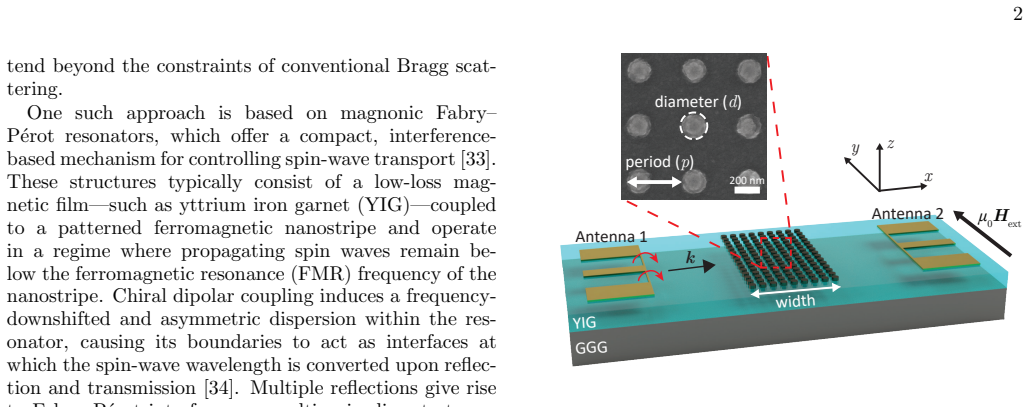
We investigate spin-wave transport in hybrid two-dimensional magnonic crystals comprising a low-damping yttrium iron garnet (YIG) film coupled to a periodic array of CoFeB nanodisks. Using propagating spin-wave spectroscopy, super-Nyquist magneto-optical Kerr effect microscopy, and micromagnetic simulations, we demonstrate the formation of pronounced and tunable bandgaps that do not originate from conventional Bragg scattering. Instead, these gaps arise from hybridization between the fundamental magnonic-crystal mode and in-plane transverse standing modes induced by the periodic nanodisk array. The spectral position and width of these gaps are controlled by geometric parameters and by the magnetic state of the nanodisks, including their vortex configuration, which governs both static and dynamic dipolar coupling. For larger lattice periods, additional gaps emerge through hybridization with modes quantized both transverse and parallel to the spin-wave propagation direction, reflecting dispersion folding in two dimensions. Our results establish mode hybridization as a versatile mechanism for engineering spin-wave band structures beyond the constraints of Bragg scattering and provide a pathway toward reconfigurable magnonic devices based on dipolar-coupled hybrid architectures.
Editorial analysis
A structured set of objections, weighed in public.
Referee Report
Summary. The paper claims that hybrid 2D magnonic crystals of a low-damping YIG film coupled to a periodic CoFeB nanodisk array exhibit pronounced, tunable spin-wave bandgaps arising from hybridization between the fundamental magnonic-crystal mode and in-plane transverse standing modes induced by the nanodisk array, rather than conventional Bragg scattering. This is shown via propagating spin-wave spectroscopy, super-Nyquist MOKE microscopy, and micromagnetic simulations, with gap position and width controlled by lattice geometry and the nanodisks' magnetic state (including vortex configurations that modulate dipolar coupling). For larger periods, additional gaps appear from 2D dispersion folding.
Significance. If the central attribution holds, the work identifies mode hybridization as a distinct, geometrically and magnetically tunable mechanism for bandgap engineering in dipolar-coupled hybrid magnonic systems, extending beyond Bragg limits and enabling reconfigurable devices. The use of three complementary techniques (spectroscopy, microscopy, and simulations) is a clear strength, as is the explicit consideration of vortex-state effects on both static and dynamic coupling.
major comments (3)
- [Micromagnetic Simulations section] The central claim that observed gaps arise exclusively from hybridization (rather than Bragg scattering or interface effects) rests on micromagnetic simulations reproducing the experimental spectra. However, the manuscript provides no sensitivity analysis on interface pinning, Gilbert damping variations, or exchange stiffness at the YIG/CoFeB boundary; these parameters can quantize or shift transverse modes and must be shown not to alter the hybridization picture.
- [Experimental Results / Propagating Spin-Wave Spectroscopy] The propagating spin-wave spectroscopy data are presented without raw spectra, fitting procedures, error bars on gap positions/widths, or explicit comparison of measured vs. simulated dispersion curves. This makes it impossible to assess whether data selection or unaccounted damping influences the reported hybridization gaps, directly affecting the claim's robustness.
- [Results on Tunable Bandgaps] The distinction from Bragg scattering is asserted via the hybridization mechanism and vortex-state dependence, but the text does not include a quantitative decomposition (e.g., via mode profiles or coupling-strength calculations) showing that the gap width scales with the transverse-mode overlap rather than lattice periodicity alone.
minor comments (2)
- [Methods] Clarify the precise definition and implementation of 'super-Nyquist' MOKE microscopy and how it spatially resolves the in-plane transverse standing modes versus the fundamental mode.
- [Introduction / Discussion] The abstract states gaps 'do not originate from conventional Bragg scattering' but the main text should include a brief side-by-side comparison of gap positions versus lattice constant to make this distinction explicit for readers.
Simulated Author's Rebuttal
We thank the referee for the constructive and detailed comments, which have helped us identify areas where the manuscript can be strengthened. We address each major comment point by point below.
read point-by-point responses
-
Referee: [Micromagnetic Simulations section] The central claim that observed gaps arise exclusively from hybridization (rather than Bragg scattering or interface effects) rests on micromagnetic simulations reproducing the experimental spectra. However, the manuscript provides no sensitivity analysis on interface pinning, Gilbert damping variations, or exchange stiffness at the YIG/CoFeB boundary; these parameters can quantize or shift transverse modes and must be shown not to alter the hybridization picture.
Authors: We agree that a sensitivity analysis on these parameters would enhance the robustness of the hybridization interpretation. Our original simulations used standard literature values (YIG: α=5×10^{-4}, A=3.7 pJ/m; CoFeB: α=5×10^{-3}, A=15 pJ/m) with no artificial interface pinning. We have since performed additional micromagnetic runs varying interface exchange coupling by ±20%, damping by ±50%, and testing weak pinning conditions. The hybridization gaps persist with position shifts below 5% and unchanged qualitative features. These results will be added as a new supplementary figure with accompanying discussion in the revised manuscript. revision: yes
-
Referee: [Experimental Results / Propagating Spin-Wave Spectroscopy] The propagating spin-wave spectroscopy data are presented without raw spectra, fitting procedures, error bars on gap positions/widths, or explicit comparison of measured vs. simulated dispersion curves. This makes it impossible to assess whether data selection or unaccounted damping influences the reported hybridization gaps, directly affecting the claim's robustness.
Authors: We acknowledge the need for greater transparency in the experimental data presentation. The spectra were obtained via vector network analyzer measurements, with gap positions extracted from transmission minima using Lorentzian fitting; typical uncertainties are ±0.1 GHz from repeated scans. We will include representative raw spectra in the supplementary information, expand the methods section to detail the fitting procedure, add error bars to the reported gap values in the main figures, and provide an explicit overlay of experimental and simulated dispersion curves in a revised figure. This will enable direct assessment of data quality and agreement with simulations. revision: yes
-
Referee: [Results on Tunable Bandgaps] The distinction from Bragg scattering is asserted via the hybridization mechanism and vortex-state dependence, but the text does not include a quantitative decomposition (e.g., via mode profiles or coupling-strength calculations) showing that the gap width scales with the transverse-mode overlap rather than lattice periodicity alone.
Authors: We partially agree. The manuscript already demonstrates that gap widths vary substantially with nanodisk magnetic state (uniform versus vortex) at fixed lattice periodicity, and provides simulated mode profiles showing spatial overlap consistent with hybridization. These elements collectively distinguish the mechanism from pure Bragg scattering. However, we did not include an explicit quantitative decomposition of coupling strength or overlap integrals. We will add this analysis in the revised manuscript, including calculations of the dipolar coupling integral between the fundamental mode and transverse standing modes, together with supporting simulation data showing the correlation between gap width and overlap for different geometries and states. revision: partial
Circularity Check
No circularity: experimental observations and independent simulations
full rationale
The paper reports direct experimental measurements via propagating spin-wave spectroscopy and super-Nyquist magneto-optical Kerr effect microscopy, together with micromagnetic simulations that reproduce the observed spectra. The attribution of bandgaps to mode hybridization (rather than Bragg scattering) follows from comparison of measured dispersion, mode profiles, and simulated dipolar fields without any self-definitional reduction, fitted-parameter predictions that loop back to the same dataset, or load-bearing self-citations. The derivation chain is self-contained against external benchmarks and does not reduce to its inputs by construction.
Axiom & Free-Parameter Ledger
Reference graph
Works this paper leans on
-
[1]
Mahmoud, F
A. Mahmoud, F. Ciubotaru, F. Vanderveken, A. V. Chu- mak, S. Hamdioui, C. Adelmann, and S. Cotofana, In- troduction to spin wave computing, J. Appl. Phys.128, 161101 (2020)
2020
-
[2]
Pirro, V
P. Pirro, V. I. Vasyuchka, A. A. Serga, and B. Hille- brands, Advances in coherent magnonics, Nat. Rev. Mater.6, 1114 (2021)
2021
-
[3]
´A. Papp, W. Porod, and G. Csaba, Nanoscale neural net- work using non-linear spin-wave interference, Nat. Com- mun.12, 6422 (2021)
2021
-
[4]
Barman, G
A. Barman, G. Gubbiotti, S. Ladak, A. O. Adeyeye, M. Krawczyk, J. Gr¨ afe, C. Adelmann, S. Cotofana, A. Naeemi, V. I. Vasyuchka,et al., The 2021 magnonics roadmap, J. Phys. Condens. Matter33, 413001 (2021)
2021
-
[5]
A. V. Chumak, P. Kabos, M. Wu, C. Abert, C. Adel- mann, A. O. Adeyeye, J. ˚Akerman, F. G. Aliev, A. Anane, A. Awad,et al., Advances in magnetics roadmap on spin-wave computing, IEEE Trans. Magn. 58, 0800172 (2022)
2022
-
[6]
Nikitov, P
S. Nikitov, P. Tailhades, and C. Tsai, Spin waves in pe- riodic magnetic structures—magnonic crystals, J. Magn. Magn. Mater.236, 320 (2001)
2001
-
[7]
Kruglyak, S
V. Kruglyak, S. Demokritov, and D. Grundler, Magnon- ics, J. Phys. D: Appl. Phys.43, 264001 (2010)
2010
-
[8]
B. Lenk, H. Ulrichs, F. Garbs, and M. M¨ unzenberg, The building blocks of magnonics, Phys. Rep.507, 107 (2011)
2011
-
[9]
Krawczyk and D
M. Krawczyk and D. Grundler, Review and prospects of magnonic crystals and devices with reprogrammable band structure, J. Phys. Condens. Matter26, 123202 (2014)
2014
-
[10]
A. V. Chumak, A. A. Serga, and B. Hillebrands, Magnonic crystals for data processing, J. Phys. D: Appl. Phys.50, 244001 (2017)
2017
-
[11]
Chumak, A
A. Chumak, A. Serga, B. Hillebrands, and M. Kostylev, Scattering of backward spin waves in a one-dimensional magnonic crystal, Appl. Phys. Lett.93, 022508 (2008)
2008
-
[12]
Qin, G.-J
H. Qin, G.-J. Both, S. J. H¨ am¨ al¨ ainen, L. Yao, and S. van Dijken, Low-loss YIG-based magnonic crystals with large tunable bandgaps, Nat. Commun.9, 5445 (2018)
2018
-
[13]
Gubbiotti, S
G. Gubbiotti, S. Tacchi, G. Carlotti, N. Singh, S. Goolaup, A. O. Adeyeye, and M. Kostylev, Collective spin modes in monodimensional magnonic crystals con- sisting of dipolarly coupled nanowires, Appl. Phys. Lett. 90, 092503 (2007)
2007
-
[14]
Kostylev, P
M. Kostylev, P. Schrader, R. L. Stamps, G. Gubbiotti, G. Carlotti, A. O. Adeyeye, S. Goolaup, and N. Singh, Partial frequency band gap in one-dimensional magnonic crystals, Appl. Phys. Lett.92, 132504 (2008)
2008
-
[15]
A. V. Chumak, P. Pirro, A. A. Serga, M. P. Kostylev, R. L. Stamps, H. Schultheiss, K. Vogt, S. J. Hermsdo- erfer, B. Laegel, P. A. Beck, and B. Hillebrands, Spin- wave propagation in a microstructured magnonic crystal, Appl. Phys. Lett.95, 262508 (2009)
2009
-
[16]
P. Frey, A. A. Nikitin, D. A. Bozhko, S. A. Bun- yaev, G. N. Kakazei, A. B. Ustinov, B. A. Kalinikos, F. Ciubotaru, A. V. Chumak, Q. Wang, V. S. Tiberke- vich, B. Hillebrands, and A. A. Serga, Reflection-less width-modulated magnonic crystal, Commun. Phys.3, 17 (2020)
2020
-
[17]
Duerr, M
G. Duerr, M. Madami, S. Neusser, S. Tacchi, G. Gub- biotti, G. Carlotti, and D. Grundler, Spatial control of spin-wave modes in Ni 80Fe20 antidot lattices by embed- ded Co nanodisks, Appl. Phys. Lett.99, 202502 (2011)
2011
-
[18]
Schwarze, R
T. Schwarze, R. Huber, G. Duerr, and D. Grundler, Com- plete band gaps for magnetostatic forward volume waves in a two-dimensional magnonic crystal, Phys. Rev. B85, 134448 (2012)
2012
-
[19]
K. O. Levchenko, K. Davidkov´ a, R. O. Serha, M. Moalic, A. A. Voronov, C. Dubs, O. Surzhenko, M. Lindner, J. Panda, Q. Wang, O. Wojewoda, B. Heinz, M. Urb´ anek, M. Krawczyk, and A. V. Chumak, 1D YIG hole-based magnonic nanocrystal, Appl. Phys. Lett.127, 172401 (2025)
2025
-
[20]
Tacchi, M
S. Tacchi, M. Madami, G. Gubbiotti, G. Carlotti, H. Tanigawa, T. Ono, and M. Kostylev, Anisotropic dy- namical coupling for propagating collective modes in a two-dimensional magnonic crystal consisting of interact- ing squared nanodots, Phys. Rev. B82, 024401 (2010)
2010
-
[21]
Tacchi, F
S. Tacchi, F. Montoncello, M. Madami, G. Gubbiotti, G. Carlotti, L. Giovannini, R. Zivieri, F. Nizzoli, S. Jain, A. O. Adeyeye, and N. Singh, Band diagram of spin waves in a two-dimensional magnonic crystal, Phys. Rev. Lett. 107, 127204 (2011)
2011
-
[22]
Z. K. Wang, V. L. Zhang, H. S. Lim, S. C. Ng, M. H. Kuok, S. Jain, and A. O. Adeyeye, Observation of fre- quency band gaps in a one-dimensional nanostructured magnonic crystal, Appl. Phys. Lett.94, 083112 (2009). 12
2009
-
[23]
Tacchi, G
S. Tacchi, G. Duerr, J. Klos, M. Madami, S. Neusser, G. Gubbiotti, G. Carlotti, M. Krawczyk, and D. Grundler, Forbidden band gaps in the spin-wave spectrum of a two-dimensional bicomponent magnonic crystal, Phys. Rev. Lett.109, 137202 (2012)
2012
-
[24]
J. Topp, D. Heitmann, M. P. Kostylev, and D. Grundler, Making a reconfigurable artificial crystal by ordering bistable magnetic nanowires, Phys. Rev. Lett.104, 207205 (2010)
2010
-
[25]
Szulc, S
K. Szulc, S. Tacchi, A. Hierro-Rodr´ ıguez, J. D´ ıaz, P. Gruszecki, P. Graczyk, C. Quir´ os, D. Mark´ o, J. I. Mart´ ın, M. V´ elez, D. S. Schmool, G. Carlotti, M. Krawczyk, and L. M. ´Alvarez Prado, Reconfigurable magnonic crystals based on imprinted magnetization tex- tures in hard and soft dipolar-coupled bilayers, ACS Nano16, 14168 (2022)
2022
-
[26]
A. V. Chumak, T. Neumann, A. A. Serga, B. Hille- brands, and M. P. Kostylev, A current-controlled, dy- namic magnonic crystal, J. Phys. D: Appl. Phys.42, 205005 (2009)
2009
-
[27]
A. V. Chumak, V. S. Tiberkevich, A. D. Karenowska, A. A. Serga, J. F. Gregg, A. N. Slavin, and B. Hille- brands, All-linear time reversal by a dynamic artificial crystal, Nat. Commun.1, 141 (2010)
2010
-
[28]
Q. Wang, A. V. Chumak, L. Jin, H. Zhang, B. Hille- brands, and Z. Zhong, Voltage-controlled nanoscale re- configurable magnonic crystal, Phys. Rev. B95, 134433 (2017)
2017
-
[29]
Merbouche, I
H. Merbouche, I. Boventer, V. Haspot, S. Fusil, V. Gar- cia, D. Gou´ er´ e, C. Carr´ et´ ero, A. Vecchiola, R. Lebrun, P. Bortolotti, L. Vila, M. Bibes, A. Barth´ el´ emy, and A. Anane, Voltage-controlled reconfigurable magnonic crystal at the sub-micrometer scale, ACS Nano15, 9775 (2021)
2021
-
[30]
Vogel, A
M. Vogel, A. V. Chumak, E. H. Waller, T. Langner, V. I. Vasyuchka, B. Hillebrands, and G. von Freymann, Opti- cally reconfigurable magnetic materials, Nat. Phys.11, 487 (2015)
2015
-
[31]
Kuznetsov, H
N. Kuznetsov, H. Qin, L. Flajˇ sman, and S. van Di- jken, Dynamic magnonic crystals based on spatiotempo- ral plasmon excitation, Adv. Mater.37, 2502474 (2025)
2025
-
[32]
A. V. Sadovnikov, A. A. Grachev, A. A. Serdobint- sev, S. E. Sheshukova, S. S. Yankin, and S. A. Nikitov, Magnon straintronics to control spin-wave computation: Strain reconfigurable magnonic-crystal directional cou- pler, IEEE Magn. Lett.10, 5506405 (2019)
2019
-
[33]
H. Qin, R. Holl¨ ander, L. Flajˇ sman, F. Hermann, R. Dreyer, G. Woltersdorf, and S. van Dijken, Nanoscale magnonic Fabry-P´ erot resonator for low-loss spin-wave manipulation, Nat. Commun.12, 2293 (2021)
2021
-
[34]
Talapatra, H
A. Talapatra, H. Qin, F. Schulz, L. Yao, L. Flajˇ sman, M. Weigand, S. Wintz, and S. van Dijken, Imaging of short-wavelength spin waves in a nanometer-thick YIG/Co bilayer, Appl. Phys. Lett.122(2023)
2023
-
[35]
Lutsenko, K
A. Lutsenko, K. G. Fripp, L. Flajˇ sman, A. V. Shy- tov, V. V. Kruglyak, and S. van Dijken, Magnonic Fabry–P´ erot resonators as programmable phase shifters, Appl. Phys. Lett.126, 082406 (2025)
2025
-
[36]
A. Lutsenko, K. G. Fripp, L. Flajˇ sman, A. V. Shy- tov, V. V. Kruglyak, and S. van Dijken, Nonlinear dynamics in magnonic Fabry–P´ erot resonators: Low- power neuron-like activation and transmission suppres- sion, arXiv preprint arXiv:2602.10650 (2026)
-
[37]
Vansteenkiste, J
A. Vansteenkiste, J. Leliaert, M. Dvornik, M. Helsen, F. Garcia-Sanchez, and B. Van Waeyenberge, The design and verification of MuMax3, AIP Adv.4, 107133 (2014)
2014
-
[38]
Moalic, amumax: a fork of MuMax3 with en- hanced Python workflow integration,https://github
M. Moalic, amumax: a fork of MuMax3 with en- hanced Python workflow integration,https://github. com/MathieuMoalic/amumax(2025), accessed: 2025
2025
-
[39]
Szulc, M
K. Szulc, M. Zelent, and M. Krawczyk, Multifunctional magnonic platform based on the interplay between spin- wave waveguide and nanodots with PMA and DMI, APL Mater.13, 091108 (2025)
2025
-
[40]
Shinjo, T
T. Shinjo, T. Okuno, R. Hassdorf, K. Shigeto, and T. Ono, Magnetic vortex core observation in circular dots of permalloy, Science289, 930 (2000)
2000
-
[41]
R. P. Cowburn, D. Koltsov, A. Adeyeye, M. Welland, and D. Tricker, Single-domain circular nanomagnets, Phys. Rev. Lett.83, 1042 (1999)
1999
-
[42]
K. Y. Guslienko, V. Novosad, Y. Otani, H. Shima, and K. Fukamichi, Magnetization reversal due to vor- tex nucleation, displacement, and annihilation in submi- cron ferromagnetic dot arrays, Phys. Rev. B65, 024414 (2001)
2001
-
[43]
H. Qin, S. J. H¨ am¨ al¨ ainen, K. Arjas, J. Witteveen, and S. van Dijken, Propagating spin waves in nanometer- thick yttrium iron garnet films: Dependence on wave vector, magnetic field strength, and angle, Phys. Rev. B98, 224422 (2018)
2018
discussion (0)
Sign in with ORCID, Apple, or X to comment. Anyone can read and Pith papers without signing in.