Recognition: unknown
A process-based dynamic occupancy model to study range dynamics under non-equilibrium conditions
Pith reviewed 2026-05-08 16:27 UTC · model grok-4.3
The pith
A dispersal-pressure dynamic occupancy model disentangles connectivity from environment to identify limits on species distributions under non-equilibrium conditions.
A machine-rendered reading of the paper's core claim, the machinery that carries it, and where it could break.
Core claim
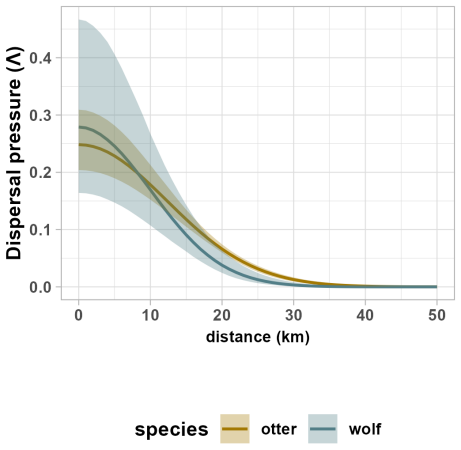
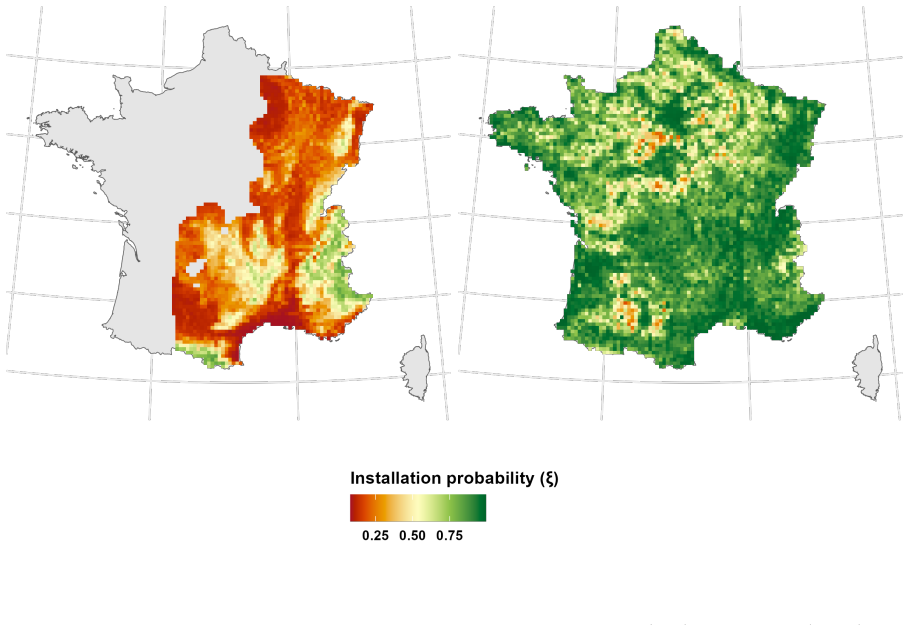
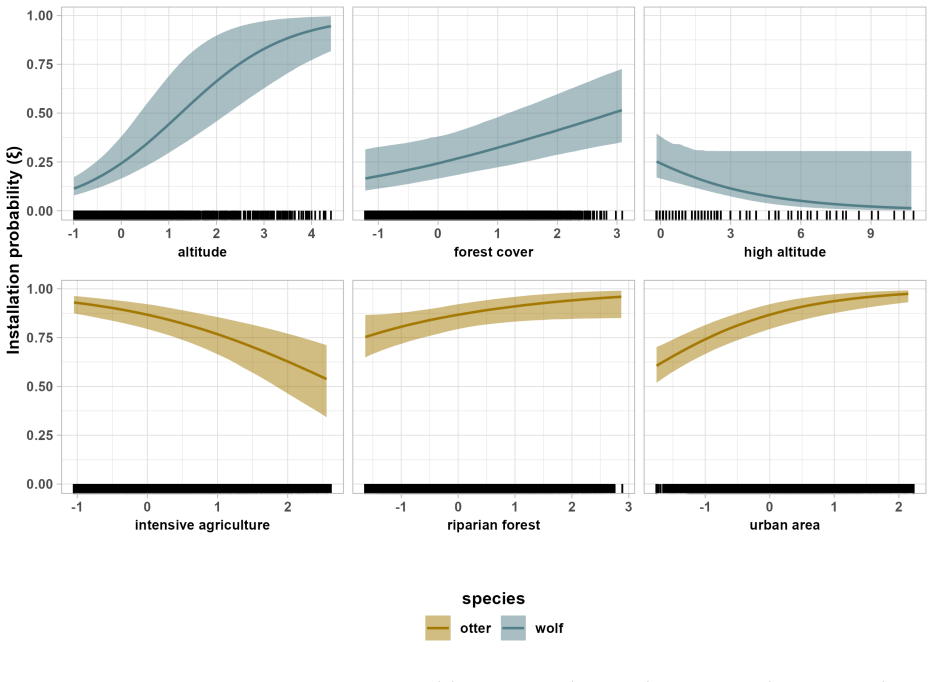
We propose a dynamic occupancy model whose colonization probability is formulated as a function of dispersal pressure from nearby occupied sites, implemented with sparse matrices for national-scale computation. Simulations confirm unbiased recovery of parameters under multiple ecological conditions. Application to grey wolf and Eurasian otter data reveals contrasting drivers: wolves constrained by altitude and forest, otters constrained by dispersal history rather than environment.
What carries the argument
The dispersal-pressure formulation of the colonization process, which models the influence of dispersing individuals from occupied neighboring sites in a flexible, interpretable way.
If this is right
- Environmental effects on occupancy can be estimated separately from dispersal effects.
- Species-specific limiting factors (habitat versus dispersal history) become identifiable.
- The approach scales to national and transnational data sets.
- Predictive performance for range dynamics improves when connectivity is modeled explicitly.
Where Pith is reading between the lines
- The framework could improve forecasts of range shifts under climate change by treating dispersal as an explicit, measurable process.
- It may help prioritize connectivity conservation where dispersal history, not habitat, is the binding constraint.
- The same structure could be adapted to model range contractions or invasions without new model classes.
Load-bearing premise
The dispersal-pressure formulation accurately captures real colonization without introducing bias into estimates of environmental effects.
What would settle it
Independent field measurements of dispersal rates or distances that deviate markedly from the colonization parameters estimated by the model on the same species would falsify the claim.
Figures

read the original abstract
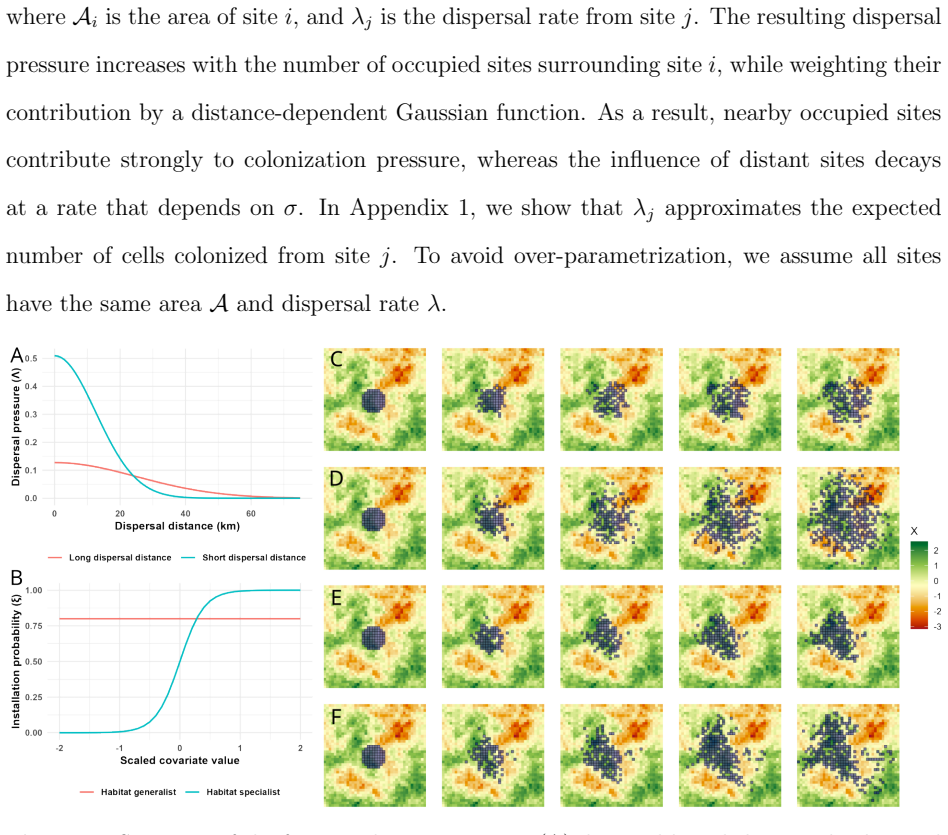
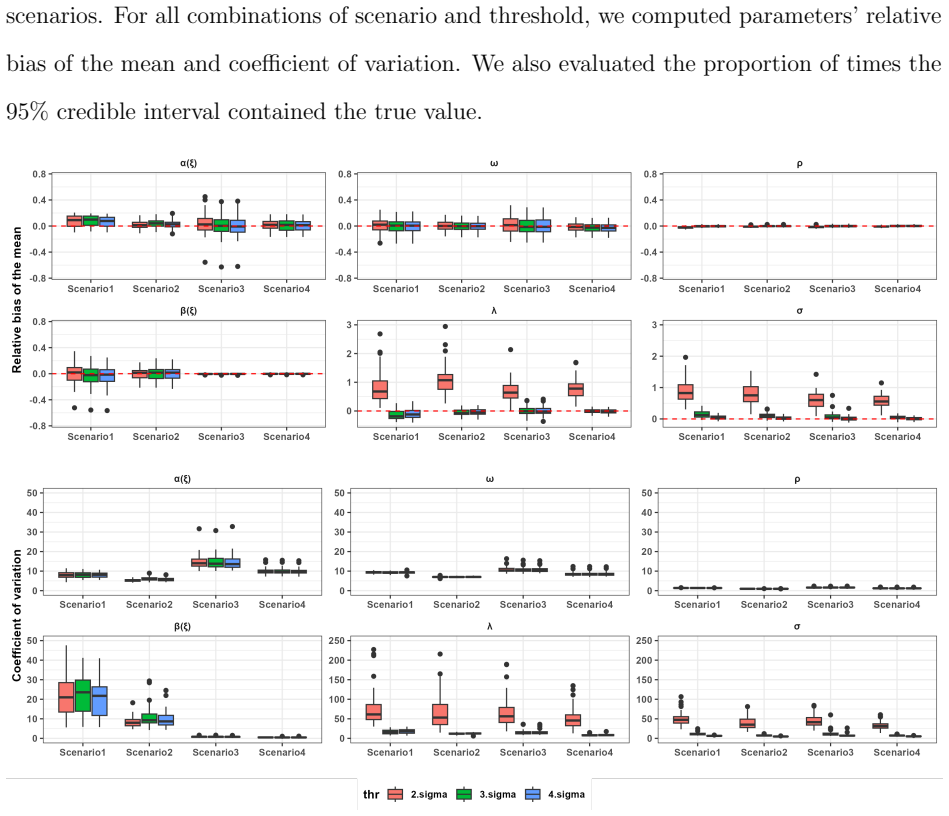
Failing to account for ecological processes such as dispersal and connectivity when modeling distributions can lead to biased inference about environmental drivers and reduced predictive performance. Spatial dynamic occupancy models are promising to study range dynamics while accounting for dispersal and connectivity, but they currently rely on restrictive formulations of the colonization process, and computational constraints prevent their application at large spatial scales. Here, we propose a process-based dynamic occupancy model to study the distribution of range-expanding species while accounting for connectivity and effects of the environment. We introduce a formulation based on dispersal-pressure that provides a flexible and ecologically interpretable representation of the colonization process, and develop a computational approach based on sparse distance matrices that enables its application to national and transnational scales. We conducted a simulation study that showed unbiased parameter estimation across various ecological scenarios. We also applied our model to two range-expanding carnivores offering complementary insights: the grey wolf and the Eurasian otter. Our model revealed contrasting colonization dynamic, with wolves primarily constrained by altitude and forest cover while otters where only marginally affected by the environment, suggesting that their distribution is limited by dispersal history rather than habitat preferences. By explicitly disentangling the influence of dispersal and environment on distributions, our model provides better insight into occupancy-environment relationships under non-equilibrium conditions, and help identifies what limits species distributions. In light of the increasing availability of large-scale biodiversity data, our framework offers opportunities to study range dynamics using mechanistic approaches across entire landscapes.
Editorial analysis
A structured set of objections, weighed in public.
Referee Report
Summary. The manuscript proposes a process-based dynamic occupancy model incorporating a dispersal-pressure formulation for the colonization process to account for connectivity and environmental effects when modeling range dynamics of expanding species under non-equilibrium conditions. It develops a sparse distance matrix approach for computational tractability at large scales, reports unbiased parameter recovery in simulations across scenarios, and applies the model to grey wolf and Eurasian otter data, concluding that wolves are primarily limited by environmental factors (altitude and forest cover) while otters are limited by dispersal history rather than habitat.
Significance. If the central claims hold, the work advances the field by providing a mechanistic framework that explicitly disentangles dispersal history from environmental drivers in occupancy models, addressing a known limitation of standard approaches. The simulation validation across scenarios and the contrasting real-data insights for two species are strengths that support its potential utility. The large-scale computational method is also a practical contribution given increasing availability of biodiversity data.
major comments (2)
- [Simulation study (as referenced in abstract)] The dispersal-pressure formulation is presented as flexible and ecologically interpretable for separating colonization from environmental effects, but the simulation study does not appear to have tested scenarios in which the environment simultaneously influences both occupancy and dispersal processes; this leaves open the possibility of residual confounding in the occupancy-environment relationships reported for the real-data applications.
- [Application section] In the real-data application, the conclusion that otters are dispersal-limited (while wolves are environment-limited) depends on the specific kernel and independence assumptions in the dispersal-pressure term; without sensitivity analyses varying the kernel form or including environment-dispersal interactions, it is unclear whether the contrasting insights reflect biological differences or model structure.
minor comments (2)
- [Abstract] The abstract contains a minor grammatical error ('help identifies' should read 'helps identify').
- [Methods] Additional details on data exclusion rules, error propagation, and exact implementation of the sparse matrix approach would improve reproducibility and clarity in the methods.
Simulated Author's Rebuttal
We thank the referee for their constructive and positive review of our manuscript. We have carefully addressed each major comment below and revised the manuscript to incorporate additional analyses where appropriate.
read point-by-point responses
-
Referee: [Simulation study (as referenced in abstract)] The dispersal-pressure formulation is presented as flexible and ecologically interpretable for separating colonization from environmental effects, but the simulation study does not appear to have tested scenarios in which the environment simultaneously influences both occupancy and dispersal processes; this leaves open the possibility of residual confounding in the occupancy-environment relationships reported for the real-data applications.
Authors: We thank the referee for highlighting this point. Our simulation study examined multiple scenarios with environmental effects on occupancy, environmental effects on colonization, and different dispersal kernels, demonstrating unbiased recovery in each case. However, we did not include an explicit scenario in which the identical environmental covariates simultaneously and directly influence both the occupancy and dispersal-pressure processes. We agree this is a useful addition for ruling out residual confounding. In the revised manuscript, we will add this simulation scenario and report the results to confirm that the model structure continues to separate the processes effectively. revision: yes
-
Referee: [Application section] In the real-data application, the conclusion that otters are dispersal-limited (while wolves are environment-limited) depends on the specific kernel and independence assumptions in the dispersal-pressure term; without sensitivity analyses varying the kernel form or including environment-dispersal interactions, it is unclear whether the contrasting insights reflect biological differences or model structure.
Authors: We agree that robustness to kernel choice and potential environment-dispersal interactions merits explicit testing. The original analyses used species-specific kernels grounded in the literature, with the independence assumption inherent to the dispersal-pressure formulation. To address the concern, the revised manuscript will include sensitivity analyses that (i) vary the kernel form (e.g., exponential versus Gaussian) and (ii) allow for environment-dispersal interactions where computationally feasible. These results will be presented alongside the main findings so that readers can evaluate whether the contrasting conclusions for wolves and otters are robust to these modeling choices. revision: yes
Circularity Check
No significant circularity: model derived from process assumptions with independent simulation validation
full rationale
The paper introduces a dispersal-pressure formulation for the colonization process in dynamic occupancy models, supported by ecological process assumptions and validated through simulation studies that recover parameters without bias across scenarios. Application to wolf and otter data provides contrasting insights based on fitted results rather than tautological reduction. No load-bearing derivation step reduces by construction to its own inputs, fitted parameters renamed as predictions, or self-citation chains. The derivation chain remains self-contained against external benchmarks like simulation recovery and real-data application.
Axiom & Free-Parameter Ledger
axioms (1)
- domain assumption Colonization can be represented via a flexible dispersal-pressure process that incorporates connectivity and environment
Reference graph
Works this paper leans on
-
[1]
Lacombe, Simon and Devillard, Sébastien and D’Hollande, Louise and Raulet, Yann and Sablain, Vincent and Barbu, Louis and Didier, Geoffrey and Mathevet, Raphaël and Miaud, Claude and Oyon, Clément and Pommelet, Eve le and Richarte, Sébastien and Rouvière, Serge and Valentini, Alice and Vazzoler-Antoine, Nathalie and Gimenez, Olivier , month = apr, year =....
-
[2]
Canadian Geographer / Le géographe canadien , author =
Traffic volume and highway permeability for a mammalian community in the. Canadian Geographer / Le géographe canadien , author =. 2005 , pages =. doi:10.1111/j.0008-3658.2005.00099.x , abstract =
-
[3]
Disentangling the contributions of dispersal limitation, ecological drift, and ecological filtering to wild bee community assembly , volume =. Ecosphere , author =. 2017 , keywords =. doi:10.1002/ecs2.1650 , abstract =
-
[4]
Dynamic occupancy models for explicit colonization processes , volume =. Ecology , author =. 2016 , keywords =. doi:10.1890/15-0416.1 , abstract =
-
[5]
and Jr, William Z
Hilty, Jodi A. and Jr, William Z. Lidicker and Merenlender, Adina M. , month = feb, year =. Corridor
-
[6]
and Nichols, James D
MacKenzie, Darryl I. and Nichols, James D. and Royle, J. Andrew and Pollock, Kenneth H. and Bailey, Larissa and Hines, James E. , month = nov, year =. Occupancy
-
[7]
Kruuk, Hans , month = aug, year =. Otters:
-
[8]
and Mosler-Berger, Christa and Olsson, Mattias and Strein, Martin , year =
Huijser, Marcel P. and Mosler-Berger, Christa and Olsson, Mattias and Strein, Martin , year =. Wildlife. Handbook of. doi:10.1002/9781118568170.ch24 , abstract =
-
[9]
Wild ungulate overabundance in. Mammal Review , author =. 2021 , keywords =. doi:10.1111/mam.12221 , abstract =
-
[10]
Wildlife Society Bulletin , author =
Why camera traps fail to detect a semi-aquatic mammal:. Wildlife Society Bulletin , author =. 2015 , keywords =. doi:10.1002/wsb.508 , abstract =
-
[11]
Methods in Ecology and Evolution , author =
Using partial aggregation in spatial capture recapture , volume =. Methods in Ecology and Evolution , author =. 2018 , keywords =. doi:10.1111/2041-210X.13030 , abstract =
-
[12]
Wildlife Society Bulletin , author =
Using cost-effectiveness analysis to compare density-estimation methods for large-scale wildlife management , volume =. Wildlife Society Bulletin , author =. 2023 , keywords =. doi:10.1002/wsb.1430 , abstract =
-
[13]
Using. Ecology , author =. 2008 , keywords =. doi:10.1890/07-1861.1 , abstract =
-
[14]
Tropical. Environmental DNA , author =. 2025 , keywords =. doi:10.1002/edn3.70141 , abstract =
-
[15]
To predict the niche, model colonization and extinction , volume =. Ecology , author =. 2015 , keywords =. doi:10.1890/14-1361.1 , abstract =
-
[16]
Ecological Applications , author =
Time-to-detection occupancy methods: performance and utility for improving efficiency of surveys , volume =. Ecological Applications , author =. 2021 , keywords =. doi:10.1002/eap.2267 , abstract =
-
[17]
Do Linh San, Emmanuel and Sato, Jun J. and Belant, Jerrold L. and Somers, Michael J. , year =. The. Small. doi:10.1002/9781118943274.ch1 , abstract =
-
[18]
Methods in Ecology and Evolution , author =
The recent past and promising future for data integration methods to estimate species’ distributions , volume =. Methods in Ecology and Evolution , author =. 2019 , keywords =. doi:10.1111/2041-210X.13110 , abstract =
-
[19]
Frontiers in Ecology and the Environment , author =
The current state of citizen science as a tool for ecological research and public engagement , volume =. Frontiers in Ecology and the Environment , author =. 2012 , pages =. doi:10.1890/110236 , abstract =
-
[20]
Molecular Ecology Resources , author =
Tag jumps illuminated – reducing sequence-to-sample misidentifications in metabarcoding studies , volume =. Molecular Ecology Resources , author =. 2015 , keywords =. doi:10.1111/1755-0998.12402 , abstract =
-
[21]
Journal of Animal Ecology , author =
Support for the size-mediated sensitivity hypothesis within a diverse carnivore community , volume =. Journal of Animal Ecology , author =. 2024 , keywords =. doi:10.1111/1365-2656.13916 , abstract =
-
[22]
Static species distribution models in dynamically changing systems: how good can predictions really be? , volume =. Ecography , author =. 2009 , pages =. doi:10.1111/j.1600-0587.2009.05810.x , abstract =
-
[23]
Conservation Science and Practice , author =
Spraints demonstrate small population size and reliance on fishponds for. Conservation Science and Practice , author =. 2023 , keywords =. doi:10.1111/csp2.12851 , abstract =
-
[24]
Methods in Ecology and Evolution , author =. 2022 , keywords =. doi:10.1111/2041-210X.13897 , abstract =
-
[25]
Methods in Ecology and Evolution , author =
Spatio-temporal data integration for species distribution modelling in. Methods in Ecology and Evolution , author =. 2024 , keywords =. doi:10.1111/2041-210X.14356 , abstract =
-
[26]
Evolutionary Applications , author =
Spatio-. Evolutionary Applications , author =. 2025 , keywords =. doi:10.1111/eva.70067 , abstract =
-
[27]
Journal of Applied Ecology , author =
Spatial replicates as an alternative to temporal replicates for occupancy modelling when surveys are based on linear features of the landscape , volume =. Journal of Applied Ecology , author =. 2014 , keywords =. doi:10.1111/1365-2664.12301 , abstract =
-
[28]
Journal of Applied Ecology , author =
Spatial occupancy models for predicting metapopulation dynamics and viability following reintroduction , volume =. Journal of Applied Ecology , author =. 2015 , keywords =. doi:10.1111/1365-2664.12481 , abstract =
-
[29]
Global Ecology and Biogeography , author =
Spatial and species-level predictions of road mortality risk using trait data , volume =. Global Ecology and Biogeography , author =. 2018 , keywords =. doi:10.1111/geb.12769 , abstract =
-
[30]
Riverine landscapes: taking landscape ecology into the water , volume =. Freshwater Biology , author =. 2002 , keywords =. doi:10.1046/j.1365-2427.2002.00887.x , abstract =
-
[31]
Journal of Applied Ecology , author =. 2015 , keywords =. doi:10.1111/1365-2664.12432 , abstract =
-
[32]
Journal of Applied Ecology , author =. 2014 , keywords =. doi:10.1111/1365-2664.12306 , abstract =
-
[33]
Conservation Biology , author =
Relative. Conservation Biology , author =. 2002 , pages =. doi:10.1046/j.1523-1739.2002.00386.x , abstract =
-
[34]
Animal Conservation , author =
Recent range contractions in the globally threatened. Animal Conservation , author =. 2018 , keywords =. doi:10.1111/acv.12422 , abstract =
-
[35]
Methods in Ecology and Evolution , author =. 2014 , keywords =. doi:10.1111/2041-210X.12162 , abstract =
-
[36]
Eos, Transactions American Geophysical Union , author =
Quantitative analysis of watershed geomorphology , volume =. Eos, Transactions American Geophysical Union , author =. 1957 , pages =. doi:10.1029/TR038i006p00913 , language =
-
[37]
Journal of Applied Ecology , author =
Proving a negative:. Journal of Applied Ecology , author =. 2025 , keywords =. doi:10.1111/1365-2664.70099 , abstract =
-
[38]
Diversity and Distributions , author =
Prioritizing road-kill mitigation areas:. Diversity and Distributions , author =. 2020 , keywords =. doi:10.1111/ddi.13064 , abstract =
-
[39]
Predictive modeling of animal-vehicle collisions involving the threatened leopard cat (
Kim, Kyungmin and Kim, Kiyoon and Bliss, Desiree Andersen and Jang, Yikweon , month = jan, year =. Predictive modeling of animal-vehicle collisions involving the threatened leopard cat (. Animal Cells and Systems , publisher =. doi:10.1080/19768354.2026.2620251 , abstract =
-
[40]
Diversity and Distributions , author =
Predicting species distributions from museum and herbarium records using multiresponse models fitted with multivariate adaptive regression splines , volume =. Diversity and Distributions , author =. 2007 , keywords =. doi:10.1111/j.1472-4642.2007.00340.x , abstract =
-
[41]
Australian & New Zealand Journal of Statistics , author =
Practical. Australian & New Zealand Journal of Statistics , author =. 2000 , keywords =. doi:10.1111/1467-842X.00128 , abstract =
-
[42]
Global Ecology and Biogeography , author =
Population density and genetic diversity are positively correlated in wild felids globally , volume =. Global Ecology and Biogeography , author =. 2023 , keywords =. doi:10.1111/geb.13727 , abstract =
-
[43]
Population and individual-scale responses to patch size, isolation and quality in the hazel dormouse , volume =. Ecosphere , author =. 2014 , keywords =. doi:10.1890/ES14-00115.1 , abstract =
-
[44]
Methods in Ecology and Evolution , author =. 2023 , keywords =. doi:10.1111/2041-210X.14091 , abstract =
-
[45]
Methods in Ecology and Evolution , author =
Point process models for presence-only analysis , volume =. Methods in Ecology and Evolution , author =. 2015 , keywords =. doi:10.1111/2041-210X.12352 , abstract =
-
[46]
Conservation Letters , author =
Poaching is more than an. Conservation Letters , author =. 2014 , keywords =. doi:10.1111/conl.12082 , abstract =
-
[47]
Journal of Applied Ecology , author =
Patterns of otter. Journal of Applied Ecology , author =. 1999 , keywords =. doi:10.1046/j.1365-2664.1999.00441.x , abstract =
-
[48]
Patterns and significance of bite wounds in. Veterinary Record , author =. 2006 , pages =. doi:10.1136/vr.158.4.113 , abstract =
-
[49]
Opportunistic records reveal. Ecography , author =. 2019 , keywords =. doi:10.1111/ecog.04122 , abstract =
-
[50]
Molecular Ecology Resources , author =
obitools: a unix-inspired software package for. Molecular Ecology Resources , author =. 2016 , keywords =. doi:10.1111/1755-0998.12428 , abstract =
-
[51]
Next-generation monitoring of aquatic biodiversity using environmental. Molecular Ecology , author =. 2016 , keywords =. doi:10.1111/mec.13428 , abstract =
-
[52]
Ecography , author =. 2019 , keywords =. doi:10.1111/ecog.04516 , abstract =
-
[53]
Ecological Entomology , author =
Nature protection areas of. Ecological Entomology , author =. 2018 , keywords =. doi:10.1111/een.12485 , abstract =
-
[54]
Zeitschrift für Tierpsychologie , author =
Mustelid. Zeitschrift für Tierpsychologie , author =. 1979 , pages =. doi:10.1111/j.1439-0310.1979.tb01023.x , abstract =
-
[55]
Aquatic Conservation: Marine and Freshwater Ecosystems , author =
Monitoring the threatened. Aquatic Conservation: Marine and Freshwater Ecosystems , author =. 2024 , keywords =. doi:10.1002/aqc.4111 , abstract =
-
[56]
Journal of Applied Ecology , author =
Monitoring species abundance and distribution at the landscape scale , volume =. Journal of Applied Ecology , author =. 2011 , keywords =. doi:10.1111/j.1365-2664.2010.01917.x , abstract =
-
[57]
The Journal of Wildlife Management , author =
Monitoring mesocarnivores with tracks and technology using multi-method modeling , volume =. The Journal of Wildlife Management , author =. 2023 , keywords =. doi:10.1002/jwmg.22382 , abstract =
-
[58]
Monitoring endangered freshwater biodiversity using environmental. Molecular Ecology , author =. 2012 , keywords =. doi:10.1111/j.1365-294X.2011.05418.x , abstract =
-
[59]
Modelling the surprising recolonisation of an understudied aquatic mammal in a highly urbanised area: fortune favoured the smooth-coated otter in. Wildlife Biology , author =. 2024 , keywords =. doi:10.1002/wlb3.01200 , abstract =
-
[60]
Modelling of species distributions, range dynamics and communities under imperfect detection: advances, challenges and opportunities , volume =. Ecography , author =. 2017 , pages =. doi:10.1111/ecog.02445 , abstract =
-
[61]
Methods in Ecology and Evolution , author =
Modelling non-. Methods in Ecology and Evolution , author =. 2015 , keywords =. doi:10.1111/2041-210X.12316 , abstract =
-
[62]
Middle-out ecology: small carnivores as sentinels of global change , volume =. Mammal Review , author =. 2022 , keywords =. doi:10.1111/mam.12300 , abstract =
-
[63]
Microplastics in. Ecosphere , author =. 2022 , keywords =. doi:10.1002/ecs2.3955 , abstract =
-
[64]
Ecology and Evolution , author =
Meta-analysis shows that environmental. Ecology and Evolution , author =. 2021 , keywords =. doi:10.1002/ece3.7382 , abstract =
-
[65]
Animal Conservation , author =
Long-distance wolf recolonization of. Animal Conservation , author =. 2003 , pages =. doi:10.1017/S1367943003003111 , abstract =
-
[66]
The Journal of Wildlife Management , author =
Long-. The Journal of Wildlife Management , author =. 2009 , keywords =. doi:10.2193/2008-510 , abstract =
-
[67]
Diversity and Distributions , author =
Land use drivers of species re-expansion: inferring colonization dynamics in. Diversity and Distributions , author =. 2012 , keywords =. doi:10.1111/j.1472-4642.2012.00898.x , abstract =
-
[68]
Methods in Ecology and Evolution , author =
Jointly estimating spatial sampling effort and habitat suitability for multiple species from opportunistic presence-only data , volume =. Methods in Ecology and Evolution , author =. 2021 , keywords =. doi:10.1111/2041-210X.13565 , abstract =
-
[69]
It's raining species:. Environmental DNA , author =. 2023 , keywords =. doi:10.1002/edn3.372 , abstract =
-
[70]
Methods in Ecology and Evolution , author =
Introducing a ‘stochastic movement simulator’ for estimating habitat connectivity , volume =. Methods in Ecology and Evolution , author =. 2011 , keywords =. doi:10.1111/j.2041-210X.2010.00073.x , abstract =
-
[71]
Inter-individual variability in dispersal behaviours impacts connectivity estimates , volume =. Oikos , author =. 2014 , pages =. doi:10.1111/oik.01248 , abstract =
-
[72]
Journal of Applied Ecology , author =
Integrating presence-only and detection/non-detection data to estimate distributions and expected abundance of difficult-to-monitor species on a landscape-scale , volume =. Journal of Applied Ecology , author =. 2024 , keywords =. doi:10.1111/1365-2664.14633 , abstract =
-
[73]
Methods in Ecology and Evolution , author =
Integrated species distribution models: combining presence-background data and site-occupancy data with imperfect detection , volume =. Methods in Ecology and Evolution , author =. 2017 , keywords =. doi:10.1111/2041-210X.12738 , abstract =
-
[74]
Ecological Applications , author =
Integrated species distribution models reveal spatiotemporal patterns of human–wildlife conflict , volume =. Ecological Applications , author =. 2022 , keywords =. doi:10.1002/eap.2647 , abstract =
-
[75]
Integrated modeling of waterfowl distribution in western. Ecosphere , author =. 2021 , keywords =. doi:10.1002/ecs2.3790 , abstract =
-
[76]
Increasing connectivity between metapopulation ecology and landscape ecology , volume =. Ecology , author =. 2018 , keywords =. doi:10.1002/ecy.2189 , abstract =
-
[77]
Molecular Ecology Resources , author =
Improving the reliability of. Molecular Ecology Resources , author =. 2021 , keywords =. doi:10.1111/1755-0998.13367 , abstract =
-
[78]
Improving biodiversity monitoring , volume =. Austral Ecology , author =. 2012 , keywords =. doi:10.1111/j.1442-9993.2011.02314.x , abstract =
-
[79]
Animal Conservation , author =
Identifying priority conservation areas for a recovering brown bear population in. Animal Conservation , author =. 2020 , keywords =. doi:10.1111/acv.12522 , abstract =
-
[80]
Journal of Biogeography , author =
Ice age distributions of. Journal of Biogeography , author =. 2009 , keywords =. doi:10.1111/j.1365-2699.2009.02089.x , abstract =
discussion (0)
Sign in with ORCID, Apple, or X to comment. Anyone can read and Pith papers without signing in.