Recognition: unknown
Update-Magnitude State Redistribution (UM-SRD): A Shut-off Extension of Weighted SRD for Cut-Cell Methods
Pith reviewed 2026-05-08 16:06 UTC · model grok-4.3
The pith
UM-SRD blends weighted state redistribution with the identity operator using an update-magnitude indicator to achieve exact steady-state preservation in cut-cell finite-volume methods.
A machine-rendered reading of the paper's core claim, the machinery that carries it, and where it could break.
Core claim
By multiplying the SRD redistribution term with a smooth scalar indicator that depends on the size of the local finite-volume update, UM-SRD reduces exactly to the base scheme when that update vanishes in the small-cell neighborhood. For a one-dimensional model problem with a single small cut cell, this blended operator is total variation diminishing under the same CFL restriction as the underlying upwind scheme. The local truncation error introduced by the modification is of higher order in smooth regions when the unnormalized indicator is employed, while the normalized form maintains first-order accuracy overall. Numerical results confirm first-order convergence, exact steady-state, and, 1
What carries the argument
The locally defined smooth blending indicator that measures the magnitude of the finite-volume update and scales the SRD correction accordingly, vanishing when the update is zero.
Load-bearing premise
The blending indicator is smooth and locally defined so that the overall operator remains conservative and inherits the total variation diminishing property from the base scheme under the same CFL limit.
What would settle it
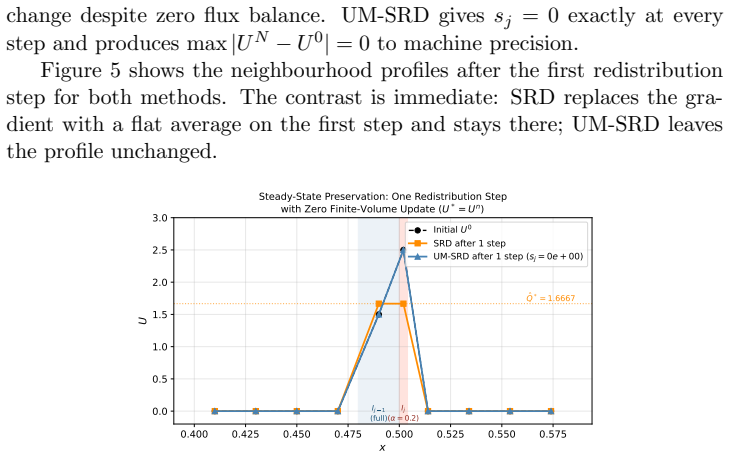
Running the one-dimensional upwind advection scheme on a domain with a single small cut cell until a steady state is reached; UM-SRD should keep the solution exactly constant once the update magnitude reaches zero, while standard SRD would continue to apply small redistributions.
Figures

read the original abstract
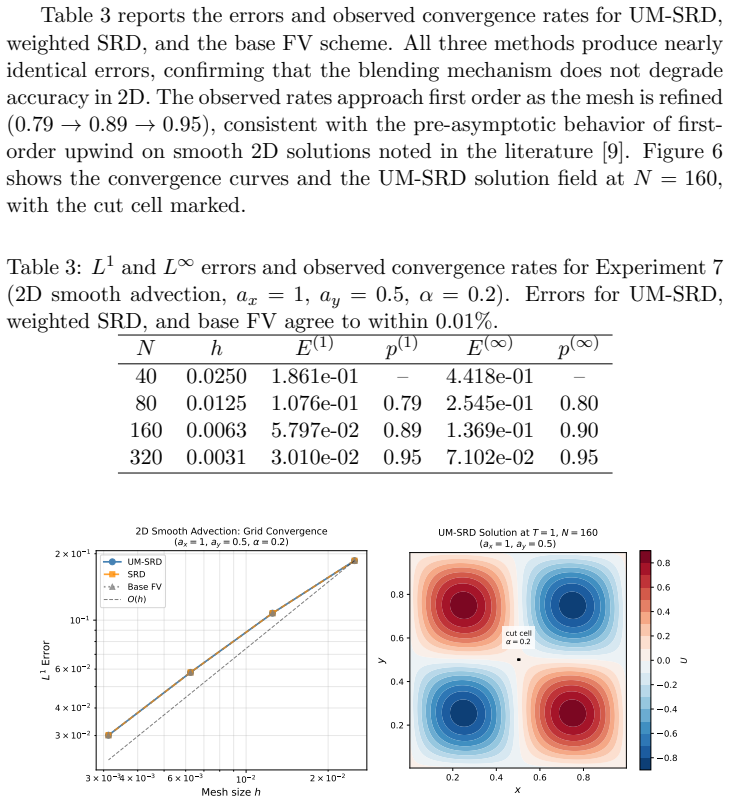
Berger & Giuliani (2024) developed a provably stable weighted state redistribution (SRD) algorithm for cut-cell meshes. A key limitation of their method is that, although flux redistribu- tion naturally vanishes when updates are small, SRD continuously applies redistribution even when the flux balance is zero, preventing exact steady-state preservation and potentially in- troducing unnecessary dissipation in smooth regions. This work introduces Update-Magnitude State Redistribution (UM-SRD), which blends the SRD operator with the identity operator via a smooth, locally-defined scalar indicator of the finite-volume update magnitude. UM-SRD preserves conservation and reduces exactly to the base scheme when the finite-volume update is exactly zero in a small-cell neighborhood. For a one-dimensional model problem with a single small cut cell, we prove UM-SRD is total variation diminishing under the same CFL condition as the base upwind scheme, show the local truncation error modification is higher-order in smooth regions with the unnormalized indicator, and show that the normalized implementation pre- serves first-order accuracy. Numerical experiments demonstrate convergence toward first order on smooth 1D and 2D advection tests, confirm shut-off behaviour, verify non-oscillatory proper- ties, provide numerical evidence that UM-SRD stabilizes the base scheme near a small cut cell where the base scheme diverges, and confirm exact steady-state preservation. The algorithm reuses existing weighted SRD infrastructure, adding only a local blending mechanism, making it practical for cut-cell finite-volume codes.
Editorial analysis
A structured set of objections, weighed in public.
Referee Report
Summary. The paper introduces Update-Magnitude State Redistribution (UM-SRD) as a shut-off extension of weighted SRD for cut-cell finite-volume methods. It blends the SRD redistribution operator with the identity operator using a smooth, locally-defined scalar indicator based on the magnitude of the finite-volume update. The method is claimed to preserve conservation, reduce exactly to the base scheme when the update is zero, and enable exact steady-state preservation. For a 1D model problem with a single small cut cell, the authors prove that UM-SRD is total variation diminishing under the base upwind CFL condition, show that the local truncation error modification is higher-order in smooth regions with the unnormalized indicator, and demonstrate that the normalized version preserves first-order accuracy. Numerical experiments on 1D and 2D advection problems confirm first-order convergence, shut-off behavior, non-oscillatory properties, stabilization near small cut cells, and exact steady-state preservation. The algorithm reuses existing weighted SRD infrastructure with only a local blending addition.
Significance. If the central claims hold, UM-SRD offers a practical, low-overhead improvement to cut-cell methods by achieving exact steady-state preservation without introducing fitted constants or sacrificing conservation. The 1D TVD proof under the base CFL condition and the explicit numerical confirmation of shut-off and steady-state preservation are clear strengths. The reuse of existing SRD infrastructure makes the approach immediately usable in existing codes. However, the significance is tempered by the fact that the multi-dimensional extension and indicator construction remain unproven beyond the 1D case, limiting the immediate applicability to 2D/3D cut-cell simulations.
major comments (2)
- Abstract: the blending indicator is asserted to be 'smooth, locally-defined' and to preserve conservation and the base CFL condition, but no explicit construction, normalization formula, or multi-dimensional definition is supplied. This is load-bearing for the TVD proof and the claim that the blended operator remains conservative when multiple small cells interact.
- Proof of TVD property and truncation-error analysis (1D model problem section): these results are derived only for a single small cut cell in one dimension. The 2D advection experiments assume the same indicator properties extend without additional justification or analysis of interface smoothness or locality across dimensions.
minor comments (1)
- Numerical experiments section: explicitly state whether the 2D tests employ the unnormalized or normalized indicator, since the abstract distinguishes their truncation-error and accuracy properties.
Simulated Author's Rebuttal
We thank the referee for the careful reading and constructive feedback on our manuscript. We address each major comment below in detail and indicate the changes we will incorporate in the revised version.
read point-by-point responses
-
Referee: Abstract: the blending indicator is asserted to be 'smooth, locally-defined' and to preserve conservation and the base CFL condition, but no explicit construction, normalization formula, or multi-dimensional definition is supplied. This is load-bearing for the TVD proof and the claim that the blended operator remains conservative when multiple small cells interact.
Authors: We agree that the abstract is brief and would benefit from additional detail on the indicator. The explicit construction of the update-magnitude indicator, including its normalization to ensure it lies in [0,1] and its smoothness properties, is given in the main body of the manuscript. The indicator is defined locally from the magnitude of the finite-volume update in each small cut cell (or its neighborhood), and the blending is constructed so that the overall operator remains a convex combination of the identity and the weighted SRD operator. This guarantees conservation is preserved regardless of the number of interacting small cells, as the telescoping flux property is retained. The same local, cell-wise definition applies directly in multiple dimensions. We will revise the abstract to include a concise statement of the indicator formula and its normalization, along with a note confirming the multi-dimensional extension. revision: yes
-
Referee: Proof of TVD property and truncation-error analysis (1D model problem section): these results are derived only for a single small cut cell in one dimension. The 2D advection experiments assume the same indicator properties extend without additional justification or analysis of interface smoothness or locality across dimensions.
Authors: The TVD proof and local truncation-error analysis are presented for the 1D model problem with a single small cut cell because this setting permits a complete, rigorous treatment under the base upwind CFL condition. The indicator itself is constructed to be strictly local and cell-based, depending only on the magnitude of the local finite-volume update; this construction is dimension-independent and requires no additional interface smoothing. The 2D numerical experiments confirm that the expected shut-off, stability, and accuracy properties hold in practice. We will add a clarifying paragraph in the revised manuscript that explicitly states the locality of the indicator, explains why the 1D analysis carries over to the multi-dimensional setting for the purposes of the numerical tests, and notes that a full multi-dimensional theoretical proof is left for future work. revision: partial
- Complete rigorous proof of the TVD property and truncation-error bounds for the multi-dimensional case, including analysis when multiple small cut cells interact across interfaces.
Circularity Check
No significant circularity; derivation is self-contained with explicit definitions and independent 1D proof
full rationale
The paper defines UM-SRD directly as a blend of the prior weighted SRD operator (cited from Berger & Giuliani 2024, different authors) with the identity via a scalar indicator constructed from the finite-volume update magnitude. This construction ensures exact reduction to the base scheme when the update is zero, which is the intended design property rather than a circular reduction. The TVD proof applies only to a 1D single-small-cell model problem under the base CFL, with truncation-error statements conditioned on indicator smoothness and locality; no equations reduce a claimed result to its own fitted inputs or prior self-citations by construction. Conservation follows from the blend definition, and numerical experiments are presented as verification rather than load-bearing derivations. No self-citation chains, ansatzes smuggled via citation, or renaming of known results appear in the load-bearing steps.
Axiom & Free-Parameter Ledger
axioms (2)
- standard math The base upwind finite-volume scheme is TVD under a standard CFL condition.
- domain assumption The blending operator preserves conservation when applied to small-cell neighborhoods.
Reference graph
Works this paper leans on
-
[1]
A high-order finite volume method for systems of conservation laws — Multi-dimensional Optimal Order Detec- tion (MOOD),
S. Clain, S. Diot, and R. Loub` ere, “A high-order finite volume method for systems of conservation laws — Multi-dimensional Optimal Order Detec- tion (MOOD),”Journal of Computational Physics, vol. 230, pp. 4028– 4050, 2011
2011
-
[2]
On upstream differencing and Godunov-type schemes for hyperbolic conservation laws,
A. Harten, P. D. Lax, and B. van Leer, “On upstream differencing and Godunov-type schemes for hyperbolic conservation laws,”SIAM Review, vol. 25, pp. 35–61, 1983
1983
-
[3]
A New Provably Stable Weighted State Redistribution Algorithm,
M. Berger and A. Giuliani, “A New Provably Stable Weighted State Redistribution Algorithm,” arXiv:2308.16332v2, 2024
-
[4]
Local adaptive mesh refinement for shock hydrodynamics,
M. J. Berger and P. Colella, “Local adaptive mesh refinement for shock hydrodynamics,”Journal of Computational Physics, vol. 82, pp. 64–84, 1989
1989
-
[5]
Chombo Software Package for AMR Applications,
P. Colella, D. T. Graves, N. D. Keen, T. J. Ligocki, D. F. Martin, P. W. McCorquodale, D. Modiano, P. O. Schwartz, T. D. Sternberg, and B. Van Straalen, “Chombo Software Package for AMR Applications,” Technical Report, Lawrence Berkeley National Laboratory, 1998
1998
-
[6]
A Cartesian grid embedded boundary method for hyperbolic conservation laws,
P. Colella, D. T. Graves, B. J. Keen, and D. Modiano, “A Cartesian grid embedded boundary method for hyperbolic conservation laws,”Journal of Computational Physics, vol. 211, pp. 347–366, 2006
2006
-
[7]
An alternative to unstructured grids for computing gas dy- namic flows around arbitrarily complex two-dimensional bodies,
J. J. Quirk, “An alternative to unstructured grids for computing gas dy- namic flows around arbitrarily complex two-dimensional bodies,”Com- puters & Fluids, vol. 23, pp. 125–142, 1994
1994
-
[8]
High resolution schemes using flux limiters for hyper- bolic conservation laws,
P. K. Sweby, “High resolution schemes using flux limiters for hyper- bolic conservation laws,”SIAM Journal on Numerical Analysis, vol. 21, pp. 995–1011, 1984
1984
-
[9]
Towards the ultimate conservative difference scheme. V. A second-order sequel to Godunov’s method,
B. van Leer, “Towards the ultimate conservative difference scheme. V. A second-order sequel to Godunov’s method,”Journal of Computational Physics, vol. 32, pp. 101–136, 1979. 36 A Implementation-Oriented Details A.1 Example Data Structures One possible data layout for an implementation is: struct Neighborhood { std::vector<int> cells; // Indices of cells ...
1979
discussion (0)
Sign in with ORCID, Apple, or X to comment. Anyone can read and Pith papers without signing in.