Recognition: 2 theorem links
· Lean TheoremOptimal Error Exponents for Composite Sequential Quantum Hypothesis Testing
Pith reviewed 2026-05-12 02:04 UTC · model grok-4.3
The pith
A mixture-based adaptive test achieves the optimal error exponents for distinguishing a fixed quantum state from a set of alternatives under sequential sampling.
A machine-rendered reading of the paper's core claim, the machinery that carries it, and where it could break.
Core claim
The central claim is that the mixture-sequential quantum probability ratio test, which adaptively selects measurements from the current mixture estimate of the alternative set and stops at the first threshold crossing of the mixture log-likelihood ratio, achieves both the Type-I error exponent and the worst-case Type-II error exponent characterized by the minimal measured relative entropies between the null state and the alternative set, under an expected sample size constraint. A matching converse establishes that no strategy can do better, thereby characterizing the optimal error exponent region. The paper further shows that vanishing error probabilities in this composite setting require a
What carries the argument
The mixture-sequential quantum probability ratio test that maintains an adaptive mixture estimate of the alternative states to choose measurements and stops on threshold crossing of the mixture log-likelihood ratio.
If this is right
- Both Type-I and worst-case Type-II error exponents are achieved simultaneously by the proposed adaptive test.
- The optimal exponents equal the minimal measured relative entropies between the null state and the alternative set.
- A matching converse proves no better exponents are possible under the expected-sample constraint.
- Vanishing error probabilities require expected sample complexity at least as large as in sequential testing of two fixed states.
Where Pith is reading between the lines
- The same adaptive mixture approach may yield optimal rates in other composite quantum decision tasks where the alternative hypothesis is a convex set.
- Efficient classical algorithms for updating the mixture estimate will be necessary before the test can be implemented on near-term quantum hardware.
- The result suggests a general template for converting classical composite sequential tests into their quantum counterparts by replacing likelihood ratios with measured relative entropies.
Load-bearing premise
The adaptive mixture estimate of the alternative set can be maintained and used to select measurements that achieve the minimal measured relative entropies without additional constraints on the quantum states or measurement apparatus.
What would settle it
A numerical simulation or experiment on a concrete set of quantum states (for example two-qubit states) showing that the achieved error exponents fall strictly below the minimal measured relative entropies, or a proof that some other strategy exceeds those exponents while respecting the same expected sample size.
Figures



read the original abstract
We study the composite sequential quantum hypothesis testing (SQHT) problem, where the objective is to distinguish a null quantum state from a set of alternative quantum states. We propose a mixture-sequential quantum probability ratio test that adaptively selects measurements based on the current mixture estimate of the alternative set, and stops upon the first threshold crossing of the mixture log-likelihood ratio. Under an expected sample size constraint, we show that our proposed strategy simultaneously achieves the Type-I and (worst-case) Type-II error exponents, characterized by the minimal measured relative entropies between the null state and the alternative set. We further establish a matching converse, thereby characterizing the optimal error exponent region. Finally, our results show that achieving vanishing error probabilities in composite SQHT requires an expected sample complexity at least as large as that of sequential testing between two fixed states.
Editorial analysis
A structured set of objections, weighed in public.
Referee Report
Summary. The paper studies composite sequential quantum hypothesis testing (SQHT), where the goal is to distinguish a fixed null quantum state from an unknown set of alternative quantum states. It proposes a mixture-sequential quantum probability ratio test that adaptively selects measurements using the current mixture estimate of the alternative set and stops at the first threshold crossing of the mixture log-likelihood ratio. Under an expected sample size constraint, the manuscript claims that this strategy simultaneously achieves the Type-I error exponent and the worst-case Type-II error exponent, both characterized by the minimal measured relative entropies between the null state and the alternative set. A matching converse is asserted, fully characterizing the optimal error exponent region. The work also concludes that achieving vanishing error probabilities in composite SQHT requires an expected sample complexity at least as large as that needed for sequential testing between two fixed states.
Significance. If the claimed achievability and converse hold, the result would provide the first complete characterization of the optimal error exponent region for composite SQHT, extending classical sequential hypothesis testing results (such as those based on likelihood ratios) to the quantum composite setting. This could be significant for quantum information theory applications involving sequential decision-making under uncertainty, such as quantum sensing or state discrimination with composite hypotheses, by quantifying the fundamental trade-offs between error exponents and expected sample size.
major comments (1)
- The full manuscript, including all proofs, definitions of the mixture estimate, technical derivations of the error exponents, and the converse argument, is unavailable—only the abstract is provided. This prevents verification of whether the adaptive mixture-based measurement selection indeed achieves the minimal measured relative entropies without hidden constraints on the states or apparatus, and whether the matching converse is rigorously established.
Simulated Author's Rebuttal
We thank the referee for their summary of the paper and for highlighting the need for the full manuscript to verify the claims. We respond to the major comment as follows.
read point-by-point responses
-
Referee: The full manuscript, including all proofs, definitions of the mixture estimate, technical derivations of the error exponents, and the converse argument, is unavailable—only the abstract is provided. This prevents verification of whether the adaptive mixture-based measurement selection indeed achieves the minimal measured relative entropies without hidden constraints on the states or apparatus, and whether the matching converse is rigorously established.
Authors: We acknowledge that in the materials provided for this review, only the abstract is included. The complete manuscript containing the definitions, proofs, and technical arguments is available as the arXiv preprint 2605.04915. We believe the adaptive mixture-based approach achieves the claimed exponents as stated in the abstract, without additional hidden constraints, and the converse is rigorously established therein. If the referee requires, we can supply the full text or specific sections for further review. revision: no
- The detailed proofs and derivations cannot be reproduced or verified in this response since the full manuscript text is not available here.
Circularity Check
No circularity detected; derivation self-contained in abstract
full rationale
Only the abstract is available, which characterizes the optimal Type-I and Type-II error exponents directly in terms of the minimal measured relative entropies between the null state and the alternative set. These are standard external information-theoretic quantities, not defined or fitted internally within the paper's claimed strategy. No equations, parameter fits, self-citations, or ansatzes are presented that reduce any prediction to its inputs by construction. The matching converse is asserted but not detailed, and the mixture-sequential test is described at a high level without self-referential definitions. This satisfies the default expectation of no significant circularity when no load-bearing reductions can be exhibited.
Axiom & Free-Parameter Ledger
axioms (2)
- standard math Quantum relative entropy is a valid and measurable distinguishability measure between quantum states
- domain assumption Sequential probability ratio tests and mixture estimates extend to composite quantum hypothesis testing
Lean theorems connected to this paper
-
IndisputableMonolith/Cost/FunctionalEquation.leanwashburn_uniqueness_aczel unclearmixture-sequential quantum probability ratio test ... minimal measured relative entropies ... A({ρ},D) = {(R0,R1): R0 ≤ D_M(D∥ρ), R1 ≤ D_M(ρ∥D)}
-
IndisputableMonolith/Foundation/RealityFromDistinction.leanreality_from_one_distinction unclearadaptive measurement selection ... m*_0(σ) = arg sup D(P_ρ,m ∥ P_σ,m)
Reference graph
Works this paper leans on
-
[1]
On quantum statistical inference,
O. E. Barndorff-Nielsen, R. D. Gill, and P. E. Jupp, “On quantum statistical inference,”Journal of the Royal Statistical Society Series B: Statistical Methodology, vol. 65, no. 4, pp. 775–804, 2003
work page 2003
-
[2]
Quantum state discrimination and its appli- cations,
J. Bae and L.-C. Kwek, “Quantum state discrimination and its appli- cations,”Journal of Physics A: Mathematical and Theoretical, vol. 48, no. 8, p. 083001, 2015
work page 2015
-
[3]
Advances in photonic quantum sensing,
S. Pirandola, B. R. Bardhan, T. Gehring, C. Weedbrook, and S. Lloyd, “Advances in photonic quantum sensing,”Nature Photonics, vol. 12, no. 12, pp. 724–733, 2018
work page 2018
-
[4]
Discrimination of quantum states,
J. A. Bergou, “Discrimination of quantum states,”Journal of Modern Optics, vol. 57, no. 3, pp. 160–180, 2010
work page 2010
-
[5]
Quantum detection and estimation theory,
C. W. Helstrom, “Quantum detection and estimation theory,”Journal of Statistical Physics, vol. 1, pp. 231–252, 1969
work page 1969
-
[6]
Statistical decision theory for quantum systems,
A. S. Holevo, “Statistical decision theory for quantum systems,”Journal of Multivariate Analysis, vol. 3, pp. 337–394, 1973
work page 1973
-
[7]
Worst-case quantum hy- pothesis testing with separable measurements,
L. P. Thinh, M. Dall’Arno, and V . Scarani, “Worst-case quantum hy- pothesis testing with separable measurements,”Quantum, vol. 4, p. 320,
-
[8]
Available: https://doi.org/10.22331/q-2020-09-11-320
[Online]. Available: https://doi.org/10.22331/q-2020-09-11-320
-
[9]
On composite quantum hypothesis testing,
M. Berta, F. G. Brandao, and C. Hirche, “On composite quantum hypothesis testing,”Communications in Mathematical Physics, vol. 385, no. 1, pp. 55–77, 2021
work page 2021
-
[10]
The generalized quantum stein’s lemma and the second law of quantum resource theories,
M. Hayashi and H. Yamasaki, “The generalized quantum stein’s lemma and the second law of quantum resource theories,”Nature Physics, pp. 1–6, 2025
work page 2025
-
[11]
A generalization of quantum stein’s lemma,
F. G. Brandao and M. B. Plenio, “A generalization of quantum stein’s lemma,”Communications in Mathematical Physics, vol. 295, no. 3, pp. 791–828, 2010
work page 2010
-
[12]
M. Berta, F. G. Brandão, G. Gour, L. Lami, M. B. Plenio, B. Regula, and M. Tomamichel, “On a gap in the proof of the generalised quantum stein’s lemma and its consequences for the reversibility of quantum resources,”Quantum, vol. 7, p. 1103, 2023
work page 2023
-
[13]
M. Hayashi, “Optimal sequence of quantum measurements in the sense of stein’s lemma in quantum hypothesis testing,”Journal of Physics A: Mathematical and General, vol. 35, no. 50, pp. 10 759–10 773, 2002
work page 2002
-
[14]
A quantum version of sanov’s theorem,
I. Bjelakovi ´c, J.-D. Deuschel, T. Krüger, R. Seiler, R. Siegmund- Schultze, and A. Szkoła, “A quantum version of sanov’s theorem,” Communications in mathematical physics, vol. 260, no. 3, pp. 659–671, 2005
work page 2005
-
[15]
Error exponents of quantum state discrim- ination with composite correlated hypotheses,
K. Fang and M. Hayashi, “Error exponents of quantum state discrim- ination with composite correlated hypotheses,”IEEE Transactions on Information Theory, 2026
work page 2026
-
[16]
Quantum state discrimination using the minimum average number of copies,
S. Slussarenko, M. M. Weston, J.-G. Li, N. Campbell, H. M. Wiseman, and G. J. Pryde, “Quantum state discrimination using the minimum average number of copies,”Physical review letters, vol. 118, no. 3, p. 030502, 2017
work page 2017
-
[17]
Quantum sequential hypothesis testing,
E. Martínez-Vargas, C. Hirche, G. Sentís, M. Skotiniotis, R. Muñoz- Tapia, and E. Bagan, “Quantum sequential hypothesis testing,”Physical Review Letters, vol. 126, no. 18, p. 180502, 2021
work page 2021
-
[18]
Optimal adaptive strategies for sequential quantum hypothesis testing,
Y . Li, V . Y . F. Tan, and M. Tomamichel, “Optimal adaptive strategies for sequential quantum hypothesis testing,”Communications in Mathemat- ical Physics, vol. 393, no. 2, pp. 819–865, 4 2022. [Online]. Available: https://link.springer.com/article/10.1007/s00220-022-04362-5
-
[19]
Generalized sequential probability ratio test for separate families of hypotheses,
X. Li, J. Liu, and Z. Ying, “Generalized sequential probability ratio test for separate families of hypotheses,”Sequential Analysis, vol. 33, no. 4, pp. 539–563, 2014, epub 2014 Oct 22
work page 2014
-
[20]
Asymptotics of sequential composite hypothesis testing under probabilistic constraints,
J. Pan, Y . Li, and V . Y . Tan, “Asymptotics of sequential composite hypothesis testing under probabilistic constraints,”IEEE Transactions on Information Theory, vol. 68, no. 8, pp. 4998–5012, 2022
work page 2022
-
[21]
A. Wald,Sequential Analysis. New York: John Wiley & Sons, 1947
work page 1947
-
[22]
Durrett,Probability: theory and examples
R. Durrett,Probability: theory and examples. Cambridge university press, 2019, vol. 49. [Online]. Available: https://sites.math.duke.edu/ ~rtd/PTE/PTE5_011119.pdf
work page 2019
-
[23]
R. L. Schilling,Measures, Integrals and Martingales, 2nd ed. Cambridge: Cambridge University Press, 2017. [Online]. Available: https://www.cambridge.org/gb/universitypress/subjects/ statistics-probability/probability-theory-and-stochastic-processes/ measures-integrals-and-martingales-2nd-edition
work page 2017
-
[24]
Axler,Measure, integration & real analysis
S. Axler,Measure, integration & real analysis. Springer, 2020. [Online]. Available: https://dlib.hust.edu.vn/server/api/core/bitstreams/ d23c5296-0f54-4cb4-a4ef-06bb96a5cb3c/content
work page 2020
-
[25]
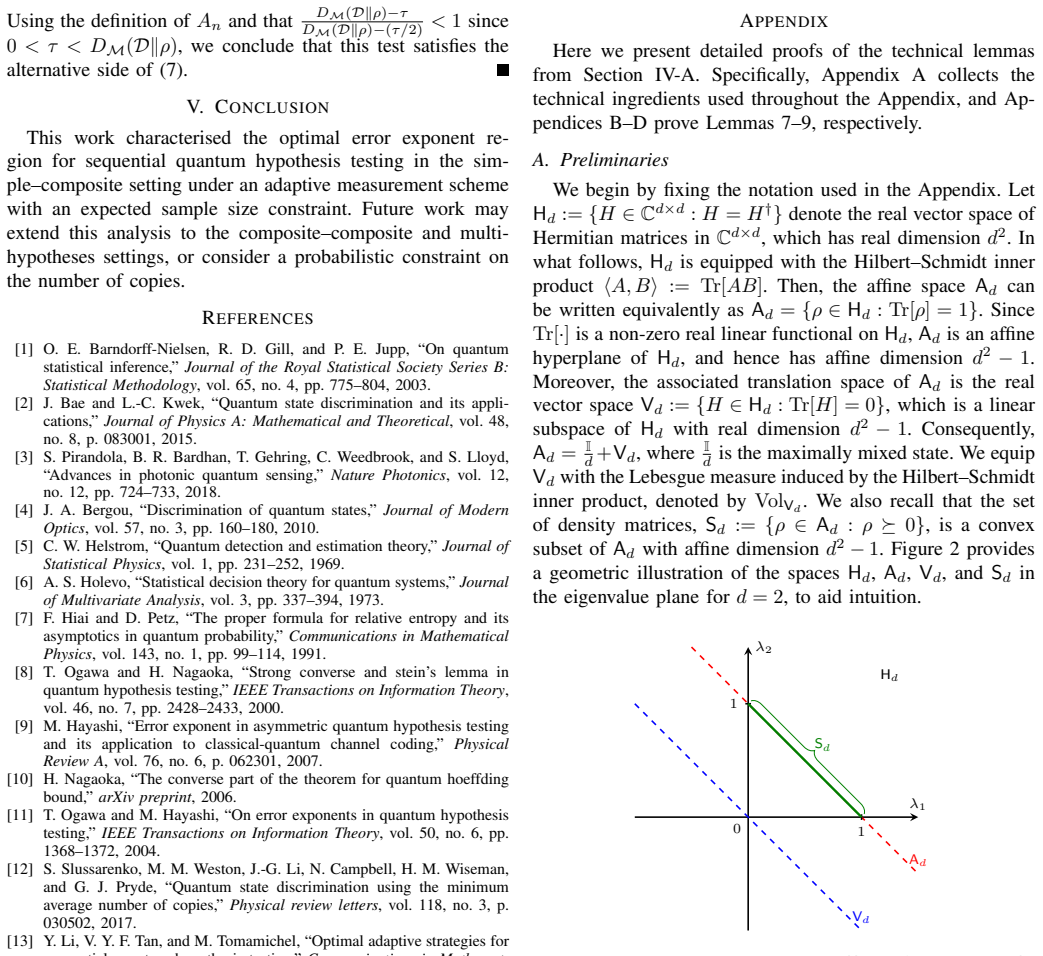
D. J. Smith and M. K. Vamanamurthy, “How small is a unit ball?” Mathematics Magazine, vol. 62, no. 2, pp. 101–107, 1989. APPENDIX Here we present detailed proofs of the technical lemmas from Section IV-A. Specifically, Appendix A collects the technical ingredients used throughout the Appendix, and Ap- pendices B–D prove Lemmas 7–9, respectively. A. Prelim...
work page 1989
-
[26]
Proof of Lemma 9 (i):Since eZk is a function ofX k, andM k isF k−1-measurable, conditioning onF k−1 and using thatXis finite yields, En,ρ[eZk | F k−1] =D Pρ,Mk ∥P˜σk−1,Mk =1 {eSk−1≥0}DM(ρ∥˜σk−1) +1 {eSk−1<0}D Pρ,m∗ 1 ( ∼ σ k−1)∥P∼ σ k−1,m∗ 1 ( ∼ σ k−1) . Now, sinceρ /∈ D,˜σk−1 ∈ D,Dis compact,σ7→D M(ρ∥σ) is continuous on the compact setDandD M(ρ∥σ)>0for e...
-
[27]
We next evaluate the conditional expectation
Proof of Lemma 9 (ii):We first write En,ρ h e−λeSk i =E n,ρ h e−λeSk−1 En,ρ h e−λeZk | F k−1 ii , which follows since eSk = eSk−1 + eZk and eSk−1 isF k−1- measurable. We next evaluate the conditional expectation. En,ρ h e−λeZk |Fk−1 i = X x∈X Pρ,Mk(x) P˜σk−1,Mk(x) Pρ,Mk(x) λ = X x∈X Pρ,Mk(x)1−λP˜σk−1,Mk(x)λ. Applying Young’s inequality withp= 1/(1−λ)andq=...
-
[28]
Proof of Lemma 9 (iii):For everyn, define for each k≥0a probability measureQ (k) n on(Ω,F k)by specifying, for eachk≥0, its Radon–Nikodym derivative with respect to Pn,ρ onF k: dQ(k) n dPn,ρ Fk :=eLk, k≥0. This family of measures is consistent, since{ eLk}k≥0 is a non-negativeP n,ρ-martingale withE n,ρ[eLk] = 1. Indeed, for A∈ F k−1, Q(k) n (A) =E n,ρ h e...
discussion (0)
Sign in with ORCID, Apple, or X to comment. Anyone can read and Pith papers without signing in.