Recognition: unknown
Near-infrared diagnostic diagrams of the gas ionization sources in nearby galaxies: a JWST NIRSpec view
Pith reviewed 2026-05-08 16:38 UTC · model grok-4.3
The pith
Two near-infrared line ratios distinguish star formation, AGN, and shocks as gas excitation sources
A machine-rendered reading of the paper's core claim, the machinery that carries it, and where it could break.
Core claim
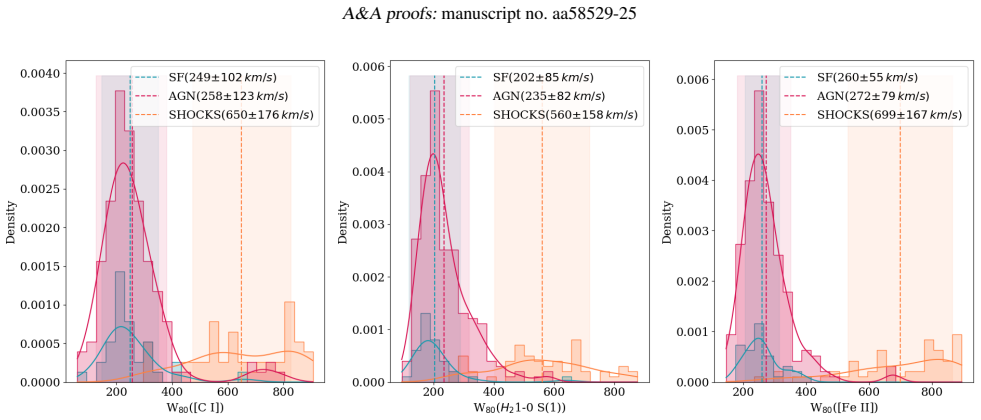
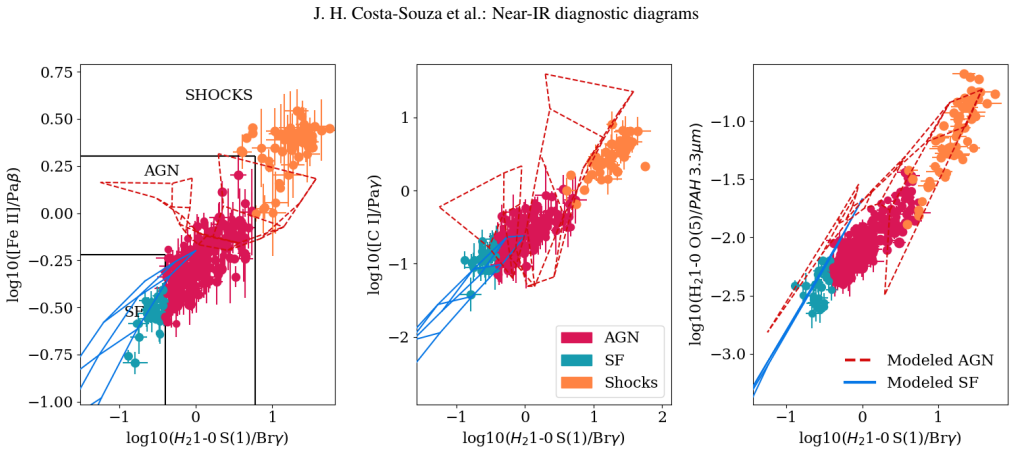
We propose two line-excitation diagnostic diagrams based on [C I]/Paγ and H2 1-0 O(5)/PAH 3.3 μm ratios. These ratios correlate directly with the hardness of the radiation field and therefore indicate whether the gas is excited by star formation, active galactic nuclei, or shocks. The analysis of nine local U/LIRGs shows that the new diagrams reproduce the classifications from established near-infrared methods and that shock-excited regions have distinctly broader line profiles.
What carries the argument
Two new diagnostic diagrams using the [C I]/Paγ and H2 1-0 O(5)/PAH 3.3μm line ratios that separate gas regions according to radiation field hardness
If this is right
- The diagrams allow classification of gas excitation in dust-obscured regions where optical lines are blocked.
- Line width at 80 percent of total flux can help flag shock-dominated zones in galaxy nuclei.
- Hydrogen molecule emission in active galactic nucleus hosts is produced by multiple processes at once.
- The tools support refined models of energy input in the central regions of dusty starburst and AGN systems.
Where Pith is reading between the lines
- The ratios could be tested on higher-redshift galaxies to track how excitation sources change over cosmic time.
- Checking the diagrams across galaxies with different metal abundances would reveal whether chemical composition affects the separations.
- Combining the near-infrared ratios with multi-wavelength data might clarify how several heating processes operate together.
Load-bearing premise
The correlations between the proposed line ratios and excitation mechanisms seen in this sample of nine local ultraluminous infrared galaxies will hold in other galaxies and will not be strongly changed by differences in metal content, gas density, or viewing geometry.
What would settle it
Apply the same two line ratios to a larger sample of galaxies whose excitation mechanisms are already classified independently from optical or X-ray observations and check whether the separations still match the expected star-formation, AGN, and shock groups.
Figures



read the original abstract
Buried active galactic nuclei and obscured young stellar clusters pose significant challenges to traditional optical diagnostic diagrams. Therefore, developing new tools to trace the excitation sources across the spectrum is a necessary effort for the advancement of the field. Our goal is to explore the full spectral range of the JWST-NIRSpec data, searching for alternative diagnostic diagrams in the less-explored NIR, and to investigate the nature of the ionizing and heating source. We analyze the high-resolution spectra of the circum-nuclear regions of nine local (z < 0.1) U/LIRGS, investigating potential emission-line ratios to trace the excitation mechanisms acting on the line-emitting gas. We investigate these objects using the well-established [Fe ii]/PaB versus H2/Bry diagram, and attempt to correlate its classifications with other emission features across the spectrum. We then compare the empirical classifications with photo-ionization models, in order to evaluate how accurately the data can be reproduced. Finally, we compare the line width at 80% of the total flux (W80 ) of selected emission lines with the corresponding gas excitation mechanisms. We propose two line-excitation diagnostic diagrams based on [C i]/Pay and H2 1-0 O(5)/PAH 3.3 um ratio, which we found to directly correlate with the hardness of the radiation field, and therefore with the gas excitation mechanisms. In addition, the line-kinematics analysis shows that the W80 values of regions excited by star formation are on average slightly lower than those of AGN-excited regions, while shock-excited regions display distinctively higher W80 values compared to the other two groups. Our JWST-NIRSpec results reinforce previous studies showing that the H2 emission in the central regions of AGN hosts is complex and likely produced by multiple excitation mechanisms.
Editorial analysis
A structured set of objections, weighed in public.
Referee Report
Summary. The manuscript analyzes high-resolution JWST-NIRSpec spectra of circum-nuclear regions in nine local (z < 0.1) U/LIRGs. It builds on the established [Fe II]/Paβ versus H₂/Brγ diagram to explore NIR emission-line ratios for diagnosing gas excitation mechanisms (star formation, AGN, shocks). The authors compare empirical classifications to photo-ionization models, examine correlations with other spectral features, and analyze line kinematics via W80. The central claim is the proposal of two new diagnostic diagrams using the [C I]/Paγ and H₂ 1-0 O(5)/PAH 3.3 μm ratios, which are reported to correlate directly with radiation-field hardness and thereby distinguish excitation mechanisms. Kinematic results indicate lower average W80 for star-formation-excited regions and distinctly higher W80 for shock-excited regions.
Significance. If the reported correlations hold after broader testing, the proposed NIR diagnostics would provide practical tools for identifying buried AGNs and obscured star clusters in dusty systems where optical line-ratio diagrams are ineffective. The multi-wavelength approach combining line ratios, photo-ionization models, and kinematics (W80) adds supporting layers. The direct exploitation of JWST NIRSpec data and the explicit comparison to models are positive elements. However, the small sample size and absence of controls for confounding parameters limit the immediate impact and generalizability of the new diagrams.
major comments (3)
- [Sample and observations section] Sample and observations section: The central claim of two generalizable NIR diagnostic diagrams rests on empirical trends observed in spectra from only nine U/LIRGs. No details are given on sample selection criteria, the range of metallicities or densities spanned, or how the targets were chosen to minimize biases. Without this information it is impossible to determine whether the reported correlations with radiation hardness are driven by excitation mechanism or by untested covariances with other variables.
- [Model comparison section] Model comparison section: The manuscript compares the data to photo-ionization models but does not state whether the model grid independently varies metallicity, density, and geometry across the observed range. If these parameters are not decoupled, the isolation of radiation-field hardness as the primary driver of the [C I]/Paγ and H₂/PAH ratios cannot be demonstrated, undermining the proposed diagnostic utility.
- [Results and discussion] Results and discussion: No quantitative assessment of correlation strength (e.g., Spearman rank coefficients), uncertainties on the measured line ratios, or statistical significance tests is provided. The absence of error analysis and validation against independent datasets makes it difficult to evaluate whether the trends in the nine objects are robust enough to support new diagnostic diagrams.
minor comments (3)
- [Abstract and throughout] Notation for the proposed ratios should be standardized (e.g., consistent use of Paγ versus Pay) and all abbreviations (including W80) defined at first use.
- [Figures showing the new diagrams] The diagnostic diagrams would benefit from inclusion of error bars on the data points and overlaid model tracks to illustrate the claimed separation.
- [Introduction] A brief discussion of how the new NIR ratios relate to or improve upon existing NIR diagnostics in the literature would strengthen the introduction.
Simulated Author's Rebuttal
We thank the referee for the constructive and detailed review. We address each major comment point by point below, providing clarifications and indicating where revisions will be made to strengthen the manuscript.
read point-by-point responses
-
Referee: [Sample and observations section] Sample and observations section: The central claim of two generalizable NIR diagnostic diagrams rests on empirical trends observed in spectra from only nine U/LIRGs. No details are given on sample selection criteria, the range of metallicities or densities spanned, or how the targets were chosen to minimize biases. Without this information it is impossible to determine whether the reported correlations with radiation hardness are driven by excitation mechanism or by untested covariances with other variables.
Authors: We acknowledge that the current Sample and observations section is concise and does not fully detail selection criteria or the spanned ranges of metallicity and density. The nine targets were drawn from the GOALS sample of local U/LIRGs with existing multi-wavelength coverage and suitable for high-resolution NIRSpec observations; we will expand this section to explicitly list the selection criteria, available ancillary data on metallicities (typically near-solar for these nuclei), and density estimates from the literature. We will also add a discussion of possible covariances and the empirical nature of the trends. However, the small sample size inherently limits the ability to fully decouple all variables, and we will emphasize this caveat more strongly. revision: yes
-
Referee: [Model comparison section] Model comparison section: The manuscript compares the data to photo-ionization models but does not state whether the model grid independently varies metallicity, density, and geometry across the observed range. If these parameters are not decoupled, the isolation of radiation-field hardness as the primary driver of the [C I]/Paγ and H₂/PAH ratios cannot be demonstrated, undermining the proposed diagnostic utility.
Authors: We agree that the model section requires clarification on parameter coverage. The photo-ionization grids used (from standard libraries such as those in Cloudy) do span ranges in metallicity, density, and ionization parameter, with geometry fixed to plane-parallel for the nuclear regions; we will revise the text to state the exact ranges explored and note which parameters were held fixed versus varied. This will better demonstrate that radiation-field hardness remains the dominant driver for the proposed ratios within the explored parameter space, while acknowledging that full decoupling is limited by the model assumptions. revision: yes
-
Referee: [Results and discussion] Results and discussion: No quantitative assessment of correlation strength (e.g., Spearman rank coefficients), uncertainties on the measured line ratios, or statistical significance tests is provided. The absence of error analysis and validation against independent datasets makes it difficult to evaluate whether the trends in the nine objects are robust enough to support new diagnostic diagrams.
Authors: We accept that the Results and discussion section lacks formal quantitative statistics. We will add Spearman rank correlation coefficients and associated p-values for the key relations involving [C I]/Paγ and H₂ 1-0 O(5)/PAH 3.3 μm, include error bars derived from the spectral fitting uncertainties, and report basic significance tests. We will also note the absence of an independent validation sample and the consequent need for future work. These additions will allow readers to better assess the robustness of the trends. revision: yes
- The small sample of only nine U/LIRGs inherently limits statistical power, full control for confounding variables, and immediate generalizability of the proposed diagnostics, which cannot be remedied by revision alone.
Circularity Check
No significant circularity in proposed NIR diagnostic diagrams
full rationale
The paper derives its proposed diagnostic diagrams ([C I]/Paγ and H2 1-0 O(5)/PAH 3.3 μm) directly from empirical line-ratio measurements and classifications in the nine observed U/LIRGs, followed by comparison against independent photo-ionization models. No step reduces a claimed prediction or first-principles result to a fitted parameter, self-referential definition, or load-bearing self-citation chain; the correlations are presented as observed trends rather than constructed outputs. The kinematics (W80) analysis is likewise an independent observational check. The derivation therefore remains self-contained against external benchmarks.
Axiom & Free-Parameter Ledger
axioms (1)
- domain assumption Photo-ionization models can be used to evaluate the accuracy of empirical line-ratio classifications for gas excitation mechanisms
Reference graph
Works this paper leans on
-
[1]
The JWST/NIRSpec view of the nuclear region in the prototypical merging galaxy NGC 6240. , keywords =. doi:10.1051/0004-6361/202452207 , archivePrefix =. 2412.14685 , primaryClass =
-
[2]
ALMA Resolves the Nuclear Disks of Arp 220. , keywords =. doi:10.3847/1538-4357/836/1/66 , archivePrefix =. 1605.09381 , primaryClass =
-
[3]
Search for High-excitation Emission Lines from a Quasar-scale Active Nucleus in Arp 220. , keywords =. doi:10.3847/1538-4357/ad7eb0 , adsurl =
-
[4]
2018, A&A, 617, A130, doi: 10.1051/0004-6361/201833053
The AKARI 2.5-5 micron spectra of luminous infrared galaxies in the local Universe. , keywords =. doi:10.1051/0004-6361/201833053 , archivePrefix =. 1806.05198 , primaryClass =
-
[5]
Unveiling the Aromatic and Aliphatic Universe at Redshifts z 0.2 0.5 with JWST NIRCam/WFSS. , keywords =. doi:10.3847/1538-4357/add538 , archivePrefix =. 2502.18464 , primaryClass =
-
[6]
BASS. L. Near-infrared Data Release 3: A Spectral Atlas and Characterization of Active Galactic Nuclei. , keywords =. doi:10.3847/1538-4365/ae2d58 , archivePrefix =. 2512.20702 , primaryClass =
-
[7]
Extended high-ionization [Mg IV] emission tracing widespread shocks in starbursts seen by JWST/NIRSpec. , keywords =. doi:10.1051/0004-6361/202449982 , archivePrefix =. 2404.16641 , primaryClass =
-
[8]
The 3.3 m Polycyclic Aromatic Hydrocarbon Emission as a Star Formation Rate Indicator. , keywords =. doi:10.1088/0004-637X/760/2/120 , archivePrefix =. 1210.1644 , primaryClass =
-
[9]
Mid-Infrared Galaxy Classification Based on Silicate Obscuration and PAH Equivalent Width. , keywords =. doi:10.1086/511268 , archivePrefix =. astro-ph/0611918 , primaryClass =
-
[10]
LINER-like Extended Nebulae in ULIRGs: Shocks Generated by Merger-Induced Flows. , keywords =. doi:10.1086/498257 , archivePrefix =. astro-ph/0509681 , primaryClass =
-
[11]
Temperature Fluctuations in the Interstellar Grains. I. Computational Method and Sublimation of Small Grains. , keywords =. doi:10.1086/167899 , adsurl =
-
[12]
2003, MNRAS, 340, 1214, doi: 10.1046/j.1365-8711.2003.06380.x
Starburst and AGN activity in ultraluminous infrared galaxies. , keywords =. doi:10.1046/j.1365-8711.2003.06696.x , archivePrefix =. astro-ph/0304154 , primaryClass =
-
[13]
The role of nuclear activity as the power source of ultraluminous infrared galaxies. , keywords =. doi:10.1111/j.1365-2966.2010.16618.x , archivePrefix =. 1003.0858 , primaryClass =
-
[14]
T., Aniano, G., Krause, O., et al
Andromeda's Dust. , keywords =. doi:10.1088/0004-637X/780/2/172 , archivePrefix =. 1306.2304 , primaryClass =
-
[15]
Polycyclic aromatic hydrocarbon processing in interstellar shocks. , keywords =. doi:10.1051/0004-6361/200911682 , archivePrefix =. 0910.2461 , primaryClass =
-
[16]
Grain Destruction in Shocks in the Interstellar Medium. , keywords =. doi:10.1086/174689 , adsurl =
-
[17]
Carbonaceous dust in interstellar shock waves: hydrogenated amorphous carbon (a-C:H) vs. graphite. , keywords =. doi:10.1051/0004-6361:200810622 , adsurl =
-
[18]
Annual Review of Astronomy &Astrophysics, vol
Interstellar Dust Grains. , keywords =. doi:10.1146/annurev.astro.41.011802.094840 , archivePrefix =. astro-ph/0304489 , primaryClass =
-
[19]
Single-Photon Infrared Emission Spectroscopy of Gaseous Polycyclic Aromatic Hydrocarbon Cations: A Direct Test for Proposed Carriers of the Unidentified Infrared Emission Bands. , keywords =. doi:10.1086/343078 , adsurl =
-
[20]
The 3.3 Micron Feature, H 2, and Ionized Gas in the Orion Bar. , keywords =. doi:10.1086/168299 , adsurl =
-
[21]
R., Nelemans, G., & Steeghs, D
CI lines as tracers of molecular gas, and their prospects at high redshifts. , keywords =. doi:10.1111/j.1365-2966.2004.07762.x , archivePrefix =. astro-ph/0403092 , primaryClass =
-
[22]
Direct Measurement of the [C I] Luminosity to Molecular Gas Mass Conversion Factor in High-redshift Star-forming Galaxies. , keywords =. doi:10.3847/2041-8213/ab6733 , archivePrefix =. 2001.05770 , primaryClass =
-
[23]
Radio Jet Feedback on the Inner Disk of Virgo Spiral Galaxy Messier 58. , keywords =. doi:10.3847/1538-4357/ad1242 , archivePrefix =. 2312.01936 , primaryClass =
-
[24]
The heating of dust by old stellar populations in the bulge of M31. , keywords =. doi:10.1111/j.1365-2966.2012.21696.x , archivePrefix =. 1206.2925 , primaryClass =
-
[25]
Structure of Stationary Photodissociation Fronts. , keywords =. doi:10.1086/177689 , archivePrefix =. astro-ph/9603032 , primaryClass =
-
[26]
Line Emission from Clumpy Photodissociation Regions. , keywords =. doi:10.1086/169516 , adsurl =
-
[27]
Photodissociation regions. I. Basic model. , keywords =. doi:10.1086/163111 , adsurl =
-
[28]
Molecular Hydrogen in Star-forming Regions: Implementation of its Microphysics in CLOUDY. , keywords =. doi:10.1086/429215 , archivePrefix =. astro-ph/0501485 , primaryClass =
-
[29]
Sensitivity of PDR Calculations to Microphysical Details. , keywords =. doi:10.1086/591505 , archivePrefix =. 0808.2532 , primaryClass =
-
[30]
Photoelectric Emission from Interstellar Dust: Grain Charging and Gas Heating. , keywords =. doi:10.1086/320852 , archivePrefix =. astro-ph/9907251 , primaryClass =
-
[31]
Optical/NIR stellar absorption and emission-line indices from luminous infrared galaxies. , keywords =. doi:10.1093/mnras/stz1077 , archivePrefix =. 1904.06460 , primaryClass =
-
[32]
A 0.8-2.4 m spectral atlas of active galactic nuclei. , keywords =. doi:10.1051/0004-6361:20065291 , archivePrefix =. astro-ph/0605463 , primaryClass =
-
[33]
An X-ray/SDSS sample. II. AGN-driven outflowing gas plasma properties. , keywords =. doi:10.1051/0004-6361/201730819 , archivePrefix =. 1705.08388 , primaryClass =
-
[34]
The JWST View of Cygnus A: Jet-driven Coronal Outflow with a Twist. , keywords =. doi:10.3847/1538-4357/adb71a , archivePrefix =. 2502.06603 , primaryClass =
-
[35]
2017, MNRAS, 467, 540, doi: 10.1093/mnras/stx055
BAT AGN Spectroscopic Survey - IV: Near-Infrared Coronal Lines, Hidden Broad Lines, and Correlation with Hard X-ray Emission. , keywords =. doi:10.1093/mnras/stx055 , archivePrefix =. 1701.02755 , primaryClass =
-
[36]
VLT-VIMOS integral field spectroscopy of luminous and ultraluminous infrared galaxies. II. Evidence for shock ionization caused by tidal forces in the extra-nuclear regions of interacting and merging LIRGs. , keywords =. doi:10.1051/0004-6361/200913239 , archivePrefix =. 1004.3933 , primaryClass =
-
[37]
JWST/NIRSpec and MIRI observations of an expanding, jet-driven bubble of warm H _ 2 in the radio galaxy 3C 326 N. , keywords =. doi:10.1051/0004-6361/202449848 , archivePrefix =. 2404.04341 , primaryClass =
-
[38]
Hard X-Ray to Radio Multiwavelength SED Analysis of Local U/LIRGs in the GOALS Sample with a Self-consistent AGN Model including a Polar-dust Component. , keywords =. doi:10.3847/1538-4365/acb349 , archivePrefix =. 2301.03613 , primaryClass =
-
[39]
Theoretical Diagnostics for Narrow-line Regions of Active Galactic Nuclei. , keywords =. doi:10.3847/1538-4357/ad8f37 , archivePrefix =. 2411.04103 , primaryClass =
-
[40]
Understanding Galaxy Evolution Through Emission Lines. , keywords =. doi:10.1146/annurev-astro-081817-051832 , archivePrefix =. 1910.09730 , primaryClass =
-
[41]
The AMUSING++ Nearby Galaxy Compilation. I. Full Sample Characterization and Galactic-scale Outflow Selection. , keywords =. doi:10.3847/1538-3881/ab7848 , archivePrefix =. 2002.09328 , primaryClass =
-
[42]
An Infrared-luminous Merger with Two Bipolar Molecular Outflows: ALMA and SMA Observations of NGC 3256. , keywords =. doi:10.1088/0004-637X/797/2/90 , archivePrefix =. 1403.7117 , primaryClass =
-
[43]
Goodness-of-fit techniques
-
[44]
A technique to select the most obscured galaxy nuclei. , keywords =. doi:10.1051/0004-6361/202142749 , archivePrefix =. 2203.14795 , primaryClass =
-
[45]
The obscured nucleus and shocked environment of VV 114E revealed by JWST/MIRI spectroscopy. , keywords =. doi:10.1093/mnras/stac3729 , archivePrefix =. 2210.04647 , primaryClass =
-
[46]
MICONIC: Dual active galactic nuclei, star formation, and ionised gas outflows in NGC 6240 seen with MIRI/JWST. , keywords =. doi:10.1051/0004-6361/202452437 , archivePrefix =. 2412.14707 , primaryClass =
-
[47]
R., Garc´ıa-Bernete, I., Rigopoulou, D., et al
Peeling back the layers of extinction of dusty galaxies in the era of JWST: modelling joint NIRSpec + MIRI spectra at rest-frame 1.5-28 m. , keywords =. doi:10.1093/mnras/stae612 , archivePrefix =. 2402.17479 , primaryClass =
-
[48]
MUSE view of Arp220: Kpc-scale multi-phase outflow and evidence for positive feedback. , keywords =. doi:10.1051/0004-6361/202038328 , archivePrefix =. 2009.03353 , primaryClass =
-
[49]
Comprehensive Broadband X-Ray and Multiwavelength Study of Active Galactic Nuclei in 57 Local Luminous and Ultraluminous Infrared Galaxies Observed with NuSTAR and/or Swift/BAT. , keywords =. doi:10.3847/1538-4365/ac17f5 , archivePrefix =. 2107.10855 , primaryClass =
-
[50]
Outflow of hot and cold molecular gas from the obscured secondary nucleus of NGC 3256: closing in on feedback physics. , keywords =. doi:10.1051/0004-6361/201423805 , archivePrefix =. 1409.4468 , primaryClass =
-
[51]
The Near-Infrared Spectrograph (NIRSpec) on the James Webb Space Telescope. I. Overview of the instrument and its capabilities. , keywords =. doi:10.1051/0004-6361/202142663 , archivePrefix =. 2202.03305 , primaryClass =
work page internal anchor Pith review doi:10.1051/0004-6361/202142663
-
[52]
Physics of ULIRGs with MUSE and ALMA: The PUMA project. I. Properties of the survey and first MUSE data results. , keywords =. doi:10.1051/0004-6361/202039702 , archivePrefix =. 2011.11676 , primaryClass =
-
[53]
The Role of Starburst-Active Galactic Nucleus Composites in Luminous Infrared Galaxy Mergers: Insights from the New Optical Classification Scheme. , keywords =. doi:10.1088/0004-637X/709/2/884 , archivePrefix =. 0911.3728 , primaryClass =
-
[54]
Theoretical Evolution of Optical Strong Lines across Cosmic Time. , keywords =. doi:10.1088/0004-637X/774/2/100 , archivePrefix =. 1307.0508 , primaryClass =
-
[55]
J., Maier , C., Yabe , K., et al
The Cosmic BPT Diagram: Confronting Theory with Observations. , keywords =. doi:10.1088/2041-8205/774/1/L10 , archivePrefix =. 1307.0514 , primaryClass =
-
[56]
Beyond BPT: A New Multidimensional Diagnostic Diagram for Classifying Power Sources Tested Using the SAMI Galaxy Survey. , keywords =. doi:10.3847/1538-4357/ace90e , archivePrefix =. 2307.11831 , primaryClass =
-
[57]
A Theoretical Three-dimensional Diagram to Separate Star Formation, Active Galactic Nuclei, and Shocks in Galaxies. , keywords =. doi:10.3847/1538-4357/ade78f , archivePrefix =. 2506.09962 , primaryClass =
-
[58]
An H Imaging Survey of All (Ultra)luminous Infrared Galaxies at Decl. -30 in the GOALS Sample. , keywords =. doi:10.3847/1538-4365/ab3bfe , archivePrefix =. 1910.10608 , primaryClass =
-
[59]
, year = 1965, month = may, volume =
The Existence of a Major New Constituent of the Universe: the Quasistellar Galaxies. , year = 1965, month = may, volume =. doi:10.1086/148245 , adsurl =
-
[60]
, year = 1961, month = jan, volume =
Integrated Colors of Bright Galaxies in the u, b, V System. , year = 1961, month = jan, volume =. doi:10.1086/190056 , adsurl =
-
[61]
Multicolor photoelectric photometry of bright extragalactic systems
-
[62]
Meddelanden fran Lunds Astronomiska Observatorium Serie II , year = 1958, month = jan, volume =
A photographic photometry of extragalactic nebulae. Meddelanden fran Lunds Astronomiska Observatorium Serie II , year = 1958, month = jan, volume =
1958
-
[63]
Nebulae and Interstellar Matter , year = 1968, editor =
Planetary Nebulae. Nebulae and Interstellar Matter , year = 1968, editor =
1968
-
[64]
, year = 1971, month = sep, volume =
Evidence for Composition Gradients across the Disks of Spiral Galaxies. , year = 1971, month = sep, volume =. doi:10.1086/151090 , adsurl =
-
[65]
Classification parameters for the emission-line spectra of extragalactic objects. , keywords =. doi:10.1086/130766 , adsurl =
-
[66]
Spectral Classification of Emission-Line Galaxies. , keywords =. doi:10.1086/191166 , adsurl =
-
[67]
Infrared Spectroscopy of Seyfert 2 Galaxies: A Look through the Obscuring Torus?. , keywords =. doi:10.1086/173746 , adsurl =
-
[68]
Using Near-Infrared [Fe II] Lines to Identify Active Galaxies. , keywords =. doi:10.1086/304184 , adsurl =
-
[69]
The Fe II Emission in Active Galactic Nuclei: Excitation Mechanisms and Location of the Emitting Region. , keywords =. doi:10.3847/0004-637X/820/2/116 , adsurl =
-
[70]
The Emission-Line Properties of Low-Redshift Quasi-stellar Objects. , keywords =. doi:10.1086/191661 , adsurl =
-
[71]
2013, MNRAS, 430, 2002, doi: 10.1093/mnras/stt026
Molecular hydrogen and [Fe II] in active galactic nuclei - III. Low-ionization nuclear emission-line region and star-forming galaxies. , keywords =. doi:10.1093/mnras/stt026 , archivePrefix =. 1301.0491 , primaryClass =
-
[72]
2003, MNRAS, 340, 1214, doi: 10.1046/j.1365-8711.2003.06380.x
Adaptive spatial binning of integral-field spectroscopic data using Voronoi tessellations. , keywords =. doi:10.1046/j.1365-8711.2003.06541.x , archivePrefix =. astro-ph/0302262 , primaryClass =
-
[73]
Separating line emission from star formation, shocks, and AGN ionization in NGC 1068. , keywords =. doi:10.1093/mnras/stz1611 , archivePrefix =. 1906.07907 , primaryClass =
-
[74]
A new diagnostic to separate line emission from star formation, shocks, and AGNs simultaneously in IFU data. , keywords =. doi:10.1093/mnrasl/slz028 , archivePrefix =. 1902.10295 , primaryClass =
-
[75]
The extent and power of 'maintenance mode' feedback in MaNGA AGN. , keywords =. doi:10.1093/mnras/stae989 , archivePrefix =. 2404.14502 , primaryClass =
-
[76]
SUPER. II. Spatially resolved ionised gas kinematics and scaling relations in z 2 AGN host galaxies. , keywords =. doi:10.1051/0004-6361/202038551 , archivePrefix =. 2008.01728 , primaryClass =
-
[77]
, archivePrefix = "arXiv", eprint =
Quasar feedback and the origin of radio emission in radio-quiet quasars. , keywords =. doi:10.1093/mnras/stu842 , archivePrefix =. 1402.6736 , primaryClass =
-
[78]
The AGNIFS survey: spatially resolved observations of hot molecular and ionized outflows in nearby active galaxies. , keywords =. doi:10.1093/mnras/stad599 , archivePrefix =. 2302.11324 , primaryClass =
-
[79]
A fast-rotator post-starburst galaxy quenched by supermassive black-hole feedback at z = 3. Nature Astronomy , keywords =. doi:10.1038/s41550-024-02345-1 , archivePrefix =. 2308.06317 , primaryClass =
-
[80]
Journal of Molecular Spectroscopy , year = 1970, month = jan, volume =
The dissociation energy of the hydrogen molecule. Journal of Molecular Spectroscopy , year = 1970, month = jan, volume =. doi:10.1016/0022-2852(70)90060-3 , adsurl =
discussion (0)
Sign in with ORCID, Apple, or X to comment. Anyone can read and Pith papers without signing in.