Recognition: unknown
Characterization of Photopolymerized Microscopic Chiral Structures Using Photonic Orbital Angular Momentum
Pith reviewed 2026-05-08 15:39 UTC · model grok-4.3
The pith
Vortex beams carrying orbital angular momentum distinguish the handedness of 15-micrometer chiral polymer structures through helical dichroism.
A machine-rendered reading of the paper's core claim, the machinery that carries it, and where it could break.
Core claim
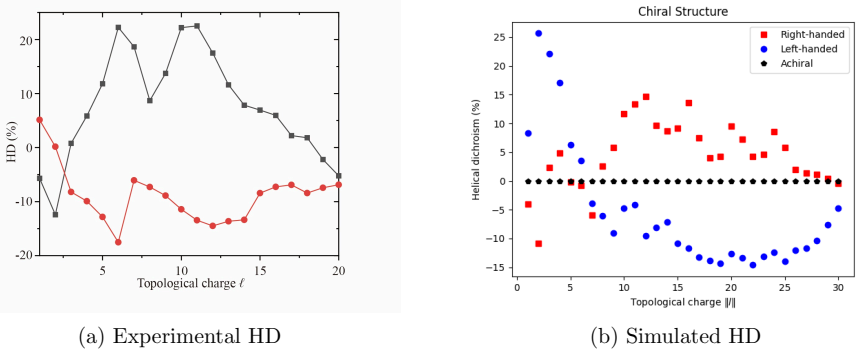
Using digital micromirror device maskless photolithography combined with capillarity-induced self-assembly, polymer microstructures of deterministic handedness and roughly 15 micrometer diameter are produced. Vortex beams generated by a liquid-crystal spatial light modulator yield helical dichroism spectra of approximately 30 percent; opposite-handed enantiomers produce near-mirror-symmetric spectra while achiral controls produce vanishing signals. Three-dimensional geometries reconstructed from high-resolution scanning electron micrographs, when used as input to finite-difference time-domain simulations, reproduce the experimental spectra and confirm that the differential orbital angular-m
What carries the argument
Helical dichroism measured with beams carrying photonic orbital angular momentum, which interacts differentially with the geometric handedness of the microstructures.
If this is right
- OAM-based helical dichroism works at the microscale with only standard laboratory lasers and modulators.
- Enantiomers can be distinguished reliably by the symmetry of their HD spectra.
- Chiral sensing and enantioselective detection become feasible without femtosecond sources or plasmonic substrates.
- The same platform can support development of photonic logic devices that exploit OAM-chiral interactions.
Where Pith is reading between the lines
- The spatial selectivity of OAM beams may allow chiral readout inside microfluidic channels or within larger photonic circuits.
- Extending the same measurement to other photopolymerized or self-assembled chiral objects could test how general the 30-percent contrast level remains.
- If the HD response scales with structure size or refractive index contrast, the method might complement circular dichroism for objects too small for conventional far-field techniques.
Load-bearing premise
The measured helical dichroism is produced purely by the geometric handedness of the structures and not by fabrication-induced birefringence, surface roughness, or alignment artifacts.
What would settle it
Fabricating achiral control structures under identical conditions and observing non-zero helical dichroism signals, or fabricating opposite-handed enantiomers and observing HD spectra that are not near-mirror-symmetric, would falsify the claim that OAM selectively reports structural chirality.
Figures






read the original abstract
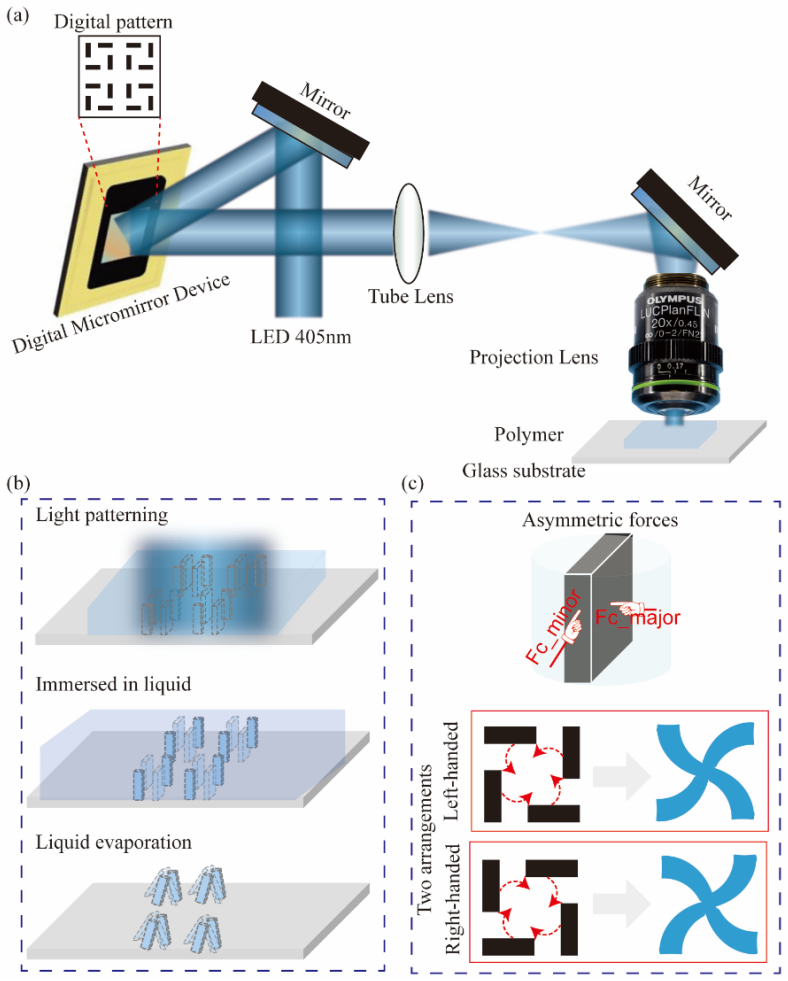
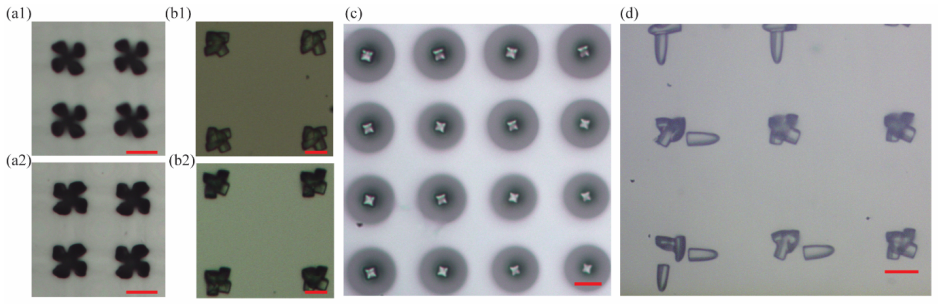
The controlled fabrication and chiroptical characterization of microscale chiral structures remain central challenges in photonics, sensing, and metamaterial engineering. Here we demonstrate an accessible, low-cost platform that combines digital micromirror device-enabled maskless photolithography with capillarity-induced self-assembly to produce polymer chiral microstructures of deterministic handedness, and a liquid-crystal spatial light modulator to generate vortex beams for their characterization via helical dichroism (HD). Using a standard 532 nm laser, we observe HD signals of approximately 30% for microstructures with a characteristic diameter of about 15 micrometers. Rigorous finite-difference time-domain simulations performed on three-dimensional geometries reconstructed from high-resolution Scanning Electron Microscopy data reproduce the experimental HD spectra and confirm the role of structural handedness in driving the differential orbital angular momentum (OAM) response. Near-mirror-symmetric HD spectra for opposite-handed enantiomers, combined with a vanishing response for achiral controls, establish OAM as a robust and spatially selective chiral probe at the microscale. Crucially, both fabrication and characterization rely on equipment standard in an optics laboratory, without recourse to femtosecond sources, plasmonic substrates, or costly photoresists. These results open practical pathways toward OAM-driven chiral sensing, enantioselective detection, and photonic logic devices.
Editorial analysis
A structured set of objections, weighed in public.
Referee Report
Summary. The manuscript reports fabrication of ~15 μm polymer chiral microstructures via maskless photolithography and self-assembly, followed by characterization through helical dichroism (HD) using OAM vortex beams from a liquid-crystal spatial light modulator at 532 nm. Experimental HD signals reach ~30% with near-mirror symmetry between enantiomers and null response for achiral controls; FDTD simulations on SEM-reconstructed 3D meshes reproduce the spectra and attribute the effect to structural handedness. The work emphasizes an accessible, low-cost platform using standard optics-lab equipment.
Significance. If the central claim holds, the results establish OAM-based HD as a spatially selective chiral probe at the microscale and provide a practical route to enantioselective sensing and photonic devices without femtosecond lasers or plasmonic substrates. The combination of direct fabrication, experimental spectra, achiral controls, and simulation on real geometries is a clear strength.
major comments (2)
- [FDTD Simulations section] FDTD Simulations section: the simulations employ the identical SEM-reconstructed surface meshes and isotropic refractive index as the experimental structures. This shared geometric input means agreement between measured and simulated HD spectra cannot independently rule out fabrication-induced birefringence, stress gradients, or surface roughness (not captured by SEM) as contributors to the ~30% signal; the achiral-control null result mitigates but does not eliminate this possibility.
- [Methods and Results sections] Methods and Results sections: the manuscript provides no error bars, statistical analysis, data-exclusion criteria, or raw spectra for the reported HD values. Without these, the quantitative claim of ~30% signals and their enantiomer symmetry cannot be fully assessed for reproducibility or significance.
Simulated Author's Rebuttal
We thank the referee for the constructive feedback and positive overall assessment of our work. We address each major comment point by point below, proposing targeted revisions where appropriate to improve clarity and rigor.
read point-by-point responses
-
Referee: [FDTD Simulations section] FDTD Simulations section: the simulations employ the identical SEM-reconstructed surface meshes and isotropic refractive index as the experimental structures. This shared geometric input means agreement between measured and simulated HD spectra cannot independently rule out fabrication-induced birefringence, stress gradients, or surface roughness (not captured by SEM) as contributors to the ~30% signal; the achiral-control null result mitigates but does not eliminate this possibility.
Authors: We agree that the simulations rely on the same reconstructed geometries and an isotropic refractive index (n ≈ 1.5 for the polymer), so they cannot independently exclude all possible material or fabrication artifacts. However, the polymer is a standard isotropic photoresist with no expected birefringence, and the achiral controls—fabricated and measured under identical conditions—show a null HD response, which would be inconsistent with uniform stress-induced birefringence or roughness effects that should appear regardless of handedness. Surface roughness is partially captured in the high-resolution SEM meshes used for reconstruction. In the revised manuscript, we will expand the discussion in the FDTD section to explicitly address these alternatives, citing the material properties and control data, and note the limitations of the current modeling approach. revision: partial
-
Referee: [Methods and Results sections] Methods and Results sections: the manuscript provides no error bars, statistical analysis, data-exclusion criteria, or raw spectra for the reported HD values. Without these, the quantitative claim of ~30% signals and their enantiomer symmetry cannot be fully assessed for reproducibility or significance.
Authors: We acknowledge that the original manuscript omitted error bars, detailed statistics, and raw data for brevity. The ~30% HD values represent averages over multiple structures and measurements, but this was not quantified. In the revision, we will add error bars (standard deviation from ≥5 independent measurements per enantiomer and control), specify data-exclusion criteria (e.g., excluding structures with visible defects via optical microscopy), and include representative raw spectra in the Supplementary Information. This will strengthen the quantitative claims and allow assessment of reproducibility. revision: yes
Circularity Check
No significant circularity in experimental validation chain
full rationale
The paper reports direct experimental measurements of helical dichroism (~30%) in photopolymerized chiral microstructures using OAM beams, with vanishing signals on achiral controls and near-mirror symmetry for enantiomers. FDTD simulations on independently SEM-reconstructed 3D geometries reproduce the spectra but do not constitute a derivation that reduces results to fitted inputs or self-citations by construction; they serve as numerical confirmation on measured geometries rather than tautological prediction. No equations, self-definitional steps, or load-bearing self-citations appear in the provided text, and the central claim rests on empirical data with standard lab equipment.
Axiom & Free-Parameter Ledger
axioms (1)
- standard math Finite-difference time-domain method accurately models electromagnetic scattering from polymer microstructures when geometry is taken from SEM.
Reference graph
Works this paper leans on
-
[1]
X. Qu, J. O. Trent, I. Fokt, W. Priebe, and J. B. Chaires. Allosteric, chiral-selective drug binding to DNA.Proc. Natl. Acad. Sci. USA, 97(22):12032–12037, 2000
2000
-
[2]
L. D. Barron. Chirality and life.Space Sci. Rev., 135(1):187–201, 2008
2008
-
[3]
D. G. Blackmond. The origin of biological homochirality.Cold Spring Harb. Perspect. Biol., 2(5):a002147, 2010
2010
-
[4]
Jiang, X
W. Jiang, X. Yi, and M. D. McKee. Chiral biomineralized structures and their biomimetic synthesis.Mater. Horiz., 6(10):1974–1990, 2019
1974
-
[5]
M. H. Godinho, J. P. Canejo, G. Feio, and E. M. Terentjev. Self-winding of helices in plant tendrils and cellulose liquid crystal fibers.Soft Matter, 6(23):5965–5970, 2010
2010
-
[6]
J. S. Wang, G. Wang, X. Q. Feng, T. Kitamura, Y. L. Kang, S. W. Yu, and Q. H. Qin. Hierarchical chirality transfer in the growth of Towel Gourd tendrils.Sci. Rep., 3:3102, 2013
2013
-
[7]
Q. Pan, Y. Guan, W. Xu, J. Zhao, Y. Liu, L. Cui, and J. Zhou. Recent advance for enantiorecognition of chiral drugs sensing: electrochemical, electrochemiluminescent and photoelectrochemical application.Biosens. Bioelectron., page 117141, 2025
2025
-
[8]
R. N. Patel. Synthesis of chiral pharmaceutical intermediates by biocatalysis.Coord. Chem. Rev., 252(5–7):659–701, 2008
2008
-
[9]
J. Xu, M. Wang, M. Li, J. Yang, and L. Yang. Based chiral biosensors using enzyme encapsulation in hydrogel network for point-of-care detection of lactate enantiomers. Anal. Chim. Acta, 1279:341834, 2023. 24
2023
-
[10]
Li, B.-W
Y.-L. Li, B.-W. Zhou, Y.-Q. Cao, J. Zhang, L. Zhang, and Y.-L. Guo. Chiral analysis of lactate during direct contact coculture by single-cell on-probe enzymatic dehydrogenation derivatization.Anal. Chem., 93(10):4576–4583, 2021
2021
-
[11]
F. Wang, X. Li, S. Jiang, J. Han, J. Wu, M. Yan, and Z. Yao. Enantioselective behaviors of chiral pesticides and enantiomeric signatures in foods and the environment.J. Agric. Food Chem., 71(33):12372–12389, 2023
2023
-
[12]
Garcia-Cansino, M
L. Garcia-Cansino, M. L. Marina, and M. A. Garcia. Chiral analysis of pesticides and emerging contaminants by capillary electrophoresis—application to toxicity evaluation. Toxics, 12(3):185, 2024
2024
-
[13]
Y. Zhao, A. N. Askarpour, L. Sun, J. Shi, X. Li, and A. Alu. Chirality detection of enantiomers using twisted optical metamaterials.Nat. Commun., 8:14180, 2017
2017
-
[14]
Gottarelli, S
G. Gottarelli, S. Lena, S. Masiero, S. Pieraccini, and G. P. Spada. The use of circular dichroism spectroscopy for studying the chiral molecular self-assembly: an overview. Chirality, 20(3–4):471–485, 2008
2008
-
[15]
A. O. Govorov, Y. K. Gun’ko, J. M. Slocik, V. A. Gerard, Z. Fan, and R. R. Naik. Chiral nanoparticle assemblies: circular dichroism, plasmonic interactions, and exciton effects. J. Mater. Chem., 21(42):16806–16818, 2011
2011
-
[16]
Fan and A
Z. Fan and A. O. Govorov. Plasmonic circular dichroism of chiral metal nanoparticle assemblies.Nano Lett., 10(7):2580–2587, 2010
2010
-
[17]
L. D. Barron.Molecular Light Scattering and Optical Activity. Cambridge University Press, 2009
2009
-
[18]
Rodger and D
A. Rodger and D. Marshall. Beginners guide to circular dichroism.Biochemist, 43(2): 58–64, 2021. 25
2021
-
[19]
W. J. Choi, G. Cheng, Z. Huang, S. Zhang, T. B. Norris, and N. A. Kotov. Tera- hertz circular dichroism spectroscopy of biomaterials enabled by kirigami polarization modulators.Nat. Mater., 18(8):820–826, 2019
2019
-
[20]
Krenn, M
M. Krenn, M. Malik, M. Erhard, and A. Zeilinger. Orbital angular momentum of photons and the entanglement of Laguerre-Gaussian modes.Philos. Trans. R. Soc. A, 375(2087): 20150442, 2017
2087
-
[21]
K. A. Forbes and D. L. Andrews. Optical orbital angular momentum: twisted light and chirality.Opt. Lett., 43(3):435–438, 2018
2018
-
[22]
Brullot, M
W. Brullot, M. K. Vanbel, T. Swusten, and T. Verbiest. Resolving enantiomers using the optical angular momentum of twisted light.Sci. Adv., 2(3):e1501349, 2016
2016
-
[23]
J. Ni, S. Liu, D. Wu, Z. Lao, Z. Wang, K. Huang, and C. W. Qiu. Gigantic vortical differential scattering as a monochromatic probe for multiscale chiral structures.Proc. Natl. Acad. Sci. USA, 118(2):e2020055118, 2021
2021
-
[24]
C. C. Pan, M. Bae, H. Wang, J. Lim, R. R. Unnithan, J. K. Yang, and S. Kim. Inverse design of chiral structures for giant helical dichroism.Nanoscale Horiz., 10(6):1077–1083, 2025
2025
-
[25]
J. Ni, S. Liu, G. Hu, Y. Hu, Z. Lao, J. Li, and C. W. Qiu. Giant helical dichroism of single chiral nanostructures with photonic orbital angular momentum.ACS Nano, 15 (2):2893–2900, 2021
2021
-
[26]
I. V. Reddy, A. Baev, E. P. Furlani, P. N. Prasad, and J. W. Haus. Interaction of structured light with a chiral plasmonic metasurface: giant enhancement of chiro-optic response.ACS Photonics, 5(3):734–740, 2018
2018
-
[27]
Wozniak, I
P. Wozniak, I. De Leon, K. Hoflich, G. Leuchs, and P. Banzer. Interaction of light 26 carrying orbital angular momentum with a chiral dipolar scatterer.Optica, 6(8):961–965, 2019
2019
-
[28]
Bartic C. Clays K. Xu J., Guo F. and de Coene Y. Dmd-based optical printing of phema hydrogel gratings for sensitive and rapid alcohol sensing.Materials Advances, 5(18): 7256–7263, 2024
2024
-
[29]
V. K. Valev, N. Smisdom, A. V. Silhanek, B. De Clercq, W. Gillijns, M. Ameloot, and T. Verbiest. Plasmonic ratchet wheels: switching circular dichroism by arranging chiral nanostructures.Nano Lett., 9(11):3945–3948, 2009
2009
-
[30]
V. K. Valev, A. V. Silhanek, N. Verellen, W. Gillijns, P. Van Dorpe, O. A. Aktsipetrov, and T. Verbiest. Asymmetric optical second-harmonic generation from chiral G-shaped gold nanostructures.Phys. Rev. Lett., 104(12):127401, 2010
2010
-
[31]
V. K. Valev. Characterization of nanostructured plasmonic surfaces with second harmonic generation.Langmuir, 28(44):15454–15471, 2012
2012
-
[32]
Chandra and S
D. Chandra and S. Yang. Capillary-force-induced clustering of micropillar arrays: is it caused by isolated capillary bridges or by the lateral capillary meniscus interaction force?Langmuir, 25(18):10430–10434, 2009
2009
-
[33]
Y. Hu, H. Yuan, S. Liu, J. Ni, Z. Lao, C. Xin, and J. Chu. Chiral assemblies of laser-printed micropillars directed by asymmetrical capillary force.Adv. Mater., 32(31): 2002356, 2020
2020
-
[34]
J. E. Curtis and D. G. Grier. Structure of optical vortices.Phys. Rev. Lett., 90(13): 133901, 2003. 27
2003
discussion (0)
Sign in with ORCID, Apple, or X to comment. Anyone can read and Pith papers without signing in.