Recognition: unknown
Adaptive Contention-based Random Access for Uplink Reporting in 3GPP Ambient IoT Networks
Pith reviewed 2026-05-08 16:35 UTC · model grok-4.3
The pith
Broadcasting an access probability in paging messages regulates device attempts and keeps collisions nearly constant in dense ambient IoT deployments.
A machine-rendered reading of the paper's core claim, the machinery that carries it, and where it could break.
Core claim
The paper claims that an EH-aware access control mechanism, in which the reader broadcasts an access probability within the paging message, regulates the number of energy-harvesting devices that attempt random access at any given time. By adapting this probability to observed energy availability patterns, the mechanism prevents the surge in simultaneous attempts that would otherwise occur in dense deployments. Simulation results indicate that collisions stay nearly constant as device numbers grow, access efficiency rises, and the total number of paging rounds required for successful uplink reports drops substantially relative to baseline schemes that lack this control.
What carries the argument
The EH-aware access control mechanism that broadcasts a tunable access probability in each paging message to throttle the fraction of devices that initiate random access.
If this is right
- Collisions remain nearly constant instead of growing with device density.
- Access efficiency improves because fewer attempts collide or waste energy.
- The total number of paging rounds needed for complete reporting falls.
- The system handles larger device populations without proportional resource increase.
- Reader-side control stays lightweight and fits within existing paging formats.
Where Pith is reading between the lines
- The same probability-broadcast idea could be applied to other contention systems that experience bursty device availability.
- Reader energy savings might occur indirectly through fewer retransmissions and shorter overall reporting cycles.
- Real-world validation would require measuring actual energy-harvesting traces against the assumed patterns.
- The approach might combine with device-side energy prediction to further tune the broadcast probability.
Load-bearing premise
Energy availability patterns and the way devices react to the broadcast access probability follow the models used in the evaluation, and paging messages reach the devices reliably.
What would settle it
A dense deployment test in which collisions rise sharply or the number of paging rounds stays the same or increases when the access-probability broadcast is used would falsify the central performance claims.
Figures



read the original abstract
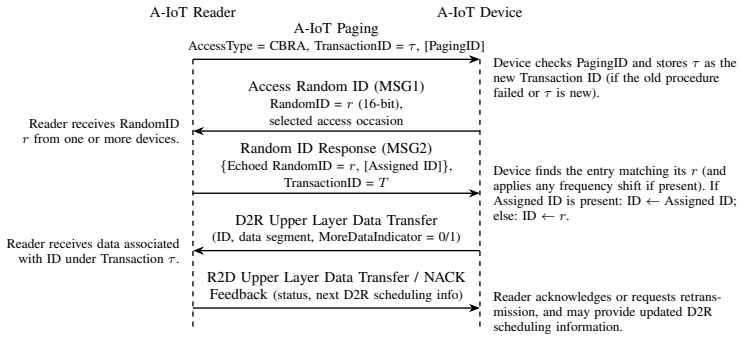
Ambient Internet of Things (A-IoT) targets energy harvesting (EH), battery-less devices as a simple connectivity solution for extensive ultra-low-power deployments. These devices typically face intermittent energy availability, making uplink reports increasingly susceptible to access collisions and energy outages. In this paper, we build upon the cellular standardization of A-IoT and examine the paging-triggered contention-based random access (CBRA) framework for uplink reporting. We analyze the effects of energy availability and collisions on these systems and introduce an EH-aware access control mechanism. In this mechanism, the reader broadcasts an access probability in the paging message, which helps regulate the number of devices attempting random access. Results show that, unlike the baselines, the proposed method scales well under dense deployments by keeping collisions nearly constant, improving access efficiency, and substantially reducing the number of paging rounds required for successful reporting. These results highlight the importance of lightweight reader-side access control for reliable and resource-efficient reporting in A-IoT environments.
Editorial analysis
A structured set of objections, weighed in public.
Referee Report
Summary. The paper proposes an energy-harvesting (EH)-aware access control mechanism for paging-triggered contention-based random access (CBRA) in 3GPP Ambient IoT networks. The reader broadcasts an access probability in the paging message to regulate the number of EH devices attempting uplink random access, with the goal of keeping collisions nearly constant, improving access efficiency, and reducing paging rounds in dense deployments compared to standard baselines.
Significance. If the simulation outcomes hold under realistic conditions, the lightweight reader-side control could provide a practical way to improve reliability and resource efficiency for battery-less A-IoT devices, which is relevant to ongoing 3GPP standardization efforts. The work supplies simulation evidence of scaling benefits over baselines, but its impact is limited by the lack of validation for the core modeling assumptions.
major comments (3)
- [§5] §5 (Performance Evaluation), Fig. 3 and associated text: the claim that collisions remain nearly constant under dense deployments is shown only under the specific EH availability process and perfect paging reception model; no sensitivity analysis is provided for deviations in EH trace variability or non-zero paging loss probability, which directly undermines the scaling result.
- [§3] §3 (System Model): the energy availability patterns and device response to the broadcast access probability are taken as given without comparison to hardware EH traces or measurement data; this assumption is load-bearing for the headline claim that the method 'scales well' unlike baselines.
- [§5] §5, Table 1 (simulation parameters): baseline definitions and exact collision analysis details are not fully specified (e.g., how 'access efficiency' is computed and whether energy outage events are modeled identically across schemes), preventing independent verification of the reported improvements in paging rounds.
minor comments (2)
- [Abstract] The abstract would benefit from one or two quantitative simulation outcomes (e.g., collision probability values or paging-round reduction factors) to substantiate the positive claims.
- [§4] Notation for the access probability and EH state transitions could be introduced earlier and used consistently to improve readability.
Simulated Author's Rebuttal
We thank the referee for the constructive comments, which highlight important aspects for improving the robustness and clarity of our work. We address each major comment point by point below, indicating planned revisions where the manuscript can be strengthened.
read point-by-point responses
-
Referee: [§5] §5 (Performance Evaluation), Fig. 3 and associated text: the claim that collisions remain nearly constant under dense deployments is shown only under the specific EH availability process and perfect paging reception model; no sensitivity analysis is provided for deviations in EH trace variability or non-zero paging loss probability, which directly undermines the scaling result.
Authors: We agree that additional sensitivity analysis would better support the scaling claims. In the revised manuscript, we will add new simulation results in Section 5 that vary the EH process parameters to reflect different levels of trace variability and incorporate non-zero paging loss probabilities. These will demonstrate that the near-constant collision rate and reduction in paging rounds remain consistent under these deviations. revision: yes
-
Referee: [§3] §3 (System Model): the energy availability patterns and device response to the broadcast access probability are taken as given without comparison to hardware EH traces or measurement data; this assumption is load-bearing for the headline claim that the method 'scales well' unlike baselines.
Authors: The EH availability is modeled via a standard stochastic process drawn from established A-IoT literature to capture intermittency. We do not have access to proprietary hardware traces for direct comparison in this study. We will revise Section 3 to include further justification with citations to relevant measurement-based EH studies and explicitly detail the independent per-device decision process for responding to the broadcast access probability. revision: partial
-
Referee: [§5] §5, Table 1 (simulation parameters): baseline definitions and exact collision analysis details are not fully specified (e.g., how 'access efficiency' is computed and whether energy outage events are modeled identically across schemes), preventing independent verification of the reported improvements in paging rounds.
Authors: We acknowledge the need for greater detail to enable verification. In the revision, we will expand Table 1 and the accompanying text in Section 5 to fully define the baselines, provide the exact formulas for access efficiency (successful reports normalized by total access attempts, incorporating both collisions and outages), and confirm that energy outage events are modeled identically using the same EH process across all schemes. revision: yes
Circularity Check
No circularity: proposal and simulation results are independent of inputs
full rationale
The paper introduces an EH-aware access probability broadcast mechanism within the paging-triggered CBRA framework, analyzes collision and energy effects, and evaluates scaling via simulations against baselines. No equations, predictions, or first-principles results are shown that reduce by construction to fitted parameters, self-citations, or ansatzes. The constant-collision property and paging-round reductions emerge from the simulation outcomes under the stated EH and reception models rather than from any definitional equivalence or load-bearing self-reference. The derivation chain is therefore self-contained.
Axiom & Free-Parameter Ledger
Reference graph
Works this paper leans on
-
[1]
Singh, A
R. Singh, A. K. Yerrapragada, and R. K. Ganti, `` Physical Layer Design for Ambient IoT ,'' IEEE Communications Standards Magazine, 2025
2025
-
[2]
López et al., `` Zero-Energy Devices for 6G: Technical Enablers at a Glance ,'' IEEE Internet Things Mag., vol
O. López et al., `` Zero-Energy Devices for 6G: Technical Enablers at a Glance ,'' IEEE Internet Things Mag., vol. 8, no. 3, pp. 14--22, Apr. 2025
2025
-
[3]
M. Qu, Y. Zhao, X. Tang, R. Jian, W. Huang, T. Zhang, and J. Zeng, `` Ambient IoT in 3GPP Release 19: A Survey ,'' in 2024 IEEE Smart World Congress (SWC). 1em plus 0.5em minus 0.4em IEEE, 2024, pp. 2181--2186
2024
-
[4]
X. Shen, J. Zhang, N. Chen, L. Hu, X. Zhang, M. Zhang, J. Ren, K. Liu, N. Hu, X. Xu et al., `` State-of-the-art Overview of 3GPP Ambient IoT Radio Access Aspects ,'' IEEE Communications Standards Magazine, 2025
2025
-
[5]
D. P. Van, A. Vesely, E. Yavuz, H. Khan, R. Ling, R. Narayanan, M. W. Wang, H. Enbuske, L. Feltrin, B. Singh et al., `` Higher Layer Design for 3GPP Ambient Internet of Things ,'' IEEE Communications Standards Magazine, 2025
2025
-
[6]
Y. Kim, L. Liu, K. Takeda, B. Han, V. Vintola, C. Wei, P. Gupta, C. Zhang, Z. Fan, K. Mukkavilli et al., `` Challenges and Advances in Ambient IoT within 3GPP ,'' IEEE Communications Magazine, 2025
2025
-
[7]
Z. Wu, K. Takeda, P. Gupta, R. Zheng, L. Yang, C. Zhang, Z. Fan, H. Xu, K. Mukkavilli, and T. Ji, `` Fast Inventory for 3GPP Ambient IoT Considering Device Unavailability due to Energy Harvesting ,'' IEEE Communications Standards Magazine, 2025
2025
-
[8]
`` 3GPP TS 38.391: NR; Ambient IoT Medium Access Control (MAC) protocol ,'' ETSI (3GPP), Tech. Rep. TS 138 391, Oct., 2025
2025
-
[9]
Nasser, H
S. Nasser, H. Duarte Moura, D. Subotic, R. K. Singh, M. Weyn, and J. Famaey, `` Feasibility of Energy Neutral Wildlife Tracking using Multi-Source Energy Harvesting ,'' in Proceedings of the 2025 International Conference on Information Technology for Social Good, 2025, pp. 344--352
2025
-
[10]
STMicroelectronics, `` STM32L496xx-Ultra-low-power Arm Cortex -M4 32-bit MCU+ FPU, 100 DMIPS, up to 1 MB flash, 320 KB SRAM, USB OTG FS, audio, HASH, external SMPS ,'' 2024
N. STMicroelectronics, `` STM32L496xx-Ultra-low-power Arm Cortex -M4 32-bit MCU+ FPU, 100 DMIPS, up to 1 MB flash, 320 KB SRAM, USB OTG FS, audio, HASH, external SMPS ,'' 2024
2024
-
[11]
Jonsson (Ed.), Peter , year =
-
[12]
IEEE Open Journal of the Communications Society , title=
L. IEEE Open Journal of the Communications Society , title=. Oct. 2023 , volume=
2023
-
[13]
arXiv preprint arXiv:2508.13825 , year=
Energy Management and Wake-up for IoT Networks Powered by Energy Harvesting , author=. arXiv preprint arXiv:2508.13825 , year=
-
[14]
Ruiz-Guirola and Prasoon Raghuwanshi and Gabriel M
David E. Ruiz-Guirola and Prasoon Raghuwanshi and Gabriel M. de Jesus and Mateen Ashraf and Onel L. A. López , year=. 2510.23125 , archivePrefix=
-
[15]
IEEE Open J
L. IEEE Open J. Commun. Soc. , year=
-
[16]
IEEE Open J
L. IEEE Open J. Commun. Soc. , title=. Oct. 2023 , volume=
2023
-
[17]
Qin, Zhijin and others , journal=. Jun. 2019 , publisher=
2019
-
[18]
Benkhelifa, Fatma and others , journal=. Apr. 2020 , publisher=
2020
-
[19]
Belli, Laura and others , journal=. Sep. 2020 , publisher=
2020
-
[20]
IEEE Internet Things J
Ru. IEEE Internet Things J. , volume=. Nov. 2022 , publisher=
2022
-
[21]
L\'opez-P\'erez, David and others , journal=. Jan. 2022 , volume=
2022
-
[22]
Goa, India, Jan
Managre, Jitendra and Khatri, Navita , journal=. Goa, India, Jan. 2022 , organization=
2022
-
[23]
2022 , publisher=
Villa, Valentina and others , journal=. 2022 , publisher=
2022
-
[24]
2019 , organization=
Shabana Anjum, Shaik and others , booktitle=. 2019 , organization=
2019
-
[25]
Nadali, Khatereh and others , journal=. Nov. 2023 , publisher=
2023
-
[26]
Nadali, Khatereh and others , journal=. Nov. 2023 , volume=
2023
-
[27]
ul Haque, Shaan and others , journal=. Aug. 2022 , publisher=
2022
-
[28]
Gonz\'alez-Palacio, Mauricio and others , journal=. Jun. 2023 , volume=
2023
-
[29]
Rome, Italy, Jun
Fedullo, Tommaso and others , booktitle=. Rome, Italy, Jun. 2021 , volume=
2021
-
[30]
Minhaj, Syed Usama and others , journal=. Jan. 2023 , volume=
2023
-
[31]
Traffic-aware Advanced Sleep Modes management in
Salem, Fatma Ezzahra and others , journal=. Traffic-aware Advanced Sleep Modes management in. Marrakesh, Morocco, Apr. 2019 , organization=
2019
-
[32]
Liu, Chih-Hung and others , booktitle=. Saarbr
-
[33]
Mahmood, Nurul Huda and others , journal=. Jun. 2021 , publisher=
2021
-
[34]
fourth quarter, 2015 , publisher=
Ku, Meng-Lin and others , journal=. fourth quarter, 2015 , publisher=
2015
-
[35]
Egorova, Vera and others , journal=. Jul. 2023 , publisher=
2023
-
[36]
Colombo, Marco , title =
-
[37]
Shiraishi, Junya and others , journal=. Mar. 2021 , volume=
2021
-
[38]
Sydney, Australia, Sep
Yomo, Hiroyuki and others , booktitle=. Sydney, Australia, Sep. 2012 , volume=
2012
-
[39]
Bertsekas, Dimitri , year=
-
[40]
Wiering, Marco A and Van Otterlo, Martijn , journal=. Mar. 2012 , publisher=
2012
-
[41]
2020 , publisher=
Yang, Helin and others , journal=. 2020 , publisher=
2020
-
[42]
Lu, ShaoFang and others , journal=. Sep. 2023 , publisher=
2023
-
[43]
2021 , publisher=
Ali, Rashid and others , journal=. 2021 , publisher=
2021
-
[44]
Ma, Ning and others , journal=. Oct. 2021 , publisher=
2021
-
[45]
Raghuwanshi, Prasoon and others , journal=. Feb. 2024 , volume=
2024
-
[46]
L. Proc. IEEE , volume=. Nov. 2023 , publisher=
2023
-
[47]
Torino, Italy, Sept
Belmega, E Veronica and others , booktitle=. Torino, Italy, Sept. 2022 , organization=
2022
-
[48]
58th Asilomar Conference Signals, Syst
Ru. 58th Asilomar Conference Signals, Syst. Computers , title=
-
[49]
Hu, Shengchao and others , journal=. Jun. 2024 , publisher=
2024
-
[50]
Chen, Lili and others , journal=
-
[51]
Wenzhe Li and others , journal=. Sep. 2023 , url =
2023
-
[52]
Agarwal, Pranav and others , journal=
-
[53]
Melo, Luckeciano C , booktitle=. Jul. 2022 , organization=
2022
-
[54]
Vaswani, Ashish and others , journal=
-
[55]
and others , journal=
Ruíz-Guirola, David E. and others , journal=. 2025 , volume=
2025
-
[56]
Tuncel, Yigit and others , journal=. Aug. 2021 , publisher=
2021
-
[57]
May 2020 , volume=
Mikhaylov, Konstantin and Karvonen, Heikki , booktitle=. May 2020 , volume=
2020
-
[58]
Motlagh, Naser Hossein and others , journal=. Feb. 2020 , publisher=
2020
-
[59]
Juan, Ronnie O Serfa and others , journal=
-
[60]
Li, Guanghui and others , journal=. Jul. 2012 , publisher=
2012
-
[61]
Ayaz, Muhammad and others , journal=. Aug. 2019 , publisher=
2019
-
[62]
Ruiz-Guirola, David E and others , journal=
-
[63]
Expert Syst
Ru. Expert Syst. Appl. , volume=. 2025 , publisher=
2025
-
[64]
Zhu, Danyang and others , journal=. Jun. 2020 , publisher=
2020
-
[65]
Ottawa, ON, Canada, Jun
Fowler, Scott and others , booktitle=. Ottawa, ON, Canada, Jun. 2012 , organization=
2012
-
[66]
Montreal, QC, Canada, Oct
Thomsen, Henning and others , booktitle=. Montreal, QC, Canada, Oct. 2017 , organization=
2017
-
[67]
Washington, DC, Nov
Howitt, Ivan and others , booktitle=. Washington, DC, Nov. 2005 , organization=
2005
-
[68]
Rostami, Soheil and others , journal=. Jan. 2020 , publisher=
2020
-
[69]
Reddy Maddikunta, Praveen Kumar and others , journal=. Nov. 2020 , publisher=
2020
-
[70]
López, Onel and others , journal=. Apr. 2025 , volume=
2025
-
[71]
Nguyen, Quan , year=
-
[72]
Bayesian optimization , author=. Feb. 2023 , publisher=
2023
-
[73]
IEEE Trans
Gindullina, Elvina and Badia, Leonardo and G. IEEE Trans. Green Commun. Netw. , volume=. 2021 , publisher=
2021
-
[74]
Hatami, Mohammad , title =
-
[75]
2025 , publisher=
Zhao, Fangming and Pappas, Nikolaos and Zhang, Meng and Yang, Howard H , journal=. 2025 , publisher=
2025
-
[76]
2023 , publisher=
Chen, Shuqi and Ho, Daniel WC , journal=. 2023 , publisher=
2023
-
[77]
2025 , publisher=
Singh, Rohit and Yerrapragada, Anil Kumar and Ganti, Radha Krishna , journal=. 2025 , publisher=
2025
-
[78]
2024 , organization=
Qu, Miao and Zhao, Yuelin and Tang, Xiaoyong and Jian, Rongling and Huang, Wenwen and Zhang, Tao and Zeng, Jie , booktitle=. 2024 , organization=
2024
-
[79]
2025 , publisher=
Shen, Xiaodong and Zhang, Jingwen and Chen, Ningyu and Hu, Lijie and Zhang, Xiaoran and Zhang, Miaoqi and Ren, Jianyang and Liu, Kangyi and Hu, Nan and Xu, Xiaodong and others , journal=. 2025 , publisher=
2025
-
[80]
2025 , publisher=
Van, Dung Pham and Vesely, Alexander and Yavuz, Emre and Khan, Hamza and Ling, Robbie and Narayanan, Revathy and Wang, Min W and Enbuske, Henrik and Feltrin, Luca and Singh, Bikramjit and others , journal=. 2025 , publisher=
2025
discussion (0)
Sign in with ORCID, Apple, or X to comment. Anyone can read and Pith papers without signing in.