Recognition: unknown
Symmetric estimator for discrete self-energy of discrete many-body systems
Pith reviewed 2026-05-08 16:48 UTC · model grok-4.3
The pith
A symmetric improved estimator produces a causal discrete self-energy on finite grids.
A machine-rendered reading of the paper's core claim, the machinery that carries it, and where it could break.
Core claim
We derive a discrete spectral representation of the single-particle self-energy using a discrete evaluation of Kugler's symmetric improved estimator. Our construction can be used on both the real and the complex frequency axis. It is guaranteed to remain causal at the numerical level, unlike standard approaches. The representation applies to quantum impurity models and dynamical mean-field theory formulated with a discrete hybridization function in its self-consistency loop, yielding improved accuracy for impurity properties.
What carries the argument
discrete evaluation of Kugler's symmetric improved estimator for the self-energy
If this is right
- Higher accuracy for impurity properties across numerical methods
- Full DMFT loop with discrete hybridization function
- No need for artificial broadening to enforce causality
- Works for arbitrary Hamiltonians on real or Matsubara axes
Where Pith is reading between the lines
- Enables finer frequency grids without causality violations in strongly correlated calculations
- May extend to other Green's function derivatives if symmetric estimators are available
- Reduces artifacts when analytic continuation is performed from the self-energy
Load-bearing premise
Direct evaluation of the symmetric estimator on a discrete frequency grid automatically preserves causality without finite-grid violations.
What would settle it
Observation of negative spectral weight in the self-energy computed on a finite grid would falsify the claimed numerical causality.
Figures


read the original abstract
We derive a discrete spectral representation of the single-particle self-energy using a discrete evaluation of Kugler's symmetric improved estimator. Our construction can be used on both the real and the complex (Matsubara) frequency axis. It is guaranteed to remain causal at the numerical level, in contrast to standard approaches that may generate unphysical negative spectral weight or require additional broadening. Our representation can be used for any Hamiltonian; here we apply it to quantum impurity models and in dynamical mean-field theory. The latter is formulated with a discrete hybridization function throughout its self-consistency loop. In both cases and across various numerical methods, we obtain significantly improved accuracy for a range of impurity properties.
Editorial analysis
A structured set of objections, weighed in public.
Referee Report
Summary. The manuscript derives a discrete spectral representation of the single-particle self-energy by applying a discrete evaluation of Kugler's symmetric improved estimator. The construction is asserted to be usable on both real and Matsubara frequency axes while guaranteeing causality at the numerical level (no unphysical negative spectral weight). It is demonstrated on quantum impurity models and on DMFT self-consistency loops that employ a discrete hybridization function throughout, yielding improved accuracy for impurity properties across numerical solvers.
Significance. If the causality guarantee is rigorously established, the work supplies a parameter-free, discrete-friendly estimator that directly addresses a common numerical pathology in many-body calculations. The extension to fully discrete DMFT loops is practically relevant for impurity solvers and could reduce the need for ad-hoc broadening or post-processing. The approach inherits the strengths of Kugler's continuous-frequency estimator without introducing new free parameters.
major comments (2)
- [§3] §3 (discrete evaluation of the symmetric estimator) and the subsequent causality claim: the manuscript asserts that direct discretization automatically preserves Im Σ(iω) ≤ 0 and positive spectral weight, yet supplies neither an explicit error bound on the quadrature of the spectral integral nor a numerical counter-example test on finite Matsubara grids when the underlying Green's function contains sharp features or when the hybridization is itself discretized. This is load-bearing for the central guarantee.
- [§5.1] §5.1 (DMFT application): the self-consistency loop is formulated entirely with discrete quantities, but the text does not demonstrate that the discrete Dyson equation plus the new self-energy estimator closes without introducing small causality violations that accumulate over iterations; an explicit check (e.g., monitoring the sign of Im Σ on the imaginary axis after each iteration) is required to substantiate the claim.
minor comments (3)
- The abstract states that accuracy is 'significantly improved' across methods but does not quantify the improvement (e.g., relative error reduction in occupation or susceptibility); a brief numerical statement would strengthen the claim.
- Notation for the discrete frequency grid (e.g., the definition of the quadrature weights and the truncation of the Matsubara sum) is introduced without a dedicated table or appendix; a compact summary table would improve readability.
- Figure captions for the spectral-function comparisons should explicitly state the grid size (number of Matsubara frequencies) and the impurity solver used, so that the causality preservation can be assessed by the reader.
Simulated Author's Rebuttal
We thank the referee for the careful reading of our manuscript and the constructive comments. We respond to each major comment below.
read point-by-point responses
-
Referee: [§3] §3 (discrete evaluation of the symmetric estimator) and the subsequent causality claim: the manuscript asserts that direct discretization automatically preserves Im Σ(iω) ≤ 0 and positive spectral weight, yet supplies neither an explicit error bound on the quadrature of the spectral integral nor a numerical counter-example test on finite Matsubara grids when the underlying Green's function contains sharp features or when the hybridization is itself discretized. This is load-bearing for the central guarantee.
Authors: The discrete symmetric estimator is constructed by replacing the frequency integrals in Kugler's continuous formula with direct sums over the discrete Matsubara grid while retaining the symmetric structure. This ensures by construction that Im Σ(iω_n) ≤ 0 holds exactly on the discrete points used, without additional parameters or post-processing. We do not claim a rigorous a priori bound on discretization error for arbitrary grids, as the representation is defined to be exact within the chosen discrete frequencies. To address the request for validation, the revised manuscript will include an explicit numerical test in §3: application of the estimator to Green's functions with sharp spectral features (obtained from exact diagonalization) on finite Matsubara grids, including discretized hybridization cases, with verification that Im Σ remains non-positive and the analytically continued spectral function exhibits no negative weight. revision: yes
-
Referee: [§5.1] §5.1 (DMFT application): the self-consistency loop is formulated entirely with discrete quantities, but the text does not demonstrate that the discrete Dyson equation plus the new self-energy estimator closes without introducing small causality violations that accumulate over iterations; an explicit check (e.g., monitoring the sign of Im Σ on the imaginary axis after each iteration) is required to substantiate the claim.
Authors: We agree that explicit verification of causality closure in the discrete DMFT loop is important. The revised manuscript will augment §5.1 with a direct check: after each self-consistency iteration we monitor the sign of Im Σ(iω_n) for all frequencies in the presented calculations (both impurity models and full DMFT loops). We will report that Im Σ(iω_n) ≤ 0 is preserved throughout, with no accumulation of violations, thereby confirming that the discrete Dyson equation combined with the estimator maintains the causality guarantee iteration by iteration. revision: yes
Circularity Check
No significant circularity; discretization of prior estimator is independent construction
full rationale
The paper's central step is an explicit discretization of Kugler's symmetric improved estimator to produce a spectral representation of the self-energy that is asserted to preserve causality on discrete grids. This construction is applied to impurity models and DMFT loops with a discrete hybridization, and the resulting formulas for the discrete self-energy are defined directly from the estimator without any parameter fitting, re-expression of input data, or reduction to a self-citation chain. The reference to Kugler's estimator is a normal citation to prior work (even with overlapping authorship) that supplies the continuous-frequency starting point; the discrete version and its numerical causality claim add independent content that does not collapse back to the inputs by definition. No other patterns (self-definitional, fitted predictions, ansatz smuggling, or renaming) are present.
Axiom & Free-Parameter Ledger
axioms (1)
- domain assumption Kugler's symmetric improved estimator is a valid and causal starting point for further discretization.
Reference graph
Works this paper leans on
-
[1]
To test this, in Fig
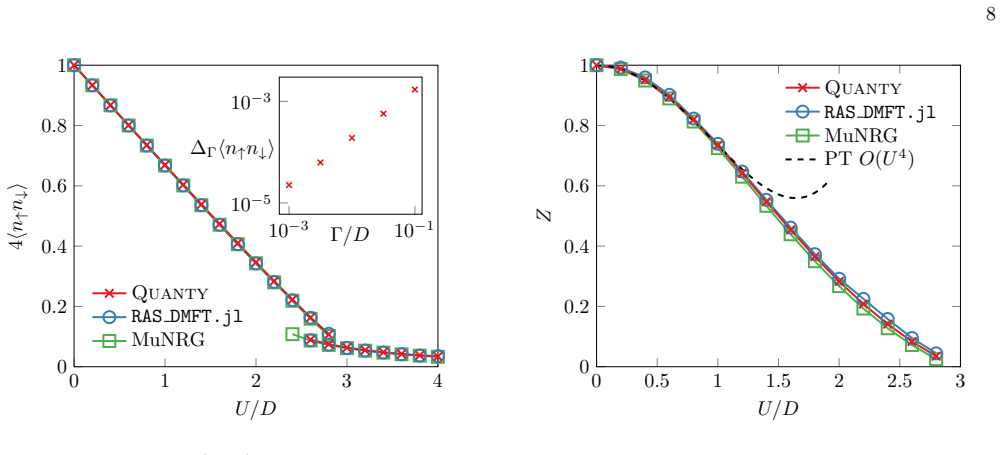
Numerical results We begin by asking whether the discrete self- consistency cycle converges to the same fixed point solution as conventional NRG. To test this, in Fig. 3 we show the double occupation⟨n↑n↓⟩as a function ofU/D. The good agreement betweenQuanty,RAS DMFT.jl, and reference NRG data in Fig. 3 indicates that all approaches converge to similar fi...
-
[2]
(32)] and shows excellent agreement between the two codes
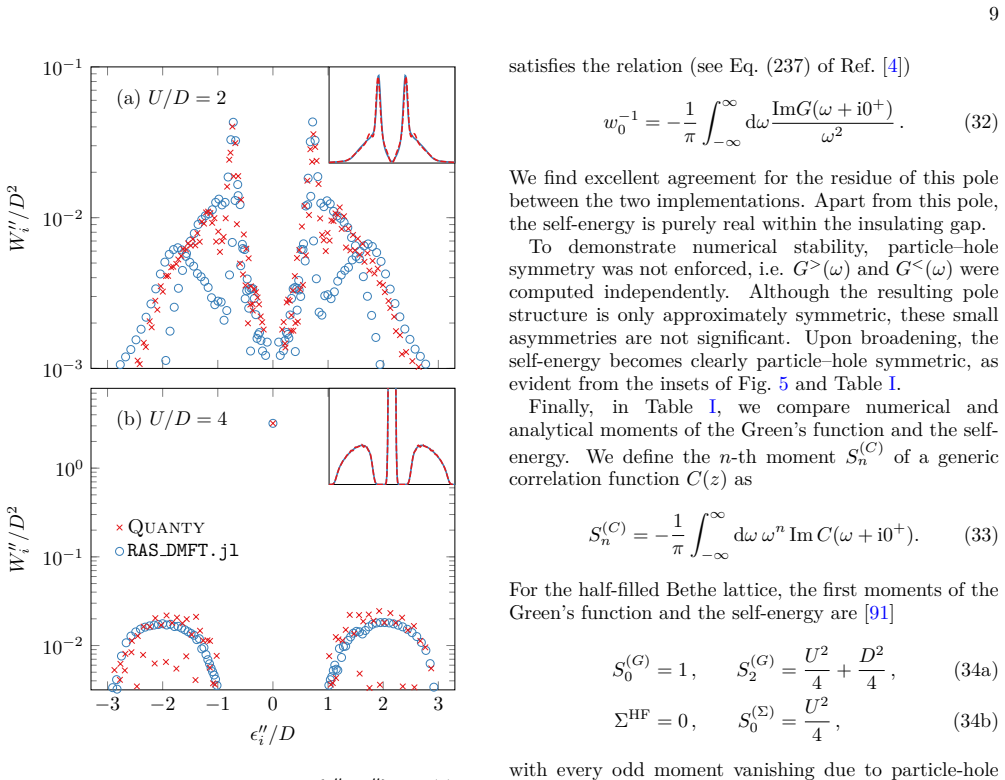
The residue of this pole is related to the negative second moment of the Green’s function [see Eq. (32)] and shows excellent agreement between the two codes. Particle–hole symmetry was not enforced, demonstrating the numerical stability of the solution. The insets show the respective self- energy convolved with a Gaussian with standard deviation σ/D= 0.08...
-
[3]
Podizanje znanstvene izvrsnosti Centra za napredne laserske tehnike (CALTboost)
Computational Details For calculations performed withRAS DMFT.jl, the first two conduction and valence bath sites are kept fully unrestricted. In the remaining conduction and valence chains, up to either a single valence-conduction excitation or up two of valence-impurity or conduction-impurity excitations are allowed. This corresponds toL= 2, p= 2 in not...
-
[4]
Those may be decomposed as Wi =B iBi,(A2) where we chooseB i to be the Hermitian principal square root ofW i, i.e.,B i =B † i
List-of-poles representation We can represent response functions on a discrete set of energiesαi∈R, withi∈{1,...,M}, which may be viewed both as pole positions and as points of an energy mesh: G(z) =A 0 + M∑ i=1 Wi z−αi ,(A1) with positive semidefinite, Hermitian spectral weight matricesW i. Those may be decomposed as Wi =B iBi,(A2) where we chooseB i to ...
-
[5]
This yields a matrix- valued continued-fraction representation, G(z) =A 0 +B 0 1 z−A1−B1 1 z−A2−...B1 B0,(A10) whereA i,B i∈CN×Nare Hermitian matrices, and the chain has lengthM
Tridiagonal (chain-impurity) representation Instead of representing a discretized Green’s function as a sum over poles and residues, we may represent it as the Green’s function of a local site coupled to a one- dimensional chain of bath sites. This yields a matrix- valued continued-fraction representation, G(z) =A 0 +B 0 1 z−A1−B1 1 z−A2−...B1 B0,(A10) wh...
-
[6]
The Green’s function then takes the form G(z) =A 0 +B 0 1 z−A1−∑M′ i=1 Bi 1 z−ai+1 Bi B0,(A26) with the impurity at site index 1 and the bath sites at indices 2 toM ′+ 1
Anderson (star-impurity) representation In the Anderson (or star) representation, the bath degrees of freedom are diagonalized. The Green’s function then takes the form G(z) =A 0 +B 0 1 z−A1−∑M′ i=1 Bi 1 z−ai+1 Bi B0,(A26) with the impurity at site index 1 and the bath sites at indices 2 toM ′+ 1. Note that the number of bath sites and their internal dime...
-
[7]
˜B1 ˜B1/2 0 .(B2) Comparing this expression to Eq
Starting from tridiagonal representation of ˜G(z) We start from ˜G(z) = ˜B1/2 0 1 z−˜A1−˜B1 1 z−˜A2−... ˜B1 ˜B1/2 0 .(B2) Comparing this expression to Eq. (16) gives ˜S1/2 = ˜B1/2,(B3) ˜Heff(z) = ˜A1 + ˜B1 1 z−˜A2−... ˜B1,(B4) with ˜Heff(z) also given in tridiagonal representation. (i)Inversion.The inverse of ˜G(z) is written as ˜G−1(z) = ˜S−1/2 ( z−˜A1−˜...
-
[8]
Starting from Anderson representation of ˜G(z) For a response function ˜G(z) in Anderson representation ˜G(z) = ˜S1/2 1 z−˜A1−∑ i ˜Bi 1 z−˜ai+1 ˜Bi ˜S1/2,(B13) ˜Heff(z) is given in a list-of-poles representation: ˜Heff(z) = ˜A1 + ∑ i ˜Bi 1 z−˜ai+1 ˜Bi.(B14) (i)Inversion.The inverse of ˜G(z) is given as ˜G−1(z) = ˜S−1/2 ( z−˜A1− ∑ i ˜Bi 1 z−˜ai+1 ˜Bi ) ˜S−...
-
[9]
Here, we describe an alternative approach that obtains the pole expansion of Σ(z) directly from the pole expansion of ˜G(z) using standard linear algebra techniques
Starting from list-of-poles representation of ˜G(z) If the transformations between different types of response functions (Appendices A 2 a, A 3 d) are available, one could first transform ˜G(z) to tridiagonal or Anderson representation and continue as described in Appendices B 1 or B 2, respectively. Here, we describe an alternative approach that obtains ...
-
[10]
P. W. Anderson, Localized Magnetic States in Metals, Physical Review124, 41 (1961)
1961
-
[11]
Kondo, Resistance Minimum in Dilute Magnetic Alloys, Progress of Theoretical Physics32, 37 (1964)
J. Kondo, Resistance Minimum in Dilute Magnetic Alloys, Progress of Theoretical Physics32, 37 (1964)
1964
-
[12]
L. Kouwenhoven and L. Glazman, Revival of the Kondo effect, Physics World 10.1088/2058-7058/14/1/28 (2001)
-
[13]
Georges, G
A. Georges, G. Kotliar, W. Krauth, and M. J. Rozenberg, Dynamical mean-field theory of strongly correlated fermion systems and the limit of infinite dimensions, Reviews of Modern Physics68, 13 (1996)
1996
-
[14]
Potthoff, Self-energy-functional approach to systems of correlated electrons, The European Physical Journal B - Condensed Matter and Complex Systems32, 429 (2003)
M. Potthoff, Self-energy-functional approach to systems of correlated electrons, The European Physical Journal B - Condensed Matter and Complex Systems32, 429 (2003)
2003
-
[15]
Huang and E
C. Huang and E. A. Carter, Potential-functional embedding theory for molecules and materials, The Journal of Chemical Physics135, 194104 (2011)
2011
-
[16]
T. A. Wesolowski, S. Shedge, and X. Zhou, Frozen- Density Embedding Strategy for Multilevel Simulations of Electronic Structure, Chemical Reviews115, 5891 (2015)
2015
-
[17]
Knizia and G
G. Knizia and G. K.-L. Chan, Density Matrix Embedding: A Simple Alternative to Dynamical Mean- Field Theory, Physical Review Letters109, 186404 (2012)
2012
-
[18]
T. N. Lan and D. Zgid, Generalized Self-Energy Embedding Theory, The Journal of Physical Chemistry Letters8, 2200 (2017)
2017
-
[19]
Keiter and J
H. Keiter and J. C. Kimball, Perturbation Technique for the Anderson Hamiltonian, Physical Review Letters25, 672 (1970)
1970
-
[20]
N. E. Bickers and D. J. Scalapino, Conserving Approximations for Strongly Fluctuating Electron Systems. I. Formalism and Calculational Approach, Annals of physics193, 206 (1989)
1989
-
[21]
Pruschke and N
T. Pruschke and N. Grewe, The Anderson model with finite Coulomb repulsion, Zeitschrift f¨ ur Physik B Condensed Matter74, 439 (1989)
1989
-
[22]
A. C. Hewson,The Kondo problem to heavy fermions, Cambridge studies in magnetism No. 2 (Cambridge University Press, Cambridge ; New York, 1993) oCLC: 25510299
1993
-
[23]
D. E. Logan, M. P. Eastwood, and M. A. Tusch, A local moment approach to the Anderson model, Journal of Physics: Condensed Matter10, 2673 (1998)
1998
-
[24]
J. E. Hirsch and R. M. Fye, Monte Carlo Method for Magnetic Impurities in Metals, Physical Review Letters 56, 2521 (1986)
1986
-
[25]
A. N. Rubtsov, V. V. Savkin, and A. I. Lichtenstein, Continuous-time quantum Monte Carlo method for fermions, Physical Review B72, 035122 (2005)
2005
-
[26]
Werner, A
P. Werner, A. Comanac, L. De’ Medici, M. Troyer, and A. J. Millis, Continuous-Time Solver for Quantum Impurity Models, Physical Review Letters97, 076405 (2006)
2006
-
[27]
E. Gull, A. J. Millis, A. I. Lichtenstein, A. N. Rubtsov, M. Troyer, and P. Werner, Continuous-time Monte Carlo methods for quantum impurity models, Reviews of Modern Physics83, 349 (2011)
2011
-
[28]
Caffarel and W
M. Caffarel and W. Krauth, Exact diagonalization approach to correlated fermions in infinite dimensions: Mott transition and superconductivity, Physical Review Letters72, 1545 (1994)
1994
-
[29]
Capone, L
M. Capone, L. De’ Medici, and A. Georges, Solving the dynamical mean-field theory at very low temperatures using the Lanczos exact diagonalization, Physical Review B76, 245116 (2007)
2007
-
[30]
Weber, A
C. Weber, A. Amaricci, M. Capone, and P. B. Littlewood, Augmented hybrid exact-diagonalization solver for dynamical mean field theory, Physical Review B86, 115136 (2012)
2012
-
[31]
Gunnarsson and K
O. Gunnarsson and K. Sch¨ onhammer, Electron spectroscopies for Ce compounds in the impurity model, Physical Review B28, 4315 (1983)
1983
-
[32]
Zgid and G
D. Zgid and G. K.-L. Chan, Dynamical mean-field theory from a quantum chemical perspective, The Journal of Chemical Physics134, 094115 (2011)
2011
-
[33]
D. Zgid, E. Gull, and G. K.-L. Chan, Truncated configuration interaction expansions as solvers for correlated quantum impurity models and dynamical 20 mean-field theory, Physical Review B86, 165128 (2012)
2012
-
[34]
M. W. Haverkort, M. Zwierzycki, and O. K. Andersen, Multiplet ligand-field theory using Wannier orbitals, Physical Review B85, 165113 (2012)
2012
-
[35]
Y. Lu, M. H¨ oppner, O. Gunnarsson, and M. W. Haverkort, Efficient real-frequency solver for dynamical mean-field theory, Physical Review B90, 085102 (2014)
2014
-
[36]
Lu and M
Y. Lu and M. W. Haverkort, Exact diagonalization as an impurity solver in dynamical mean field theory, The European Physical Journal Special Topics226, 2549 (2017)
2017
-
[37]
Y. Lu, X. Cao, P. Hansmann, and M. W. Haverkort, Natural-orbital impurity solver and projection approach for Green’s functions, Physical Review B100, 115134 (2019)
2019
-
[38]
K. G. Wilson, The renormalization group: Critical phenomena and the Kondo problem, Reviews of Modern Physics47, 773 (1975)
1975
-
[39]
Krishna-murthy, J
H. Krishna-murthy, J. Wilkins, and K. Wilson, Renormalization-group approach to the Anderson model of dilute magnetic alloys. I. Static properties for the symmetric case, Physical Review B21, 1003 (1980)
1980
-
[40]
Bulla, T
R. Bulla, T. A. Costi, and T. Pruschke, Numerical renormalization group method for quantum impurity systems, Reviews of Modern Physics80, 395 (2008)
2008
-
[41]
Weichselbaum, Tensor networks and the numerical renormalization group, Phys
A. Weichselbaum, Tensor networks and the numerical renormalization group, Phys. Rev. B86, 245124 (2012)
2012
-
[42]
Nishimoto, F
S. Nishimoto, F. Gebhard, and E. Jeckelmann, Dynamical mean-field theory calculation with the dynamical density-matrix renormalization group, Physica B: Condensed Matter378-380, 283 (2006)
2006
-
[43]
Weichselbaum, F
A. Weichselbaum, F. Verstraete, U. Schollw¨ ock, J. I. Cirac, and J. Von Delft, Variational matrix-product-state approach to quantum impurity models, Physical Review B80, 165117 (2009)
2009
-
[44]
Ganahl, M
M. Ganahl, M. Aichhorn, H. G. Evertz, P. Thunstr¨ om, K. Held, and F. Verstraete, Efficient DMFT impurity solver using real-time dynamics with matrix product states, Physical Review B92, 155132 (2015)
2015
-
[45]
F. A. Wolf, I. P. McCulloch, O. Parcollet, and U. Schollw¨ ock, Chebyshev matrix product state impurity solver for dynamical mean-field theory, Physical Review B90, 115124 (2014)
2014
-
[46]
F. A. Wolf, A. Go, I. P. McCulloch, A. J. Millis, and U. Schollw¨ ock, Imaginary-Time Matrix Product State Impurity Solver for Dynamical Mean-Field Theory, Physical Review X5, 041032 (2015)
2015
-
[47]
Bauernfeind, M
D. Bauernfeind, M. Zingl, R. Triebl, M. Aichhorn, and H. G. Evertz, Fork Tensor-Product States: Efficient Multiorbital Real-Time DMFT Solver, Physical Review X7, 031013 (2017)
2017
-
[48]
X. Cao, Y. Lu, P. Hansmann, and M. W. Haverkort, Tree tensor-network real-time multiorbital impurity solver: Spin-orbit coupling and correlation functions in Sr2RuO4, Physical Review B104, 115119 (2021)
2021
-
[49]
Raas and G
C. Raas and G. S. Uhrig, Spectral densities from dynamic density-matrix renormalization, The European Physical Journal B45, 293 (2005)
2005
-
[50]
Peters, Spectral functions for single- and multi- impurity models using density matrix renormalization group, Physical Review B84, 075139 (2011)
R. Peters, Spectral functions for single- and multi- impurity models using density matrix renormalization group, Physical Review B84, 075139 (2011)
2011
-
[51]
S.-S. B. Lee and A. Weichselbaum, Adaptive broadening to improve spectral resolution in the numerical renormalization group, Physical Review B94, 235127 (2016)
2016
-
[52]
X. Wang, H. T. Dang, and A. J. Millis, High-frequency asymptotic behavior of self-energies in quantum impurity models, Physical Review B84, 073104 (2011)
2011
-
[53]
Li and W
G. Li and W. Hanke, Efficient treatment of the high- frequency tail of the self-energy function and its relevance for multiorbital models, Physical Review B85, 115103 (2012)
2012
-
[54]
Han and H
M. Han and H. J. Choi, Causal optimization method for imaginary-time Green’s functions in interacting electron systems, Physical Review B104, 115112 (2021)
2021
-
[55]
LaBollita, J
H. LaBollita, J. Kaye, and A. Hampel, Stabilizing the calculation of the self-energy in dynamical mean-field theory using constrained residual minimization, Physical Review B111, 115155 (2025)
2025
-
[56]
Bulla, A
R. Bulla, A. C. Hewson, and T. Pruschke, Numerical renormalization group calculations for the self-energy of the impurity Anderson model, Journal of Physics: Condensed Matter10, 8365 (1998)
1998
-
[57]
Hafermann, K
H. Hafermann, K. R. Patton, and P. Werner, Improved estimators for the self-energy and vertex function in hybridization-expansion continuous-time quantum Monte Carlo simulations, Physical Review B85, 205106 (2012)
2012
-
[58]
Werner and A
P. Werner and A. J. Millis, Hybridization expansion impurity solver: General formulation and application to Kondo lattice and two-orbital models, Physical Review B74, 155107 (2006)
2006
-
[59]
Kaufmann, P
J. Kaufmann, P. Gunacker, A. Kowalski, G. Sangiovanni, and K. Held, Symmetric improved estimators for continuous-time quantum Monte Carlo, Physical Review B100, 075119 (2019)
2019
-
[60]
F. B. Kugler, Improved estimator for numerical renormalization group calculations of the self-energy, Physical Review B105, 245132 (2022)
2022
-
[61]
L¨ owdin, On the Non-Orthogonality Problem Connected with the Use of Atomic Wave Functions in the Theory of Molecules and Crystals, The Journal of Chemical Physics18, 365 (1950)
P.-O. L¨ owdin, On the Non-Orthogonality Problem Connected with the Use of Atomic Wave Functions in the Theory of Molecules and Crystals, The Journal of Chemical Physics18, 365 (1950)
1950
-
[62]
L¨ owdin, A Note on the Quantum-Mechanical Perturbation Theory, The Journal of Chemical Physics 19, 1396 (1951)
P.-O. L¨ owdin, A Note on the Quantum-Mechanical Perturbation Theory, The Journal of Chemical Physics 19, 1396 (1951)
1951
-
[63]
L¨ owdin, Quantum Theory of Many-Particle Systems
P.-O. L¨ owdin, Quantum Theory of Many-Particle Systems. I. Physical Interpretations by Means of Density Matrices, Natural Spin-Orbitals, and Convergence Problems in the Method of Configurational Interaction, Physical Review97, 1474 (1955)
1955
-
[64]
O. K. Andersen, Linear methods in band theory, Physical Review B12, 3060 (1975)
1975
-
[65]
O. K. Andersen and T. Saha-Dasgupta, Muffin-tin orbitals of arbitrary order, Physical Review B62, R16219 (2000)
2000
-
[66]
Gunnarsson, O
O. Gunnarsson, O. K. Andersen, O. Jepsen, and J. Zaanen, Density-functional calculation of the parameters in the Anderson model: Application to Mn in CdTe, Physical Review B39, 1708 (1989)
1989
-
[67]
V. I. Anisimov and O. Gunnarsson, Density-functional calculation of effective Coulomb interactions in metals, Physical Review B43, 7570 (1991)
1991
-
[68]
E. Koch, G. Sangiovanni, and O. Gunnarsson, Sum rules and bath parametrization for quantum cluster theories, Physical Review B78, 115102 (2008)
2008
-
[69]
The notation ˜G11 =G, ˜G21 =F L, ˜G12 =F R, ˜G22 =Iis 21 used in Ref. 51
-
[70]
Weichselbaum and J
A. Weichselbaum and J. von Delft, Sum-rule conserving spectral functions from the numerical renormalization group, Phys. Rev. Lett.99, 076402 (2007)
2007
-
[71]
Peters, T
R. Peters, T. Pruschke, and F. B. Anders, Numerical renormalization group approach to green’s functions for quantum impurity models, Phys. Rev. B74, 245114 (2006)
2006
-
[72]
O. Kovalska, J. von Delft, and A. Gleis, Tangent space Krylov computation of real-frequency spectral functions: Influence of density-assisted hopping on 2D Mott physics, 2510.07279 [cond-mat.str-el] (2025)
-
[73]
F. D. Picoli, M. Huang, J. von Delft, and A. Gleis, Tangent-space krylov solver for quantum impurity models, to be published (2026)
2026
-
[74]
www.Quanty.org - a quantum many body script language (2025)
2025
-
[75]
F. B. Anders and A. Schiller, Real-time dynamics in quantum-impurity systems: A time-dependent numerical renormalization-group approach, Phys. Rev. Lett.95, 196801 (2005)
2005
-
[76]
Hewson, A
A. Hewson, A. Oguri, and D. Meyer, Renormalized parameters for impurity models, Eur. Phys. J. B40, 177 (2004)
2004
-
[77]
Bauer, A
J. Bauer, A. Oguri, and A. Hewson, Spectral properties of locally correlated electrons in a BCS superconductor, J. Phys.: Cond. Mat.19, 486211 (2007)
2007
-
[78]
Nishikawa, D
Y. Nishikawa, D. J. G. Crow, and A. C. Hewson, Renormalized parameters and perturbation theory for an n-channel Anderson model with Hund’s rule coupling: Symmetric case, Phys. Rev. B82, 115123 (2010)
2010
-
[79]
F. B. Kugler, M. Zingl, H. U. Strand, S.-S. B. Lee, J. von Delft, and A. Georges, Strongly correlated materials from a numerical renormalization group perspective: How the fermi-liquid state of Sr 2RuO4 emerges, Physical Review Letters124, 016401 (2020)
2020
-
[80]
A. C. Hewson, Renormalized perturbation calculations for the single-impurity Anderson model, Journal of Physics: Condensed Matter13, 10011 (2001)
2001
discussion (0)
Sign in with ORCID, Apple, or X to comment. Anyone can read and Pith papers without signing in.