Recognition: unknown
Probabilistic Atomic Swaps for Bitcoin and Friends
Pith reviewed 2026-05-08 17:03 UTC · model grok-4.3
The pith
Probabilistic swaps extend atomic swaps so one party's transfer occurs with a fixed public probability that neither side can bias or predict.
A machine-rendered reading of the paper's core claim, the machinery that carries it, and where it could break.
Core claim
We introduce probabilistic swaps, a cryptographic primitive in which one party's asset transfer executes with a fixed, publicly specified probability that is embedded in the protocol and cannot be biased by either participant; the construction combines adaptor signatures with oblivious pseudorandom functions to realize this unbiased outcome, introduces an auxiliary mechanism for atomic exchange of OPRF evaluations, and preserves the minimal on-chain footprint of standard atomic-swap protocols while remaining compatible with existing Bitcoin scripts.
What carries the argument
Adaptor signatures combined with oblivious pseudorandom functions (OPRFs) to enforce an unbiased, publicly verifiable probability through atomic exchange of OPRF evaluations.
If this is right
- Trustless lotteries and randomized cross-chain allocations become possible without intermediaries.
- The same on-chain footprint as ordinary atomic swaps allows immediate deployment on Bitcoin and Lightning.
- Transactions remain indistinguishable from standard ones, preserving privacy and fungibility.
- A new auxiliary primitive for atomic OPRF evaluation exchange is available for other protocols.
- Formal security definitions support the claim that neither party can bias the embedded probability.
Where Pith is reading between the lines
- The OPRF-exchange mechanism could be reused in other settings that need private yet verifiable randomness tied to payments.
- Probabilistic swaps open a route to decentralized mechanisms for fair random allocation of scarce on-chain resources.
- The approach could be generalized to multi-party probabilistic exchanges if the OPRF composition extends cleanly.
Load-bearing premise
Adaptor signatures and OPRFs can be composed so that the resulting probability is fixed, publicly verifiable, and immune to prediction or bias by either participant.
What would settle it
Multiple executions of the protocol on Bitcoin testnet in which the observed frequency of the probabilistic transfer deviates from the specified probability by more than statistical sampling error, or in which one party succeeds in forcing a particular outcome.
Figures






read the original abstract
Atomic swaps are a fundamental primitive for the trustless exchange of digital assets across blockchains: they guarantee that either both parties receive the agreed assets or neither party transfers. While this all-or-nothing guarantee is powerful, it also imposes an inherent determinism that rules out exchanges whose intended outcome is probabilistic. As a result, existing atomic swaps cannot realize trustless exchanges in which one party pays for a fixed chance of receiving a larger asset or reward, as in lotteries, randomized allocation mechanisms, and probabilistic cross-chain trades. We introduce probabilistic swaps, a new cryptographic primitive that extends atomic swaps to the probabilistic setting. In a probabilistic swap, one party's transfer is executed with a fixed, publicly specified probability embedded in the protocol and cannot be biased by either party. This yields a trustless mechanism for randomized exchange with verifiable odds and no trusted intermediary. Our construction combines adaptor signatures with oblivious pseudorandom functions (OPRFs) to realize the desired probabilistic outcome while ensuring that neither party can predict or bias it in advance. Along the way, we introduce a new mechanism for the atomic exchange of OPRF evaluations for payments, which may be of independent interest. A key feature of our approach is that it preserves the minimal on-chain footprint of modern atomic-swap protocols. The protocol relies only on standard Bitcoin scripts, such as digital signatures and timelocks, and is deployable on any blockchain that already supports atomic swaps. Consequently, probabilistic swaps are indistinguishable from ordinary on-chain transactions, which helps preserve privacy and fungibility. We provide formal security foundations and demonstrate practicality through a probabilistic swap in the Bitcoin testnet and in the Lightning Network.
Editorial analysis
A structured set of objections, weighed in public.
Referee Report
Summary. The paper introduces probabilistic atomic swaps as an extension of atomic swaps, enabling trustless exchanges where one party's transfer executes with a fixed, publicly specified probability p that cannot be biased by either party. The construction combines adaptor signatures with oblivious pseudorandom functions (OPRFs) and introduces a new atomic exchange mechanism for OPRF evaluations; it claims formal security foundations and demonstrates the protocol via a Bitcoin testnet implementation and Lightning Network deployment using only standard scripts such as signatures and timelocks.
Significance. If the security claims hold, the work enables new applications including trustless lotteries, randomized allocations, and probabilistic cross-chain trades without intermediaries. The preservation of minimal on-chain footprint and indistinguishability from ordinary transactions are practical strengths that could extend the applicability of atomic-swap infrastructure while maintaining privacy and fungibility.
major comments (2)
- [§4] §4 (Atomic OPRF Exchange Mechanism): The load-bearing claim that the new atomic exchange of OPRF evaluations enforces an unbiased probability p rests on the composition preserving the OPRF output distribution under adaptor-signature locking; however, the description does not detail how Bitcoin-script timelocks and signature verification interact with the OPRF to prevent early revelation or bias by an adaptive party.
- [§5] §5 (Security Foundations): The formal security reduction for the probabilistic swap is asserted to follow from the security of adaptor signatures and OPRFs, but the proof sketch does not explicitly address whether the custom atomic-exchange sub-protocol preserves both atomicity and the exact uniform distribution of the OPRF output in the presence of concurrent executions or script-specific constraints.
minor comments (2)
- [§6] The testnet demonstration would be strengthened by reporting the empirical distribution of outcomes over multiple runs to allow direct verification that the realized probability matches the specified p.
- Notation for the probability parameter p and the OPRF evaluation output could be introduced more explicitly in the preliminaries to improve readability for readers unfamiliar with the composition.
Simulated Author's Rebuttal
We thank the referee for the constructive and detailed feedback. We address each major comment below and indicate the specific revisions planned for the next version of the manuscript.
read point-by-point responses
-
Referee: [§4] §4 (Atomic OPRF Exchange Mechanism): The load-bearing claim that the new atomic exchange of OPRF evaluations enforces an unbiased probability p rests on the composition preserving the OPRF output distribution under adaptor-signature locking; however, the description does not detail how Bitcoin-script timelocks and signature verification interact with the OPRF to prevent early revelation or bias by an adaptive party.
Authors: We agree that the current description in §4 would benefit from greater explicitness on the interaction between adaptor signatures, OPRF outputs, timelocks, and signature verification. In the revised manuscript we will augment §4 with a precise transaction-sequence diagram and accompanying prose that shows: (1) how the adaptor-signature lock is placed on the OPRF evaluation result, (2) the role of the timelock in preventing premature revelation of the OPRF output, and (3) why an adaptive party cannot bias the outcome or extract the output before the protocol reaches the intended phase. These additions will make the preservation of the uniform distribution under the Bitcoin-script constraints explicit. revision: yes
-
Referee: [§5] §5 (Security Foundations): The formal security reduction for the probabilistic swap is asserted to follow from the security of adaptor signatures and OPRFs, but the proof sketch does not explicitly address whether the custom atomic-exchange sub-protocol preserves both atomicity and the exact uniform distribution of the OPRF output in the presence of concurrent executions or script-specific constraints.
Authors: We acknowledge that the security reduction sketch in §5 is currently high-level and does not spell out the composition with the atomic-exchange sub-protocol under concurrency or script constraints. We will expand the proof sketch to include: (i) a modular argument showing that atomicity is inherited from the underlying adaptor-signature and OPRF definitions, (ii) an explicit claim that the uniform distribution of the OPRF output is preserved because the only way the output becomes public is through the locked adaptor-signature path, and (iii) a brief discussion of why concurrent executions and Bitcoin-script execution semantics do not introduce additional leakage or bias. We believe these clarifications can be added without altering the core claims. revision: yes
Circularity Check
No circularity: new composition of independent primitives with claimed formal security
full rationale
The paper defines probabilistic swaps as a new primitive extending atomic swaps via a combination of adaptor signatures and OPRFs, plus a novel atomic OPRF-evaluation exchange mechanism. It explicitly states that the construction relies on the standard security properties of these existing primitives and provides formal security foundations. No equations, definitions, or self-citations in the abstract or described structure reduce the central claim to a fitted input, self-definition, or load-bearing prior result by the same authors. The derivation chain is self-contained against external cryptographic assumptions.
Axiom & Free-Parameter Ledger
axioms (1)
- domain assumption Security properties of adaptor signatures and oblivious pseudorandom functions hold under standard cryptographic assumptions
Reference graph
Works this paper leans on
-
[1]
Emulating op_rand in bitcoin.https://delvingbitcoin.org/t/emulating-op-rand/1409/5(2025), delving Bitcoin forum discussion
2025
-
[2]
In: Lie, D., Mannan, M., Backes, M., Wang, X
Agrawal, S., Miao, P., Mohassel, P., Mukherjee, P.: PASTA: PASsword-based threshold authentication. In: Lie, D., Mannan, M., Backes, M., Wang, X. (eds.) ACM CCS 2018. pp. 2042–2059. ACM Press (Oct 2018).https: //doi.org/10.1145/3243734.3243839
-
[3]
In: 2014 IEEE Symposium on Security and Privacy
Andrychowicz, M., Dziembowski, S., Malinowski, D., Mazurek, L.: Secure multiparty computations on Bitcoin. In: 2014 IEEE Symposium on Security and Privacy. pp. 443–458. IEEE Computer Society Press (May 2014). https://doi.org/10.1109/SP.2014.35
-
[4]
In: Tibouchi, M., Wang, H
Aumayr, L., Ersoy, O., Erwig, A., Faust, S., Hostáková, K., Maffei, M., Moreno-Sanchez, P., Riahi, S.: Gen- eralized channels from limited blockchain scripts and adaptor signatures. In: Tibouchi, M., Wang, H. (eds.) ASIACRYPT 2021, Part II. LNCS, vol. 13091, pp. 635–664. Springer, Cham (Dec 2021).https://doi.org/10. 1007/978-3-030-92075-3_22
2021
-
[5]
In: Yin, H., Stavrou, A., Cremers, C., Shi, E
Aumayr, L., Thyagarajan, S.A.K., Malavolta, G., Moreno-Sanchez, P., Maffei, M.: Sleepy channels: Bi-directional payment channels without watchtowers. In: Yin, H., Stavrou, A., Cremers, C., Shi, E. (eds.) ACM CCS 2022. pp. 179–192. ACM Press (Nov 2022).https://doi.org/10.1145/3548606.3559370
-
[6]
In: Kalai, Y.T., Kamara, S.F
Badertscher, C., Campanelli, M., Ciampi, M., Russo, L., Siniscalchi, L.: Universally composable SNARKs with transparent setup without programmable random oracle. In: Kalai, Y.T., Kamara, S.F. (eds.) CRYPTO 2025, Part VII. LNCS, vol. 16006, pp. 225–258. Springer, Cham (Aug 2025).https://doi.org/10. 1007/978-3-032-01907-3_8
2025
-
[7]
Cryptology ePrint Archive, Report 2025/388 (2025),https://eprint.iacr.org/ 2025/388
Baecker, R., Gerhart, P., Katz, J., Schröder, D.: Fair exchange for decentralized autonomous organizations via threshold adaptor signatures. Cryptology ePrint Archive, Report 2025/388 (2025),https://eprint.iacr.org/ 2025/388
2025
-
[8]
In: Financial Cryptography and Data Security
Bartoletti, M., Zunino, R.: Constant-deposit multiparty lotteries on bitcoin. In: Financial Cryptography and Data Security. pp. 231–247. Springer International Publishing, Cham (2017)
2017
-
[9]
Basso, A., Maino, L.: POKÉ: A compact and efficient PKE from higher-dimensional isogenies. In: Fehr, S., Fouque, P.A. (eds.) EUROCRYPT 2025, Part II. LNCS, vol. 15602, pp. 94–123. Springer, Cham (May 2025). https://doi.org/10.1007/978-3-031-91124-8_4
-
[10]
Bentov, I., Kumaresan, R.: How to use Bitcoin to design fair protocols. In: Garay, J.A., Gennaro, R. (eds.) CRYPTO 2014, Part II. LNCS, vol. 8617, pp. 421–439. Springer, Berlin, Heidelberg (Aug 2014).https://doi. org/10.1007/978-3-662-44381-1_24
-
[11]
Beullens, W., Dodgson, L., Faller, S.H., Hesse, J.: The 2Hash OPRF framework and efficient post-quantum instantiations. In: Fehr, S., Fouque, P.A. (eds.) EUROCRYPT 2025, Part VIII. LNCS, vol. 15608, pp. 332–362. Springer, Cham (May 2025).https://doi.org/10.1007/978-3-031-91101-9_12
-
[12]
Bitcoin Optech: Point time-locked contracts (ptlcs).https://bitcoinops.org/en/topics/ptlc/, accessed: 2026- 04-27
2026
-
[13]
Blum, M., Feldman, P., Micali, S.: Non-interactive zero-knowledge and its applications (extended abstract). In: 20th ACM STOC. pp. 103–112. ACM Press (May 1988).https://doi.org/10.1145/62212.62222
-
[14]
In: 2018 IEEE Symposium on Security and Privacy
Bünz, B., Bootle, J., Boneh, D., Poelstra, A., Wuille, P., Maxwell, G.: Bulletproofs: Short proofs for confidential transactions and more. In: 2018 IEEE Symposium on Security and Privacy. pp. 315–334. IEEE Computer Society Press (May 2018).https://doi.org/10.1109/SP.2018.00020
-
[15]
In: Ray, I., Li, N., Kruegel, C
Camenisch, J., Lehmann, A., Neven, G.: Optimal distributed password verification. In: Ray, I., Li, N., Kruegel, C. (eds.) ACM CCS 2015. pp. 182–194. ACM Press (Oct 2015).https://doi.org/10.1145/2810103.2813722
-
[16]
In: Thuraisingham, B.M., Evans, D., Malkin, T., Xu, D
Choudhuri, A.R., Green, M., Jain, A., Kaptchuk, G., Miers, I.: Fairness in an unfair world: Fair multiparty computation from public bulletin boards. In: Thuraisingham, B.M., Evans, D., Malkin, T., Xu, D. (eds.) ACM CCS 2017. pp. 719–728. ACM Press (Oct / Nov 2017).https://doi.org/10.1145/3133956.3134092
-
[17]
In: Handschuh, H., Lysyanskaya, A
Davies, G.T., Faller, S.H., Gellert, K., Handirk, T., Hesse, J., Horváth, M., Jager, T.: Security analy- sis of the WhatsApp end-to-end encrypted backup protocol. In: Handschuh, H., Lysyanskaya, A. (eds.) CRYPTO 2023, Part IV. LNCS, vol. 14084, pp. 330–361. Springer, Cham (Aug 2023).https://doi.org/10. 1007/978-3-031-38551-3_11 24
2023
-
[18]
De Santis, A., Di Crescenzo, G., Ostrovsky, R., Persiano, G., Sahai, A.: Robust non-interactive zero knowledge. In: Kilian, J. (ed.) CRYPTO 2001. LNCS, vol. 2139, pp. 566–598. Springer, Berlin, Heidelberg (Aug 2001). https://doi.org/10.1007/3-540-44647-8_33
-
[19]
In: Chen, L., Li, N., Liang, K., Schneider, S.A
Esgin, M.F., Ersoy, O., Erkin, Z.: Post-quantum adaptor signatures and payment channel networks. In: Chen, L., Li, N., Liang, K., Schneider, S.A. (eds.) ESORICS 2020, Part II. LNCS, vol. 12309, pp. 378–397. Springer, Cham (Sep 2020).https://doi.org/10.1007/978-3-030-59013-0_19
-
[20]
Even, S., Goldreich, O., Lempel, A.: A randomized protocol for signing contracts. Commun. ACM28(6), 637–647 (Jun 1985).https://doi.org/10.1145/3812.3818,https://doi.org/10.1145/3812.3818
-
[21]
In: Jung, J., Holz, T
Everspaugh, A., Chatterjee, R., Scott, S., Juels, A., Ristenpart, T.: The pythia PRF service. In: Jung, J., Holz, T. (eds.) USENIX Security 2015. pp. 547–562. USENIX Association (Aug 2015),https://www.usenix.org/ conference/usenixsecurity15/technical-sessions/presentation/everspaugh
2015
-
[22]
Faust, S., Kohlweiss, M., Marson, G.A., Venturi, D.: On the non-malleability of the Fiat-Shamir transform. In: Galbraith, S.D., Nandi, M. (eds.) INDOCRYPT 2012. LNCS, vol. 7668, pp. 60–79. Springer, Berlin, Heidelberg (Dec 2012).https://doi.org/10.1007/978-3-642-34931-7_5
-
[23]
Fiat, A., Shamir, A.: How to prove yourself: Practical solutions to identification and signature problems. In: Odlyzko, A.M. (ed.) CRYPTO’86. LNCS, vol. 263, pp. 186–194. Springer, Berlin, Heidelberg (Aug 1987).https: //doi.org/10.1007/3-540-47721-7_12
-
[24]
Freedman, M.J., Ishai, Y., Pinkas, B., Reingold, O.: Keyword search and oblivious pseudorandom functions. In: Kilian, J. (ed.) TCC 2005. LNCS, vol. 3378, pp. 303–324. Springer, Berlin, Heidelberg (Feb 2005).https: //doi.org/10.1007/978-3-540-30576-7_17
-
[25]
Gennaro, R., Jarecki, S., Krawczyk, H., Rabin, T.: Secure distributed key generation for discrete-log based cryptosystems. In: Stern, J. (ed.) EUROCRYPT’99. LNCS, vol. 1592, pp. 295–310. Springer, Berlin, Heidelberg (May 1999).https://doi.org/10.1007/3-540-48910-X_21
-
[26]
In: Advances in Cryptology – EUROCRYPT 2026
Gerhart, P., Calsi, D.L., Russo, L., Schröder, D.: Fully-adaptive two-round threshold schnorr signatures from DDH. In: Advances in Cryptology – EUROCRYPT 2026. Lecture Notes in Computer Science, Springer (2026)
2026
-
[27]
In: Proceedings of the 2026 ACM SIGSAC Conference on Computer and Communications Security
Gerhart, P., Rausch, D., Schröder, D.: Universally composable adaptor signatures. In: Proceedings of the 2026 ACM SIGSAC Conference on Computer and Communications Security. Association for Computing Machinery (2026)
2026
-
[28]
(eds.) EUROCRYPT 2024, Part II
Gerhart,P.,Schröder,D.,Soni,P.,Thyagarajan,S.A.K.:Foundationsofadaptorsignatures.In:Joye,M.,Leander, G. (eds.) EUROCRYPT 2024, Part II. LNCS, vol. 14652, pp. 161–189. Springer, Cham (May 2024).https: //doi.org/10.1007/978-3-031-58723-8_6
-
[29]
In: Yin, H., Stavrou, A., Cremers, C., Shi, E
Glaeser, N., Maffei, M., Malavolta, G., Moreno-Sanchez, P., Tairi, E., Thyagarajan, S.A.K.: Foundations of coin mixing services. In: Yin, H., Stavrou, A., Cremers, C., Shi, E. (eds.) ACM CCS 2022. pp. 1259–1273. ACM Press (Nov 2022).https://doi.org/10.1145/3548606.3560637
-
[30]
Goldwasser, S., Micali, S., Rackoff, C.: The knowledge complexity of interactive proof-systems (extended ab- stract). In: 17th ACM STOC. pp. 291–304. ACM Press (May 1985).https://doi.org/10.1145/22145.22178
-
[31]
In: Handschuh, H., Lysyanskaya, A
Golovnev, A., Lee, J., Setty, S.T.V., Thaler, J., Wahby, R.S.: Brakedown: Linear-time and field-agnostic SNARKs for R1CS. In: Handschuh, H., Lysyanskaya, A. (eds.) CRYPTO 2023, Part II. LNCS, vol. 14082, pp. 193–226. Springer, Cham (Aug 2023).https://doi.org/10.1007/978-3-031-38545-2_7
-
[32]
Groth, J., Maller, M.: Snarky signatures: Minimal signatures of knowledge from simulation-extractable SNARKs. In: Katz, J., Shacham, H. (eds.) CRYPTO 2017, Part II. LNCS, vol. 10402, pp. 581–612. Springer, Cham (Aug 2017).https://doi.org/10.1007/978-3-319-63715-0_20
-
[33]
Groth, J., Malvai, H., Miller, A., Zhang, Y.N.: Constraint-friendly map-to-elliptic-curve-group relations and their applications. In: Hanaoka, G., Yang, B.Y. (eds.) ASIACRYPT 2025, Part II. LNCS, vol. 16246, pp. 511–543. Springer, Singapore (Dec 2025).https://doi.org/10.1007/978-981-95-5096-8_16
-
[34]
Do you play it by the books? a study on incident response playbooks and influencing factors,
Hanzlik, L., Loss, J., Thyagarajan, S.A.K., Wagner, B.: Sweep-UC: Swapping coins privately. In: 2024 IEEE Symposium on Security and Privacy. pp. 3822–3839. IEEE Computer Society Press (May 2024).https://doi. org/10.1109/SP54263.2024.00081
-
[35]
Heilman, E., Alshenibr, L., Baldimtsi, F., Scafuro, A., Goldberg, S.: TumbleBit: An untrusted Bitcoin-compatible anonymous payment hub. In: NDSS 2017. The Internet Society (Feb / Mar 2017).https://doi.org/10.14722/ ndss.2017.23086
-
[36]
Hesse, J., Jarecki, S., Krawczyk, H., Wood, C.: Password-authenticated TLS via OPAQUE and post-handshake authentication. In: Hazay, C., Stam, M. (eds.) EUROCRYPT 2023, Part V. LNCS, vol. 14008, pp. 98–127. Springer, Cham (Apr 2023).https://doi.org/10.1007/978-3-031-30589-4_4
-
[37]
Jarecki, S., Kiayias, A., Krawczyk, H.: Round-optimal password-protected secret sharing and T-PAKE in the password-only model. In: Sarkar, P., Iwata, T. (eds.) ASIACRYPT 2014, Part II. LNCS, vol. 8874, pp. 233–253. Springer, Berlin, Heidelberg (Dec 2014).https://doi.org/10.1007/978-3-662-45608-8_13 25
-
[38]
In: 2016 IEEE European Symposium on Security and Privacy (EuroS&P)
Jarecki, S., Kiayias, A., Krawczyk, H., Xu, J.: Highly-efficient and composable password-protected secret sharing (or: How to protect your bitcoin wallet online). In: 2016 IEEE European Symposium on Security and Privacy (EuroS&P). pp. 276–291 (2016).https://doi.org/10.1109/EuroSP.2016.30
-
[39]
Jarecki, S., Krawczyk, H., Xu, J.: OPAQUE: An asymmetric PAKE protocol secure against pre-computation attacks. In: Nielsen, J.B., Rijmen, V. (eds.) EUROCRYPT 2018, Part III. LNCS, vol. 10822, pp. 456–486. Springer, Cham (Apr / May 2018).https://doi.org/10.1007/978-3-319-78372-7_15
-
[40]
Kaptchuk, G., Green, M., Miers, I.: Giving state to the stateless: Augmenting trustworthy computation with ledgers. In: NDSS 2019. The Internet Society (Feb 2019).https://doi.org/10.14722/ndss.2019.23060
-
[41]
Chapman and Hall, CRC Press, third edn
Katz, J., Lindell, Y.: Introduction to Modern Cryptography. Chapman and Hall, CRC Press, third edn. (2014)
2014
-
[42]
In: Ray, I., Li, N., Kruegel, C
Kumaresan, R., Moran, T., Bentov, I.: How to use Bitcoin to play decentralized poker. In: Ray, I., Li, N., Kruegel, C. (eds.) ACM CCS 2015. pp. 195–206. ACM Press (Oct 2015).https://doi.org/10.1145/2810103.2813712
- [43]
-
[44]
Cryptology ePrint Archive, Report 2016/046 (2016),https://eprint.iacr.org/2016/046
Lindell, Y.: How to simulate it - A tutorial on the simulation proof technique. Cryptology ePrint Archive, Report 2016/046 (2016),https://eprint.iacr.org/2016/046
2016
-
[45]
Lindell,Y.,Pinkas,B.:Securetwo-partycomputationviacut-and-chooseoblivioustransfer.JournalofCryptology 25(4), 680–722 (Oct 2012).https://doi.org/10.1007/s00145-011-9107-0
-
[46]
In: NDSS 2023
Madathil, V., Thyagarajan, S.A.K., Vasilopoulos, D., Fournier, L., Malavolta, G., Moreno-Sanchez, P.: Crypto- graphic oracle-based conditional payments. In: NDSS 2023. The Internet Society (Feb 2023)
2023
-
[47]
Malavolta, G., Moreno-Sanchez, P., Schneidewind, C., Kate, A., Maffei, M.: Anonymous multi-hop locks for blockchain scalability and interoperability. In: NDSS 2019. The Internet Society (Feb 2019).https://doi.org/ 10.14722/ndss.2019.23330
-
[48]
In: 2017 IEEE European Symposium on Security and Privacy Workshops (EuroS&PW)
Miller, A., Bentov, I.: Zero-collateral lotteries in bitcoin and ethereum. In: 2017 IEEE European Symposium on Security and Privacy Workshops (EuroS&PW). pp. 4–13 (2017).https://doi.org/10.1109/EuroSPW.2017.44
-
[49]
Miller, A., Bentov, I., Bakshi, S., Kumaresan, R., McCorry, P.: Sprites and state channels: Payment networks that go faster than lightning. In: Goldberg, I., Moore, T. (eds.) FC 2019. LNCS, vol. 11598, pp. 508–526. Springer, Cham (Feb 2019).https://doi.org/10.1007/978-3-030-32101-7_30
-
[50]
Nolan, T.: Alt chains and atomic transfers.https://bitcointalk.org/index.php?topic=193281.0(2013)
2013
-
[51]
In: 2013 IEEE Symposium on Security and Privacy
Parno, B., Howell, J., Gentry, C., Raykova, M.: Pinocchio: Nearly practical verifiable computation. In: 2013 IEEE Symposium on Security and Privacy. pp. 238–252. IEEE Computer Society Press (May 2013).https: //doi.org/10.1109/SP.2013.47
-
[52]
In: 2023 IEEE Symposium on Security and Privacy
Qin, X., Pan, S., Mirzaei, A., Sui, Z., Ersoy, O., Sakzad, A., Esgin, M.F., Liu, J.K., Yu, J., Yuen, T.H.: BlindHub: Bitcoin-compatible privacy-preserving payment channel hubs supporting variable amounts. In: 2023 IEEE Symposium on Security and Privacy. pp. 2462–2480. IEEE Computer Society Press (May 2023).https: //doi.org/10.1109/SP46215.2023.10179427
-
[53]
Regev, O.: On lattices, learning with errors, random linear codes, and cryptography. J. ACM56(6) (Sep 2009). https://doi.org/10.1145/1568318.1568324,https://doi.org/10.1145/1568318.1568324
-
[54]
Sahai, A.: Non-malleable non-interactive zero knowledge and adaptive chosen-ciphertext security. In: 40th FOCS. pp. 543–553. IEEE Computer Society Press (Oct 1999).https://doi.org/10.1109/SFFCS.1999.814628
-
[55]
In: 2021 IEEE Symposium on Security and Privacy
Tairi, E., Moreno-Sanchez, P., Maffei, M.: A2L: Anonymous atomic locks for scalability in payment channel hubs. In: 2021 IEEE Symposium on Security and Privacy. pp. 1834–1851. IEEE Computer Society Press (May 2021). https://doi.org/10.1109/SP40001.2021.00111
-
[56]
Tairi, E., Moreno-Sanchez, P., Maffei, M.: Post-quantum adaptor signature for privacy-preserving off-chain pay- ments. In: Borisov, N., Díaz, C. (eds.) FC 2021, Part II. LNCS, vol. 12675, pp. 131–150. Springer, Berlin, Heidelberg (Mar 2021).https://doi.org/10.1007/978-3-662-64331-0_7
-
[57]
Taylor, J.: Bitcoin probabilistic swaps.https://github.com/EzePze/bitcoin-probabilistic-swaps(2026), ac- cessed: 2026-05-05
2026
-
[58]
Financial Cryptography and Data Security (2026),https://fc26.ifca.ai/preproceedings/113
Taylor, J., Gerhart, P., Thyagarajan, S.A.: How to make delegated payments on bitcoin: A question for the AI agentic future. Financial Cryptography and Data Security (2026),https://fc26.ifca.ai/preproceedings/113. pdf
2026
-
[59]
In: Ligatti, J., Ou, X., Katz, J., Vigna, G
Thyagarajan, S.A.K., Bhat, A., Malavolta, G., Döttling, N., Kate, A., Schröder, D.: Verifiable timed signatures made practical. In: Ligatti, J., Ou, X., Katz, J., Vigna, G. (eds.) ACM CCS 2020. pp. 1733–1750. ACM Press (Nov 2020).https://doi.org/10.1145/3372297.3417263
-
[60]
2021 IEEE Symposium on Security and Privacy (SP) pp
Thyagarajan, S.A.K., Malavolta, G.: Lockable signatures for blockchains: Scriptless scripts for all signatures. 2021 IEEE Symposium on Security and Privacy (SP) pp. 937–954 (2021),https://api.semanticscholar.org/ CorpusID:231732350
2021
-
[61]
Model Stealing Attacks Against Inductive Graph Neural Networks
Thyagarajan, S.A.K., Malavolta, G., Moreno-Sanchez, P.: Universal atomic swaps: Secure exchange of coins across all blockchains. In: 2022 IEEE Symposium on Security and Privacy. pp. 1299–1316. IEEE Computer Society Press (May 2022).https://doi.org/10.1109/SP46214.2022.9833731 26
-
[62]
In: Dunkelman, O., Dziembowski, S
Tyagi, N., Celi, S., Ristenpart, T., Sullivan, N., Tessaro, S., Wood, C.A.: A fast and simple partially oblivious PRF, with applications. In: Dunkelman, O., Dziembowski, S. (eds.) EUROCRYPT 2022, Part II. LNCS, vol. 13276, pp. 674–705. Springer, Cham (May / Jun 2022).https://doi.org/10.1007/978-3-031-07085-3_23
-
[63]
In: Luo, B., Liao, X., Xu, J., Kirda, E., Lie, D
Vanjani, N., Soni, P., Thyagarajan, S.A.K.: Functional adaptor signatures: Beyond all-or-nothing blockchain- based payments. In: Luo, B., Liao, X., Xu, J., Kirda, E., Lie, D. (eds.) ACM CCS 2024. pp. 1493–1507. ACM Press (Oct 2024).https://doi.org/10.1145/3658644.3690240 A Preliminaries We recall preliminaries on oblivious PRFs, adaptor signatures, and ze...
-
[64]
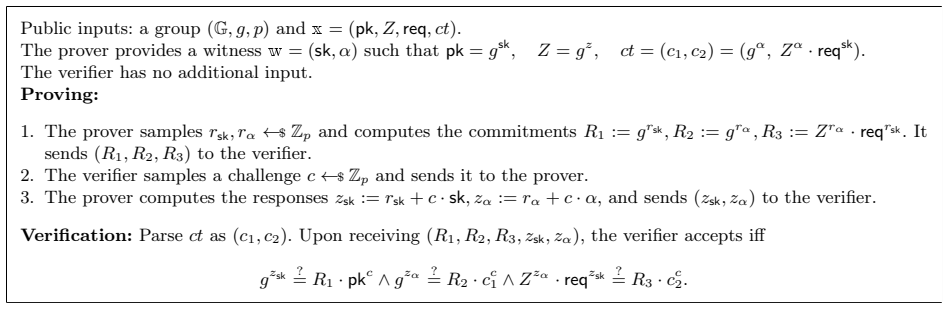
The prover samplesrsk, rα ←$ Zp and computes the commitmentsR1 :=g rsk , R2 :=g rα , R3 :=Z rα ·req rsk .It sends(R 1, R2, R3)to the verifier
-
[66]
Verification:Parsectas(c 1, c2)
The prover computes the responseszsk :=r sk +c·sk, z α :=r α +c·α,and sends(z sk, zα)to the verifier. Verification:Parsectas(c 1, c2). Upon receiving(R1, R2, R3, zsk, zα), the verifier accepts iff gzsk ? =R 1 ·pk c ∧g zα ? =R 2 ·c c 1 ∧Z zα ·req zsk ? =R 3 ·c c 2. Fig.14.Interactive Schnorr proof for the relationREnc. Proofs of knowledge for commitment-op...
-
[67]
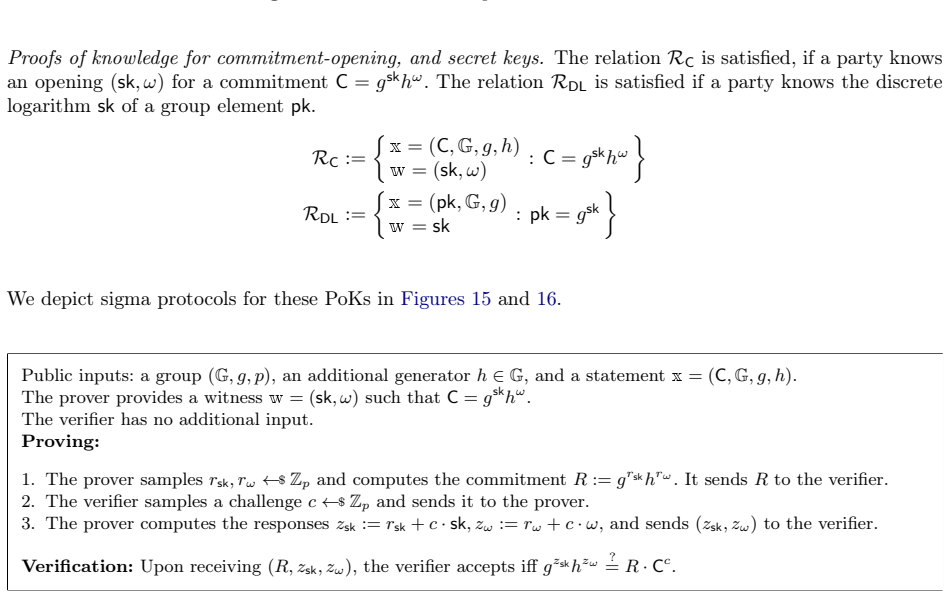
The prover samplesrsk, rω ←$ Zp and computes the commitmentR:=g rsk hrω .It sendsRto the verifier
-
[69]
Verification:Upon receiving(R, z sk, zω), the verifier accepts iffgzsk hzω ? =R·C c
The prover computes the responseszsk :=r sk +c·sk, z ω :=r ω +c·ω,and sends(z sk, zω)to the verifier. Verification:Upon receiving(R, z sk, zω), the verifier accepts iffgzsk hzω ? =R·C c. Fig.15.Interactive Schnorr proof for the relationRC. Lemma 2.The cut-and-choose protocol in Figure 17 is complete, computationally sound under the DDH assumption, and hon...
-
[70]
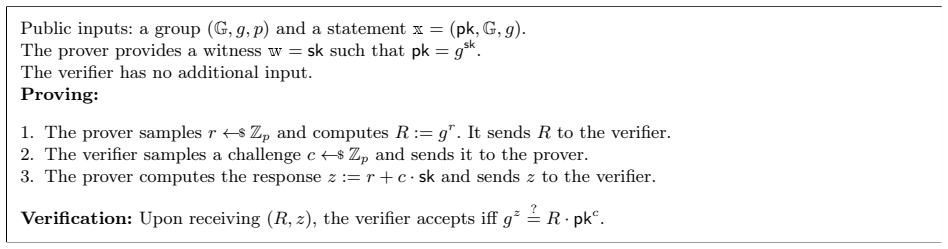
The prover samplesr← $ Zp and computesR:=g r.It sendsRto the verifier
-
[72]
Verification:Upon receiving(R, z), the verifier accepts iffgz ? =R·pk c
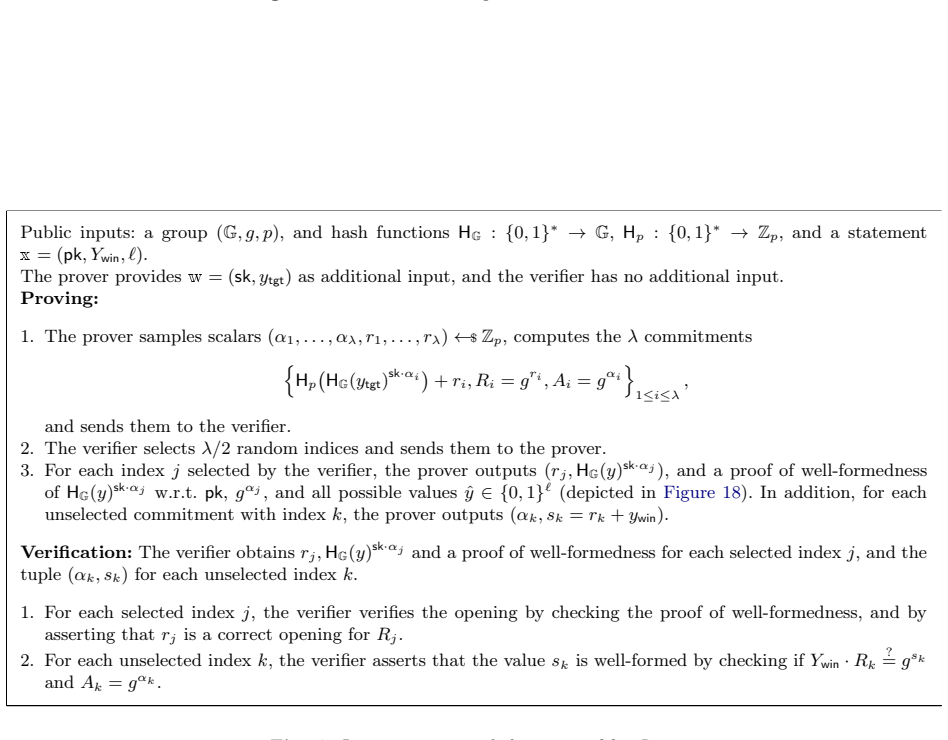
The prover computes the responsez:=r+c·skand sendszto the verifier. Verification:Upon receiving(R, z), the verifier accepts iffgz ? =R·pk c. Fig.16.Interactive Schnorr proof for the relationRDL. Public inputs: a group(G, g, p), and hash functionsH G :{0,1} ∗ →G,H p :{0,1} ∗ →Z p, and a statement x= (pk, Y win, ℓ). The prover providesw= (sk, y tgt)as addit...
-
[73]
, αλ, r1,
The prover samples scalars(α1, . . . , αλ, r1, . . . , rλ)← $ Zp, computes theλcommitments n Hp HG(ytgt)sk·αi +r i, Ri =g ri , Ai =g αi o 1≤i≤λ , and sends them to the verifier
-
[74]
The verifier selectsλ/2random indices and sends them to the prover
-
[75]
In addition, for each unselected commitment with indexk, the prover outputs(αk, sk =r k +y win)
For each indexjselected by the verifier, the prover outputs(r j,H G(y)sk·αj ), and a proof of well-formedness ofH G(y)sk·αj w.r.t.pk,g αj, and all possible valuesˆy∈ {0,1} ℓ (depicted in Figure 18). In addition, for each unselected commitment with indexk, the prover outputs(αk, sk =r k +y win). Verification:The verifier obtainsrj,H G(y)sk·αj and a proof o...
-
[76]
For each selected indexj, the verifier verifies the opening by checking the proof of well-formedness, and by asserting thatr j is a correct opening forRj
-
[77]
Fig.17.Interactive cut-and-choose proof forR win
For each unselected indexk, the verifier asserts that the valuesk is well-formed by checking ifYwin ·R k ? =g sk andA k =g αk. Fig.17.Interactive cut-and-choose proof forR win. 33 any of the selected instances’ OR statements either. Hence for each selected indexjthe prover must either produce an accepting transcript of Lemma 3 without a valid witness, or ...
-
[78]
For the real branchˆy=y, the prover computesBy :=h α y .It samplest α, tsk ←$ Zp and computes a1,y =g tα , a 2,y =h tα y , a 3,y =g tsk , a 4,y =B tsk y
-
[79]
For every simulated branchˆy∈ {0,1} ℓ \ {y}, the prover samplesc ˆy, zα,ˆy, zsk,ˆy, βˆy←$ Zp,definesB ˆy:=h β ˆy ˆy , and computes a1,ˆy=g zα,ˆyA−c ˆy, a 2,ˆy=h zα,ˆy ˆy B −c ˆy ˆy , a 3,ˆy=g zsk,ˆypk−c ˆy, a 4,ˆy=B zsk,ˆy ˆy T −c ˆy
-
[80]
The prover sends, for everyˆy∈ {0,1}ℓ, the first message Bˆy, a1,ˆy, a2,ˆy, a3,ˆy, a4,ˆy to the verifier
-
[82]
The prover setscy :=c− P ˆy∈{0,1}ℓ\{y} cˆy,and computes the real responses zα,y :=t α +c yα, z sk,y :=t sk +c ysk
-
[83]
Verification:Upon receiving Bˆy, a1,ˆy, a2,ˆy, a3,ˆy, a4,ˆy, cˆy, zα,ˆy, zsk,ˆy ˆy∈{0,1}ℓ ,the verifier accepts iff:
The prover sends, for everyˆy∈ {0,1}ℓ, the tuple(cˆy, zα,ˆy, zsk,ˆy)to the verifier. Verification:Upon receiving Bˆy, a1,ˆy, a2,ˆy, a3,ˆy, a4,ˆy, cˆy, zα,ˆy, zsk,ˆy ˆy∈{0,1}ℓ ,the verifier accepts iff:
-
[84]
The branch challenges sum to the global challenge:P ˆy∈{0,1}ℓ cˆy≡c(modp)
discussion (0)
Sign in with ORCID, Apple, or X to comment. Anyone can read and Pith papers without signing in.