Recognition: unknown
Capturing statistical isotropy violation with rotational averages
Pith reviewed 2026-05-08 17:09 UTC · model grok-4.3
The pith
Averaging the angular correlation function over all rotations isolates non-statistical isotropy in the CMB sky.
A machine-rendered reading of the paper's core claim, the machinery that carries it, and where it could break.
Core claim
Rotational averages of the angular correlation function, weighted by Wigner matrices, systematically isolate the non-statistically isotropic components of the CMB sky and supply a real-space route to interpreting the breaking of rotational symmetry captured by the BipoSH formalism.
What carries the argument
Rotational averages of the angular correlation function weighted by Wigner matrices, which isolate nSI signals by integrating over all orientations at fixed multipole.
If this is right
- Rotational averages provide a physical-space interpretation of how the BipoSH coefficients encode violations of rotational symmetry.
- nSI information at a given multipole can be read directly from the correlation function, bypassing computation of BipoSH coefficients to arbitrarily high internal ranks.
- Real-space analysis of the temperature map can avoid the partial-sky effects that complicate harmonic-space methods.
- The same formalism extends to studies of primordial non-Gaussianity, CMB polarization, weak lensing, and general random fields on the sphere.
Where Pith is reading between the lines
- The approach may simplify nSI searches on masked high-resolution maps by working entirely in pixel space.
- It offers a natural way to combine temperature and polarization data at the level of two-point correlations without separate harmonic transforms.
- Numerical stability of the Wigner-weighted integrals on incomplete spheres could be tested against standard BipoSH pipelines on the same masked realizations.
Load-bearing premise
That these averages, when applied to real or masked observations, extract nSI information at a chosen multipole without new biases from the mask or from incomplete modeling.
What would settle it
Compute the rotational average measures on a simulated dipole-modulated CMB map with a realistic galactic mask and check whether they recover the input nSI amplitudes without additional corrections.
Figures


read the original abstract
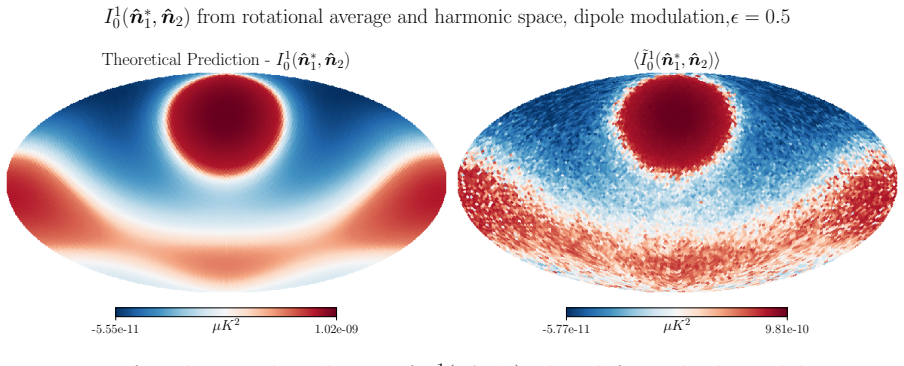
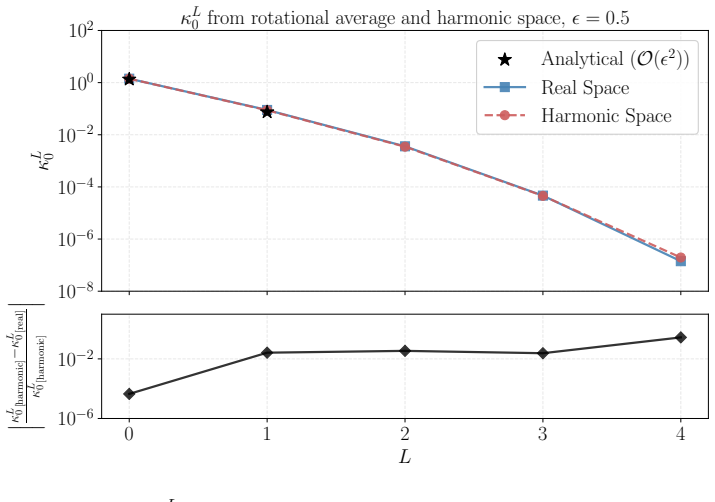
Recent high precision cosmological observations have revealed several anomalies in the Cosmic Microwave Background (CMB), indicating possible violations of statistical isotropy (nSI). Typically, nSI in the CMB sky is studied in the harmonic space, such as, using the Bipolar Spherical Harmonics (BipoSH) formalism, where the BipoSH coefficients capture the general structure of the angular correlation function. In this work, we present a geometric real space framework to quantify violations of statistical isotropy complementing the BipoSH approach. This geometric approach involves averaging the angular correlation function over all rotated configurations, weighted by Wigner matrices. These rotational averages systematically isolate the nSI components of the CMB sky. They also provide a physical space based route to interpretation of how the BipoSH formalism captures breaking of rotational symmetry. As a demonstration, we consider an analytical dipole modulation model. We numerically implement the rotational average measures and show their agreement with their harmonic space counterparts. The real space approach to quantify nSI could be advantageous in certain scenarios: rotational averages can directly extract nSI information from the correlation function at the level of a given multipole, bypassing the need to compute BipoSH coefficients up to arbitrarily high internal ranks. Importantly, analyzing the temperature map in real space can circumvent the unavoidable partial-sky effects present in CMB observations, which typically complicate harmonic space approaches. We envisage broader applications of this formalism to studies of primordial non-Gaussianity, CMB polarization, and weak gravitational lensing, as well as to the characterization of general random fields on a sphere.
Editorial analysis
A structured set of objections, weighed in public.
Referee Report
Summary. The paper proposes a real-space geometric framework to quantify violations of statistical isotropy (nSI) in the CMB by averaging the angular correlation function over all rotations, weighted by Wigner D-matrices. This isolates nSI components and complements the BipoSH harmonic-space formalism. The method is demonstrated numerically on an analytical dipole modulation model, showing agreement with BipoSH coefficients, and the authors claim advantages for extracting nSI at fixed multipoles and circumventing partial-sky mask effects without additional modeling.
Significance. If the rotational-average construction holds under realistic conditions, it offers a geometrically intuitive complement to BipoSH that could simplify multipole-specific nSI extraction and interpretation. The numerical agreement with BipoSH for the full-sky analytical dipole model is a concrete strength that supports the basic isolation property. However, the manuscript's central practical claim—that the approach circumvents partial-sky biases—remains untested.
major comments (2)
- [Abstract] Abstract: the assertion that 'analyzing the temperature map in real space can circumvent the unavoidable partial-sky effects' is not supported by any derivation or test. Applying the Wigner-weighted rotational average to a masked map necessarily rotates the mask, producing a position-dependent selection function whose effect on the extracted nSI coefficients is neither derived nor simulated.
- [Demonstration section] Demonstration (analytical dipole model): while numerical agreement with BipoSH is reported, the manuscript supplies no explicit derivation of the rotational-average operator, no error analysis, and no convergence tests with respect to the number of rotations or multipole truncation. The isolation property is therefore asserted rather than proven for general nSI fields.
minor comments (1)
- [Abstract] The abstract would be clearer if it briefly stated the specific dipole-modulation parameters used in the numerical test.
Simulated Author's Rebuttal
We thank the referee for their careful reading of the manuscript and for the constructive comments, which have helped us identify areas where the presentation and rigor can be improved. We respond to each major comment below and indicate the revisions we will make.
read point-by-point responses
-
Referee: [Abstract] Abstract: the assertion that 'analyzing the temperature map in real space can circumvent the unavoidable partial-sky effects' is not supported by any derivation or test. Applying the Wigner-weighted rotational average to a masked map necessarily rotates the mask, producing a position-dependent selection function whose effect on the extracted nSI coefficients is neither derived nor simulated.
Authors: We agree that the current manuscript does not contain a derivation or numerical test of the method on masked skies, so the abstract statement is not fully supported. The conceptual basis for the claim is that real-space correlation functions can be evaluated directly on the observed pixels, avoiding the mode-mixing that arises when spherical harmonics are computed on a cut sky. Nevertheless, the referee correctly notes that rotating the mask produces a position-dependent selection function whose impact on the extracted coefficients requires explicit treatment. In the revised manuscript we will qualify the abstract statement to indicate that the real-space approach has the potential to reduce certain harmonic-space complications but that a full analysis of masked skies, including the rotated-mask effect, is beyond the scope of the present work and will be addressed in future studies. We will also add a short paragraph in the conclusions discussing the additional steps (e.g., Monte-Carlo mask simulations) needed for realistic applications. revision: yes
-
Referee: [Demonstration section] Demonstration (analytical dipole model): while numerical agreement with BipoSH is reported, the manuscript supplies no explicit derivation of the rotational-average operator, no error analysis, and no convergence tests with respect to the number of rotations or multipole truncation. The isolation property is therefore asserted rather than proven for general nSI fields.
Authors: We thank the referee for highlighting this gap. The present version demonstrates numerical agreement for the specific analytical dipole-modulation model but does not supply a general derivation or convergence diagnostics. In the revised manuscript we will insert a new appendix that derives the rotational-average operator explicitly, showing how the Wigner-D weighting isolates the nSI components of the two-point function. We will also add an error-analysis subsection to the demonstration, presenting results for a range of rotation-sample sizes and multipole truncations, together with quantitative convergence metrics. These additions will convert the isolation property from a numerical observation into a mathematically demonstrated feature for the class of nSI fields considered. revision: yes
Circularity Check
No significant circularity; derivation relies on independent Wigner matrix properties and explicit numerical verification.
full rationale
The paper defines rotational averages of the angular correlation function weighted by Wigner D-matrices to isolate nSI components. This construction follows from standard properties of Wigner matrices and rotational symmetry on the sphere, which are external mathematical facts not defined in terms of the target nSI quantities. The demonstration computes these averages for an analytical dipole modulation model and shows numerical agreement with BipoSH coefficients; this is a direct verification step rather than a fitted parameter renamed as a prediction. No self-definitional loops, ansatz smuggling via self-citation, or uniqueness theorems imported from the authors' prior work appear in the load-bearing steps. The partial-sky claim is an asserted advantage without reducing any result to an input by construction.
Axiom & Free-Parameter Ledger
axioms (1)
- standard math Wigner D-matrices correctly encode the transformation of functions under arbitrary rotations on the sphere
Reference graph
Works this paper leans on
-
[1]
The large-scale smoothness of the Universe
Kelvin K. S. Wu, Ofer Lahav, and Martin J. Rees. “The large-scale smoothness of the Universe”. In:Nature397 (1999). Ed. by H. Sato and N. Sugiyama, pp. 225–230.doi: 10.1038/16637. arXiv:astro-ph/9804062
-
[2]
Planck2018 results: VII. Isotropy and statistics of the CMB
Y. Akrami et al. “Planck2018 results: VII. Isotropy and statistics of the CMB”. In:As- tronomy & Astrophysics641 (Sept. 2020), A7.issn: 1432-0746.doi:10 . 1051 / 0004 - 6361/201935201. 12 10−8 10−6 10−4 10−2 100 102 κL 0 κL 0 from rotational average and harmonic space, ϵ = 0.5 Analytical ( O(ϵ2)) Real Space Harmonic Space 0 1 2 3 4 L 10−6 10−2 ⏐⏐⏐ κL 0 [h...
2020
-
[3]
Dominik J Schwarz et al. “CMB anomalies after Planck”. In:Classical and Quantum Gravity33.18 (Aug. 2016), p. 184001.doi:10.1088/0264-9381/33/18/184001
-
[4]
N. Aghanim et al. “Planck 2018 results. I. Overview and the cosmological legacy of Planck”. In:Astron. Astrophys.641 (2020), A1.doi:10 . 1051 / 0004 - 6361 / 201833880. arXiv: 1807.06205 [astro-ph.CO]
-
[5]
Constraints on mode couplings and modulation of the CMB with WMAP data
Simon Prunet et al. “Constraints on mode couplings and modulation of the CMB with WMAP data”. In:Phys. Rev. D71 (2005), p. 083508.doi:10.1103/PhysRevD.71.083508. arXiv:astro-ph/0406364
-
[6]
Broken Isotropy from a Linear Modulation of the Primordial Pertur- bations
Christopher Gordon. “Broken Isotropy from a Linear Modulation of the Primordial Pertur- bations”. In:The Astrophysical Journal656.2 (Feb. 2007), pp. 636–640.issn: 1538-4357. doi:10.1086/510511
-
[7]
Translational Invariance and the Anisotropy of the Cosmic Microwave Background
Sean M. Carroll, Chien-Yao Tseng, and Mark B. Wise. “Translational Invariance and the Anisotropy of the Cosmic Microwave Background”. In:Phys. Rev. D81 (2010), p. 083501. doi:10.1103/PhysRevD.81.083501. arXiv:0811.1086 [astro-ph]
-
[8]
An estimator for statistical anisotropy from the CMB bispectrum
N Bartolo et al. “An estimator for statistical anisotropy from the CMB bispectrum”. In: Journal of Cosmology and Astroparticle Physics2012.01 (Jan. 2012), pp. 029–029.issn: 1475-7516.doi:10.1088/1475-7516/2012/01/029
-
[9]
Relating the inhomogeneous power spectrum to the CMB hemispherical anisotropy
Pranati K. Rath, Pavan K. Aluri, and Pankaj Jain. “Relating the inhomogeneous power spectrum to the CMB hemispherical anisotropy”. In:Physical Review D91.2 (Jan. 2015). doi:10.1103/physrevd.91.023515
-
[10]
Imprint of inhomogeneous and anisotropic primordial power spec- trum on CMB polarization
Rahul Kothari et al. “Imprint of inhomogeneous and anisotropic primordial power spec- trum on CMB polarization”. In:Monthly Notices of the Royal Astronomical Society460.2 (May 2016), pp. 1577–1587.doi:10.1093/mnras/stw1039. 13
-
[11]
Cosmological consequences of statistical inhomo- geneity
H. V. Ragavendra, Dipayan Mukherjee, and Shiv K. Sethi. “Cosmological consequences of statistical inhomogeneity”. In:Physical Review D111.2 (Jan. 2025).issn: 2470-0029.doi: 10.1103/physrevd.111.023541
-
[12]
H., Jedamzik, K., & Pogosian, L
Sanjit Mitra, Anand S. Sengupta, and Tarun Souradeep. “CMB power spectrum estimation using non-circular beam”. In:Phys. Rev. D70 (2004), p. 103002.doi:10.1103/PhysRevD. 70.103002. arXiv:astro-ph/0405406
-
[13]
Bipolar Harmonic encoding of CMB correlation patterns
Nidhi Joshi et al. “Bipolar Harmonic encoding of CMB correlation patterns”. In:Phys. Rev. D81 (2010), p. 083012.doi:10 . 1103 / PhysRevD . 81 . 083012. arXiv:0912 . 3217 [astro-ph.CO]
2010
-
[14]
Santanu Das et al. “Statistical isotropy violation in WMAP CMB maps resulting from non-circular beams”. In:Astron. Astrophys.591 (2016), A97.doi:10.1051/0004-6361/ 201424164. arXiv:1401.7757 [astro-ph.CO]
-
[15]
Statistically anisotropic Gaussian simulations of the CMB temperature field
Suvodip Mukherjee and Tarun Souradeep. “Statistically anisotropic Gaussian simulations of the CMB temperature field”. In:Phys. Rev. D89.6 (2014), p. 063013.doi:10.1103/ PhysRevD.89.063013. arXiv:1311.5837 [astro-ph.CO]
-
[16]
Orthogonal bipolar spherical harmonics measures: Scrutinizing sources of isotropy violation
Saurabh Kumar et al. “Orthogonal bipolar spherical harmonics measures: Scrutinizing sources of isotropy violation”. In:Phys. Rev. D91 (2015), p. 043501.doi:10 . 1103 / PhysRevD.91.043501. arXiv:1409.4886 [astro-ph.CO]
-
[17]
Dipanshu, Tarun Souradeep, and Shriya Hirve. “Capturing Statistical Isotropy Violation with Generalized Isotropic Angular Correlation Functions of Cosmic Microwave Back- ground Anisotropy”. In:Astrophys. J.954.2 (2023), p. 181.doi:10.3847/1538- 4357/ ace895. arXiv:2301.04539 [astro-ph.CO]
-
[18]
Measuring statistical isotropy of the CMB anisotropy
Amir Hajian and Tarun Souradeep. “Measuring statistical isotropy of the CMB anisotropy”. In:Astrophys. J. Lett.597 (2003), pp. L5–L8.doi:10 . 1086 / 379757. arXiv:astro - ph/0308001
-
[19]
D. A. Varshalovich, A. N. Moskalev, and V. K. Khersonskii.Quantum Theory of Angular Momentum: Irreducible Tensors, Spherical Harmonics, Vector Coupling Coefficients, 3nj Symbols. World Scientific Publishing Company, 1988.isbn: 978-981-4415-49-1, 978-9971- 5-0107-5.doi:10.1142/0270
-
[20]
The Cosmic microwave background bipolar power spectrum: Basic formalism and applications
Amir Hajian and Tarun Souradeep. “The Cosmic microwave background bipolar power spectrum: Basic formalism and applications”. In: (Jan. 2005). arXiv:astro-ph/0501001
work page internal anchor Pith review arXiv 2005
-
[21]
Fast clustering analysis of inhomogeneous megapixel cmb maps
I. Szapudi, S. Prunet, and S. Colombi. “Fast clustering analysis of inhomogeneous megapixel cmb maps”. In: (July 2001). arXiv:astro-ph/0107383
work page internal anchor Pith review arXiv 2001
-
[22]
Amir Hajian and Tarun Souradeep. “Testing Global Isotropy of Three-Year Wilkinson Microwave Anisotropy Probe (WMAP) Data: Temperature Analysis”. In:Phys. Rev. D 74 (2006), p. 123521.doi:10.1103/PhysRevD.74.123521. arXiv:astro-ph/0607153
-
[23]
E. Hivon et al. “Master of the cosmic microwave background anisotropy power spectrum: a fast method for statistical analysis of large and complex cosmic microwave background data sets”. In:Astrophys. J.567 (2002), p. 2.doi:10.1086/338126. arXiv:astro-ph/0105302
-
[24]
Analysis of CMB polarization on an incomplete sky
Antony Lewis, Anthony Challinor, and Neil Turok. “Analysis of CMB polarization on an incomplete sky”. In:Phys. Rev. D65 (2002), p. 023505.doi:10.1103/PhysRevD.65. 023505. arXiv:astro-ph/0106536
-
[25]
C. S. Carvalho and K. Moodley. “Real space estimator for the weak lensing convergence from the CMB”. In:Phys. Rev. D81 (2010), p. 123010.doi:10.1103/PhysRevD.81. 123010. arXiv:1005.4288 [astro-ph.CO]
-
[26]
CMB Lensing Reconstruction in Real Space
Martin Bucher et al. “CMB Lensing Reconstruction in Real Space”. In:Phys. Rev. D85 (2012), p. 043016.doi:10.1103/PhysRevD.85.043016. arXiv:1004.3285 [astro-ph.CO]. 14
-
[27]
Ken Shoemake.Graphic Gems III. Ed. by David Kirk. Academic Press, 1992, pp. 124–132. doi:10.1016/B978-0-08-050755-2.50036-1
-
[28]
Marc Lachieze-Rey and Jean-Pierre Luminet. “Cosmic topology”. In:Phys. Rept.254 (1995), pp. 135–214.doi:10.1016/0370-1573(94)00085-H. arXiv:gr-qc/9605010
-
[29]
Faddeev wave function decomposition using bipolar harmonics
James Lewis Friar et al. “Faddeev wave function decomposition using bipolar harmonics”. In:Phys. Rev. C24 (1981), pp. 677–683.doi:10.1103/PhysRevC.24.677
-
[30]
General structure of a two-body operator for spin- 1 2 particles
S. N. Ershov. “General structure of a two-body operator for spin- 1 2 particles”. In:Phys. Rev. C70 (2004), p. 054604.doi:10.1103/PhysRevC.70.054604
-
[31]
Multipole expansions of ir- reducible tensor sets and some applications
N L Manakov, A V Meremianin, and Anthony F Starace. “Multipole expansions of ir- reducible tensor sets and some applications”. In:Journal of Physics B: Atomic, Molec- ular and Optical Physics35.1 (Jan. 2002), pp. 77–91.issn: 0953-4075, 1361-6455.doi: 10.1088/0953-4075/35/1/306
-
[32]
The three-body rigid rotator and multipole expansions of the three- body continuum
A V Meremianin. “The three-body rigid rotator and multipole expansions of the three- body continuum”. In:Journal of Physics B: Atomic, Molecular and Optical Physics38.6 (Mar. 2005), pp. 757–775.issn: 0953-4075, 1361-6455.doi:10.1088/0953-4075/38/6/ 013. 15
discussion (0)
Sign in with ORCID, Apple, or X to comment. Anyone can read and Pith papers without signing in.