Recognition: unknown
Geometrical control of topology with orbital angular momentum modes
Pith reviewed 2026-05-08 16:15 UTC · model grok-4.3
The pith
Tuning the relative angle between sites in an OAM-loaded staggered lattice switches the system between different topological regimes as set by the winding number.
A machine-rendered reading of the paper's core claim, the machinery that carries it, and where it could break.
Core claim
The topological properties of the staggered lattice with OAM l=1 modes are controlled geometrically by the ladder angle, which tunes the system across regimes whose winding numbers dictate the presence and number of topologically protected edge states.
What carries the argument
Creutz ladder model obtained by unwrapping OAM circulation states into a synthetic dimension, where the ladder angle sets the hopping parameters that determine the winding number.
If this is right
- For given hopping strengths, different winding numbers and hence different numbers of protected edge states become accessible solely by angle adjustment.
- Band inversion occurs precisely at the topological transitions identified by the winding number.
- The transition appears in experiment as a sudden change in how light propagates along the waveguide array.
- All regimes remain reachable without altering the underlying hopping amplitudes.
Where Pith is reading between the lines
- If the mapping remains clean under angle variation, the same geometrical knob could enable fast, all-optical switching of topological protection in photonic devices.
- The synthetic-dimension construction may extend to other angular-mode lattices, allowing angle control of higher-dimensional or multi-band topological phases.
- Testing the model with small controlled losses would clarify the practical robustness of the predicted edge states.
Load-bearing premise
The original staggered lattice with OAM l=1 states can be accurately depicted as a Creutz ladder model when the different state circulations are unwrapped in a synthetic dimension, and angle tuning affects only the topological invariants without introducing extraneous couplings or losses.
What would settle it
A measurement in the proposed photonic waveguide array showing that the number or location of localized light modes at the edges does not change with ladder angle in the manner predicted by the winding number would falsify the claimed geometrical control.
Figures




read the original abstract
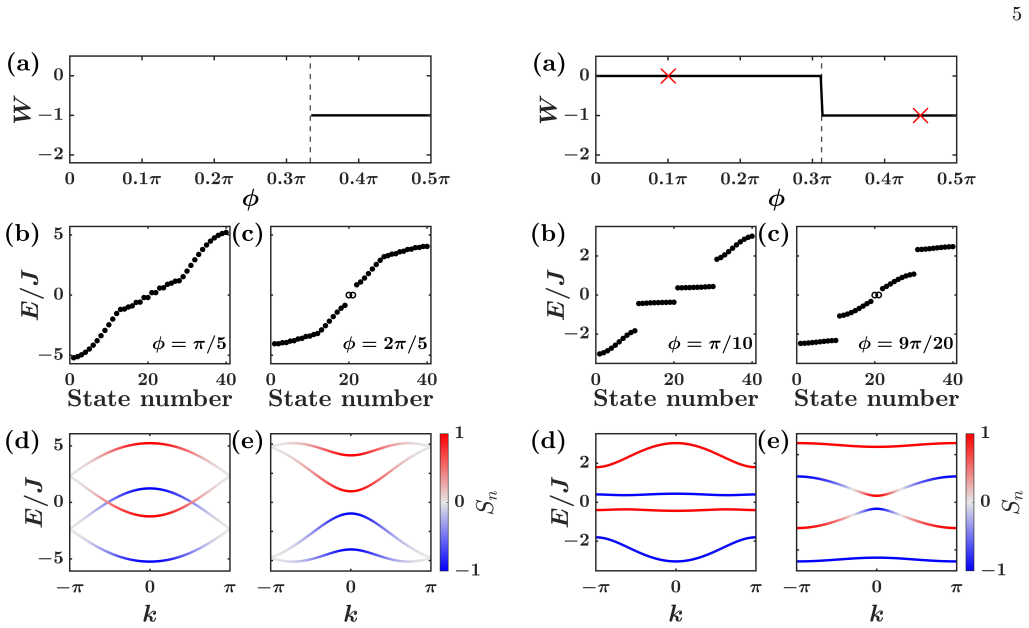
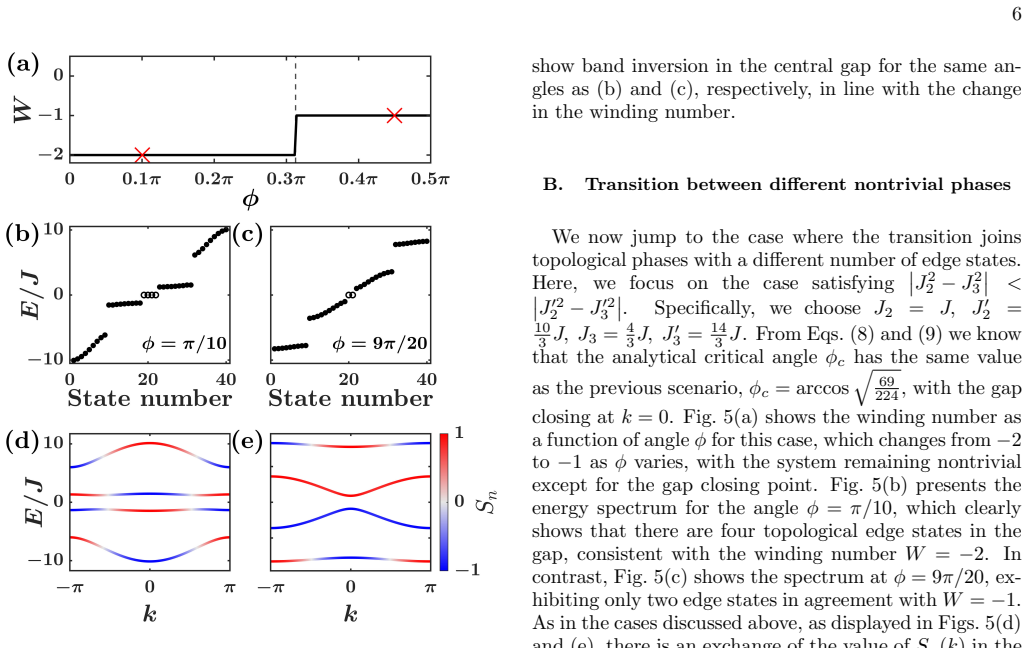
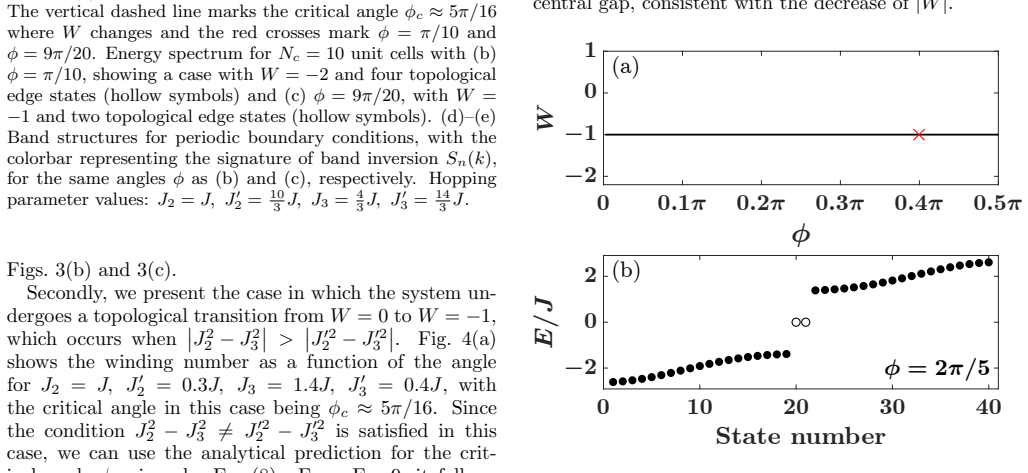
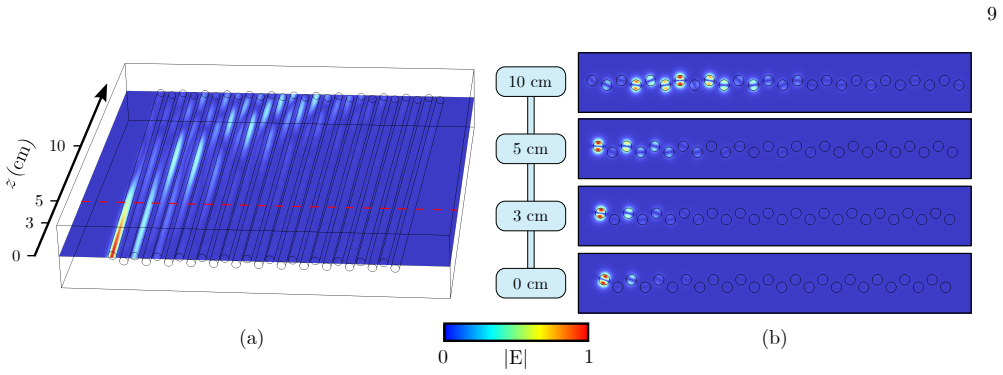
We study how the topological properties of a one-dimensional staggered lattice, loaded into states with orbital angular momentum $l=1$, can be controlled simply by tuning the relative angle between sites. The original system under consideration can be depicted as a Creutz ladder model when unwrapping the different state circulations in a synthetic dimension. Depending on the hopping strengths of the chain, different topological regimes may be accessed by changing the ladder angle, as determined by the value of the winding number of the chain. We analytically and numerically explore the different available regimes, and determine the number of topologically protected edge states that exist in each case. We also study the emergence of band inversion across topological transitions and show that it agrees with the winding number calculations, thus serving as an additional topological marker. Then, we propose a realistic experimental implementation in a photonic waveguide system, where the topological transition manifests as a sudden change of the behavior of the propagation of light in the system.
Editorial analysis
A structured set of objections, weighed in public.
Referee Report
Summary. The paper claims that topological properties of a 1D staggered lattice loaded with OAM l=1 states can be controlled geometrically by tuning the relative angle between sites. The system is mapped to an angle-tunable Creutz ladder in a synthetic dimension, where different topological regimes (accessed via hopping strengths and ladder angle) are diagnosed by the winding number; analytical/numerical results are given for the regimes and number of protected edge states, band inversion is shown to agree as an independent marker, and a photonic waveguide implementation is proposed.
Significance. If the mapping to the Creutz ladder is free of extraneous couplings, the work demonstrates a clean geometrical knob for accessing topological transitions in OAM lattices, with consistent use of winding number and band inversion as markers. This could enable tunable photonic topological devices, though the result's impact hinges on experimental verification of the effective model.
major comments (1)
- [Mapping to Creutz ladder / effective Hamiltonian derivation] The load-bearing step is the reduction of the OAM l=1 staggered lattice to a clean Creutz ladder whose only angle-dependent parameters are the rung and leg hoppings. The manuscript must explicitly derive the effective Hamiltonian (in the section on synthetic-dimension unwrapping) and demonstrate that geometric angle tuning introduces neither next-nearest-neighbor couplings, additional on-site potentials, nor radiative losses; otherwise the predicted winding-number transitions and edge-state counts cannot be trusted.
Simulated Author's Rebuttal
We thank the referee for the careful reading of our manuscript and the constructive feedback. We agree that the mapping to the Creutz ladder is the central element of the work and that an explicit derivation is necessary to confirm the absence of extraneous terms. We address the major comment below and will revise the manuscript accordingly.
read point-by-point responses
-
Referee: [Mapping to Creutz ladder / effective Hamiltonian derivation] The load-bearing step is the reduction of the OAM l=1 staggered lattice to a clean Creutz ladder whose only angle-dependent parameters are the rung and leg hoppings. The manuscript must explicitly derive the effective Hamiltonian (in the section on synthetic-dimension unwrapping) and demonstrate that geometric angle tuning introduces neither next-nearest-neighbor couplings, additional on-site potentials, nor radiative losses; otherwise the predicted winding-number transitions and edge-state counts cannot be trusted.
Authors: We agree that the effective Hamiltonian derivation must be shown explicitly. In the revised version we will add a dedicated subsection (immediately following the synthetic-dimension unwrapping paragraph) that starts from the overlap integrals of the l=1 OAM modes centered on each waveguide. Because the lattice is strictly one-dimensional and staggered, only nearest-neighbor overlaps appear; the angular dependence enters solely through the relative phase and amplitude of the two counter-circulating components, which map directly onto the rung and leg hoppings of the Creutz ladder. We will prove analytically that next-nearest-neighbor matrix elements vanish identically for l=1 due to the azimuthal symmetry and the staggered placement, and that no additional on-site potentials are generated. For radiative losses, the ideal tight-binding model we employ assumes coherent, lossless hopping; uniform loss (present in any real photonic realization) factors out of the eigenvalue problem and does not modify the winding number or the topological edge-state count. We will include a short numerical check confirming that the extracted hoppings reproduce the full overlap integrals to within 1% for the angle range considered. revision: yes
Circularity Check
No circularity: winding number derived analytically from effective Creutz ladder; band inversion serves as independent check
full rationale
The paper maps the staggered OAM lattice to a Creutz ladder via synthetic dimension unwrapping, then computes the winding number directly from the resulting Hamiltonian parameters (hopping strengths and angle). Band inversion is calculated separately and shown to match the winding number transitions, providing an orthogonal topological marker. No parameters are fitted to the target invariants, no self-citation chain justifies the central mapping or uniqueness, and no prediction reduces to a renamed input. The derivation chain remains self-contained against the stated model assumptions.
Axiom & Free-Parameter Ledger
axioms (1)
- domain assumption The staggered lattice with OAM l=1 states maps to a Creutz ladder when unwrapping circulations in a synthetic dimension
Reference graph
Works this paper leans on
-
[1]
In contrast, the coefficientJ 3 (J ′ 3) represents the intracell (intercell) hopping strength be- tween states with opposite circulations
denotes the intra- cell (intercell) hopping strength between states with the same circulation. In contrast, the coefficientJ 3 (J ′ 3) represents the intracell (intercell) hopping strength be- tween states with opposite circulations. All hopping co- efficients in the system are considered to be real. As shown in Refs. [41, 50, 61], the amplitudes of all h...
-
[2]
decrease exponentially with distance. Therefore, forϕ∈(0, π/2), the next-nearest neighbor hopping betweenA j (Bj) andA j+1 (Bj+1) can be safely neglected. The origin of the complex tunnel- ing phases is the azimuthal phase of the OAM states on each site, which appears in the calculation of the over- lap integral between wavefunctions corresponding to lo- ...
-
[3]
Goldman, J
N. Goldman, J. C. Budich, and P. Zoller, Topological quantum matter with ultracold gases in optical lattices, Nature Physics12, 639 (2016)
2016
-
[4]
N. R. Cooper, J. Dalibard, and I. B. Spielman, Topo- logical bands for ultracold atoms, Rev. Mod. Phys.91, 015005 (2019)
2019
-
[5]
L. Lu, J. D. Joannopoulos, and M. Soljaˇ ci´ c, Topological photonics, Nature Photonics8, 821 (2014)
2014
-
[6]
Ozawa, H
T. Ozawa, H. M. Price, A. Amo, N. Goldman, M. Hafezi, L. Lu, M. C. Rechtsman, D. Schuster, J. Simon, O. Zil- berberg, and I. Carusotto, Topological photonics, Re- views of Modern Physics91, 015006 (2019)
2019
-
[7]
Leykam and L
D. Leykam and L. Yuan, Topological phases in ring res- onators: recent progress and future prospects, Nanopho- tonics9, 4473 (2020)
2020
-
[8]
Z. Yang, F. Gao, X. Shi, X. Lin, Z. Gao, Y. Chong, and B. Zhang, Topological Acoustics, Physical Review Letters114, 114301 (2015)
2015
-
[9]
H. Xue, Y. Yang, and B. Zhang, Topological acoustics, Nature Reviews Materials7, 974 (2022)
2022
-
[10]
Imhof, C
S. Imhof, C. Berger, F. Bayer, J. Brehm, L. W. Molenkamp, T. Kiessling, F. Schindler, C. H. Lee, M. Greiter, T. Neupert, and R. Thomale, Topolectrical- circuit realization of topological corner modes, Nature Physics14, 925 (2018)
2018
-
[11]
Helbig, T
T. Helbig, T. Hofmann, S. Imhof, M. Abdelghany, T. Kiessling, L. W. Molenkamp, C. H. Lee, A. Szameit, M. Greiter, and R. Thomale, Generalized bulk–boundary correspondence in non-hermitian topolectrical circuits, Nature Physics16, 747 (2020)
2020
-
[12]
M. Z. Hasan and C. L. Kane, Colloquium : Topological insulators, Reviews of Modern Physics82, 3045 (2010)
2010
-
[13]
Qi and S.-C
X.-L. Qi and S.-C. Zhang, Topological insulators and su- perconductors, Rev. Mod. Phys.83, 1057 (2011)
2011
-
[14]
de L´ es´ eleuc, V
S. de L´ es´ eleuc, V. Lienhard, P. Scholl, D. Barredo, S. We- ber, N. Lang, H. P. B¨ uchler, T. Lahaye, and A. Browaeys, Observation of a symmetry-protected topological phase of interacting bosons with rydberg atoms, Science365, 775 (2019)
2019
-
[15]
St-Jean, V
P. St-Jean, V. Goblot, E. Galopin, A. Lemaˆ ıtre, T. Ozawa, L. Le Gratiet, I. Sagnes, J. Bloch, and A. Amo, Lasing in topological edge states of a one-dimensional lat- tice, Nature Photonics11, 651 (2017)
2017
-
[16]
Barik, A
S. Barik, A. Karasahin, C. Flower, T. Cai, H. Miyake, W. DeGottardi, M. Hafezi, and E. Waks, A topological quantum optics interface, Science359, 666 (2018)
2018
-
[17]
K. v. Klitzing, G. Dorda, and M. Pepper, New method for high-accuracy determination of the fine-structure con- stant based on quantized hall resistance, Phys. Rev. Lett. 45, 494 (1980)
1980
-
[18]
R. B. Laughlin, Quantized hall conductivity in two di- mensions, Phys. Rev. B23, 5632 (1981)
1981
-
[19]
D. J. Thouless, M. Kohmoto, M. P. Nightingale, and M. den Nijs, Quantized hall conductance in a two- dimensional periodic potential, Phys. Rev. Lett.49, 405 (1982)
1982
-
[20]
D. C. Tsui, H. L. Stormer, and A. C. Gossard, Two- dimensional magnetotransport in the extreme quantum limit, Phys. Rev. Lett.48, 1559 (1982)
1982
-
[21]
Tom´ e and H
M. Tom´ e and H. D. Rosales, Topological phase transition driven by magnetic field and topological hall effect in an antiferromagnetic skyrmion lattice, Phys. Rev. B103, L020403 (2021)
2021
-
[22]
Bhandari, P.-H
H. Bhandari, P.-H. Chang, R. B. Regmi, B. G. M´ arkus, L. Forr´ o, J. F. Mitchell, I. I. Mazin, and N. J. Ghimire, Tunable topological transitions in the frustrated magnet hoagge, Communications Materials6, 52 (2025)
2025
-
[23]
Y. Xie, K. Ji, J. He, X. Shen, D. Wang, and J. Zhang, Manipulation of topology by electric field in breathing kagome lattice, Phys. Rev. Lett.135, 056701 (2025). 12
2025
-
[24]
Allein, A
F. Allein, A. Anastasiadis, R. Chaunsali, I. Frankel, N. Boechler, F. K. Diakonos, and G. Theocharis, Strain topological metamaterials and revealing hidden topology in higher-order coordinates, Nature Communications14, 6633 (2023)
2023
-
[25]
H. S. Inbar, D. Q. Ho, S. Chatterjee, A. N. Engel, S. Khalid, C. P. Dempsey, M. Pendharkar, Y. H. Chang, S. Nishihaya, A. V. Fedorov, D. Lu, M. Hashimoto, D. Read, A. Janotti, and C. J. Palmstrøm, Tuning the band topology of gdsb by epitaxial strain, APL Materials 11, 111106 (2023)
2023
- [26]
-
[27]
M.-A. Miri, M. Heinrich, and D. N. Christodoulides, Supersymmetry-generated complex optical potentials with real spectra, Phys. Rev. A87, 43819 (2013)
2013
-
[28]
Queralt´ o, M
G. Queralt´ o, M. Kremer, L. J. Maczewsky, M. Heinrich, J. Mompart, V. Ahufinger, and A. Szameit, Topological state engineering via supersymmetric transformations, Communications Physics3, 49 (2020)
2020
-
[29]
Viedma, G
D. Viedma, G. Queralt´ o, J. Mompart, and V. Ahufin- ger, High-efficiency topological pumping with discrete su- persymmetry transformations, Optics Express30, 23531 (2022)
2022
-
[30]
L. J. Maczewsky, M. Heinrich, M. Kremer, S. K. Ivanov, M. Ehrhardt, F. Martinez, Y. V. Kartashov, V. V. Kono- top, L. Torner, D. Bauer, and A. Szameit, Nonlinearity- induced photonic topological insulator, Science370, 701 (2020)
2020
-
[31]
S. Xia, D. Kaltsas, D. Song, I. Komis, J. Xu, A. Szameit, H. Buljan, K. G. Makris, and Z. Chen, Nonlinear tun- ing of pt symmetry and non-hermitian topological states, Science372, 72 (2021)
2021
-
[32]
T. Dai, Y. Ao, J. Mao, Y. Yang, Y. Zheng, C. Zhai, Y. Li, J. Yuan, B. Tang, Z. Li, J. Luo, W. Wang, X. Hu, Q. Gong, and J. Wang, Non-hermitian topological phase transitions controlled by nonlinearity, Nature Physics20, 101 (2024)
2024
-
[33]
Jaksch and P
D. Jaksch and P. Zoller, Creation of effective magnetic fields in optical lattices: the hofstadter butterfly for cold neutral atoms, New Journal of Physics5, 56 (2003)
2003
-
[34]
Y.-J. Lin, R. L. Compton, K. Jim´ enez-Garc´ ıa, J. V. Porto, and I. B. Spielman, Synthetic magnetic fields for ultracold neutral atoms, Nature462, 628 (2009)
2009
-
[35]
Dalibard, F
J. Dalibard, F. Gerbier, G. Juzeli¯ unas, and P. ¨Ohberg, Colloquium: Artificial gauge potentials for neutral atoms, Rev. Mod. Phys.83, 1523 (2011)
2011
-
[36]
Struck, C
J. Struck, C. ¨Olschl¨ ager, M. Weinberg, P. Hauke, J. Si- monet, A. Eckardt, M. Lewenstein, K. Sengstock, and P. Windpassinger, Tunable gauge potential for neutral and spinless particles in driven optical lattices, Phys. Rev. Lett.108, 225304 (2012)
2012
-
[37]
K. Fang, Z. Yu, and S. Fan, Realizing effective magnetic field for photons by controlling the phase of dynamic modulation, Nature Photonics6, 782 (2012)
2012
-
[38]
Aidelsburger, M
M. Aidelsburger, M. Atala, M. Lohse, J. T. Barreiro, B. Paredes, and I. Bloch, Realization of the hofstadter hamiltonian with ultracold atoms in optical lattices, Phys. Rev. Lett.111, 185301 (2013)
2013
-
[39]
Hafezi, S
M. Hafezi, S. Mittal, J. Fan, A. Migdall, and J. M. Tay- lor, Imaging topological edge states in silicon photonics, Nature Photonics7, 1001 (2013)
2013
-
[40]
Goldman and J
N. Goldman and J. Dalibard, Periodically driven quan- tum systems: Effective hamiltonians and engineered gauge fields, Phys. Rev. X4, 031027 (2014)
2014
-
[41]
J. Polo, J. Mompart, and V. Ahufinger, Geometrically induced complex tunnelings for ultracold atoms carry- ing orbital angular momentum, Physical Review A93, 033613 (2016)
2016
-
[42]
M., Daley, A
Nicolau, E., Pelegr´ ı, G., Polo, J., Marques, A. M., Daley, A. J., Mompart, J., Dias, R. G., and Ahufinger, V., Ul- tracold atoms carrying orbital angular momentum: En- gineering topological phases in lattices, EPL145, 35001 (2024)
2024
-
[43]
Pelegr´ ı, A
G. Pelegr´ ı, A. M. Marques, R. G. Dias, A. J. Daley, V. Ahufinger, and J. Mompart, Topological edge states with ultracold atoms carrying orbital angular momen- tum in a diamond chain, Physical Review A99, 023612 (2019)
2019
-
[44]
Pelegr´ ı, A
G. Pelegr´ ı, A. M. Marques, R. G. Dias, A. J. Daley, J. Mompart, and V. Ahufinger, Topological edge states and aharanov-bohm caging with ultracold atoms carry- ing orbital angular momentum, Phys. Rev. A99, 023613 (2019)
2019
-
[45]
Nicolau, A
E. Nicolau, A. M. Marques, R. G. Dias, J. Mompart, and V. Ahufinger, Many-body aharonov-bohm caging in a lattice of rings, Physical Review A107, 023305 (2023)
2023
-
[46]
Corman, L
L. Corman, L. Chomaz, T. Bienaim´ e, R. Desbuquois, C. Weitenberg, S. Nascimb` ene, J. Dalibard, and J. Beugnon, Quench-induced supercurrents in an annular bose gas, Phys. Rev. Lett.113, 135302 (2014)
2014
-
[47]
K. C. Wright, R. B. Blakestad, C. J. Lobb, W. D. Phillips, and G. K. Campbell, Driving phase slips in a superfluid atom circuit with a rotating weak link, Phys. Rev. Lett.110, 025302 (2013)
2013
-
[48]
M. F. Andersen, C. Ryu, P. Clad´ e, V. Natarajan, A. Vaziri, K. Helmerson, and W. D. Phillips, Quantized rotation of atoms from photons with orbital angular mo- mentum, Phys. Rev. Lett.97, 170406 (2006)
2006
-
[49]
J¨ org, G
C. J¨ org, G. Queralt´ o, M. Kremer, G. Pelegr´ ı, J. Schulz, A. Szameit, G. von Freymann, J. Mompart, and V. Ahufinger, Artificial gauge field switching using or- bital angular momentum modes in optical waveguides, Light: Science & Applications9, 150 (2020)
2020
-
[50]
Jiang, Y
C. Jiang, Y. Wu, M. Qin, and S. Ke, Topological bound modes with orbital angular momentum in optical waveg- uide arrays, Journal of Lightwave Technology41, 2205 (2023)
2023
-
[51]
Y. Wang, C. Jiang, M. Zhao, D. Zhao, and S. Ke, Com- pact topological edge modes through hybrid coupling of orbital angular momentum modes, Phys. Rev. A109, 063516 (2024)
2024
-
[52]
Viedma, A
D. Viedma, A. M. Marques, R. G. Dias, and V. Ahufin- ger, Flux-mediated effective su–schrieffer–heeger model in an impurity decorated diamond chain, APL Photonics 9, 120801 (2024)
2024
-
[53]
A. Celi, P. Massignan, J. Ruseckas, N. Goldman, I. B. Spielman, G. Juzeli¯ unas, and M. Lewenstein, Synthetic gauge fields in synthetic dimensions, Physical Review Letters112, 043001 (2014)
2014
-
[54]
Ozawa, H
T. Ozawa, H. M. Price, N. Goldman, O. Zilberberg, and I. Carusotto, Synthetic dimensions in integrated photon- ics: From optical isolation to four-dimensional quantum hall physics, Physical Review A93, 043827 (2016)
2016
-
[55]
L. Yuan, Q. Lin, M. Xiao, and S. Fan, Synthetic dimen- 13 sion in photonics, Optica5, 1396 (2018)
2018
-
[56]
D. Yu, W. Song, L. Wang, R. Srikanth, S. Kaushik Srid- har, T. Chen, C. Huang, G. Li, X. Qiao, X. Wu,et al., Comprehensive review on developments of synthetic di- mensions, Photonics Insights4, R06 (2025)
2025
-
[57]
Creutz, Aspects of chiral symmetry and the lattice, Rev
M. Creutz, Aspects of chiral symmetry and the lattice, Rev. Mod. Phys.73, 119 (2001)
2001
-
[58]
Kuno, Extended flat band, entanglement, and topo- logical properties in a creutz ladder, Phys
Y. Kuno, Extended flat band, entanglement, and topo- logical properties in a creutz ladder, Phys. Rev. B101, 184112 (2020)
2020
-
[59]
J. Zurita, C. E. Creffield, and G. Platero, Topology and interactions in the photonic creutz and creutz- hubbard ladders, Advanced Quantum Technologies3, 10.1002/qute.201900105 (2020)
-
[60]
Y. Zhai, A. Usui, A. M. Marques, R. G. Dias, and V. Ahufinger, Topological bound states in a lattice of rings with nearest-neighbor interactions, Phys. Rev. A 113, 033303 (2026)
2026
-
[61]
Y. Liu, X. Chen, and Y. Xu, Topological phononics: From fundamental models to real materials, Advanced Functional Materials30, 1904784 (2020)
2020
-
[62]
S. Widmann, J. D¨ ureth, S. Dam, C. G. Mayer, D. Laibacher, M. Emmerling, M. Kamp, F. Reinert, M. ¨Unzelmann, S. Betzold, S. H¨ ofling, and S. Klembt, Direct experimental access to the bulk band inversion in a topological metamaterial (2025), arXiv:2511.08414 [physics.optics]
-
[63]
A. M. Marques, D. Viedma, V. Ahufinger, and R. G. Dias, Impurity flat band states in the diamond chain, Communications Physics7, 387 (2024)
2024
-
[64]
Nicolau, A
E. Nicolau, A. M. Marques, J. Mompart, R. G. Dias, and V. Ahufinger, Bosonic orbital su-schrieffer-heeger model in a lattice of rings, Phys. Rev. A108, 023317 (2023)
2023
-
[65]
W. P. Su, J. R. Schrieffer, and A. J. Heeger, Solitons in Polyacetylene, Phys. Rev. Lett.42, 1698 (1979)
1979
-
[66]
A. P. Schnyder, S. Ryu, A. Furusaki, and A. W. W. Lud- wig, Classification of topological insulators and super- conductors in three spatial dimensions, Phys. Rev. B78, 195125 (2008)
2008
-
[67]
D. Liu, P. Matveeva, D. Gutman, and S. T. Carr, El- ementary models of three-dimensional topological insu- lators with chiral symmetry, Phys. Rev. B108, 035418 (2023)
2023
-
[68]
J. K. Asb´ oth, L. Oroszl´ any, and A. P. P´ alyi,A Short Course on Topological Insulators: Band Structure and Edge States in One and Two Dimensions(Springer In- ternational Publishing, 2016)
2016
-
[69]
Longhi, Quantum-optical analogies using photonic structures, Laser & Photonics Reviews3, 243 (2009)
S. Longhi, Quantum-optical analogies using photonic structures, Laser & Photonics Reviews3, 243 (2009)
2009
-
[70]
Leykam and S
D. Leykam and S. Flach, Perspective: Photonic flat- bands, APL Photonics3, 070901 (2018)
2018
-
[71]
R. A. Vicencio, Photonic flat band dynamics, Advances in Physics: X6, 1878057 (2021)
2021
-
[72]
C´ aceres-Aravena, D
G. C´ aceres-Aravena, D. Guzm´ an-Silva, I. Salinas, and R. A. Vicencio, Controlled transport based on multior- bital aharonov-bohm photonic caging, Physical Review Letters128, 256602 (2022)
2022
-
[73]
Schulz, J
J. Schulz, J. Noh, W. A. Benalcazar, G. Bahl, and G. von Freymann, Photonic quadrupole topological insulator us- ing orbital-induced synthetic flux, Nature Communica- tions13, 6597 (2022)
2022
-
[74]
Viedma, J
D. Viedma, J. Mompart, and V. Ahufinger, Mode pump- ing in photonic lattices using a single tailored auxiliary waveguide, Physical Review A107, 023506 (2023)
2023
-
[75]
X. Liu, Z. Lin, W. Song, J. Sun, C. Huang, S. Wu, X. Xiao, H. Xin, S. Zhu, and T. Li, Perfect excitation of topological states by supersymmetric waveguides, Phys. Rev. Lett.132, 016601 (2024)
2024
-
[76]
B. Real, D. Guzm´ an-Silva, and R. A. Vicen- cio, Radiation-based wave-packet generator in one- dimensional lattices, Physical Review B109, 064308 (2024)
2024
-
[77]
X. Liu, X. Han, W. Song, Y. Wang, Z. Lin, S. Wu, L. Zhong, S. Zhu, J. Qiu, and T. Li, Broadband selec- tive excitation of topological bound states in the con- tinuum within two-dimensional supersymmetric photonic lattices, Phys. Rev. B111, 075427 (2025)
2025
-
[78]
V. M. Martinez Alvarez and M. D. Coutinho-Filho, Edge states in trimer lattices, Phys. Rev. A99, 013833 (2019)
2019
-
[79]
D. Xie, W. Gou, T. Xiao, B. Gadway, and B. Yan, Topo- logical characterizations of an extended su–schrieffer– heeger model, npj Quantum Information5, 55 (2019)
2019
-
[80]
A. N. Carroll, H. Hirzler, C. Miller, D. Wellnitz, S. R. Muleady, J. Lin, K. P. Zamarski, R. R. W. Wang, J. L. Bohn, A. M. Rey, and J. Ye, Observation of generalized ¡i¿t-j¡/i¿ spin dynamics with tunable dipolar interactions, Science388, 381 (2025)
2025
discussion (0)
Sign in with ORCID, Apple, or X to comment. Anyone can read and Pith papers without signing in.