Recognition: unknown
First Detection of Extensive Air Showers Using a Small-Aperture Fluorescence Telescope
Pith reviewed 2026-05-08 17:05 UTC · model grok-4.3
The pith
A compact 25 cm fluorescence telescope has detected extensive air showers from ultra-high-energy cosmic rays for the first time.
A machine-rendered reading of the paper's core claim, the machinery that carries it, and where it could break.
Core claim
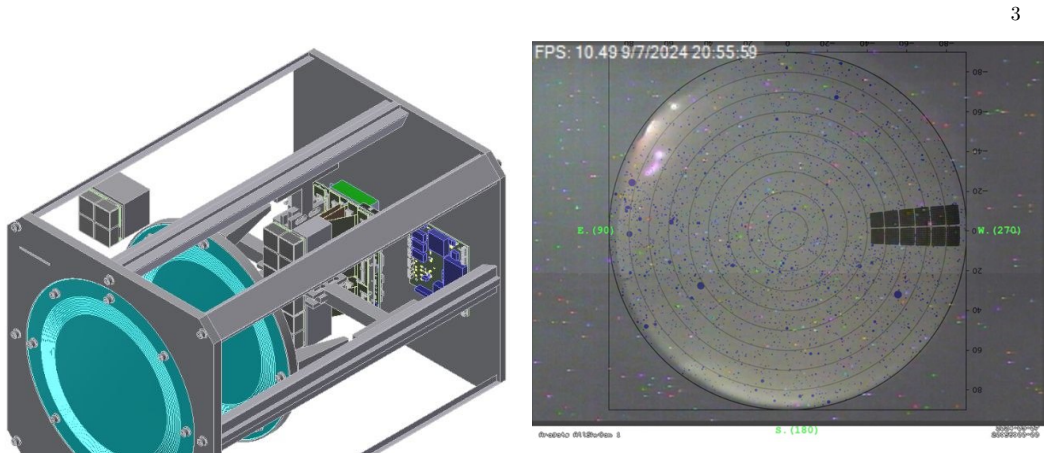
A fluorescence telescope fitted with a 25 cm diameter Fresnel lens and running at 2.625 microsecond time resolution recorded characteristic tracks of extensive air showers at Mount Aragats. Two independent pipelines, a conventional cut-based selection and a deep-learning classifier, each isolated more than 15 high-confidence events from moonless-night data. The observed topologies match the expected light patterns of showers, after rejection of focal-plane artifacts that mimic the real signals. These observations establish that a compact aperture suffices to detect ultra-high-energy cosmic ray showers.
What carries the argument
The 25 cm aperture fluorescence telescope with Fresnel lens and 2.625 μs sampling, paired with dual independent event-selection pipelines (cut-based analysis and neural networks) that isolate true shower tracks from background mimics.
If this is right
- Fluorescence detection of cosmic rays becomes possible with smaller and lower-cost instruments than previously assumed.
- The same compact design can be replicated for ground-based arrays or adapted for space-borne missions.
- Neural-network frameworks developed for track identification can be extended directly to primary-energy reconstruction.
- Background-rejection methods tested here reduce the need for very large optics while maintaining discrimination power.
- High-altitude sites can serve as test beds for validating small-aperture fluorescence systems before wider deployment.
Where Pith is reading between the lines
- Multiple small telescopes could be deployed together to increase sky coverage and statistics without the cost of one large instrument.
- The timing resolution and neural-network approach might transfer to detection of other fast atmospheric light transients.
- Slight increases in aperture size while keeping the compact form factor could raise the energy threshold reach without losing the main advantage.
- Hybrid operation with surface particle detectors at the same site would allow direct calibration of the fluorescence yield.
Load-bearing premise
The selected high-confidence tracks are genuine extensive air showers rather than residual background light or instrumental artifacts.
What would settle it
A quantitative match between the observed event rate, track lengths, and brightness profiles and predictions from air-shower simulation codes, or a cross-check against simultaneous data from a larger co-located fluorescence detector.
Figures



read the original abstract
We report on the successful detection of extensive air showers (EAS) generated by ultra-high-energy cosmic rays using a small-aperture fluorescence telescope (FT) deployed at the Mount Aragats high-altitude research station. The instrument is equipped with a 25 cm diameter Fresnel lens and operates with a 2.625 $\mu$s time resolution. To our knowledge, this represents the first-ever observation of EAS achieved with an FT of such a compact aperture. To isolate shower events from the observational data, we implemented two independent event selection pipelines: a conventional cut-based analysis and a deep learning approach utilizing neural networks. Both algorithms successfully identified over 15 high-confidence EAS tracks from data acquired during clear, moonless nights. We present selected event topologies and detail the background rejection methodology employed to discriminate true shower tracks from spurious focal-plane signals mimicking EAS signatures. These results provide an important proof-of-concept for the advancement of fluorescence detection techniques, demonstrating their viability for forthcoming ground-based and space-borne missions. Future efforts will focus on primary energy reconstruction utilizing a previously developed neural-network framework.
Editorial analysis
A structured set of objections, weighed in public.
Referee Report
Summary. The manuscript reports the first detection of extensive air showers (EAS) from ultra-high-energy cosmic rays using a compact 25 cm aperture fluorescence telescope equipped with a Fresnel lens at the Mount Aragats station. Two independent pipelines (cut-based analysis and a deep neural network) each identified over 15 high-confidence EAS tracks in data from clear, moonless nights. The paper describes the background rejection methods to separate true EAS signatures from spurious focal-plane signals, presents example event topologies, and frames the result as a proof-of-concept for future ground-based and space-borne fluorescence detection missions.
Significance. If the event identifications hold under quantitative scrutiny, the result would establish that EAS detection is feasible with substantially smaller and more portable fluorescence telescopes than those traditionally employed. This could enable denser arrays, lower-cost deployments, and new observational geometries for UHECR studies. The dual-pipeline strategy is a methodological strength that helps mitigate selection biases.
major comments (3)
- [Abstract] Abstract: the central claim that 'both algorithms successfully identified over 15 high-confidence EAS tracks' is presented without any reported false-positive rates, purity, efficiency, or calibration metrics. For a 25 cm aperture instrument where the signal is expected to be marginal, these quantities are required to substantiate that the selected tracks are genuine EAS rather than artifacts.
- [Background rejection methodology] Background rejection methodology: the paper states that the methodology is detailed, yet no numerical results from end-to-end simulations, injected-shower tests, or cross-validation between the two pipelines are provided. Without these, the discrimination power cannot be evaluated and the 'first detection' assertion remains unanchored.
- [Results] Event topologies and results: selected events are shown, but the manuscript supplies no quantitative comparison to expected EAS light profiles, timing distributions, or reconstructed energies, nor error estimates on the event parameters. This leaves open the possibility that the tracks are residual background.
minor comments (2)
- The time resolution is given as 2.625 μs; clarify whether this is the sampling interval, integration time, or trigger resolution, and how it relates to the expected EAS duration.
- [Abstract] The abstract mentions 'previously developed neural-network framework' for future energy reconstruction; a brief reference or citation to that prior work would improve context.
Simulated Author's Rebuttal
We thank the referee for their thorough and constructive review of our manuscript. Their comments highlight important aspects for strengthening the presentation of this proof-of-concept result. We address each major comment below and will incorporate revisions to improve the quantitative support for the detections while maintaining the focus on the first successful observation with a compact 25 cm aperture instrument.
read point-by-point responses
-
Referee: [Abstract] Abstract: the central claim that 'both algorithms successfully identified over 15 high-confidence EAS tracks' is presented without any reported false-positive rates, purity, efficiency, or calibration metrics. For a 25 cm aperture instrument where the signal is expected to be marginal, these quantities are required to substantiate that the selected tracks are genuine EAS rather than artifacts.
Authors: We agree that the abstract would benefit from additional context on performance metrics to support the claim. In the revised manuscript, we will update the abstract to note that the two independent pipelines exhibit substantial overlap in selected events and that background-only analyses indicate a low contamination rate. We will also briefly contextualize the marginal signal levels expected for this aperture size. Comprehensive efficiency and purity figures from full simulations are not included here, as this work emphasizes real-data detection; such metrics will be developed in follow-up studies on energy reconstruction. revision: yes
-
Referee: [Background rejection methodology] Background rejection methodology: the paper states that the methodology is detailed, yet no numerical results from end-to-end simulations, injected-shower tests, or cross-validation between the two pipelines are provided. Without these, the discrimination power cannot be evaluated and the 'first detection' assertion remains unanchored.
Authors: The methods section provides a detailed description of both the cut-based criteria and the neural network training procedure. To strengthen this, we will add quantitative cross-validation results, including the fraction of events identified by both pipelines and the rate of pipeline-specific selections in background data samples. End-to-end simulations and injected-shower tests are not available in the current analysis due to the emphasis on observational data and the complexities of modeling the small-aperture response; we will include a discussion of expected discrimination performance based on the observed consistency and outline plans for such tests in future work. revision: partial
-
Referee: [Results] Event topologies and results: selected events are shown, but the manuscript supplies no quantitative comparison to expected EAS light profiles, timing distributions, or reconstructed energies, nor error estimates on the event parameters. This leaves open the possibility that the tracks are residual background.
Authors: We will revise the results section to include quantitative comparisons of the observed event topologies to expected EAS characteristics, such as scaled light profiles and timing distributions drawn from established literature on larger fluorescence detectors. Error estimates on parameters like track direction and duration will be added for the presented events. As stated in the abstract, full primary energy reconstruction is reserved for future work using the previously developed neural-network framework; we will note this limitation explicitly while providing preliminary consistency checks to support the EAS interpretation over residual background. revision: yes
Circularity Check
No circularity: observational detection report with independent pipelines
full rationale
The manuscript reports an empirical detection of EAS events using a compact fluorescence telescope. It describes two independent event-selection pipelines (cut-based analysis and a neural-network approach) applied to raw observational data from clear nights. No equations, derivations, fitted parameters, or model outputs are presented that reduce to the input data or prior results by construction. The sole reference to prior work is a forward-looking statement about future energy reconstruction using a 'previously developed neural-network framework,' which is not load-bearing for the current detection claim. Event selection and background rejection are presented as data-driven procedures without self-referential loops or renamings of known results. This is a standard observational paper whose central claim rests on empirical identification rather than any mathematical or definitional circularity.
Axiom & Free-Parameter Ledger
Reference graph
Works this paper leans on
-
[1]
2018, Astroparticle Physics, 102, 98, doi:https://doi.org/10.1016/j.astropartphys.2018.05.007
Abdellaoui, G., Abe, S., Adams, J., et al. 2018, Astroparticle Physics, 102, 98, doi:https://doi.org/10.1016/j.astropartphys.2018.05.007
-
[2]
2024, Journal of Instrumentation, 19, P01007, doi:10.1088/1748-0221/19/01/P01007
Abe, S., Adams, J., Allard, D., et al. 2024, Journal of Instrumentation, 19, P01007, doi:10.1088/1748-0221/19/01/P01007
-
[3]
Abraham, J., Abreu, P., Aglietta, M., et al. 2010, Nuclear Instruments and Methods in Physics Research A, 620, 227, doi:10.1016/j.nima.2010.04.023
-
[4]
2015a, Experimental Astronomy, 40, 301–314, doi:https://doi.org/10.1007/s10686-015-9441-6
Adams, J., Ahmad, S., Albert, J.-N., et al. 2015a, Experimental Astronomy, 40, 301–314, doi:https://doi.org/10.1007/s10686-015-9441-6
-
[5]
2024, Astroparticle Physics, 163, 103007, doi:https://doi.org/10.1016/j.astropartphys.2024.103007
Adams, J., Anchordoqui, L., Barghini, D., et al. 2024, Astroparticle Physics, 163, 103007, doi:https://doi.org/10.1016/j.astropartphys.2024.103007
-
[6]
2015b, Experimental Astronomy, 40, 3, doi:10.1007/s10686-015-9482-x —
Adams, J.H., J., Ahmad, S., Albert, J.-N., et al. 2015b, Experimental Astronomy, 40, 3, doi:10.1007/s10686-015-9482-x —. 2015c, Experimental Astronomy, 40, 19, doi:10.1007/s10686-014-9418-x
-
[7]
E., Boone, J
Bergeson, H. E., Boone, J. C., & Cassiday, G. L. 1975, in International Cosmic Ray Conference, Vol. 8, International Cosmic Ray Conference, 3059
1975
-
[8]
2007, Astroparticle Physics, 26, 420–432, doi:10.1016/j.astropartphys.2006.08.005
Bergmann, T., Engel, R., Heck, D., et al. 2007, Astroparticle Physics, 26, 420–432, doi:10.1016/j.astropartphys.2006.08.005
-
[9]
E., Barghini, D., Battisti, M., et al
Bertaina, M. E., Barghini, D., Battisti, M., et al. 2023, in Proceedings of 27th European Cosmic Ray Symposium — PoS(ECRS), Vol. 423, 082, doi:10.22323/1.423.0082
-
[10]
2022, Advances in Space Research, 70, 2794, doi:10.1016/j.asr.2021.12.028
Filippatos, G., Battisti, M., Belov, A., et al. 2022, Advances in Space Research, 70, 2794, doi:10.1016/j.asr.2021.12.028
-
[11]
2025, in Proceedings of 39th International Cosmic Ray Conference — PoS(ICRC2025), Vol
Fujii, T. 2025, in Proceedings of 39th International Cosmic Ray Conference — PoS(ICRC2025), Vol. 501, 258, doi:10.22323/1.501.0258
-
[12]
2016, Astroparticle Physics, 74, 64, doi:10.1016/j.astropartphys.2015.10.006
Fujii, T., Malacari, M., Bertaina, M., et al. 2016, Astroparticle Physics, 74, 64, doi:10.1016/j.astropartphys.2015.10.006
-
[13]
1965, in International Cosmic Ray Conference, Vol
Greisen, K. 1965, in International Cosmic Ray Conference, Vol. 1, International Cosmic Ray Conference, 609
1965
-
[14]
Khrenov, B. A., Klimov, P. A., Panasyuk, M. I., et al. 2017, Journal of Cosmology and Astroparticle Physics, 2017, 006, doi:https://doi.org/10.1088/1475-7516/2017/09/006
-
[15]
Klimov, P., Zotov, M., Sharakin, S., et al. 2025, The orbital telescope system ERA: Extreme Relativistic Astrophysics, Report at The 5th International Symposium on Cosmic Rays and Astrophysics (ISCRA); https://indico.nevod.mephi.ru/event/13/
2025
-
[16]
Klimov, P. A., Zotov, M. Y., Chirskaya, N. P., et al. 2017, Bulletin of the Russian Academy of Sciences, Physics, 81, 407, doi:10.3103/S1062873817040256
-
[17]
Kuempel, D., Kampert, K. H., & Risse, M. 2008, Astroparticle Physics, 30, 167, doi:10.1016/j.astropartphys.2008.08.003
-
[18]
2025, Physics of Particles and Nuclei, 56, 297
Kuzmichev, L. 2025, Physics of Particles and Nuclei, 56, 297
2025
-
[19]
2015, Astroparticle Physics, 67, 8, doi:https://doi.org/10.1016/j.astropartphys.2015.01.006
Liu, J., Yang, R., Xiao, G., et al. 2015, Astroparticle Physics, 67, 8, doi:https://doi.org/10.1016/j.astropartphys.2015.01.006
-
[20]
2011, Astrophysics and Space Sciences Transactions, 7, 183, doi:10.5194/astra-7-183-2011
Meurer, C., Scharf, N., & Pierre Auger Collaboration. 2011, Astrophysics and Space Sciences Transactions, 7, 183, doi:10.5194/astra-7-183-2011
-
[21]
Navas, S., et al. 2024, Phys. Rev. D, 110, 030001, doi:10.1103/PhysRevD.110.030001
-
[22]
Sigaeva, K. F., Belov, A. A., Klimov, P. A., et al. 2025, Bulletin of the Russian Academy of Sciences, Physics, 89, 687, doi:10.1134/S1062873825711171
-
[23]
2025, in Proceedings of 39th International Cosmic Ray Conference — PoS(ICRC2025), Vol
Tameda, Y. 2025, in Proceedings of 39th International Cosmic Ray Conference — PoS(ICRC2025), Vol. 501, 411, doi:10.22323/1.501.0411
-
[24]
2012, Nuclear Instruments and Methods in Physics Research A, 676, 54, doi:10.1016/j.nima.2012.02.044
Tokuno, H., Tameda, Y., Takeda, M., et al. 2012, Nuclear Instruments and Methods in Physics Research A, 676, 54, doi:10.1016/j.nima.2012.02.044
-
[25]
Virtanen, P., Gommers, R., Oliphant, T. E., et al. 2020, Nature Methods, 17, 261, doi:10.1038/s41592-019-0686-2
-
[26]
2024, Moscow University Physics Bulletin, 79, S712–S723, doi:10.3103/s0027134924702187
Zotov, M. 2024, Moscow University Physics Bulletin, 79, S712–S723, doi:10.3103/s0027134924702187
-
[27]
2025, arXiv e-prints, arXiv:2510.10783, doi:10.48550/arXiv.2510.10783
Zotov, M., & Trusov, A. 2025, arXiv e-prints, arXiv:2510.10783, doi:10.48550/arXiv.2510.10783
-
[28]
2016, in Proceedings of The 34th International Cosmic Ray Conference — PoS(ICRC2015), Vol
Zundel, Z. 2016, in Proceedings of The 34th International Cosmic Ray Conference — PoS(ICRC2015), Vol. 236, 445, doi:10.22323/1.236.0445 This paper was built using the Open Journal of As- trophysics LATEX template. The OJA is a journal which provides fast and easy peer review for new papers in the astro-phsection of the arXiv, making the reviewing pro- ces...
discussion (0)
Sign in with ORCID, Apple, or X to comment. Anyone can read and Pith papers without signing in.