Recognition: unknown
Crossing limit cycles of discontinuous piecewise differential systems with Pleshkan's isochronous centers
Pith reviewed 2026-05-08 16:24 UTC · model grok-4.3
The pith
Discontinuous piecewise systems with linear and cubic isochronous centers have explicit upper bounds on crossing limit cycles in most cases.
A machine-rendered reading of the paper's core claim, the machinery that carries it, and where it could break.
Core claim
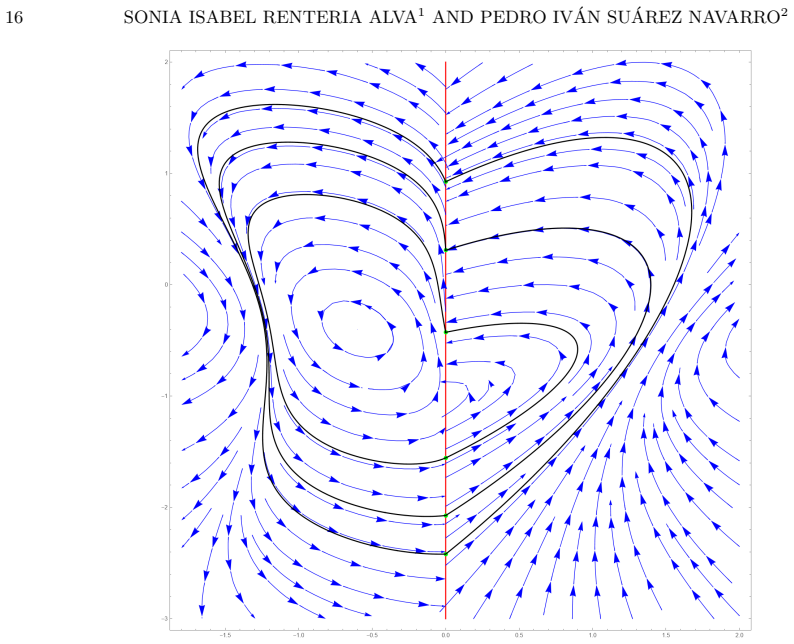
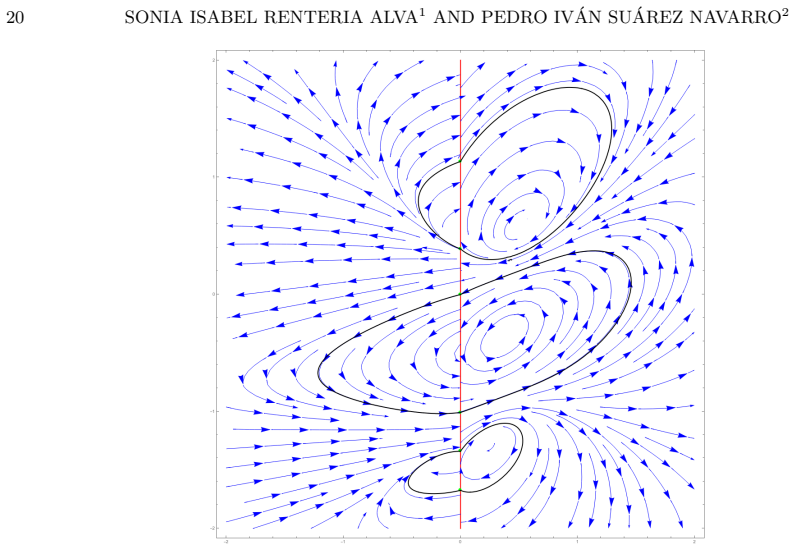
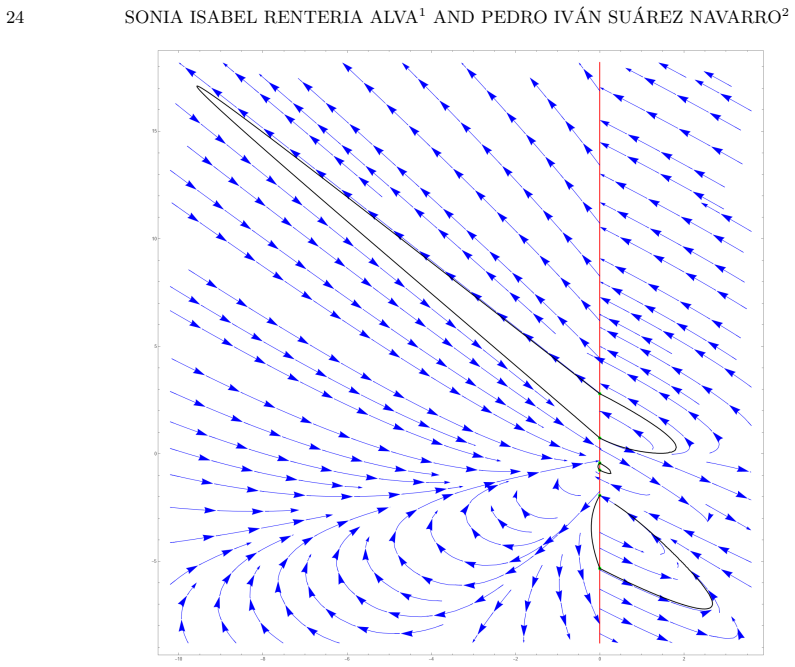
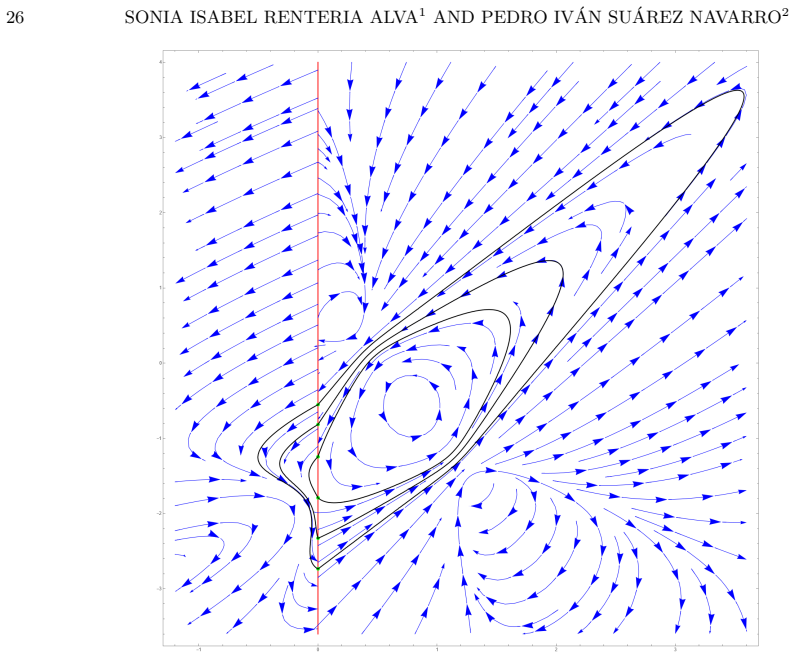
In the fifteen classes of such piecewise systems, the number of crossing limit cycles admits explicit upper bounds except in three configurations, and at least three crossing limit cycles exist in every class as shown by explicit constructions.
What carries the argument
Reduction via first integrals to algebraic closing conditions for periodic orbits crossing the discontinuity line.
If this is right
- Explicit upper bounds apply to twelve of the fifteen system classes.
- Every class admits at least three crossing limit cycles.
- The algebraic reduction provides a systematic way to analyze all combinations.
- Previous bounds are improved and new configurations are included.
Where Pith is reading between the lines
- The approach may extend to other isochronous centers possessing first integrals.
- Resolving the three open cases could reveal whether higher numbers of cycles are possible there.
- These results indicate that the discontinuity line can support multiple isolated crossing orbits in hybrid systems.
- Applications might include modeling of mechanical systems with switches or impacts.
Load-bearing premise
That the first integrals fully capture all crossing limit cycles and that the fifteen classes cover the complete set of relevant pairings without missing degenerate or non-algebraic behaviors.
What would settle it
Constructing a piecewise system in one of the twelve bounded classes that has more crossing limit cycles than the explicit upper bound given for that class.
Figures






read the original abstract
In recent decades, piecewise linear differential systems have attracted considerable attention due to their ability to describe a wide range of phenomena. A central problem, as in the theory of general planar differential systems, is to determine the existence and the maximal number of crossing limit cycles. However, deriving sharp upper bounds for this quantity remains a highly challenging problem. In this work we study crossing limit cycles in planar discontinuous piecewise differential systems separated by a straight line, where each subsystem is either a linear center or a cubic isochronous center with homogeneous nonlinearities. Within this setting, we consider all possible combinations arising from these families, leading to fifteen distinct classes of piecewise systems. Using the existence of first integrals, we reduce the detection of crossing limit cycles to algebraic closing conditions on the discontinuity set, which allows for a systematic and unified analysis across all configurations. As a consequence, we establish explicit upper bounds for the number of crossing limit cycles in all cases except for three configurations that remain open. In addition, we construct examples exhibiting three crossing limit cycles in every class, providing a nontrivial uniform lower bound. Our results extend and complement earlier work in the literature by including previously unstudied configurations and improving some known bounds, thereby providing a comprehensive description of the number of crossing limit cycles within this class of systems
Editorial analysis
A structured set of objections, weighed in public.
Referee Report
Summary. The manuscript examines crossing limit cycles in planar discontinuous piecewise differential systems separated by a straight line, where each half-plane is governed by either a linear center or a cubic isochronous center with homogeneous nonlinearities. It enumerates all 15 combinations of these families, reduces the detection of crossing limit cycles to algebraic closing conditions on the discontinuity line via the polynomial first integrals of each subsystem, derives explicit upper bounds for 12 of the 15 classes (leaving three configurations open), and constructs explicit examples realizing three crossing limit cycles in every class.
Significance. If the algebraic reductions and case analyses hold, the work supplies a systematic and largely complete picture of crossing limit cycles for this concrete family of piecewise systems, extending prior literature by treating previously unexamined pairings and furnishing a uniform lower bound of three. The first-integral reduction is a standard, parameter-free technique that converts the geometric problem into polynomial equations, and the provision of both upper bounds and concrete examples strengthens the contribution.
major comments (2)
- The central upper-bound claims rest on exhaustive solution of the algebraic matching equations obtained from the first integrals; the manuscript should supply explicit details (e.g., polynomial degrees, resultant computations, or root-counting arguments) confirming that all real solutions were enumerated in the 12 resolved classes, as the abstract provides no such verification.
- The three open configurations are not identified in the abstract or summary; the manuscript must name the specific pairings that remain unresolved and explain why the algebraic method does not close them, since these exceptions directly affect the completeness of the stated bounds.
minor comments (2)
- The abstract could be strengthened by briefly indicating the three open cases and the achieved upper bounds (e.g., “at most four crossing limit cycles except in cases X, Y, Z”).
- Notation for the fifteen classes should be introduced early and used consistently when stating the bounds and examples.
Simulated Author's Rebuttal
We thank the referee for the positive evaluation and the helpful comments on our manuscript. We address each major comment below and will revise the paper accordingly to improve clarity and completeness.
read point-by-point responses
-
Referee: The central upper-bound claims rest on exhaustive solution of the algebraic matching equations obtained from the first integrals; the manuscript should supply explicit details (e.g., polynomial degrees, resultant computations, or root-counting arguments) confirming that all real solutions were enumerated in the 12 resolved classes, as the abstract provides no such verification.
Authors: We agree that the manuscript would benefit from more explicit verification of the algebraic enumerations. In the revised version we will add a new subsection (or appendix) that states the precise degrees of the polynomial closing conditions for each of the 12 resolved classes and outlines the resultant computations or Bézout-type arguments used to bound the number of real roots. This will confirm that all solutions have been accounted for. revision: yes
-
Referee: The three open configurations are not identified in the abstract or summary; the manuscript must name the specific pairings that remain unresolved and explain why the algebraic method does not close them, since these exceptions directly affect the completeness of the stated bounds.
Authors: We accept the referee’s observation. The revised manuscript will explicitly name the three unresolved pairings both in the abstract and in the introduction, and will briefly explain that in these cases the first-integral matching conditions produce polynomial equations whose degrees exceed the reach of the bounding techniques applied to the other classes, leaving the exact maxima open. This will make the scope of the stated bounds fully transparent. revision: yes
Circularity Check
No significant circularity identified
full rationale
The paper reduces crossing limit cycles to algebraic closing conditions on the switching line by invoking the known global polynomial first integrals of the linear and cubic isochronous centers. This is a direct, non-circular mathematical equivalence: every orbit segment lies on a level set, so periodic crossings are exactly the roots of the resulting polynomial system. The fifteen classes arise from exhaustive enumeration of the established families on each side of the discontinuity, with separate treatment of degeneracies. Lower-bound examples are constructed explicitly and independently. No self-definitional reductions, fitted parameters renamed as predictions, or load-bearing self-citations appear in the derivation chain.
Axiom & Free-Parameter Ledger
axioms (2)
- domain assumption Linear centers and cubic isochronous centers with homogeneous nonlinearities possess first integrals
- domain assumption All trajectories that cross the discontinuity line do so transversally and can be matched by solving algebraic equations at the intersection points
Reference graph
Works this paper leans on
-
[1]
Nonlinear Dynamics , volume=
Piecewise linear differential systems with only centers can create limit cycles? , author=. Nonlinear Dynamics , volume=. 2018 , publisher=
2018
-
[2]
Symmetry , volume=
Limit cycles of planar piecewise differential systems with linear Hamiltonian saddles , author=. Symmetry , volume=. 2021 , publisher=
2021
-
[3]
2013 , publisher=
Differential equations with discontinuous righthand sides: control systems , author=. 2013 , publisher=
2013
-
[4]
2008 , publisher=
Piecewise-smooth dynamical systems: theory and applications , author=. 2008 , publisher=
2008
-
[5]
Contributions to Differential Equations , volume=
Behavior of the period of solutions of certain plane autonomous systems near centers , author=. Contributions to Differential Equations , volume=
-
[6]
Qualitative theory of dynamical systems , volume=
A survey of isochronous centers , author=. Qualitative theory of dynamical systems , volume=. 1999 , publisher=
1999
-
[7]
Differential Equations and Dynamical Systems , volume=
The 16th Hilbert Problem for Discontinuous Piecewise Linear Hamiltonian Saddles and Isochronous Centers Separated by a Straight Line , author=. Differential Equations and Dynamical Systems , volume=. 2025 , publisher=
2025
-
[8]
International Journal of Bifurcation and Chaos , volume=
The extended 16th Hilbert problem for discontinuous piecewise systems formed by linear centers and linear Hamiltonian saddles separated by a nonregular line , author=. International Journal of Bifurcation and Chaos , volume=. 2023 , publisher=
2023
-
[9]
International Journal of Bifurcation and Chaos , volume=
Crossing Limit Cycles from Discontinuous Piecewise Linear Differential Centers Separated by Two Circles , author=. International Journal of Bifurcation and Chaos , volume=. 2025 , publisher=
2025
-
[10]
Chaos, Solitons & Fractals , volume=
Crossing limit cycles for discontinuous piecewise differential systems formed by linear Hamiltonian saddles or linear centers separated by a conic , author=. Chaos, Solitons & Fractals , volume=. 2022 , publisher=
2022
-
[11]
International Journal of Bifurcation and Chaos , volume=
Limit cycles in a family of planar piecewise linear differential systems with a nonregular separation line , author=. International Journal of Bifurcation and Chaos , volume=. 2019 , publisher=
2019
-
[12]
International Journal of Bifurcation and Chaos , volume=
Limit cycles of the discontinuous piecewise differential systems separated by a nonregular line and formed by a linear center and a quadratic one , author=. International Journal of Bifurcation and Chaos , volume=. 2024 , publisher=
2024
-
[13]
Mediterranean Journal of Mathematics , volume=
Limit cycles in a class of planar discontinuous piecewise quadratic differential systems with a non-regular line of discontinuity (II) , author=. Mediterranean Journal of Mathematics , volume=. 2024 , publisher=
2024
-
[14]
2010 , publisher=
Bifurcations in piecewise-smooth continuous systems , author=. 2010 , publisher=
2010
-
[15]
Differential Equations , volume=
A new method of investigating the isochronicity of a system of two differential equations , author=. Differential Equations , volume=
-
[16]
Bulletin of the American Mathematical Society , volume=
Centennial history of Hilbert’s 16th problem , author=. Bulletin of the American Mathematical Society , volume=
-
[17]
1992 , publisher=
Qualitative theory of differential equations , author=. 1992 , publisher=
1992
-
[18]
Dynamical Systems , volume=
Crossing limit cycles of planar discontinuous piecewise differential systems formed by isochronous centres , author=. Dynamical Systems , volume=. 2022 , publisher=
2022
-
[19]
International Journal of Bifurcation and Chaos , volume=
Lower Bounds for the Number of Limit Cycles of Discontinuous Piecewise-Linear Systems Without Equilibrium Points but with a Nonregular Separation Line , author=. International Journal of Bifurcation and Chaos , volume=. 2025 , publisher=
2025
discussion (0)
Sign in with ORCID, Apple, or X to comment. Anyone can read and Pith papers without signing in.