Recognition: unknown
Impossibility of Distribution-Free Predictive Inference for Individual Treatment Effects
Pith reviewed 2026-05-08 16:24 UTC · model grok-4.3
The pith
Distribution-free prediction sets for individual treatment effects must be trivial with infinite expected length when covariates are continuous.
A machine-rendered reading of the paper's core claim, the machinery that carries it, and where it could break.
Core claim
Any distribution-free prediction set achieving desired coverage for individual treatment effects must have infinite expected length in the presence of continuous covariates. This follows from finite-sample and asymptotic impossibility results that connect ITE prediction-set validity to the hardness of conditional independence testing between treatment and potential outcomes given the covariates, under the missing-data structure of causal inference.
What carries the argument
The reduction of ITE prediction-set validity to the hardness of conditional independence testing under continuous covariates.
Load-bearing premise
That any valid distribution-free ITE prediction set reduces to performing a conditional independence test that cannot succeed with continuous covariates.
What would settle it
A construction or empirical instance of a finite-length distribution-free prediction set for ITEs that achieves the target coverage under continuous covariates and standard causal assumptions would falsify the result.
Figures

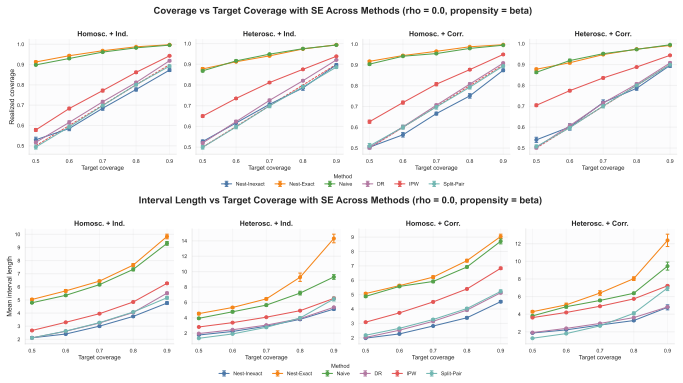
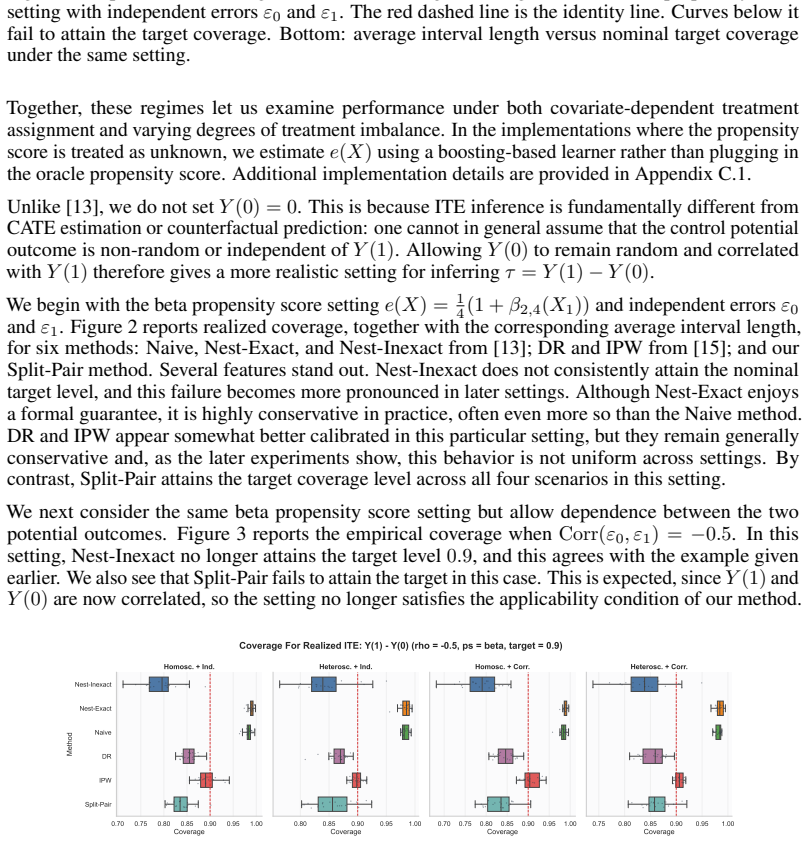
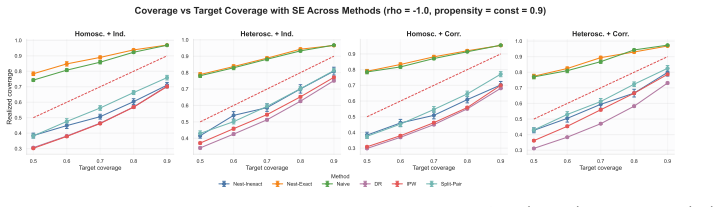
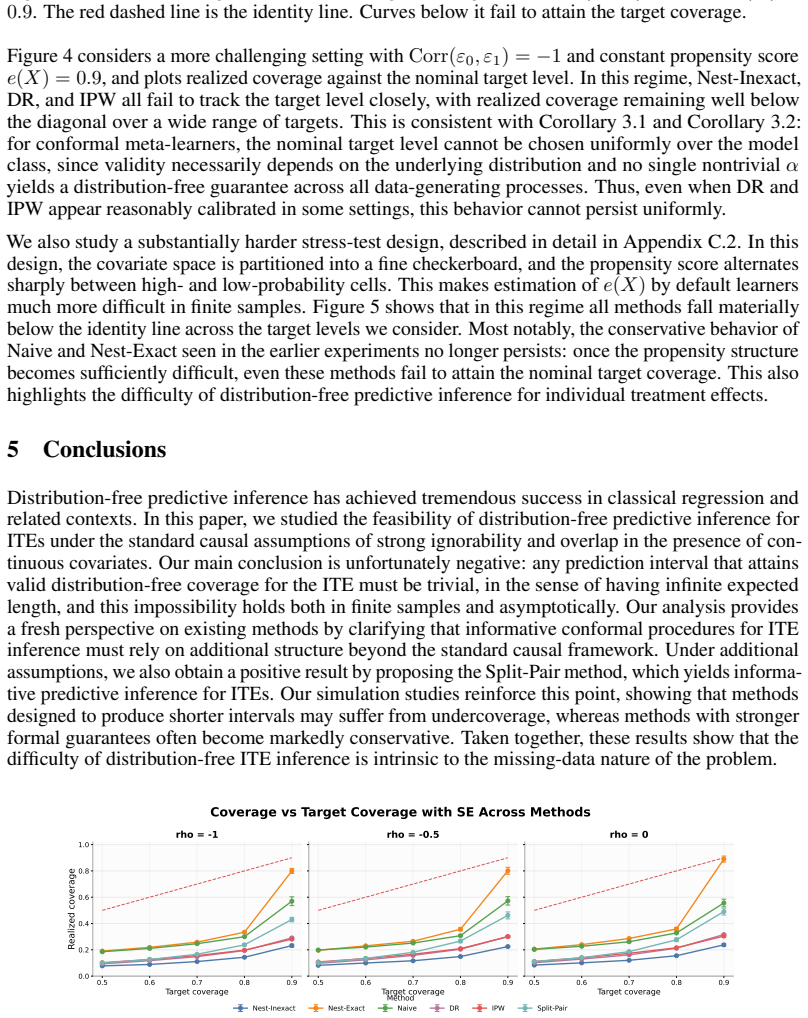

read the original abstract
Uncertainty quantification for individual treatment effects (ITEs) is a daunting challenge in causal inference. Motivated by recent advances in conformal prediction, several works aim to construct distribution-free prediction sets for ITEs with desired coverage under standard assumptions such as strong ignorability and overlap. In this paper, we show that such goals are fundamentally unattainable in the presence of continuous covariates. Specifically, we establish finite-sample and asymptotic impossibility results demonstrating that any distribution-free prediction set achieving desired coverage for ITEs must be trivial, in the sense that it has infinite expected length. Our analysis relies on a connection between ITE inference and the hardness of conditional independence testing, and highlights the intrinsic limitations imposed by the missing data nature of causal inference. These results provide a new perspective on existing methods, clarifying that their apparent success necessarily relies on additional structural assumptions beyond standard causal assumptions.
Editorial analysis
A structured set of objections, weighed in public.
Referee Report
Summary. The manuscript proves finite-sample and asymptotic impossibility results for distribution-free prediction sets for individual treatment effects (ITEs). Under strong ignorability, overlap, and continuous covariates, any prediction set achieving valid coverage must be trivial (infinite expected length). The argument reduces ITE coverage validity to the known hardness of nonparametric conditional independence testing, exploiting the missing-data structure where only one potential outcome is observed per unit.
Significance. If the reduction holds, the result is significant for causal inference and conformal prediction. It rigorously demonstrates intrinsic limitations of distribution-free ITE methods without further assumptions, explaining why recent conformal approaches for causal effects require implicit structure. The connection to conditional independence testing is a clear strength, providing a clean proof strategy that leverages established statistical impossibilities and the fundamental missing-data problem in causal settings. This offers a valuable theoretical clarification for the field.
minor comments (3)
- [Abstract and §1] The abstract and introduction could more explicitly distinguish marginal coverage from conditional coverage when defining 'valid coverage' for the random ITE, as this distinction is load-bearing for the reduction.
- [§5] In the discussion of implications, add a brief paragraph on how the result interacts with common practical relaxations such as smoothness or parametric assumptions on the outcome models.
- [§2] Notation for the prediction set C_n(x, t) and the ITE random variable should be introduced with a dedicated notation subsection or table to improve readability for readers unfamiliar with the conformal literature.
Simulated Author's Rebuttal
We thank the referee for their positive summary and significance assessment of our impossibility results for distribution-free ITE prediction sets. We appreciate the recognition of the connection to conditional independence testing and the missing-data structure in causal inference. The referee recommends minor revision, but no specific major comments were raised.
Circularity Check
No significant circularity identified
full rationale
The paper establishes an impossibility result for distribution-free ITE prediction sets by reducing the coverage requirement to the known statistical hardness of finite-sample or consistent nonparametric conditional independence testing, under standard assumptions (strong ignorability, overlap, continuous covariates). This reduction exploits the missing-data structure of potential outcomes and does not rely on any fitted parameters, self-definitional equations, or load-bearing self-citations. The central claim is an external reduction to a pre-existing result in nonparametric statistics rather than a renaming, ansatz, or construction that collapses to the paper's own inputs. The derivation is therefore self-contained.
Axiom & Free-Parameter Ledger
axioms (2)
- domain assumption Strong ignorability and overlap hold.
- domain assumption Covariates are continuous.
Reference graph
Works this paper leans on
-
[1]
Personalized evidence based medicine: predictive approaches to heterogeneous treatment effects.Bmj, 363, 2018
David M Kent, Ewout Steyerberg, and David Van Klaveren. Personalized evidence based medicine: predictive approaches to heterogeneous treatment effects.Bmj, 363, 2018
2018
-
[2]
Who should be treated? empirical welfare maximization methods for treatment choice.Econometrica, 86(2):591–616, 2018
Toru Kitagawa and Aleksey Tetenov. Who should be treated? empirical welfare maximization methods for treatment choice.Econometrica, 86(2):591–616, 2018
2018
-
[3]
Policy learning with observational data.Econometrica, 89(1): 133–161, 2021
Susan Athey and Stefan Wager. Policy learning with observational data.Econometrica, 89(1): 133–161, 2021
2021
-
[4]
Bayesian nonparametric modeling for causal inference.Journal of Computa- tional and Graphical Statistics, 20(1):217–240, 2011
Jennifer L Hill. Bayesian nonparametric modeling for causal inference.Journal of Computa- tional and Graphical Statistics, 20(1):217–240, 2011
2011
-
[5]
Estimation and inference of heterogeneous treatment effects using random forests.Journal of the American Statistical Association, 113(523):1228–1242, 2018
Stefan Wager and Susan Athey. Estimation and inference of heterogeneous treatment effects using random forests.Journal of the American Statistical Association, 113(523):1228–1242, 2018
2018
-
[6]
Metalearners for estimating heterogeneous treatment effects using machine learning.Proceedings of the National Academy of Sciences, 116(10):4156–4165, 2019
Sören R Künzel, Jasjeet S Sekhon, Peter J Bickel, and Bin Yu. Metalearners for estimating heterogeneous treatment effects using machine learning.Proceedings of the National Academy of Sciences, 116(10):4156–4165, 2019
2019
-
[7]
Quasi-oracle estimation of heterogeneous treatment effects
Xinkun Nie and Stefan Wager. Quasi-oracle estimation of heterogeneous treatment effects. Biometrika, 108(2):299–319, 2021
2021
-
[8]
Towards optimal doubly robust estimation of heterogeneous causal effects
Edward H Kennedy. Towards optimal doubly robust estimation of heterogeneous causal effects. Electronic Journal of Statistics, 17(2):3008–3049, 2023
2023
-
[9]
A tutorial on conformal prediction.Journal of Machine Learning Research, 9(Mar):371–421, 2008
Glenn Shafer and Vladimir V ovk. A tutorial on conformal prediction.Journal of Machine Learning Research, 9(Mar):371–421, 2008
2008
-
[10]
Distribution-free predictive inference for regression.Journal of the American Statistical Associ- ation, 113(523):1094–1111, 2018
Jing Lei, Max G’Sell, Alessandro Rinaldo, Ryan J Tibshirani, and Larry Wasserman. Distribution-free predictive inference for regression.Journal of the American Statistical Associ- ation, 113(523):1094–1111, 2018
2018
-
[11]
Anastasios N. Angelopoulos and Stephen Bates. Conformal prediction: A gentle introduction. Found. Trends Mach. Learn., 16(4):494–591, March 2023. ISSN 1935-8237. doi: 10.1561/ 2200000101. URLhttps://doi.org/10.1561/2200000101
-
[12]
arXiv preprint arXiv:2411.11824 , year=
Anastasios N. Angelopoulos, Rina Foygel Barber, and Stephen Bates. Theoretical foundations of conformal prediction, 2026. URLhttps://arxiv.org/abs/2411.11824
-
[13]
Conformal inference of counterfactuals and individual treatment effects.Journal of the Royal Statistical Society Series B: Statistical Methodology, 83 (5):911–938, 2021
Lihua Lei and Emmanuel J Candès. Conformal inference of counterfactuals and individual treatment effects.Journal of the Royal Statistical Society Series B: Statistical Methodology, 83 (5):911–938, 2021
2021
-
[14]
Sensitivity analysis of individual treatment effects: A robust conformal inference approach.Proceedings of the National Academy of Sciences, 120(6):e2214889120, 2023
Ying Jin, Zhimei Ren, and Emmanuel J Candès. Sensitivity analysis of individual treatment effects: A robust conformal inference approach.Proceedings of the National Academy of Sciences, 120(6):e2214889120, 2023
2023
-
[15]
Conformal meta-learners for predictive inference of individual treatment effects.Advances in neural information processing systems, 36:47682–47703, 2023
Ahmed M Alaa, Zaid Ahmad, and Mark van der Laan. Conformal meta-learners for predictive inference of individual treatment effects.Advances in neural information processing systems, 36:47682–47703, 2023
2023
-
[16]
Conformal inference of individual treatment effects using conditional density estimates
Baozhen Wang and Xingye Qiao. Conformal inference of individual treatment effects using conditional density estimates. InProceedings of the AAAI Conference on Artificial Intelligence, volume 39, pages 21009–21016, 2025
2025
-
[17]
The central role of the propensity score in observational studies for causal effects.Biometrika, 70(1):41–55, 1983
Paul R Rosenbaum and Donald B Rubin. The central role of the propensity score in observational studies for causal effects.Biometrika, 70(1):41–55, 1983
1983
-
[18]
Shah and Jonas Peters
Rajen D. Shah and Jonas Peters. The hardness of conditional independence testing and the generalised covariance measure.The Annals of Statistics, 48(3):1514 – 1538, 2020. 10
2020
-
[19]
Doubly robust calibra- tion of prediction sets under covariate shift.Journal of the Royal Statistical Society Series B: Statistical Methodology, 86(4):943–965, 2024
Yachong Yang, Arun Kumar Kuchibhotla, and Eric Tchetgen Tchetgen. Doubly robust calibra- tion of prediction sets under covariate shift.Journal of the Royal Statistical Society Series B: Statistical Methodology, 86(4):943–965, 2024
2024
-
[20]
Statistics and causal inference.Journal of the American Statistical Association, 81(396):945–960, 1986
Paul W Holland. Statistics and causal inference.Journal of the American Statistical Association, 81(396):945–960, 1986
1986
-
[21]
Optimal global rates of convergence for nonparametric regression.The annals of statistics, pages 1040–1053, 1982
Charles J Stone. Optimal global rates of convergence for nonparametric regression.The annals of statistics, pages 1040–1053, 1982
1982
-
[22]
Optimal uniform convergence rates and asymptotic normality for series estimators under weak dependence and weak conditions.Journal of Econometrics, 188(2):447–465, 2015
Xiaohong Chen and Timothy M Christensen. Optimal uniform convergence rates and asymptotic normality for series estimators under weak dependence and weak conditions.Journal of Econometrics, 188(2):447–465, 2015
2015
-
[23]
Overlap in observational studies with high-dimensional covariates.Journal of Econometrics, 221(2): 644–654, 2021
Alexander D’Amour, Peng Ding, Avi Feller, Lihua Lei, and Jasjeet Sekhon. Overlap in observational studies with high-dimensional covariates.Journal of Econometrics, 221(2): 644–654, 2021
2021
-
[24]
Toward a curse of dimensionality appropriate (coda) asymptotic theory for semi-parametric models.Statistics in medicine, 16(3):285–319, 1997
James M Robins and Ya’acov Ritov. Toward a curse of dimensionality appropriate (coda) asymptotic theory for semi-parametric models.Statistics in medicine, 16(3):285–319, 1997. 11 A Proof of Main Theorems We provide the proofs of the main theorems in Section 2 in the Appendix. The Appendix is organized as follows: A.1. we state technical lemmas on the hard...
1997
-
[25]
The marginal of(X, T)is preserved:Q X,T =P X,T
-
[26]
nest”,exact = FALSE, and CQR. • Nest-Exact: the exact nested conformal ITE method implemented by cfcausal::conformalItewithalgo = “nest
The conditional distribution of(Y(1), Y(0))given(X, T)is QY(1),Y(0)|X,T=t = ( L Y(0) +y, Y(0) , Y(0)∼P Y(0)|X,T=0 , t= 0, L Y(1), Y(1)−y , Y(1)∼P Y(1)|X,T=1 , t= 1, whereL(·)denotes the law of a random vector. Under this construction, Q(X,T,Y) =P (X,T,Y) , and, moreover, QY(1)|X,T=1 =P Y(1)|X,T=1 , Q Y(0)|X,T=0 =P Y(0)|X,T=0 , and QY(1)−Y(0)|X,T=1 =Q Y(1)...
discussion (0)
Sign in with ORCID, Apple, or X to comment. Anyone can read and Pith papers without signing in.