Recognition: unknown
Interpretable Neural Networks to Predict Momentum Fluxes of Orographic Gravity Waves
Pith reviewed 2026-05-08 16:18 UTC · model grok-4.3
The pith
Neural networks trained on ERA5 reanalysis data predict momentum fluxes of orographic gravity waves with R² values from 0.56 to 0.72.
A machine-rendered reading of the paper's core claim, the machinery that carries it, and where it could break.
Core claim
Neural networks can successfully predict momentum fluxes of inertia-gravity waves, including the subgrid-scale portion, as a function of the resolved state variables. Performance holds across different cases covering the full spectrum or mountainous regions only, and the models capture physically meaningful features according to explainable AI diagnostics. This establishes a data-driven approach as a viable alternative to conventional parameterization schemes such as that of Lott and Miller.
What carries the argument
Neural networks that take coarse-grained atmospheric state variables as input and output momentum fluxes of inertia-gravity waves, verified for physical consistency with SHAP values.
If this is right
- The method supplies a practical route to parameterize unresolved orographic gravity waves inside coarse Earth system models.
- Offline skill on reanalysis data indicates that the networks can reproduce the net momentum transport that affects the resolved flow.
- Comparison against the Lott-Miller scheme supplies a quantitative benchmark for any future operational implementation.
- The same training pipeline can be applied to other subgrid atmospheric processes once suitable wave-filtered targets are available.
Where Pith is reading between the lines
- Online coupling success would allow climate models to reduce systematic biases caused by missing wave drag over complex terrain.
- The approach may extend naturally to non-orographic gravity waves if suitable filtered targets can be prepared from reanalysis or model output.
- Combining reanalysis with linear wave-extraction tools offers a general template for training physically interpretable machine-learning parameterizations.
Load-bearing premise
That offline prediction skill on reanalysis data will translate to improved performance when the neural network is coupled online inside an Earth system model.
What would settle it
Inserting the trained network into an Earth system model and finding that the simulated large-scale circulation or gravity-wave drag does not improve relative to a control run or to high-resolution benchmark simulations.
Figures




read the original abstract
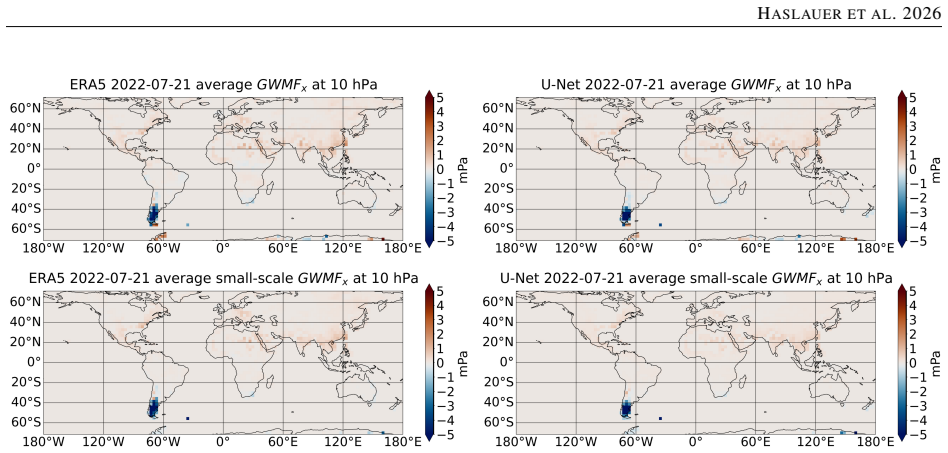
State-of-the-art Earth system models (ESMs) cannot explicitly resolve many small-scale atmospheric processes such as atmospheric gravity waves, and thus must represent, or parameterise, their effects on the resolved state. Machine learning (ML) has the potential to improve these parameterisations. In our study, we train neural networks (NNs) on ERA5 reanalysis data to predict momentum fluxes of orographic gravity waves as a function of the state variables at the resolution of a coarse ESM. Employing a full year of data, we extract inertia-gravity waves using the software MODES, which applies linear theory for wave filtering, and train ML models on data coarse-grained to the ESM's target resolution. We consider four different cases: the full spectrum of inertia-gravity waves resolved in ERA5, or just the part of the spectrum that is subgrid-scale in the target ESM, both over all land or just over mountainous terrain. Our NNs successfully predict momentum fluxes, with a global coefficient of determination ($R^2$) ranging from 0.72 to 0.56, depending on the case, when evaluated offline with data from another year. An analysis of our models using SHAP values, an explainable AI technique, suggests that the networks learned physically meaningful relationships. In addition, we give a comparison with the physics-based parameterisation scheme by Lott and Miller. This work forms the basis for the development of operational ML-based parameterisations to improve the representation of gravity waves and their effects in climate models.
Editorial analysis
A structured set of objections, weighed in public.
Referee Report
Summary. The manuscript trains neural networks on ERA5 reanalysis data filtered with MODES (linear theory) and coarse-grained to ESM resolution to predict orographic gravity-wave momentum fluxes. Four cases are examined (full/subgrid inertia-gravity wave spectrum; all land vs. mountainous terrain only). Offline evaluation on a held-out year yields global R² values of 0.56–0.72. SHAP analysis indicates the networks capture physically meaningful relationships, and results are benchmarked against the Lott-Miller physics-based scheme. The work is presented as a foundation for ML-based gravity-wave parameterizations in Earth system models.
Significance. If the offline skill and interpretability translate to coupled use, the approach could yield more accurate, data-driven subgrid gravity-wave drag schemes that improve large-scale circulation in ESMs. The paper earns credit for reporting concrete offline R² metrics on held-out reanalysis, performing SHAP-based interpretability checks, and including a direct comparison to the established Lott-Miller scheme. These elements provide external grounding and reduce circularity relative to purely fitted parameterizations.
major comments (2)
- [§4 and §5] §4 (Evaluation) and §5 (Discussion): The central results consist exclusively of offline predictions on reanalysis. No online coupling experiments are reported in which the NN is inserted into an ESM dynamical core and allowed to interact with the resolved flow. This assumption—that offline skill on MODES-filtered targets will produce improved subgrid drag when coupled—is load-bearing for the claim that the work forms the basis for operational parameterizations, yet remains untested.
- [§3] §3 (Methods): The target momentum fluxes rely on linear-theory filtering via MODES followed by a specific coarse-graining operator. The manuscript does not quantify how well this extracted quantity matches the true subgrid orographic gravity-wave momentum flux that an ESM cannot resolve (e.g., via comparison to high-resolution simulations or observations beyond ERA5). This directly affects whether the reported R² values correspond to the intended physical process.
minor comments (3)
- [Abstract] Abstract: The abstract states the R² range but does not list the four cases explicitly or note the training/testing year split; adding one sentence would improve immediate readability.
- [Figures] Figure captions (e.g., those showing SHAP dependence plots): Additional labels clarifying the physical meaning of the input variables (e.g., which wind component or stability measure) would aid readers unfamiliar with the MODES output.
- [§5] §5 (Discussion): A short paragraph explicitly acknowledging that offline R² does not guarantee online performance, together with suggested next steps for coupling tests, would strengthen the positioning of the work as a basis for parameterization development.
Simulated Author's Rebuttal
We thank the referee for the constructive review. We address each major comment below and have revised the manuscript to clarify scope and limitations.
read point-by-point responses
-
Referee: [§4 and §5] §4 (Evaluation) and §5 (Discussion): The central results consist exclusively of offline predictions on reanalysis. No online coupling experiments are reported in which the NN is inserted into an ESM dynamical core and allowed to interact with the resolved flow. This assumption—that offline skill on MODES-filtered targets will produce improved subgrid drag when coupled—is load-bearing for the claim that the work forms the basis for operational parameterizations, yet remains untested.
Authors: We agree that online coupled experiments are required to confirm that offline skill translates to improved large-scale circulation in an ESM. The manuscript presents an offline study as a necessary foundation, including data extraction, training, SHAP interpretability, and benchmarking against Lott-Miller. We have added explicit language in the Discussion to state this limitation, temper claims about operational readiness, and outline the additional steps needed for online implementation. revision: partial
-
Referee: [§3] §3 (Methods): The target momentum fluxes rely on linear-theory filtering via MODES followed by a specific coarse-graining operator. The manuscript does not quantify how well this extracted quantity matches the true subgrid orographic gravity-wave momentum flux that an ESM cannot resolve (e.g., via comparison to high-resolution simulations or observations beyond ERA5). This directly affects whether the reported R² values correspond to the intended physical process.
Authors: MODES linear filtering on ERA5 supplies a globally consistent, observationally constrained target for inertia-gravity wave fluxes, following standard diagnostic practice. Direct global validation against independent high-resolution simulations or additional observations is desirable but limited by data availability at the necessary resolution and coverage. We have expanded the Methods section to discuss the assumptions inherent in the MODES-derived targets and their relation to subgrid orographic drag. revision: partial
Circularity Check
No circularity: standard ML training and held-out evaluation on independent reanalysis
full rationale
The manuscript trains neural networks on MODES-processed ERA5 reanalysis to predict orographic gravity-wave momentum fluxes at coarse ESM resolution and reports R² on a fully separate year of data. This is ordinary supervised learning with temporal hold-out; the reported skill is not a quantity that reduces to the training inputs by construction, nor does any equation or claim equate a fitted parameter to a 'prediction' of itself. The Lott-Miller comparison supplies an external physics-based reference. No self-citation chains, uniqueness theorems, or ansatz smuggling appear in the load-bearing steps. The offline-only evaluation is stated explicitly, so the derivation chain remains self-contained against external benchmarks.
Axiom & Free-Parameter Ledger
axioms (2)
- domain assumption ERA5 reanalysis and MODES software accurately capture orographic gravity wave momentum fluxes at the scales relevant for coarse ESM grids
- domain assumption Offline prediction performance on reanalysis will translate to improved online performance inside an Earth system model
Reference graph
Works this paper leans on
-
[1]
Ulrich Achatz and M. Joan Alexander and Erich Becker and Hye-Yeong Chun and Andreas Dörnbrack and Laura Holt and Riwal Plougonven and Inna Polichtchouk and Kaoru Sato and Aditi Sheshadri and Claudia Christine Stephan and Annelize van Niekerk and Corwin J. Wright. Atmospheric Gravity Waves: Processes and Parameterization. Journal of the Atmospheric Science...
-
[2]
Alexander, M. J. and Geller, M. and McLandress, C. and Polavarapu, S. and Preusse, P. and Sassi, F. and Sato, K. and Eckermann, S. and Ern, M. and Hertzog, A. and Kawatani, Y. and Pulido, M. and Shaw, T. A. and Sigmond, M. and Vincent, R. and Watanabe, S. , title =. Quarterly Journal of the Royal Meteorological Society , volume =. doi:https://doi.org/10.1...
-
[3]
Review of deep learning: concepts,. Journal of Big Data , author =. 2021 , pages =. doi:10.1186/s40537-021-00444-8 , number =
-
[4]
Journal of the Atmospheric Sciences , author =
Using. Journal of the Atmospheric Sciences , author =. 2023 , pages =. doi:10.1175/JAS-D-22-0021.1 , number =
-
[5]
npj Climate and Atmospheric Science , author =
Climate model trend errors are evident in seasonal forecasts at short leads , volume =. npj Climate and Atmospheric Science , author =. 2024 , pages =. doi:10.1038/s41612-024-00832-w , number =
-
[6]
Geoscientific Model Development , author =
Machine learning for numerical weather and climate modelling: a review , volume =. Geoscientific Model Development , author =. 2023 , pages =. doi:10.5194/gmd-16-6433-2023 , number =
-
[7]
Bushell, A. C. and Anstey, J. A. and Butchart, N. and Kawatani, Y. and Osprey, S. M. and Richter, J. H. and Serva, F. and Braesicke, P. and Cagnazzo, C. and Chen, C.-C. and Chun, H.-Y. and Garcia, R. R. and Gray, L. J. and Hamilton, K. and Kerzenmacher, T. and Kim, Y.-H. and Lott, F. and McLandress, C. and Naoe, H. and Scinocca, J. and Smith, A. K. and St...
-
[8]
Journal of Advances in Modeling Earth Systems , volume =
Chantry, Matthew and Hatfield, Sam and Dueben, Peter and Polichtchouk, Inna and Palmer, Tim , title =. Journal of Advances in Modeling Earth Systems , volume =. doi:https://doi.org/10.1029/2021MS002477 , abstract =
-
[9]
Connelly, David S. and Gerber, Edwin P. , title =. Journal of Advances in Modeling Earth Systems , volume =. doi:https://doi.org/10.1029/2023MS004184 , abstract =
-
[10]
Atmospheric Chemistry and Physics , author =
Gravity waves excited during a minor sudden stratospheric warming , volume =. Atmospheric Chemistry and Physics , author =. 2018 , pages =. doi:10.5194/acp-18-12915-2018 , number =
-
[11]
Journal of the Atmospheric Sciences , author =
Stratospheric. Journal of the Atmospheric Sciences , author =. 2022 , pages =. doi:10.1175/JAS-D-21-0057.1 , number =
-
[12]
Dong, Wenjun and Fritts, David C. and Liu, Alan Z. and Lund, Thomas S. and Liu, Han-Li and Snively, Jonathan , title =. Geophysical Research Letters , volume =. doi:https://doi.org/10.1029/2023GL104668 , year =
-
[13]
Effects of missing gravity waves on stratospheric dynamics; part 1: climatology , volume =. Climate Dynamics , author =. 2020 , pages =. doi:10.1007/s00382-020-05166-w , number =
-
[14]
Geoscientific Model Development , author =
Emulating lateral gravity wave propagation in a global chemistry–climate model (. Geoscientific Model Development , author =. 2023 , pages =. doi:10.5194/gmd-16-5561-2023 , abstract =
-
[15]
Ern, M. and Preusse, P. and Gille, J. C. and Hepplewhite, C. L. and Mlynczak, M. G. and Russell III, J. M. and Riese, M. , title =. Journal of Geophysical Research: Atmospheres , volume =. doi:https://doi.org/10.1029/2011JD015821 , year =
-
[16]
Journal of Geophysical Research: Atmospheres , author =
Interaction of gravity waves with the. Journal of Geophysical Research: Atmospheres , author =. 2014 , pages =. doi:10.1002/2013JD020731 , language =
-
[17]
and Sheshadri, Aditi and Cain, Gerald R
Espinosa, Zachary I. and Sheshadri, Aditi and Cain, Gerald R. and Gerber, Edwin P. and DallaSanta, Kevin J. , title =. Geophysical Research Letters , volume =. 2022 , keywords =
2022
-
[18]
and Alexander, M
Fritts, David C. and Alexander, M. Joan , title =. Reviews of Geophysics , volume =
-
[19]
Bulletin of the American Meteorological Society , author =
The. Bulletin of the American Meteorological Society , author =. 2016 , pages =. doi:10.1175/BAMS-D-14-00269.1 , number =
-
[20]
Pushing the frontiers in climate modelling and analysis with machine learning , volume =. Nature Climate Change , author =. 2024 , pages =. doi:10.1038/s41558-024-02095-y , number =
-
[21]
A. Journal of Climate , author =. 2013 , pages =. doi:10.1175/JCLI-D-12-00545.1 , abstract =
-
[22]
Gentine, P. and Pritchard, M. and Rasp, S. and Reinaudi, G. and Yacalis, G. , title =. Geophysical Research Letters , volume =. doi:https://doi.org/10.1029/2018GL078202 , year =
-
[23]
Giorgetta, M. A. and Brokopf, R. and Crueger, T. and Esch, M. and Fiedler, S. and Helmert, J. and Hohenegger, C. and Kornblueh, L. and Köhler, M. and Manzini, E. and Mauritsen, T. and Nam, C. and Raddatz, T. and Rast, S. and Reinert, D. and Sakradzija, M. and Schmidt, H. and Schneck, R. and Schnur, R. and Silvers, L. and Wan, H. and Zängl, G. and Stevens,...
-
[24]
International Journal of System Assurance Engineering and Management , author =
A review of recent advances and strategies in transfer learning , volume =. International Journal of System Assurance Engineering and Management , author =. 2025 , pages =. doi:10.1007/s13198-024-02684-2 , language =
-
[25]
and Eyring, Veronika , title =
Grundner, Arthur and Beucler, Tom and Gentine, Pierre and Iglesias-Suarez, Fernando and Giorgetta, Marco A. and Eyring, Veronika , title =. Journal of Advances in Modeling Earth Systems , volume =. doi:https://doi.org/10.1029/2021MS002959 , year =
-
[26]
Gravity. Scientific Data , author =. 2024 , pages =. doi:10.1038/s41597-024-03699-x , number =
-
[27]
Aman Gupta and Aditi Sheshadri and Sujit Roy and Vishal Gaur and Manil Maskey and Rahul Ramachandran , title =
-
[28]
Aman Gupta and Robert Reichert and Andreas Dörnbrack and Hella Garny and Roland Eichinger and Inna Polichtchouk and Bernd Kaifler and Thomas Birner. Estimates of Southern Hemispheric Gravity Wave Momentum Fluxes across Observations, Reanalyses, and Kilometer-Scale Numerical Weather Prediction Model. Journal of the Atmospheric Sciences. 2024. doi:10.1175/J...
-
[29]
Journal of Advances in Modeling Earth Systems , volume =
Gupta, Aman and Sheshadri, Aditi and Roy, Sujit and Anantharaj, Valentine , title =. Journal of Advances in Modeling Earth Systems , volume =. doi:https://doi.org/10.1029/2025MS004977 , year =
-
[30]
doi:10.48550/arXiv.2509.03816 , author =
Finetuning. doi:10.48550/arXiv.2509.03816 , author =
-
[31]
Steven C. Hardiman and Adam A. Scaife and Annelize van Niekerk and Rachel Prudden and Aled Owen and Samantha V. Adams and Tom Dunstan and Nick J. Dunstone and Sam Madge. Machine Learning for Nonorographic Gravity Waves in a Climate Model. Artificial Intelligence for the Earth Systems. 2023. doi:10.1175/AIES-D-22-0081.1
-
[32]
In preparation , author =
Gravity Wave Momentum Fluxes in. In preparation , author =
-
[33]
The. Quarterly Journal of the Royal Meteorological Society , author =. 2020 , keywords =. doi:https://doi.org/10.1002/qj.3803 , number =
-
[34]
and Eyring, Veronika , title =
Heuer, Helge and Schwabe, Mierk and Gentine, Pierre and Giorgetta, Marco A. and Eyring, Veronika , title =. Journal of Advances in Modeling Earth Systems , volume =. doi:https://doi.org/10.1029/2024MS004398 , abstract =
-
[35]
Geophysical Research Letters , author =
An 18‐. Geophysical Research Letters , author =. doi:10.1029/2020GL089557 , language =
-
[36]
Hines , abstract =
Colin O. Hines , abstract =. Doppler-spread parameterization of gravity-wave momentum deposition in the middle atmosphere. Part 2: Broad and quasi monochromatic spectra, and implementation , journal =. 1997 , doi =
1997
-
[37]
Proceedings of the Royal Society of London , volume =
Hough, Sydney Samuel , title =. Proceedings of the Royal Society of London , volume =. 1898 , doi =
-
[38]
Journal of Geophysical Research: Atmospheres , author =
Lidar observations of gravity wave activity in the middle atmosphere over. Journal of Geophysical Research: Atmospheres , author =. 2015 , pages =. doi:10.1002/2014JD022879 , number =
-
[39]
Lidar observations of large-amplitude mountain waves in the stratosphere above. Scientific Reports , author =. 2020 , pages =. doi:10.1038/s41598-020-71443-7 , number =
-
[40]
Spectral. Monthly Weather Review , author =. 1981 , pages =. doi:10.1175/1520-0493(1981)109<0037:SROTDG>2.0.CO;2 , language =
-
[41]
An overview of the past, present and future of gravity‐wave drag parametrization for numerical climate and weather prediction models , volume =. Atmosphere-Ocean , author =. 2003 , pages =. doi:10.3137/ao.410105 , language =
-
[42]
Lear, Emily J. and Wright, Corwin J. and Hindley, Neil P. and Polichtchouk, Inna and Hoffmann, Lars , title =. Journal of Geophysical Research: Atmospheres , volume =. doi:https://doi.org/10.1029/2023JD040097 , year =
-
[43]
Deep learning , volume =. Nature , author =. 2015 , pages =. doi:10.1038/nature14539 , language =
-
[44]
Journal of Geophysical Research: Atmospheres , author =
11. Journal of Geophysical Research: Atmospheres , author =. 2019 , pages =. doi:10.1029/2018JD028673 , number =
-
[45]
M. S. Longuet-Higgins , journal =. The Eigenfunctions of Laplace's Tidal Equations over a Sphere , volume =
-
[46]
Lott, François and Miller, Martin J. , title =. Quarterly Journal of the Royal Meteorological Society , volume =. doi:https://doi.org/10.1002/qj.49712353704 , year =
-
[47]
Alleviation of. Monthly Weather Review , author =. 1999 , pages =. doi:10.1175/1520-0493(1999)127<0788:AOSBIA>2.0.CO;2 , language =
-
[48]
and Lee, Su-In , title =
Lundberg, Scott M. and Lee, Su-In , title =. Proceedings of the 31st International Conference on Neural Information Processing Systems , pages =. 2017 , publisher =
2017
-
[49]
Matsuoka, D. and Watanabe, S. and Sato, K. and Kawazoe, S. and Yu, W. and Easterbrook, S. , title =. Geophysical Research Letters , volume =. doi:https://doi.org/10.1029/2020GL089436 , year =
-
[50]
WIREs Climate Change , volume =
McFarlane, Norman , title =. WIREs Climate Change , volume =. doi:https://doi.org/10.1002/wcc.122 , year =
-
[51]
Shepherd and Saroja Polavarapu and Stephen R
Charles McLandress and Theodore G. Shepherd and Saroja Polavarapu and Stephen R. Beagley. Is Missing Orographic Gravity Wave Drag near 60°S the Cause of the Stratospheric Zonal Wind Biases in Chemistry–Climate Models?. Journal of the Atmospheric Sciences. 2012. doi:10.1175/JAS-D-11-0159.1
-
[52]
Journal of the Atmospheric Sciences , author =
Dynamical. Journal of the Atmospheric Sciences , author =. 2013 , pages =. doi:10.1175/JAS-D-12-0297.1 , number =
-
[53]
uller, W. A. and Lorenz, S. and Pham, T. V. and Schneidereit, A. and Brokopf, R. and Brovkin, V. and Br\
M\"uller, W. A. and Lorenz, S. and Pham, T. V. and Schneidereit, A. and Brokopf, R. and Brovkin, V. and Br\"uggemann, N. and Chegini, F. and Dommenget, D. and Fr\"ohlich, K. and Fr\"uh, B. and Gayler, V. and Haak, H. and Hagemann, S. and Hanke, M. and Ilyina, T. and Jungclaus, J. and K\"ohler, M. and Korn, P. and Kornbl\"uh, L. and Kroll, C. and Kr\"uger,...
2025
-
[54]
Quarterly Journal of the Royal Meteorological Society , author =
Alleviation of a systematic westerly bias in general circulation and numerical weather prediction models through an orographic gravity wave drag parametrization , volume =. Quarterly Journal of the Royal Meteorological Society , author =. 1986 , pages =. doi:10.1002/qj.49711247406 , number =
-
[55]
Journal of the Atmospheric Sciences , year =
Polichtchouk, Inna and van Niekerk, Annelize and Wedi, Nils , title =. Journal of the Atmospheric Sciences , year =
-
[56]
and Zaj\'
Proch\'azkov\'a, Z. and Zaj\'. Climatology, long-term variability and trend of resolved gravity wave drag in the stratosphere revealed by ERA5 , JOURNAL =. 2025 , NUMBER =
2025
-
[57]
Bulletin of the American Meteorological Society , author =. 2021 , pages =. doi:10.1175/BAMS-D-20-0034.1 , number =
-
[58]
Pritchard and Pierre Gentine , title =
Stephan Rasp and Michael S. Pritchard and Pierre Gentine , title =. Proceedings of the National Academy of Sciences , volume =. 2018 , doi =
2018
-
[59]
Quarterly Journal of the Royal Meteorological Society , author =
Response of the. Quarterly Journal of the Royal Meteorological Society , author =. 2022 , pages =. doi:10.1002/qj.3749 , number =
-
[60]
Ronneberger, Olaf and Fischer, Philipp and Brox, Thomas , editor =. U-. Medical. 2015 , doi =
2015
-
[61]
A physics-informed machine learning parameterization for cloud microphysics in
Sarauer, Ellen and Schwabe, Mierk and Weiss, Philipp and Lauer, Axel and Stier, Philip and Eyring, Veronika , year =. A physics-informed machine learning parameterization for cloud microphysics in. doi:10.1017/eds.2025.10016 , journal =
-
[62]
doi:10.5281/zenodo.10020800 , journal =
Schulzweida, Uwe , title =. doi:10.5281/zenodo.10020800 , journal =
-
[63]
Shapley, L. S. , editor =. 17. Contributions to the. 1953 , doi =
1953
-
[64]
, month = may, year =
Stensrud, David J. , month = may, year =. Parameterization
-
[65]
Intercomparison of Gravity Waves in Global Convection-Permitting Models
Claudia Christine Stephan and Cornelia Strube and Daniel Klocke and Manfred Ern and Lars Hoffmann and Peter Preusse and Hauke Schmidt. Intercomparison of Gravity Waves in Global Convection-Permitting Models. Journal of the Atmospheric Sciences. 2019. doi:10.1175/JAS-D-19-0040.1
-
[66]
Qiang and Hassanzadeh, Pedram and Alexander, M
Sun, Y. Qiang and Hassanzadeh, Pedram and Alexander, M. Joan and Kruse, Christopher G. , title =. Journal of Advances in Modeling Earth Systems , volume =. doi:https://doi.org/10.1029/2022MS003585 , year =
-
[67]
Journal of Advances in Modeling Earth Systems , author =
Data. Journal of Advances in Modeling Earth Systems , author =. doi:10.1029/2023MS004145 , number =
-
[68]
Journal of Geophysical Research: Atmospheres , author =
Large‐. Journal of Geophysical Research: Atmospheres , author =. 2019 , pages =. doi:10.1029/2019JD030932 , number =
-
[69]
Geophysical Research Letters , author =
Can. Geophysical Research Letters , author =. doi:10.1029/2025GL115499 , number =
-
[70]
and Kaiser,
Vaswani, Ashish and Shazeer, Noam and Parmar, Niki and Uszkoreit, Jakob and Jones, Llion and Gomez, Aidan N. and Kaiser,. Attention is all you need , year =. Proceedings of the 31st International Conference on Neural Information Processing Systems , pages =
-
[71]
Nature Communications , author =
Heat extremes in. Nature Communications , author =. 2023 , pages =. doi:10.1038/s41467-023-42143-3 , language =
-
[72]
Do. Climate Dynamics , author =. 2022 , pages =. doi:10.1007/s00382-021-06034-x , number =
-
[73]
Yoshida, L. and Tomikawa, Y. and Ejiri, M. K. and Tsutsumi, M. and Kohma, M. and Sato, K. , title =. Journal of Geophysical Research: Atmospheres , volume =. doi:https://doi.org/10.1029/2023JD040490 , year =
-
[74]
Nature Communications , author =
Stable machine-learning parameterization of subgrid processes for climate modeling at a range of resolutions , volume =. Nature Communications , author =. 2020 , pages =. doi:10.1038/s41467-020-17142-3 , number =
-
[75]
Yuval, Janni and O’Gorman, Paul A. , title =. Journal of Advances in Modeling Earth Systems , volume =. doi:https://doi.org/10.1029/2023MS003606 , year =
-
[76]
Geoscientific Model Development , author =
Normal-mode function representation of global 3-. Geoscientific Model Development , author =. 2015 , pages =. doi:10.5194/gmd-8-1169-2015 , number =
-
[77]
Energy spectra and inertia-gravity waves in global analyses , journal =
N. Energy spectra and inertia-gravity waves in global analyses , journal =. 2017 , volume =
2017
-
[78]
Journal of the Atmospheric Sciences , volume=
Decomposition of vertical velocity and its zonal wavenumber kinetic energy spectra in the hydrostatic atmosphere , author=. Journal of the Atmospheric Sciences , volume=. 2023 , publisher=
2023
-
[79]
rep., World Meteorological Organization, 56 pp
Zängl, Günther and Reinert, Daniel and Rípodas, Pilar and Baldauf, Michael , title =. Quarterly Journal of the Royal Meteorological Society , volume =. doi:https://doi.org/10.1002/qj.2378 , year =
discussion (0)
Sign in with ORCID, Apple, or X to comment. Anyone can read and Pith papers without signing in.