Recognition: unknown
Growth of shear failure in snow slab avalanche release: analytical solution for a compliant weak layer with finite softening
Pith reviewed 2026-05-08 15:47 UTC · model grok-4.3
The pith
Finite softening in weak snow layers increases the fully softened crack length for avalanche release beyond the classical brittle prediction.
A machine-rendered reading of the paper's core claim, the machinery that carries it, and where it could break.
Core claim
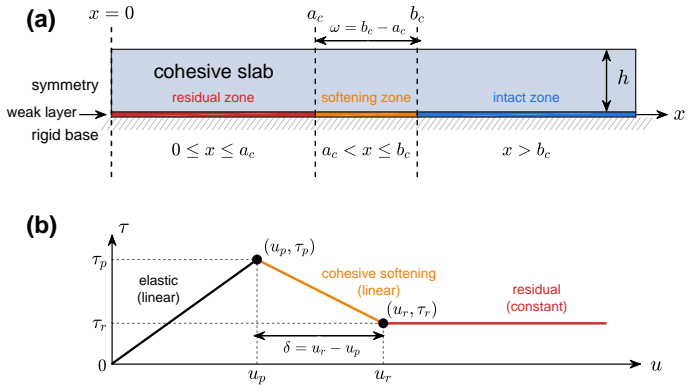
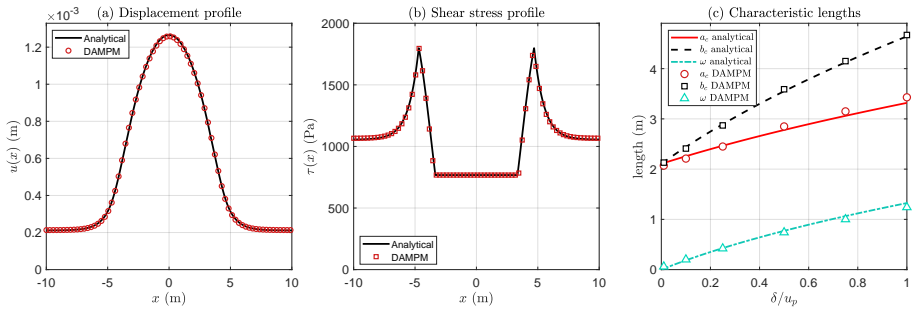
For a compliant weak layer undergoing finite linear softening the fully softened crack length a_c exceeds the classical critical length a_c0, while the total affected length b_c is larger still because it encompasses the fracture process zone; the solution recovers a_c0 exactly in the limit of vanishing softening displacement and yields the approximation a_c ≃ a_c0 √(1 + C_a δ / u_p) for small softening.
What carries the argument
The one-dimensional weak-spot framework extended to a symmetric failure consisting of a fully softened central zone, a linear-softening fracture process zone, and an outer intact elastic region; this decomposition produces closed-form relations for the two lengths a_c and b_c.
Load-bearing premise
The derivation assumes a symmetric failure composed of a fully softened zone, a linear-softening fracture process zone, and an intact elastic region inside the one-dimensional weak-spot framework.
What would settle it
A laboratory shear test on a layered snow sample that measures both the fully softened zone and the surrounding partially softened region and finds that their length ratio or the dependence of critical length on softening displacement deviates from the analytical predictions would falsify the central claim.
Figures




read the original abstract
Snow slab avalanches are among the most dangerous natural hazards in mountain areas. Recent progress in numerical modelling, field measurements, and large-scale fracture experiments has renewed interest in shear-failure interpretations of avalanche release, particularly in connection with dynamic crack propagation and supershear fracture. Yet most existing stress-based models either assume a perfectly brittle stress drop, neglecting post-peak energy dissipation, or neglect weak-layer pre-peak elasticity, which influences stress redistribution and critical crack length. Here, we derive an analytical solution for shear-failure propagation in a weak layer beneath an elastic snow slab, explicitly accounting for finite post-peak softening and elastic mismatch between slab and weak layer. Building on the one-dimensional weak-spot framework of Gaume et al.\ (2013), we consider a symmetric failure composed of a fully softened zone, a fracture process zone with linear softening, and an intact elastic region. In the limit of vanishing softening displacement $\delta$, the model recovers the classical stress-based critical length $a_{c0}$. For finite softening, the solution distinguishes between the fully softened crack length $a_c$ and the total affected length $b_c$, which includes the fracture process zone. The formulation provides a direct analytical link between weak-spot and fracture-energy approaches, since fracture energy enters through the constitutive softening law itself. For small softening, the exact solution yields the compact approximation $a_c \simeq a_{c0}\sqrt{1+C_a\delta/u_p}$. This distinction is important when comparing with numerical models that may identify the full damaged region rather than the fully softened zone alone.
Editorial analysis
A structured set of objections, weighed in public.
Referee Report
Summary. The manuscript derives an analytical solution for the growth of shear failure beneath an elastic snow slab, extending the one-dimensional weak-spot framework of Gaume et al. (2013) to include finite post-peak softening in a compliant weak layer. The model assumes symmetric failure consisting of a fully softened zone of length a_c, a linear-softening fracture process zone, and an intact elastic region, with elastic mismatch between slab and weak layer. It recovers the classical stress-based critical length a_c0 in the limit of vanishing softening displacement δ, distinguishes a_c from the total affected length b_c, and supplies the small-softening approximation a_c ≃ a_c0 √(1 + C_a δ / u_p). The formulation is presented as providing a direct analytical link between weak-spot and fracture-energy approaches.
Significance. If the derivation and matching conditions hold, the work supplies a compact analytical bridge between stress-based critical-length models and energy-based fracture descriptions that is directly usable for interpreting numerical simulations and field observations of avalanche release. The explicit separation of a_c and b_c, together with the recovery of known limits, addresses a recognized limitation of perfectly brittle assumptions and could improve estimates of the fracture process zone size in dynamic crack propagation studies.
major comments (2)
- [§3] §3 (derivation of the exact solution and matching conditions): the central claim that the solution recovers a_c0 as δ → 0 and yields the stated approximation for small δ rests on the continuity of displacement and stress at the zone boundaries; the manuscript should explicitly show the algebraic steps that produce the compact form a_c ≃ a_c0 √(1 + C_a δ / u_p) and state the range of δ/u_p over which the approximation remains accurate to within a stated tolerance.
- [§4] §4 (results and limits): while the abstract states that the model recovers known limits, no direct numerical solution of the same boundary-value problem is reported to confirm the analytical expressions for a_c and b_c; such a benchmark is load-bearing for the claim that the distinction between fully softened and total affected lengths is quantitatively reliable.
minor comments (2)
- Notation: the constant C_a appearing in the approximation is introduced without an explicit definition or derivation in the main text; a brief appendix or inline expression would improve readability.
- Figure clarity: the schematic of the three zones (fully softened, process zone, intact) should include the displacement profile u(x) and the linear softening law to make the constitutive assumptions visually explicit.
Simulated Author's Rebuttal
We thank the referee for the constructive comments and positive assessment of the manuscript's potential to bridge stress-based and energy-based approaches to avalanche release. We address each major comment below.
read point-by-point responses
-
Referee: [§3] §3 (derivation of the exact solution and matching conditions): the central claim that the solution recovers a_c0 as δ → 0 and yields the stated approximation for small δ rests on the continuity of displacement and stress at the zone boundaries; the manuscript should explicitly show the algebraic steps that produce the compact form a_c ≃ a_c0 √(1 + C_a δ / u_p) and state the range of δ/u_p over which the approximation remains accurate to within a stated tolerance.
Authors: We agree that the derivation steps merit explicit presentation. In the revised manuscript we will expand the matching conditions in §3 to show the full algebra: starting from continuity of slab displacement and shear stress at the interfaces between the fully softened zone (0 < x < a_c), the linear-softening process zone (a_c < x < b_c), and the outer elastic region (x > b_c), we solve the resulting system for a_c and b_c in terms of the softening displacement δ. The exact relation is then expanded for small δ/u_p to recover the compact square-root form, with the coefficient C_a arising directly from the elastic mismatch and softening slope. We will also add a short paragraph quantifying the approximation accuracy, stating that the relative error remains below 5 % for δ/u_p < 0.15 and below 10 % for δ/u_p < 0.25 when compared with the exact solution. revision: yes
-
Referee: [§4] §4 (results and limits): while the abstract states that the model recovers known limits, no direct numerical solution of the same boundary-value problem is reported to confirm the analytical expressions for a_c and b_c; such a benchmark is load-bearing for the claim that the distinction between fully softened and total affected lengths is quantitatively reliable.
Authors: We acknowledge that an independent numerical check would strengthen confidence in the quantitative separation of a_c and b_c. Although the solution is obtained analytically by enforcing equilibrium and compatibility, we will add in the revised §4 (or a new appendix) a direct comparison of the closed-form expressions against numerical integration of the governing ordinary differential equation for the slab deflection, using a standard finite-difference scheme. This benchmark will be shown for representative values of δ/u_p, confirming both the recovery of a_c0 as δ → 0 and the predicted growth of the total affected length b_c. revision: yes
Circularity Check
Minor self-citation to prior 1D framework; new analytical derivation independent
specific steps
-
self citation load bearing
[Abstract]
"Building on the one-dimensional weak-spot framework of Gaume et al. (2013), we consider a symmetric failure composed of a fully softened zone, a fracture process zone with linear softening, and an intact elastic region."
The load-bearing modeling assumptions (symmetric zones and 1D weak-spot setup) are imported via self-citation to prior work by the lead author; while the subsequent analytical matching and approximation are derived independently, the foundational framework itself is not re-derived or externally benchmarked here.
full rationale
The paper adopts the one-dimensional weak-spot framework from Gaume et al. (2013) by the lead author and derives an analytical solution for finite softening within it. The solution recovers the classical a_c0 limit as δ→0 and yields the small-δ approximation directly from zone definitions and the linear softening law. No predictions reduce to fitted inputs by construction, no self-definitional loops, and the central derivation has independent mathematical content beyond the imported framework. This qualifies as minor self-citation (score 2) rather than load-bearing circularity.
Axiom & Free-Parameter Ledger
axioms (2)
- domain assumption One-dimensional weak-spot framework with symmetric failure zones from Gaume et al. (2013)
- domain assumption Linear softening constitutive law in the fracture process zone
Reference graph
Works this paper leans on
-
[1]
Journal of Geotechnical and Geoenvironmental Engineering , Year =
Material point method for coupled hydromechanical problems , Author =. Journal of Geotechnical and Geoenvironmental Engineering , Year =
-
[2]
Likelihood of a model and information criteria , Author =. J. Econometrics , Year =
-
[3]
Contributions from the Institute of Low Temperature Science , Year =
Studies on depth hoar , Author =. Contributions from the Institute of Low Temperature Science , Year =
-
[4]
Journal of tribology , Year =
Parameters affecting the kinetic friction of ice , Author =. Journal of tribology , Year =
-
[5]
2004 , Pages =
Computing extreme avalanches , Author =. 2004 , Pages =
2004
-
[6]
Acta Geotechnica , Year =
Grain-scale experimental investigation of localised deformation in sand: a discrete particle tracking approach , Author =. Acta Geotechnica , Year =
-
[7]
2005 , Volume =
Fracture Mechanics: Fundamentals and Applications , Author =. 2005 , Volume =
2005
-
[8]
Acoustic fields and waves in solids , Author =
-
[9]
The Cryosphere , Year =
Mapping snow depth in alpine terrain with unmanned aerial systems (UAS): potential and limitations , Author =. The Cryosphere , Year =
-
[10]
Hydrological Sciences Journal des Sciences Hydrologiques
Incertitude d'estimation des pluies extr�mes du pourtour m�diterran�en: illustration par les donn�es de Marseille , Author =. Hydrological Sciences Journal des Sciences Hydrologiques. , Year =
-
[11]
USA SIPRE Report 7 , Year =
Preliminary investigations of some physical properties of snow , Author =. USA SIPRE Report 7 , Year =
-
[12]
1990 , Pages =
On the mechanics of snow slab release , Author =. 1990 , Pages =
1990
-
[13]
1965 , Owner =
A theory of snow failure , Author =. 1965 , Owner =
1965
-
[14]
ISSW , Year =
In situ and photogrammetric measurements of avalanche crown transects , Author =. ISSW , Year =
-
[15]
2008 , Pages =
Avalanche crown depth distributions , Author =. 2008 , Pages =
2008
-
[16]
The Cryosphere , Year =
The influence of edge effects on crack propagation in snow stability tests , Author =. The Cryosphere , Year =
-
[17]
2012 , Pages =
A field study on failure of storm snow slab avalanches , Author =. 2012 , Pages =
2012
-
[18]
Annual Review of Fluid Mechanics , Year =
Yielding to Stress: Recent Developments in Viscoplastic Fluid Mechanics , Author =. Annual Review of Fluid Mechanics , Year =. doi:10.1146/annurev-fluid-010313-141424 , Eprint =
-
[19]
International Journal for Numerical and Analytical Methods in Geomechanics , Year =
Modelling landslides in unsaturated slopes subjected to rainfall infiltration using material point method , Author =. International Journal for Numerical and Analytical Methods in Geomechanics , Year =
-
[20]
2004 , Pages =
Risk assessment in avalanche prone areas , Author =. 2004 , Pages =
2004
-
[21]
Surveys in Geophysics , Year =
A new method for the estimation of avalanche distance exceeded probabilities , Author =. Surveys in Geophysics , Year =
-
[22]
Application and evaluation of statistical and hydraulic-continuum dense-snow avalanche models to five real
Barbolini, M and Gruber, U and Keylock, C and Naaim, M and Savi, F , Journal = CR, Year =. Application and evaluation of statistical and hydraulic-continuum dense-snow avalanche models to five real
-
[23]
Effect of release conditions uncertainty on avalanche hazard mapping , Author =. Nat. Hazard , Year =
-
[24]
Computer methods in applied mechanics and engineering , Year =
The material-point method for granular materials , Author =. Computer methods in applied mechanics and engineering , Year =
-
[25]
Proceedings of the Royal Society of London A: Mathematical, Physical and Engineering Sciences , Year =
The friction and creep of polycrystalline ice , Author =. Proceedings of the Royal Society of London A: Mathematical, Physical and Engineering Sciences , Year =
-
[26]
Nature Physics , Year =
Propagating compaction bands in confined compression of snow: Experiment and Modelling , Author =. Nature Physics , Year =
-
[27]
arXiv preprint arXiv:1501.02184 , Year =
Propagating compaction bands in confined compression of snow: Experiment and Modelling , Author =. arXiv preprint arXiv:1501.02184 , Year =
-
[28]
SFISAR Internal Report , Year =
Numerical Modelling of Dense Snow Avalanches Using a Voellmy-Fluid Flow Law Solved by a Finite Difference Method , Author =. SFISAR Internal Report , Year =
-
[29]
SFISAR Internal Report , Year =
Modelling dense snow avalanche flow as a Criminale-Ericksen-Filby fluid without choesion , Author =. SFISAR Internal Report , Year =
-
[30]
ISSW Proc
A mixed flowing/powder snow avalanche model , Author =. ISSW Proc. , Year =
-
[31]
A physical
Perry Bartelt and Michael Lehning , Journal = CR, Year =. A physical
-
[32]
2009 , Number =
Granulometric investigations of snow avalanches , Author =. 2009 , Number =
2009
-
[33]
and Salm, B
Bartelt, P. and Salm, B. and Gruber, U. , Journal = JoG, Year =. Calculating dense-snow avalanche runout using a
-
[34]
, Author =
The stress system in a suspension of force-free particules. , Author =. J. Fluid Mechanics of cohesive-frictional materials , Year =
-
[35]
Percus--Yevick equation for hard spheres with surface adhesion , Author =. J. Chem. Phys. , Year =
-
[36]
2003 , Owner =
Size effect law and fracture mechanics of the triggering of dry snow slab avalanches , Author =. 2003 , Owner =
2003
-
[37]
, Author =
Assessing extremal dependence of environmental spatial fields. , Author =. Environmetrics , Year =
-
[38]
2011 , Pages =
Measuring spatial variations of weak layer and slab properties with regard to snow slope stability , Author =. 2011 , Pages =
2011
-
[39]
International Journal for Numerical Methods in Engineering , Year =
Dynamic crack propagation based on loss of hyperbolicity and a new discontinuous enrichment , Author =. International Journal for Numerical Methods in Engineering , Year =
-
[40]
International Journal of Solids and Structures , Year =
A mechanically-based model of snow slab and weak layer fracture in the Propagation Saw Test , Author =. International Journal of Solids and Structures , Year =
-
[41]
1990 , Owner =
The spatial variability of snow resistance on potential avalanche slopes , Author =. 1990 , Owner =
1990
-
[42]
1995 , Pages =
The spatial variability of snow resistance on potential avalanche slopes , Author =. 1995 , Pages =
1995
-
[43]
The role of slab and weak layers in fracture arrest , Author =. P. Haegeli (Editor), 2014 International Snow Science Workshop, Banff, Alberta , Year =
2014
-
[44]
ISSMA Proc
A comparison of the spatial structure of the penetration resistance of snow layers in two different snow climates , Author =. ISSMA Proc. , Year =
-
[45]
, Author =
Changes in shear strength and micropenetration hardness of a buried surface-hoar layer. , Author =. 2004 , Pages =
2004
-
[46]
and Schweizer, J and Jamieson, B , Journal =
Birkeland, K. and Schweizer, J and Jamieson, B , Journal =. Fracture propagation:. 2009 , Pages =
2009
-
[47]
The effect of changing slope angles on compression test results , Author =. P. Haegeli (Editor), 2014 International Snow Science Workshop, Banff, Alberta , Year =
2014
-
[48]
Cold Regions Science and Technology , Year =
Temporal changes in the mechanical properties of snow related to crack propagation after loading , Author =. Cold Regions Science and Technology , Year =
-
[49]
Geophysical Research Letters , Year =
Field measurements of sintering after fracture of snowpack weak layers , Author =. Geophysical Research Letters , Year =
-
[50]
Experiments in fluids , Year =
An automated single-particle tracker: application to characterization of non-azimuthal motion in Couette flows at low Reynolds number , Author =. Experiments in fluids , Year =
-
[51]
Spatial modelling of extreme snow depth , Author =. Ann. Appl. Stat. , Year =
-
[52]
, Author =
Mapping snow depth return levels: smooth spatial modeling versus station interpolation. , Author =. Hydrol. Earth Syst. Sc. Disc. , Year =
-
[53]
, Author =
Extreme value statistics of snowfall in the Swiss Alpine region. , Author =. Water Resources Research. , Year =
-
[54]
Proceedings of the European Conference on Computational Mechanics , Year =
Modeling crack propagation for snow slab avaalnche release with discrete elements , Author =. Proceedings of the European Conference on Computational Mechanics , Year =
-
[55]
and Medagliani, M
Bocchiola, D. and Medagliani, M. and Rosso, R. , Journal = CR, Year =. Regional snow depth frequency curves for avalanche hazard mapping in central
-
[56]
American Journal of Physics , Year =
Comment on wave propagation in snow , Author =. American Journal of Physics , Year =
-
[57]
Rheologica Acta , Year =
Measuring yield stress: a new, practical, and precise technique derived from detailed penetrometry analysis , Author =. Rheologica Acta , Year =
-
[58]
Journal of Rheology , Year =
Boundary layer in pastes�Displacement of a long object through a yield stress fluid , Author =. Journal of Rheology , Year =
-
[59]
Applications of the Potential to the Research of the Equilibrium and Movement of Elastic Solids , Year =
Application des Potentials a l'Etude de l'Equilibre et du Mouvement des Solides Elastiques (Gauthier-Villars, Paris, 1885) , Author =. Applications of the Potential to the Research of the Equilibrium and Movement of Elastic Solids , Year =
-
[60]
1885 , Owner =
Application des Potentials a l'Etude de l'Equilibre et du Mouvement des Solides Elastiques , Author =. 1885 , Owner =
-
[61]
Brackbill and H
J. Brackbill and H. Ruppel , Journal =. 1986 , Pages =
1986
-
[62]
, Author =
Extreme values of independant stochastic processes. , Author =. Journal of Applied Probability , Year =
-
[63]
Cold regions science and technology , Year =
Modeling the changes in microstructure of snow during metamorphism , Author =. Cold regions science and technology , Year =
-
[64]
Journal of Applied Physics , Year =
A volumetric constitutive law for snow based on a neck growth model , Author =. Journal of Applied Physics , Year =
-
[65]
, Journal =
Brun, E. , Journal =. 1989 , Pages =
1989
-
[66]
Brun and P
E. Brun and P. David and M. Sudul and G. Brunot , Journal =. 1992 , Number =
1992
-
[67]
Brzoska and C
J.-B. Brzoska and C. Col. 3. ESRF Newsletter , Year =
-
[68]
Image Anal
Computation of the surface area of natural snow 3D images from X-ray tomography: two approaches , Author =. Image Anal. Stereol. , Year =
-
[69]
Brzoska and F
J.-B. Brzoska and F. Flin and N. Ogawa , Booktitle =. Using. 2007 , Address =
2007
-
[70]
, Journal =
Bucher, E. , Journal =. Beitr\". 1948 , Volume =
1948
-
[71]
Journal of
Theory of elasticity of a multilayered medium , Author =. Journal of. 1971 , Number =
1971
-
[72]
International Conference on the Structural Design of Asphalt Pavements , Year =
Applications of layered concepts and principles to interpretations and evaluations of asphalt pavement performances and to design and construction , Author =. International Conference on the Structural Design of Asphalt Pavements , Year =
-
[73]
I, II, III , Author =
The general theory of stresses and displacements in layered systems. I, II, III , Author =. Journal of Applied Physics , Year =
-
[74]
1956 , Owner =
Strength studies of high-density snow , Author =. 1956 , Owner =
1956
-
[75]
Granular Matter , Year =
Small-scale tests to investigate the dynamics of finite-sized dry granular avalanches and forces on a wall-like obstacle , Author =. Granular Matter , Year =
-
[76]
Caillerie, Denis and Cambou, Bernard and Jean, Michel and Lanier Jack and Radja� Frank , Publisher =. Microm. 2001 , Owner =
2001
-
[77]
The Cryosphere , Year =
Study of a temperature gradient metamorphism of snow from 3-D images: time evolution of microstructures, physical properties and their associated anisotropy , Author =. The Cryosphere , Year =
-
[78]
Mathematical and computer modelling , Year =
Limitations and perspectives of the Micromechanical modelling of granular materials , Author =. Mathematical and computer modelling , Year =
-
[79]
Computers and geotechnics , Year =
Numerical study of rock and concrete behaviour by discrete element modelling , Author =. Computers and geotechnics , Year =
-
[80]
Cambou, Bernard and Jean, Michel , Year =. Microm
discussion (0)
Sign in with ORCID, Apple, or X to comment. Anyone can read and Pith papers without signing in.